 by Marie Curie

On my table this morning there is a bunch of toy balloons, bought from a seller at the edge of a Paris park, and tied together by their necks at a single knot. I did not arrange them. I tied the knot and let go, and they arranged themselves: four balloons, each pointing as far from the other three as it can. A molecule does the same thing with its electrons. In the last lesson you learned to draw a molecule flat on paper, with dots and lines. Today we lift the drawing off the page and give it its true shape in space. By the end you will be able to take any small molecule, count the groups of electrons around its central atom, and say what shape it has and roughly what its angles are.
In science, we must be interested in things, not in persons.
Marie Curie, as quoted by Ève Curie in Madame Curie, 1937
What you will learn
- Count the electron domains around a central atom from its Lewis structure.
- Name the five basic arrangements of two to six domains and give their angles.
- Explain why lone pairs squeeze bond angles, and why water's angle is 104.5°.
- Name the shape of a molecule from its atoms alone: bent, trigonal pyramidal, seesaw, T-shaped, square planar and the rest.
- Predict the shape of a new molecule or ion in five steps.
- Draw a molecule in three dimensions with wedges and dashes.
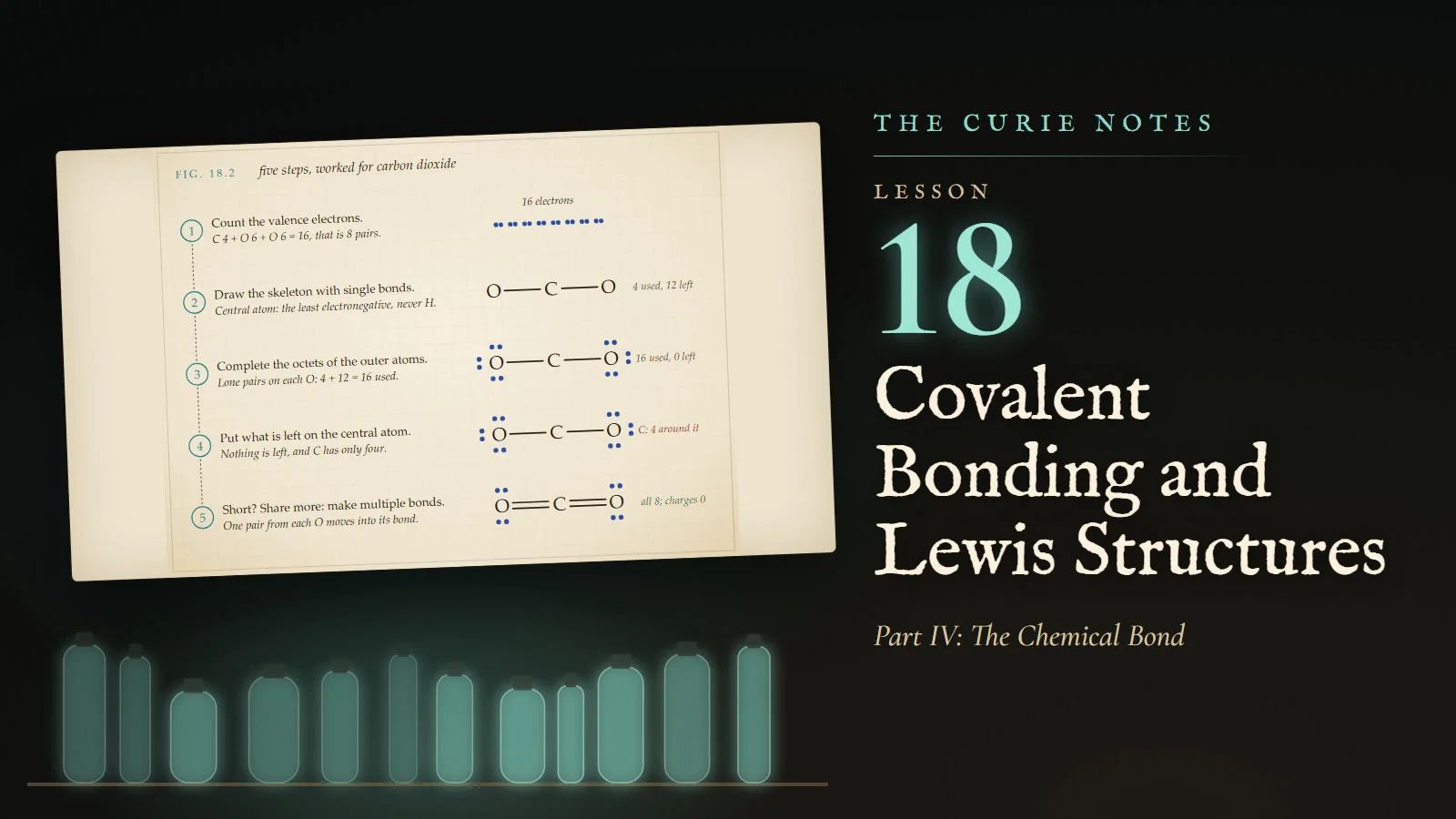
What you need first: Lesson 18, Covalent Bonding and Lewis Structures, above all. You should be able to count valence electrons and draw a Lewis structure with its lone pairs. Lesson 15, Orbitals and Electron Configurations, helps but is not essential.
Why the shape of a molecule matters
A chemical formula tells you which atoms a molecule holds and how many. A Lewis structure tells you which atoms are joined, and where the lone pairs sit. Neither tells you the shape, because both are drawn flat, on paper. Real molecules are small objects in three dimensions, with lengths and angles.
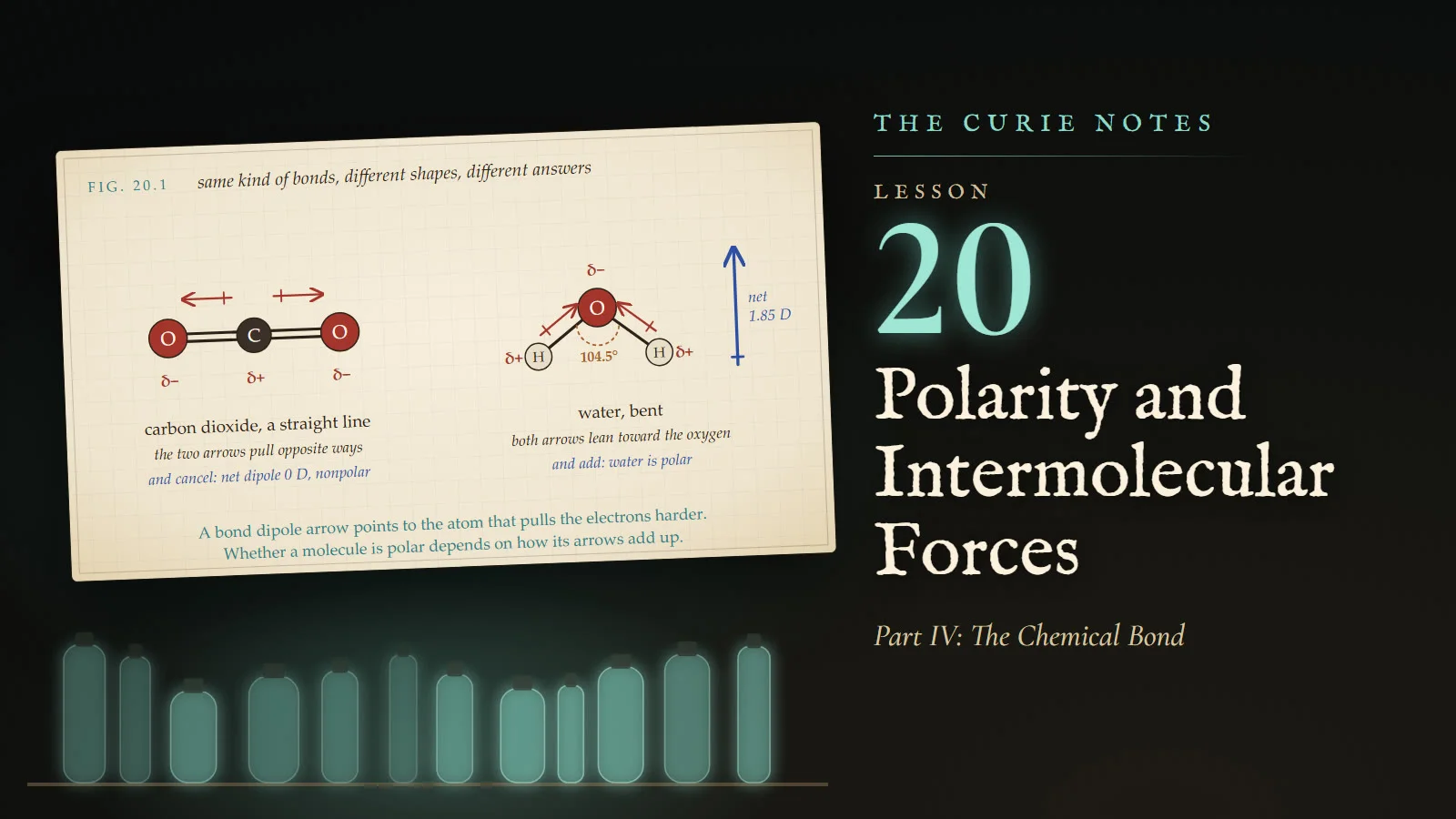
Consider water, \(\ce{H2O}\), and carbon dioxide, \(\ce{CO2}\). Each is three atoms with one atom in the middle. Yet carbon dioxide is a straight line, and water is bent like an open elbow. This one difference has large consequences. Water's bent shape makes it a polar molecule. That is why salt dissolves in it, why it boils at 100 °C instead of far below zero, and why ice floats. We shall see all of this in Lesson 20.
Shape also decides how molecules fit together. A molecule that fits a pocket in another molecule can react with it; one that fits badly reacts slowly or not at all. In living things, almost everything depends on molecules of the right shape meeting each other.
Two words first. The central atom is the atom in the middle, joined to the others. The bond angle is the angle between two bonds that meet at the central atom. In water, the bond angle is the angle H–O–H, with the oxygen at the corner. It measures 104.5°.
Margin
I must tell you honestly: I never learned the method in this lesson. Nobody had written it down in my lifetime. Nevil Sidgwick and Herbert Powell proposed its main idea in 1940, six years after my death, and Ronald Gillespie and Ronald Nyholm made it a complete method in 1957. Chemists call it VSEPR, for "valence shell electron pair repulsion". I give it to you because it works, and because it is simple enough to use with a pencil. What I did know was that carbon is tetrahedral. Jacobus van 't Hoff in Holland and Joseph Le Bel in Paris proposed it separately in 1874, to explain certain crystals and solutions that turn polarised light. Van 't Hoff received the first Nobel Prize in Chemistry, in 1901.
Electron domains
Everything in this lesson rests on one idea. The electrons around a central atom gather in groups, and the groups push each other apart.
Why do they push? Every electron carries a negative charge, and like charges repel. A group of electrons around one atom is pushed away by every other group around the same atom. The groups therefore spread out until they are as far apart as possible. The shape of the molecule is simply the shape in which the groups have the most room.
We call each group an electron domain: a region around the central atom where electrons are concentrated. These are the rules for counting them:
- A single bond is one domain.
- A double bond is one domain. Its four electrons all lie between the same two atoms, so they point in one direction.
- A triple bond is also one domain, for the same reason.
- A lone pair on the central atom is one domain.
So the thing to count is directions. Ask: in how many different directions do the electrons around this atom point? That number is the number of electron domains. Some books call it the steric number.
We also need a short way to write what surrounds the central atom. Chemists use the letters A, X and E. A is the central atom. X is an atom bonded to it. E is a lone pair on the central atom. Water, with two bonded hydrogens and two lone pairs on its oxygen, is written \(\mathrm{AX_2E_2}\). Methane, with four hydrogens and no lone pairs, is \(\mathrm{AX_4}\). The total number of domains is the number of X plus the number of E.
An analogy from my Paris
Go back to the balloons on my table. A balloon seller ties his balloons by the necks to one knot. Tie two together and they point in opposite directions, in a straight line. Tie three and they spread into a flat triangle. Tie four and they do something you might not expect: they point to the four corners of a little pyramid with a triangular base, a shape called a tetrahedron. Nobody arranges them. Each balloon pushes the others, and they stop moving when each is as far as it can get from all the rest. Electron domains behave in exactly this way around an atom.
Worked example 1
How many electron domains surround the central atom in water, \(\ce{H2O}\), and in carbon dioxide, \(\ce{CO2}\)?
- Draw the Lewis structure of water. Oxygen has 6 valence electrons and each hydrogen 1, so there are \(6 + 2 = 8\) electrons in all.
- Two O–H bonds use 4 of them. The other 4 make two lone pairs on the oxygen.
- Count directions around the oxygen: two bonds and two lone pairs, so 4 domains. Water is \(\mathrm{AX_2E_2}\).
- Now carbon dioxide. Carbon has 4 valence electrons and each oxygen 6, so there are \(4 + 12 = 16\) electrons.
- The Lewis structure is \(\ce{O=C=O}\), with two lone pairs on each oxygen. Carbon has no lone pairs.
- Count directions around the carbon: two double bonds, each one domain. So carbon has 2 domains. Carbon dioxide is \(\mathrm{AX_2}\).
Check: both molecules have three atoms, yet water's centre has 4 domains and carbon dioxide's has 2. That difference is the whole reason one is bent and the other straight.
A common mistake
Students count a double bond as two domains, because it has two lines in the drawing. It is one domain. The two shared pairs lie side by side between the same two atoms, like two ropes tied between the same two posts. They point the same way, so they take one place around the atom.
The five basic arrangements
Atoms in ordinary molecules have from two to six electron domains around them. For each number there is one best arrangement, the one that puts the domains farthest apart. Learn these five. Everything else in the lesson comes from them.
- Two domains: linear. The two point in opposite directions. The angle between them is 180°. Example: \(\ce{CO2}\), or beryllium chloride, \(\ce{BeCl2}\), as a gas.
- Three domains: trigonal planar. They lie flat, in one plane, at the corners of a triangle with equal sides. Each angle is 120°, because \(360^\circ / 3 = 120^\circ\). Example: boron trifluoride, \(\ce{BF3}\).
- Four domains: tetrahedral. They point to the corners of a tetrahedron. Each angle is 109.5°. Example: methane, \(\ce{CH4}\).
- Five domains: trigonal bipyramidal. Three lie flat around the "waist" at 120° from each other, like the trigonal planar case. Two more point straight up and straight down, at 90° to the waist. Example: phosphorus pentachloride, \(\ce{PCl5}\).
- Six domains: octahedral. They point along three crossed lines, up and down, left and right, forward and back. Every angle between neighbours is 90°. Example: sulfur hexafluoride, \(\ce{SF6}\).
The positions in the five-domain arrangement have names. The two at the top and bottom are axial, because they lie on the axis. The three around the waist are equatorial, like places on the equator of a globe. Remember these two words: we need them shortly.
Why 109.5° and not 90°
Many students expect four domains to make a flat cross, with angles of 90°. On paper that looks natural. But a cross wastes the third dimension. If the four domains are allowed to leave the page, they can all move farther apart. Lift two of them up out of the page and push the other two down, and every angle between neighbours opens from 90° to 109.5°, while the two across the square close from 180° to the same 109.5°.
Where does that odd number come from? Geometry gives it exactly. For two corners of a perfect tetrahedron, seen from its centre, the cosine of the angle is minus one third:
\[ \cos\theta = -\tfrac{1}{3}, \qquad \theta = 109.47^\circ \]
We round it to 109.5°. You do not need to prove this. You need to remember the number, and to remember that it is larger than 90°.
Drawing in three dimensions
Paper is flat, so chemists use a simple code to draw molecules in space. A plain line is a bond lying in the plane of the paper. A solid wedge, wide at the far end, is a bond coming out of the paper toward you. A dashed wedge is a bond going behind the paper, away from you. To draw methane, put the carbon in the page with two plain bonds, one wedge and one dashed wedge. The two plain bonds lie in the page; the wedge and the dash lie in a second plane, at right angles to the first.
Try it
Plate 19.1 is an instrument for these shapes. Move the first slider to choose how many atoms are bonded to the centre, and the second to choose how many lone pairs it has. Drag the molecule to turn it, and look at it from every side. Turn the tetrahedron until you see that no view shows all four angles as 90°.
Lone pairs and the shape we name
Now comes the step that makes the method useful. When some domains are lone pairs, we must keep two ideas apart.
The electron-domain geometry (or arrangement) is the arrangement of all the domains, lone pairs included. It is always one of the five basic arrangements.
The molecular geometry, or shape, is the arrangement of the atoms alone. We name a molecule by where its atoms are, because atoms are what we can locate by experiment. A lone pair is present and takes room, but it has no atom at its end, so it is left out of the name.
Take ammonia, \(\ce{NH3}\). Nitrogen has three bonds and one lone pair: four domains, so the arrangement is tetrahedral. Now look only at the atoms. The nitrogen sits at the top, and the three hydrogens form a triangle below it. That is a low pyramid on a triangular base: we say ammonia is trigonal pyramidal.
Water has four domains too, but two are lone pairs. Remove them from view and you see three atoms in a V. Water is bent.
Lone pairs take more room
If all four domains were the same, every angle in ammonia and water would be 109.5°. They are not. Methane's angle is 109.5°, ammonia's is 107°, and water's is 104.5°. Why do the angles shrink?
A bonding pair is shared between two nuclei. It is pulled out along the bond, toward the other atom, so it is long and thin. A lone pair belongs to one nucleus only. Nothing pulls it outward, so it stays close to its own atom and spreads sideways. It is short and fat. Being close to the centre, it crowds its neighbours more than a bond does.
So the pushes are not all equal. The order, from strongest to weakest, is:
- lone pair against lone pair (strongest),
- lone pair against bonding pair,
- bonding pair against bonding pair (weakest).
In ammonia, one lone pair pushes the three bonds a little closer together: 109.5° falls to 107°. In water, two lone pairs push harder still: 109.5° falls to 104.5°. Multiple bonds also take a little more room than single bonds, because they hold more electrons. In formaldehyde, \(\ce{H2CO}\), the three domains around carbon begin at 120°, but the double bond to oxygen pushes the two C–H bonds together, to about 116°.
An analogy from Warsaw
In a Warsaw winter, a bench on a horse tram holds fewer people than in summer. A passenger wrapped in a thick fur coat, sitting close against the wall, takes the room of one and a half. The thin passengers beside him are squeezed together. A lone pair is the passenger in the fur coat. It sits close to the central atom and spreads out, and the bonds next to it must make do with less room.
Try it
Plate 19.2 lets you test the idea with balloons that really push. The red balloons are bonds; the fat blue-green ones are lone pairs, set a little closer to the knot. Choose the balloons, press Shake, and watch them settle. With three red balloons and one fat one, the angle between the red balloons settles near 107°, close to ammonia's. With two of each it settles near 105°, close to water's 104.5°.
Where lone pairs go with five domains
In the tetrahedron and the octahedron every corner is the same as every other, so a lone pair can take any corner. The trigonal bipyramid is different: it has two kinds of seat. Which does a lone pair choose?
Count the close neighbours. The 90° neighbours are the ones that crowd. An axial seat, at a pole, has three neighbours at 90°: the three equatorial positions. An equatorial seat has only two neighbours at 90° (the two poles), and its other two neighbours are at a roomier 120°. So a lone pair, which needs more room, always takes an equatorial seat. If there are two or three lone pairs, they all go to the waist.
This gives three new shapes:
- One lone pair (\(\mathrm{AX_4E}\)): the four atoms make a seesaw. Example: sulfur tetrafluoride, \(\ce{SF4}\).
- Two lone pairs (\(\mathrm{AX_3E_2}\)): the three atoms make a T-shape. Example: chlorine trifluoride, \(\ce{ClF3}\).
- Three lone pairs (\(\mathrm{AX_2E_3}\)): the three lone pairs fill the waist and the two atoms sit at the poles, in a straight line. The shape is linear. Example: xenon difluoride, \(\ce{XeF2}\).
An analogy from my Paris
Think of the long benches inside a Paris omnibus. A passenger with a large parcel does not take the middle of the bench, pressed by a neighbour on each side and knees in front. He takes the end, where he has one neighbour fewer. A lone pair in a trigonal bipyramid chooses its seat the same way: the seat with the fewest close neighbours.
Six domains with lone pairs
In the octahedron, the first lone pair may take any corner. The other five corners hold atoms: four in a square and one at the top or bottom. That shape is square pyramidal. Example: bromine pentafluoride, \(\ce{BrF5}\).
A second lone pair goes to the corner opposite the first, 180° away. Anywhere else it would sit at 90° to the first lone pair, the most crowded contact of all. The four atoms left make a flat square around the centre: square planar. Example: xenon tetrafluoride, \(\ce{XeF4}\).
The whole list
Here is every case, in one list. The first name is the arrangement of domains; the second is the shape of the molecule.
- 2 domains, no lone pair: linear; linear, 180°.
- 3 domains, no lone pair: trigonal planar; trigonal planar, 120°.
- 3 domains, 1 lone pair: trigonal planar; bent, a little under 120°.
- 4 domains, no lone pair: tetrahedral; tetrahedral, 109.5°.
- 4 domains, 1 lone pair: tetrahedral; trigonal pyramidal, about 107°.
- 4 domains, 2 lone pairs: tetrahedral; bent, about 104.5°.
- 5 domains, no lone pair: trigonal bipyramidal; trigonal bipyramidal, 90° and 120°.
- 5 domains, 1 lone pair: trigonal bipyramidal; seesaw.
- 5 domains, 2 lone pairs: trigonal bipyramidal; T-shaped, a little under 90°.
- 5 domains, 3 lone pairs: trigonal bipyramidal; linear, 180°.
- 6 domains, no lone pair: octahedral; octahedral, 90°.
- 6 domains, 1 lone pair: octahedral; square pyramidal, a little under 90°.
- 6 domains, 2 lone pairs: octahedral; square planar, 90°.
A common mistake
The commonest error of all is to name the arrangement when the question asks for the shape. "Water is tetrahedral" is wrong. Water's domains are arranged tetrahedrally, but the molecule, its three atoms, is bent. Always ask yourself at the end: where are the atoms?
Predicting a shape, step by step
Now you have all the pieces. Here is the method, in five steps. Use it every time, in this order, and write each step down.
- Draw the Lewis structure. Count the valence electrons, add one for each negative charge, take one away for each positive charge.
- Count the electron domains on the central atom: bonds (single, double or triple, each counts once) plus lone pairs.
- Choose the arrangement from the number of domains: 2 linear, 3 trigonal planar, 4 tetrahedral, 5 trigonal bipyramidal, 6 octahedral.
- Place the lone pairs: anywhere in 3 and 4; on the waist in 5; opposite each other in 6.
- Name the shape from the atoms alone, and estimate the angles. Start from the ideal angle and make it a little smaller for each lone pair.
Worked example 2
What is the shape of the ammonium ion, \(\ce{NH4+}\)?
- Valence electrons: nitrogen 5, four hydrogens 4, and take away 1 for the positive charge. Total: \(5 + 4 - 1 = 8\).
- Four N–H bonds use all 8 electrons. Nitrogen has no lone pair.
- Domains on nitrogen: 4 bonds + 0 lone pairs = 4. Arrangement: tetrahedral.
- No lone pairs to place.
- Shape: tetrahedral, with every H–N–H angle 109.5°.
Check: ammonia, \(\ce{NH3}\), is a pyramid at 107°. When ammonia takes a hydrogen ion, its lone pair becomes the fourth bond. All four domains become alike, and the angles open to 109.5°. That is sensible.
Worked example 3
What is the shape of sulfur tetrafluoride, \(\ce{SF4}\)?
- Valence electrons: sulfur 6, four fluorines \(4 \times 7 = 28\). Total: 34.
- Four S–F bonds use 8 electrons. Each fluorine needs three lone pairs to complete its octet: \(4 \times 6 = 24\) electrons. Used so far: \(8 + 24 = 32\).
- Left over: \(34 - 32 = 2\) electrons, one lone pair, on the sulfur.
- Domains on sulfur: 4 bonds + 1 lone pair = 5. Arrangement: trigonal bipyramidal.
- The lone pair takes an equatorial seat. Two fluorines are axial and two are equatorial.
- Shape: seesaw. The measured angles are about 173° between the two axial fluorines and about 102° between the two equatorial ones. Both are less than the ideal 180° and 120°, because the lone pair pushes the bonds away from itself.
Check: sulfur holds 10 electrons around itself here, more than an octet. Lesson 18 showed that atoms of the third period and below can do this.
Worked example 4
What is the shape of xenon tetrafluoride, \(\ce{XeF4}\)?
- Valence electrons: xenon 8, four fluorines 28. Total: 36.
- Four Xe–F bonds use 8. Three lone pairs on each fluorine use 24. Used: 32.
- Left over: \(36 - 32 = 4\) electrons, two lone pairs, on the xenon.
- Domains on xenon: 4 + 2 = 6. Arrangement: octahedral.
- The two lone pairs go opposite each other, one above and one below.
- Shape: square planar. The five atoms lie in one flat square, with F–Xe–F angles of 90°.
Check: the molecule is perfectly symmetric, with each lone pair balancing the other. So there is no reason for any angle to bend away from 90°.
Worked example 5
What is the shape of sulfur dioxide, \(\ce{SO2}\)?
- Valence electrons: sulfur 6, two oxygens 12. Total: 18.
- One Lewis structure is \(\ce{O=S-O}\): one double bond, one single bond. The double-bonded oxygen has two lone pairs, the single-bonded oxygen three, and sulfur one. Count: \(6\) in bonds \(+ 4 + 6 + 2 = 18\). Good.
- Domains on sulfur: two bonding domains (the double bond counts once) plus one lone pair = 3. Arrangement: trigonal planar.
- The lone pair takes one corner of the triangle.
- Shape: bent. The angle is a little under 120°; it measures about 119°.
Check: resonance (Lesson 18) makes the two S–O bonds equal in the real molecule. That does not change the count. Whichever resonance structure you draw, sulfur has three domains.
Try it
Exercise 19.3 gives you eight molecules and ions to shape. Two of the questions make fresh examples each time you press New numbers, so you can practise the five steps as often as you like.
Molecules with more than one centre
Most molecules have more than one central atom. The method still works: apply it to each centre in turn. The shape of the whole molecule is the shapes of its centres joined together.
Worked example 6
Describe the shape of methanol, \(\ce{CH3OH}\), around the carbon and around the oxygen.
- Lewis structure: carbon is bonded to three hydrogens and to the oxygen. The oxygen is bonded to the carbon and one hydrogen, and it carries two lone pairs.
- Around carbon: 4 bonds, no lone pairs. Four domains, so the carbon is tetrahedral, with angles near 109.5°.
- Around oxygen: 2 bonds and 2 lone pairs. Four domains, tetrahedral arrangement, two of them lone pairs. The C–O–H part is bent, like water, with an angle a little under 109.5°.
Check: methanol is water with one hydrogen replaced by a small carbon group, \(\ce{CH3}\). It is natural that the oxygen keeps water's bent shape.
Worked example 7
Describe the shape of ethene, \(\ce{C2H4}\), the gas that ripens fruit.
- Lewis structure: \(\ce{H2C=CH2}\). Each carbon has two single bonds to hydrogen and one double bond to the other carbon. Neither carbon has a lone pair.
- Each carbon has 3 domains (the double bond counts once). Each is trigonal planar, with angles near 120°.
- The double bond holds the two flat halves in the same plane. All six atoms lie flat, in one sheet.
Check: for comparison, ethane, \(\ce{C2H6}\), has only single bonds. Each of its carbons has four domains and is tetrahedral, so ethane is not flat. Carbon's shape changes with the bonds it makes: tetrahedral with four single bonds, flat with a double bond, and straight with a triple bond, as in ethyne, \(\ce{HC#CH}\).
In my laboratory
Pierre spent his youth among crystals. With his brother Jacques he studied how certain crystals, quartz among them, produce electric charge when pressed. In 1894 he published a paper on symmetry in physical phenomena, which showed how the symmetry of a cause must appear in its effect. His piezoelectric quartz became the heart of the instrument I used to measure the rays of uranium. I learned from him to look at the shape of a thing as carefully as at its weight. In a crystal, the outer faces show the order of the atoms inside. In a molecule, the angles show the order of the electrons inside. In both, shape is a measurement, and it tells you what is hidden.
A common mistake
Students sometimes predict the shape of a large molecule by looking at its formula. The formula \(\ce{C2H4}\) says nothing about flatness. Only the Lewis structure, centre by centre, tells you the shape. Draw it first.
What to remember
- Electron domains around an atom repel each other and spread as far apart as possible.
- Count domains as directions: a single, double or triple bond is one domain; a lone pair is one domain.
- Two domains: linear, 180°. Three: trigonal planar, 120°. Four: tetrahedral, 109.5°. Five: trigonal bipyramidal, 90° and 120°. Six: octahedral, 90°.
- Lone pairs take more room: lone pair on lone pair pushes hardest, bond on bond least.
- Methane 109.5°, ammonia 107°, water 104.5°: each lone pair squeezes a little more.
- With five domains, lone pairs take the equatorial seats: seesaw, T-shaped, linear.
- With six domains, two lone pairs sit opposite each other: square planar.
- The shape is named by the atoms alone; the arrangement includes the lone pairs.
- The five steps: Lewis structure, count domains, choose arrangement, place lone pairs, name the shape.
Problems for your notebook
Problem 1. What is the shape of phosphorus trichloride, \(\ce{PCl3}\), and is its Cl–P–Cl angle larger or smaller than 109.5°?
Answer. Valence electrons: \(5 + 3 \times 7 = 26\). Three P–Cl bonds use 6, three lone pairs on each chlorine use 18, so 24 are used and 2 remain: one lone pair on phosphorus. Domains: 3 + 1 = 4, tetrahedral arrangement. With one lone pair the shape is trigonal pyramidal, and the lone pair squeezes the angle below 109.5°. (It measures about 100°.)
Problem 2. Boron trifluoride, \(\ce{BF3}\), is flat, but ammonia, \(\ce{NH3}\), is a pyramid. Both have three atoms around the centre. Explain the difference.
Answer. Boron has 3 valence electrons, and all three go into the B–F bonds. Boron has no lone pair: 3 domains, trigonal planar, 120°. Nitrogen has 5 valence electrons; three go into bonds and two form a lone pair. Nitrogen has 4 domains, a tetrahedral arrangement, and the lone pair takes one corner. The atoms then form a pyramid. The lone pair you cannot see decides the shape.
Problem 3. Predict the shape of chlorine trifluoride, \(\ce{ClF3}\).
Answer.
- Valence electrons: \(7 + 3 \times 7 = 28\).
- Three Cl–F bonds use 6; three lone pairs on each fluorine use 18. Used: 24. Left: 4, which is two lone pairs on chlorine.
- Domains: 3 + 2 = 5, trigonal bipyramidal.
- Both lone pairs take equatorial seats. The three fluorines are one equatorial and two axial.
- Shape: T-shaped. The lone pairs push the axial fluorines back, so the F–Cl–F angles are a little under 90° (about 87.5°).
Problem 4. The triiodide ion, \(\ce{I3-}\), is found in the brown solution of iodine in potassium iodide. Predict its shape.
Answer.
- Valence electrons: \(3 \times 7 + 1 = 22\) (add one for the negative charge).
- Two I–I bonds from the central iodine use 4. Three lone pairs on each end iodine use 12. Used: 16. Left: 6, three lone pairs on the central iodine.
- Domains on the centre: 2 + 3 = 5, trigonal bipyramidal.
- The three lone pairs fill the three equatorial seats. The two end iodines take the axial seats.
- Shape: linear, 180°.
Problem 5. In formaldehyde, \(\ce{H2CO}\), carbon is joined to two hydrogens by single bonds and to oxygen by a double bond. Predict the shape, and say whether the H–C–H angle is exactly 120°, more, or less.
Answer. Carbon has 3 domains (two single bonds and one double bond, which counts once) and no lone pair. The arrangement and the shape are both trigonal planar, so the ideal angles are 120°. But the double bond holds four electrons and takes more room than a single bond. It pushes the two C–H bonds together, so the H–C–H angle is less than 120° (it measures about 116°), and each H–C–O angle is a little more than 120°. Check: the three angles of a flat triangle of bonds must add to 360°, and \(116^\circ + 2 \times 122^\circ = 360^\circ\).
After my time
The method in this lesson came after me. Sidgwick and Powell suggested in 1940 that the shapes of molecules follow from the number of electron pairs around the central atom. Gillespie and Nyholm added the rules about lone pairs and multiple bonds in 1957, and Gillespie spent much of his life refining them. The method is a rule of thumb. It is easy, and for most molecules of the main groups it gives the right shape.
It has limits. Hydrogen sulfide, \(\ce{H2S}\), has the same four domains as water, yet its angle is about 92°, much smaller than the method suggests. Compounds of the transition metals, such as those of iron, copper and platinum, often follow other rules. For these, chemists use the quantum mechanics that was being built in my last years, when I sat among the physicists at the Solvay Conference of 1927. Linus Pauling's idea of hybrid orbitals, published in 1931, was one early step. Today computers solve the equations for a molecule and give its angles directly.
The shapes themselves are measured, never only predicted. The first measurements of gas molecules by beams of electrons were made around 1930, and later by beams of X-rays through crystals and by the light that molecules absorb. The angles in this lesson, 107° for ammonia and 104.5° for water, come from such measurements.
If you would like to practise more shapes, or if the trigonal bipyramid still puzzles you, come and ask me. In the next lesson, Lesson 20, Polarity and Intermolecular Forces, we use these shapes. We will see why the bent water molecule pulls so strongly on its neighbours, while the straight carbon dioxide molecule hardly pulls at all.
Sources and liberties
The Curie Notes are a modern chemistry course written in Marie Curie's voice by Eternal Gardens. The chemistry is standard modern chemistry; dates, people, apparatus and quotations come from the sources below; the teaching, the analogies and the private remarks are our reconstruction.
- Marie Curie, Pierre Curie, with her Autobiographical Notes, translated by Charlotte and Vernon Kellogg (Macmillan, 1923): Project Gutenberg
- OpenStax, Chemistry 2e, section 7.6, "Molecular Structure and Polarity": openstax.org
- R. J. Gillespie and R. S. Nyholm, "Inorganic stereochemistry", Quarterly Reviews, Chemical Society 11, 339 (1957): doi.org
- NIST Computational Chemistry Comparison and Benchmark Database, experimental bond angles: cccbdb.nist.gov
- Jacobus van 't Hoff, Nobel Prize in Chemistry 1901: nobelprize.org
- AIP Center for History of Physics, "Marie Curie and the Science of Radioactivity": history.aip.org
Uncertain or simplified history: the balloon seller, the Warsaw tram and the omnibus are illustrations, not records. Measured angles are rounded; the values for sulfur tetrafluoride, chlorine trifluoride and phosphorus trichloride vary slightly between sources.