 by Marie Curie

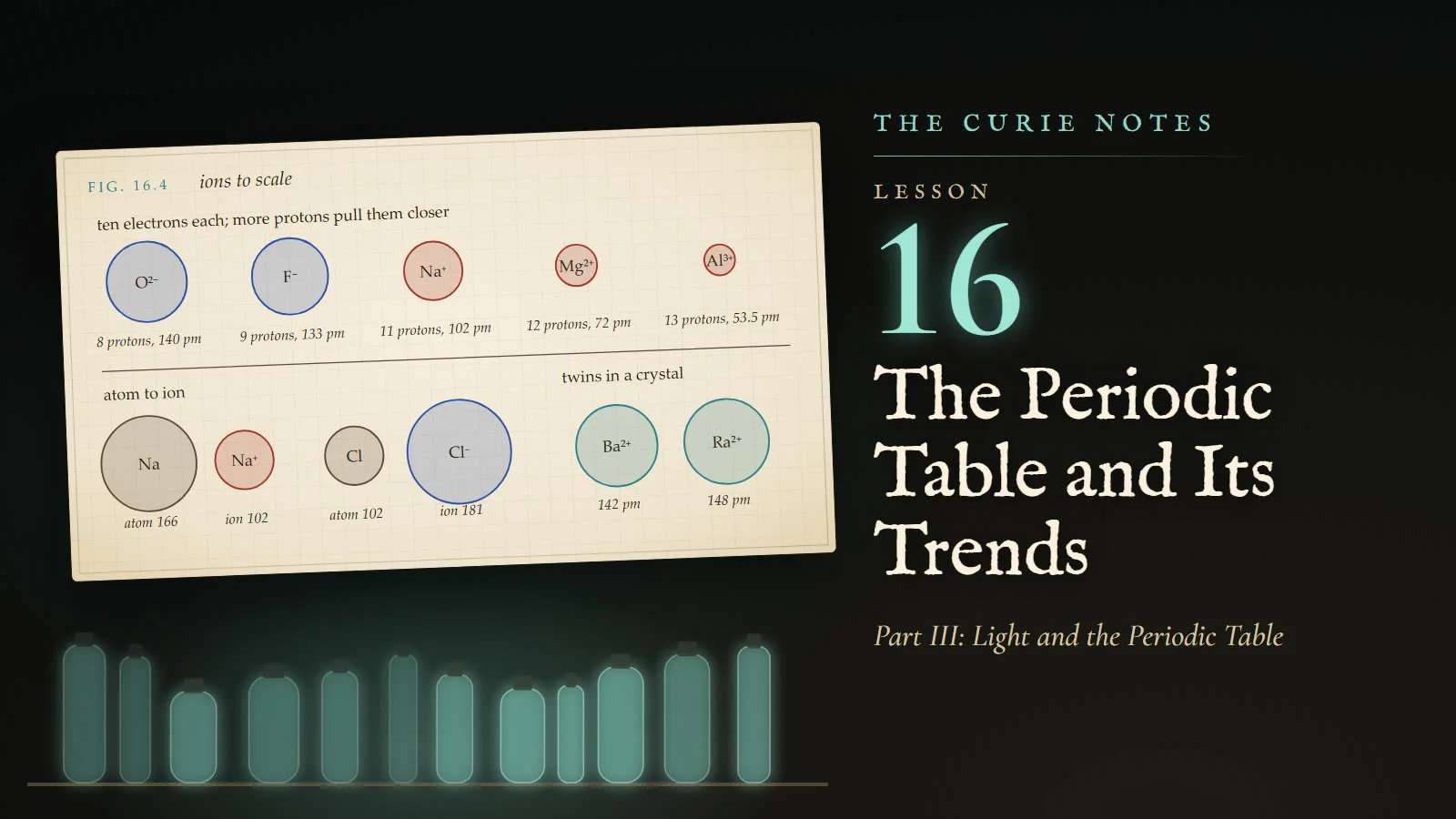
On the wall of my laboratory hangs a periodic table, and on it, in my own pencil, two small marks: one under tellurium and one under barium. Those marks are where polonium and radium went in 1898, before anyone knew why the table had the shape it has. In this lesson I will show you that shape and its reasons. You will learn how Mendeleev built his table and dared to leave it empty in places, how the table follows from the electron configurations of the last lesson, and how to predict, for any element, whether its atoms are large or small, and whether they give up or grab electrons.
I believe international work is a heavy task, but that it is nevertheless indispensable.
Marie Curie, letter to Ève Curie, July 1929, as quoted in Madame Curie, 1937
What you will learn
- Tell the story of Mendeleev's table of 1869, its gaps and its successful predictions.
- Read the modern table: periods, groups, the s, p, d and f blocks, metals, non-metals and metalloids.
- Find an element's place in the table from its electron configuration, and the reverse.
- Explain shielding and effective nuclear charge, and estimate the effective nuclear charge.
- Predict and explain the trends in atomic radius, ionisation energy, electron affinity and electronegativity.
- Compare the sizes of ions, and explain why radium followed barium.
What you need first: Lesson 4, Inside the Atom (atomic number, ions); Lesson 13, Light and Spectra; and Lesson 15, Orbitals and Electron Configurations (configurations, valence electrons, noble-gas shorthand).
Mendeleev and his empty places
By 1869 chemists knew 63 elements. They knew the atomic weight of most of them, measured with great care on balances like mine. They also knew that some elements came in families. Lithium, sodium and potassium are soft metals that react violently with water. Chlorine, bromine and iodine are coloured, poisonous, and make salts with metals. As early as 1829 Johann Döbereiner had noticed that the middle member of such a family of three often has an atomic weight close to the average of the other two.
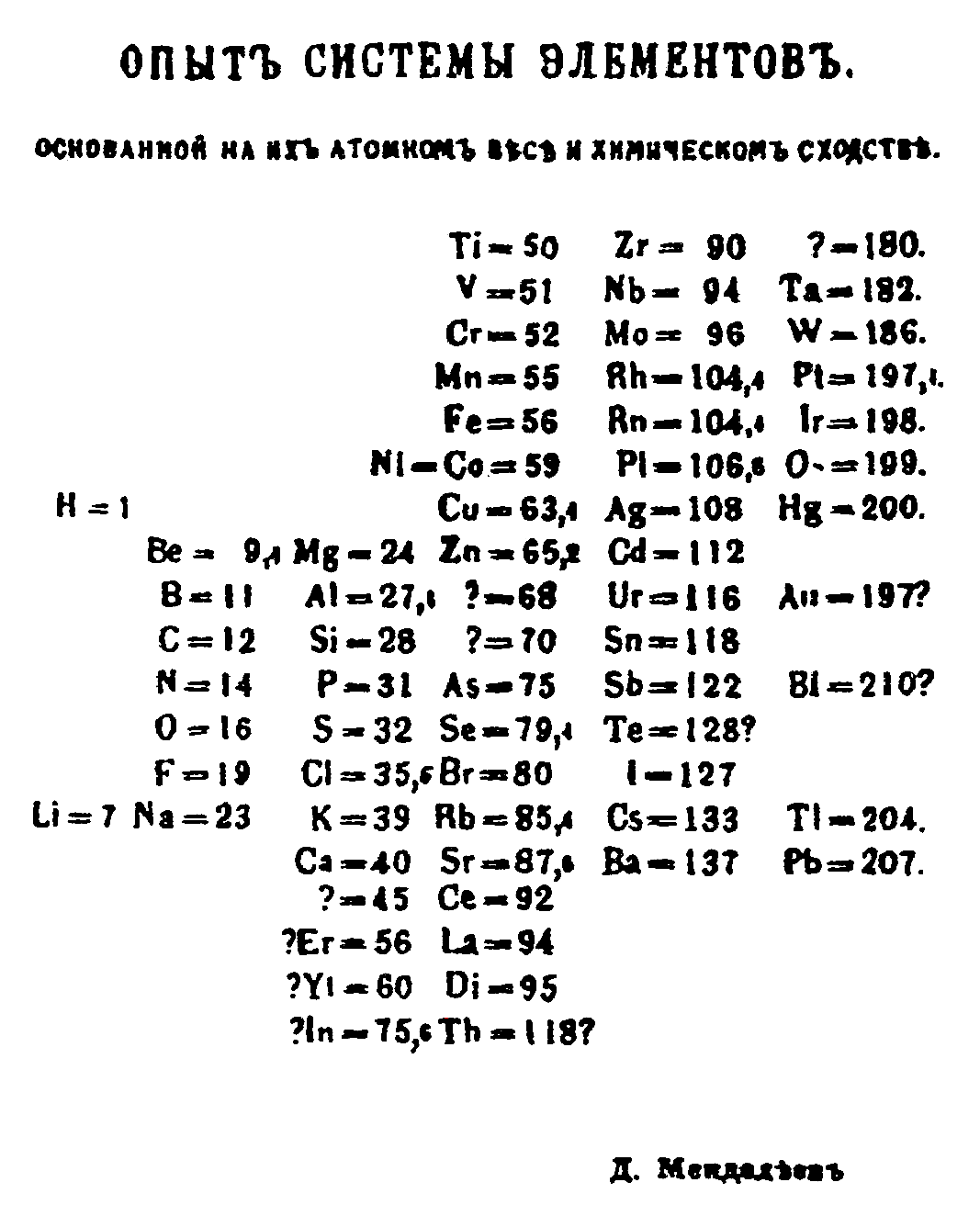
Dmitri Mendeleev, professor in St Petersburg, wrote each element on a card with its atomic weight and its properties. He laid the cards out in order of atomic weight, and he started a new row each time the properties began to repeat. Lithium, sodium and potassium fell into one column. Fluorine, chlorine and bromine fell into another. A property that returns at regular intervals is called periodic, and his arrangement became the periodic table.
Others had tried this. Mendeleev did two bold things that they did not. First, where the next known element did not fit the family below which it would fall, he left an empty place and moved the element on. Second, he predicted the properties of the elements that would one day fill the empty places.
An analogy from my Paris
Walk down a Paris street and read the house numbers: 10, 12, 14, then 18. You do not doubt for a moment that number 16 exists. Perhaps it hides behind a courtyard, or is still being built. You can even guess what it looks like, because the houses on either side, and across the street, are of the same period and style.
Mendeleev read the elements as a street. Calcium at 40 and titanium at 48 left a house missing between them. Zinc at 65 and arsenic at 75 left two. He did not invent elements to fill them. He left the numbers empty and described the houses.
He named the missing elements with the Sanskrit word for "one": eka-boron, eka-aluminium and eka-silicon, meaning "one place below" boron, aluminium and silicon. Within seventeen years all three were found. In 1875 Paul-Émile Lecoq de Boisbaudran, working in France with a spectroscope, saw two new violet lines in a zinc ore and named the new metal gallium, after Gaul. Lars Nilson in Sweden found scandium in 1879. Clemens Winkler in Germany found germanium in 1886.
The gallium story is the one I like best. Lecoq de Boisbaudran reported a density of 4.7 grams per cubic centimetre. Mendeleev wrote from Russia to say the density should be about 5.9, and that the sample was probably impure. Lecoq purified it again and measured once more. He found 5.9. A man at a desk in St Petersburg had corrected a measurement made at the bench in France, by trusting a pattern. I have never forgotten that lesson. Trust the measurement, yes; but when a measurement breaks a pattern that has held everywhere else, measure again.
Worked example 1
Do what Mendeleev did. Estimate the atomic weight of germanium as the average of its four neighbours: silicon above (28.09), tin below (118.71), gallium to the left (69.72) and arsenic to the right (74.92). Compare with the true value, 72.63.
- Add the two neighbours above and below: \(28.09 + 118.71 = 146.80\).
- Add the two neighbours left and right: \(69.72 + 74.92 = 144.64\).
- Add the two sums: \(146.80 + 144.64 = 291.44\).
- Divide by four: \(291.44 / 4 = 72.86\).
- Compare: \(72.86 - 72.63 = 0.23\), and \(0.23 / 72.63 = 0.0032\), so the estimate is 0.3 per cent too high.
Check: the answer lies between the left and right neighbours, as it must. Mendeleev, without gallium to help him, predicted "about 72".
Margin
Mendeleev's table had a few places where the order of atomic weight was wrong for the families. Tellurium, 127.6, is heavier than iodine, 126.9, yet tellurium plainly belongs with sulfur and selenium, and iodine with chlorine and bromine. Mendeleev put them where their properties belonged and suspected the weights. The weights were right. The fault was in the ordering principle. In 1913 the young Henry Moseley, in Manchester, measured the X-rays given out by the elements and found a whole number that rose by one from each element to the next: the atomic number, the number of protons in the nucleus (Lesson 4). Ordered by atomic number, tellurium (52) comes before iodine (53), and every family falls in place. Moseley was killed at Gallipoli in 1915, at twenty-seven. It was a great loss to science.
From Warsaw
My cousin Józef Boguski ran the laboratory of the Museum of Industry and Agriculture in Warsaw, where I did my first chemical experiments, in the evenings and on Sundays. He had been an assistant to Mendeleev. So the periodic table came to me in Warsaw almost as family news, before I ever saw Paris. I did not imagine then that I would one day write two new names into it.
Reading the modern table
The modern table is ordered by atomic number. Its rows are called periods and its columns groups. Today the groups are numbered 1 to 18 from left to right. Elements in the same group are a chemical family.
Some groups have family names. Group 1 (without hydrogen) are the alkali metals. Group 2 are the alkaline earth metals: beryllium, magnesium, calcium, strontium, barium and radium. Group 17 are the halogens, the "salt makers". Group 18 are the noble gases, which react hardly at all. Groups 3 to 12 are the transition metals.
Mendeleev's table had no place for the noble gases, because none was known in 1869. Lord Rayleigh and William Ramsay found argon in the air in 1894. Ramsay found helium on Earth in 1895, and neon, krypton and xenon with Morris Travers in 1898. They did not fit into any existing family, so a whole new column was added. A table that can take in a new column without breaking is a strong table.
The shape comes from the orbitals
Now look at the table with the eyes of Lesson 15. Each period begins when electrons start a new shell. From the second period on, it ends when a p subshell is full; the first period, with only 1s, ends when 1s is full. The width of each part of the table is the number of electrons a subshell holds.
- The s block, groups 1 and 2 (and helium), is two columns wide, because an s subshell holds 2.
- The p block, groups 13 to 18, is six columns wide: a p subshell holds 6.
- The d block, groups 3 to 12, is ten columns wide: a d subshell holds 10.
- The f block, the two long rows usually printed below the table, is fourteen wide: an f subshell holds 14.
So the period number is the outermost shell, n, and the block tells which subshell the last electron entered. For the s and p blocks, the group tells the number of valence electrons: group 1 has 1, group 2 has 2, and a p-block group has the group number minus 10. Group 16 has \(16 - 10 = 6\) valence electrons.
Running through the p block is a staircase. To its left and below are the metals: shiny, good conductors, ready to lose electrons. To its right and above are the non-metals. Along the staircase lie the metalloids, with properties in between: boron, silicon, germanium, arsenic, antimony and tellurium. More than three quarters of the elements are metals.
Worked example 2
An element has the configuration \(\mathrm{[Ar]\,4s^{2}\,3d^{10}\,4p^{4}}\). Find its period, block and group, and name it.
- The outermost shell is \(n = 4\), so the element is in period 4.
- The last electron entered a p subshell, so it is in the p block.
- Valence electrons: those with \(n = 4\), \(2 + 4 = 6\). Group number: \(10 + 6 = 16\).
- Atomic number: \(18 + 2 + 10 + 4 = 34\). Element 34 is selenium.
Check: selenium sits in group 16 below sulfur, and like sulfur it has six valence electrons.
Try it
Plate 16.1 is the table itself, coloured by a property you choose. Start with Blocks s, p, d, then Metals and non-metals, then Found after 1869 to see Mendeleev's empty places light up, among them my polonium and radium. Tap any element to read its configuration and values. Keep this plate open; we will return to it for each trend.
Shielding and the pull of the nucleus
All the trends in this lesson come from one tug of war. The nucleus pulls each electron inward. The other electrons push it outward. What matters is the balance.
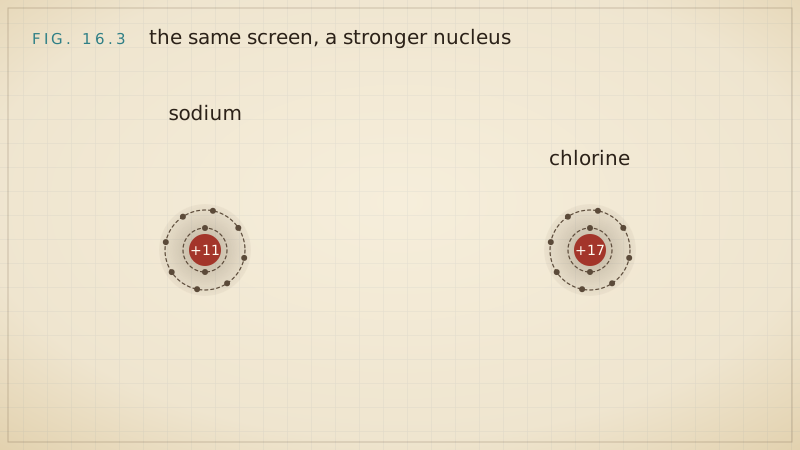
The inner electrons, those in shells below the outermost one, sit between the nucleus and the outer electrons. They cancel part of the nucleus's charge. We say they shield or screen the outer electrons. The charge that an outer electron actually feels is called the effective nuclear charge, written \(Z_{\mathrm{eff}}\).
A simple estimate: each inner electron cancels one unit of nuclear charge, and electrons in the same shell cancel nothing. In words, the effective charge equals the atomic number minus the number of inner electrons:
\[ Z_{\mathrm{eff}} \approx Z - (\text{number of inner electrons}) \]
From the shed
In winter our shed on the rue Lhomond was bitterly cold, and the only warmth came from a small iron stove. When visitors came, they gathered round it. Those in the first ring felt the full heat. Those standing behind them felt much less, because the first ring of bodies took most of it. Standing beside a person in your own ring hardly cost you any warmth at all.
The stove is the nucleus. The inner ring of people is the inner electrons. An outer electron, like a visitor in the back ring, feels only what the inner ring lets through.
Worked example 3
Estimate the effective nuclear charge felt by an outer electron of sodium (\(Z = 11\)) and of chlorine (\(Z = 17\)).
- Sodium is \(\mathrm{[Ne]\,3s^{1}}\). The neon core holds 10 inner electrons.
- \(Z_{\mathrm{eff}} \approx 11 - 10 = +1\).
- Chlorine is \(\mathrm{[Ne]\,3s^{2}\,3p^{5}}\). The same 10 inner electrons.
- \(Z_{\mathrm{eff}} \approx 17 - 10 = +7\).
Check: both atoms have the same inner screen, but chlorine's nucleus has six more protons. Its outer electrons are pulled about seven times harder. The simple estimate always equals the number of valence electrons for main-group atoms, which is a useful check in itself.
Margin
Electrons in the same shell do screen one another a little, and inner electrons do not screen perfectly. In 1930 the American physicist John Slater gave better rules: each other electron in the same shell cancels 0.35, each electron in the shell just below cancels 0.85, and each deeper electron cancels 1.00. For chlorine: \(6 \times 0.35 + 8 \times 0.85 + 2 \times 1.00 = 2.10 + 6.80 + 2.00 = 10.90\), so \(Z_{\mathrm{eff}} = 17 - 10.90 = 6.10\). For sodium: \(8 \times 0.85 + 2 \times 1.00 = 8.80\), so \(Z_{\mathrm{eff}} = 2.20\). The numbers change; the lesson does not. Chlorine's outer electrons feel a much larger pull.
Try it
On Plate 16.2, move the slider through the first 36 elements. The grey fog is the screen of inner electrons; the blue dots are the outer electrons. Watch the estimate of the pull rise by one at each step across a period, then fall back to +1 when a new shell begins. The chart beside it shows the first ionisation energy, or press Radius to see the atoms shrink across each period and jump at each new shell.
Atomic radius
An atom has no hard edge: its outer orbitals fade gradually. So we measure size by bonding. The covalent radius is half the distance between the nuclei of two identical atoms joined by a single bond. Two chlorine atoms in \(\ce{Cl2}\) are 199 pm apart, which gives chlorine a radius of about 100 pm. The values in this lesson are a modern, consistent set. Noble gases make almost no bonds, so we leave them out.
Down a group, atoms get larger. Each period adds a new shell, further from the nucleus. The effective nuclear charge on the outer electrons stays about the same, because the new inner electrons screen the added protons. Lithium is 128 pm, sodium 166 pm, potassium 203 pm, rubidium 220 pm and caesium 244 pm.
Across a period, atoms get smaller. The outer electrons stay in the same shell, but each step adds a proton that the electrons of that shell barely screen. The effective nuclear charge rises, and the shell is pulled in. Along period 3: sodium 166, magnesium 141, aluminium 121, silicon 111, phosphorus 107, sulfur 105, chlorine 102 pm.
The transition metals shrink only slowly across their row, because the new electrons go into an inner d subshell, which screens the outer 4s electrons fairly well.
A common mistake
Students reason that more protons and more electrons must make a bigger atom, so chlorine (17) must be larger than sodium (11). Across a period the opposite is true. The added electrons go into the same shell, while the added protons pull that whole shell inward. Size depends on the number of shells and on the pull, never simply on the number of particles.
Ionisation energy
The first ionisation energy is the energy needed to remove one electron from each atom in a mole of gaseous atoms. For sodium:
\[ \ce{Na(g) -> Na+(g) + e-} \qquad 496\,\mathrm{kJ/mol} \]
The atoms must be gaseous, separate from one another, so that we measure the atom alone. A small ionisation energy means the electron leaves easily; such elements form positive ions readily and are metals.
The trend is the mirror of radius. Up a group and across a period, ionisation energy rises. A smaller atom with a larger effective charge holds its outer electrons more tightly. Caesium, at 376 kJ/mol, gives up its electron most easily of the elements in my laboratory; helium, at 2372 kJ/mol, holds its electrons hardest of all. Each noble gas is a peak, and each alkali metal just after it is a deep valley.
Two small dips, explained by orbitals
Across period 2 the rise is not smooth. Boron (801 kJ/mol) is lower than beryllium (900). Oxygen (1314) is lower than nitrogen (1402). The orbitals of Lesson 15 explain both.
Boron's outer electron is the first in 2p. A 2p electron lies a little higher in energy than a 2s electron and is partly screened by the 2s pair, so it is easier to remove. Oxygen's fourth 2p electron is the first to share an orbital. Two electrons in one orbital repel each other, so removing one of them is easier. The same two dips appear in period 3: aluminium below magnesium, and sulfur below phosphorus.
Successive ionisation energies
We can go on removing electrons. The second ionisation energy removes a second electron from the 1+ ion, the third from the 2+ ion, and so on. Each is larger than the last, because each electron is pulled from an ion that is more and more positive. But somewhere there is an enormous jump: the moment you break into a full noble-gas core.
An analogy from my Paris
In a Paris apartment the coal for the stove sits in a scuttle by the door. Taking the first lumps is easy; the next ones need a little bending; still easy. When the scuttle is empty, the next coal is in the cellar, five flights down, behind a locked door with the concierge holding the key. The effort jumps.
The valence electrons are the coal in the scuttle. The core electrons are the coal in the cellar. Count the easy lumps before the big jump and you know how many valence electrons the atom has.
Worked example 4
An element has successive ionisation energies of 738, 1451 and 7733 kJ/mol. How many valence electrons does it have, and which group is it in? What does it cost to make its 2+ ion from the gaseous atom?
- Divide each energy by the one before. \(1451 / 738 = 1.97\). \(7733 / 1451 = 5.33\).
- The first step doubles; the second multiplies by more than five. The big jump comes after the second electron.
- So the atom has 2 valence electrons and is in group 2. (It is magnesium.)
- To make the 2+ ion, remove the first and the second electrons: \(738 + 1451 = 2189\,\mathrm{kJ/mol}\).
Check: magnesium is \(\mathrm{[Ne]\,3s^{2}}\). After two electrons leave, the next one must come from the neon core, which is far closer to the nucleus.
Electron affinity and electronegativity
Ionisation energy measures how hard an atom holds its electrons. Two more quantities measure how much it wants other electrons.
The electron affinity is the energy released when a mole of gaseous atoms each gain one electron. For chlorine:
\[ \ce{Cl(g) + e- -> Cl-(g)} \qquad 349\,\mathrm{kJ/mol}\ \text{released} \]
A large electron affinity means the atom gladly takes an electron. The halogens release the most, because one more electron fills their p subshell: chlorine 349, fluorine 328, bromine 325, iodine 295 kJ/mol. The noble gases, and atoms such as beryllium, nitrogen and magnesium, form no stable negative ion at all: the new electron would have to enter a higher subshell, or pair up in a half-filled one. The trend is the roughest of the four. It generally rises across a period, with these exceptions.
Notice that fluorine releases less than chlorine. The fluorine atom is so small that the new electron is crowded among the seven already there, and their repulsion takes back some of the energy.
The electronegativity of an atom is its pull on the electrons it shares in a chemical bond. Electrons shared between two atoms are not always shared equally; the more electronegative atom takes the larger part. In 1932 Linus Pauling in California put numbers on this, from the energies of bonds. His scale runs from about 0.8 for caesium to 3.98 for fluorine, the most electronegative element of all. Oxygen is 3.44, chlorine 3.16, nitrogen 3.04, carbon 2.55 and hydrogen 2.20. Electronegativity rises up a group and across a period, for the same reasons as ionisation energy: a small atom with a large effective charge pulls hardest. Electronegativity will be essential when we study bonds in Part IV.
Margin
Pauling's scale was new when I last read about it, and I give it to you because chemists have used it ever since. Metals have low electronegativity and low ionisation energy: they give electrons away. Non-metals have high values: they take electrons or share them on their own terms. This is the true meaning of the staircase between them.
The sizes of ions, and radium's twin
When an atom becomes an ion, its size changes a great deal.
A positive ion is smaller than its atom. Sodium loses its single 3s electron and with it the whole third shell. The 11 protons now pull on only 10 electrons. The sodium atom is 166 pm; the \(\ce{Na+}\) ion is 102 pm.
A negative ion is larger than its atom. Chlorine gains an electron. Now 17 protons hold 18 electrons, and the extra repulsion swells the cloud. The chlorine atom is 102 pm; the \(\ce{Cl-}\) ion is 181 pm.
Ions with the same number of electrons form an isoelectronic series. In such a series, the ion with more protons pulls the same electrons in more tightly and is smaller.
Worked example 5
Put \(\ce{K+}\), \(\ce{S^2-}\), \(\ce{Ca^2+}\) and \(\ce{Cl-}\) in order of size, largest first.
- Count electrons. Potassium (19) minus 1 is 18. Sulfur (16) plus 2 is 18. Calcium (20) minus 2 is 18. Chlorine (17) plus 1 is 18. All four are isoelectronic, with the configuration of argon.
- Count protons: S 16, Cl 17, K 19, Ca 20.
- Fewest protons, weakest pull, largest ion. Order: \(\ce{S^2-}\), \(\ce{Cl-}\), \(\ce{K+}\), \(\ce{Ca^2+}\).
Check against measured radii: 184, 181, 138 and 100 pm. The order agrees.
In my laboratory
Now you can see the whole reason why radium hid in barium. Radium and barium sit in the same group. Both have two s electrons outside a noble-gas core, and both form ions of charge 2+. And their ions are nearly the same size. In a crystal where each ion is surrounded by eight neighbours, \(\ce{Ba^2+}\) has a radius of about 142 pm and \(\ce{Ra^2+}\) about 148 pm.
Same charge, almost the same size: a radium ion can take the place of a barium ion in a crystal of barium chloride, and the crystal hardly notices. That is why radium was carried along with barium through every step of the analysis of pitchblende. And it is why I could separate them only by fractional crystallisation, thousands of times over. Radium chloride is a little less soluble than barium chloride, so each crystallisation left the crystals a little richer in radium. A little, every time. Group 2 gave me my enemy and my method at once.
Polonium followed bismuth, its neighbour to the left, and I placed it below tellurium in group 16, where its six outer electrons put it. In 1898 we placed both elements by their chemistry alone. The table had room for them, as Mendeleev had promised it would have room for whatever was true.
Try it
Exercise 16.3 asks you to put elements in order by each trend, to read the big jump in a list of ionisation energies, to estimate an atomic weight as Döbereiner did, and to predict like Mendeleev where radium and polonium belong.
What to remember
- Mendeleev (1869) ordered the elements by atomic weight, grouped families in columns, left gaps and predicted gallium, scandium and germanium.
- The modern table is ordered by atomic number (Moseley, 1913). Rows are periods; columns are groups 1 to 18.
- The blocks are 2, 6, 10 and 14 wide because s, p, d and f subshells hold 2, 6, 10 and 14 electrons.
- Period number = outermost shell; s- and p-block groups give the valence electrons (group, or group minus 10).
- Effective nuclear charge: \(Z_{\mathrm{eff}} \approx Z - (\text{inner electrons})\); inner electrons shield the outer ones.
- Atomic radius grows down a group and shrinks across a period.
- Ionisation energy and electronegativity rise up a group and across a period; fluorine is the most electronegative element.
- Dips in ionisation energy at boron and oxygen come from the 2p subshell and from pairing.
- A big jump in successive ionisation energies marks the end of the valence electrons.
- Cations are smaller than their atoms, anions larger; in an isoelectronic series more protons mean a smaller ion.
Problems for your notebook
Problem 1. Give the period, block and group of calcium, \(\mathrm{[Ar]\,4s^{2}}\), and of bromine, \(\mathrm{[Ar]\,4s^{2}\,3d^{10}\,4p^{5}}\).
Answer. Calcium: outermost shell \(n = 4\), so period 4; last electron in 4s, so the s block; 2 valence electrons, so group 2. Bromine: period 4; last electron in 4p, so the p block; valence electrons \(2 + 5 = 7\), so group \(10 + 7 = 17\), the halogens.
Problem 2. Which is larger in each pair, and why? (a) Mg or Ba. (b) Mg or S. (c) \(\ce{Fe^2+}\) or \(\ce{Fe^3+}\).
Answer.
- (a) Ba. It is further down group 2, with three more shells (215 pm against 141 pm).
- (b) Mg. Both are in period 3, but sulfur has four more protons pulling on the same shell (141 pm against 105 pm).
- (c) \(\ce{Fe^2+}\). Both have 26 protons, but \(\ce{Fe^2+}\) has 24 electrons and \(\ce{Fe^3+}\) only 23. Fewer electrons, less repulsion, the same pull: \(\ce{Fe^3+}\) is smaller.
Problem 3. Explain why the first ionisation energy of nitrogen (1402 kJ/mol) is higher than that of oxygen (1314 kJ/mol), even though oxygen has more protons.
Answer. Nitrogen is \(\mathrm{[He]\,2s^{2}\,2p^{3}}\): one electron in each 2p orbital, none paired (Hund). Oxygen is \(\mathrm{[He]\,2s^{2}\,2p^{4}}\): its fourth 2p electron shares an orbital. The two electrons in that orbital repel each other, so one of them is easier to remove. The extra repulsion outweighs oxygen's extra proton.
Problem 4. An element in period 3 has successive ionisation energies of 578, 1817, 2745 and 11577 kJ/mol. Identify it, and find the energy needed to make its 3+ ion from the gaseous atom.
Answer.
- Ratios: \(1817 / 578 = 3.14\); \(2745 / 1817 = 1.51\); \(11577 / 2745 = 4.22\).
- The biggest jump comes after the third electron, so there are 3 valence electrons: group 13.
- Group 13 in period 3 is aluminium, \(\mathrm{[Ne]\,3s^{2}\,3p^{1}}\).
- Energy for the 3+ ion: \(578 + 1817 + 2745 = 5140\,\mathrm{kJ/mol}\).
Problem 5. Using the effective nuclear charge, explain why potassium (419 kJ/mol) has a lower first ionisation energy than sodium (496 kJ/mol), and why both are far below chlorine (1251 kJ/mol).
Answer.
- Potassium: \(Z - \text{inner} = 19 - 18 = +1\). Sodium: \(11 - 10 = +1\). The pull is about the same.
- But potassium's outer electron is in shell 4, further from the nucleus (203 pm against 166 pm). A more distant electron is held more weakly, so it leaves more easily.
- Chlorine: \(17 - 10 = +7\), in the same shell as sodium's electron, and closer in (102 pm). A seven-fold pull at a shorter distance holds the electron far more tightly.
After my time
The empty places I knew in the table have all been filled. Element 43, technetium, was made in 1937 and was the first element made by human hand. Element 87, francium, was found in 1939 by Marguerite Perey, who had worked as my assistant at the Radium Institute. Element 85, astatine, followed in 1940 and element 61 in 1945. In the 1940s Glenn Seaborg moved the elements after actinium into a second f row below the lanthanides, which is the form of the table you see printed today. One of those elements, number 96, bears our name, curium.
The numbering of groups from 1 to 18 was recommended by the international union of chemists in 1988; I knew the columns by Roman numerals. Since my death the table has grown to 118 elements, the heaviest made one atom at a time. The trends you learned today still hold for all of them, with refinements for the very heavy atoms, whose inner electrons move so fast that Einstein's relativity changes their sizes.
If you would like to talk about how radium and barium were finally separated, crystal by crystal, come and ask me. In the next lesson, Lesson 17, Ionic Bonding and Crystals, we will put what you learned today to work: atoms that give electrons meet atoms that take them, and salts are born.
Sources and liberties
The Curie Notes are a modern chemistry course written in Marie Curie's voice by Eternal Gardens. The chemistry is standard modern chemistry; dates, people, apparatus and quotations come from the sources below; the teaching, the analogies and the private remarks are our reconstruction.
- Marie Curie, Pierre Curie, with Autobiographical Notes (1923), Project Gutenberg.
- Marie Curie, The Discovery of Radium, Vassar College lecture, 1921, Project Gutenberg.
- OpenStax, Chemistry 2e, chapter 6, Electronic Structure and Periodic Properties of Elements.
- NIST, ionization energies of the neutral atoms.
- B. Cordero and co-workers, Covalent radii revisited, Dalton Transactions, 2008.
- R. D. Shannon, Revised effective ionic radii, Acta Crystallographica A, 1976.
- IUPAC, Periodic Table of Elements.
- AIP Center for History of Physics, Marie Curie and the Science of Radioactivity.
Uncertain history in this lesson: the pencil marks on her wall table and the visitors at the shed stove are our reconstruction, and the exact words of Mendeleev's letter about gallium's density are not quoted, only its substance.