 by Marie Curie

On my bench this afternoon stand three small dishes. One holds a little water, one a little ether, and one a few grey crystals of iodine. I poured the two liquids at the same moment. The ether is already gone, vanished into the air of the room, while the water has hardly moved. The iodine, a solid, gives off a faint violet vapour of its own. Why should one liquid leave so quickly and another stay? The answer lies in the forces between molecules, and those forces come from the way electrons are shared inside each molecule, and from the shapes you learned in the last lesson. This lesson closes our part on the chemical bond. By its end you will be able to say whether a molecule is polar, name the forces that hold its neighbours, and use them to explain boiling points, mixing and the floating of ice.
It is my earnest desire that some of you should carry on this scientific work and keep for your ambition the determination to make a permanent contribution to science.
Marie Curie, lecture at Vassar College, 14 May 1921
What you will learn
- Decide from electronegativities whether a bond is nonpolar, polar or mostly ionic.
- Calculate a dipole moment and the percent ionic character of a bond.
- Use the shape of a molecule to decide whether its bond dipoles cancel or add.
- Name the four forces between molecules: London dispersion, dipole–dipole, hydrogen bonding and ion–dipole.
- Rank substances by boiling point and explain why water is so unusual.
- Explain "like dissolves like", surface tension, and why ice floats.
What you need first: Lesson 16, The Periodic Table and Its Trends, for electronegativity; Lesson 18, Covalent Bonding and Lewis Structures; and Lesson 19, Molecular Shapes: VSEPR.
Bond polarity
In Lesson 16 you met electronegativity: how strongly an atom in a bond pulls the shared electrons toward itself. Fluorine pulls hardest of all. The pull grows as you go right along a period and up a group. On the scale chemists use, fluorine is 3.98, oxygen 3.44, nitrogen 3.04, chlorine 3.16, carbon 2.55 and hydrogen 2.20. The metals at the left of the table are low: sodium is 0.93.
When two identical atoms share electrons, as in \(\ce{H2}\) or \(\ce{Cl2}\), they pull equally. The shared pair sits exactly in the middle. We call this a nonpolar covalent bond.
When two different atoms share electrons, the more electronegative one pulls the pair closer. It gains a small share of extra negative charge. The other atom is left a little positive. These are partial charges, smaller than the charge of one electron, and we write them with the Greek letter delta: \(\delta+\) and \(\delta-\). Such a bond is a polar covalent bond, because it has a positive end and a negative end, like the two poles of a magnet.
In hydrogen chloride, chlorine (3.16) pulls harder than hydrogen (2.20):
\[ \overset{\delta+}{\ce{H}}-\overset{\delta-}{\ce{Cl}} \]
Chemists also draw a bond dipole as an arrow along the bond, pointing toward the negative end, with a small cross at its tail like a plus sign. The arrow says: the electrons lean this way.
How large a difference?
The size of the lean depends on the electronegativity difference, written \(\Delta EN\): the larger value minus the smaller. These rough borders are useful:
- \(\Delta EN\) below about 0.4: nonpolar covalent. The sharing is nearly even.
- \(\Delta EN\) from about 0.4 to 1.8: polar covalent. The electrons are shared unevenly.
- \(\Delta EN\) above about 1.8: mostly ionic. One atom has, in effect, taken the electron (Lesson 17).
Worked example 1
Classify the bonds C–H, H–Cl, O–H and Na–Cl.
- C–H: \(2.55 - 2.20 = 0.35\). Below 0.4, so nonpolar covalent (very nearly).
- H–Cl: \(3.16 - 2.20 = 0.96\). Between 0.4 and 1.8, so polar covalent, with chlorine \(\delta-\).
- O–H: \(3.44 - 2.20 = 1.24\). Polar covalent, strongly so, with oxygen \(\delta-\).
- Na–Cl: \(3.16 - 0.93 = 2.23\). Above 1.8, so mostly ionic: \(\ce{Na+}\) and \(\ce{Cl-}\).
Check: the order of the differences, 0.35, 0.96, 1.24, 2.23, matches what we know. Oils made of C–H bonds do not mix with water; salt is an ionic crystal.
A common mistake
Students treat 0.4 and 1.8 as walls. They are only signposts. Bonds change gradually, from perfectly even sharing to complete transfer, and nothing special happens at 1.8. Hydrogen fluoride, with a difference of 1.78, is made of covalent molecules; its bond is simply very polar.
An analogy from my Paris
Picture two horses harnessed side by side to one omnibus. If they are equally strong, the coach goes straight down the middle of the street. If one horse is stronger, the coach drifts toward its side. Two atoms sharing a pair of electrons are the two horses, and the pair is the coach. The stronger puller, the more electronegative atom, draws the electrons toward itself.
Margin
The numbers I use for electronegativity were published by Linus Pauling, in America, in 1932, two years before my death. He worked them out from the energies of bonds. It was new when I saw it. Modern tables use slightly revised values, which are the ones in this lesson.
Dipole moments and the shape of a molecule
How do we measure the polarity of a bond? We measure its dipole moment, written \(\mu\) (the Greek letter mu). It is the size of the partial charge multiplied by the distance between the two charges:
\[ \mu = q \times d \]
A larger charge, or the same charge farther apart, makes a larger dipole moment. In SI units, charge is in coulombs and distance in metres, so \(\mu\) is in coulomb metres. The numbers are tiny, so chemists use a smaller unit, the debye (D):
\[ 1\,\mathrm{D} = 3.336 \times 10^{-30}\,\mathrm{C\,m} \]
Peter Debye, a Dutch physicist, worked out the theory of polar molecules in 1912. He sat among us at the Solvay Conference of 1927, and the unit now carries his name.
Worked example 2
Hydrogen chloride has a dipole moment of 1.11 D and a bond length of 127.5 pm. If a whole electron's charge sat on each atom, what would the dipole moment be? What fraction of that is real?
- Change the bond length to metres. One picometre is \(10^{-12}\) m, so \(127.5\,\mathrm{pm} = 1.275 \times 10^{-10}\,\mathrm{m}\).
- The charge of one electron is \(1.602 \times 10^{-19}\,\mathrm{C}\).
- Dipole moment for full charges: \(\mu = (1.602 \times 10^{-19}\,\mathrm{C})(1.275 \times 10^{-10}\,\mathrm{m}) = 2.043 \times 10^{-29}\,\mathrm{C\,m}\).
- In debye: \(2.043 \times 10^{-29} \div 3.336 \times 10^{-30} = 6.12\,\mathrm{D}\).
- Real over full: \(1.11 \div 6.12 = 0.181\). The bond behaves as if each atom carried about 18% of one electron's charge.
Check: we call this the percent ionic character, here 18%. It agrees with the electronegativity difference of 0.96: polar, but far from ionic.
Polar bonds, polar molecules
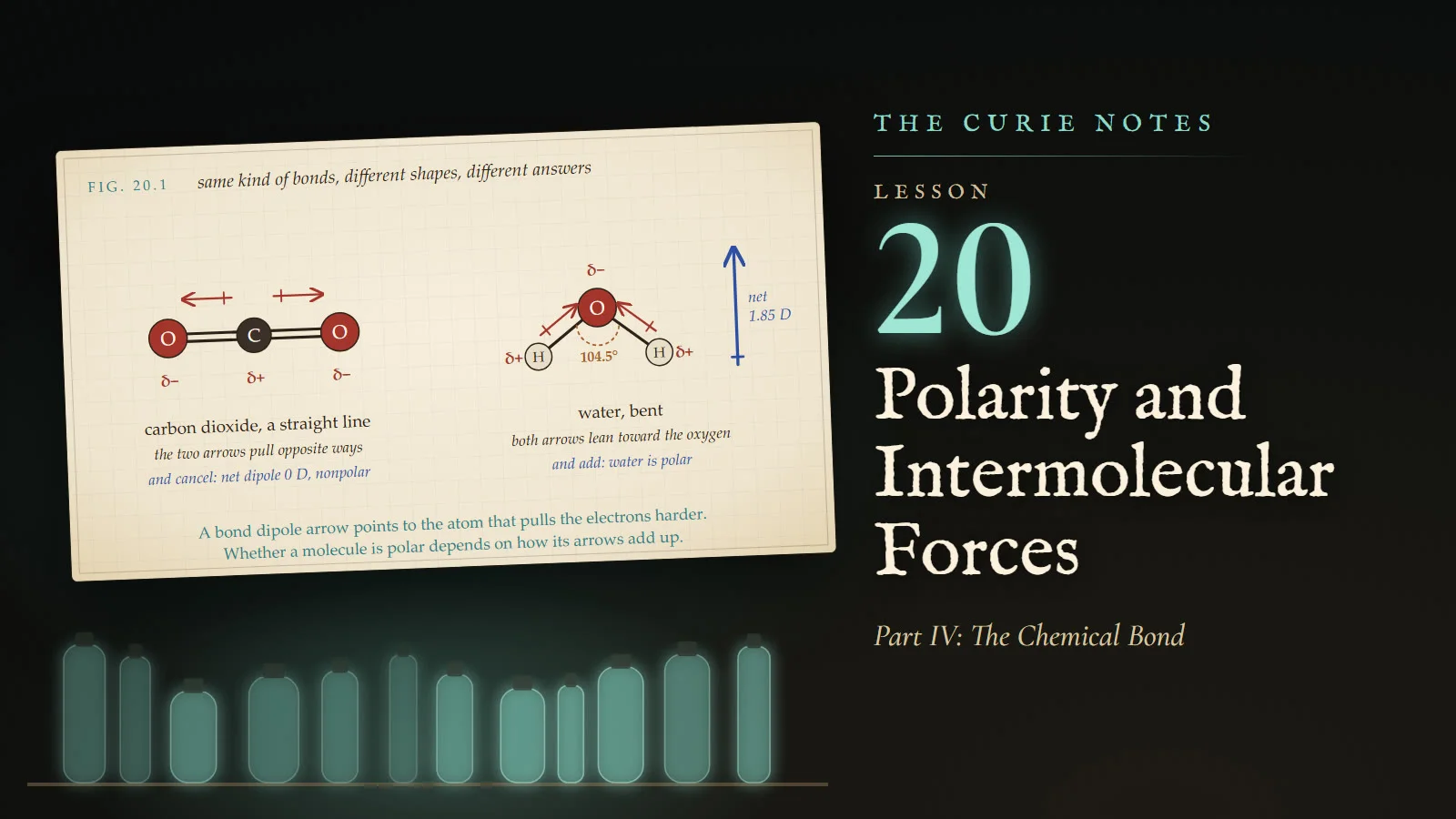
A molecule with only one bond is polar if that bond is polar. A molecule with several bonds is harder. Each bond has its own dipole arrow, and the molecule's dipole moment is the sum of all the arrows. Arrows add like forces: their directions matter as well as their sizes. Two equal arrows pointing opposite ways add to nothing.
This is where the shapes of Lesson 19 earn their keep. Look at carbon dioxide and water again.
Carbon dioxide, \(\ce{O=C=O}\), is linear. Each C=O bond is polar, with an arrow pointing out toward its oxygen. But the two arrows point in exactly opposite directions, and they are equal. They cancel. Carbon dioxide has polar bonds, yet it is a nonpolar molecule: its dipole moment is zero.
Water is bent, at 104.5°. Each O–H bond has an arrow pointing toward the oxygen. The two arrows do not point opposite ways; both lean toward the oxygen side. They add. Water is a polar molecule, with the oxygen end negative and the hydrogen end positive. Its dipole moment is 1.85 D.
Worked example 3
Each O–H bond in water has a dipole of 1.51 D, and the angle between the bonds is 104.5°. What is the dipole moment of the whole molecule?
- Draw the two arrows from the hydrogens toward the oxygen. The line that cuts the angle in half is the molecule's axis.
- Each arrow makes half the angle with that axis: \(104.5^\circ \div 2 = 52.25^\circ\).
- Split each arrow into a part along the axis and a part across it. The parts across the axis are equal and opposite, so they cancel.
- The part of each arrow along the axis is \(1.51\,\mathrm{D} \times \cos 52.25^\circ = 1.51 \times 0.612 = 0.924\,\mathrm{D}\).
- Add the two parts along the axis: \(2 \times 0.924 = 1.85\,\mathrm{D}\).
Check: this is water's measured dipole moment. Had water been straight, at 180°, the cosine of 90° is zero, and the sum would have been zero. The bend makes all the difference.
Symmetry cancels
The same rule holds for larger molecules. When identical bonds are spread evenly around the centre, their arrows always cancel. Boron trifluoride, \(\ce{BF3}\), is a flat triangle of three B–F bonds: nonpolar. Carbon tetrachloride, \(\ce{CCl4}\), is a tetrahedron of four C–Cl bonds: nonpolar. Methane, \(\ce{CH4}\), is nonpolar too.
Replace one chlorine of carbon tetrachloride with a hydrogen and the balance is broken. Chloroform, \(\ce{CHCl3}\), has three C–Cl arrows that no longer meet an equal fourth. It is polar, with a dipole moment of 1.04 D. Ammonia, a pyramid, is polar (1.47 D), because its three N–H arrows all lean toward the nitrogen.
So, to decide whether a molecule is polar, ask two questions in order. Are any of its bonds polar? If so, does the shape let the bond arrows cancel?
Try it
On Plate 20.1, choose a molecule and turn it with your finger. The red arrows are the bond dipoles; the blue arrow is their sum. Try carbon dioxide and boron trifluoride, where the arrows cancel, then water and chloroform, where they do not. Last, choose "Bend water yourself" and open the angle to 180°: watch the dipole moment fall to zero.
A common mistake
"It has polar bonds, so it is a polar molecule." This is false for every symmetric molecule. Carbon dioxide, with two very polar bonds, is nonpolar. Always look at the shape before you decide.
In my laboratory
My first measurements were made in a damp, crowded room on the ground floor of the School of Physics and Chemistry. Damp was my enemy. My electrometer measured currents of about a hundred-thousandth of a millionth of an ampere, and a thin film of moisture on an insulator could leak the charge away and spoil an afternoon's work. I did not then think of it in terms of dipoles. But the reason is the one in this lesson. Water molecules are polar, so they cling to surfaces in thin films, and they dissolve traces of salts into ions that carry current. I learned to keep my insulators clean and dry, and to repeat every reading.
Forces between molecules
So far we have looked inside one molecule. Now we look between molecules. The bonds inside a molecule, covalent bonds, are strong. The forces between neighbouring molecules are much weaker. We call them intermolecular forces ("inter" means between).
The difference in strength is large. To break every O–H bond in a mole of water would take about 926 kJ. To boil a mole of water at 100 °C takes about 41 kJ. When water boils, its molecules are pulled apart from each other. The molecules themselves stay whole: steam is still \(\ce{H2O}\).
Intermolecular forces decide whether a substance is a gas, a liquid or a solid at room temperature. They decide its boiling point, whether it mixes with water, and much else. There are four kinds to learn:
- London dispersion forces, between all molecules.
- Dipole–dipole forces, between polar molecules.
- Hydrogen bonds, a strong special case of dipole–dipole force.
- Ion–dipole forces, between an ion and a polar molecule, as when salt dissolves in water.
Chemists often call the first two together van der Waals forces, after Johannes van der Waals of Amsterdam. In 1873 he showed that real gases behave as if their molecules attract each other weakly. He received the Nobel Prize in Physics in 1910. We shall meet his work again in Part V.
London dispersion forces
Helium atoms have no polar bonds; they have no bonds at all. Yet helium can be made liquid, at 4 degrees above absolute zero. Something holds the atoms together, however weakly. What?
The electrons of an atom are always moving. On average, they are spread evenly around the nucleus. But at any one instant, by chance, a few more of them may be on one side than the other. For that instant, the atom is a tiny dipole: a little negative on one side, a little positive on the other. This flicker of charge acts on the neighbouring atom. Its negative side pushes the neighbour's electrons away, so the neighbour becomes a dipole too, with its positive side facing the first atom. The two attract. A moment later the flicker changes, and the neighbour follows.
This weak, flickering attraction is the London dispersion force. Fritz London explained it with the new quantum mechanics in 1930. It acts between every pair of atoms and molecules, polar or not.
What makes London forces stronger
Large atoms and molecules have many electrons, and their outer electrons are held loosely, far from the nucleus. Their clouds are easily pushed out of shape. We say they are more polarisable. So London forces grow with the number of electrons, and roughly with the molar mass.
The noble gases show this cleanly, since they feel no other force. Helium boils at −269 °C, neon at −246 °C, argon at −186 °C, krypton at −153 °C and xenon at −108 °C. The halogens show it too. Fluorine and chlorine are gases at room temperature, bromine is a liquid that boils at 59 °C, and iodine is a solid that boils at 184 °C.
Shape matters as well. Pentane and its isomer neopentane are both \(\ce{C5H12}\), with the same mass and the same electrons. Pentane is a long chain; neopentane is a compact ball. Long molecules lie alongside each other and touch along their whole length; balls touch only at a point. Pentane boils at 36 °C, neopentane at 9.5 °C.
An analogy from my Paris
Stand in a crowded carriage of the Métro, which opened in Paris in 1900. When the train lurches and one passenger leans, the passenger beside him leans the same way at once, and for a moment the two move together. Each passenger simply answers the movement of the next, and no hand holds another. London forces are like that: no permanent hold, only one flicker answered by another, again and again.
Dipole–dipole forces and hydrogen bonds
Polar molecules have permanent partial charges. The positive end of one molecule attracts the negative end of its neighbour. In a liquid, the molecules turn so that, on the whole, unlike ends face each other. This is the dipole–dipole force. It acts in addition to London forces.
To see its effect, compare two molecules of the same mass, so that their London forces are about equal. Butane, \(\ce{C4H10}\), and acetone, \(\ce{CH3COCH3}\), both have a molar mass of 58 g/mol. Butane is nonpolar and boils at about −1 °C. Acetone has a polar C=O bond, and it boils at 56 °C. The dipole–dipole force accounts for the difference.
Hydrogen bonds
One kind of dipole–dipole attraction is so strong that it has its own name. A hydrogen bond forms when a hydrogen atom bonded to nitrogen, oxygen or fluorine is attracted to a lone pair on a nitrogen, oxygen or fluorine atom of another molecule.
Why only these three? They are small and very electronegative. Bonded to one of them, the hydrogen loses most of its share of the electrons. A hydrogen atom has no inner electrons to hide behind, so it is left as an almost bare proton, very small and strongly positive. It can come very close to a lone pair on a neighbour and hold it.
We write a hydrogen bond as a dotted line. In water:
\[ \ce{H-O-H}\cdots\ce{:OH2} \]
A hydrogen bond in water has an energy of about 20 kJ/mol. That is about a twentieth of the O–H bond inside the molecule, but several times stronger than an ordinary dipole–dipole attraction. Each water molecule has two hydrogens to give and two lone pairs to receive, so each can hold four neighbours at once.
Worked example 4
Which of these can form hydrogen bonds between their own molecules: methane \(\ce{CH4}\), ammonia \(\ce{NH3}\), hydrogen fluoride \(\ce{HF}\), and dimethyl ether \(\ce{CH3OCH3}\)?
- Methane: its hydrogens are bonded to carbon, which is not very electronegative. No hydrogen bonds.
- Ammonia: hydrogens bonded to nitrogen, and nitrogen has a lone pair. Yes.
- Hydrogen fluoride: hydrogen bonded to fluorine, and fluorine has three lone pairs. Yes, strongly.
- Dimethyl ether: it has an oxygen with lone pairs, but all its hydrogens are bonded to carbon. With no H on N, O or F, it cannot hydrogen-bond to itself.
Check: dimethyl ether can still receive a hydrogen bond from water, through its oxygen. That is why it dissolves fairly well in water, even though it cannot hydrogen-bond to its own kind.
The strange boiling point of water
Now look at the hydrides, the simple compounds of hydrogen, of groups 14 to 17. In group 14, from methane down to tin hydride, the boiling point rises steadily with molar mass, as London forces predict. Groups 15, 16 and 17 follow the same rising line for their heavier members. But the first member of each, ammonia, water and hydrogen fluoride, breaks the pattern. Each boils far higher than its heavier cousins. These three are exactly the hydrides that form hydrogen bonds.
Water is the most extreme. A straight line through the boiling points of hydrogen sulfide, hydrogen selenide and hydrogen telluride, carried back to water's molar mass, predicts that water should boil near −73 °C. It boils at 100 °C, some 170 degrees higher. Without hydrogen bonds, water would be a gas at the temperatures of everyday life, and the Earth would have no seas.
Try it
Plate 20.2 draws the boiling points of all sixteen hydrides against their molar masses. Hide and show each family with the buttons, and tap any point to read its values. Then press "Where water ought to boil" to draw the trend line of water's heavier cousins.
Ion–dipole forces
The fourth force acts between an ion and a polar molecule. When salt dissolves in water (Lesson 9), each sodium ion is surrounded by water molecules turned with their negative oxygen ends toward it. Each chloride ion is surrounded by water molecules turned with their positive hydrogen ends toward it. This ion–dipole force is the strongest of the four. It is strong enough to pull ions out of a crystal, which is why water dissolves so many salts.
What the forces explain
With the four forces we can now explain a great deal of everyday chemistry.
Ranking boiling points
To rank substances by boiling point, work in this order:
- Ionic compounds boil highest of all, because full charges hold their ions together.
- For molecules of similar size, hydrogen bonding beats dipole–dipole, which beats London forces alone.
- For molecules held by the same kind of force, the larger molecule, with more electrons, boils higher.
- For molecules of the same formula, the longer, less branched one boils higher.
Worked example 5
Rank propane \(\ce{C3H8}\) (44 g/mol), dimethyl ether \(\ce{CH3OCH3}\) (46 g/mol) and ethanol \(\ce{C2H5OH}\) (46 g/mol) by boiling point.
- The molar masses are almost equal, so the London forces are about equal. The other forces decide.
- Propane: only C–C and C–H bonds, nonpolar. London forces only.
- Dimethyl ether: the C–O–C part is bent and polar. Dipole–dipole forces, but no O–H, so no hydrogen bonds between its molecules.
- Ethanol: an O–H group. Hydrogen bonds.
- Order, lowest to highest: propane, dimethyl ether, ethanol.
Check: the measured boiling points are −42 °C, −24 °C and 78 °C. The two last are isomers, with exactly the same atoms, yet they boil about 100 degrees apart.
Like dissolves like
Why does oil not mix with water? Water molecules hold each other by hydrogen bonds. To make room for an oil molecule, they would have to break some of these bonds, and the oil, being nonpolar, offers nothing as good in return. So the water molecules keep to themselves and push the oil out. Ethanol, by contrast, mixes with water in any proportion, because its O–H group can hydrogen-bond with water.
The rule chemists use is short: like dissolves like. Polar and ionic substances dissolve in polar solvents such as water. Nonpolar substances dissolve in nonpolar solvents. Iodine, a nonpolar molecule, barely dissolves in water, but it dissolves well in carbon tetrachloride, giving a violet solution. We shall study solutions closely in Part V.
Surface tension
A molecule in the middle of a liquid is pulled equally on all sides by its neighbours. A molecule at the surface has neighbours only below and beside it, so it is pulled inward. The surface behaves like a stretched skin. We call this surface tension. Water, with its hydrogen bonds, has a high surface tension: a drop of water stands as a round bead on a waxed table, and a dry steel needle laid gently on water can float. A drop of ether, with weaker forces, spreads flat at once.
Ice floats
Almost every substance is denser as a solid than as a liquid. Solid wax sinks in melted wax. Water is the great exception: ice floats.
The reason is the hydrogen bond. In ice, every water molecule holds four neighbours by hydrogen bonds, at the corners of a tetrahedron, as Fig. 20.3 shows. This gives an open, honeycomb-like crystal with much empty space. When ice melts, some hydrogen bonds break, the open pattern partly collapses, and the molecules crowd into the holes. Ice has a density of \(0.917\,\mathrm{g/cm^3}\); liquid water is close to \(1.000\,\mathrm{g/cm^3}\). Water expands by about one part in eleven when it freezes.
Liquid water has one more oddity. As it cools, it becomes denser, until 4 °C. Below 4 °C, the first open clusters begin to form, and it becomes less dense again. So the densest water, at 4 °C, sinks to the bottom of a lake or river, and the colder water stays above it, where it freezes.
An analogy from Warsaw
In the winters of my childhood the Vistula froze, and the ice lay across the river from bank to bank. It formed on the top and grew downward, and under it the river went on flowing, and the fish lived through the winter in water a few degrees above freezing. If ice sank, as most solids do in their own liquid, rivers and lakes would freeze from the bottom up. Each winter's ice would pile up on the bed, and in cold lands much of it might never melt. The hydrogen bond, a force of about 20 kJ per mole, keeps the fish of the Vistula alive.
From the shed
The shed on the rue Lhomond was stifling in summer and bitterly cold in winter. My daughter Ève later wrote that on one winter day I noted in our notebook a temperature of only six degrees inside. Water is a good companion in a cold room. Its hydrogen bonds give it a high heat capacity: it takes 4.18 joules to warm one gram of water by one degree, far more than most liquids. A basin of water warms slowly and cools slowly, and so do the seas.
Try it
Exercise 20.3 brings the lesson together: electronegativity differences, polar molecules, percent ionic character, and ranking by the forces between molecules. The first, second and fourth questions give fresh numbers whenever you ask.
The end of Part IV, and what comes next
With this lesson we finish our study of the chemical bond. Let us look back over the road. In Lesson 17 atoms gave and took electrons and became ions, held in crystals by the pull of opposite charges. In Lesson 18 they shared electrons in pairs, and we learned to draw the sharing. In Lesson 19 the shared and unshared pairs pushed each other into shapes. Today the unevenness of the sharing, and those shapes, gave molecules their poles and their forces on each other.
The whole of it rests on one fact: opposite charges attract and like charges repel. Each bond, each shape and each force in these four lessons is that one law at work.
Part V, States of Matter, takes the forces of this lesson and asks what happens when we heat, cool and squeeze. We begin with gases, where the molecules are so far apart that the forces almost vanish, and simple laws connect pressure, volume and temperature. Then come the kinetic theory and real gases, liquids and vapour pressure, solids and their crystal lattices, and solutions, where "like dissolves like" becomes a science of its own.
What to remember
- Electronegativity difference: below about 0.4 nonpolar, 0.4 to 1.8 polar covalent, above 1.8 mostly ionic.
- A polar bond has partial charges \(\delta+\) and \(\delta-\); its dipole arrow points to the negative end.
- Dipole moment \(\mu = q \times d\); \(1\,\mathrm{D} = 3.336 \times 10^{-30}\,\mathrm{C\,m}\).
- A molecule is polar if it has polar bonds and its shape does not let their arrows cancel. Carbon dioxide is nonpolar; water is polar (1.85 D).
- London dispersion forces act between all molecules and grow with size and number of electrons.
- Dipole–dipole forces act between polar molecules.
- Hydrogen bonds: H on N, O or F, attracted to a lone pair on N, O or F; about 20 kJ/mol in water.
- Ion–dipole forces hold water around dissolved ions.
- Stronger intermolecular forces mean higher boiling points; "like dissolves like".
- Ice floats because hydrogen bonds hold it in an open lattice; water is densest at 4 °C.
Problems for your notebook
Problem 1. Classify the bonds C–Cl, K–Br and N–H, using C 2.55, Cl 3.16, K 0.82, Br 2.96, N 3.04, H 2.20.
Answer. C–Cl: \(3.16 - 2.55 = 0.61\), polar covalent, chlorine \(\delta-\). K–Br: \(2.96 - 0.82 = 2.14\), mostly ionic. N–H: \(3.04 - 2.20 = 0.84\), polar covalent, nitrogen \(\delta-\).
Problem 2. Which of these molecules are polar: sulfur dioxide \(\ce{SO2}\), carbon dioxide \(\ce{CO2}\), dichloromethane \(\ce{CH2Cl2}\), carbon tetrachloride \(\ce{CCl4}\)?
Answer. Sulfur dioxide is bent (Lesson 19), so its two S–O dipoles add: polar (1.63 D). Carbon dioxide is linear, and its dipoles cancel: nonpolar. Dichloromethane is a tetrahedron with two H and two Cl corners; the corners are unlike, so the arrows do not cancel: polar (1.60 D). Carbon tetrachloride has four identical corners: nonpolar.
Problem 3. Put \(\ce{H2O}\), \(\ce{H2S}\) and \(\ce{H2Se}\) in order of boiling point, lowest first, and explain.
Answer. Hydrogen sulfide (−60 °C), then hydrogen selenide (−41 °C), then water (100 °C). Between \(\ce{H2S}\) and \(\ce{H2Se}\), the heavier molecule, with more electrons, has stronger London forces. Water is lightest of all but forms hydrogen bonds, which outweigh everything else.
Problem 4. Hydrogen bromide has a dipole moment of 0.83 D and a bond length of 141.4 pm. Find its percent ionic character.
Answer.
- \(141.4\,\mathrm{pm} = 1.414 \times 10^{-10}\,\mathrm{m}\).
- Full charges: \(\mu = (1.602 \times 10^{-19}\,\mathrm{C})(1.414 \times 10^{-10}\,\mathrm{m}) = 2.265 \times 10^{-29}\,\mathrm{C\,m}\).
- In debye: \(2.265 \times 10^{-29} \div 3.336 \times 10^{-30} = 6.79\,\mathrm{D}\).
- Percent ionic: \(0.83 \div 6.79 \times 100 = 12\%\).
Check: less ionic than hydrogen chloride (18%), as expected, since bromine (2.96) is less electronegative than chlorine (3.16).
Problem 5. Pentane and neopentane are both \(\ce{C5H12}\), nonpolar, with the same number of electrons. Pentane boils at 36 °C and neopentane at 9.5 °C. Explain.
Answer. Both are held only by London forces, and both have the same electrons, so the difference must come from shape. Pentane is a long chain; neighbouring chains lie side by side and touch along their whole length, so the flickering attractions act over a large area. Neopentane is a compact ball, and two balls touch over a small area. Less contact means weaker London forces and a lower boiling point.
After my time
The hydrogen bond was named and described in my lifetime, by Wendell Latimer and Worth Rodebush in America in 1920, and Fritz London explained the dispersion force in 1930. In 1933, John Desmond Bernal and Ralph Fowler in Cambridge proposed the arrangement of hydrogen bonds in ice that I have described. But the great harvest came later. Linus Pauling gave the hydrogen bond a central place in his book on the chemical bond in 1939. In 1953, Francis Crick and James Watson, using the X-ray photographs of Rosalind Franklin and Maurice Wilkins, showed that the two strands of the molecule of heredity, DNA, are held together by hydrogen bonds. The same weak bonds hold proteins in their shapes. Life is built on forces of about 20 kJ per mole.
London forces, too, proved more important than anyone expected. In 2000 biologists found that a gecko climbs a pane of glass largely by London forces between millions of tiny hairs on its feet and the glass.
If something in this lesson still puzzles you, or if you would like another molecule to test, come and ask me. The next lesson, Lesson 21, opens Part V with the gas laws: what happens when the molecules fly so far apart that their forces almost vanish.
Sources and liberties
The Curie Notes are a modern chemistry course written in Marie Curie's voice by Eternal Gardens. The chemistry is standard modern chemistry; dates, people, apparatus and quotations come from the sources below; the teaching, the analogies and the private remarks are our reconstruction.
- Marie Curie, Pierre Curie, with her Autobiographical Notes, translated by Charlotte and Vernon Kellogg (Macmillan, 1923): Project Gutenberg
- OpenStax, Chemistry 2e, sections 7.2 (electronegativity and bond polarity), 7.6 (molecular polarity) and 10.1 (intermolecular forces): openstax.org
- NIST Chemistry WebBook, boiling points and phase data: webbook.nist.gov
- NIST Computational Chemistry Comparison and Benchmark Database, experimental dipole moments and bond lengths: cccbdb.nist.gov
- Peter Debye, Nobel Prize in Chemistry 1936 (for his work on dipole moments): nobelprize.org
- Johannes Diderik van der Waals, Nobel Prize in Physics 1910: nobelprize.org
- AIP Center for History of Physics, "Marie Curie and the Science of Radioactivity": history.aip.org
- Ève Curie, Madame Curie (1937), for the shed's winter temperature: archive.org
Uncertain or simplified history: the six-degree reading in the shed comes from my daughter's biography, which is family tradition rather than a checked document; the omnibus and Métro scenes are illustrations, not records.