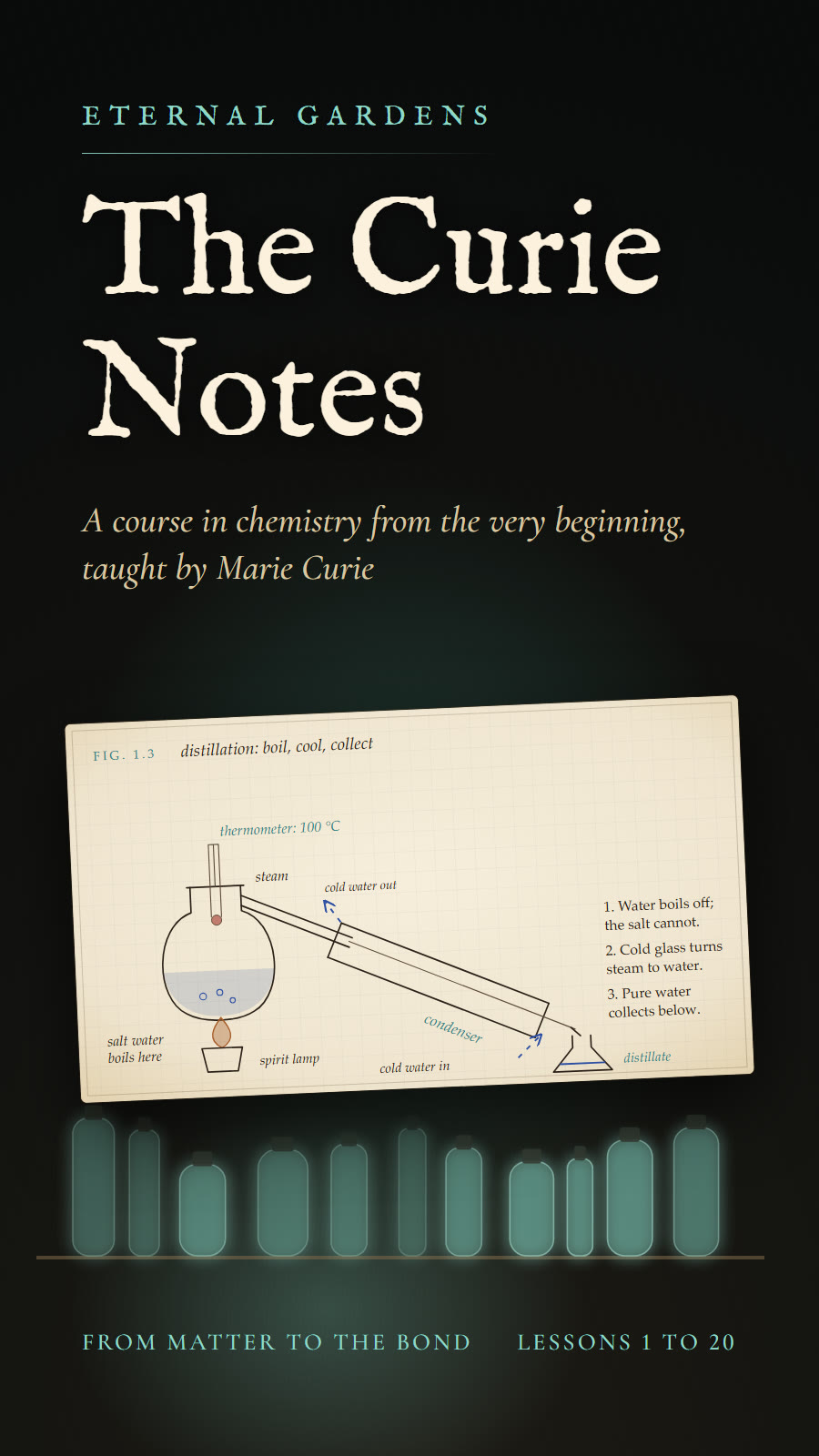
A complete course in chemistry from the very beginning, taught by Marie Curie in her own voice. Plain words, every step shown, analogies from her Paris and Warsaw, ink sketches, and interactive plates and exercises in every lesson: matter and measurement, atoms and the mole, formulas and equations, stoichiometry, solutions, precipitates, acids and bases, redox, light and spectra, the Bohr atom, orbitals, the periodic table, and the chemical bond. When a lesson is done, you can go and ask her about it.
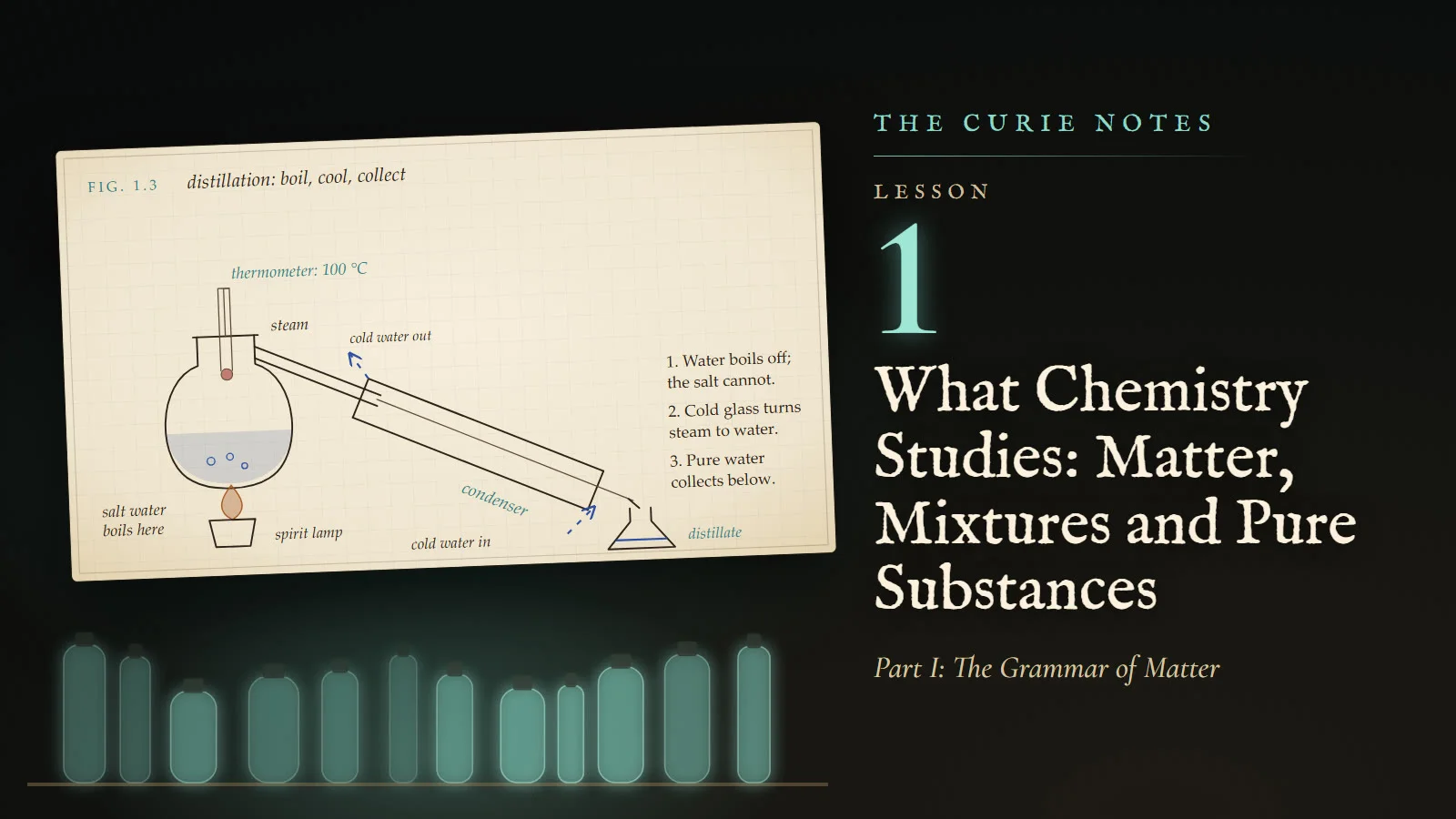 Curie Notes 01: What Chemistry Studies: Matter, Mixtures and Pure Substances
Learn the states of matter, physical and chemical change, elements, compounds and mixtures, how to separate a mixture, and how density identifies a substance.
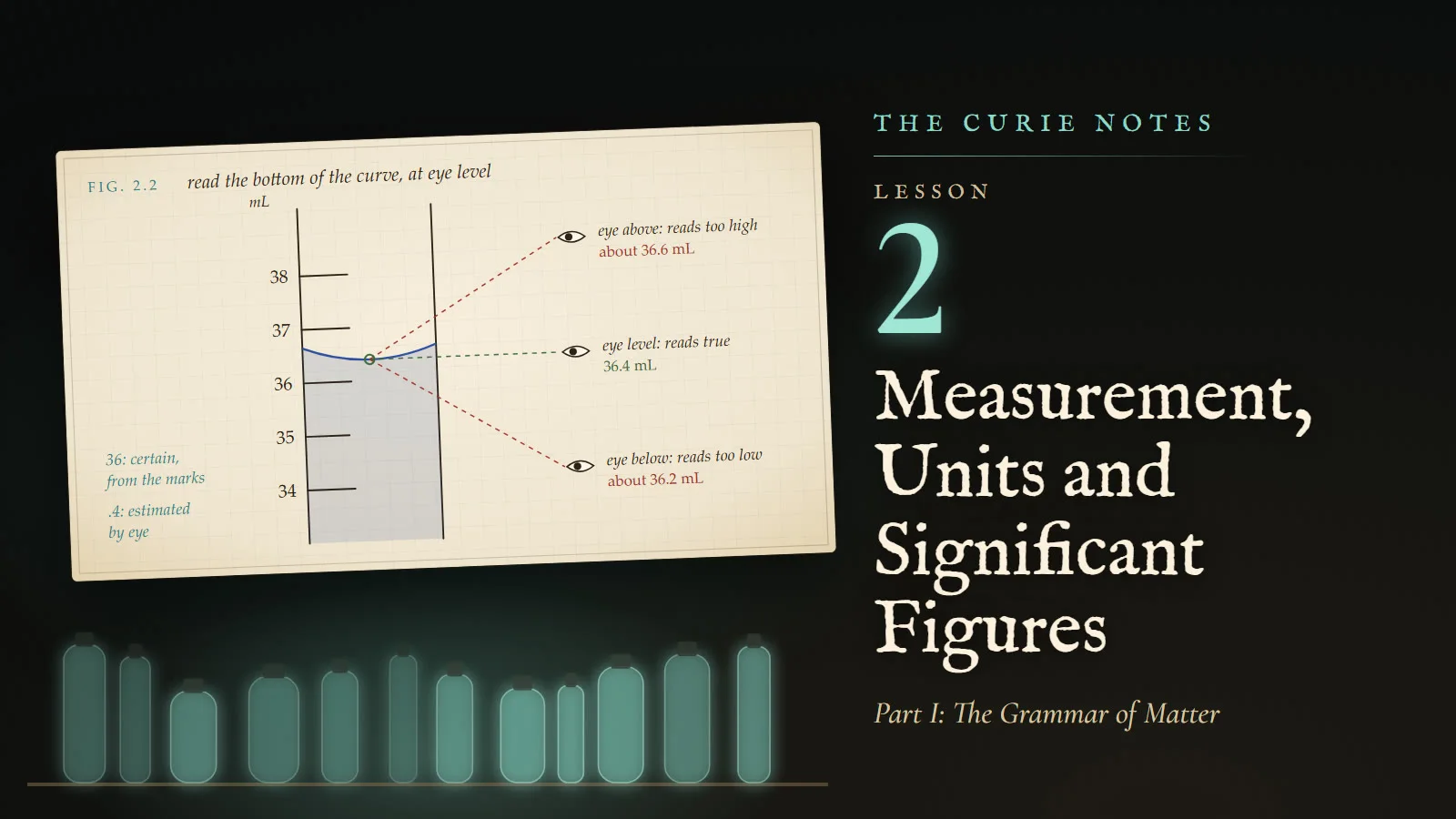 Curie Notes 02: Measurement, Units and Significant Figures
Learn SI units and prefixes, mass and weight, reading a scale, accuracy and precision, significant figures, scientific notation and unit conversions.
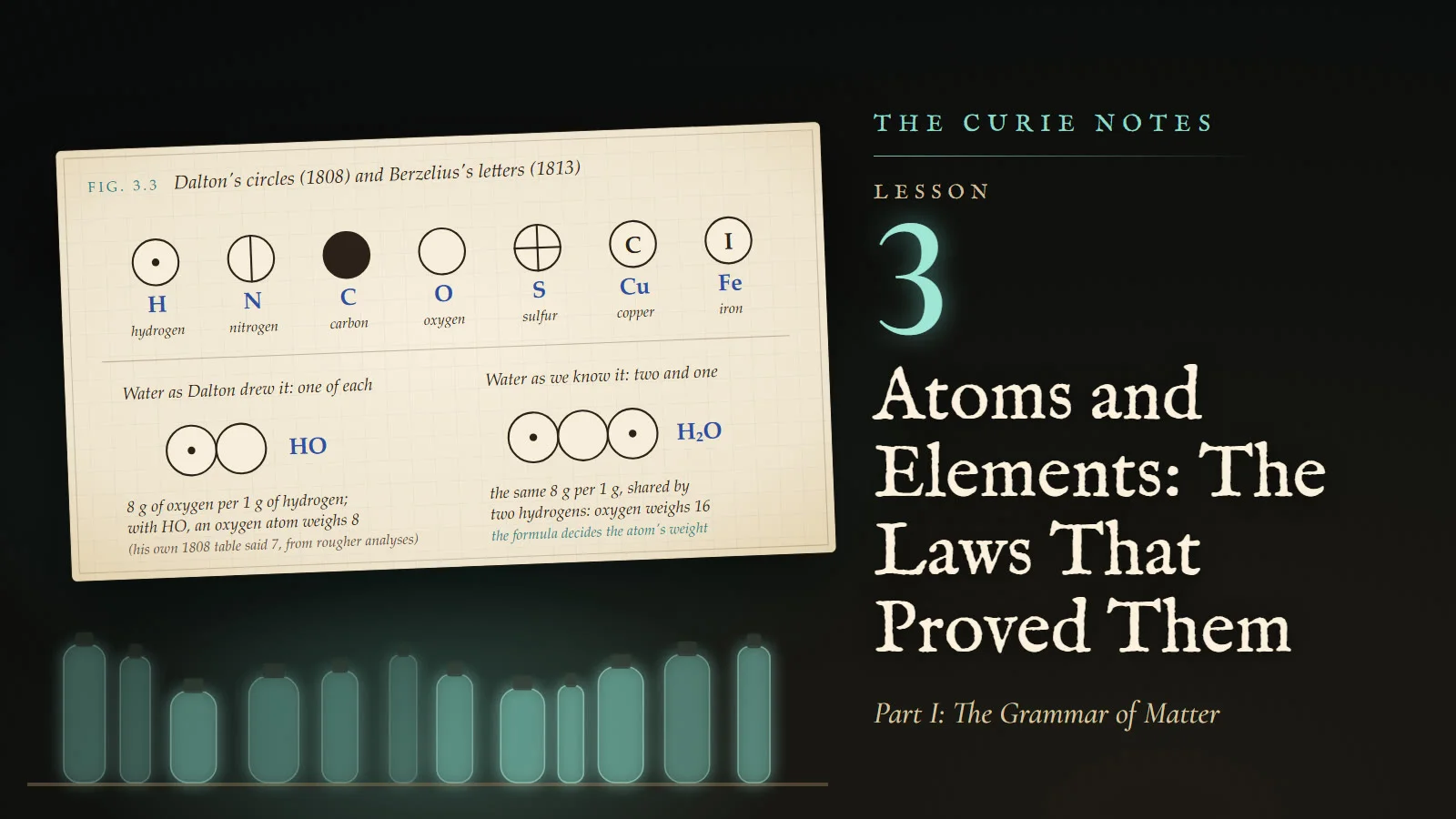 Curie Notes 03: Atoms and Elements: The Laws That Proved Them
Learn conservation of mass, definite and multiple proportions, Dalton's atomic theory and what was corrected, element symbols, and how small an atom is.
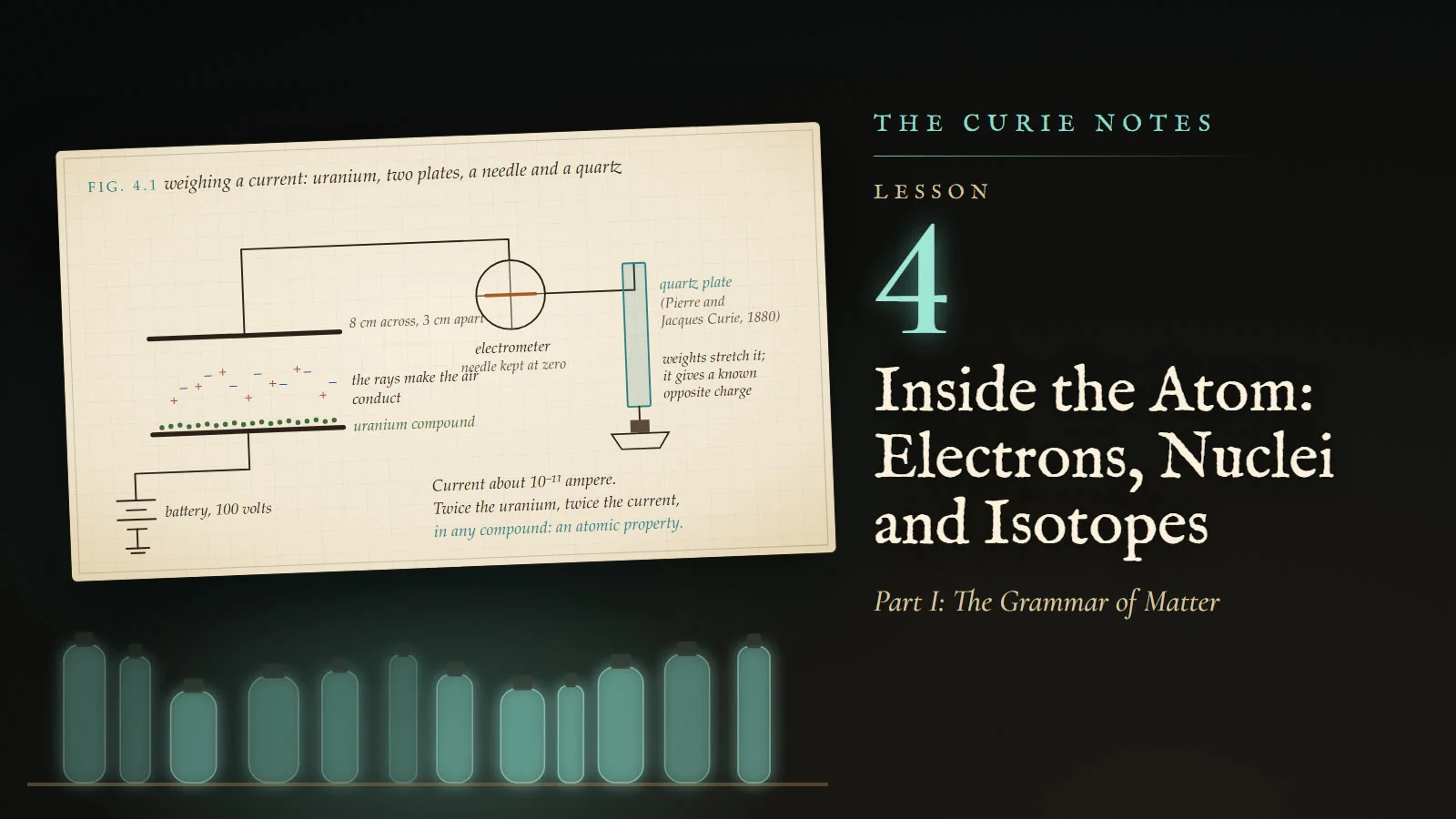 Curie Notes 04: Inside the Atom: Electrons, Nuclei and Isotopes
Learn electrons, the nucleus, protons and neutrons, read isotope symbols, count particles in ions, and calculate average atomic mass from isotopes.
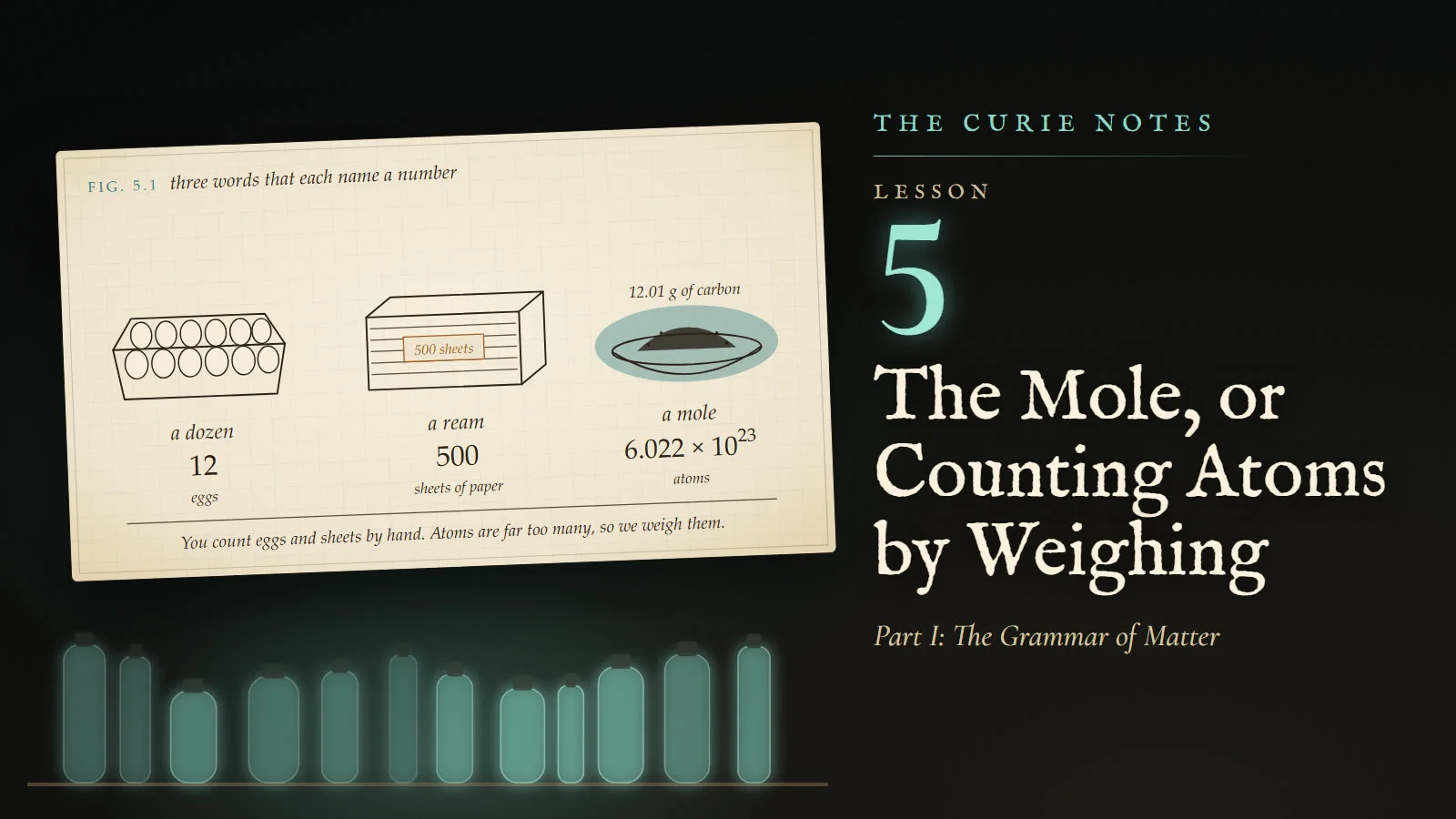 Curie Notes 05: The Mole, or Counting Atoms by Weighing
Learn the mole and the Avogadro constant, find molar masses, and convert grams to moles to atoms, with Marie Curie and Jean Perrin's grains.
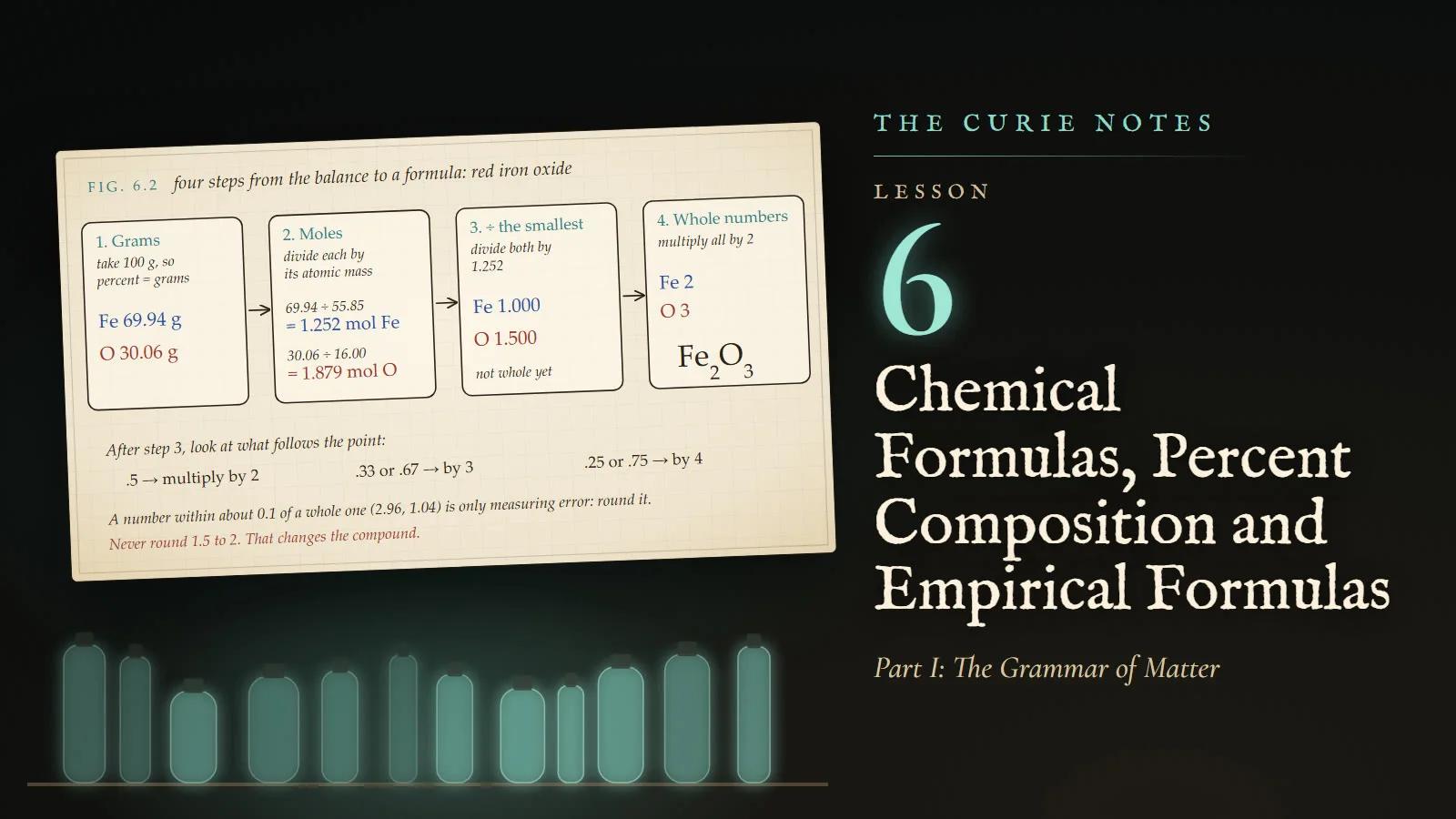 Curie Notes 06: Chemical Formulas, Percent Composition and Empirical Formulas
Read chemical formulas, calculate percent composition, find empirical and molecular formulas in four steps, and work out the water in a hydrate.
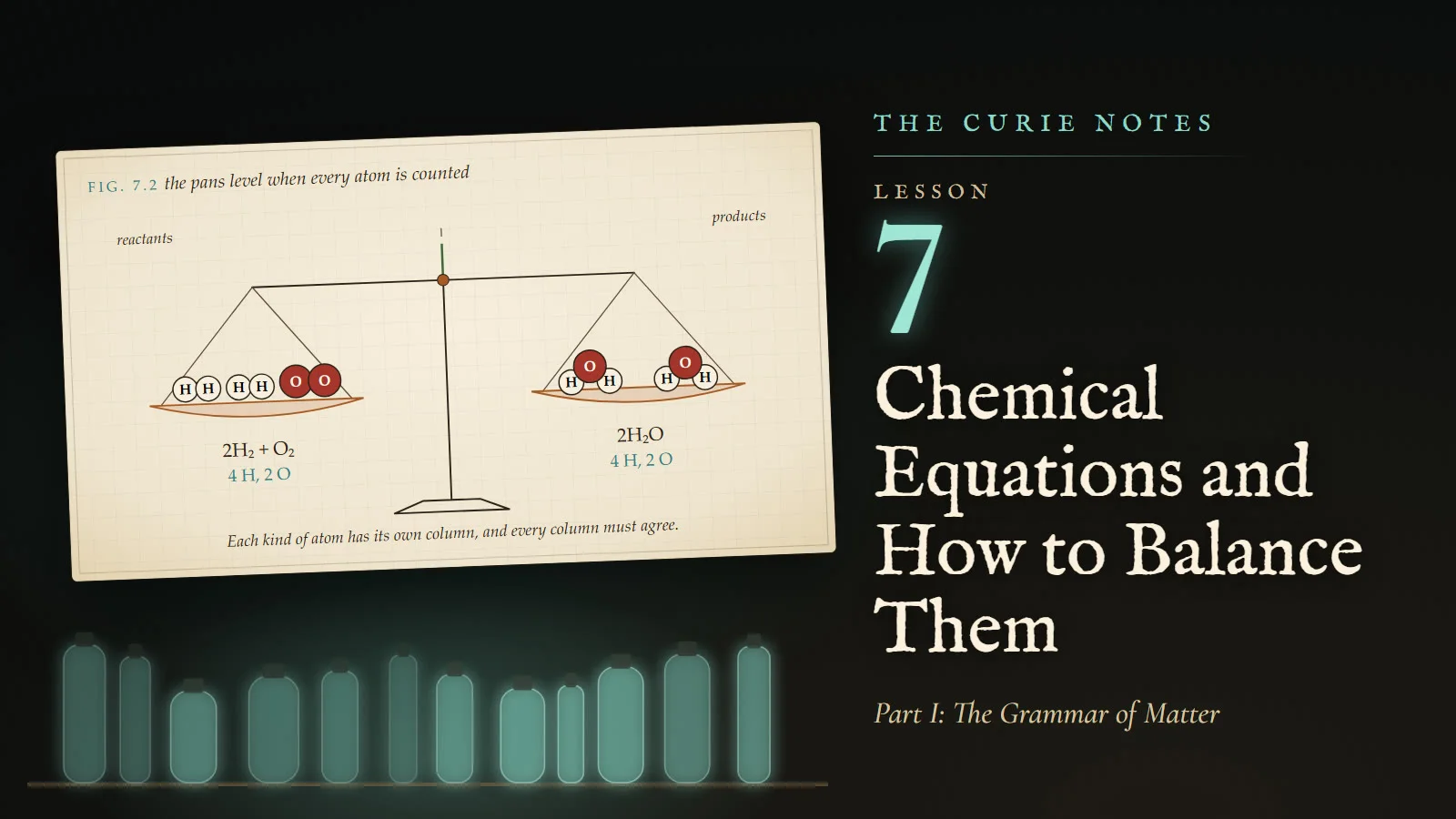 Curie Notes 07: Chemical Equations and How to Balance Them
Learn to read and balance chemical equations by inspection, step by step, name five reaction types, and read an equation in moles and grams.
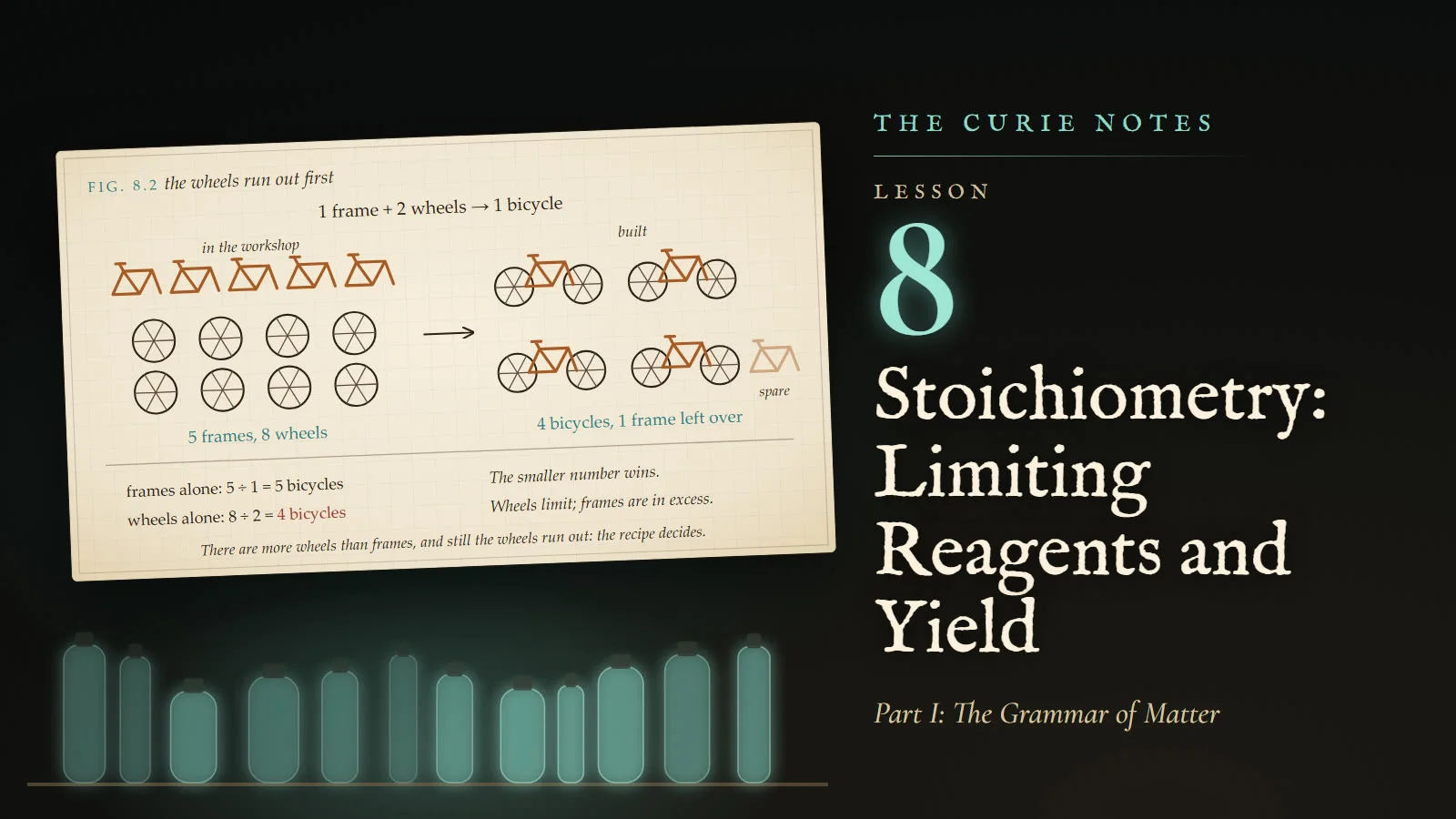 Curie Notes 08: Stoichiometry: Limiting Reagents and Yield
Learn mole ratios, grams-to-grams calculations, limiting and excess reagents, and theoretical, actual, percent and multi-step yield, worked step by step.
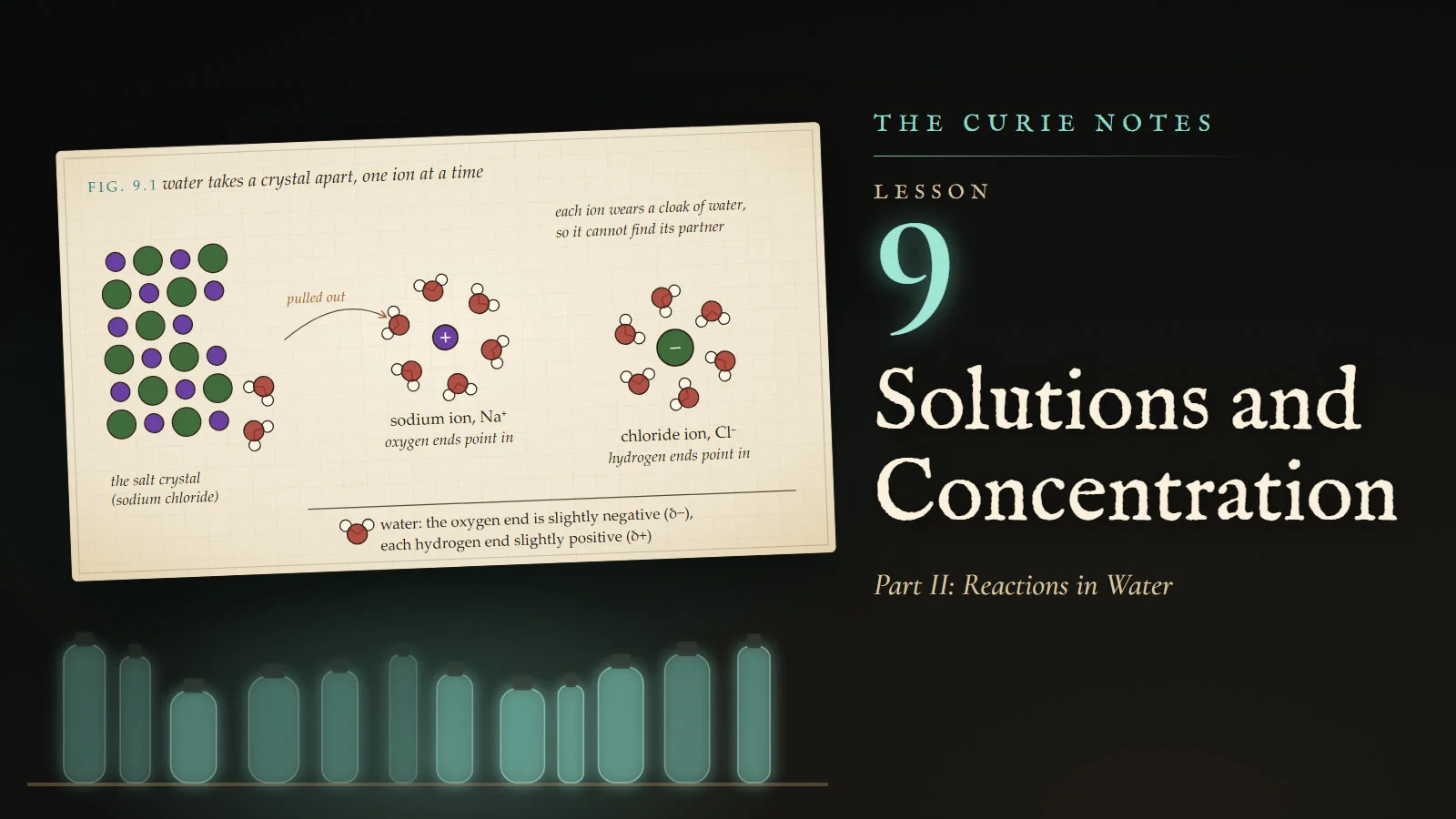 Curie Notes 09: Solutions and Concentration
Solute, solvent and how water dissolves salt; mass percent, ppm and molarity; making a solution in a volumetric flask; dilution with c1V1 = c2V2.
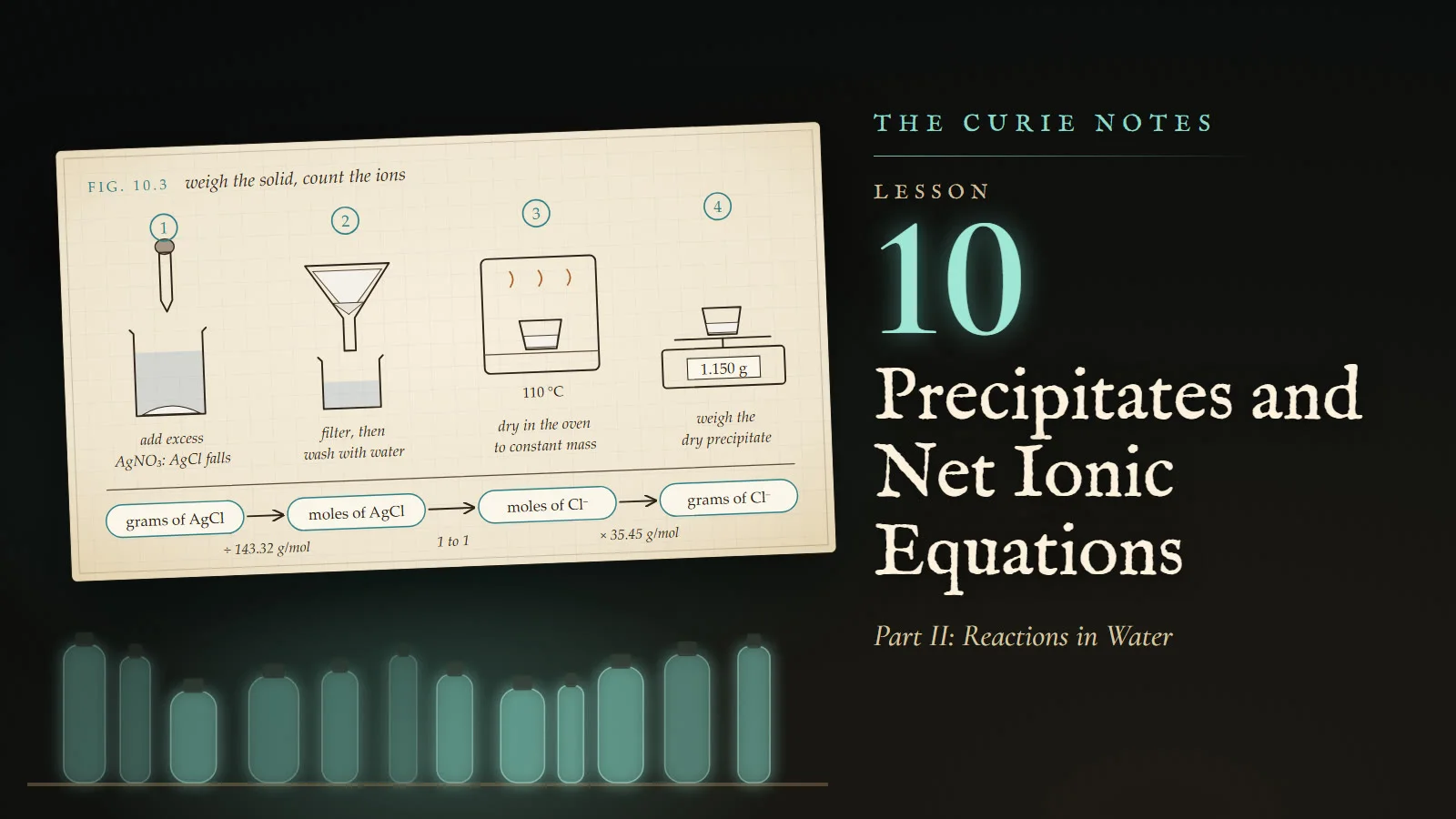 Curie Notes 10: Precipitates and Net Ionic Equations
Electrolytes, the solubility rules, predicting precipitates, molecular, complete and net ionic equations, spectator ions and gravimetric analysis.
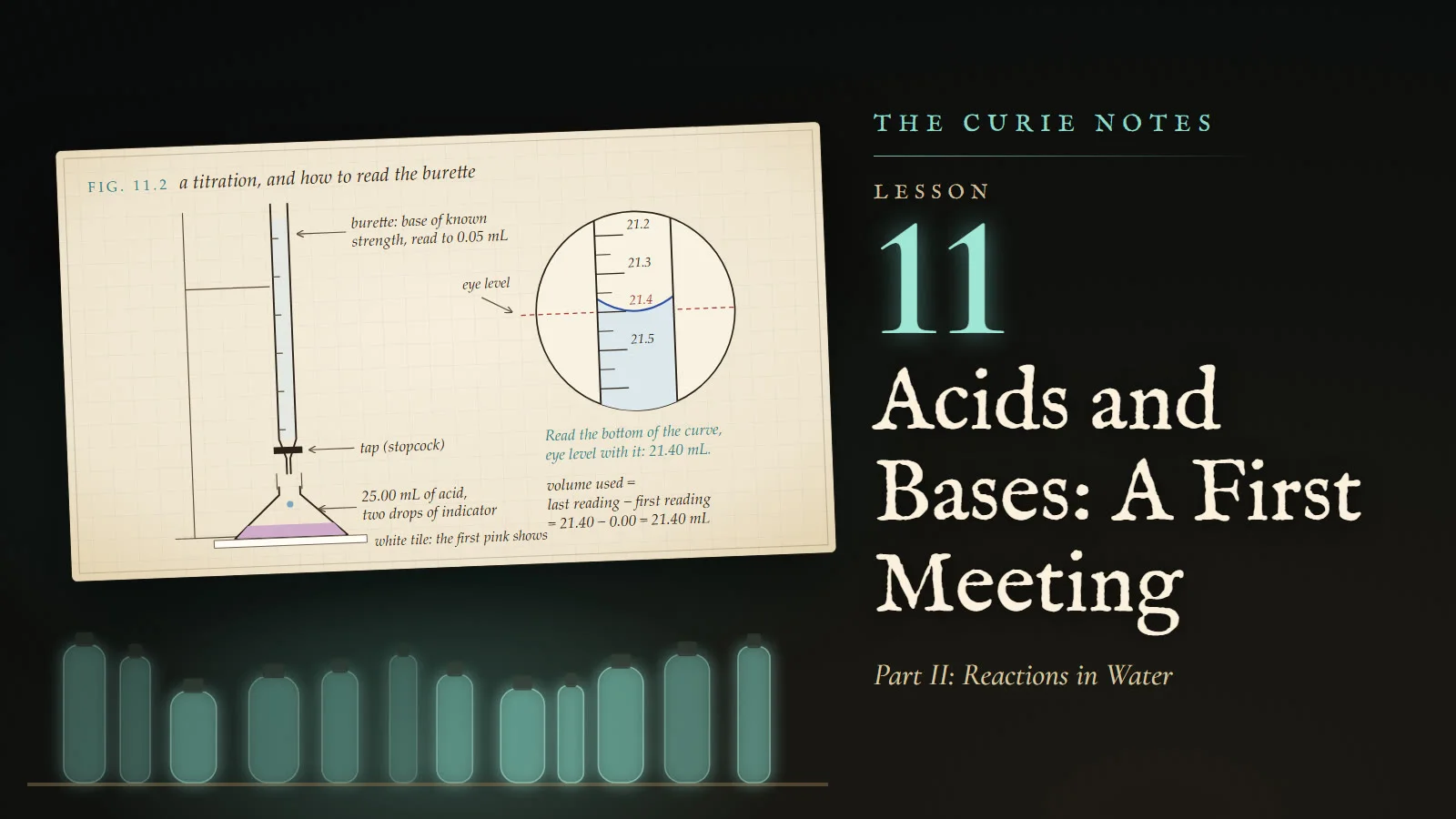 Curie Notes 11: Acids and Bases: A First Meeting
Learn Arrhenius and Brønsted-Lowry acids and bases, conjugate pairs, strong and weak acids, salts, indicators, the pH scale and titration calculations.
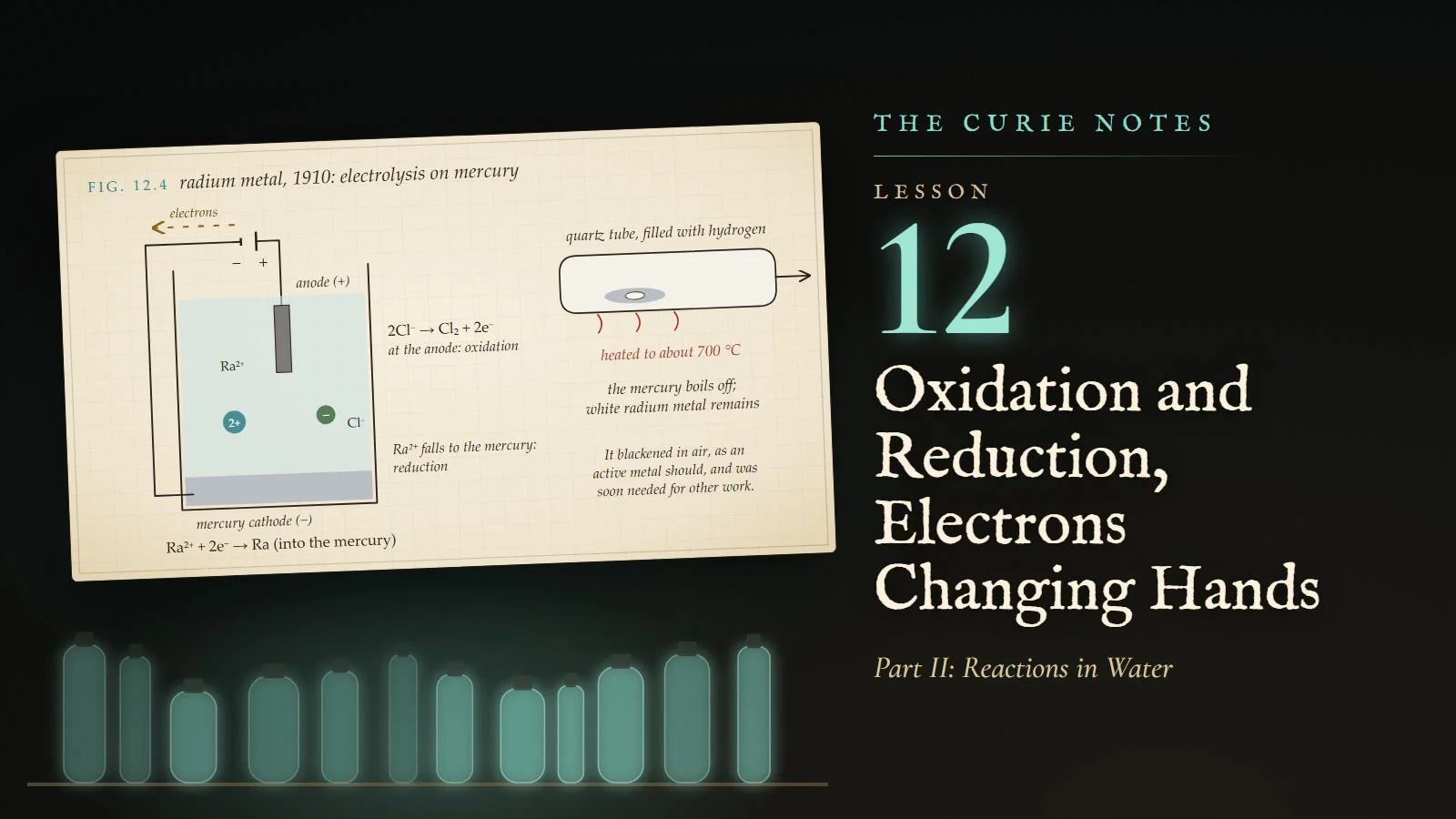 Curie Notes 12: Oxidation and Reduction, Electrons Changing Hands
Learn oxidation and reduction, oxidation-number rules, oxidising and reducing agents, half-reactions, balancing redox in acid, the activity series and rust.
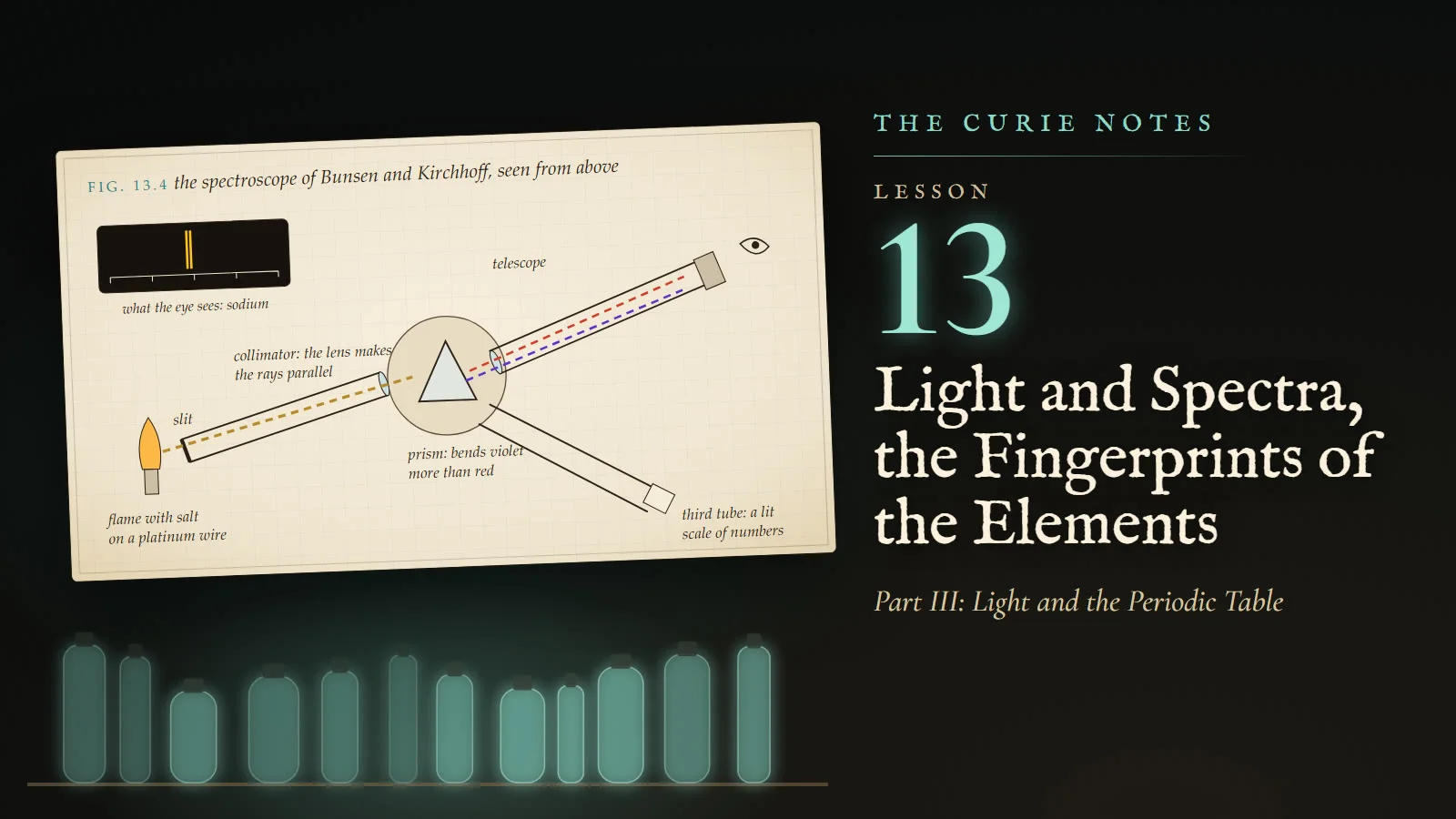 Curie Notes 13: Light and Spectra, the Fingerprints of the Elements
Wavelength, frequency and photons with c = λν and E = hν, the electromagnetic spectrum, line spectra, flame tests and the spectroscope, step by step.
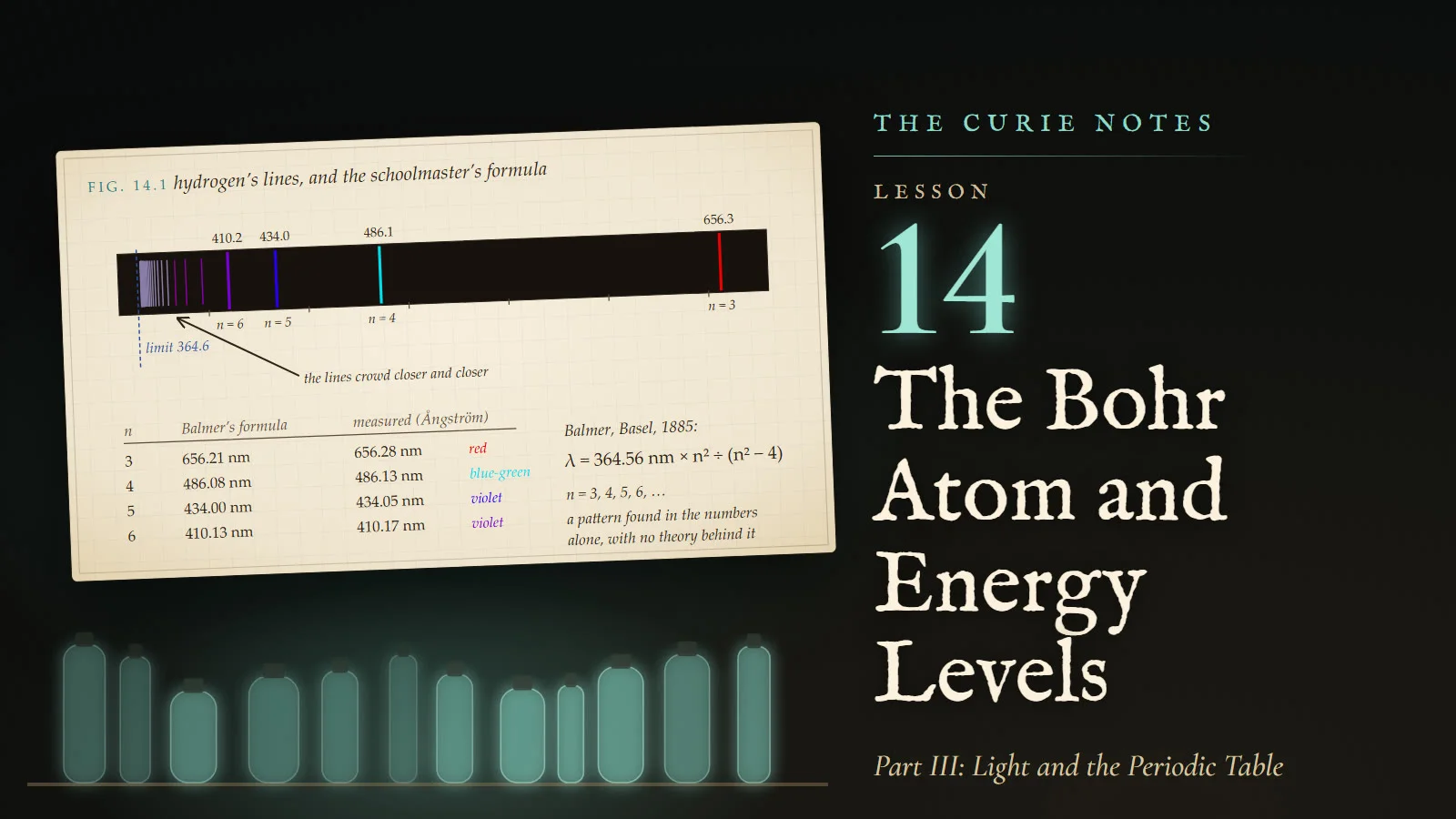 Curie Notes 14: The Bohr Atom and Energy Levels
Balmer and Rydberg formulas, Bohr's energy levels E = −13.6 eV/n², emission and absorption, the hydrogen series and ionisation energy, worked step by step.
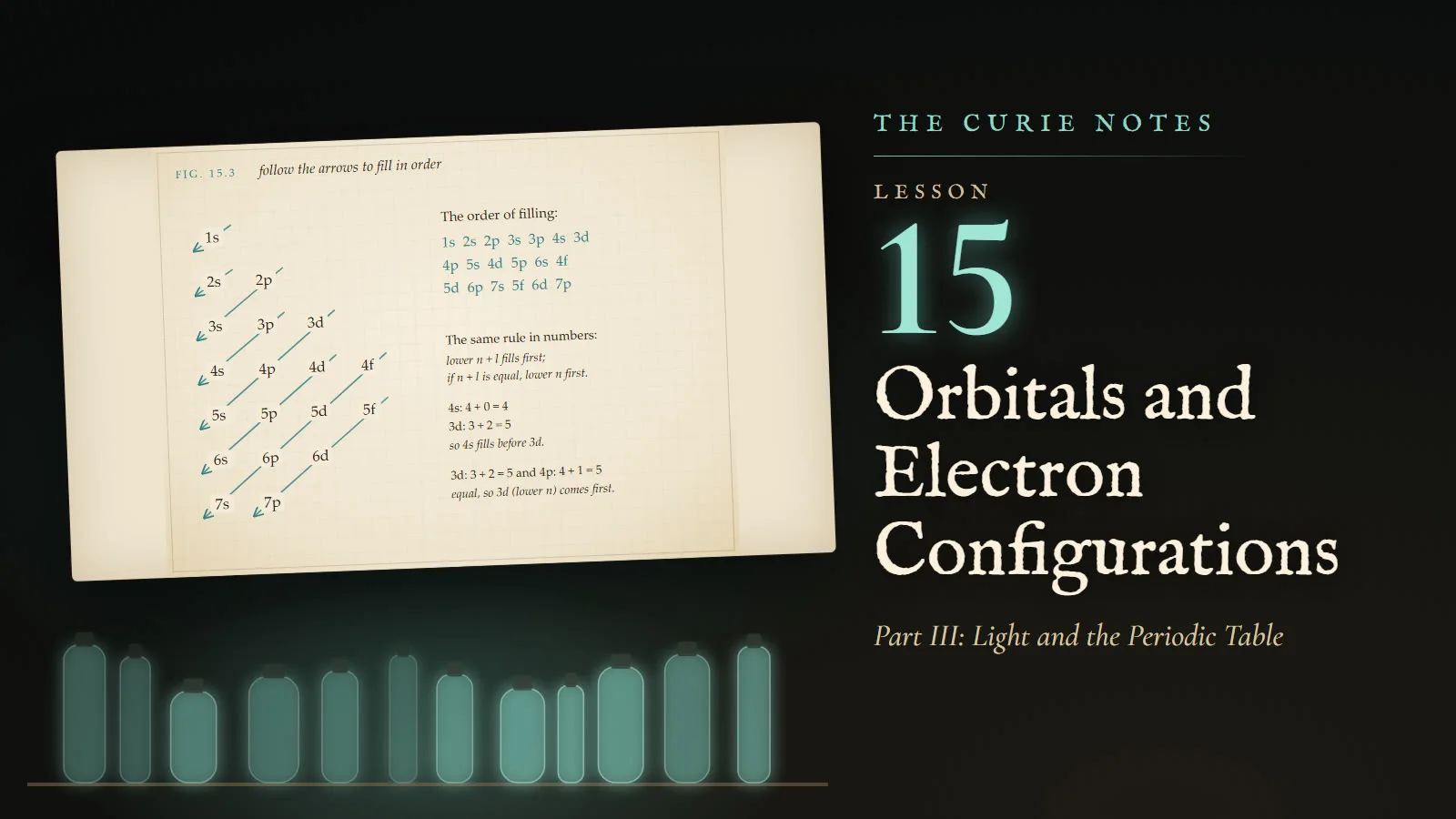 Curie Notes 15: Orbitals and Electron Configurations
Learn orbitals, quantum numbers, the Aufbau, Pauli and Hund rules, and how to write electron configurations and box diagrams, with chromium and copper.
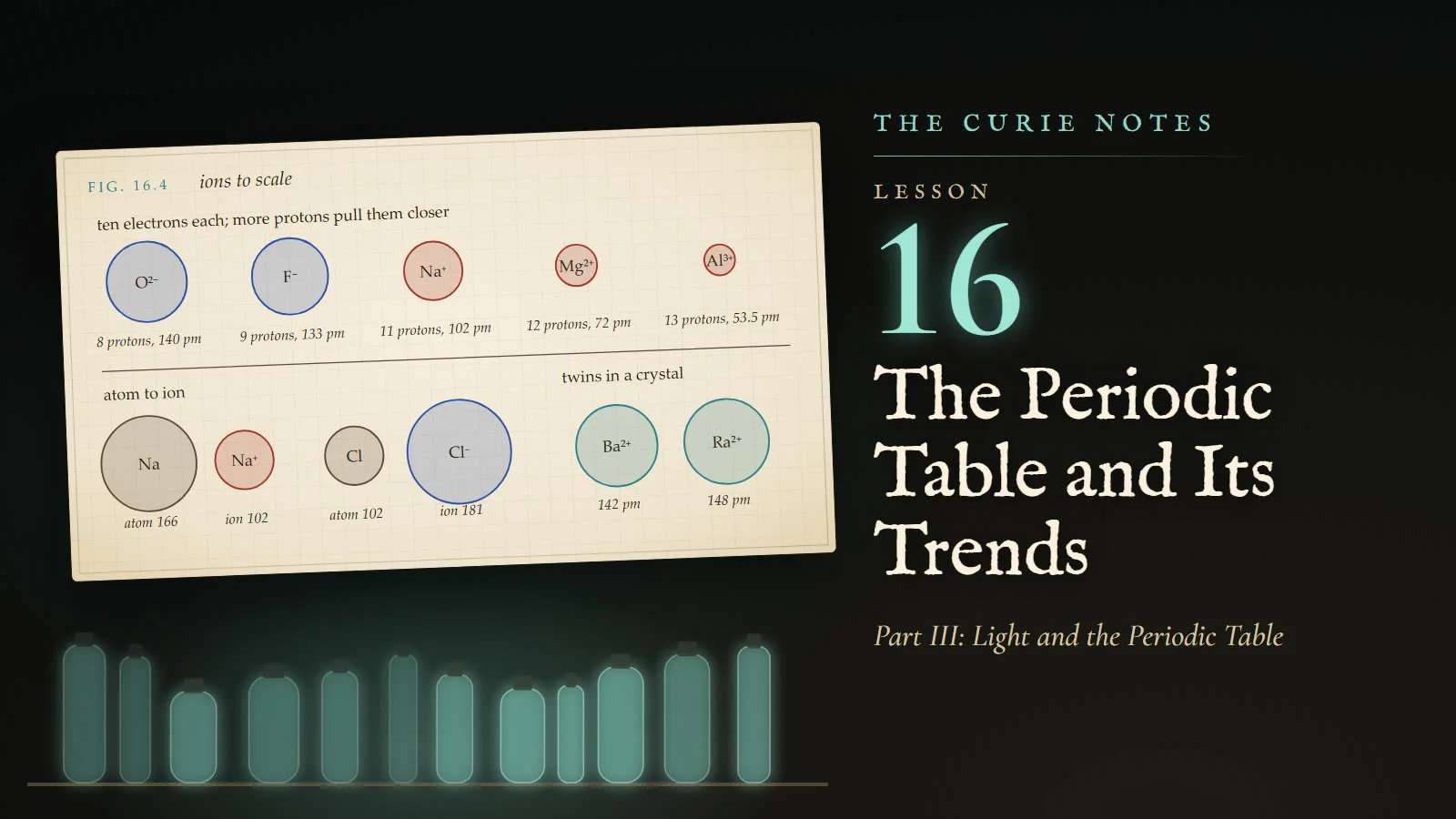 Curie Notes 16: The Periodic Table and Its Trends
Mendeleev's table and its gaps, blocks and groups, shielding and effective nuclear charge, and the trends in radius, ionisation energy and electronegativity.
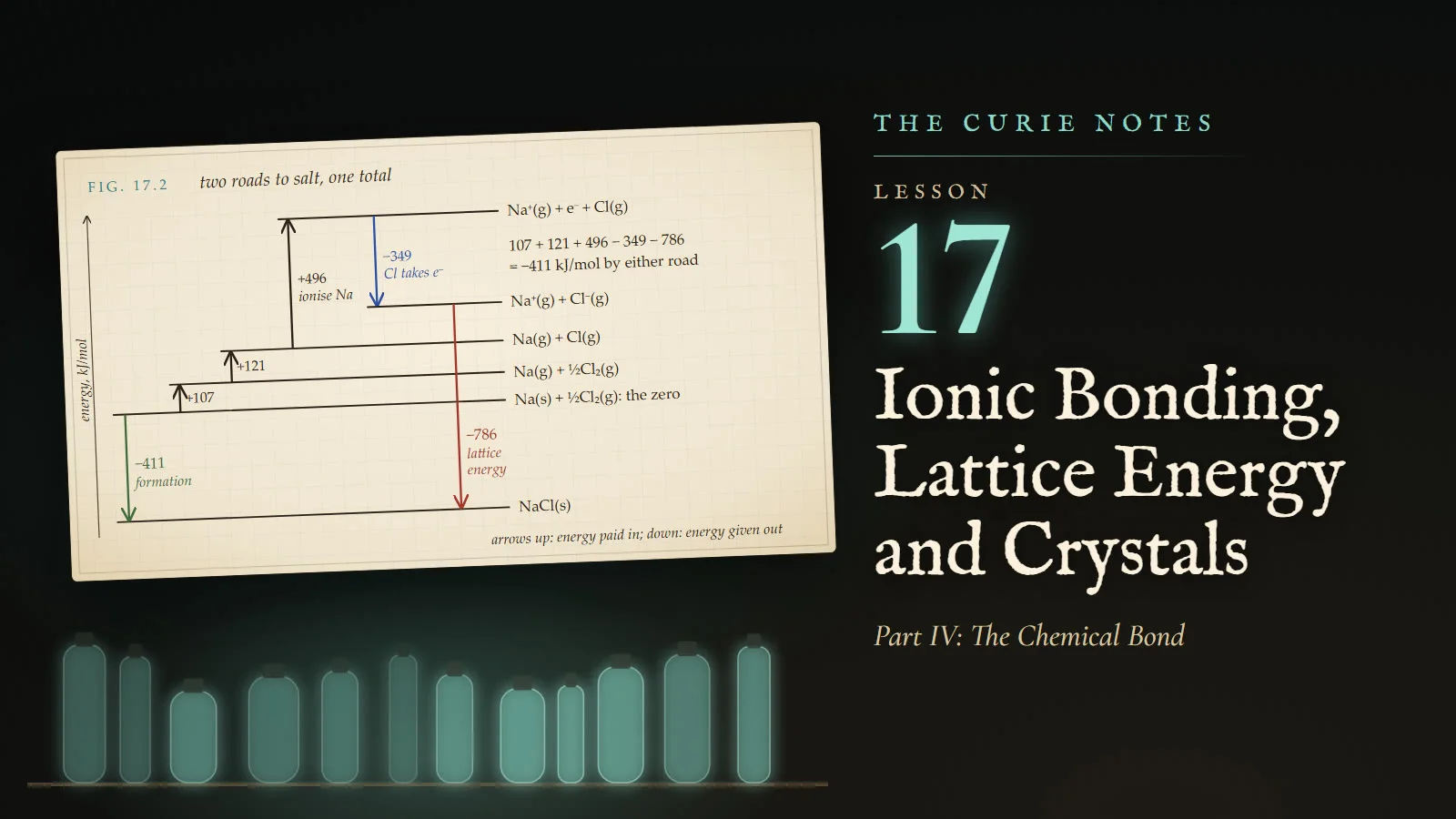 Curie Notes 17: Ionic Bonding, Lattice Energy and Crystals
Learn why ions form, how Coulomb's law sets lattice energy, how to work a Born-Haber cycle, and how to write and name ionic formulas and explain salt crystals.
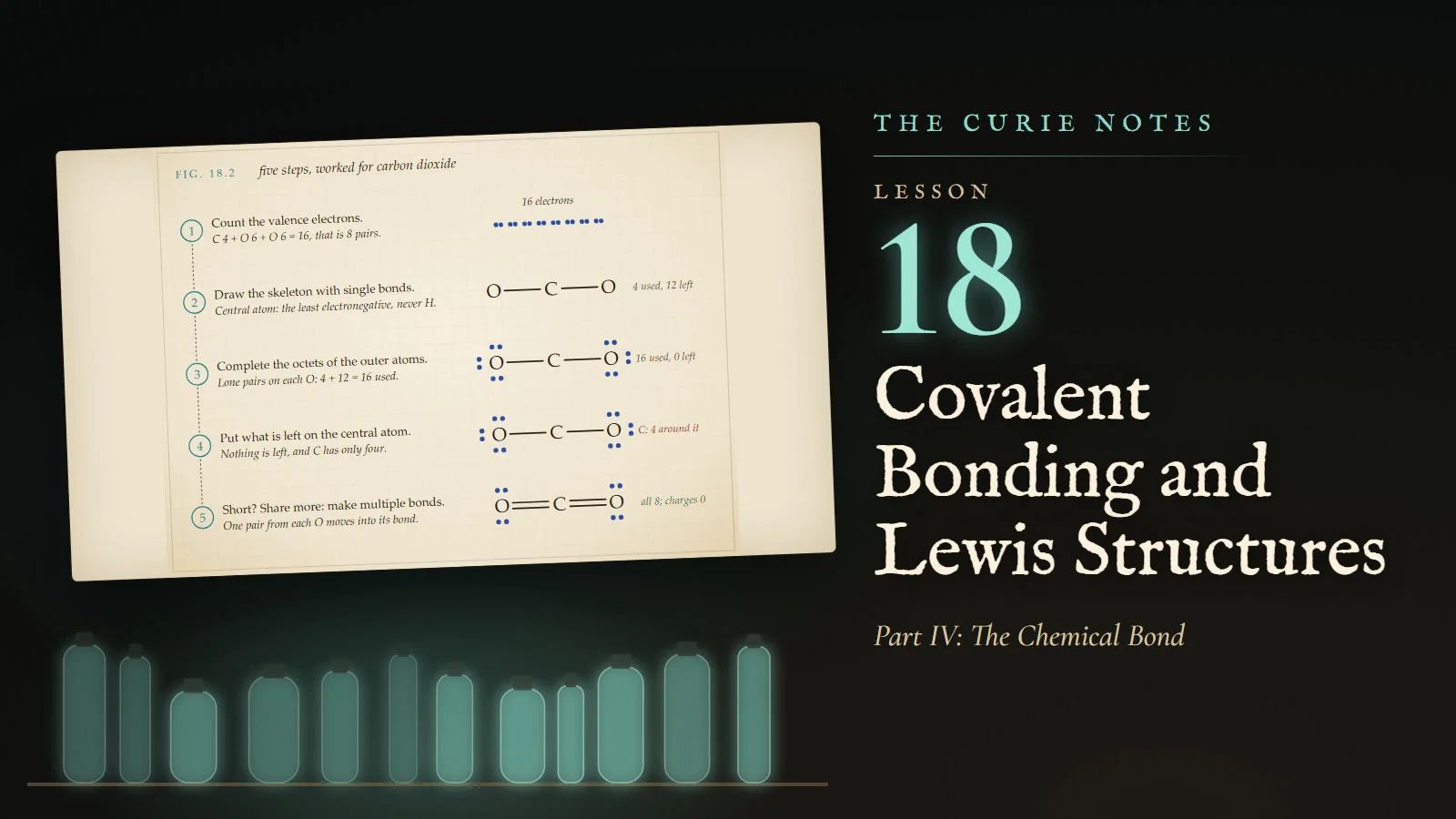 Curie Notes 18: Covalent Bonding and Lewis Structures
Learn how shared electron pairs hold molecules together, draw Lewis structures in five steps, and use bond length, formal charge and resonance to check them.
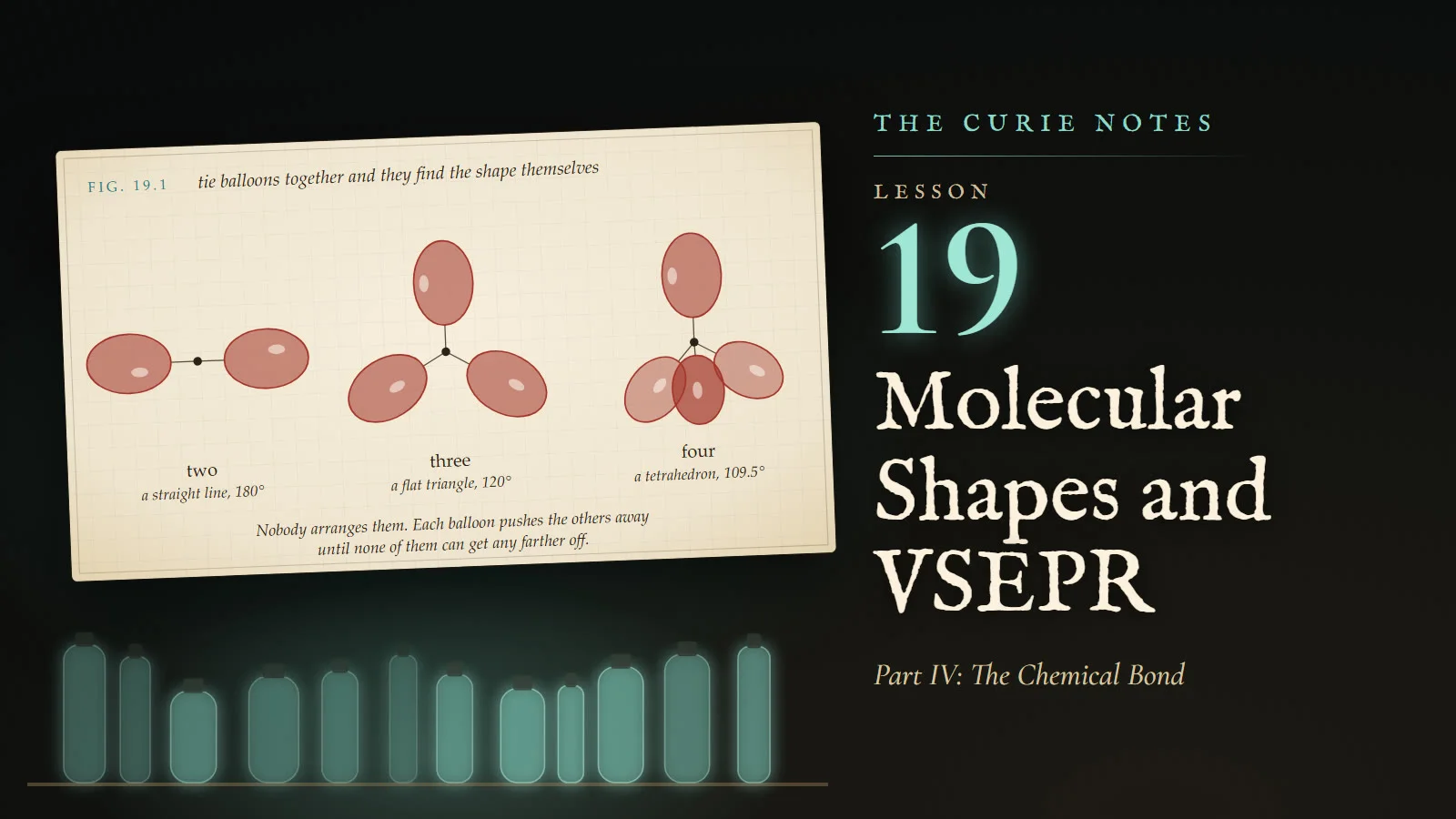 Curie Notes 19: Molecular Shapes and VSEPR
Count electron domains, learn the five basic geometries, see why lone pairs squeeze angles, and predict molecular shapes with VSEPR in five steps.
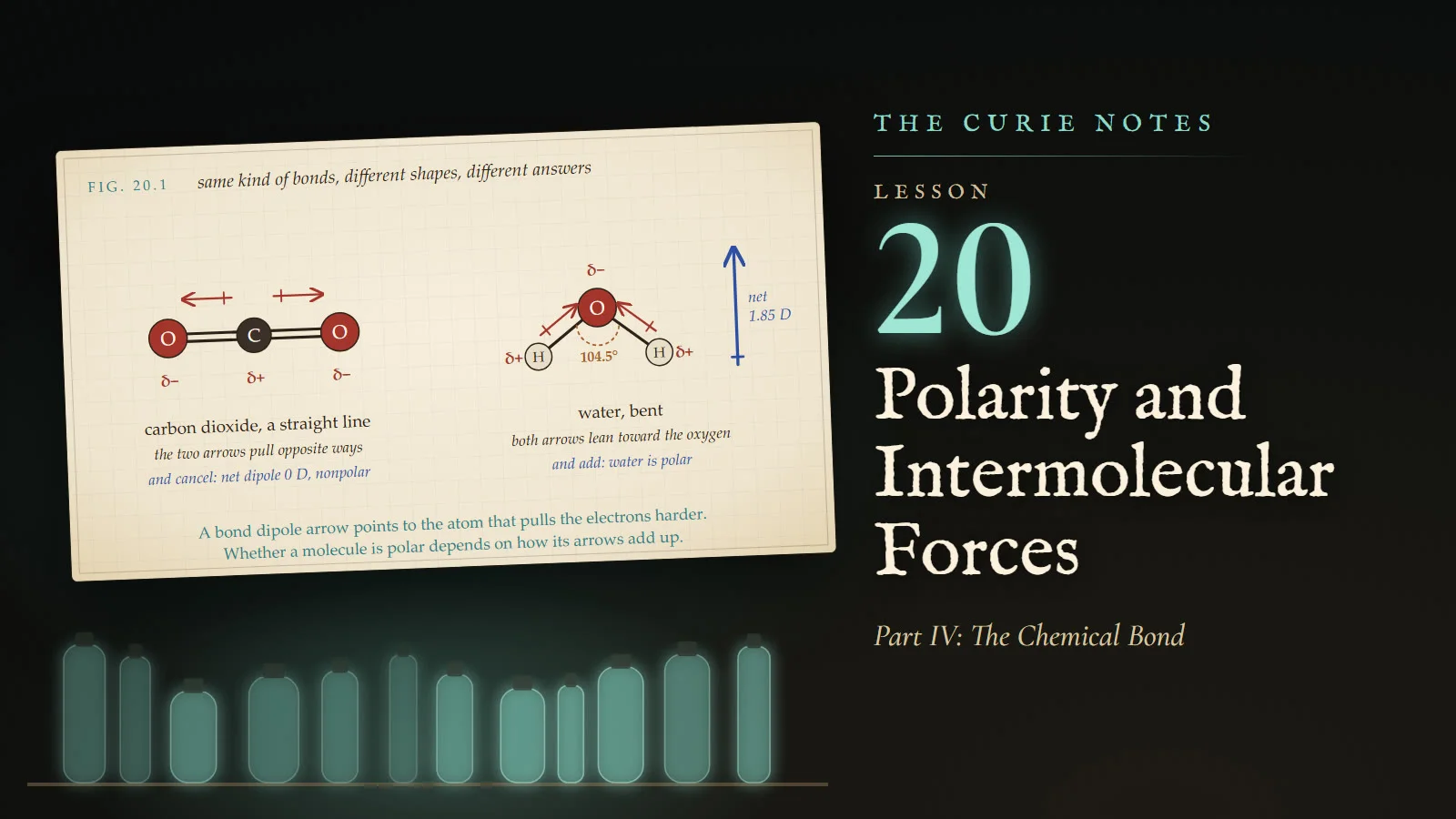 Curie Notes 20: Polarity and Intermolecular Forces
Learn bond polarity, dipole moments and molecular polarity, then London forces, dipole forces and hydrogen bonds, and why water boils high and ice floats.







 by Marie Curie

Comments