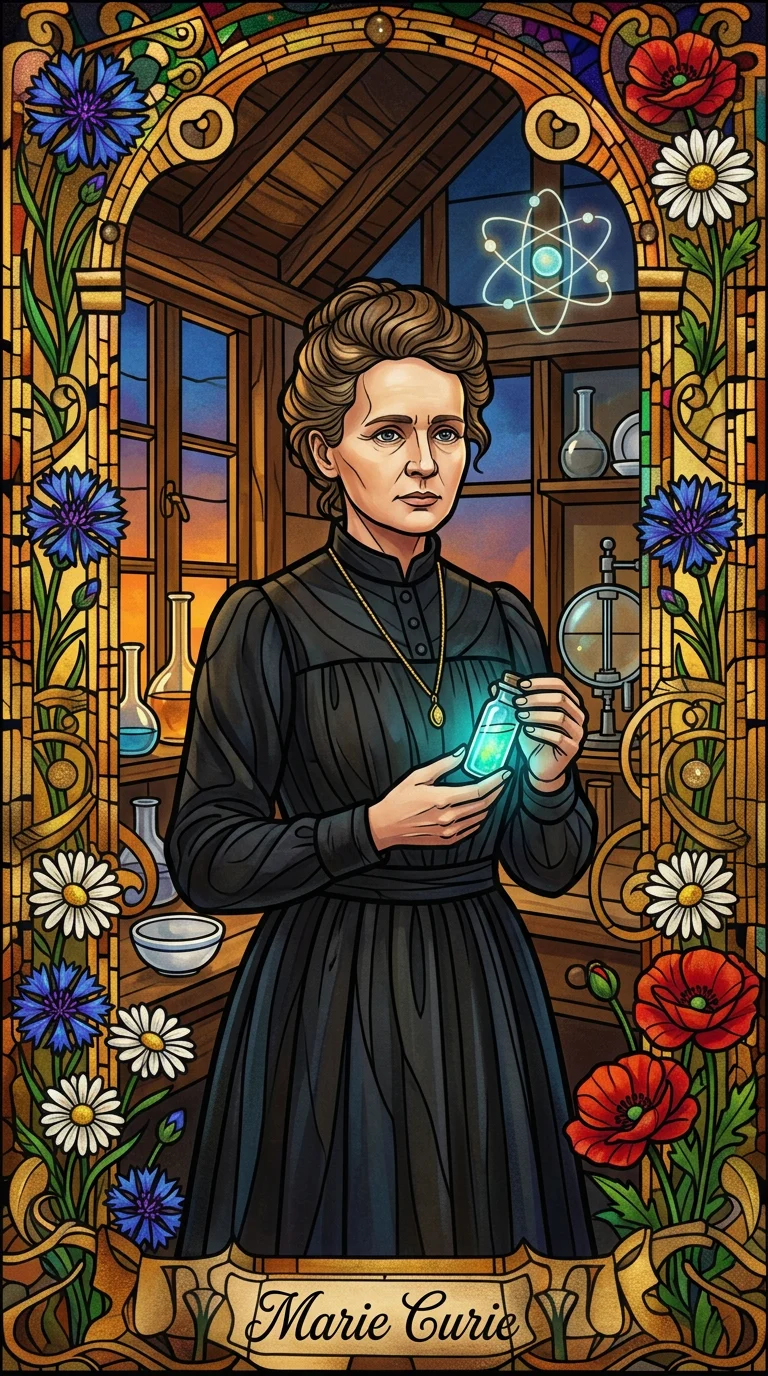
 by Marie Curie

Today the bench holds measuring things: a balance in its glass case, a set of brass weights lifted only with tweezers, a burette clamped upright, a ruler, a thermometer, and my old notebook from 1898, open at a page of currents. Every discovery I ever made began as a number written in a notebook like this one. In this lesson you will learn to make such numbers honestly: to choose the right unit, to read an instrument to the right digit, to know how far a measurement can be trusted, to carry its uncertainty through a calculation, and to change from one unit to another without error.
This fact is most remarkable, and suggests that these minerals may contain an element much more active than uranium.
Marie Curie, Comptes rendus, 12 April 1898
What you will learn
- Name the SI base units and use the prefixes from nano to kilo.
- Tell mass from weight, and convert between units of volume and temperature.
- Read a scale to the right number of digits, including a meniscus.
- Tell accuracy from precision, and random error from systematic error.
- Count significant figures and round a result correctly after multiplying, dividing, adding or subtracting.
- Write numbers in scientific notation and convert units with a chain of unit factors.
What you need first: Lesson 1, What Chemistry Studies: Matter, Mixtures and Pure Substances, for mass, volume and density.
Units: the SI and its prefixes
The sentence in my epigraph came from a measurement. I had measured the rays of many uranium minerals with the electrometer. Two of them, pitchblende and chalcolite, gave more current than their uranium could explain. I trusted that number, and the number led to polonium and radium. A chemist who cannot measure can only guess.
Every measurement has two parts: a number and a unit. "The flask holds 250" means nothing. 250 millilitres, 250 litres and 250 drops are different flasks. Never write a measured number without its unit.
Scientists everywhere now use one system of units, the International System of Units, called the SI from its French name, Système international d'unités. It grew out of the metric system of the French Revolution. It is built on seven base units; every other unit is made from them. Five matter to us now:
- length: the metre (m)
- mass: the kilogram (kg)
- time: the second (s)
- temperature: the kelvin (K)
- amount of substance: the mole (mol), the subject of Lesson 5
The other two are the ampere (A) for electric current and the candela (cd) for brightness of light.
Units made by combining base units are derived units. Volume is a length cubed, so its SI unit is the cubic metre, \(\mathrm{m^3}\). Density is a mass divided by a volume, so its SI unit is \(\mathrm{kg/m^3}\).
Prefixes
A metre is a good unit for a room and a poor one for a grain of salt or for the road from Paris to Warsaw. So the SI puts a prefix before the unit to multiply it by a power of ten. Learn these:
- kilo (k): one thousand, \(10^{3}\). A kilometre is 1,000 metres.
- deci (d): one tenth, \(10^{-1}\). A decimetre is 0.1 metre.
- centi (c): one hundredth, \(10^{-2}\). A centimetre is 0.01 metre.
- milli (m): one thousandth, \(10^{-3}\). A millimetre is 0.001 metre.
- micro (µ): one millionth, \(10^{-6}\). A micrometre is 0.000 001 metre.
- nano (n): one thousand-millionth, \(10^{-9}\). A nanometre is 0.000 000 001 metre.
Larger ones exist too: mega (M) for a million, \(10^{6}\), and giga (G) for \(10^{9}\). Smaller still is pico (p), \(10^{-12}\). The prefixes work the same with every unit: a milligram is a thousandth of a gram, a millilitre a thousandth of a litre, a microsecond a millionth of a second.
Worked example 1
How many milligrams are in 0.0450 kg? How many micrometres are in 3.2 mm?
- Kilograms to grams: one kilogram is 1,000 grams, so multiply by 1,000. \(0.0450 \times 1000 = 45.0\), so we have 45.0 g.
- Grams to milligrams: one gram is 1,000 milligrams, so multiply by 1,000 again. \(45.0 \times 1000 = 45{,}000\), so we have 45,000 mg. (Later in this lesson you will see how to write it as \(4.50 \times 10^{4}\,\mathrm{mg}\), so that the zeros do not mislead.)
- Millimetres to micrometres: a millimetre is \(10^{-3}\) m and a micrometre is \(10^{-6}\) m, so one millimetre holds 1,000 micrometres.
- \(3.2 \times 1000 = 3200\), so 3.2 mm is 3,200 µm.
Check: going to a smaller unit, the number must grow. Both numbers grew.
Margin
The metre was first defined, in 1791, as one ten-millionth of the distance from the North Pole to the equator along the meridian through Paris. The gram was the mass of a cubic centimetre of water. In 1875 seventeen nations signed the Metre Convention and founded the International Bureau of Weights and Measures at Sèvres, near Paris. In 1889, two years before I arrived in Paris, the Bureau received the international prototypes: a bar for the metre and a cylinder for the kilogram, both of an alloy of 90 parts platinum and 10 parts iridium, kept in a vault and compared with the copies of every nation. The SI itself was named in 1960, after my death, and the mole joined its base units in 1971.
In my laboratory
The currents I measured from uranium were tiny. In my note of April 1898, metallic uranium gave about 24 millionths of a millionth of an ampere. With prefixes that is simply 24 picoamperes, 24 pA, or \(2.4 \times 10^{-11}\,\mathrm{A}\). A pitchblende from Johanngeorgenstadt gave 83 pA. No ordinary meter could read such currents. Pierre and his brother Jacques had found that a plate of quartz gives out a small, exactly known electric charge when weights are hung on it. I balanced the current from my sample against the charge from the quartz, so that the needle of the electrometer stayed at zero, and timed it with a stopwatch. A hard measurement made by a careful method.
Mass, weight, volume and temperature
Mass is the amount of matter in an object, measured in kilograms or grams. Weight is the force with which gravity pulls on that mass. Force has its own unit, the newton (N). On the Earth's surface, weight in newtons is the mass in kilograms times 9.81:
\[ W = m \times g, \qquad g = 9.81\,\mathrm{m/s^2} \text{ on Earth} \]
A student of mass 50.0 kg weighs \(50.0 \times 9.81 = 490.5\), about 491 N, on Earth. On the Moon, where gravity is weaker (\(g = 1.62\,\mathrm{m/s^2}\)), the same student weighs only 81 N. The mass, 50.0 kg, has not changed at all. That is why chemists speak of mass: it belongs to the substance, not to the place.
An analogy from my Paris
Look at the pharmacist's balance on the counter of any Paris pharmacy, with its two brass pans. He puts the powder in one pan and weights in the other until the beam is level. If he carried his balance to the Moon, the powder would press down less, but so would the weights, by exactly the same fraction, and the beam would balance at the same reading. A beam balance compares masses. A spring scale, like the one the coal man hangs his sacks on, measures how hard gravity pulls; on the Moon it would read one sixth as much. Our laboratory balances are true balances, so they give mass. In everyday speech, and even in the laboratory, we say "weigh" when we mean "find the mass". That is allowed, as long as you know the difference.
Volume
The SI unit of volume, the cubic metre, is the size of a large crate, too big for the bench. Chemists use three smaller units:
- the litre (L), which is one cubic decimetre: \(1\,\mathrm{L} = 1\,\mathrm{dm^3}\), and \(1\,\mathrm{m^3} = 1000\,\mathrm{L}\);
- the millilitre (mL), a thousandth of a litre;
- the cubic centimetre (\(\mathrm{cm^3}\)), which is exactly one millilitre.
Margin
In 1901 the General Conference on Weights and Measures defined the litre as the volume of one kilogram of pure water at its densest. Careful measurement later showed that this volume was 1.000028 cubic decimetres, not exactly one. In 1964 the litre was made exactly one cubic decimetre again. Twenty-eight parts in a million: small, but the people who keep the standards are right to care.
Temperature
In the laboratory we read temperature in degrees Celsius (°C), on which water freezes at 0 °C and boils at 100 °C at ordinary pressure. The SI unit is the kelvin (K). The kelvin is the same size as the Celsius degree, but its zero is the coldest possible temperature, absolute zero, which is −273.15 °C. To convert, add 273.15:
\[ T(\mathrm{K}) = t(^{\circ}\mathrm{C}) + 273.15 \]
A room at 25 °C is at 298.15 K, usually rounded to 298 K. We write "298 K", without a degree sign. In my time we said "degrees absolute"; the name kelvin for the unit came later.
Worked example 2
A metal block measures 2.00 cm by 2.50 cm by 4.00 cm and has a mass of 54.0 g. Find its density.
- Volume of a block: length times width times height. \(V = 2.00\,\mathrm{cm} \times 2.50\,\mathrm{cm} \times 4.00\,\mathrm{cm} = 20.0\,\mathrm{cm^3}\).
- Density is mass divided by volume: \(\rho = m/V\).
- \(\rho = \dfrac{54.0\,\mathrm{g}}{20.0\,\mathrm{cm^3}} = 2.70\,\mathrm{g/cm^3}\).
- From Lesson 1, aluminium has a density of \(2.70\,\mathrm{g/cm^3}\).
Check: the unit is grams per cubic centimetre, as it must be, and a light metal a little under three times as dense as water is sensible for aluminium.
Reading an instrument
A scale has marks. Your eye can do a little better than the marks. The rule for reading any scale is: write down every digit the marks give you for certain, and then one more digit, estimated by eye. That last digit is uncertain, but it is still information.
Take a ruler marked in millimetres. The edge of a crystal falls between 4.3 cm and 4.4 cm, about six tenths of the way along the gap. You write 4.36 cm. The 4 and the 3 are certain; the 6 is your estimate. Another careful reader might write 4.35 or 4.37, but nobody would write 4.2 or 4.5.
The same rule tells you how many digits each instrument deserves:
- a ruler with millimetre marks: read to a tenth of a millimetre, such as 4.36 cm;
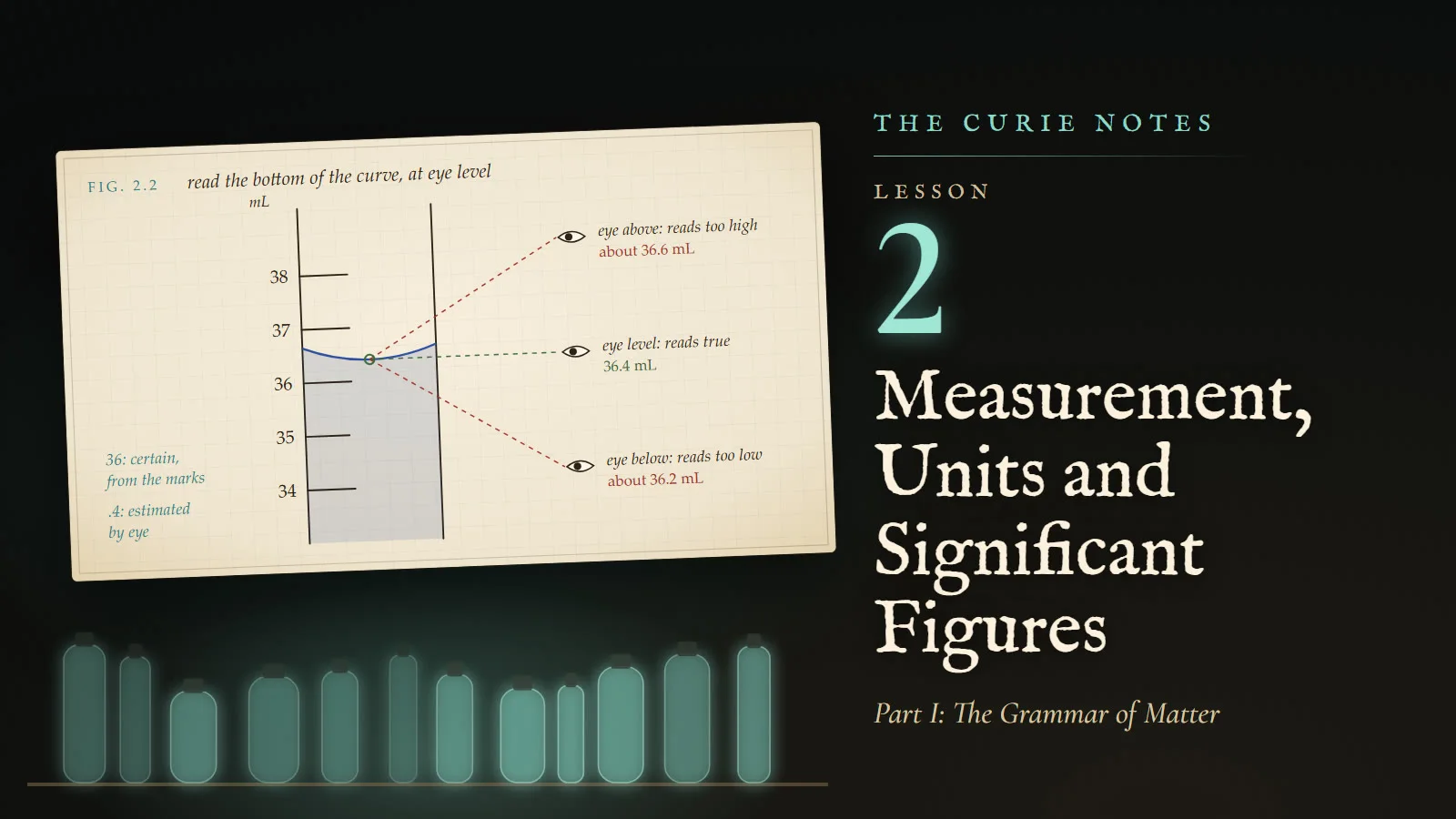
- a measuring cylinder with 1 mL marks: read to a tenth of a millilitre, such as 36.4 mL;
- a burette with 0.1 mL marks: read to a hundredth of a millilitre, such as 23.46 mL.
Liquids in narrow glass tubes curve at the surface. This curved surface is the meniscus. For water it dips in the middle. Always read the bottom of the curve, with your eye level with it. If your eye is above the surface, you will read a cylinder too high; if below, too low. This error from looking at a slant is called parallax.
Worked example 3
The bottom of the meniscus in a burette lies between the marks 23.4 and 23.5 mL, a little past halfway. Note that a burette is numbered from the top down. What do you write?
- The marks are 0.1 mL apart, so the tenths digit is certain: the reading is 23.4 and something.
- Estimate the hundredths: a little more than halfway from 23.4 to 23.5 is about six tenths of the gap, so 0.06 mL.
- Write 23.46 mL.
Check: four digits, of which only the last is estimated. Writing 23.5 would throw away information; writing 23.463 would claim a digit the eye cannot see.
An analogy from Warsaw
In Warsaw in winter every household watched the thermometer outside the window. It was marked in whole degrees. If the red thread stood between −12 and −13, halfway, nobody would say "−12" and nobody would say "−12.473". They would say "about twelve and a half below". Without knowing it, they were following the rule: all the certain digits, and one estimated.
Try it
On Plate 2.1, choose a ruler, a measuring cylinder or a burette. The plate shows a magnified scale with a sample in place. Type your reading with one estimated digit, then check it. The plate tells you whether you read the right number of digits, and how many of them are certain.
Accuracy, precision and error
No measurement is perfect. Two different words describe how good it is, and students mix them up constantly.
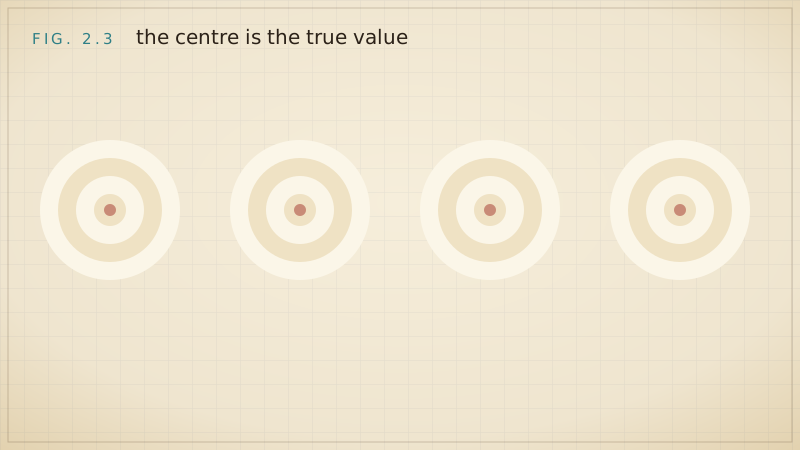
Accuracy is how close a measurement is to the true value. Precision is how close repeated measurements are to one another. A set of measurements can be precise without being accurate: all close together, all wrong by the same amount.
The errors behind them are of two kinds.
A random error pushes a reading sometimes up, sometimes down, by chance: a draught on the balance pan, the eye estimating the last digit a little differently each time. Random errors spoil precision. You reduce their effect by repeating the measurement and taking the average, the mean.
A systematic error pushes every reading the same way: a balance that was not set to zero, a thermometer whose scale is shifted, a burette read always from above. Systematic errors spoil accuracy, and repeating does not help at all; you get the same wrong answer every time. You find them only by checking the instrument against a known standard, or by measuring the same thing by a different method.
Worked example 4
Four students weigh the same standard mass, known to be 10.00 g, four times each. Student A: 10.01, 9.99, 10.00, 10.01 g. Student B: 10.32, 10.30, 10.31, 10.33 g. Student C: 9.6, 10.5, 10.2, 9.7 g. Student D: 10.6, 9.8, 10.9, 10.3 g. Describe each.
- Find each mean: add the four readings and divide by 4. A: \(40.01/4 = 10.00\) g. B: \(41.26/4 = 10.32\) g. C: \(40.0/4 = 10.0\) g. D: \(41.6/4 = 10.4\) g.
- Find each spread, the largest reading minus the smallest. A: 0.02 g. B: 0.03 g. C: 0.9 g. D: 1.1 g.
- A: mean on the true value, small spread. Accurate and precise.
- B: small spread, but every reading about 0.3 g too high. Precise but not accurate: a systematic error, perhaps a balance not zeroed.
- C: mean on the true value, but a large spread. Accurate on average, not precise: large random errors.
- D: large spread and a mean 0.4 g too high. Neither accurate nor precise.
Check: only student B could fix the trouble by one correction (subtract 0.32 g, or zero the balance). Student C needs more care, or many more repeats.
An analogy from my Paris
Think of two timekeepers in Paris. One is a fine station clock that some careless hand has set five minutes fast. Every day it is wrong by exactly five minutes: precise, not accurate, a systematic error. The other is a cheap pocket watch that gains a little one day and loses a little the next; on average it keeps good time, but you never quite trust it: accurate on average, not precise, random error. You can correct the station clock with one turn of a key once you compare it with a true time signal. The pocket watch can only be improved by looking at it many times and averaging, or by buying a better watch.
Try it
On Plate 2.2, set the size of the systematic error and of the random error with two sliders, and watch eight measurements of a 10.00 g standard fall on a target and on a scale of grams. The plate gives the mean and the spread, and names what you see. The buttons A to D load the four students of Worked example 4.
In my laboratory
In 1911 I sealed about 22 milligrams of pure radium chloride (21.99 mg by my weighing) in a thin glass tube. In 1912 it was compared with standards prepared independently in Vienna by Otto Hönigschmid; the two agreed, and mine became the international radium standard, kept at Sèvres with the metre and the kilogram. Every hospital and laboratory that bought radium could have its tube compared with it. That is how you defeat systematic error across a whole world: one standard, and everyone compares against it.
Significant figures
The digits that carry real information in a measurement are its significant figures: all the certain digits plus the one estimated digit. The burette reading 23.46 mL has four significant figures. Counting them tells the reader how precise you were.
Rules for counting:
- Every non-zero digit counts. 2.71 has three.
- Zeros between non-zero digits count. 4.06 has three; 1002 has four.
- Zeros at the front never count; they only place the decimal point. 0.0052 has two.
- Zeros at the end count if there is a decimal point. 5.20 has three; 0.00520 has three; 100.0 has four.
- Zeros at the end of a whole number with no decimal point are uncertain. Does 1020 have three or four? You cannot tell. Scientific notation removes the doubt, as we shall see.
Exact numbers have no uncertainty, so they never limit a result. They are numbers you count (four students, twelve crystals) and numbers fixed by definition (\(1\,\mathrm{m} = 100\,\mathrm{cm}\); \(1\,\mathrm{kg} = 1000\,\mathrm{g}\)).
Rounding. To round to a given number of figures, look at the first digit you will drop. If it is 5 or more, increase the last digit you keep by one; if it is less than 5, leave it. 6.594 to two figures is 6.6. 0.7892 to three figures is 0.789.
Multiplying and dividing
The rule: the result has as many significant figures as the measurement with the fewest. A chain is no stronger than its weakest link.
Worked example 5
(a) A rectangle measures 3.14 cm by 2.1 cm. Find its area. (b) In my 1898 table, the pitchblende of Johanngeorgenstadt gave 83 pA and metallic uranium 24 pA. How many times more active was the pitchblende?
- (a) Multiply: \(3.14\,\mathrm{cm} \times 2.1\,\mathrm{cm} = 6.594\,\mathrm{cm^2}\) on the calculator.
- 3.14 has three figures, 2.1 has two. The fewest is two.
- Round 6.594 to two figures: the first dropped digit is 9, so round up. Area \(= 6.6\,\mathrm{cm^2}\).
- (b) Divide: \(83\,\mathrm{pA} / 24\,\mathrm{pA} = 3.4583\). The units cancel; a ratio has none.
- Both have two figures, so the result has two: 3.5. The pitchblende was about three and a half times as active as uranium itself.
Check: the calculator's 6.594 claims a precision in thousandths of a square centimetre that a measurement to a tenth of a centimetre cannot give.
Adding and subtracting
Here the rule is different: the result has as many decimal places as the measurement with the fewest decimal places. What matters is where the uncertainty sits, not how many digits there are.
An analogy from my Paris
A coal merchant weighs a sack on his big scale and reads 349.0 kg; his scale cannot tell tenths of a kilogram any better than that. Now a clerk at the post office weighs a letter on her fine scale: 0.012 kg. If you put the letter on the sack, how much do they weigh together? Not 349.012 kg. The sack is only known to a tenth of a kilogram, so the twelve grams of the letter are lost inside its uncertainty. The total is 349.0 kg. The least exact place in the sum decides.
Worked example 6
(a) Add 12.52 g, 349.0 g and 8.24 g. (b) An empty flask has a mass of 25.42 g; filled to the mark with alcohol, 45.15 g. The flask holds 25.0 mL. Find the density of the alcohol.
- (a) Add: \(12.52 + 349.0 + 8.24 = 369.76\) g.
- Decimal places: 12.52 has two, 349.0 has one, 8.24 has two. The fewest is one.
- Round to one decimal place: 369.8 g.
- (b) Mass of alcohol by subtraction: \(45.15\,\mathrm{g} - 25.42\,\mathrm{g} = 19.73\,\mathrm{g}\). Both have two decimal places, so the result keeps two: 19.73 g, four significant figures.
- Density: \(19.73\,\mathrm{g} / 25.0\,\mathrm{mL} = 0.7892\,\mathrm{g/mL}\) on the calculator.
- Division: 19.73 has four figures, 25.0 has three. Keep three: \(0.789\,\mathrm{g/mL}\). That is the density of ethanol.
Check: in (b) I applied the subtraction rule to the subtraction and the division rule to the division, one step at a time, and rounded only at the end.
A common mistake
Rounding in the middle of a calculation. If you round each step, the small errors pile up and the last figure can come out wrong. Keep one or two extra digits in your working, and round once, at the end. The opposite mistake is just as common: copying every digit the calculator shows. A density of 0.789189 g/mL from a volume read to three figures claims a precision nobody ever had.
Scientific notation
Chemistry deals in very large and very small numbers. The number of atoms in twelve grams of carbon is about 602,200,000,000,000,000,000,000. The diameter of an atom is about 0.000 000 000 1 m. Writing such numbers in full invites mistakes. Instead we use scientific notation: a number between 1 and 10, multiplied by 10 raised to a whole-number power.
\[ 602{,}200{,}000{,}000{,}000{,}000{,}000{,}000 = 6.022 \times 10^{23} \]
The exponent (here 23) says how many places the decimal point moved. Moving it to the left, to make a large number small, gives a positive exponent. Moving it to the right, for a number smaller than 1, gives a negative exponent: \(0.000\,089\,\mathrm{m} = 8.9 \times 10^{-5}\,\mathrm{m}\).
Scientific notation also settles the question of trailing zeros. If 1020 g was measured to the nearest gram, write \(1.020 \times 10^{3}\,\mathrm{g}\): four significant figures. If only to the nearest ten grams, write \(1.02 \times 10^{3}\,\mathrm{g}\): three. All digits in the first number count.
Worked example 7
(a) Write 0.000452 m and 37,500,000 s (three significant figures) in scientific notation. (b) Multiply \(3.0 \times 10^{4}\) by \(2.0 \times 10^{-6}\).
- (a) For 0.000452: move the decimal point four places to the right to get 4.52. Moving right gives a negative exponent: \(4.52 \times 10^{-4}\,\mathrm{m}\).
- For 37,500,000: move the point seven places to the left to get 3.75. \(3.75 \times 10^{7}\,\mathrm{s}\).
- (b) Multiply the front numbers: \(3.0 \times 2.0 = 6.0\).
- Multiply the powers of ten by adding the exponents: \(10^{4} \times 10^{-6} = 10^{4 + (-6)} = 10^{-2}\).
- The result: \(6.0 \times 10^{-2}\), which is 0.060. Two significant figures, like both factors.
Check: 0.000452 is less than 1, so its exponent must be negative, and 37 million is greater than 10, so its exponent must be positive.
Dimensional analysis: changing units
The safest way to change units is to carry the units through the arithmetic as if they were numbers, and cancel them. This is called dimensional analysis, or the factor-label method.
It rests on one idea. Any true equality between units, such as \(1\,\mathrm{km} = 1000\,\mathrm{m}\), can be written as a fraction equal to one:
\[ \dfrac{1000\,\mathrm{m}}{1\,\mathrm{km}} = 1 \qquad \text{or} \qquad \dfrac{1\,\mathrm{km}}{1000\,\mathrm{m}} = 1 \]
Such a fraction is a unit factor. Multiplying by one never changes a quantity, only its unit. Choose the form that puts the unit you want to remove on the bottom, so that it cancels.
An analogy from Warsaw
When I travelled from Warsaw to Paris in 1891, my money changed its name twice: roubles in Poland, marks in Germany, francs in France. Suppose, to keep the arithmetic round, that one rouble bought two marks and that one mark bought 1.25 francs. Then 40 roubles become \(40 \times 2 = 80\) marks, and 80 marks become \(80 \times 1.25 = 100\) francs. Each exchange is a unit factor, "2 marks per rouble", "1.25 francs per mark". The roubles cancel against the roubles, the marks against the marks, and only francs remain. (These rates are invented for the example; real rates moved every day.)
Worked example 8
(a) How many seconds are in 2.50 hours? (b) One of my X-ray cars in the war drives at 36.0 km/h. What is its speed in metres per second?
- (a) Write the chain, with each unit to be removed on the bottom of the next factor: \[ 2.50\,\mathrm{h} \times \dfrac{60\,\mathrm{min}}{1\,\mathrm{h}} \times \dfrac{60\,\mathrm{s}}{1\,\mathrm{min}} \]
- Cancel hours with hours and minutes with minutes. Seconds remain.
- Multiply: \(2.50 \times 60 \times 60 = 9000\). The 60s are exact, so keep three figures: \(9.00 \times 10^{3}\,\mathrm{s}\).
- (b) Kilometres must become metres (on top) and hours must become seconds (on the bottom): \[ 36.0\,\dfrac{\mathrm{km}}{\mathrm{h}} \times \dfrac{1000\,\mathrm{m}}{1\,\mathrm{km}} \times \dfrac{1\,\mathrm{h}}{3600\,\mathrm{s}} \]
- Kilometres cancel, hours cancel, metres per second remain.
- \(36.0 \times 1000 / 3600 = 10.0\), so the speed is \(10.0\,\mathrm{m/s}\).
Check: a car covers ten metres, the length of two cabs, in a second at a moderate speed. Sensible.
Worked example 9
Convert the density of aluminium, \(2.70\,\mathrm{g/cm^3}\), to \(\mathrm{kg/m^3}\).
- Grams to kilograms on top: multiply by \(\dfrac{1\,\mathrm{kg}}{1000\,\mathrm{g}}\).
- Cubic centimetres to cubic metres on the bottom. One metre is 100 centimetres, so one cubic metre is \(100 \times 100 \times 100 = 10^{6}\) cubic centimetres. The factor is \(\dfrac{10^{6}\,\mathrm{cm^3}}{1\,\mathrm{m^3}}\).
- The chain: \[ 2.70\,\dfrac{\mathrm{g}}{\mathrm{cm^3}} \times \dfrac{1\,\mathrm{kg}}{1000\,\mathrm{g}} \times \dfrac{10^{6}\,\mathrm{cm^3}}{1\,\mathrm{m^3}} = 2.70 \times 10^{3}\,\dfrac{\mathrm{kg}}{\mathrm{m^3}} \]
- Grams cancel, cubic centimetres cancel. The number: \(2.70 \times 10^{6} / 10^{3} = 2.70 \times 10^{3}\).
Check: water is \(1.00\,\mathrm{g/cm^3}\), which is 1000 kg in a cubic metre; aluminium, 2.7 times denser, should be 2,700 kg in a cubic metre. It is.
A common mistake
Forgetting to cube the factor. Students write "\(1\,\mathrm{m} = 100\,\mathrm{cm}\), so \(1\,\mathrm{m^3} = 100\,\mathrm{cm^3}\)". It is a million. A cube one metre on each side holds a hundred rows of a hundred columns of a hundred little cubes. Whenever a unit is squared or cubed, square or cube its factor too.
Try it
Exercise 2.3 tests the whole lesson: counting significant figures, rounding products and sums, scientific notation, prefixes and chains of unit factors. Most questions make new numbers when you ask, so you can practise until they are easy.
What to remember
- Every measurement is a number and a unit. SI base units: metre, kilogram, second, kelvin, mole (and ampere, candela).
- Prefixes: kilo \(10^{3}\), centi \(10^{-2}\), milli \(10^{-3}\), micro \(10^{-6}\), nano \(10^{-9}\).
- Mass is the amount of matter (kg); weight is the pull of gravity on it (N), \(W = mg\).
- \(1\,\mathrm{mL} = 1\,\mathrm{cm^3}\), \(1\,\mathrm{L} = 1000\,\mathrm{mL}\), \(1\,\mathrm{m^3} = 1000\,\mathrm{L}\); \(T(\mathrm{K}) = t(^{\circ}\mathrm{C}) + 273.15\).
- Read every certain digit and one estimated digit; read a meniscus at its bottom, at eye level.
- Accuracy: close to the true value. Precision: close to each other. Random error spoils precision; systematic error spoils accuracy.
- Multiplying or dividing: keep the fewest significant figures. Adding or subtracting: keep the fewest decimal places. Round once, at the end.
- Scientific notation: a number from 1 to 10 times a power of ten; all its digits are significant.
- Change units with unit factors, arranged so the unwanted unit cancels; square or cube the factor for squared or cubed units.
Problems for your notebook
Problem 1. Convert 125 mL to litres and to cubic metres.
Answer. One litre is 1000 mL, so \(125\,\mathrm{mL} \times \dfrac{1\,\mathrm{L}}{1000\,\mathrm{mL}} = 0.125\,\mathrm{L}\). One cubic metre is 1000 L, so \(0.125\,\mathrm{L} \times \dfrac{1\,\mathrm{m^3}}{1000\,\mathrm{L}} = 1.25 \times 10^{-4}\,\mathrm{m^3}\).
Problem 2. How many significant figures are in 0.03050 g and in \(5.00 \times 10^{3}\) m? Round 7.8549 to three significant figures.
Answer. 0.03050 has four: the leading zeros do not count, the zero between 3 and 5 counts, and the final zero counts because there is a decimal point. \(5.00 \times 10^{3}\) has three. For 7.8549, keep 7.85; the first dropped digit is 4, less than 5, so the answer is 7.85.
Problem 3. Give each answer with the right number of figures: (a) \(4.18 \times 0.52\); (b) \(106.1 + 0.27 + 15\), where 15 was measured to the nearest whole unit.
Answer. (a) The calculator gives 2.1736. 0.52 has two figures, so the answer is 2.2. (b) The sum is 121.37. The number 15 has no decimal places, so the answer has none: 121.
Problem 4. My radium standard held 21.99 mg of radium chloride. Express this in grams and in kilograms, in scientific notation.
Answer. \(21.99\,\mathrm{mg} \times \dfrac{1\,\mathrm{g}}{1000\,\mathrm{mg}} = 0.02199\,\mathrm{g} = 2.199 \times 10^{-2}\,\mathrm{g}\). Then \(2.199 \times 10^{-2}\,\mathrm{g} \times \dfrac{1\,\mathrm{kg}}{1000\,\mathrm{g}} = 2.199 \times 10^{-5}\,\mathrm{kg}\). Four significant figures throughout.
Problem 5. A tank holds \(2.00\,\mathrm{m^3}\) of water, of density \(1.00\,\mathrm{g/cm^3}\). What is the mass of the water in kilograms?
Answer.
- Cubic metres to cubic centimetres: \(2.00\,\mathrm{m^3} \times \dfrac{10^{6}\,\mathrm{cm^3}}{1\,\mathrm{m^3}} = 2.00 \times 10^{6}\,\mathrm{cm^3}\).
- Volume to mass with the density: \(2.00 \times 10^{6}\,\mathrm{cm^3} \times \dfrac{1.00\,\mathrm{g}}{1\,\mathrm{cm^3}} = 2.00 \times 10^{6}\,\mathrm{g}\).
- Grams to kilograms: \(2.00 \times 10^{6}\,\mathrm{g} \times \dfrac{1\,\mathrm{kg}}{1000\,\mathrm{g}} = 2.00 \times 10^{3}\,\mathrm{kg}\), two tonnes.
After my time
The system I worked in was the metric system with the metre and kilogram kept at Sèvres. In 1960, the General Conference on Weights and Measures gave it its modern name, the International System of Units. The mole was added as the seventh base unit in 1971, and the kelvin got its present name in 1967.
The greatest change came in 2019. The platinum-iridium kilogram, which had sat under its glass bells since 1889, was retired. Every base unit is now defined by fixing the exact value of a constant of nature: the kilogram by the Planck constant, the mole by the Avogadro constant, the metre by the speed of light. Any well-equipped laboratory in the world can now realise the kilogram without travelling to Sèvres. I would have liked that very much; a standard that belongs to nature belongs to everyone.
Next comes Lesson 3, Atoms and Elements: The Laws That Proved Them, where careful weighing reveals that matter is made of atoms. If you would like more practice before then, come and ask me for another problem; I will check your figures.
Sources and liberties
The Curie Notes are a modern chemistry course written in Marie Curie's voice by Eternal Gardens. The chemistry is standard modern chemistry; dates, people, apparatus and quotations come from the sources below; the teaching, the analogies and the private remarks are our reconstruction.
- M. Curie, "Rayons émis par les composés de l'uranium et du thorium", Comptes rendus 126, 1101 to 1103, 12 April 1898, in translation by Carmen Giunta: Classic Chemistry, Le Moyne College
- Marie Curie, Pierre Curie, with Autobiographical Notes, Macmillan, 1923: Project Gutenberg
- American Institute of Physics, "Marie Curie and the Science of Radioactivity": history.aip.org
- BIPM, the International System of Units (SI Brochure) and the history of the metre and kilogram: bipm.org
- NIST, Guide for the Use of the International System of Units: nist.gov
- OpenStax, Chemistry 2e, sections 1.4 to 1.6, measurements, uncertainty, and mathematical treatment of results: openstax.org
The exchange rates in the Warsaw analogy are invented. The exact amount of radium chloride in the 1911 standard is given as 21.99 mg in most sources; her own account says "about 21 milligrammes".