 by Marie Curie

Today there is a flask of water on my bench, a sealed tube of pale green chlorine gas, and a reprint of a paper by an American chemist, Gilbert Newton Lewis, sent to me from Berkeley. In the last lesson atoms gave and took electrons and held each other as ions. But water does not conduct a current, chlorine gas is made of pairs of identical atoms, and neither can be explained by one atom robbing another. Lewis proposed something simpler and stranger: two atoms can hold a pair of electrons in common. In this lesson you will learn to count the electrons in a molecule, draw its Lewis structure step by step, tell single bonds from double and triple ones by their length and strength, use formal charge to choose between drawings, and recognise resonance and the molecules that break the rule of eight.
We took out no patent and we did not reserve any advantage in any industrial exploitation ... Yet, I still believe that we have done right.
Marie Curie, Autobiographical Notes, 1923
What you will learn
- Explain how sharing a pair of electrons holds two atoms together.
- Count the valence electrons of any molecule or polyatomic ion.
- Draw Lewis structures by a five-step method, with single, double and triple bonds.
- Relate the number of shared pairs to bond length and bond energy.
- Calculate formal charges and use them to choose the best structure.
- Draw resonance structures and recognise the exceptions to the octet rule.
What you need first: Lesson 13 (Light and Spectra), for the energy of a photon; Lesson 15 (Orbitals and Electron Configurations), for valence electrons; Lesson 16 (The Periodic Table and Its Trends), for electronegativity; and Lesson 17 (Ionic Bonding and Crystals).
Sharing instead of giving
In salt, sodium gave an electron and chlorine took it. That worked because sodium holds its outer electron weakly and chlorine attracts one strongly. Now take two chlorine atoms. Each has seven outer electrons. Each would be settled with eight. Neither will give an electron to the other, for they are identical: whatever one would gain, the other would lose. Yet chlorine gas is made of \(\ce{Cl2}\) molecules, held together firmly. How?
The answer is that each atom offers one electron, and the two electrons form a pair that belongs to both atoms at once. A covalent bond is a pair of electrons shared between two atoms. Each atom counts the shared pair as its own. So each chlorine counts its six unshared electrons plus the two shared ones: eight, the arrangement of argon. Fig. 17.1 showed electrons being handed over; Fig. 18.1 shows them being held in common.
Why should sharing hold atoms together? Look at the simplest case, hydrogen. Two hydrogen atoms far apart do not attract. As they approach, the electron of each begins to feel the nucleus of the other as well as its own. The two electrons settle mostly in the space between the two nuclei. There, each electron is attracted by two positive nuclei instead of one, and that lowers the energy. Come closer still, and the two nuclei repel each other strongly. The balance is struck at 74 pm between the nuclei. At that distance the energy is 436 kJ/mol lower than for two separate atoms. That is the bond energy of \(\ce{H2}\): the energy needed to break one mole of these bonds, leaving separate gaseous atoms.
An analogy from my Paris
In the old buildings of Paris, two households on the same landing often share one gas lamp on the stair. Each family, coming home at night, counts that lamp as lighting its own door. Neither owns it alone; neither would give it up. The shared pair of electrons is that lamp. It lights both doors, and it is counted twice, once by each atom, though there is only one pair. When you count to eight around an atom, the shared pairs are counted for every atom that shares them.
Margin
Lewis gave the shared pair its place in chemistry in 1916. He did not know why sharing should lower the energy; he only saw that it fitted the facts of chemistry wonderfully. The explanation came from the new quantum mechanics. In 1927 two young men in Zürich, Walter Heitler and Fritz London, calculated the energy of two hydrogen atoms with Schrödinger's equation and found the bond: a minimum of energy at about the right distance. I heard the new mechanics argued at the Solvay Conference that same year. It was strange to see chemistry's oldest question answered by physicists with equations, and it pleased me very much.
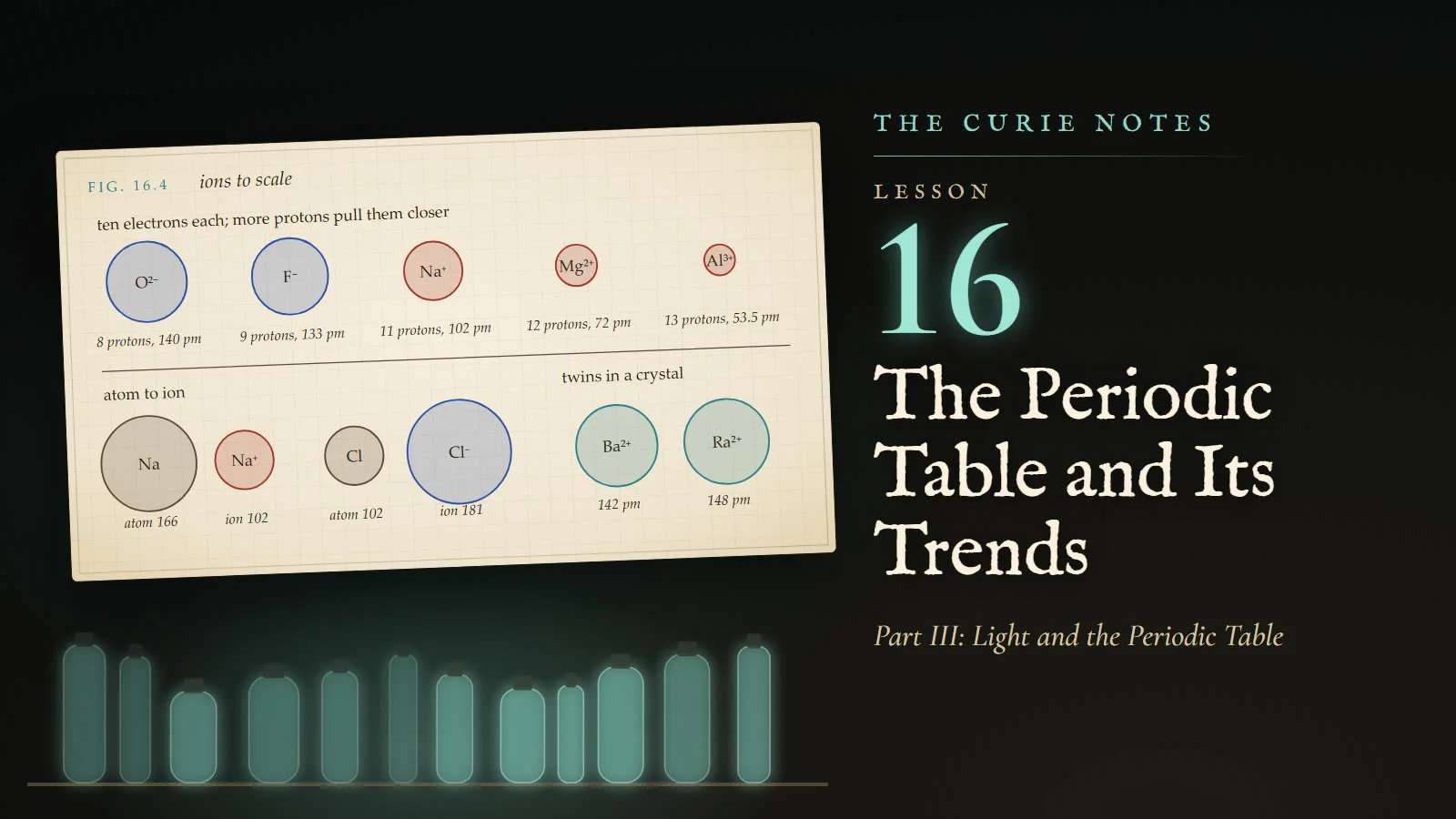
When do atoms share and when do they give? It depends on how strongly each atom attracts electrons, the electronegativity you met in Lesson 16. A metal with low electronegativity meeting a non-metal with high electronegativity gives its electrons away: ionic bonding. Two non-metals, both attracting electrons, share them: covalent bonding. Most of the substances of life, water, sugar, the gases of the air, the wax of a candle, are held together by shared pairs.
Lewis's dots and the octet
Only the outer electrons take part in bonding. These are the valence electrons: the electrons in the outermost shell, the s and p electrons of the highest shell number. For the main groups, the number of valence electrons is easy to read from the periodic table:
- Group 1: 1 (H, Li, Na). Group 2: 2. Group 13: 3 (B, Al).
- Group 14: 4 (C, Si). Group 15: 5 (N, P). Group 16: 6 (O, S).
- Group 17: 7 (F, Cl, Br, I). Group 18: 8, except helium with 2.
Lewis drew each valence electron as a dot around the symbol of the element. Carbon gets four dots, nitrogen five, oxygen six, chlorine seven. We still draw them so, and a drawing of a molecule with all its valence electrons as dots and lines is called a Lewis structure. A shared pair is drawn as a line between two atoms, standing for two electrons. A pair that belongs to one atom only is a lone pair, drawn as two dots.
The rule that guides the drawing is the octet rule: atoms of the second row (carbon, nitrogen, oxygen, fluorine) end with eight electrons around them, counting shared pairs fully. Hydrogen is the exception: it holds only two, like helium, and so it always makes exactly one bond.
From the octet rule follows the usual number of bonds each atom makes. An atom with \(v\) valence electrons needs \(8 - v\) more to make eight, and it gains one by each bond it forms. So:
- H makes 1 bond; the halogens F, Cl, Br, I usually make 1.
- O and S usually make 2 bonds, with 2 lone pairs left over.
- N and P usually make 3 bonds, with 1 lone pair.
- C usually makes 4 bonds, with no lone pairs.
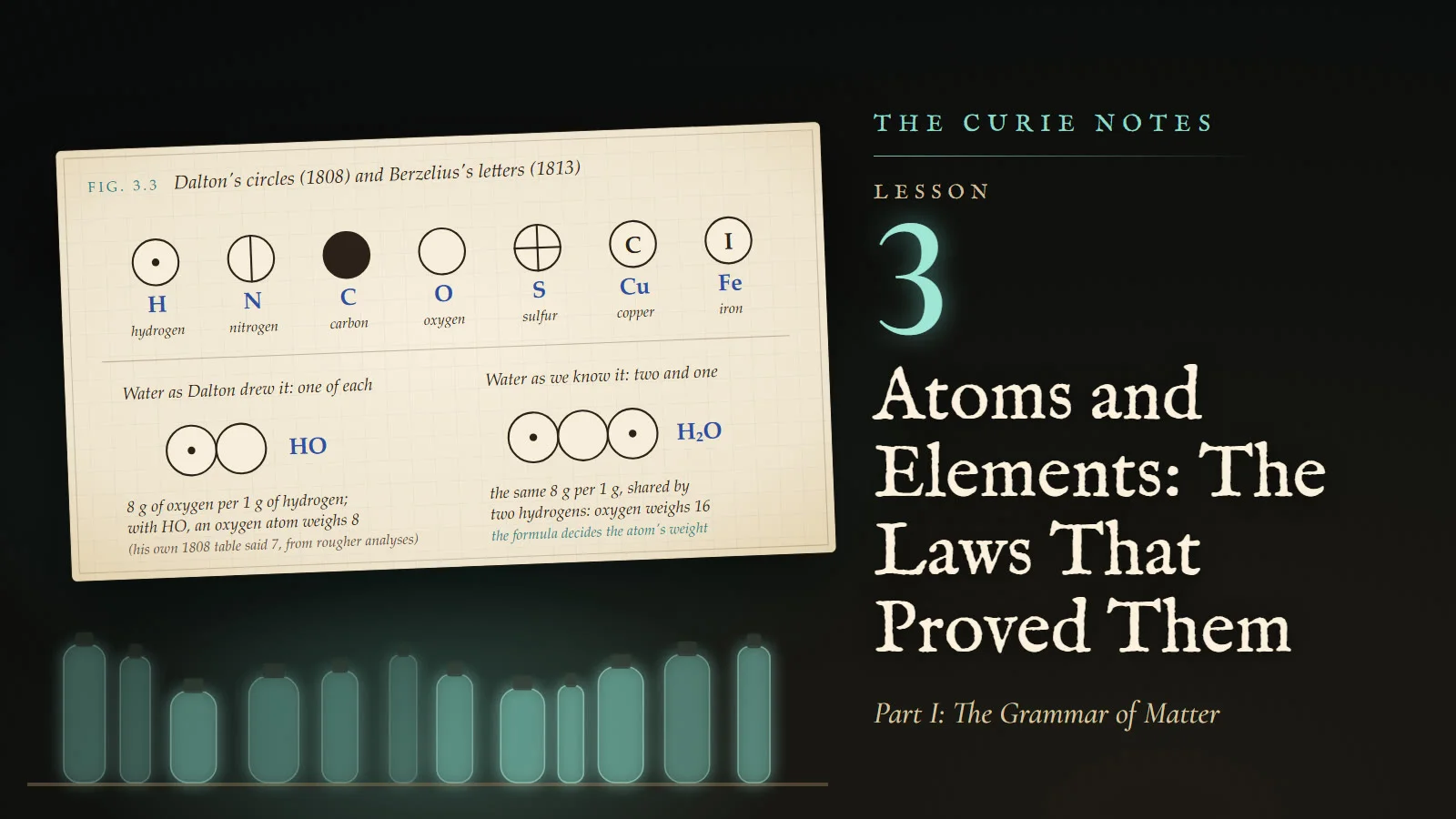
These numbers are the old valences of chemistry: carbon tetravalent, oxygen divalent. Chemists had used them for half a century before anyone knew why. The shared pair explained them in one stroke.
Margin
Lewis imagined the eight outer electrons at the corners of a cube. A single bond was two cubes sharing an edge; a double bond, two cubes sharing a face. He wrote that the picture first came to him in 1902, while he was explaining valence to students at Harvard, and he kept it in a drawer for fourteen years. The cubes did not survive; the pairs and the octets did. In 1919 Irving Langmuir took up Lewis's ideas, named the shared pair a covalent bond, and preached the octet so well that many chemists thought it was his.
Worked example 1
Draw the Lewis structure of water, \(\ce{H2O}\).
- Count the valence electrons: H 1, H 1, O 6. Total \(1 + 1 + 6 = 8\) electrons, which is 4 pairs.
- Hydrogen makes only one bond, so oxygen must be in the middle: H, O, H.
- Join each H to O with a single bond: \(\ce{H-O-H}\). That uses 2 pairs.
- Two pairs are left. Place them on oxygen as lone pairs.
- Check each atom. Each H has one shared pair: 2 electrons. Oxygen has two shared pairs and two lone pairs: \(2 \times 2 + 2 \times 2 = 8\).
Check: 4 pairs placed, 4 pairs counted. Oxygen has its octet, each hydrogen its two. The two lone pairs on oxygen will matter very much in Lessons 19 and 20, when we look at the shape of water and why ice floats.
Drawing Lewis structures step by step
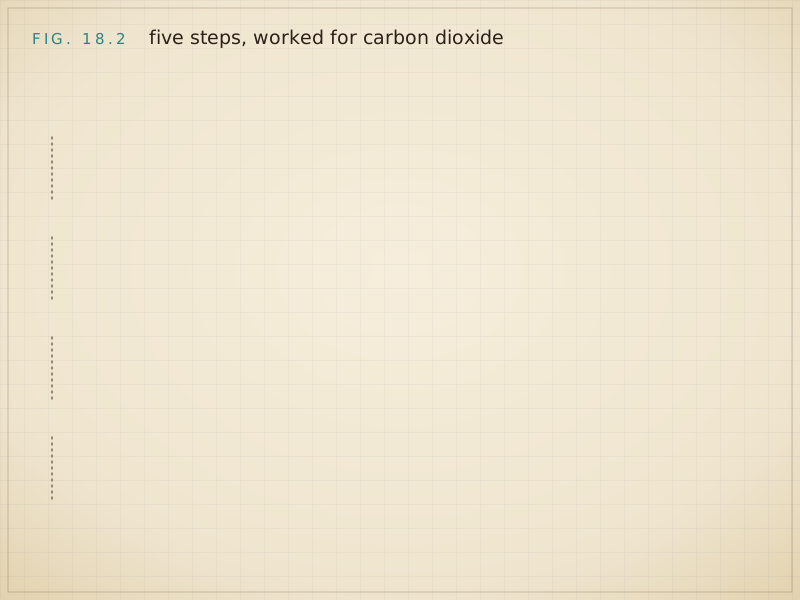
For a larger molecule, guessing is slow. Here is a method that always works for the molecules of this course. Fig. 18.2 carries it out for carbon dioxide.
- Count the valence electrons of all the atoms. For a negative ion add one electron for each negative charge; for a positive ion subtract one for each positive charge.
- Draw the skeleton, joining the atoms with single bonds. The central atom is usually the one with the lowest electronegativity, and usually the one written first in the formula. Hydrogen and fluorine are never central, because they make only one bond.
- Complete the octets of the outer atoms with lone pairs (hydrogen needs none).
- Place any electrons that remain on the central atom as lone pairs.
- If the central atom has fewer than eight, move a lone pair from an outer atom into the bond between them, making a double bond. Repeat if needed, making a triple bond or a second double bond.
At the end, check two things: the number of electrons drawn equals the number counted in step 1, and every atom has its octet (hydrogen two).
Worked example 2
Draw the Lewis structure of carbon dioxide, \(\ce{CO2}\).
- Count: C 4, O 6, O 6. Total \(4 + 6 + 6 = 16\) electrons, 8 pairs.
- Skeleton: carbon has the lower electronegativity, so it goes in the middle: O, C, O, joined by single bonds. That uses 2 pairs; 6 pairs are left.
- Complete each oxygen's octet. Each oxygen has one bond, so it needs 3 lone pairs. Two oxygens take 6 pairs. None are left.
- Nothing remains for the central atom.
- Carbon has only two bonds, 4 electrons. Move one lone pair from each oxygen into its bond. Now there are two double bonds, \(\ce{O=C=O}\), and each oxygen keeps 2 lone pairs.
Check: bonds hold 4 pairs, lone pairs 4 pairs, total 8 pairs = 16 electrons. Carbon: two double bonds, \(4 \times 2 = 8\). Each oxygen: one double bond and two lone pairs, \(4 + 4 = 8\).
A double bond is two shared pairs between the same two atoms; a triple bond is three. Here is a triple bond.
Worked example 3
Draw the Lewis structure of hydrogen cyanide, \(\ce{HCN}\).
- Count: H 1, C 4, N 5. Total 10 electrons, 5 pairs.
- Skeleton: H cannot be central, and carbon is less electronegative than nitrogen, so: H, C, N. Two single bonds use 2 pairs; 3 pairs are left.
- Complete the outer atoms. H already has its two. N has one bond and needs 3 lone pairs. That uses the remaining 3 pairs.
- Nothing is left for carbon.
- Carbon has only two bonds, 4 electrons: it is 4 short. Move two lone pairs from nitrogen into the C to N bond. It becomes a triple bond, and nitrogen keeps one lone pair: \(\ce{H-C#N}\).
Check: bonds hold \(1 + 3 = 4\) pairs, the lone pair 1: total 5 pairs = 10 electrons. Carbon: \(1 + 3 = 4\) bonds, 8 electrons. Nitrogen: 3 shared pairs and 1 lone pair, 8 electrons. Hydrogen: 2.
Polyatomic ions, the sealed parcels of Lesson 17, are drawn the same way. Their atoms are held together by covalent bonds, and the whole group carries the charge. The only change is in step 1.
Worked example 4
Draw the Lewis structure of the ammonium ion, \(\ce{NH4+}\).
- Count: N 5, four H at 1 each, 4. Atoms together: 9. The charge is +1, so one electron is missing: \(9 - 1 = 8\) electrons, 4 pairs.
- Skeleton: N in the middle, four single bonds to H. That uses 4 pairs.
- The hydrogens are complete with their bond each.
- No electrons remain for nitrogen.
- Nitrogen has four bonds, 8 electrons. No change is needed.
Check: 4 pairs drawn, 4 counted. We write the structure in square brackets with the charge outside, because the charge belongs to the whole ion, not to one atom. We shall see in a moment where the charge "sits" by bookkeeping.
A common mistake
The commonest error is in step 1: forgetting the charge of an ion, or applying it the wrong way. A negative ion has extra electrons, so you add; a positive ion has lost electrons, so you subtract. The second commonest is putting hydrogen in the middle of a skeleton. Hydrogen can hold only one pair, so it can make only one bond, and an atom with one bond is always at the end.
In my laboratory
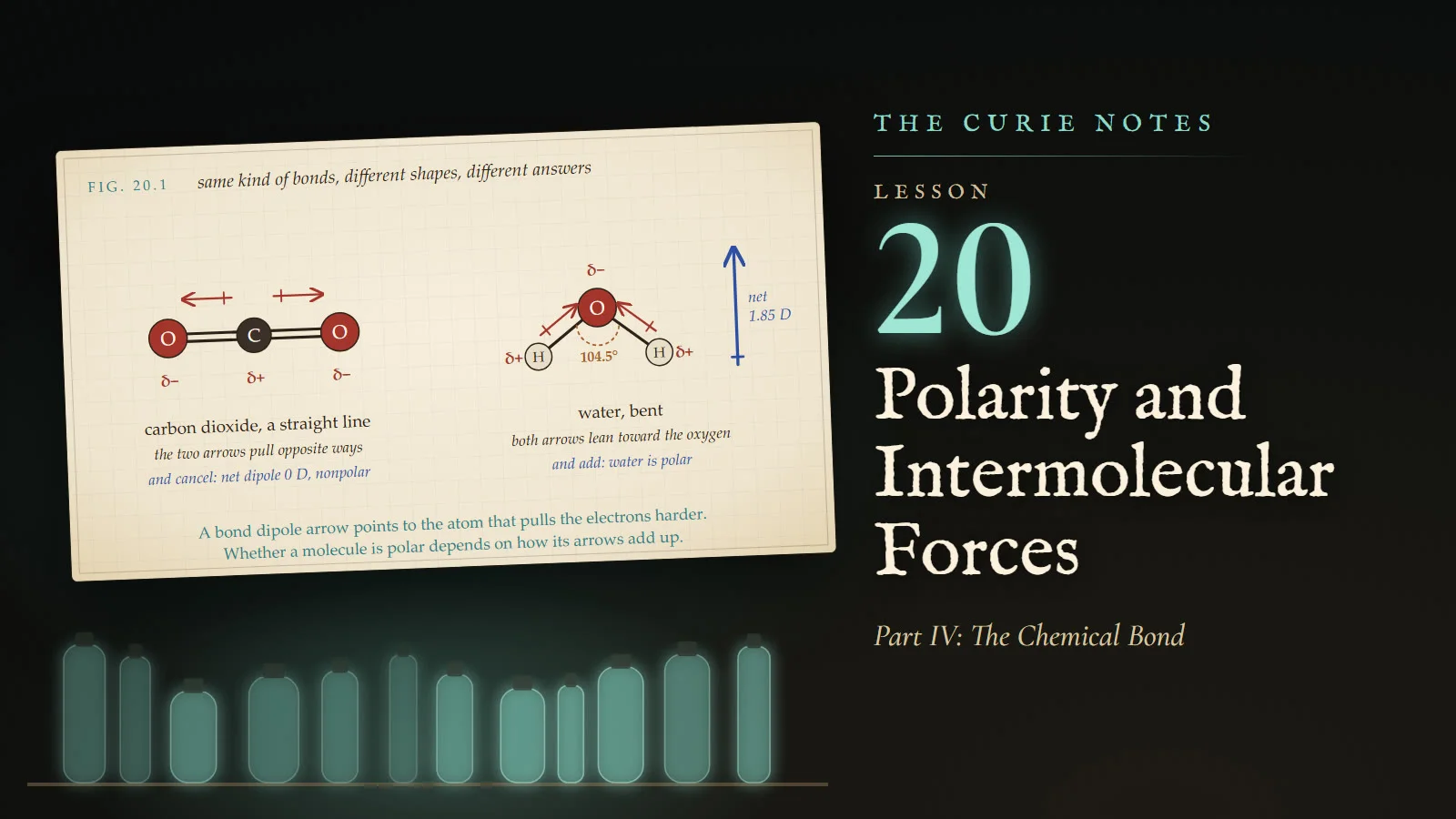
In the shed I dissolved the crude carbonates of barium and radium in hydrochloric acid, by the bucket. The gas hydrogen chloride, \(\ce{HCl}\), is a covalent molecule: \(\ce{H-Cl}\), one shared pair, three lone pairs on chlorine. As a gas it does not conduct electricity at all. Yet the moment it dissolves in water it becomes ions, \(\ce{H3O+}\) and \(\ce{Cl-}\), and the solution conducts very well. The chlorine, which attracts the shared pair much more strongly than hydrogen does, keeps the whole pair when water pulls the hydrogen away. So the line between sharing and giving is not a wall. It is a question of how unequal the sharing is, and the surroundings can tip the balance. Lesson 20 will measure that inequality.
Try it
Plate 18.1 is a Lewis-structure bench. Choose a molecule or ion; its skeleton is drawn with single bonds. Tap a bond to make it double or triple; tap an atom to add a lone pair. The readout counts the electrons you must place, and the small number by each atom counts the electrons around it, green when the octet (or the hydrogen pair) is complete. When everything is placed, the plate tells you whether the structure is good, and shows formal charges, which we come to shortly.
Double and triple bonds: length and strength
The number of shared pairs between two atoms is the bond order: 1 for a single bond, 2 for a double, 3 for a triple. The more pairs two atoms share, the more electron charge lies between their nuclei, and the more tightly the nuclei are pulled together. So a higher bond order means a shorter bond and a stronger one.
The bond length is the distance between the two nuclei. The bond energy, as for hydrogen, is the energy needed to break one mole of the bond into separate gaseous atoms. Here are values for the same pairs of atoms, single, double and triple (bond energies are averages over many molecules, rounded; tables differ by a few kJ/mol):
- Carbon to carbon: \(\ce{C-C}\) 154 pm, 348 kJ/mol; \(\ce{C=C}\) 134 pm, 614 kJ/mol; \(\ce{C#C}\) 120 pm, 839 kJ/mol.
- Nitrogen to nitrogen: \(\ce{N-N}\) 147 pm, 163 kJ/mol; \(\ce{N=N}\) 124 pm, 418 kJ/mol; \(\ce{N#N}\) 110 pm, 941 kJ/mol.
- Oxygen to oxygen: \(\ce{O-O}\) 148 pm, 146 kJ/mol; \(\ce{O=O}\) 121 pm, 495 kJ/mol.
- Some single bonds: \(\ce{H-H}\) 74 pm, 436; \(\ce{C-H}\) 109 pm, 413; \(\ce{O-H}\) 96 pm, 463; \(\ce{Cl-Cl}\) 199 pm, 242.
Read down each family and the rule is plain: each extra pair shortens the bond and strengthens it. Notice also that for carbon a double bond is not twice as strong as a single bond, nor a triple three times. The second and third pairs lie less directly between the nuclei and add less. For nitrogen the opposite holds: the triple bond, 941 kJ/mol, is far stronger than three single bonds; that is why the nitrogen of the air is so unreactive, and why turning it into fertiliser took Fritz Haber's high pressures and hot iron.
An analogy from my Paris
Watch the barges moored along the quays of the Seine. When the river is quiet, a bargeman ties his boat to the next with one rope, and the two hulls ride a little apart. When the current is strong, he adds a second rope, and a third, and each one draws the hulls closer and makes them harder to part. Bonds are like those ropes. One shared pair holds two atoms at a certain distance; two pairs hold them closer and more firmly; three pairs closer and more firmly still.
Worked example 5
The \(\ce{Cl-Cl}\) bond energy is 242 kJ/mol. What energy does it take to break one chlorine molecule, and what is the longest wavelength of light whose photons can do it?
- Energy per bond = energy per mole divided by the Avogadro constant: \(242{,}000\,\mathrm{J/mol} \div 6.022 \times 10^{23}\,\mathrm{mol^{-1}} = 4.02 \times 10^{-19}\,\mathrm{J}\).
- From Lesson 13, a photon of wavelength \(\lambda\) has energy \(E = hc/\lambda\). Rearranged: \(\lambda = hc/E\).
- \(hc = 6.626 \times 10^{-34}\,\mathrm{J\,s} \times 2.998 \times 10^{8}\,\mathrm{m/s} = 1.986 \times 10^{-25}\,\mathrm{J\,m}\).
- \(\lambda = 1.986 \times 10^{-25}\,\mathrm{J\,m} \div 4.02 \times 10^{-19}\,\mathrm{J} = 4.94 \times 10^{-7}\,\mathrm{m} = 494\,\mathrm{nm}\).
Check: 494 nm is blue-green visible light. Any light of shorter wavelength, blue, violet or ultraviolet, carries enough energy per photon to split \(\ce{Cl2}\). This is why a mixture of hydrogen and chlorine kept in the dark is quiet, but explodes in bright sunlight: the light breaks chlorine molecules into atoms, and the atoms start the reaction. Robert Bunsen and Henry Roscoe measured light by exactly this reaction in the 1850s.
Worked example 6
How much energy is needed to break every bond in one mole of methane, \(\ce{CH4}\), into separate atoms?
- The Lewis structure of methane has carbon in the middle with four \(\ce{C-H}\) single bonds and no lone pairs (count: \(4 + 4 \times 1 = 8\) electrons, 4 pairs, all in bonds).
- One mole of methane holds 4 moles of \(\ce{C-H}\) bonds.
- Energy: \(4 \times 413\,\mathrm{kJ/mol} = 1{,}652\,\mathrm{kJ}\).
Check: the answer uses an average bond energy, so it is close but not exact. Lesson 28 will show how such sums of bond energies predict the heat of a reaction.
Try it
Plate 18.2 draws the energy of two atoms against the distance between their nuclei. Far apart, the energy is zero. As they approach, it falls into a well; closer still, the nuclei repel and it climbs steeply. The bottom of the well is the bond length; its depth is the bond energy. Choose \(\ce{C-C}\), then \(\ce{C=C}\), then \(\ce{C#C}\), and watch the well grow deeper and move to the left. Press Vibrate to see that real atoms never sit still at the bottom: the bond length is the middle of their trembling.
Formal charge
Often you can draw more than one Lewis structure that obeys the octet rule. Which is best? Chemists keep a small account for each atom, called its formal charge, and prefer the structure whose accounts are most nearly even.
An analogy from Warsaw
Two students who share a cold room in Warsaw split the rent in half. When each does her accounts, she counts her own money in full, and half of what they hold in common. Formal charge is the same bookkeeping for an atom. It owns its lone pairs entirely. It owns half of every shared pair. Compare what it owns with what it brought, its valence electrons, and you have its account.
The formal charge of an atom in a Lewis structure is
\[ \text{formal charge} = V - L - \tfrac{1}{2}B \]
where \(V\) is the number of valence electrons of the free atom, \(L\) the number of electrons in its lone pairs, and \(B\) the number of electrons in its bonds. Since each bond holds 2 electrons, \(\tfrac{1}{2}B\) is simply the number of bonds to the atom. The formal charges of all the atoms add up to the charge of the whole molecule or ion.
Three rules choose among structures:
- Prefer the structure in which the formal charges are zero, or as close to zero as possible.
- If some charges must remain, prefer the structure that puts a negative formal charge on the more electronegative atom.
- Avoid like charges on neighbouring atoms.
For the ammonium ion of Worked example 4: nitrogen has \(V = 5\), no lone pairs, four bonds. Formal charge \(= 5 - 0 - 4 = +1\). Each hydrogen: \(1 - 0 - 1 = 0\). Total +1, the charge of the ion. So by our bookkeeping the charge "sits" on nitrogen.
Worked example 7
Two structures for carbon dioxide both give every atom an octet: \(\ce{O=C=O}\), with two lone pairs on each oxygen, and \(\ce{O#C-O}\), with one lone pair on the triply bonded oxygen and three on the singly bonded one. Which is better?
- In \(\ce{O=C=O}\), each oxygen: \(6 - 4 - 2 = 0\). Carbon: \(4 - 0 - 4 = 0\). All zero.
- In \(\ce{O#C-O}\), the triply bonded oxygen: \(6 - 2 - 3 = +1\). Carbon: \(4 - 0 - 4 = 0\). The singly bonded oxygen: \(6 - 6 - 1 = -1\).
- Both sets add to zero, as they must for a neutral molecule.
- Rule 1 prefers all zeros: \(\ce{O=C=O}\) is the better structure.
Check: in nature, the two C to O bonds in carbon dioxide are measured to be equal, each 116 pm, as the symmetrical structure says.
Worked example 8
Draw the Lewis structure of carbon monoxide, \(\ce{CO}\), and find the formal charges.
- Count: \(4 + 6 = 10\) electrons, 5 pairs.
- Skeleton C to O with a single bond: 1 pair used, 4 left.
- Complete oxygen's octet with 3 lone pairs: 1 pair left.
- Put it on carbon. Carbon has one bond and one lone pair, only 4 electrons.
- Move one lone pair from oxygen into the bond (double), then another (triple). Now: a triple bond, one lone pair on carbon, one on oxygen. Each atom has \(6 + 2 = 8\).
- Formal charges: carbon \(4 - 2 - 3 = -1\); oxygen \(6 - 2 - 3 = +1\).
Check: the sum is 0, right for a neutral molecule. Here the octets force a negative charge onto carbon, the less electronegative atom, against rule 2. Octets come first; the formal-charge rules only choose among structures that have them. The real molecule is only slightly lopsided, and measurements show its carbon end is in fact very slightly negative. The bond, 113 pm, is one of the shortest and strongest known between two different atoms.
A common mistake
Formal charge is bookkeeping, not a measurement. The +1 on the nitrogen of ammonium does not mean that nitrogen carries a whole positive charge; the real charge is spread over the ion, and much of it lies on the hydrogens. Use formal charge to choose between drawings and to find where charge is likely to gather. Do not confuse it with the real charge, nor with the oxidation number of Lesson 12, which pretends instead that every bond is fully ionic.
Margin
Lewis and Langmuir already kept count of charges on atoms in roughly this way. The rule as students learn it now, with its name and its three preferences, became settled in the textbooks after my time. I give it to you because it works.
Resonance
Draw ozone, \(\ce{O3}\), by the five steps. There are 18 electrons. The skeleton O, O, O uses 2 pairs; the end oxygens take 3 lone pairs each, 6 pairs; one pair is left for the middle oxygen. The middle oxygen then has only 6 electrons, so one end oxygen must lend a lone pair to make a double bond. But which end? The left and the right are equally good. Fig. 18.3 shows both.
If either drawing were true, ozone would have one short bond (121 pm) and one long bond (148 pm). Measurement finds two equal bonds of 128 pm. So neither drawing is the molecule. When a molecule can be drawn in two or more equally good ways that differ only in where the electrons are placed, the drawings are called resonance structures, and the real molecule, a single blend of them all, is the resonance hybrid. We join the drawings with a double-headed arrow. In ozone each bond has a bond order of \((1 + 2)/2 = 1.5\).
From the shed
At night in the shed our radium salts glowed with a faint light, a pale colour between blue and green. Suppose you had only two paints, a blue and a green, and had to describe that glow to someone far away. You would write: "it is like blue, and it is like green." Your reader must not imagine that the tube flickers from blue to green and back. It is one steady colour all the time, which your two paints can only describe together. Resonance structures are those two paints. The molecule is the one steady colour.
Worked example 9
Draw the resonance structures of the nitrate ion, \(\ce{NO3-}\), and find the order of each N to O bond.
- Count: N 5, three O at 6 each, 18. The charge is −1, so add 1: total 24 electrons, 12 pairs.
- Skeleton: nitrogen in the middle, single bonds to three oxygens: 3 pairs used, 9 left.
- Each oxygen takes 3 lone pairs: 9 pairs used, 0 left.
- Nothing remains for nitrogen, which has only 6 electrons.
- Move one lone pair from one oxygen into its bond: one \(\ce{N=O}\) and two \(\ce{N-O}\). Nitrogen now has 8.
- The double bond could go to any of the three oxygens: three resonance structures.
- Formal charges in each: nitrogen \(5 - 0 - 4 = +1\); the double-bonded oxygen \(6 - 4 - 2 = 0\); each single-bonded oxygen \(6 - 6 - 1 = -1\). Sum \(+1 + 0 - 1 - 1 = -1\), the charge of the ion.
- Bond order: in each structure there are \(2 + 1 + 1 = 4\) shared pairs between nitrogen and the oxygens, spread equally over 3 bonds in the hybrid: \(4/3 = 1.33\).
Check: X-ray measurements of nitrate salts find three equal N to O bonds, about 124 pm, between the lengths of a single and a double bond. The extra negative charge is spread over all three oxygens, two-thirds of a charge on each.
A common mistake
Never say that the molecule "switches" or "resonates back and forth" between its structures. The word resonance was borrowed from the mathematics of vibrations, and it misleads. The hybrid is one structure, always the same. The many drawings are our fault, not the molecule's: Lewis's dots and lines can only place a pair in one bond or another, and cannot draw a pair spread over three bonds at once.
Exceptions to the octet rule
The octet rule is a strong habit of the second-row atoms, not a law of nature. Three kinds of molecules break it.
Odd-electron molecules. If the count in step 1 is an odd number, no drawing can pair every electron, and at least one atom must have fewer than eight. Nitrogen monoxide, \(\ce{NO}\), has \(5 + 6 = 11\) valence electrons; nitrogen dioxide, \(\ce{NO2}\), has \(5 + 12 = 17\). In each, nitrogen is left with seven and one electron stands unpaired. Molecules with an unpaired electron are called radicals. They are usually very reactive, always seeking a partner for the lonely electron. Two \(\ce{NO2}\) molecules join readily to make \(\ce{N2O4}\), pairing their odd electrons in a new bond.
Incomplete octets. Boron has only three valence electrons. In boron trifluoride, \(\ce{BF3}\), it makes three single bonds and stops with six. Count: \(3 + 3 \times 7 = 24\) electrons. Three bonds use 3 pairs, and each fluorine takes 3 lone pairs, 9 pairs: all 12 pairs are placed, and boron has six. You could give boron an octet by making one \(\ce{B=F}\) double bond, but that puts a formal charge of +1 on fluorine, the most electronegative atom of all, and −1 on boron. Chemists prefer the structure with six. Boron's empty place shows itself in its chemistry: \(\ce{BF3}\) eagerly accepts a lone pair from ammonia, forming \(\ce{F3B-NH3}\), in which boron at last has eight.
Expanded octets. Atoms of the third row and below, such as phosphorus, sulfur and chlorine, can hold more than eight. They are larger, with room for more neighbours around them.
Worked example 10
Draw the Lewis structure of phosphorus pentachloride, \(\ce{PCl5}\).
- Count: P 5, five Cl at 7 each, 35. Total 40 electrons, 20 pairs.
- Skeleton: phosphorus in the middle with five single bonds to chlorine: 5 pairs used, 15 left.
- Each chlorine takes 3 lone pairs: 15 pairs used, 0 left.
- Nothing remains for phosphorus.
- Phosphorus has five bonds, 10 electrons around it. As a third-row atom it may exceed eight, so no change is needed.
Check: formal charges: phosphorus \(5 - 0 - 5 = 0\); each chlorine \(7 - 6 - 1 = 0\). Twenty pairs drawn, twenty counted. In the same way sulfur hexafluoride, \(\ce{SF6}\), has sulfur with six bonds and twelve electrons.
Nitrogen, in the row above phosphorus, never does this: there is no \(\ce{NCl5}\). Carbon, nitrogen, oxygen and fluorine hold at most eight.
Try it
Exercise 17.3 drilled ions; Exercise 18.3 drills shared pairs. It asks you to count valence electrons (a new molecule or ion each time you press New numbers), to choose the best structure for carbon dioxide from four drawings, to find formal charges, to order bonds by length, and to reason about resonance and the exceptions.
What to remember
- A covalent bond is a pair of electrons shared by two atoms; each atom counts the pair as its own.
- Valence electrons: H 1, B 3, C 4, N 5, O 6, halogens 7. For ions, add one per negative charge, subtract one per positive charge.
- Octet rule: second-row atoms end with eight electrons; hydrogen with two. Usual bonds: H 1, O 2, N 3, C 4.
- Five steps: count, skeleton, outer octets, leftovers on the centre, then multiple bonds if the centre is short.
- More shared pairs, shorter and stronger bonds: \(\ce{C-C}\) 154 pm, 348 kJ/mol; \(\ce{C=C}\) 134 pm, 614; \(\ce{C#C}\) 120 pm, 839.
- Formal charge \(= V - L - \tfrac{1}{2}B\); prefer charges near zero, negative charge on the more electronegative atom.
- Resonance: several drawings, one real molecule, a hybrid with bonds of intermediate order (ozone 1.5, nitrate 1.33).
- Exceptions: odd-electron radicals (\(\ce{NO}\), \(\ce{NO2}\)), incomplete octets (\(\ce{BF3}\)), expanded octets in the third row and below (\(\ce{PCl5}\), \(\ce{SF6}\)).
Problems for your notebook
Problem 1. Count the valence electrons in \(\ce{PCl3}\), \(\ce{SO4^2-}\), \(\ce{H2O2}\) and \(\ce{C2H2}\).
Answer. \(\ce{PCl3}\): \(5 + 3 \times 7 = 26\). \(\ce{SO4^2-}\): \(6 + 4 \times 6 + 2 = 32\). \(\ce{H2O2}\): \(2 \times 1 + 2 \times 6 = 14\). \(\ce{C2H2}\): \(2 \times 4 + 2 \times 1 = 10\).
Problem 2. Draw the Lewis structure of phosphorus trichloride, \(\ce{PCl3}\).
Answer.
- 26 electrons, 13 pairs.
- Phosphorus in the middle, three single bonds to chlorine: 3 pairs used, 10 left.
- Each chlorine takes 3 lone pairs: 9 pairs, 1 left.
- The last pair goes on phosphorus as a lone pair.
- Phosphorus: 3 bonds and 1 lone pair, 8 electrons. Each chlorine: 1 bond and 3 lone pairs, 8. All formal charges are zero.
Problem 3. Draw the Lewis structure of ethylene, \(\ce{C2H4}\), in which the two carbons are joined and each carries two hydrogens. What length do you expect for the carbon to carbon bond?
Answer.
- Count: \(2 \times 4 + 4 \times 1 = 12\) electrons, 6 pairs.
- Skeleton: C to C, with two H on each carbon: 5 single bonds, 5 pairs used, 1 left.
- The hydrogens are complete.
- Put the last pair on one carbon: that carbon has 8, the other only 6.
- Move that lone pair into the C to C bond: \(\ce{H2C=CH2}\). Each carbon now has two C to H bonds and one double bond, 8 electrons.
- A carbon to carbon double bond: about 134 pm.
Problem 4. Laughing gas, \(\ce{N2O}\), has the skeleton N, N, O. Compare the structures \(\ce{N=N=O}\) (two lone pairs on the end nitrogen, two on oxygen) and \(\ce{N#N-O}\) (one lone pair on the end nitrogen, three on oxygen). Which is better by formal charge?
Answer.
- Count: \(5 + 5 + 6 = 16\) electrons. Both structures hold 4 bonding pairs and 4 lone pairs: 16. Both give every atom eight.
- \(\ce{N=N=O}\): end N \(5 - 4 - 2 = -1\); middle N \(5 - 0 - 4 = +1\); O \(6 - 4 - 2 = 0\).
- \(\ce{N#N-O}\): end N \(5 - 2 - 3 = 0\); middle N \(5 - 0 - 4 = +1\); O \(6 - 6 - 1 = -1\).
- Both have one +1 and one −1. Rule 2 prefers the negative charge on the more electronegative atom, oxygen: \(\ce{N#N-O}\) is better.
- The real molecule is a hybrid of the two, closer to the second: its N to N bond, 113 pm, is nearly as short as a triple bond (110 pm).
Problem 5. Draw the resonance structures of the nitrite ion, \(\ce{NO2-}\), find the formal charges and the bond order.
Answer.
- Count: \(5 + 2 \times 6 + 1 = 18\) electrons, 9 pairs.
- Skeleton O, N, O with single bonds: 2 pairs used, 7 left. Each oxygen takes 3 lone pairs: 6 pairs, 1 left, which goes on nitrogen.
- Nitrogen has 2 bonds and 1 lone pair, 6 electrons. Move a lone pair from one oxygen into its bond: one \(\ce{N=O}\), one \(\ce{N-O}\). Nitrogen now has 8.
- The double bond can sit on either oxygen: two resonance structures.
- Formal charges: N \(5 - 2 - 3 = 0\); double-bonded O \(6 - 4 - 2 = 0\); single-bonded O \(6 - 6 - 1 = -1\). Sum −1.
- Bond order: \((2 + 1)/2 = 1.5\) for each N to O bond, which are equal in the real ion.
After my time
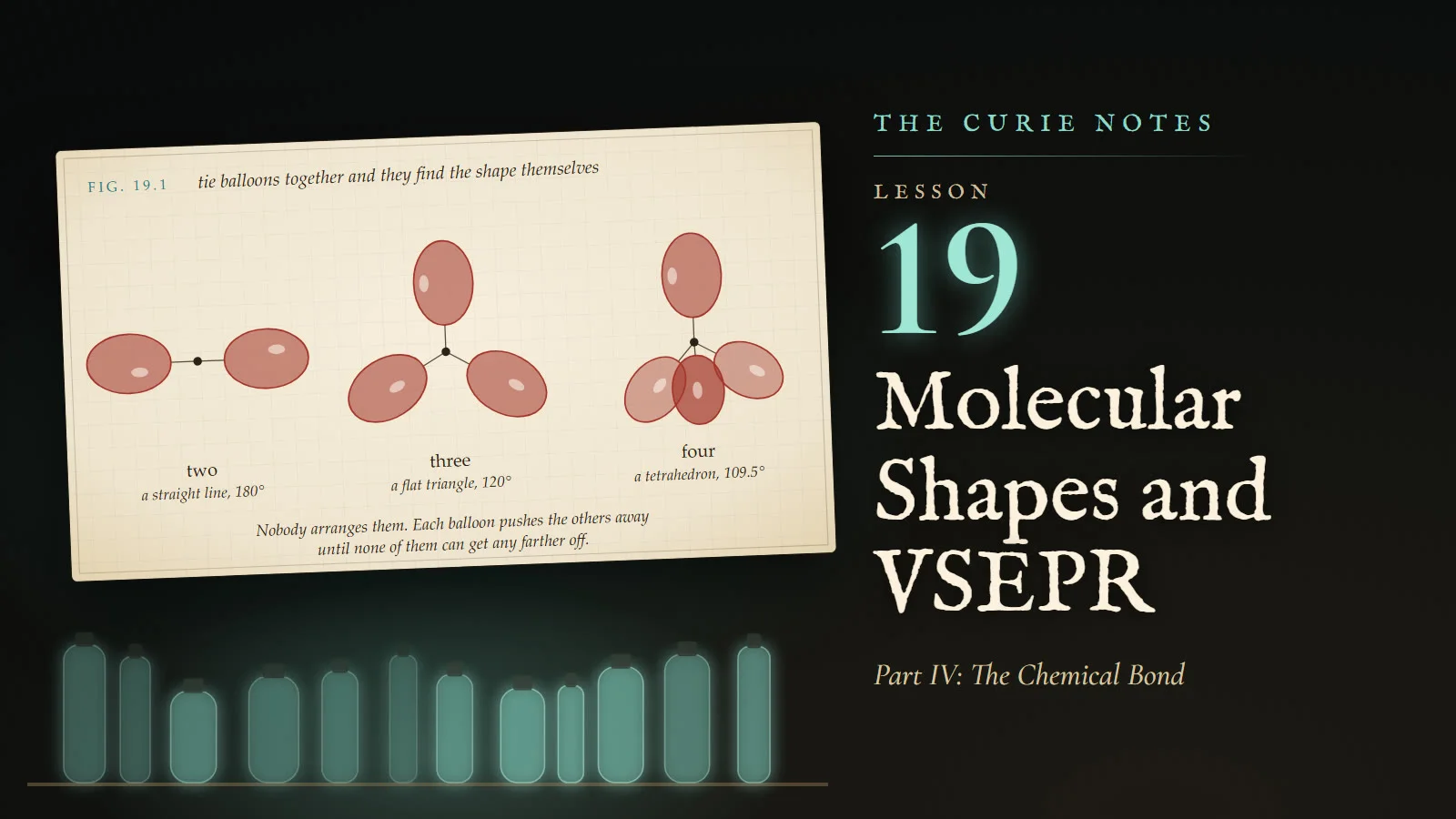
Lewis's pairs tell us which atoms are joined and by how many pairs, but not the shape of the molecule in space. The rules that predict shapes from the pairs around an atom were set out by Nevil Sidgwick and Herbert Powell in 1940 and made into a working method by Ronald Gillespie and Ronald Nyholm in 1957. You will learn them in the next lesson, and I shall learn them with you, for I never knew them.
Linus Pauling made resonance a central idea of chemistry in papers from 1931 onward and in his book of 1939. At the same time Robert Mulliken, Friedrich Hund and others built a different picture, in which electrons belong to orbitals spread over the whole molecule. That picture explains things Lewis's dots cannot: for example, that the oxygen molecule is drawn to a magnet, because it has two unpaired electrons, although its Lewis structure, \(\ce{O=O}\), shows every electron paired. Today computers solve Schrödinger's equation for molecules of many atoms, and bond lengths are predicted to a picometre.
Careful calculations also showed that the "expanded octets" of sulfur and phosphorus do not really use extra orbitals as chemists once thought; the extra electrons are spread among the outer atoms instead. The drawings with ten and twelve electrons remain useful bookkeeping. And the octet rule, like the rule of the full shell in the last lesson, turned out to be a strong habit and not a law. I find it a comfort that the simple picture still works so well for so many molecules, and an honour to science that people kept testing it.
Next comes Lesson 19: Molecular Shapes: VSEPR, where the pairs you have learned to draw push each other apart and give molecules their three-dimensional forms. If you want to practise first, come and ask me, and bring a molecule you would like to draw.
Sources and liberties
The Curie Notes are a modern chemistry course written in Marie Curie's voice by Eternal Gardens. The chemistry is standard modern chemistry; dates, people, apparatus and quotations come from the sources below; the teaching, the analogies and the private remarks are our reconstruction.
- Marie Curie, Pierre Curie, with her Autobiographical Notes, trans. C. and V. Kellogg (1923): Project Gutenberg
- Marie Curie, The Discovery of Radium, Vassar College lecture (1921): Project Gutenberg
- G. N. Lewis, "The Atom and the Molecule", Journal of the American Chemical Society 38 (1916): doi.org
- I. Langmuir, "The Arrangement of Electrons in Atoms and Molecules", Journal of the American Chemical Society 41 (1919): doi.org
- OpenStax, Chemistry 2e, chapter 7 (covalent bonding, Lewis symbols and structures, formal charge, resonance, bond strength): openstax.org
- NIST Chemistry WebBook, bond lengths and thermochemical data: webbook.nist.gov
- American Institute of Physics, "Marie Curie and the Science of Radioactivity": history.aip.org
The reprint from Berkeley, the shared lamp, the moored barges and the students' accounts are our reconstruction; we do not know whether Lewis sent her his paper, and his date of 1902 for the cubical atom rests on his own later recollection.