 by Marie Curie

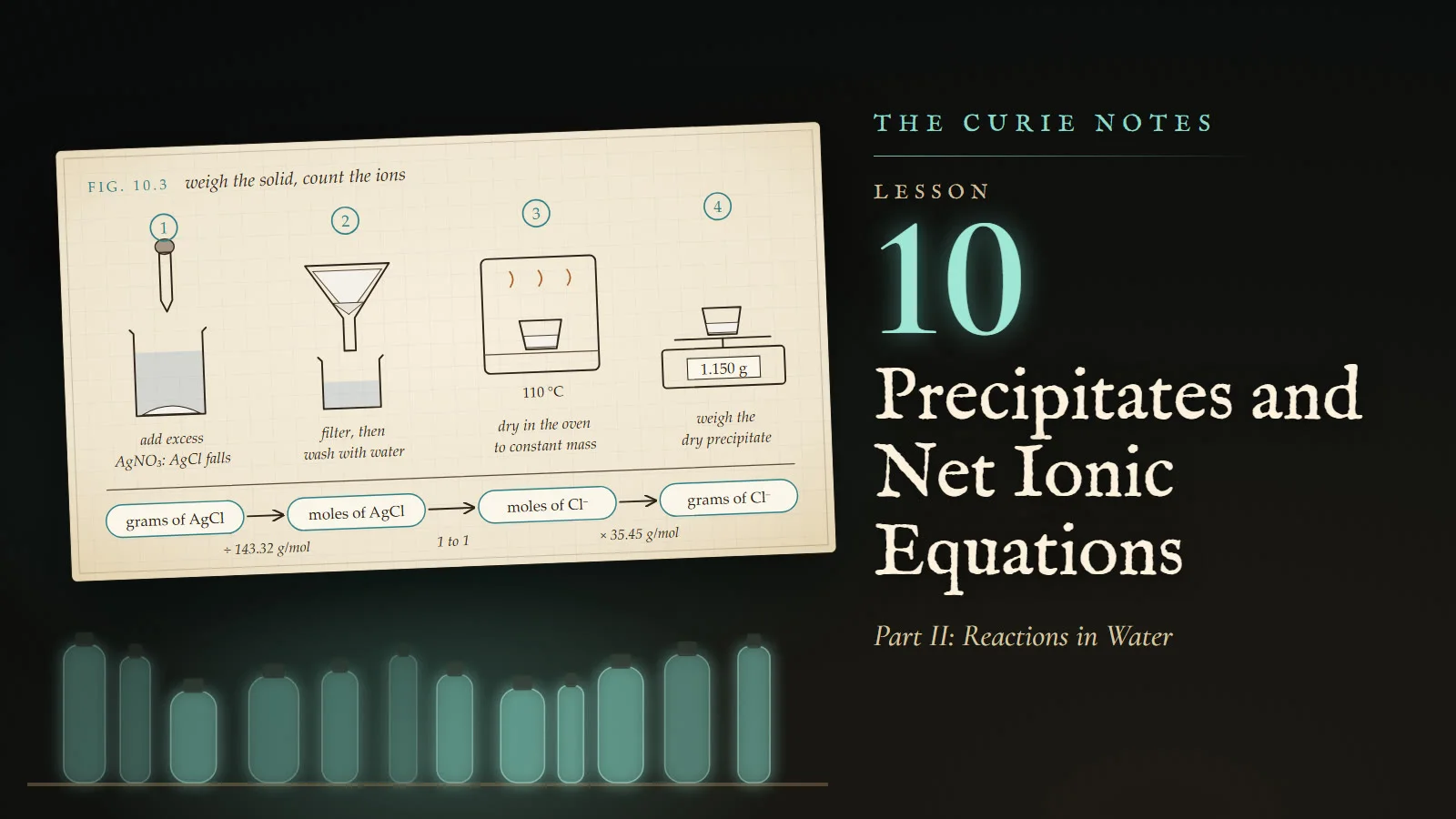
Two beakers stand on the bench, and both look like plain water. One holds silver nitrate, the other common salt. I pour the first into the second, and at once a thick white cloud fills the glass, as if someone had stirred milk into it. In a minute the cloud begins to settle into a white mud at the bottom. Out of two clear liquids, a solid. Today you will learn why this happens and how to predict it. You will learn to write it so that only the true change appears on the page. And you will learn how a chemist weighs that white mud to find out what was in the water.
Life is not easy for any of us. But what of that? We must have perseverance and above all confidence in ourselves. We must believe that we are gifted for something, and that this thing, at whatever cost, must be attained.
Marie Curie, letter of about 1894, as quoted by Ève Curie in Madame Curie, 1937
What you will learn
- Sort dissolved substances into strong electrolytes, weak electrolytes and non-electrolytes.
- Use the solubility rules to say whether an ionic compound dissolves in water.
- Predict whether mixing two solutions gives a precipitate, and name it.
- Write the molecular, complete ionic and net ionic equations, and pick out the spectator ions.
- Calculate the amount of a substance in a sample from the mass of a precipitate (gravimetric analysis).
- Explain co-precipitation, and how it hid radium inside barium.
What you need first: Lesson 5 (The Mole, or Counting Atoms by Weighing), Lesson 7 (Chemical Equations and How to Balance Them), Lesson 8 (Stoichiometry: Limiting Reagents and Yield) and Lesson 9 (Solutions and Concentration).
Electrolytes: solutions that carry a current
Pure water hardly carries an electric current at all. Put two metal plates in a glass of distilled water, join them through a small lamp to a battery, and the lamp stays dark. Now stir in a spoonful of salt. The lamp lights. Stir sugar into a fresh glass instead, and the lamp stays dark, however much sugar you add.
A current is a flow of charge. In a metal wire, electrons carry it. In a solution there are no free electrons, so something else must carry the charge: the ions. When salt dissolves, as you saw in Lesson 9, it comes apart into sodium ions, \(\ce{Na+}\), and chloride ions, \(\ce{Cl-}\). The positive ions drift towards the negative plate and the negative ions towards the positive plate. That drift is the current. Sugar dissolves as whole, uncharged molecules, so there is nothing to carry the charge.
A substance whose solution conducts electricity is an electrolyte. A substance whose solution does not is a non-electrolyte. Electrolytes come in two strengths:
- A strong electrolyte comes apart into ions almost completely. Soluble salts, such as sodium chloride and copper sulfate, are strong electrolytes. So are the strong acids, such as hydrochloric acid, and the strong bases, such as sodium hydroxide.
- A weak electrolyte comes apart into ions only a little. Most of it stays as whole molecules. Acetic acid, the acid of vinegar, is the classic example: in a 0.1 M solution only about one molecule in seventy-five is split into ions at any moment. Ammonia is another. The lamp glows, but dimly.
- A non-electrolyte dissolves as whole molecules and gives no ions: sugar, alcohol, urea.
We write the difference in the arrow. A strong electrolyte goes all the way, with a single arrow:
\[ \ce{HCl(aq) -> H+(aq) + Cl-(aq)} \]
A weak electrolyte splits and rejoins all the time, so only a small share is in pieces at any instant. We show this with a double arrow, which you will study properly in Lesson 35:
\[ \ce{CH3COOH(aq) <=> H+(aq) + CH3COO-(aq)} \]
An analogy from my Paris
Think of letters crossing Paris. A letter moves from one side of the city to the other only because a postman carries it. Remove the postmen and the letters stay where they are, however many there are. In a solution, the ions are the postmen of charge. A spoonful of salt sends out a whole army of them. A spoonful of acetic acid sends out only a few, while most of the molecules stand idle. A spoonful of sugar sends none at all: plenty of people in the street, and none of them carrying the post.
Margin
That dissolved salts are present as free ions was the idea of Svante Arrhenius, set out in his thesis at Uppsala in 1884 and in full in 1887. The examiners gave his thesis the lowest passing grade. Within twenty years his theory was in every textbook. He received the Nobel Prize in Chemistry in 1903, the year Pierre and I shared the prize in physics with Henri Becquerel. When I measured the tiny currents carried by air made conducting by uranium rays, I was measuring ions too, ions made in a gas instead of a liquid.
Worked example 1
What are the concentrations of the ions in 0.150 M calcium chloride, and is it a strong electrolyte?
- Calcium chloride is a soluble salt, so it is a strong electrolyte: it comes apart completely.
- Write the dissolving: \(\ce{CaCl2(s) -> Ca^2+(aq) + 2Cl-(aq)}\).
- Each formula unit gives one calcium ion: \(\ce{[Ca^2+]} = 0.150\,\mathrm{M}\). (Square brackets around a formula mean "the concentration of" it.)
- Each formula unit gives two chloride ions: \(\ce{[Cl-]} = 2 \times 0.150 = 0.300\,\mathrm{M}\).
Check: count the charge. \(0.150 \times (+2) = +0.300\) and \(0.300 \times (-1) = -0.300\). The solution as a whole is neutral, as every solution must be.
Try it
On Plate 10.1, choose a substance and a concentration. The lamp shows how well the solution conducts, and the beaker shows what is really in the water: whole molecules, ions, or a mixture. Compare salt and acetic acid at the same concentration, then turn the salt down to a thousandth of a mole per litre.
Which salts dissolve: the solubility rules
Not every ionic compound dissolves. Common salt dissolves easily, but chalk, which is calcium carbonate, lies on the bottom of the glass for ever. Silver chloride, the white cloud from my opening, dissolves so little that we call it insoluble. Whether a compound dissolves decides whether a solid will appear when two solutions meet, so we need to know.
Chemists have measured the solubility of thousands of salts. The results fall into a few simple patterns, the solubility rules. Here they are for water at room temperature. A compound is called soluble if more than about a tenth of a mole dissolves in a litre, and insoluble if much less than that does.
- Compounds of the alkali metals (lithium, sodium, potassium and the others of group 1) and of the ammonium ion, \(\ce{NH4+}\), are soluble.
- Nitrates, \(\ce{NO3-}\), and acetates, \(\ce{CH3COO-}\), are soluble.
- Chlorides, bromides and iodides are soluble, except those of silver, \(\ce{Ag+}\), lead, \(\ce{Pb^2+}\), and mercury(I), \(\ce{Hg2^2+}\).
- Sulfates, \(\ce{SO4^2-}\), are soluble, except those of barium, strontium and lead. Calcium sulfate and silver sulfate dissolve only slightly.
- Hydroxides, \(\ce{OH-}\), are insoluble, except those of group 1 and barium. Calcium hydroxide dissolves slightly.
- Carbonates, \(\ce{CO3^2-}\), and phosphates, \(\ce{PO4^3-}\), are insoluble, except those of group 1 and ammonium.
When two rules disagree, the earlier rule wins. Sodium carbonate is soluble, because rule 1 (sodium) comes before rule 6 (carbonates).
Worked example 2
Which of these dissolve in water: potassium iodide, lead(II) sulfate, magnesium hydroxide, barium nitrate, calcium carbonate?
- \(\ce{KI}\): potassium is in group 1, so rule 1 says soluble.
- \(\ce{PbSO4}\): sulfates are soluble, but lead is an exception in rule 4. Insoluble.
- \(\ce{Mg(OH)2}\): hydroxides are insoluble unless group 1 or barium (rule 5). Magnesium is neither. Insoluble.
- \(\ce{Ba(NO3)2}\): every nitrate is soluble (rule 2). Soluble.
- \(\ce{CaCO3}\): carbonates are insoluble unless group 1 or ammonium (rule 6). Insoluble. This is chalk and limestone.
Check: for each compound, look at both ions, and use the first rule that mentions either of them.
A common mistake
"Insoluble" means that very little dissolves, though never quite nothing. A litre of water dissolves about two thousandths of a gram of silver chloride, and about two and a half thousandths of a gram of barium sulfate. For weighing, that is close enough to nothing. For a radioactive substance followed by its rays, it can still be a great deal, as you will see at the end of this lesson.
Margin
These rules are summaries of measurements. They do not explain why lead chloride is less soluble than sodium chloride. That depends on a contest: the ions attract each other in the crystal, and water attracts the ions. We shall weigh that contest in Lessons 17 and 25. For now, learn the rules as a pharmacist learns the shelves of his shop: by heart, and checked against the label.
Precipitation: ions change partners
Now we can understand the white cloud. A solid that forms when two solutions are mixed is called a precipitate, and the reaction is a precipitation reaction. It is one kind of the double displacement reactions you met in Lesson 7.
Before mixing, the silver nitrate solution holds \(\ce{Ag+}\) and \(\ce{NO3-}\) ions, and the salt solution holds \(\ce{Na+}\) and \(\ce{Cl-}\) ions, each wrapped in water. When we pour them together, all four kinds of ion wander through the same water. Each ion now meets ions of opposite charge it never met before. Silver ions meet chloride ions, and silver chloride is insoluble. So the silver and chloride ions hold on to each other, build tiny crystals, and the crystals grow until they are big enough to see. The sodium and nitrate ions find no partner they cannot let go of: sodium nitrate is soluble. They stay dissolved, exactly as they were.
To predict any precipitation, follow four steps:
- List the ions in each solution.
- Swap partners: pair the cation of the first with the anion of the second, and the cation of the second with the anion of the first.
- Look up each new pair in the solubility rules.
- If a new pair is insoluble, it is the precipitate. If both are soluble, no reaction happens: you have simply made a mixture of ions.
An analogy from Warsaw
At a dance in Warsaw, couples arrive together, and when the music changes the dancers change partners. Most new couples dance a turn and part again. But now and then two people meet who do not wish to let go. They leave the floor together and sit down in a corner for the rest of the evening. The ions in a mixed solution are the dancers. The pair that will not let go, silver with chloride, leaves the floor and sinks to the bottom as a solid. Everyone else goes on dancing in the water.
Worked example 3
Will a precipitate form when solutions of lead(II) nitrate and potassium iodide are mixed? If so, write the balanced equation.
- Ions: lead(II) nitrate gives \(\ce{Pb^2+}\) and \(\ce{NO3-}\); potassium iodide gives \(\ce{K+}\) and \(\ce{I-}\).
- Swap partners: \(\ce{Pb^2+}\) with \(\ce{I-}\), and \(\ce{K+}\) with \(\ce{NO3-}\).
- Write correct formulas by balancing the charges: one \(\ce{Pb^2+}\) needs two \(\ce{I-}\), so \(\ce{PbI2}\); one \(\ce{K+}\) with one \(\ce{NO3-}\), so \(\ce{KNO3}\).
- Solubility: iodides are soluble except silver, lead and mercury(I), so \(\ce{PbI2}\) is insoluble. \(\ce{KNO3}\) is soluble (rules 1 and 2).
- So lead(II) iodide precipitates. Write the unbalanced equation with state symbols, then balance the iodide and potassium with a 2 in front of \(\ce{KI}\) and of \(\ce{KNO3}\):
\[ \ce{Pb(NO3)2(aq) + 2KI(aq) -> PbI2(s) + 2KNO3(aq)} \]
Check: Pb 1 and 1; N 2 and 2; O 6 and 6; K 2 and 2; I 2 and 2. Lead iodide is a brilliant golden yellow; chemists call the slowly crystallising solid golden rain.
Worked example 4
What happens when potassium nitrate and sodium chloride solutions are mixed?
- Ions: \(\ce{K+}\), \(\ce{NO3-}\), \(\ce{Na+}\), \(\ce{Cl-}\).
- New pairs: \(\ce{KCl}\) and \(\ce{NaNO3}\).
- Both contain a group 1 ion, so both are soluble.
- No precipitate forms. Nothing reacts: we have a single clear solution holding four kinds of ion.
Check: if you boiled this solution dry you would get a mixture of salts, and you could not say which ion had been "with" which. In solution, the ions simply have no partners.
Try it
Plate 10.2 is a mixing bench. Choose a nitrate solution for the left beaker and a sodium salt solution for the right, then pour. If a precipitate forms, you will see the partners meet and fall, and the plate writes all three equations that the next section teaches. Try silver with chloride, lead with iodide, iron(III) with hydroxide, and potassium with anything.
Molecular, complete ionic and net ionic equations
The equation in Worked example 3 is true, but it hides what really happens. In the solution there is no such thing as a molecule of potassium iodide; there are potassium ions and iodide ions, moving separately. Chemists write a precipitation in three ways, each closer to the truth than the last.
The molecular equation writes every substance as a complete formula, as if it were a whole molecule. It tells you what to take from the shelf. The complete ionic equation writes every strong electrolyte in solution as its separate ions. It tells you what is really in the water. The net ionic equation keeps only the ions that change, and strikes out the rest. It tells you what really happens.
The ions that appear unchanged on both sides of the complete ionic equation are called spectator ions. They are present for the reaction, like a crowd watching a race, but they take no part in it.
Here is the method. Follow it in order, every time.
- Write the balanced molecular equation with state symbols.
- Split every soluble strong electrolyte marked \(\ce{(aq)}\) into its ions. Multiply each ion by the coefficient in front of its compound and by the subscript in the formula. Leave solids, liquids such as water, gases and weak electrolytes as whole formulas.
- Strike out the ions that appear identically on both sides: the spectators.
- Write what is left. Check that atoms balance and that the total charge is the same on both sides.
Worked example 5
Write the three equations for the reaction of silver nitrate with sodium chloride.
- Molecular: \(\ce{AgNO3(aq) + NaCl(aq) -> AgCl(s) + NaNO3(aq)}\).
- Complete ionic: split the three aqueous salts; keep the solid whole: \(\ce{Ag+(aq) + NO3-(aq) + Na+(aq) + Cl-(aq) -> AgCl(s) + Na+(aq) + NO3-(aq)}\).
- Spectators: \(\ce{Na+(aq)}\) and \(\ce{NO3-(aq)}\) appear on both sides unchanged. Strike them out: \(\ce{Ag+(aq)} + \cancel{\ce{NO3-(aq)}} + \cancel{\ce{Na+(aq)}} + \ce{Cl-(aq) -> AgCl(s)} + \cancel{\ce{Na+(aq)}} + \cancel{\ce{NO3-(aq)}}\).
- Net ionic:
\[ \ce{Ag+(aq) + Cl-(aq) -> AgCl(s)} \]
Check: one silver and one chlorine on each side; charge \((+1) + (-1) = 0\) on the left and 0 on the right. This net ionic equation says something the molecular one does not: any soluble silver salt and any soluble chloride will give the same white precipitate. Silver nitrate with hydrochloric acid, silver acetate with calcium chloride: one and the same reaction.
Worked example 6
Write the complete ionic and net ionic equations for barium chloride and sodium sulfate.
- Swap partners: \(\ce{BaSO4}\) (insoluble, rule 4) and \(\ce{NaCl}\) (soluble).
- Molecular, balanced: \(\ce{BaCl2(aq) + Na2SO4(aq) -> BaSO4(s) + 2NaCl(aq)}\).
- Complete ionic. One \(\ce{BaCl2}\) gives one \(\ce{Ba^2+}\) and two \(\ce{Cl-}\); one \(\ce{Na2SO4}\) gives two \(\ce{Na+}\) and one \(\ce{SO4^2-}\); two \(\ce{NaCl}\) give two \(\ce{Na+}\) and two \(\ce{Cl-}\): \(\ce{Ba^2+(aq) + 2Cl-(aq) + 2Na+(aq) + SO4^2-(aq) -> BaSO4(s) + 2Na+(aq) + 2Cl-(aq)}\).
- Strike out \(\ce{2Cl-(aq)}\) and \(\ce{2Na+(aq)}\) from both sides.
- Net ionic: \(\ce{Ba^2+(aq) + SO4^2-(aq) -> BaSO4(s)}\).
Check: charge \((+2) + (-2) = 0\) on the left and 0 on the right. This is the reaction I used more than any other in my life, as you will see.
Worked example 7
Iron(III) nitrate solution is mixed with sodium hydroxide solution. Write the net ionic equation.
- Swap partners: iron(III) with hydroxide, and sodium with nitrate. One \(\ce{Fe^3+}\) needs three \(\ce{OH-}\), so the first is \(\ce{Fe(OH)3}\), insoluble (rule 5). \(\ce{NaNO3}\) is soluble.
- Molecular: \(\ce{Fe(NO3)3(aq) + 3NaOH(aq) -> Fe(OH)3(s) + 3NaNO3(aq)}\).
- Complete ionic: \(\ce{Fe^3+(aq) + 3NO3-(aq) + 3Na+(aq) + 3OH-(aq) -> Fe(OH)3(s) + 3Na+(aq) + 3NO3-(aq)}\).
- Strike out \(\ce{3Na+}\) and \(\ce{3NO3-}\).
- Net ionic: \(\ce{Fe^3+(aq) + 3OH-(aq) -> Fe(OH)3(s)}\).
Check: Fe 1 and 1; O 3 and 3; H 3 and 3; charge \((+3) + 3(-1) = 0\) on each side. The precipitate is a rust-brown jelly.
A common mistake
Three mistakes, all common. First, splitting the precipitate into ions: \(\ce{AgCl(s)}\) is a solid, and its ions are locked in the crystal, so it stays whole. Second, forgetting to multiply: \(\ce{3NaOH}\) gives \(\ce{3Na+}\) and \(\ce{3OH-}\), not one of each. Third, splitting polyatomic ions: the nitrate ion \(\ce{NO3-}\) stays a single ion; it never becomes nitrogen and oxygen in the water. If your net equation has unequal charges on its two sides, one of these three has happened.
An analogy from my Paris
Pierre and I were married at the town hall of Sceaux in July 1895. Our families were in the room, before the ceremony and after it, and they left exactly as they came. Only two people changed: two who arrived separately and left together. The marriage register records the couple and not the guests. The net ionic equation is that register. The spectator ions are the guests: present, necessary for the room to be full and neutral, and unchanged.
Try it
Exercise 10.3 asks you to classify electrolytes, judge solubility, predict precipitates, write net ionic equations, and calculate from precipitate masses. The last questions bring in the next section, so read on first if you like.
Weighing a precipitate: gravimetric analysis
A precipitate is more than a curiosity. It is one of the most exact measuring tools in chemistry. Suppose I want to know how much chloride is in a sample. I dissolve it, add silver nitrate until no more precipitate forms, then collect the silver chloride and weigh it. From its mass I can count the moles of chloride. This method is called gravimetric analysis: analysis by weighing.
For it to work, the precipitate must be very insoluble, so that almost none is left in the liquid. It must be pure, with a known formula. And it must be easy to filter, wash and dry. Silver chloride and barium sulfate have all three virtues, which is why they are the two most famous precipitates in analysis.
The procedure, step by step:
- Weigh the sample accurately and dissolve it in water.
- Add the precipitating solution slowly, with stirring, to the warm solution. Add a little more than enough, an excess, so that every last ion you want is caught. (In the language of Lesson 8, the ion you are measuring must be the limiting reagent.)
- Let the precipitate stand warm for a while. Small crystals dissolve and large ones grow, which makes the solid purer and easier to filter. Chemists call this digestion.
- Filter through a weighed filter crucible, or through a filter paper that burns away without ash.
- Wash the precipitate with a little water to remove the dissolved spectator ions.
- Dry it in an oven, or heat it strongly, then cool it and weigh it. Repeat heating and weighing until two weighings agree: constant mass, as in Lesson 6.
- Calculate.
The calculation always follows the same road: grams of precipitate, to moles of precipitate, to moles of the ion you want, to grams of that ion. You walked this road in Lesson 8.
Worked example 8
A 0.500 g sample of impure table salt is dissolved and treated with excess silver nitrate. The dry silver chloride weighs 1.150 g. What is the mass percent of chloride in the sample?
- Molar mass of \(\ce{AgCl}\): \(107.87 + 35.45 = 143.32\,\mathrm{g/mol}\).
- Moles of \(\ce{AgCl}\): \(1.150\,\mathrm{g} / 143.32\,\mathrm{g/mol} = 8.024 \times 10^{-3}\,\mathrm{mol}\).
- The net equation \(\ce{Ag+ + Cl- -> AgCl}\) is one to one, so the sample held \(8.024 \times 10^{-3}\,\mathrm{mol}\) of chloride.
- Mass of chloride: \(8.024 \times 10^{-3}\,\mathrm{mol} \times 35.45\,\mathrm{g/mol} = 0.2845\,\mathrm{g}\).
- Mass percent: \(0.2845\,\mathrm{g} / 0.500\,\mathrm{g} \times 100\% = 56.9\%\).
Check: pure sodium chloride is \(35.45 / 58.44 = 60.7\%\) chloride. Our sample is a little lower, as an impure salt should be. If all the chloride came from sodium chloride, the sample held \(8.024 \times 10^{-3} \times 58.44 = 0.469\,\mathrm{g}\) of it, which is 93.8% of the sample.
Worked example 9
A 0.4000 g sample of a fertiliser is dissolved and excess barium chloride is added. The dried barium sulfate weighs 0.6250 g. What is the mass percent of sulfate in the fertiliser?
- Molar mass of \(\ce{BaSO4}\): \(137.33 + 32.06 + 4(15.999) = 233.39\,\mathrm{g/mol}\).
- Moles of \(\ce{BaSO4}\): \(0.6250 / 233.39 = 2.678 \times 10^{-3}\,\mathrm{mol}\).
- From \(\ce{Ba^2+ + SO4^2- -> BaSO4}\), one mole of sulfate gives one mole of precipitate: \(2.678 \times 10^{-3}\,\mathrm{mol}\) of \(\ce{SO4^2-}\).
- Molar mass of \(\ce{SO4^2-}\): \(32.06 + 4(15.999) = 96.06\,\mathrm{g/mol}\) (the two extra electrons have no mass worth counting).
- Mass of sulfate: \(2.678 \times 10^{-3} \times 96.06 = 0.2572\,\mathrm{g}\).
- Mass percent: \(0.2572 / 0.4000 \times 100\% = 64.3\%\).
Check: pure ammonium sulfate, a common fertiliser, is 72.7% sulfate. Our sample is below that, which is sensible for a mixture.
In my laboratory
Chemists would not believe that radium was an element until they had its atomic weight, and I obtained it by exactly this method. I dissolved a weighed amount of my purest radium chloride, added silver nitrate in excess, and weighed the silver chloride. My determination of 1902, as historians have reconstructed it from my paper, used 0.09192 g of radium chloride and gave 0.08890 g of silver chloride. Let us work it as I did.
Worked example 10
0.09192 g of radium chloride, \(\ce{RaCl2}\), gives 0.08890 g of silver chloride. What is the atomic weight of radium?
- Moles of \(\ce{AgCl}\): \(0.08890\,\mathrm{g} / 143.32\,\mathrm{g/mol} = 6.203 \times 10^{-4}\,\mathrm{mol}\). That is also the moles of chloride.
- Each \(\ce{RaCl2}\) holds two chlorides, so moles of \(\ce{RaCl2}\) \(= 6.203 \times 10^{-4} / 2 = 3.101 \times 10^{-4}\,\mathrm{mol}\).
- Molar mass of \(\ce{RaCl2}\): \(0.09192\,\mathrm{g} / 3.101 \times 10^{-4}\,\mathrm{mol} = 296.4\,\mathrm{g/mol}\).
- Take away the two chlorines: \(296.4 - 2(35.45) = 225.5\). The atomic weight of radium is about 225.5.
Check: with the atomic weights we used in 1902 (silver 107.8, chlorine 35.4), the same steps give 225.3. I reported 225. Five years later, with about four times as much radium chloride, I found about 226.4, and today's value is 226. The method was sound; the purity and the quantity improved.
Co-precipitation: how radium hid with barium
A precipitate does not always form alone. As its crystals grow, it can carry other ions down with it, trapped on its surfaces or built into its crystal pattern. This is called co-precipitation. In gravimetric analysis it is an enemy: the trapped ions add mass, and the result comes out too high. Digestion and careful washing are the chemist's defence.
Co-precipitation is strongest when the stranger ion resembles the ion of the precipitate: the same charge, a similar size, a similar chemistry. Then it can slip into the crystal pattern as if it belonged there. Radium and barium are just such a pair. Both form ions with a charge of \(+2\), and both stand in the same column of the periodic table, as you will see in Lesson 16.
From the shed
In the pitchblende residues, radium was present in less than one part in a million, and it travelled with the barium. When barium sulfate came down, the radium came down with it, because radium sulfate is even less soluble than barium sulfate and fits into its crystals. No chemical reagent could pull the two apart. The crude sulfates from the residues had to be boiled with a strong solution of sodium carbonate to turn them into carbonates, which dissolve in hydrochloric acid. Then, as chlorides, the radium and barium could at last be separated, slowly, by fractional crystallisation.
So co-precipitation was my enemy, because it chained radium to barium. It was also my servant. Because radium followed barium so faithfully, barium was a perfect carrier: a substance present in weighable amounts that drags an invisible trace along with it. I could not see a millionth of a gram of radium, but I could always find it with my electrometer in whatever fraction the barium had gone to. A chemist working with traces learns to be grateful for a faithful carrier.
A common mistake
Students sometimes think that an excess of precipitating reagent must be harmful, because the extra ions are "left over". In gravimetric analysis the excess is essential: it makes sure every ion you are measuring is caught. The extra reagent stays dissolved and is washed away. What harms the result is an ion that comes down with the precipitate, and that is co-precipitation, a different matter.
What to remember
- Electrolytes give ions in water and conduct: strong ones completely, weak ones a little; non-electrolytes not at all.
- Soluble ionic compounds are strong electrolytes; count each ion: 0.150 M \(\ce{CaCl2}\) is 0.300 M in \(\ce{Cl-}\).
- Solubility rules: group 1, ammonium, nitrates and acetates dissolve; chlorides dissolve except silver, lead and mercury(I); sulfates dissolve except barium, strontium and lead; hydroxides, carbonates and phosphates mostly do not.
- To predict a precipitate: list the ions, swap partners, look up the new pairs.
- Molecular equation: whole formulas. Complete ionic: every dissolved strong electrolyte split into ions. Net ionic: spectators struck out.
- Never split a solid, a liquid, a gas or a weak electrolyte; never split a polyatomic ion; multiply by coefficients.
- A net ionic equation must balance in atoms and in charge: \(\ce{Ba^2+(aq) + SO4^2-(aq) -> BaSO4(s)}\).
- Gravimetric analysis: excess reagent, digest, filter, wash, dry to constant mass, weigh; then grams to moles to moles of ion to grams.
- Co-precipitation carries similar ions down with a precipitate: a source of error, and a way of carrying traces such as radium with barium.
Problems for your notebook
Problem 1. Classify each as a strong electrolyte, a weak electrolyte or a non-electrolyte: potassium bromide, glucose, acetic acid.
Answer. Potassium bromide is a soluble salt, so a strong electrolyte. Glucose dissolves as whole molecules, so a non-electrolyte. Acetic acid splits into ions only slightly, so a weak electrolyte.
Problem 2. Will a precipitate form when sodium carbonate and calcium chloride solutions are mixed? Write the molecular and net ionic equations.
Answer. Swap partners: \(\ce{CaCO3}\) (insoluble, rule 6) and \(\ce{NaCl}\) (soluble). Yes, calcium carbonate precipitates. Molecular: \(\ce{Na2CO3(aq) + CaCl2(aq) -> CaCO3(s) + 2NaCl(aq)}\). Net ionic: \(\ce{Ca^2+(aq) + CO3^2-(aq) -> CaCO3(s)}\).
Problem 3. Write the complete ionic equation for barium nitrate and potassium sulfate, and name the spectator ions.
Answer. Molecular: \(\ce{Ba(NO3)2(aq) + K2SO4(aq) -> BaSO4(s) + 2KNO3(aq)}\). Complete ionic: \(\ce{Ba^2+(aq) + 2NO3-(aq) + 2K+(aq) + SO4^2-(aq) -> BaSO4(s) + 2K+(aq) + 2NO3-(aq)}\). The spectators are \(\ce{K+}\) and \(\ce{NO3-}\), and the net ionic equation is the same as in Worked example 6.
Problem 4. Excess silver nitrate is added to 25.00 mL of a chloride solution. The silver chloride weighs 0.2867 g. What was the molarity of chloride ion?
Answer.
- Moles of \(\ce{AgCl}\): \(0.2867 / 143.32 = 2.000 \times 10^{-3}\,\mathrm{mol}\), so \(2.000 \times 10^{-3}\,\mathrm{mol}\) of \(\ce{Cl-}\).
- Volume: \(25.00\,\mathrm{mL} = 0.02500\,\mathrm{L}\).
- Molarity: \(2.000 \times 10^{-3} / 0.02500 = 0.0800\,\mathrm{M}\).
Problem 5. 50.0 mL of 0.100 M lead(II) nitrate is mixed with 50.0 mL of 0.150 M potassium iodide. What mass of lead(II) iodide precipitates, and which ion is left over in solution?
Answer.
- Net ionic: \(\ce{Pb^2+(aq) + 2I-(aq) -> PbI2(s)}\).
- Moles of \(\ce{Pb^2+}\): \(0.100 \times 0.0500 = 5.00 \times 10^{-3}\,\mathrm{mol}\). Moles of \(\ce{I-}\): \(0.150 \times 0.0500 = 7.50 \times 10^{-3}\,\mathrm{mol}\).
- All the lead would need \(2 \times 5.00 \times 10^{-3} = 1.00 \times 10^{-2}\,\mathrm{mol}\) of iodide, but only \(7.50 \times 10^{-3}\) is there. Iodide is the limiting reagent.
- Moles of \(\ce{PbI2}\): \(7.50 \times 10^{-3} / 2 = 3.75 \times 10^{-3}\,\mathrm{mol}\).
- Molar mass of \(\ce{PbI2}\): \(207.2 + 2(126.90) = 461.0\,\mathrm{g/mol}\). Mass: \(3.75 \times 10^{-3} \times 461.0 = 1.73\,\mathrm{g}\).
- Lead ions left: \(5.00 \times 10^{-3} - 3.75 \times 10^{-3} = 1.25 \times 10^{-3}\,\mathrm{mol}\) in 100.0 mL, which is \(0.0125\,\mathrm{M}\) of \(\ce{Pb^2+}\), with the potassium and nitrate spectators.
After my time
Four years after my death, the carrier method of this lesson led to one of the great discoveries of the century. In Berlin in December 1938, Otto Hahn and Fritz Strassmann bombarded uranium with neutrons and found new radioactive substances that came down with barium. They believed, as I would have believed, that these were isotopes of radium, carried by barium as radium always was. But however hard they tried, they could not separate them from the barium by fractional crystallisation. At last they had to conclude that the substances were barium itself. A uranium nucleus had split into two smaller ones. Lise Meitner and Otto Frisch explained this splitting early in 1939 and called it fission.
Gravimetric analysis is slower than the instruments that measure most elements today, which can find parts per billion in minutes. But it needs no calibration against a standard, only a balance and a known formula. For that reason it is still used for the most exact work, and to check the instruments themselves.
If something here is not yet clear, come and ask me. The next lesson is Acids and Bases: A First Meeting. There we turn to reactions in water that make salt and water instead of a precipitate, and we learn to measure an acid drop by drop.
Sources and liberties
The Curie Notes are a modern chemistry course written in Marie Curie's voice by Eternal Gardens. The chemistry is standard modern chemistry; dates, people, apparatus and quotations come from the sources below; the teaching, the analogies and the private remarks are our reconstruction.
- Marie Curie, Pierre Curie, with her Autobiographical Notes, translated by Charlotte and Vernon Kellogg (1923), Project Gutenberg.
- Marie Curie, The Discovery of Radium, address at Vassar College, 14 May 1921, Project Gutenberg.
- Carmen Giunta, worked problem on Curie's 1902 atomic weight of radium (data from Comptes rendus 135, 1902), Le Moyne College.
- OpenStax, Chemistry 2e, chapter 4 (precipitation reactions and net ionic equations) and chapter 11 (electrolytes), openstax.org.
- American Institute of Physics, Marie Curie and the Science of Radioactivity, history.aip.org.
- The Nobel Prize in Chemistry 1903 (Svante Arrhenius), nobelprize.org.
- The Nobel Prize in Chemistry 1944 (Otto Hahn, for the discovery of fission), nobelprize.org.
The 1902 radium chloride and silver chloride masses come from a published reconstruction of her paper; we have not checked the original Comptes rendus page ourselves. The 1907 figure is commonly quoted as 226.45, though sources differ slightly.