 by Marie Curie

Come and stand by the bench under the window of the shed on rue Lhomond. In this flask is a white powder: barium carbonate from the pitchblende residues, with a very little radium hidden among it. I pour in hydrochloric acid. The powder fizzes, bubbles of gas rise, and after a minute the flask holds a clear liquid. Something has happened, and the first duty of a chemist is to write down exactly what. In this lesson you will learn to write a reaction as a chemical equation, to check it by counting atoms the way a careful clerk checks a ledger, and to balance it when the count is wrong. You will also learn to recognise the common kinds of reaction and to read an equation in moles.
I am among those who think that science has great beauty. A scientist in his laboratory is not only a technician: he is also a child placed before natural phenomena which impress him like a fairy tale.
Marie Curie, as quoted by her daughter Ève Curie in Madame Curie, 1937
What you will learn
- Read a chemical equation: reactants, products, the arrow, coefficients, subscripts and state symbols.
- Count the atoms of each element on both sides of an equation.
- Balance an equation by inspection, in a fixed order, treating polyatomic ions as blocks and clearing fractions when they appear.
- Recognise five kinds of reaction: combination, decomposition, single displacement, double displacement and combustion.
- Read a balanced equation in molecules, in moles and in grams, and explain why mass is conserved while the number of molecules may change.
What you need first: Lesson 3, Atoms and Elements: The Laws That Proved Them (the conservation of mass); Lesson 5, The Mole, or Counting Atoms by Weighing (moles and molar mass); and Lesson 6, Chemical Formulas, Percent Composition and Empirical Formulas (what the small numbers in a formula mean).
What a chemical equation says
A chemical reaction is a change in which substances become different substances. The atoms are not destroyed in a reaction. They let go of their old partners and join new ones. A chemical equation is a short written record of that change, in formulas instead of words.
Let us begin with words. When hydrogen burns in oxygen, water forms. Written as a word equation, this is:
\[\text{hydrogen} + \text{oxygen} \longrightarrow \text{water}\]
The substances you start with are the reactants. They are written on the left. The substances that form are the products. They are written on the right. The arrow means "react to give". A plus sign means "and".
Now replace each word by its formula, as you learned in Lesson 6. Hydrogen gas is made of molecules of two atoms, \(\ce{H2}\). Oxygen gas is also made of pairs, \(\ce{O2}\). Water is \(\ce{H2O}\). Here is a first attempt:
\[\ce{H2 + O2 -> H2O}\]
This line tells the truth about which substances take part. It does not yet tell the truth about how many. Count the oxygen atoms: there are two on the left and only one on the right. One oxygen atom seems to have vanished, and atoms do not vanish. A line like this is called a skeleton equation, or an unbalanced equation. We shall correct it in a moment.
Two kinds of small number
An equation uses two kinds of number. You must never confuse them.
- A subscript is the small number written low, inside a formula. It belongs to the substance. In \(\ce{H2O}\) the 2 says that each molecule of water holds two hydrogen atoms. If you change it, you change the substance: \(\ce{H2O2}\) is hydrogen peroxide, a bleach, and nobody drinks it.
- A coefficient is the full-size number written in front of a formula. It counts how many molecules (or formula units) of that substance take part. \(\ce{2H2O}\) means two molecules of water. A coefficient of 1 is never written; it is understood.
So \(\ce{2H2O}\) means two molecules, and each one has two hydrogen atoms and one oxygen atom. That makes four hydrogen atoms and two oxygen atoms in all. Now we can repair the water equation. Two molecules of water hold two oxygen atoms, which matches the one \(\ce{O2}\) molecule. They also hold four hydrogen atoms, which needs two \(\ce{H2}\) molecules. The honest equation is:
\[\ce{2H2 + O2 -> 2H2O}\]
Read it aloud: two molecules of hydrogen react with one molecule of oxygen to give two molecules of water.
State symbols
We often add a state symbol in brackets after each formula. It says what physical state the substance is in:
- (s) means solid;
- (l) means liquid;
- (g) means gas;
- (aq) means aqueous, that is, dissolved in water (from the Latin aqua, water).
Here is the reaction in my flask, written with state symbols:
\[\ce{BaCO3(s) + 2HCl(aq) -> BaCl2(aq) + H2O(l) + CO2(g)}\]
Read it aloud: solid barium carbonate and hydrochloric acid give dissolved barium chloride, liquid water and carbon dioxide gas. The state symbols tell you what you will see. The solid disappears into solution and a gas bubbles off. A condition needed for the reaction, such as heat, can be written over the arrow, as in \(\ce{CaCO3(s) ->[heat] CaO(s) + CO2(g)}\).
An analogy from my Paris
Go early in the morning to the market of Les Halles. Carts arrive with sacks of carrots, onions and leeks. The stall-keepers empty the sacks and arrange the vegetables again, in small baskets and bunches for sale. The bundles are new. The carrots are the same carrots. A careful stall-keeper keeps a ledger with one column for each vegetable. If two hundred carrots came in at dawn, then by evening the carrots sold, the carrots left and the carrots spoiled must add up to two hundred. A reaction is the same kind of rearrangement, and the equation is its ledger. It needs one column for each element, and every column must agree.
Margin
Lavoisier, whose sealed vessels you met in Lesson 3, wrote in 1789 that one may treat the substances before and after a fermentation as the two sides of an algebraic equation. He was a tax collector as well as a chemist, and he kept his chemistry like accounts. For most of the nineteenth century chemists wrote an equals sign between the two sides. The arrow says the same thing and adds a direction: this became that.
Counting atoms on both sides
In Lesson 3 you met the law of conservation of mass: in a closed vessel, the mass after a reaction equals the mass before it. Dalton's atoms explain why. Every atom present before the reaction is present after it, and an atom keeps its mass. So an equation is true only when each element has the same number of atoms on the left as on the right. Such an equation is called balanced.
To check an equation, you must count atoms quickly and without error. There are four rules.
- A subscript multiplies only the atom just before it. In \(\ce{CO2}\) there is one carbon atom and two oxygen atoms.
- A subscript after a bracket multiplies everything inside the bracket. In \(\ce{Ca(OH)2}\) there is one calcium, two oxygens and two hydrogens.
- A coefficient multiplies everything in the formula that follows it.
- Add up the counts for the same element wherever it appears on one side.
Worked example 1
How many atoms of each element are in \(\ce{3Ca(OH)2}\)?
- One formula unit of \(\ce{Ca(OH)2}\) holds 1 Ca. The bracket holds 1 O and 1 H, and the 2 after the bracket doubles them: 2 O and 2 H.
- The coefficient 3 multiplies all of it. Calcium: \(3 \times 1 = 3\).
- Oxygen: \(3 \times 2 = 6\).
- Hydrogen: \(3 \times 2 = 6\).
Check: three formula units, each with five atoms, make 15 atoms. And \(3 + 6 + 6 = 15\).
Worked example 2
Count the atoms in \(\ce{2Al2(SO4)3}\), aluminium sulfate.
- One formula unit holds 2 Al. The bracket \(\ce{SO4}\) holds 1 S and 4 O, and the 3 after it triples them: 3 S and 12 O.
- The coefficient 2 doubles everything. Aluminium: \(2 \times 2 = 4\).
- Sulfur: \(2 \times 3 = 6\).
- Oxygen: \(2 \times 12 = 24\).
Check: one formula unit has \(2 + 3 + 12 = 17\) atoms, so two have 34. And \(4 + 6 + 24 = 34\).
A common mistake
Students often let the subscript after a bracket touch only the last atom. They read \(\ce{Ca(OH)2}\) as one O and two H. The bracket is there for exactly this reason: the whole group \(\ce{OH}\) is taken twice. Another mistake is to forget that the coefficient reaches every atom in the formula, the last as well as the first.
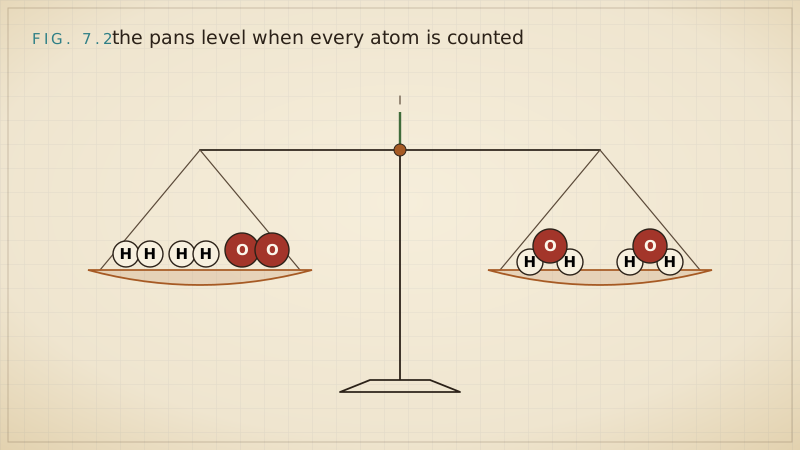
Now look at the balanced water equation on a pair of scales. On the left pan stand \(\ce{2H2}\) and \(\ce{O2}\): four hydrogen atoms and two oxygen atoms. On the right pan stands \(\ce{2H2O}\): four hydrogen atoms and two oxygen atoms. The two ledgers agree, column by column, so the pans hang level.
Try it
Try it on Plate 7.1. Choose a reaction, then add or take away whole molecules on either pan with the buttons. The ledger counts every kind of atom as you go, and the beam tips toward the heavier side. When every column agrees, the beam comes level and the plate tells you the equation is balanced. Notice that you can change only the number of molecules. You cannot change what a molecule is made of.
Margin
There is one kind of change in which atoms do not keep their identity, and it is the kind I know best. In 1902 Rutherford and Soddy showed that a radioactive atom turns into an atom of another element. Radium gives radon and helium: \(\ce{^{226}_{88}Ra -> ^{222}_{86}Rn + ^{4}_{2}He}\). Such a nuclear equation balances in its own way: the mass numbers (226 = 222 + 4) and the atomic numbers (88 = 86 + 2) must agree. You will meet it in Lesson 44. In every ordinary chemical reaction, the atoms of each element stay atoms of that element.
Balancing by inspection
To balance an equation is to choose coefficients so that each element has the same number of atoms on both sides. Doing it by inspection means looking at the equation and adjusting one coefficient at a time, with a good order to guide you. There are two firm rules before we begin.
- Never change a subscript. A subscript is part of the substance. Changing it writes a different substance, and the equation becomes a lie about a reaction that did not happen.
- Never add or remove a substance to make the count come out. Only the coefficients are yours to choose.
Here is the order I teach. It is not a law of nature. It is a habit that saves you from going round in circles.
- Write every formula correctly first.
- Balance the metals.
- Balance the non-metals other than hydrogen and oxygen. If a group such as \(\ce{SO4}\) passes through the reaction unchanged, balance it as one block.
- Balance hydrogen.
- Balance oxygen last.
- Count every element again, on both sides. Clear any fraction, and divide by any common factor so that the coefficients are the smallest whole numbers.
Why this order? A metal usually appears in only one substance on each side, so its coefficient is easy to fix and rarely needs to move again. Hydrogen and oxygen appear in many substances (water, acids, carbonates, hydroxides), so fixing them early means fixing them again later. Oxygen often appears alone, as \(\ce{O2}\), and a lone element can be adjusted at the end without disturbing anything else.
Worked example 3
Balance the reaction in my flask: barium carbonate with hydrochloric acid, \(\ce{BaCO3 + HCl -> BaCl2 + H2O + CO2}\).
- The formulas are correct. Barium chloride is \(\ce{BaCl2}\) because the barium ion carries two positive charges and each chloride ion one negative charge (Lesson 6).
- Metals. Barium: 1 on the left, 1 on the right. It is already balanced.
- Other non-metals. Carbon: 1 on the left, 1 on the right. Chlorine: 1 on the left, 2 on the right. Put 2 in front of \(\ce{HCl}\). Now the equation reads \(\ce{BaCO3 + 2HCl -> BaCl2 + H2O + CO2}\).
- Hydrogen. Left: 2 (from 2 HCl). Right: 2 (in one \(\ce{H2O}\)). Balanced.
- Oxygen. Left: 3 (in \(\ce{BaCO3}\)). Right: 1 in water plus 2 in carbon dioxide, which is 3. Balanced.
- Final check, element by element: Ba 1 and 1; C 1 and 1; Cl 2 and 2; H 2 and 2; O 3 and 3.
\[\ce{BaCO3 + 2HCl -> BaCl2 + H2O + CO2}\]
Check: one gas, one salt, one water, as I saw in the flask; the only coefficient needed was the 2, which supplies the second chlorine.
Worked example 4
Aluminium burns in oxygen to give aluminium oxide. Balance \(\ce{Al + O2 -> Al2O3}\).
- Metals. Aluminium: 1 on the left, 2 on the right. Write \(\ce{2Al}\) for now.
- There are no other non-metals and no hydrogen.
- Oxygen. The left has oxygen in pairs; the right has it in threes. The smallest number that both 2 and 3 divide into is 6. So aim for 6 oxygen atoms on each side: \(\ce{3O2}\) on the left (\(3 \times 2 = 6\)) and \(\ce{2Al2O3}\) on the right (\(2 \times 3 = 6\)).
- That change disturbed the aluminium. The right now has \(2 \times 2 = 4\) aluminium atoms. Go back and write \(\ce{4Al}\).
- Final check: Al 4 and 4; O 6 and 6.
\[\ce{4Al + 3O2 -> 2Al2O3}\]
Check: the coefficients 4, 3, 2 have no common factor, so they are the smallest whole numbers.
The last step matters. Balancing is a loop. A change to one coefficient can upset an element you balanced earlier, and then you go round again. With the good order, you rarely need more than one extra turn.
A common mistake
Faced with \(\ce{H2 + O2 -> H2O}\), a tired student writes \(\ce{H2 + O2 -> H2O2}\). The atoms now agree, but the product is hydrogen peroxide, which is not what forms when hydrogen burns. The equation is balanced and false. A second mistake is to stop too early. \(\ce{4H2 + 2O2 -> 4H2O}\) is balanced, but every coefficient can be divided by 2. We always write the smallest whole numbers: \(\ce{2H2 + O2 -> 2H2O}\).
Harder cases: blocks and fractions
Two tricks will carry you through most of the equations you will meet. The first is to keep groups of atoms together. The second is to allow a fraction for a moment and then clear it.
Polyatomic ions as blocks
A polyatomic ion is a group of atoms that carries a charge and usually travels as one unit. Here are the common ones: sulfate \(\ce{SO4^2-}\), nitrate \(\ce{NO3-}\), carbonate \(\ce{CO3^2-}\), phosphate \(\ce{PO4^3-}\) and hydroxide \(\ce{OH-}\). When such a group appears unchanged on both sides of an equation, count it as one block. You will then balance three or four things instead of six or seven.
An analogy from my Paris
At the post office, letters for the same town are tied into a bundle with string. A clerk who must check that every letter from the morning bags has gone out again does not untie each bundle. He counts bundles, as long as the bundles travel tied. Only when a bundle is untied, and its letters go out loose with other mail, must he count the letters one by one. A sulfate group that goes in as sulfate and comes out as sulfate is a tied bundle. A hydroxide group that turns into water has been untied.
Worked example 5
Slaked lime, calcium hydroxide, reacts with phosphoric acid to give calcium phosphate and water. Balance \(\ce{Ca(OH)2 + H3PO4 -> Ca3(PO4)2 + H2O}\).
- Metals. Calcium: 1 on the left, 3 on the right. Write \(\ce{3Ca(OH)2}\).
- Blocks. The phosphate group \(\ce{PO4}\) goes in as phosphate and comes out as phosphate, so treat it as one block. Left: 1. Right: 2. Write \(\ce{2H3PO4}\).
- The hydroxide groups do not survive: they become water. So we count their hydrogen and oxygen separately.
- Hydrogen. Left: \(3 \times 2 = 6\) from the hydroxide, plus \(2 \times 3 = 6\) from the acid, which makes 12. Right: water has 2 each, so write \(\ce{6H2O}\) (\(6 \times 2 = 12\)).
- Oxygen. Left: \(3 \times 2 = 6\) from the hydroxide, plus \(2 \times 4 = 8\) from the acid, which makes 14. Right: \(2 \times 4 = 8\) in the phosphate, plus 6 in the water, which makes 14. Balanced, and we did not need to move anything.
- Final check: Ca 3 and 3; P 2 and 2; H 12 and 12; O 14 and 14.
\[\ce{3Ca(OH)2 + 2H3PO4 -> Ca3(PO4)2 + 6H2O}\]
Check: oxygen came out right by itself at the end. When the last element balances without being touched, it is a good sign that the earlier steps were right.
The fraction trick
Sometimes the last element, nearly always oxygen, needs an odd number of atoms while it comes in pairs. Then allow yourself a fraction for a moment. Write the coefficient that makes the count right, even if it is \(\tfrac{7}{2}\). Then multiply every coefficient by the denominator, usually 2, to make them all whole.
An analogy from my Paris
A baker's recipe may come out, when you work it through, as three and a half eggs for one tray of cakes. Nobody can buy half an egg at the market. So the baker makes two trays: seven eggs, and everything else in the recipe doubled. The proportions are the same. Only the batch is larger. Half a molecule is as impossible as half an egg, so we double the batch in the same way.
Worked example 6
Ethane, a gas found with methane in natural gas, burns in oxygen. Balance \(\ce{C2H6 + O2 -> CO2 + H2O}\).
- No metals. Carbon: 2 on the left, so write \(\ce{2CO2}\).
- Hydrogen: 6 on the left, so write \(\ce{3H2O}\) (\(3 \times 2 = 6\)).
- Oxygen on the right: \(2 \times 2 = 4\) in the carbon dioxide, plus 3 in the water, which makes 7. On the left, oxygen comes in pairs, and \(7 \div 2 = \tfrac{7}{2}\). Write \(\ce{C2H6 + 7/2 O2 -> 2CO2 + 3H2O}\).
- Clear the fraction: multiply every coefficient by 2. That gives 2, 7, 4 and 6.
- Final check: C 4 and 4; H 12 and 12; O 14 and \(8 + 6 = 14\).
\[\ce{2C2H6 + 7O2 -> 4CO2 + 6H2O}\]
Check: the coefficients 2, 7, 4, 6 have no common factor, because 7 is odd and prime.
A common mistake
Students multiply only the coefficient that held the fraction. They write \(\ce{C2H6 + 7O2 -> 2CO2 + 3H2O}\), which now has 14 oxygen atoms on the left and 7 on the right. When you double the batch, every ingredient doubles, the carbon and hydrogen as well as the oxygen.
Try it
Exercise 7.2 gives you eight equations, from the easy to the hard. Type a coefficient in each box. A blank box counts as 1. The ledger under the equation shows each element on both sides, green when it agrees and red when it does not. Use the order of Fig. 7.3. The last two need a block and a fraction.
Five kinds of reaction
There are millions of reactions, but most of the ones you will meet in a first course follow a few simple patterns. If you can see the pattern, you can often predict the products before you are told them. Let A, B, C and D stand for elements or groups.
Combination
In a combination reaction (also called synthesis), two or more substances join to make one product. The pattern is A + B gives AB. The photographer's magnesium flash is an example: magnesium burns with a dazzling white light to give magnesium oxide.
\[\ce{2Mg + O2 -> 2MgO}\]
Decomposition
In a decomposition reaction, one substance breaks into two or more simpler ones. The pattern is AB gives A + B. Most decompositions need energy, usually heat. In a lime kiln, limestone (calcium carbonate) is heated strongly, and it gives quicklime (calcium oxide) and carbon dioxide. Builders use the quicklime for mortar.
\[\ce{CaCO3 ->[heat] CaO + CO2}\]
Single displacement
In a single displacement reaction, an element pushes another element out of a compound and takes its place. The pattern is A + BC gives AC + B. Put an iron knife into a blue solution of copper sulfate. In a few minutes the blade is coated with red copper, because the iron has taken the copper's place in solution.
\[\ce{Fe + CuSO4 -> FeSO4 + Cu}\]
Zinc in hydrochloric acid is another example, and an old way of making hydrogen: \(\ce{Zn + 2HCl -> ZnCl2 + H2}\). Which metal can push out which is decided by the activity series, in Lesson 12.
Double displacement
In a double displacement reaction, two compounds exchange partners. The pattern is AB + CD gives AD + CB. It happens mostly between substances dissolved in water. Often one of the new pairs does not dissolve, and it falls out of the liquid as a fine solid called a precipitate. Pour a solution of barium chloride into a solution of sodium sulfate, and a white cloud of barium sulfate forms at once:
\[\ce{BaCl2(aq) + Na2SO4(aq) -> BaSO4(s) + 2NaCl(aq)}\]
Precipitation is the subject of Lesson 10. The reaction of an acid with a base, such as \(\ce{HCl + NaOH -> NaCl + H2O}\), follows the same pattern of exchange; it is the subject of Lesson 11.
Combustion
A combustion is a rapid reaction of a substance with oxygen that gives out heat and usually light. When the fuel is made of carbon and hydrogen (and perhaps oxygen), and there is enough air, the products are carbon dioxide and water. The pattern is fuel + oxygen gives carbon dioxide + water.
\[\ce{CH4 + 2O2 -> CO2 + 2H2O}\]
An analogy from my Paris
Walk along a Paris street at dusk and watch the lamplighter. With his long pole he opens the tap and lights the gas in each lamp. The gas is coal gas, made at the gasworks, and much of it is hydrogen and methane. In the lamp it burns with the oxygen of the air. Out of the lamp come heat, light, water vapour and carbon dioxide. Every lamp on the boulevard is a small combustion, and every one of them obeys the equation above.
A common mistake
Do not sort reactions by how they look in the flask. Sort them by what happens to the formulas. Count the reactants and products and see who has changed partners. Also, the names are a convenience and not a law. Magnesium burning in oxygen is a combination (two substances make one) and also a combustion (a rapid burning in oxygen). Both names are correct.
In my laboratory
Radium is chemically very like barium. Whatever barium does, radium does too, in an equation of the same form: write Ra where you see Ba. When barium sulfate falls as a precipitate, radium sulfate falls with it. When barium carbonate dissolves in hydrochloric acid, radium carbonate dissolves beside it. In 1898 this likeness was my difficulty, because I could not separate the two by any simple reaction. It was also my method. I let barium carry the radium through every reaction, and then separated the two chlorides slowly, by fractional crystallisation, because radium chloride is a little less soluble.
Reading an equation in moles
A balanced equation tells you how many molecules react. But no one can count molecules on a bench. We weigh. Lesson 5 gave us the bridge: a mole is a fixed number of particles, \(6.022 \times 10^{23}\), and a mole of a substance has a mass in grams equal to its formula mass.
Take the balanced water equation, \(\ce{2H2 + O2 -> 2H2O}\), and read it at three scales.
- In molecules: 2 molecules of hydrogen react with 1 molecule of oxygen to give 2 molecules of water.
- In dozens: 2 dozen hydrogen molecules react with 1 dozen oxygen molecules to give 2 dozen water molecules. Multiplying every coefficient by the same number keeps the equation true.
- In moles: multiply every coefficient by \(6.022 \times 10^{23}\). Then 2 mol of hydrogen react with 1 mol of oxygen to give 2 mol of water.
So the coefficients may be read as moles. This is the most useful sentence in the lesson, and Lesson 8 is built on it.
Now weigh those moles. The molar mass of \(\ce{H2}\) is \(2 \times 1.008 = 2.016\,\mathrm{g\,mol^{-1}}\). For \(\ce{O2}\) it is \(2 \times 15.999 = 31.998\,\mathrm{g\,mol^{-1}}\). For \(\ce{H2O}\) it is \(2 \times 1.008 + 15.999 = 18.015\,\mathrm{g\,mol^{-1}}\).
- Left: \(2 \times 2.016\,\mathrm{g} = 4.032\,\mathrm{g}\) of hydrogen, plus \(31.998\,\mathrm{g}\) of oxygen, which makes \(36.030\,\mathrm{g}\).
- Right: \(2 \times 18.015\,\mathrm{g} = 36.030\,\mathrm{g}\) of water.
The masses agree exactly, as Lavoisier's law demands. But look at the number of moles: 3 mol on the left, 2 mol on the right. Mass is conserved in every reaction. The number of molecules is not. Atoms are conserved; molecules are only the bundles they travel in.
Worked example 7
Methane burns as \(\ce{CH4 + 2O2 -> CO2 + 2H2O}\). If 3.00 mol of methane burns completely, how many moles of oxygen are used, and how many moles of each product form? Show that mass is conserved.
- The coefficients are 1, 2, 1, 2. They are a recipe: for each 1 mol of methane, 2 mol of oxygen, 1 mol of carbon dioxide and 2 mol of water.
- We have 3.00 mol of methane, which is 3 times the recipe. So multiply every coefficient by 3.00.
- Oxygen used: \(2 \times 3.00\,\mathrm{mol} = 6.00\,\mathrm{mol}\).
- Carbon dioxide formed: \(1 \times 3.00\,\mathrm{mol} = 3.00\,\mathrm{mol}\). Water formed: \(2 \times 3.00\,\mathrm{mol} = 6.00\,\mathrm{mol}\).
- Molar masses: \(\ce{CH4}\) is \(12.011 + 4 \times 1.008 = 16.043\,\mathrm{g\,mol^{-1}}\); \(\ce{CO2}\) is \(12.011 + 2 \times 15.999 = 44.009\,\mathrm{g\,mol^{-1}}\).
- Mass on the left: \(3.00 \times 16.043\,\mathrm{g} + 6.00 \times 31.998\,\mathrm{g} = 48.129\,\mathrm{g} + 191.988\,\mathrm{g} = 240.117\,\mathrm{g}\).
- Mass on the right: \(3.00 \times 44.009\,\mathrm{g} + 6.00 \times 18.015\,\mathrm{g} = 132.027\,\mathrm{g} + 108.090\,\mathrm{g} = 240.117\,\mathrm{g}\).
Check: the two masses agree, about 240 g on each side. Here the moles happen to agree as well (9.00 mol on each side), but in the water equation they did not, so never rely on it.
A common mistake
The coefficients are numbers of particles or moles. They are never masses. The water equation does not say that 2 g of hydrogen react with 1 g of oxygen. It says 2 mol react with 1 mol, which is 4.032 g of hydrogen with 31.998 g of oxygen. By mass, oxygen is nearly eight times the hydrogen. To go from moles to grams you must always pass through the molar mass.
Margin
Gay-Lussac found in 1808 that gases combine in simple ratios by volume. Two volumes of hydrogen and one volume of oxygen give two volumes of steam, if all are measured at the same temperature and pressure. The coefficients 2, 1, 2 were sitting in his measurements before anyone could explain them. Avogadro explained them in 1811: equal volumes of gases, at the same temperature and pressure, hold equal numbers of molecules. It took fifty years, and Cannizzaro's pamphlet at the Karlsruhe congress of 1860, before most chemists believed him.
In my laboratory
When I measured the atomic weight of radium, I dissolved radium chloride and added silver nitrate. All the chloride fell as silver chloride:
\[\ce{RaCl2 + 2AgNO3 -> 2AgCl + Ra(NO3)2}\]
The 2 in front of the silver chloride was the hinge of the whole measurement. One mole of radium chloride gives two moles of silver chloride, because each formula unit carries two chlorine atoms. If I had forgotten it, my atomic weight would have been wrong by more than a hundred units. Lesson 6 shows how the masses gave the atomic weight. You will weigh the same reaction again in Lesson 8.
Try it
Exercise 7.3 asks you to name the kind of each reaction, to read state symbols, and to read an equation in moles. The question on moles makes new numbers each time you press New numbers, so you can practise until it is easy.
What to remember
- Reactants are on the left, products on the right; the arrow means "react to give".
- A subscript belongs to the substance and must never be changed; a coefficient counts molecules and is yours to choose.
- State symbols: (s) solid, (l) liquid, (g) gas, (aq) dissolved in water.
- Atoms are neither made nor destroyed in a chemical reaction, so each element must have the same count on both sides.
- Balancing order: correct formulas, metals, other non-metals and polyatomic blocks, hydrogen, oxygen last, then check.
- Clear a fraction by multiplying every coefficient by its denominator; always reduce to the smallest whole numbers.
- Five patterns: combination A + B gives AB; decomposition AB gives A + B; single displacement A + BC gives AC + B; double displacement AB + CD gives AD + CB; combustion fuel + \(\ce{O2}\) gives \(\ce{CO2}\) + \(\ce{H2O}\).
- Coefficients can be read as moles: \(\ce{2H2 + O2 -> 2H2O}\) means 2 mol + 1 mol gives 2 mol.
- Mass is always conserved; the number of molecules or moles need not be.
Problems for your notebook
Problem 1. How many atoms of each element are in \(\ce{2Fe2(SO4)3}\), iron(III) sulfate?
Answer. One formula unit holds 2 Fe, and the bracket holds 1 S and 4 O taken 3 times: 3 S and 12 O. The coefficient 2 doubles everything: iron \(2 \times 2 = 4\), sulfur \(2 \times 3 = 6\), oxygen \(2 \times 12 = 24\). Check: one unit has 17 atoms, two have 34, and \(4 + 6 + 24 = 34\).
Problem 2. Sodium reacts with water to give sodium hydroxide and hydrogen. Balance \(\ce{Na + H2O -> NaOH + H2}\).
Answer.
- Sodium: 1 and 1, balanced for now.
- Hydrogen: left 2; right 1 in NaOH plus 2 in \(\ce{H2}\), which is 3. An odd number against an even one: try doubling the water and the sodium hydroxide. With \(\ce{2H2O}\) and \(\ce{2NaOH}\), the left has 4 H and the right has \(2 + 2 = 4\) H.
- Sodium is now 1 on the left and 2 on the right, so write \(\ce{2Na}\).
- Oxygen: 2 and 2.
\(\ce{2Na + 2H2O -> 2NaOH + H2}\). Check: Na 2 and 2; H 4 and 4; O 2 and 2. It is a single displacement: sodium pushes out hydrogen.
Problem 3. Aluminium dissolves in hydrochloric acid to give aluminium chloride and hydrogen. Balance \(\ce{Al + HCl -> AlCl3 + H2}\) using the fraction trick.
Answer.
- Aluminium: 1 and 1.
- Chlorine: 3 on the right, so \(\ce{3HCl}\).
- Hydrogen: 3 on the left, in pairs on the right, so \(\tfrac{3}{2}\,\ce{H2}\).
- Multiply everything by 2: 2, 6, 2, 3.
\(\ce{2Al + 6HCl -> 2AlCl3 + 3H2}\). Check: Al 2 and 2; Cl 6 and 6; H 6 and 6.
Problem 4. When potassium chlorate is heated, it gives potassium chloride and oxygen. Balance \(\ce{KClO3 -> KCl + O2}\) and name the kind of reaction.
Answer. Potassium and chlorine are 1 and 1. Oxygen: 3 on the left, 2 on the right; the smallest common multiple is 6. So write \(\ce{2KClO3}\) and \(\ce{3O2}\). Now K and Cl are 2 on the left, so write \(\ce{2KCl}\). \(\ce{2KClO3 -> 2KCl + 3O2}\). Check: K 2 and 2; Cl 2 and 2; O 6 and 6. One substance breaks into two: a decomposition.
Problem 5. The engines of my X-ray cars in the war burned petrol, which is mostly hydrocarbons such as octane, \(\ce{C8H18}\). Balance the combustion of octane. Then say how many moles of carbon dioxide form when 3.0 mol of octane burns.
Answer.
- Carbon: 8, so \(\ce{8CO2}\). Hydrogen: 18, so \(\ce{9H2O}\).
- Oxygen on the right: \(8 \times 2 + 9 = 25\). On the left, \(\tfrac{25}{2}\,\ce{O2}\).
- Multiply all by 2: \(\ce{2C8H18 + 25O2 -> 16CO2 + 18H2O}\). Check: C 16 and 16; H 36 and 36; O 50 and \(32 + 18 = 50\).
- The ratio of carbon dioxide to octane is 16 to 2, which is 8 to 1. So 3.0 mol of octane gives \(3.0 \times 8 = 24\) mol of carbon dioxide.
You can now write a reaction honestly and read it as a recipe in moles. In Lesson 8, Stoichiometry: Limiting Reagents and Yield, we use that recipe to answer the practical questions of the bench: how many grams to weigh out, which reagent runs out first, and how much of what the equation promises you really collect. If an equation will not balance for you, or you want another to try, come and ask me.
Sources and liberties
The Curie Notes are a modern chemistry course written in Marie Curie's voice by Eternal Gardens. The chemistry is standard modern chemistry; dates, people, apparatus and quotations come from the sources below; the teaching, the analogies and the private remarks are our reconstruction.
- Marie Curie, Pierre Curie, with the Autobiographical Notes of Marie Curie (1923), Project Gutenberg.
- Marie Curie, The Discovery of Radium, address at Vassar College (1921), Project Gutenberg.
- OpenStax, Chemistry 2e, chapter 4, Stoichiometry of Chemical Reactions (equations, balancing and reaction types).
- American Institute of Physics, Marie Curie and the Science of Radioactivity.
- IUPAC, Periodic Table of the Elements and standard atomic weights.
- Antoine Lavoisier, Elements of Chemistry (1789; English translation by Robert Kerr, 1790), Project Gutenberg.
The steps of her radium chemistry are simplified here: the radium-bearing sulfates were first converted to carbonates and then to chlorides, and the details of each batch varied over the years.