 by Marie Curie

On the bench today there is a bottle of vinegar from the grocer, half a lemon, a jar of washing soda from the laundry, a little lime water, and a strip of litmus paper. These five things look like a kitchen. They are also the whole of this lesson. Some of them are sour and some are soapy, and when a sour one meets a soapy one, both lose their character. Chemists call them acids and bases. In this lesson you will learn what acids and bases are, why some are strong and some weak, how an indicator shows which is which, and how to measure exactly how much acid a solution holds, one drop at a time.
All my life through, the new sights of Nature made me rejoice like a child.
Marie Curie, Autobiographical Notes, 1923
What you will learn
- Recognise acids and bases by what they do, and name the common ones of the kitchen and the laboratory.
- Use the Arrhenius definitions and the Brønsted-Lowry definitions, and find conjugate acid-base pairs.
- Tell a strong acid from a weak one, and strength from concentration.
- Write the equation for a neutralisation and name the salt it makes.
- Read the pH scale and find the pH of a solution whose concentration is a power of ten.
- Carry out a titration calculation, including acids that give two protons.
What you need first: Lesson 5 (The Mole, or Counting Atoms by Weighing), Lesson 7 (Chemical Equations and How to Balance Them), Lesson 9 (Solutions and Concentration) for molarity, and Lesson 10 (Reactions in Water: Precipitates and Net Ionic Equations) for ions, electrolytes and net ionic equations.
What acids and bases do
Long before anyone knew what an acid was made of, people knew how acids behaved. Chemists sorted substances by what they did, the way a gardener sorts plants by their leaves before he knows their families.
An acid, in the old practical sense, is a substance whose solution in water does five things. It tastes sour: vinegar, lemon juice and sour milk all owe their taste to acids. It turns blue litmus paper red. It attacks many metals, such as zinc and iron, and gives off hydrogen gas. It fizzes with chalk, limestone and washing soda, giving off carbon dioxide. And it loses all these powers when it is mixed with the right amount of a base.
A base is the opposite kind of substance. Its solution tastes bitter and feels slippery, like soap between the fingers. It turns red litmus paper blue. And it destroys the powers of an acid. A base that dissolves well in water is also called an alkali, an old word from the Arabic for the ashes of plants, from which potash was once made.
Never taste or touch a laboratory acid or base to find out which it is. The sour taste of a lemon and the burn of sulfuric acid are the same property at very different strengths. I tell you about taste only because it is how people first knew them.
Here are the acids and bases you should know by name. The acids: hydrochloric acid, \(\ce{HCl}\), which the old books call muriatic acid; nitric acid, \(\ce{HNO3}\); sulfuric acid, \(\ce{H2SO4}\); acetic acid, \(\ce{CH3COOH}\), the acid of vinegar; carbonic acid, \(\ce{H2CO3}\), which forms when carbon dioxide dissolves in water; and citric acid, the acid of lemons. The bases: sodium hydroxide, \(\ce{NaOH}\), called caustic soda; potassium hydroxide, \(\ce{KOH}\), caustic potash; calcium hydroxide, \(\ce{Ca(OH)2}\), slaked lime, whose solution is lime water; and ammonia, \(\ce{NH3}\), sold as household ammonia. Sodium carbonate, \(\ce{Na2CO3}\), the washing soda of every Paris laundry, also behaves as a base.
An analogy from my Paris
Walk past a laundry on a Monday morning and you will see the copper boilers steaming. The laundress throws a handful of washing soda into the water. Her hands become red and the water feels slippery: that is the base at work, turning the grease of the linen into a kind of soap. If she rinses her hands in a little vinegar, the slipperiness goes. She is doing, without the words, what we will write in equations today: an acid has undone a base.
Margin
Lavoisier believed that oxygen was the element that made acids. He named it so: oxygène means "acid-maker" in Greek. He had good reasons, because sulfur, phosphorus and carbon all burn in oxygen to give oxides that make acids in water. But in 1810 Humphry Davy showed that muriatic acid, our hydrochloric acid, contains no oxygen at all: it is hydrogen and chlorine. Chemists then looked again and saw that every acid they knew contained hydrogen. The great Lavoisier was wrong in this one point, and the name stayed. Names in chemistry are like that: they record what we believed when we gave them.
Arrhenius: ions in water
In Lesson 10 you met electrolytes: substances whose solutions carry an electric current because they contain ions. The man who explained them was a young Swede, Svante Arrhenius. In his doctoral thesis at Uppsala in 1884 he measured how well solutions conduct electricity, and by 1887 he had a bold theory: many substances break into ions as soon as they dissolve. His examiners did not like it. He received the Nobel Prize in Chemistry for it in 1903, the same year that Pierre and I shared the prize in physics with Henri Becquerel.
Arrhenius gave the first definitions that explain why acids behave alike.
- An Arrhenius acid is a substance that produces hydrogen ions, \(\ce{H+}\), when it dissolves in water.
- An Arrhenius base is a substance that produces hydroxide ions, \(\ce{OH-}\), when it dissolves in water.
So hydrochloric acid in water gives \(\ce{HCl(aq) -> H+(aq) + Cl-(aq)}\), and sodium hydroxide gives \(\ce{NaOH(aq) -> Na+(aq) + OH-(aq)}\). Every acid makes the same ion, \(\ce{H+}\), and that is why every acid is sour and turns litmus red. Every such base makes \(\ce{OH-}\), and that is why they all feel soapy.
A hydrogen ion is a hydrogen atom that has lost its only electron. What is left is a single proton, a particle so small that it never wanders about alone in water. It attaches at once to a water molecule and forms the hydronium ion, \(\ce{H3O+}\). So the true equation for hydrochloric acid in water is:
\[ \ce{HCl(aq) + H2O(l) -> H3O+(aq) + Cl-(aq)} \]
Chemists write \(\ce{H+(aq)}\) and \(\ce{H3O+(aq)}\) for the same thing. The short form saves ink; the long form tells the truth about where the proton is. In this lesson I use both, and you should be able to read either.
When an acid meets a base, the \(\ce{H+}\) of one and the \(\ce{OH-}\) of the other join to make water. This reaction is called neutralisation: the solution loses the properties of both.
Worked example 1
Write the molecular, complete ionic and net ionic equations for hydrochloric acid reacting with sodium hydroxide.
- Molecular equation, with the substances written whole: \(\ce{HCl(aq) + NaOH(aq) -> NaCl(aq) + H2O(l)}\).
- Split the strong electrolytes into their ions. Hydrochloric acid, sodium hydroxide and sodium chloride are all fully ionised in water. Water stays as molecules.
- Complete ionic equation: \(\ce{H+(aq) + Cl-(aq) + Na+(aq) + OH-(aq) -> Na+(aq) + Cl-(aq) + H2O(l)}\).
- The sodium and chloride ions appear unchanged on both sides. They are spectator ions. Cross them out.
- Net ionic equation: \(\ce{H+(aq) + OH-(aq) -> H2O(l)}\).
Check: atoms and charges agree on each side of the net equation (two H, one O, total charge zero). Every neutralisation of a strong acid by a strong base has this same net equation, whatever the acid and base.
The Arrhenius picture has two weaknesses. Ammonia, \(\ce{NH3}\), is plainly a base, yet it has no \(\ce{OH}\) in its formula. And acids and bases can react in gases or in other liquids, where there is no water to make ions in. A wider definition was needed.
Brønsted and Lowry: the proton changes hands
In 1923 two chemists found the wider definition at the same time, without knowing of each other: Johannes Brønsted in Copenhagen and Thomas Lowry in England. Their idea is so simple that it is a pleasure to teach.
- A Brønsted-Lowry acid is a proton donor: it gives away an \(\ce{H+}\).
- A Brønsted-Lowry base is a proton acceptor: it takes an \(\ce{H+}\).
An acid-base reaction is then a single event: one proton passes from the acid to the base. Look again at hydrochloric acid in water. \(\ce{HCl}\) gives its proton, so it is the acid. Water takes the proton, so in this reaction water is the base.
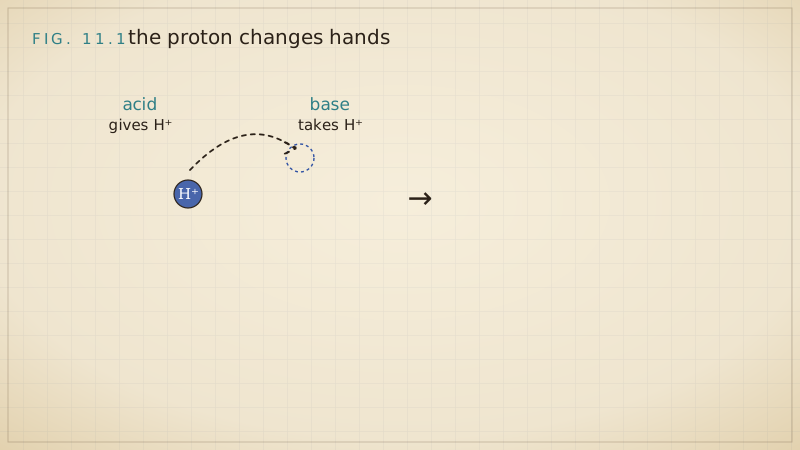
Now look at the products. The chloride ion, \(\ce{Cl-}\), is what remains of the acid after it has given its proton. In principle it could take a proton back, so it is a base. We call it the conjugate base of \(\ce{HCl}\). The hydronium ion, \(\ce{H3O+}\), is water with a proton added. It could give that proton away again, so it is an acid: the conjugate acid of water.
An acid and its conjugate base form a conjugate pair. The two members of a pair differ by exactly one proton, \(\ce{H+}\). Two rules follow, and they are all you need:
- To find the conjugate base of an acid, take away one H and lower the charge by one: \(\ce{HNO3}\) becomes \(\ce{NO3-}\); \(\ce{H2SO4}\) becomes \(\ce{HSO4-}\).
- To find the conjugate acid of a base, add one H and raise the charge by one: \(\ce{NH3}\) becomes \(\ce{NH4+}\); \(\ce{OH-}\) becomes \(\ce{H2O}\).
An analogy from Warsaw
When I was a girl in Warsaw, Polish history and Polish books were forbidden in the schools by the Russian authorities. In the secret classes we called the Floating University, a precious book passed from hand to hand across the table. The one who held it out was the giver; the one who reached for it was the taker. A moment later the taker held the book and could pass it on again, so she had become a giver; the first girl, her hands empty, could now only receive. A proton passes in the same way. The acid gives it and becomes a base; the base takes it and becomes an acid. Nothing is created or lost: one small thing has changed hands.
Worked example 2
Ammonia dissolves in water: \(\ce{NH3(aq) + H2O(l) <=> NH4+(aq) + OH-(aq)}\). Name the acid, the base and the two conjugate pairs.
- Follow each substance from left to right. \(\ce{NH3}\) becomes \(\ce{NH4+}\): it has gained one H and one unit of positive charge. It took a proton, so ammonia is the base.
- \(\ce{H2O}\) becomes \(\ce{OH-}\): it has lost one H. It gave the proton, so here water is the acid.
- Pair one: \(\ce{NH3}\) (base) and \(\ce{NH4+}\) (its conjugate acid).
- Pair two: \(\ce{H2O}\) (acid) and \(\ce{OH-}\) (its conjugate base).
Check: each pair differs by exactly one \(\ce{H+}\). The two-way arrow \(\ce{<=>}\) means the proton can travel back, a point we come to in the next section.
Notice what water did. With hydrochloric acid it was a base; with ammonia it was an acid. A substance that can act either way is called amphiprotic. Water is the most important amphiprotic substance there is, and it explains how ammonia makes \(\ce{OH-}\) ions without containing any: it takes protons from water.
A common mistake
Students sometimes take away two protons, writing \(\ce{SO4^2-}\) as the conjugate base of \(\ce{H2SO4}\). That is two steps, and a conjugate pair is always one step apart. \(\ce{HSO4-}\) is the conjugate base of \(\ce{H2SO4}\); \(\ce{SO4^2-}\) is the conjugate base of \(\ce{HSO4-}\). Count the hydrogens, then count the charge, every time.
Strong and weak
Put the same amount of two acids into water and test them with a small lamp wired across two electrodes, as Arrhenius did with his conductivity cells. With hydrochloric acid the lamp shines brightly. With acetic acid of the same concentration it glows dimly. The difference is in how many molecules have given up their protons.
A strong acid gives its proton to water completely. In a solution of hydrochloric acid there are essentially no \(\ce{HCl}\) molecules left: only \(\ce{H3O+}\) and \(\ce{Cl-}\) ions. We write a single arrow: \(\ce{HCl + H2O -> H3O+ + Cl-}\). The strong acids you should know are hydrochloric, hydrobromic, hydriodic, nitric, perchloric and sulfuric acid (sulfuric gives its first proton completely).
A weak acid gives its proton only partly. In a solution of acetic acid at 0.10 mol/L, only about one molecule in seventy-five has ionised at any moment; the rest stay whole. We write the two-way arrow, because protons are always passing both ways: \(\ce{CH3COOH + H2O <=> H3O+ + CH3COO-}\). Most acids are weak: acetic, citric, carbonic, hydrofluoric, and the acids of fruit and milk.
Bases are sorted the same way. The strong bases are the hydroxides of the group 1 metals (lithium, sodium, potassium) and the dissolved part of calcium, strontium and barium hydroxides: they are made of ions and release all their \(\ce{OH-}\) in water. Ammonia is a weak base: only a small fraction of its molecules take a proton from water.
An analogy from my Paris
Think of a horse omnibus reaching the end of its line at the Place de la Bastille. Every passenger steps down; the omnibus is empty. That is a strong acid: every molecule has given up its proton. Now think of the same omnibus at a stop in the middle of the boulevard. A few passengers step down and a few others climb up. The number on board hardly changes, though the faces change all the time. That is a weak acid. The two-way arrow means exactly this busy coming and going, which we call an equilibrium. You will study equilibrium properly in Part VII; for now, the picture of the omnibus is enough.
Try it
Plate 11.1 shows a hundred molecules of acid in water. Choose hydrochloric or nitric acid and every molecule is split into ions. Choose acetic or hydrofluoric acid and most molecules stay whole, while a few flicker between whole and split, which is the equilibrium at work. Then move the concentration slider: a weak acid ionises a larger fraction as it becomes more dilute, but the total amount of \(\ce{H3O+}\) still falls.
A common mistake
Strong and concentrated are different words. Strength tells you what fraction of the acid has ionised. Concentration tells you how much acid is in each litre. A bottle of concentrated acetic acid is concentrated and weak. A very dilute hydrochloric acid is dilute and strong. A student who says "this acid is strong because there is a lot of it" has mixed the two questions together. Ask them separately: how much, and how completely?
Neutralisation and salts
When an acid neutralises a base, the hydrogen of the acid and the hydroxide of the base make water. What is left over is the metal ion of the base and the anion of the acid. Together they form a salt: an ionic compound made of a cation from a base and an anion from an acid. Common table salt, sodium chloride, is only one member of a large family.
In words: acid + base → salt + water. The salt's name is the metal from the base followed by the anion from the acid. Hydrochloric acid gives chlorides, nitric acid gives nitrates, sulfuric acid gives sulfates, acetic acid gives acetates.
Acids also react with carbonates, which is why they fizz on limestone: acid + carbonate → salt + water + carbon dioxide.
Worked example 3
Write balanced equations, and name the salt, for (a) sulfuric acid with sodium hydroxide and (b) hydrochloric acid with calcium hydroxide.
- (a) The salt contains \(\ce{Na+}\) and \(\ce{SO4^2-}\). To balance the charges we need two sodium ions for one sulfate: \(\ce{Na2SO4}\), sodium sulfate.
- Write the skeleton: \(\ce{H2SO4 + NaOH -> Na2SO4 + H2O}\).
- Two sodiums on the right, so 2 NaOH. That gives 2 \(\ce{OH-}\) to meet the 2 \(\ce{H+}\) of the acid, so 2 \(\ce{H2O}\).
- Balanced: \(\ce{H2SO4(aq) + 2NaOH(aq) -> Na2SO4(aq) + 2H2O(l)}\).
- (b) The salt contains \(\ce{Ca^2+}\) and \(\ce{Cl-}\): \(\ce{CaCl2}\), calcium chloride.
- Calcium hydroxide gives two \(\ce{OH-}\), so it needs two HCl and makes two waters.
- Balanced: \(\ce{2HCl(aq) + Ca(OH)2(aq) -> CaCl2(aq) + 2H2O(l)}\).
Check: in (a) there are 4 H, 2 Na, 1 S and 6 O on each side; in (b), 4 H, 2 Cl, 1 Ca and 2 O on each side. The coefficient on the water always equals the number of protons that changed hands.
Notice the ratios. One sulfuric acid needs two sodium hydroxides, because it has two protons to give. One calcium hydroxide needs two hydrochloric acids, because it has two hydroxides to give. These ratios will matter in every titration.
In my laboratory
Acids and bases were the daily tools of the shed on rue Lhomond. To work the pitchblende residues we dissolved them, precipitated them, and dissolved them again, over and over. When the radium travelled with the barium as a carbonate, hydrochloric acid turned the carbonate into the chloride we needed for crystallising: \(\ce{BaCO3 + 2HCl -> BaCl2 + H2O + CO2}\). The fizzing of carbon dioxide told me the reaction was going, and when the fizzing stopped I knew the carbonate was used up. The same equation held for the radium that hid among the barium: radium carbonate became radium chloride, waiting in the solution for the next crystallisation.
Indicators and the pH scale
An indicator is a dye whose colour depends on how acidic or basic the solution is. A drop of it in a flask shows you, at a glance, which side you are on.
- Litmus is a dye made from lichens, used by chemists for centuries. It is red in acid and blue in base, changing over a wide range in the middle.
- Phenolphthalein, first made by Adolf von Baeyer in 1871, is colourless in acid and in neutral water, and turns pink when the solution becomes clearly basic.
- Methyl orange, a coal-tar dye, is red in fairly strong acid and yellow in weak acid, neutral water and base.
Indicators tell you "acid" or "base". A chemist wants a number. That number came from Copenhagen. In 1909 Søren Sørensen, head of chemistry at the Carlsberg Laboratory, was studying how enzymes work in brewing. He found that they were exquisitely sensitive to how acidic the solution was, and he needed a convenient way to write it. The concentration of hydrogen ions in his solutions was tiny and awkward, numbers such as 0.0000001 mol/L. So he wrote down only the power of ten.
Here is his idea in words first. Write the concentration of hydronium ions as a power of ten. The pH is that power, with its minus sign removed. So a solution with \([\ce{H3O+}] = 10^{-3}\,\mathrm{mol/L}\) has pH 3. The square brackets mean "concentration of, in moles per litre". As a formula:
\[ [\ce{H3O+}] = 10^{-\mathrm{pH}}\ \mathrm{mol/L} \]
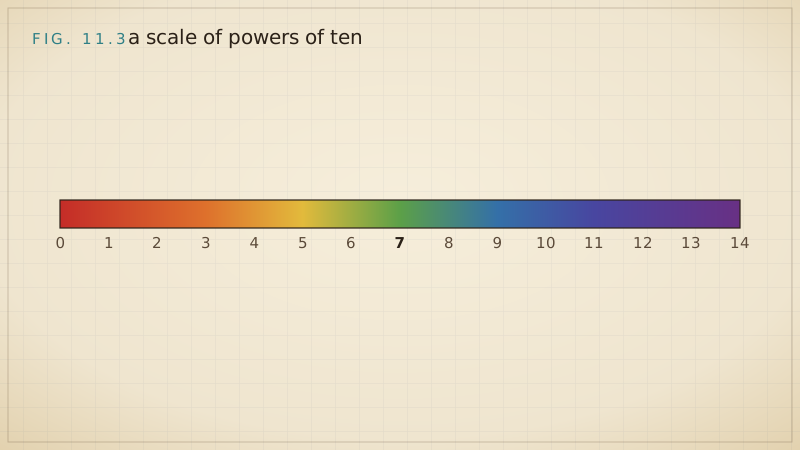
Three things follow at once. First, a small pH means a lot of acid: pH 1 is ten times more acidic than pH 2. Second, each step of one on the scale is a factor of ten. Third, the scale runs, for ordinary solutions, from about 0 to about 14.
Why 14? Because pure water is itself very slightly ionised. Now and then one water molecule passes a proton to another: \(\ce{H2O + H2O <=> H3O+ + OH-}\). At 25 °C this gives \([\ce{H3O+}] = [\ce{OH-}] = 1.0 \times 10^{-7}\,\mathrm{mol/L}\), so pure water has pH 7. And in any water solution at 25 °C the two concentrations always multiply to the same number:
\[ [\ce{H3O+}] \times [\ce{OH-}] = 1.0 \times 10^{-14} \]
If the acid goes up, the hydroxide goes down, and the other way about. A solution with pH below 7 is acidic; pH 7 is neutral; pH above 7 is basic.
Worked example 4
Find the pH of (a) hydrochloric acid at 0.010 mol/L and (b) sodium hydroxide at 0.0010 mol/L.
- (a) Hydrochloric acid is strong, so every molecule gives its proton: \([\ce{H3O+}] = 0.010\,\mathrm{mol/L}\).
- Write it as a power of ten: \(0.010 = 10^{-2}\).
- The pH is the power without its minus sign: pH 2.
- (b) Sodium hydroxide is a strong base, so \([\ce{OH-}] = 0.0010\,\mathrm{mol/L} = 10^{-3}\,\mathrm{mol/L}\).
- Use the water rule: \([\ce{H3O+}] = 10^{-14} \div 10^{-3} = 10^{-11}\,\mathrm{mol/L}\). (To divide powers of ten, subtract the powers: \(-14 - (-3) = -11\).)
- The pH is 11.
Check: the acid has a pH below 7 and the base above 7, as they must. The acid at 0.010 mol/L has a lower pH than it would at 0.0010 mol/L (pH 3), because more acid means more hydronium.
Margin
When the concentration is not a neat power of ten, the pH is not a whole number. Then we use the logarithm: \(\mathrm{pH} = -\log_{10}[\ce{H3O+}]\). For acetic acid at 0.10 mol/L, \([\ce{H3O+}]\) is about \(1.3 \times 10^{-3}\,\mathrm{mol/L}\) and the pH is about 2.9. Logarithms belong to a later lesson on acids (Lesson 37); here the powers of ten are enough. One more caution: pH 7 is neutral only at 25 °C. Warm water ionises more, so hot pure water has a pH a little below 7 and is still neutral.
In the same year, 1909, Fritz Haber and his student Zygmunt Klemensiewicz, a young Pole, showed in Karlsruhe that a thin bulb of glass dipped in a solution develops a voltage that follows the acidity. Their glass electrode let chemists measure pH with an instrument instead of guessing by colour. I am glad that a Pole stood at the beginning of it.
Try it
Exercise 11.2 asks you to find acids, bases and conjugate partners, to tell strong from weak, and to work out pH from powers of ten. The pH questions make new numbers whenever you ask.
Titration: measuring an acid drop by drop
Now we come to the most useful skill of the lesson. Suppose a bottle of hydrochloric acid has lost its label, or a grocer's vinegar may have been watered. How much acid is really in it? We find out by titration: adding a solution of known concentration, drop by drop, until it has exactly neutralised a measured volume of the unknown.
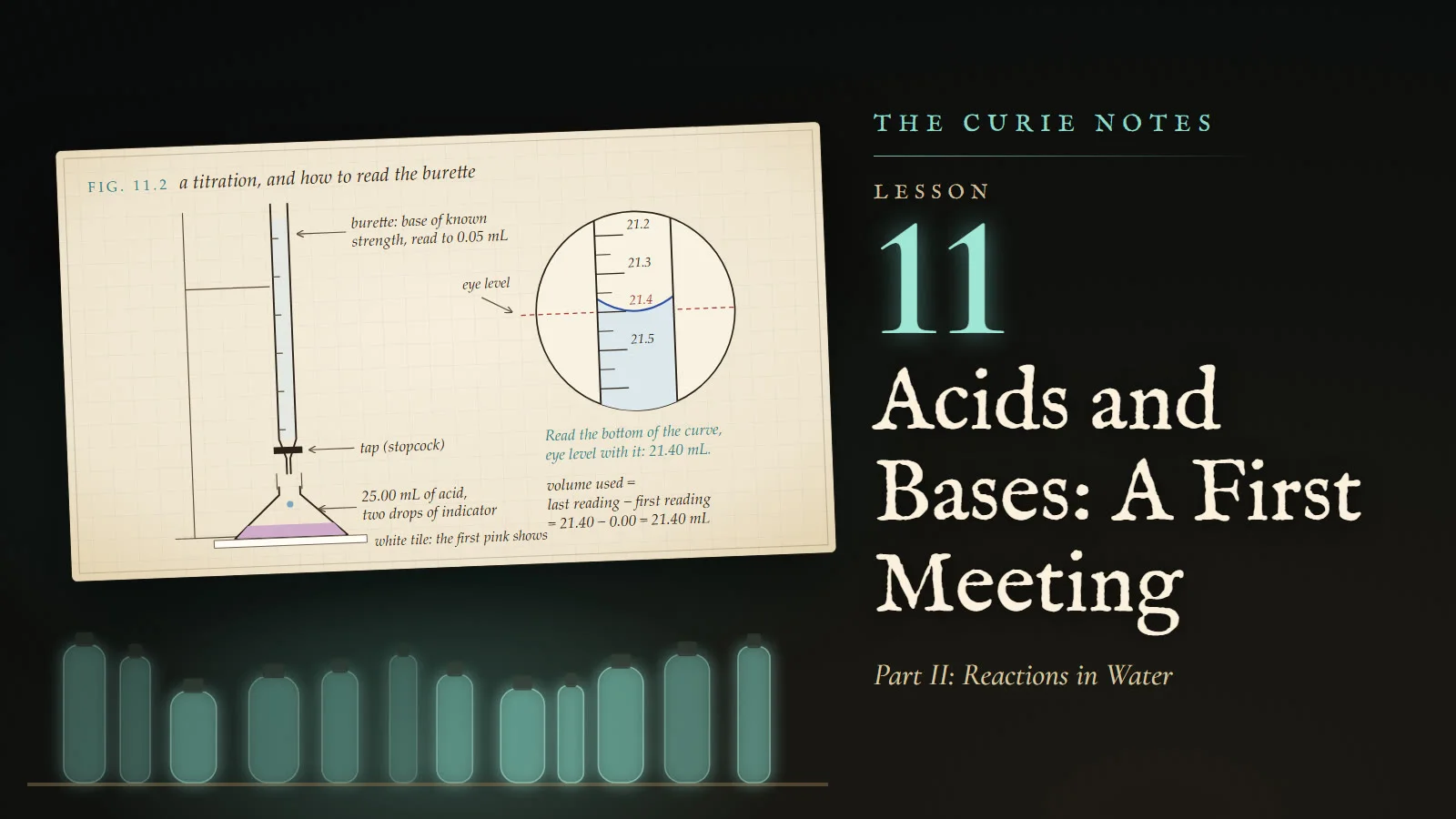
The apparatus is simple and beautiful. A pipette delivers an exact volume of the unknown acid, for example 25.00 mL, into a conical flask. Two drops of indicator go in. A burette, a long glass tube marked in tenths of a millilitre with a tap at the bottom, holds the base of known concentration, called the standard solution. You read the burette, open the tap, swirl the flask, and slow to single drops as the colour begins to linger. When one drop changes the colour for good, you close the tap and read the burette again.
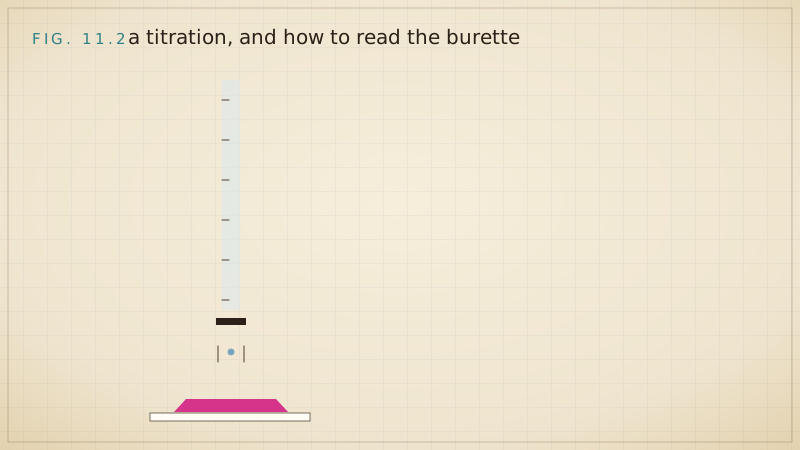
Two words must be kept apart. The equivalence point is the moment when the moles of base added are exactly what the balanced equation requires for the moles of acid present. It is a fact of the chemistry. The end point is the moment the indicator changes colour. It is what we see. A good choice of indicator makes the end point fall within one drop of the equivalence point.
An analogy from my Paris
Watch a pharmacist on the boulevard Saint-Michel weigh out a powder. The powder sits in one pan of his balance. Into the other pan he puts large weights first, quickly, then smaller ones, then the tiniest wire weights with his tweezers, one at a time. For a long while the beam does not move. Then one small weight, no heavier than the others, makes it swing across. That last weight does not cause the balance; it only shows it. A titration is the same. For many millilitres the flask stays colourless, then one drop turns it pink. The drop shows you the equivalence point; the arithmetic tells you what it means.
The calculation always follows the same road, the one you learned in Lesson 8:
- Moles of the standard solution used: concentration times volume in litres, \(n = c \times V\).
- Moles of the unknown, from the ratio in the balanced equation.
- Concentration of the unknown: its moles divided by its volume in litres, \(c = n / V\).
Worked example 5
25.00 mL of hydrochloric acid is titrated with 0.1000 mol/L sodium hydroxide, using phenolphthalein. The burette reads 0.00 mL at the start and 21.40 mL at the end point. What is the concentration of the acid?
- Volume of base used: \(21.40 - 0.00 = 21.40\,\mathrm{mL} = 0.02140\,\mathrm{L}\).
- Moles of NaOH: \(0.1000\,\mathrm{mol/L} \times 0.02140\,\mathrm{L} = 0.002140\,\mathrm{mol}\).
- Equation: \(\ce{HCl + NaOH -> NaCl + H2O}\). One HCl for one NaOH, so moles of HCl = 0.002140 mol.
- Volume of acid: \(25.00\,\mathrm{mL} = 0.02500\,\mathrm{L}\).
- Concentration: \(0.002140\,\mathrm{mol} \div 0.02500\,\mathrm{L} = 0.08560\,\mathrm{mol/L}\).
Check: less base was needed (21.40 mL) than the volume of acid (25.00 mL), and both were measured with the same one-to-one ratio, so the acid must be a little weaker than the base: 0.0856 is a little less than 0.1000. The units cancel to mol/L.
Worked example 6
20.00 mL of sulfuric acid needs 32.50 mL of 0.1200 mol/L sodium hydroxide. What is the concentration of the sulfuric acid?
- Moles of NaOH: \(0.1200\,\mathrm{mol/L} \times 0.03250\,\mathrm{L} = 0.003900\,\mathrm{mol}\).
- Equation: \(\ce{H2SO4 + 2NaOH -> Na2SO4 + 2H2O}\). One sulfuric acid for two sodium hydroxides.
- Moles of \(\ce{H2SO4}\): \(0.003900\,\mathrm{mol} \div 2 = 0.001950\,\mathrm{mol}\).
- Concentration: \(0.001950\,\mathrm{mol} \div 0.02000\,\mathrm{L} = 0.09750\,\mathrm{mol/L}\).
Check: if we had forgotten the 2 we would have found 0.1950 mol/L, twice too much. A quick sense test: each litre of this acid carries two moles of protons per mole of acid, so its "proton concentration" is 0.1950 mol/L, which matches the larger volume of base it needed.
A common mistake
The most common error in titration is to leave out the ratio from the equation. Students learn "moles of acid equals moles of base" from the first example and use it for every acid. It is true only when the equation is one to one. Always write the balanced equation first. Sulfuric acid gives two protons; calcium hydroxide and barium hydroxide take two; a carbonate takes two before it becomes carbon dioxide.
Worked example 7
10.00 mL of table vinegar needs 16.65 mL of 0.5000 mol/L sodium hydroxide. How many grams of acetic acid are in 100 mL of the vinegar?
- Moles of NaOH: \(0.5000\,\mathrm{mol/L} \times 0.01665\,\mathrm{L} = 0.008325\,\mathrm{mol}\).
- Equation: \(\ce{CH3COOH + NaOH -> CH3COONa + H2O}\), one to one. Moles of acetic acid = 0.008325 mol.
- Molar mass of \(\ce{CH3COOH}\): \(2(12.011) + 4(1.008) + 2(15.999) = 60.052\,\mathrm{g/mol}\).
- Mass in 10.00 mL: \(0.008325\,\mathrm{mol} \times 60.052\,\mathrm{g/mol} = 0.4999\,\mathrm{g}\).
- Mass in 100 mL: \(0.4999\,\mathrm{g} \times 10 = 5.00\,\mathrm{g}\).
Check: table vinegar is usually about 4 to 8 grams of acetic acid in 100 mL, so 5.00 g is sensible. The grocer has not watered it.
Which indicator should you choose? Look at the pH at the equivalence point. When a strong acid meets a strong base, the flask at equivalence holds only salt and water, so the pH is 7. When a weak acid such as acetic acid meets sodium hydroxide, the flask at equivalence holds sodium acetate, and the acetate ion is a weak base, so the pH is about 8.7. Near equivalence the pH climbs very steeply: one drop may move it by several units. The rule is to choose an indicator whose colour changes inside that steep climb. Phenolphthalein, which changes between pH 8.2 and 10, suits both of our titrations with sodium hydroxide. Methyl orange, which changes between pH 3.1 and 4.4, would be far too early for acetic acid.
Try it
On Plate 11.3 you have a burette, a flask of 25.00 mL of acid, and three indicators. Open the tap or add single drops and watch the pH curve climb, flatten, and then leap at the equivalence point. Try acetic acid with methyl orange and see how early, and how slowly, the colour drifts. Then choose "unknown HCl", titrate it, and work out its concentration from your end point before you press Reveal.
Exercise 11.4 gives you titrations of every kind we have met: one to one, two to one, lime water, and vinegar. Each calculation question makes new numbers when you ask.
What to remember
- Acids taste sour, turn litmus red and fizz with carbonates; bases taste bitter, feel soapy and turn litmus blue.
- Arrhenius (1887): an acid makes \(\ce{H+}\) in water, a base makes \(\ce{OH-}\). The proton really sits on water as \(\ce{H3O+}\).
- Brønsted-Lowry (1923): an acid gives a proton, a base takes one. A conjugate pair differs by exactly one \(\ce{H+}\).
- Water is amphiprotic: it can give or take a proton.
- Strong acids ionise completely (HCl, HBr, HI, \(\ce{HNO3}\), \(\ce{HClO4}\), \(\ce{H2SO4}\)); weak acids only partly. Strength is not concentration.
- Acid + base → salt + water; net ionic equation \(\ce{H+ + OH- -> H2O}\).
- \([\ce{H3O+}] = 10^{-\mathrm{pH}}\,\mathrm{mol/L}\); each pH step is a factor of ten; at 25 °C, \([\ce{H3O+}][\ce{OH-}] = 1.0 \times 10^{-14}\) and neutral water has pH 7.
- Titration: moles of standard \(n = c \times V\); use the equation's ratio; concentration \(c = n / V\).
- Choose an indicator that changes colour on the steep part of the curve, near the pH at equivalence.
Problems for your notebook
Problem 1. In the reaction \(\ce{HF(aq) + H2O(l) <=> H3O+(aq) + F-(aq)}\), name the acid, the base, and the two conjugate pairs.
Answer. HF loses a proton, so it is the acid, and \(\ce{F-}\) is its conjugate base. Water gains the proton, so it is the base, and \(\ce{H3O+}\) is its conjugate acid. The pairs are \(\ce{HF}\)/\(\ce{F-}\) and \(\ce{H3O+}\)/\(\ce{H2O}\). The two-way arrow tells us hydrofluoric acid is weak.
Problem 2. Write the balanced molecular equation and the net ionic equation for nitric acid neutralising potassium hydroxide. Name the salt.
Answer. Molecular: \(\ce{HNO3(aq) + KOH(aq) -> KNO3(aq) + H2O(l)}\). Potassium and nitrate ions are spectators, so the net ionic equation is \(\ce{H+(aq) + OH-(aq) -> H2O(l)}\). The salt is potassium nitrate, the saltpetre of gunpowder makers.
Problem 3. (a) What is the pH of nitric acid at 0.0010 mol/L? (b) A solution has pH 5. What is \([\ce{H3O+}]\)? (c) How many times more hydronium is in the solution of (a) than in (b)?
Answer.
- (a) Nitric acid is strong: \([\ce{H3O+}] = 0.0010 = 10^{-3}\,\mathrm{mol/L}\), so pH 3.
- (b) \([\ce{H3O+}] = 10^{-5}\,\mathrm{mol/L} = 0.000010\,\mathrm{mol/L}\).
- (c) \(10^{-3} \div 10^{-5} = 10^{2} = 100\) times. Two pH units, two factors of ten.
Problem 4. 15.00 mL of sodium hydroxide solution needs 18.75 mL of 0.1000 mol/L hydrochloric acid to reach the end point. What is the concentration of the sodium hydroxide?
Answer.
- Moles of HCl: \(0.1000 \times 0.01875\,\mathrm{L} = 0.001875\,\mathrm{mol}\).
- One to one, so moles of NaOH = 0.001875 mol.
- Concentration: \(0.001875\,\mathrm{mol} \div 0.01500\,\mathrm{L} = 0.1250\,\mathrm{mol/L}\).
Problem 5. To find the exact strength of a hydrochloric acid, a chemist weighs 0.530 g of pure anhydrous sodium carbonate, dissolves it in water, and titrates it with the acid using methyl orange. The end point comes at 25.00 mL. The reaction is \(\ce{Na2CO3 + 2HCl -> 2NaCl + H2O + CO2}\). What is the concentration of the acid?
Answer.
- Molar mass of \(\ce{Na2CO3}\): \(2(22.990) + 12.011 + 3(15.999) = 105.988\,\mathrm{g/mol}\).
- Moles of \(\ce{Na2CO3}\): \(0.530\,\mathrm{g} \div 105.988\,\mathrm{g/mol} = 0.00500\,\mathrm{mol}\).
- Two HCl for each \(\ce{Na2CO3}\): moles of HCl = \(2 \times 0.00500 = 0.0100\,\mathrm{mol}\).
- Concentration: \(0.0100\,\mathrm{mol} \div 0.02500\,\mathrm{L} = 0.400\,\mathrm{mol/L}\).
This is how a standard solution is itself checked: against a pure solid that can be weighed exactly. Sodium carbonate keeps well and weighs true, which is why chemists have trusted it for this work for a long time.
After my time
In the years around my death the glass electrode of Haber and Klemensiewicz was built into compact meters with a needle and a dial. Today every laboratory has a pH meter on the bench, and chemists read the pH of a solution to two decimal places in a few seconds. The titration I have taught you is still done everywhere, but often the meter draws the whole curve and finds the equivalence point without any indicator at all.
The definition of pH itself was refined. Chemists now define it with the activity of the hydrogen ion, a kind of effective concentration that allows for the ions crowding one another. In dilute solutions the two agree closely, and everything in this lesson stands. Chemists also came to use, alongside Brønsted and Lowry, a still wider idea published in the same year, 1923, by the American G. N. Lewis: an acid is anything that accepts a pair of electrons. It took some decades to become common. You will meet it when we study bonding and the metals that hold molecules around them.
If you have a question about this lesson, or would like another titration worked through slowly, come and ask me. In the next lesson, Oxidation and Reduction, we follow something smaller than a proton: the electron, passing from one atom to another when iron rusts, when zinc dissolves, and when I made radium into a metal.
Sources and liberties
The Curie Notes are a modern chemistry course written in Marie Curie's voice by Eternal Gardens. The chemistry is standard modern chemistry; dates, people, apparatus and quotations come from the sources below; the teaching, the analogies and the private remarks are our reconstruction.
- Marie Curie, Pierre Curie, with Autobiographical Notes (1923), Project Gutenberg.
- Marie Curie, The Discovery of Radium, lecture at Vassar College, 1921, Project Gutenberg.
- OpenStax, Chemistry 2e, chapters on acid-base reactions, titration and pH.
- The Nobel Prize, Svante Arrhenius, Nobel Prize in Chemistry 1903.
- IUPAC, Gold Book entry for pH.
- American Institute of Physics, Marie Curie and the Science of Radioactivity.
The account of the barium carbonate step in the shed follows her published method only in outline; the scene at the bench, the laundry and the pharmacist are illustrations, and the pH values in Fig. 11.3 are typical values that vary from sample to sample.