 by Marie Curie

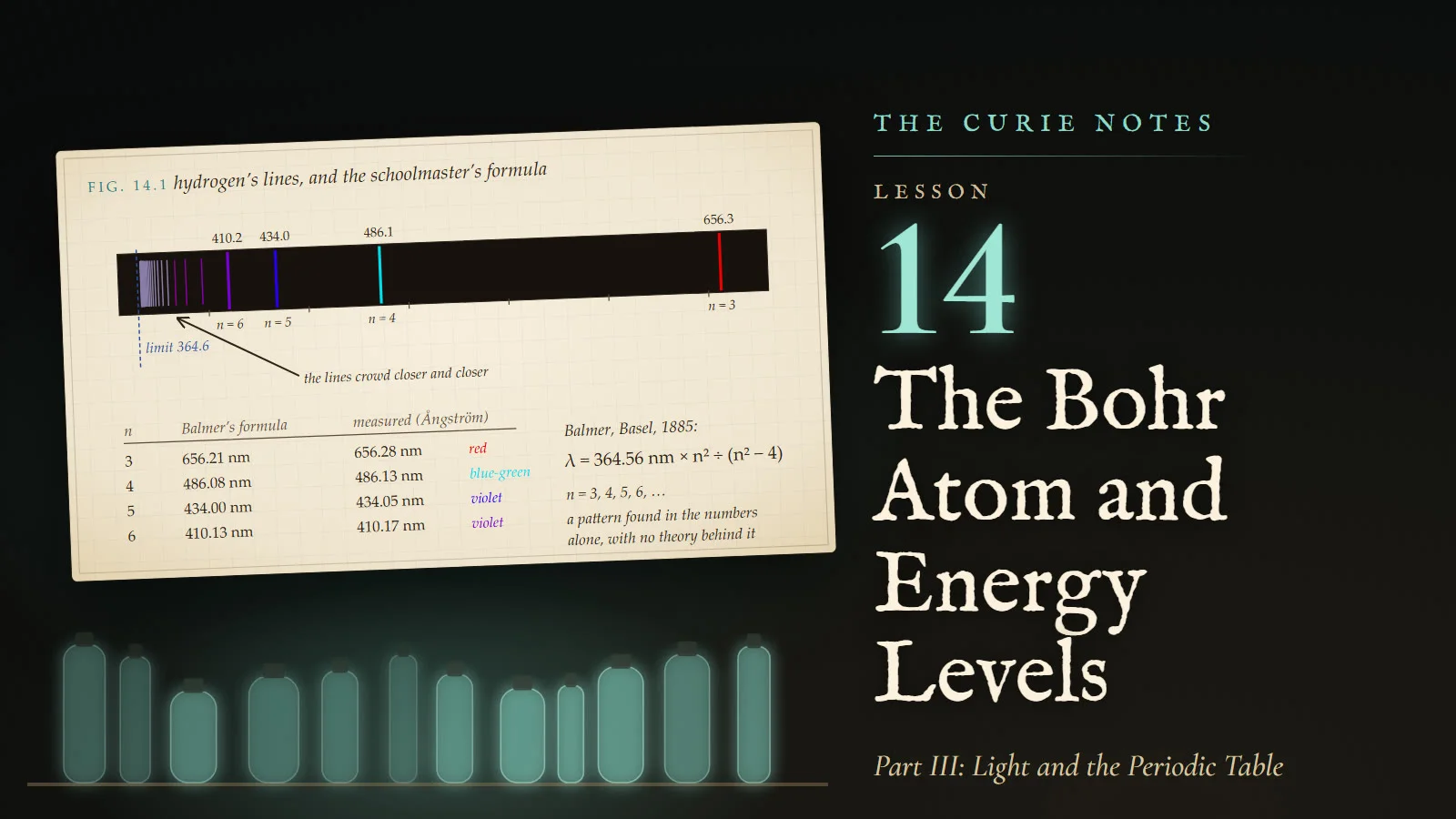
On my table today there is a glass tube filled with hydrogen at low pressure, with a metal wire sealed into each end. When I connect it to an induction coil, the gas glows a soft pinkish violet. Through the spectroscope that glow is four bright lines: a red one, a blue-green one and two violet ones, always in the same places. In the last lesson we learned to read such lines as an element's fingerprint. In this lesson we ask why they are there at all. Why does hydrogen give out exactly these wavelengths and no others? The answer, found by a young Dane in 1913, gives us a picture of the inside of the atom. By the end you will be able to calculate every line of hydrogen yourself.
Humanity, surely, needs practical men who make the best of their work for the sake of their own interests, without forgetting the general interest. But it also needs dreamers, for whom the unselfish following of a purpose is so imperative that it becomes impossible for them to devote much attention to their own material benefit.
Marie Curie, Autobiographical Notes, 1923
What you will learn
- Use the Rydberg formula to calculate the wavelengths of hydrogen's lines.
- State Bohr's three ideas: allowed orbits, energy levels \(E_n = -13.6\,\mathrm{eV}/n^2\), and light given out or taken in only in jumps.
- Calculate the energy and wavelength of the photon for any jump in hydrogen.
- Tell emission from absorption, and name the Lyman, Balmer and Paschen series.
- Calculate the ionisation energy of hydrogen, per atom and per mole.
- Explain what Bohr's model cannot do, and why chemists still use it.
What you need first: Lesson 4, Inside the Atom: Electrons, Nuclei and Isotopes; Lesson 5, The Mole, or Counting Atoms by Weighing; Lesson 13, Light and Spectra: The Fingerprints of the Elements.
The puzzle of hydrogen's lines
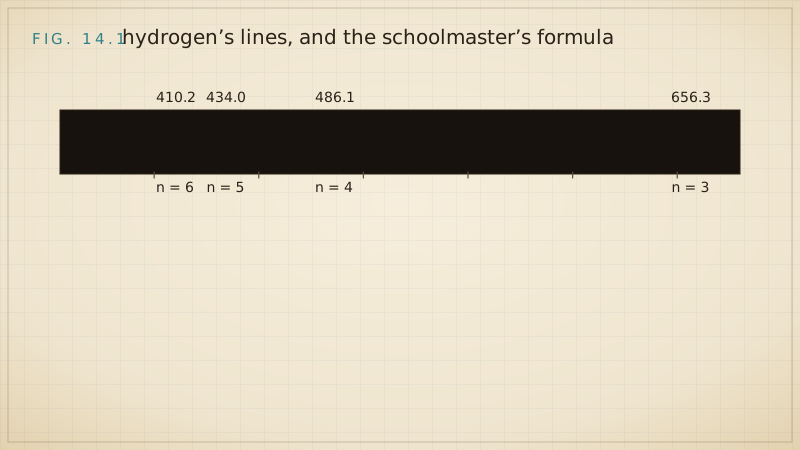
Hydrogen is the simplest atom: one proton in the nucleus and one electron around it. You would expect its spectrum to be the simplest too, and it is. In the visible region it has just four strong lines. The Swedish physicist Anders Ångström measured them carefully in the 1860s. Today we give them as
- 656.3 nm, red;
- 486.1 nm, blue-green;
- 434.0 nm, violet;
- 410.2 nm, deep violet.
Photographs later showed more lines beyond the violet, in the ultraviolet, each closer to the next, crowding together toward a limit near 364.6 nm.
Look at those four numbers. They seem to have nothing to do with one another. For twenty years after Ångström nobody could see a pattern. Then, in 1885, Johann Jakob Balmer, a schoolmaster who taught mathematics at a girls' school in Basel, found one. He was nearly sixty and was not a physicist. He simply played with the numbers until they gave way.
Balmer found that every one of the lines obeys
\[ \lambda = 364.56\,\mathrm{nm} \times \frac{n^2}{n^2 - 4} \]
where \(n\) is a whole number: 3 for the red line, 4 for the blue-green, 5 and 6 for the violets. Try it for \(n = 3\): \(n^2 = 9\), so \(\lambda = 364.56 \times 9/5 = 656.21\,\mathrm{nm}\). Ångström measured 656.28 nm. The agreement for all four lines is within a few hundredths of a nanometre. And as \(n\) grows very large, \(n^2/(n^2 - 4)\) comes closer and closer to 1, so the lines crowd toward 364.56 nm. That is the limit seen in the photographs.
The Rydberg formula
In 1888 Johannes Rydberg, at Lund in Sweden, wrote Balmer's rule in a better form. He worked with one over the wavelength, \(1/\lambda\), which is the number of waves in one metre. His formula is
\[ \frac{1}{\lambda} = R_\mathrm{H}\left(\frac{1}{n_1^2} - \frac{1}{n_2^2}\right) \]
Here \(R_\mathrm{H} = 1.097 \times 10^{7}\,\mathrm{m^{-1}}\) is the Rydberg constant for hydrogen, and \(n_1\) and \(n_2\) are whole numbers with \(n_2\) larger than \(n_1\). Balmer's visible lines are the case \(n_1 = 2\). Rydberg's form suggested more: there should be other families of lines with \(n_1 = 1\), \(n_1 = 3\) and so on. They were found. Theodore Lyman at Harvard found the family with \(n_1 = 1\) in the ultraviolet, between 1906 and 1914. Friedrich Paschen found the family with \(n_1 = 3\) in the infrared in 1908.
Worked example 1
Use the Rydberg formula to find the wavelength of hydrogen's red line, for which \(n_1 = 2\) and \(n_2 = 3\).
- Write the formula: \(1/\lambda = R_\mathrm{H}(1/n_1^2 - 1/n_2^2)\).
- Square the whole numbers: \(n_1^2 = 4\) and \(n_2^2 = 9\).
- Work the bracket: \(1/4 - 1/9 = 0.2500 - 0.1111 = 0.1389\). (Exactly, it is \(9/36 - 4/36 = 5/36\).)
- Multiply by the constant: \(1/\lambda = 1.097 \times 10^{7}\,\mathrm{m^{-1}} \times 0.1389 = 1.524 \times 10^{6}\,\mathrm{m^{-1}}\).
- Turn it over: \(\lambda = 1/(1.524 \times 10^{6}\,\mathrm{m^{-1}}) = 6.563 \times 10^{-7}\,\mathrm{m}\).
- In nanometres: \(656.3\,\mathrm{nm}\).
Check: the measured line is at 656.3 nm. The units are right too: one over "per metre" is metres.
A common mistake
Students forget the last step and give \(1.524 \times 10^{6}\) as the wavelength. That number is \(1/\lambda\), the number of waves in a metre, and its unit is per metre. Always turn it over at the end. Another mistake is to square after subtracting. Square each whole number first, take one over each, and only then subtract.
Balmer and Rydberg gave a rule that worked perfectly. They could not say why it worked. A formula that fits is a description. Physics wants the reason.
Why the old physics could not explain it
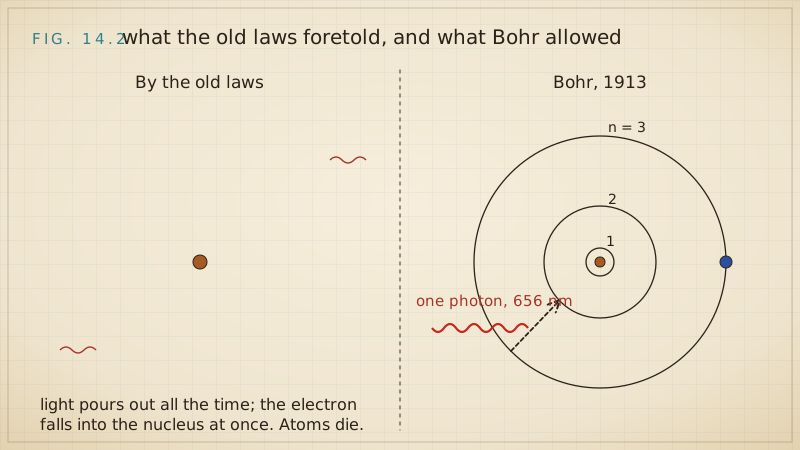
In 1911 Ernest Rutherford showed that an atom has a tiny, heavy, positive nucleus with electrons somewhere around it (Lesson 4). The obvious picture was a small solar system: the electron circling the nucleus as the Earth circles the sun, held by electric attraction.
But the old physics, the physics of Maxwell, said that a charge moving in a circle must radiate light continuously. Radiating, it must lose energy. Losing energy, it must sink closer to the nucleus, circling faster, radiating at ever higher frequency, until it falls in. The calculation gave a lifetime far shorter than a millionth of a second. By those laws every atom should collapse at once, and while collapsing it should give out a smear of all frequencies, a continuous spectrum. Instead atoms last for ever, and hydrogen gives sharp lines. Something in the old physics was wrong for atoms.
Bohr's atom
Niels Bohr was a young Danish physicist who spent 1912 in Rutherford's laboratory in Manchester. He believed in Rutherford's nucleus, and he knew Planck's and Einstein's quanta. Early in 1913 a colleague showed him Balmer's formula. He said later that as soon as he saw it, the whole thing became clear to him. That summer he published his model of the hydrogen atom. It rests on three ideas.
- Allowed orbits. The electron can move only on certain orbits, numbered \(n = 1, 2, 3, \ldots\) While it stays on one, it does not radiate, whatever the old laws say. Bohr called these stationary states. The number \(n\) is the quantum number.
- Fixed energies. Each orbit has a definite energy. For hydrogen, \(E_n = -2.18 \times 10^{-18}\,\mathrm{J}/n^2\). The lowest, \(n = 1\), is the ground state. The others are excited states.
- Light only in jumps. The electron can jump from one orbit to another. When it falls from a higher level to a lower one, it gives out one photon whose energy is exactly the difference between the two levels: \(E_\mathrm{photon} = E_\mathrm{upper} - E_\mathrm{lower} = h\nu\). To rise, it must take in a photon of exactly that energy.
The radii of the allowed orbits come out as \(r_n = n^2 \times 0.0529\,\mathrm{nm}\). The smallest orbit, 0.0529 nm, is called the Bohr radius. The next is four times larger, 0.212 nm; the third nine times, 0.476 nm. The atom swells quickly as the electron is lifted.
The electronvolt
Energies of single atoms are tiny in joules, so physicists use a smaller unit. The electronvolt (eV) is the energy an electron gains when it is pushed through a potential difference of one volt: \(1\,\mathrm{eV} = 1.602 \times 10^{-19}\,\mathrm{J}\). In electronvolts Bohr's energies are
\[ E_n = -\frac{13.6\,\mathrm{eV}}{n^2} \]
Check that the two forms agree: \(13.6 \times 1.602 \times 10^{-19}\,\mathrm{J} = 2.18 \times 10^{-18}\,\mathrm{J}\). They do.
Why the energies are negative
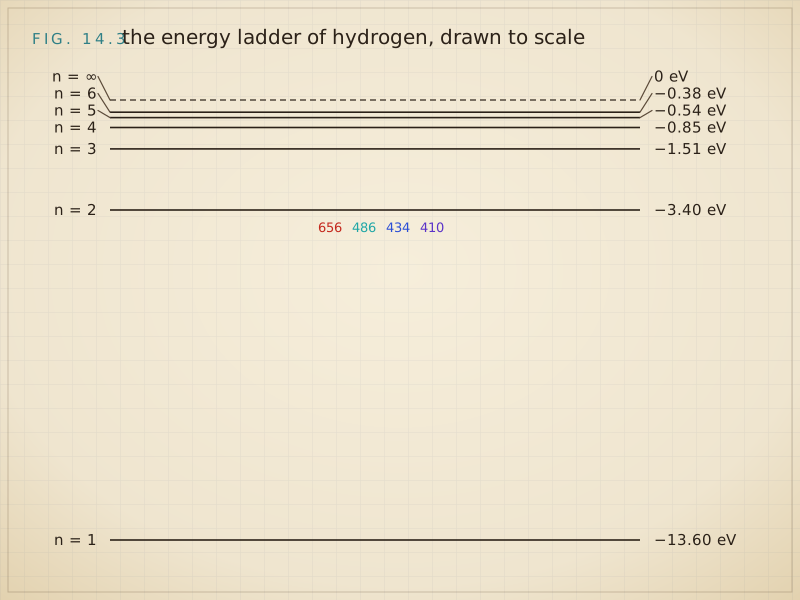
We choose zero to mean the electron completely free, at rest, far from the nucleus. A bound electron has less energy than a free one, because we must supply energy to pull it away. So every bound energy is below zero, that is, negative. The ground state is the most negative, \(-13.6\,\mathrm{eV}\). As \(n\) grows the energies rise toward zero: \(-3.40\), \(-1.51\), \(-0.85\,\mathrm{eV}\).
An analogy from Warsaw
In the courtyards of old Warsaw there were wells. Measure every height from the top of the well, at street level, and call that height zero. A bucket at the bottom of the well is then at a negative height, say minus ten metres. To bring it out, you must lift it ten metres, and the work you do is set by that depth. An electron in an atom is a bucket in a well. Zero is the street, where it is free. The ground state is the bottom of the well. The ionisation energy, which we meet below, is the work of winding the bucket all the way up.
Worked example 2
Find the energies of the levels \(n = 1\), 2 and 3 of hydrogen, in electronvolts and in joules.
- For \(n = 1\): \(n^2 = 1\), so \(E_1 = -13.6\,\mathrm{eV}\), or \(-2.18 \times 10^{-18}\,\mathrm{J}\).
- For \(n = 2\): \(n^2 = 4\), so \(E_2 = -13.6/4 = -3.40\,\mathrm{eV}\), or \(-2.18 \times 10^{-18}/4 = -5.45 \times 10^{-19}\,\mathrm{J}\).
- For \(n = 3\): \(n^2 = 9\), so \(E_3 = -13.6/9 = -1.51\,\mathrm{eV}\), or \(-2.18 \times 10^{-18}/9 = -2.42 \times 10^{-19}\,\mathrm{J}\).
Check: the gap from 1 to 2 is \(10.2\,\mathrm{eV}\); from 2 to 3 it is only \(1.89\,\mathrm{eV}\). The levels crowd together as they rise, exactly as the lines crowd in the spectrum.
An analogy from my Paris
When I was a student I lived in a garret up six flights of stairs in the Latin Quarter. Picture instead a strange staircase. You may stand on any step but never between two steps. The first step up from the ground floor is enormous; each one after it is smaller, and near the top they are so shallow that they almost merge. At the top is the door to the roof: go through it and you are free. Coming down, you may drop one step or several at once, and each drop gives off a definite amount of energy, set by the heights of the two steps. Hydrogen's electron lives on such a staircase. Each drop sends out one photon, and the size of the drop fixes its colour.
Jumps, photons and series
Now we can calculate a line from Bohr's levels. The photon's energy is the difference of two levels:
\[ \Delta E = E_\mathrm{upper} - E_\mathrm{lower} = 2.18 \times 10^{-18}\,\mathrm{J}\left(\frac{1}{n_\mathrm{lower}^2} - \frac{1}{n_\mathrm{upper}^2}\right) \]
Then, from Lesson 13, the wavelength is \(\lambda = hc/\Delta E\).
Worked example 3
An electron in hydrogen falls from \(n = 3\) to \(n = 2\). Find the energy of the photon and its wavelength.
- The bracket: \(1/2^2 - 1/3^2 = 1/4 - 1/9 = 0.2500 - 0.1111 = 0.1389\).
- The energy: \(\Delta E = 2.18 \times 10^{-18}\,\mathrm{J} \times 0.1389 = 3.028 \times 10^{-19}\,\mathrm{J}\).
- In electronvolts: \(3.028 \times 10^{-19}\,\mathrm{J} \div 1.602 \times 10^{-19}\,\mathrm{J/eV} = 1.89\,\mathrm{eV}\). (Or directly: \(3.40 - 1.51 = 1.89\,\mathrm{eV}\).)
- For the wavelength we need \(hc = (6.626 \times 10^{-34}\,\mathrm{J\,s})(3.00 \times 10^{8}\,\mathrm{m/s}) = 1.988 \times 10^{-25}\,\mathrm{J\,m}\).
- \(\lambda = hc/\Delta E = 1.988 \times 10^{-25}\,\mathrm{J\,m} \div 3.028 \times 10^{-19}\,\mathrm{J} = 6.565 \times 10^{-7}\,\mathrm{m}\).
- In nanometres: \(656.5\,\mathrm{nm}\), red.
Check: the measured red line is at 656.3 nm. The small difference comes from rounding our constants to three or four figures. Bohr's picture has given us Balmer's red line from the inside of the atom.
Why Bohr's levels give Rydberg's formula
Put the two steps of Worked example 3 together. Since \(1/\lambda = \Delta E/(hc)\),
\[ \frac{1}{\lambda} = \frac{2.18 \times 10^{-18}\,\mathrm{J}}{hc}\left(\frac{1}{n_1^2} - \frac{1}{n_2^2}\right) \]
This is exactly Rydberg's formula, with \(R_\mathrm{H} = 2.18 \times 10^{-18}\,\mathrm{J} \div 1.988 \times 10^{-25}\,\mathrm{J\,m} = 1.097 \times 10^{7}\,\mathrm{m^{-1}}\). The whole numbers in Balmer's and Rydberg's formulas are the numbers of Bohr's orbits. And there is more. Bohr did not take the 13.6 eV from the spectrum. He calculated it from the charge and mass of the electron and from Planck's constant, and it agreed with Rydberg's measured constant. That is when the physicists began to believe him.
The series
Every line of hydrogen belongs to a family, called a series, named by the level where the electron lands.
- Falls to \(n = 1\): the Lyman series. These are big drops, 10.2 eV and more, so the photons are ultraviolet, from 121.6 nm down to a limit at 91.2 nm.
- Falls to \(n = 2\): the Balmer series. The first four lines are visible: \(3 \to 2\) at 656 nm, \(4 \to 2\) at 486 nm, \(5 \to 2\) at 434 nm, \(6 \to 2\) at 410 nm. The rest are in the near ultraviolet, crowding toward 364.6 nm.
- Falls to \(n = 3\): the Paschen series, in the infrared, from 1875 nm down to 820 nm.
Two more were found in my lifetime: the Brackett series (to \(n = 4\), 1922) and the Pfund series (to \(n = 5\), 1924), both farther in the infrared.
Worked example 4
Find the wavelength of the first line of the Lyman series, the fall from \(n = 2\) to \(n = 1\).
- The bracket: \(1/1^2 - 1/2^2 = 1 - 0.25 = 0.75\).
- The energy: \(\Delta E = 2.18 \times 10^{-18}\,\mathrm{J} \times 0.75 = 1.635 \times 10^{-18}\,\mathrm{J}\), which is 10.2 eV.
- The wavelength: \(\lambda = 1.988 \times 10^{-25}\,\mathrm{J\,m} \div 1.635 \times 10^{-18}\,\mathrm{J} = 1.216 \times 10^{-7}\,\mathrm{m} = 121.6\,\mathrm{nm}\).
Check: 121.6 nm is shorter than 380 nm, so it is ultraviolet, as every Lyman line must be. The photon carries \(0.75/0.1389 = 5.4\) times the energy of the red Balmer photon, and its wavelength is 5.4 times shorter: \(656.5/121.6 = 5.4\).
Emission and absorption
When the electron falls, a photon is given out: emission. This happens in a hot gas or an electric discharge, where collisions keep lifting electrons to higher levels, and they fall back. When light of all colours passes through cool hydrogen, nearly all the atoms sit in the ground state. An atom can take in a photon only if its energy exactly equals the gap to a higher level: absorption. Now you see why Kirchhoff's dark lines fall exactly where the bright lines are. The same gaps between the same levels decide both.
A common mistake
Students think an atom in the ground state can take in any photon with enough energy to reach a higher level, keeping the change. It cannot. A photon of 11.0 eV meets a hydrogen atom whose first gap is 10.2 eV and whose second is 12.1 eV. There is no level 11.0 eV up, so the atom ignores the photon and it passes by. The jump must fit exactly. Only above 13.6 eV, when the electron is torn right out of the atom, can any larger amount be taken, because a free electron may move off with any speed.
Try it
Plate 14.1 is hydrogen's ladder. Choose an upper and a lower level, and watch the electron fall and the photon leave. Each line you make is kept on the photographic plate at the bottom, which runs from the ultraviolet to the infrared. Press "Balmer's four" to see the visible lines together, then try falls to \(n = 1\) and \(n = 3\) and see where they land. Press "Absorb" to send the electron up instead.
Plate 14.2 shows each series by itself. Choose a series and raise the upper level. The lines march toward the series limit and never pass it. Rydberg's formula is worked with your numbers under the strip.
Ionisation energy
The ionisation energy is the energy needed to remove an electron completely from an atom in its ground state. For hydrogen this means lifting the electron from \(n = 1\) all the way to \(n = \infty\), where its energy is zero.
Worked example 5
Find the ionisation energy of hydrogen, per atom in joules and in electronvolts, and per mole in kJ/mol.
- Start: \(E_1 = -2.18 \times 10^{-18}\,\mathrm{J}\). End: \(E_\infty = 0\).
- Energy needed: \(0 - (-2.18 \times 10^{-18}\,\mathrm{J}) = 2.18 \times 10^{-18}\,\mathrm{J}\) per atom, which is 13.6 eV.
- Per mole: \(2.18 \times 10^{-18}\,\mathrm{J} \times 6.022 \times 10^{23}\,\mathrm{mol^{-1}} = 1.313 \times 10^{6}\,\mathrm{J/mol}\).
- In kilojoules: \(1313\,\mathrm{kJ/mol}\).
Check: the measured ionisation energy of hydrogen is 1312 kJ/mol. Compare it with Lesson 13: a mole of yellow photons carries about 203 kJ. To ionise hydrogen you need ultraviolet light shorter than 91.2 nm, the Lyman limit.
Notice what the series limits mean. The limit of the Lyman series, 91.2 nm, is the photon for a fall from \(n = \infty\) to \(n = 1\): it is the ionisation energy turned into light. The Balmer limit, 364.6 nm, is the energy to free an electron from \(n = 2\): \(2.18 \times 10^{-18}/4 = 5.45 \times 10^{-19}\,\mathrm{J}\), or 3.40 eV. So a spectroscopist who measures a series limit has measured an ionisation energy.
Margin
Bohr's model also works for any atom that has kept only one electron, such as helium that has lost one of its two, \(\ce{He+}\). The nucleus then has charge \(Z\), and every energy is multiplied by \(Z^2\): \(E_n = -13.6\,\mathrm{eV} \times Z^2/n^2\). In 1896 Edward Pickering in America had seen a series of lines in the light of a star that nobody could place. Bohr showed in 1913 that they come from \(\ce{He+}\), and laboratory tests soon agreed. It was one of the first proofs that he was right.
In my laboratory
I trust a new idea when a second, independent measurement confirms it. Bohr's levels had that confirmation within a year. In 1914, in Berlin, James Franck and Gustav Hertz fired electrons through mercury vapour and measured how much energy the electrons lost. They lost none at all, or 4.9 eV at once, never anything in between. And the mercury then glowed with ultraviolet light of 253.7 nm. Check it: \(hc/(4.9\,\mathrm{eV}) = 1.988 \times 10^{-25}\,\mathrm{J\,m} \div (4.9 \times 1.602 \times 10^{-19}\,\mathrm{J}) = 2.53 \times 10^{-7}\,\mathrm{m}\), or 253 nm. Two methods, one by light and one by collisions, gave the same step. That is how a measurement becomes a fact.
The same idea of levels reaches into my own subject. The X-rays of my war cars include sharp lines that come from electrons falling between the deep inner levels of the metal in the tube. In 1913 Henry Moseley used those lines, and Bohr's reasoning, to show that each element has its own atomic number.
Now practise the calculations. Exercise 14.3 gives new levels each time you ask.
What Bohr's model cannot do
Bohr's model is a triumph for hydrogen. It is also, as Bohr himself knew from the start, a patch: it forbids the electron to radiate on its orbit, but gives no reason. Its failures soon appeared.
- It fails for helium and every atom with more than one electron. When two electrons push on each other, Bohr's rules give the wrong lines.
- It cannot say why some lines are bright and others faint.
- Under a fine spectroscope many of hydrogen's lines split into close pairs. Arnold Sommerfeld in 1916 added elliptical orbits to explain this, which helped for a while.
- Above all, it gives the electron a definite path, like a planet. In 1927 Werner Heisenberg showed that we can never know an electron's position and speed exactly at the same time. The neat circular track does not exist.
The new mechanics that replaced Bohr's orbits came quickly. In 1924 Louis de Broglie, here in Paris, proposed in his thesis that the electron has a wave nature. In 1926 Erwin Schrödinger wrote the equation for that wave. Bohr's energies for hydrogen, \(-13.6\,\mathrm{eV}/n^2\), come out of Schrödinger's equation exactly. The orbits do not; they are replaced by clouds of probability, which we shall study in the next lesson.
An analogy from my Paris
Since 1900 we have had the Métro under Paris. Its map shows the lines as clean coloured strokes and the stations as neat dots, evenly spaced. The real tunnels bend and twist, and the stations are anything but evenly spaced. Yet with the map you will never get off at the wrong station. Bohr's model is a map of that kind. The circular orbits are not the real roads of the electron. But the stations, the energy levels, are in exactly the right places for hydrogen, and with them you can calculate every line. A model is a tool, and a good tool is used for as long as it does its work.
Margin
I knew Bohr from the Solvay conferences in Brussels. In October 1927 we were there together, and for days he and Einstein argued about what the new mechanics really meant, Einstein proposing one clever objection after another and Bohr answering each. I listened more than I spoke. Whatever the theorists decided, the measured lines stayed exactly where they were.
What to remember
- Hydrogen's visible lines (656.3, 486.1, 434.0, 410.2 nm) fit Balmer's formula, and all its lines fit Rydberg's: \(1/\lambda = R_\mathrm{H}(1/n_1^2 - 1/n_2^2)\), \(R_\mathrm{H} = 1.097 \times 10^{7}\,\mathrm{m^{-1}}\).
- Bohr (1913): the electron has allowed orbits with fixed energies, and gives no light while on one.
- Hydrogen's levels: \(E_n = -13.6\,\mathrm{eV}/n^2 = -2.18 \times 10^{-18}\,\mathrm{J}/n^2\). Zero is the free electron.
- \(1\,\mathrm{eV} = 1.602 \times 10^{-19}\,\mathrm{J}\).
- A jump gives or takes one photon: \(\Delta E = E_\mathrm{upper} - E_\mathrm{lower} = h\nu\), and \(\lambda = hc/\Delta E\).
- Falls to \(n = 1\): Lyman (ultraviolet). To \(n = 2\): Balmer (visible). To \(n = 3\): Paschen (infrared).
- Absorption happens only for photons that fit a gap exactly, so dark and bright lines coincide.
- Ionisation energy of hydrogen: 13.6 eV per atom, 1312 kJ/mol. A series limit is an ionisation energy turned into light.
- Bohr's model works for one-electron atoms only; its energies survive in modern quantum mechanics, its orbits do not.
Problems for your notebook
Problem 1. What is the energy of hydrogen's level \(n = 4\), in electronvolts and in joules?
Answer. \(n^2 = 16\). \(E_4 = -13.6/16 = -0.850\,\mathrm{eV}\). In joules, \(E_4 = -2.18 \times 10^{-18}/16 = -1.36 \times 10^{-19}\,\mathrm{J}\). Check: \(0.850 \times 1.602 \times 10^{-19} = 1.36 \times 10^{-19}\).
Problem 2. Calculate from Bohr's levels the wavelength of the blue-green line, the fall from \(n = 4\) to \(n = 2\).
Answer.
- Bracket: \(1/4 - 1/16 = 0.2500 - 0.0625 = 0.1875\).
- \(\Delta E = 2.18 \times 10^{-18}\,\mathrm{J} \times 0.1875 = 4.088 \times 10^{-19}\,\mathrm{J}\).
- \(\lambda = 1.988 \times 10^{-25}\,\mathrm{J\,m} \div 4.088 \times 10^{-19}\,\mathrm{J} = 4.863 \times 10^{-7}\,\mathrm{m} = 486.3\,\mathrm{nm}\). The measured line is at 486.1 nm.
Problem 3. Use the Rydberg formula to find the wavelength of the first Paschen line, \(n = 4 \to n = 3\). In which part of the spectrum is it?
Answer. \(1/9 - 1/16 = 0.11111 - 0.06250 = 0.04861\). Then \(1/\lambda = 1.097 \times 10^{7}\,\mathrm{m^{-1}} \times 0.04861 = 5.333 \times 10^{5}\,\mathrm{m^{-1}}\), so \(\lambda = 1.875 \times 10^{-6}\,\mathrm{m} = 1875\,\mathrm{nm}\). That is longer than 750 nm: infrared, invisible to the eye.
Problem 4. Cool hydrogen absorbs ultraviolet light of wavelength 97.3 nm. To which level does the electron jump from the ground state?
Answer.
- Photon energy: \(E = hc/\lambda = 1.988 \times 10^{-25}\,\mathrm{J\,m} \div 9.73 \times 10^{-8}\,\mathrm{m} = 2.043 \times 10^{-18}\,\mathrm{J}\).
- This must equal \(2.18 \times 10^{-18}\,\mathrm{J} \times (1 - 1/n^2)\). Divide: \(1 - 1/n^2 = 2.043/2.18 = 0.937\).
- So \(1/n^2 = 0.063\), and \(n^2 = 1/0.063 = 15.9\), which is 16 within rounding.
- \(n = 4\). The electron jumps from \(n = 1\) to \(n = 4\).
Problem 5. For the ion \(\ce{He+}\) (one electron, nuclear charge \(Z = 2\)), find the ionisation energy in eV and the wavelength of the fall from \(n = 4\) to \(n = 3\).
Answer.
- Every energy is \(Z^2 = 4\) times hydrogen's. Ionisation energy: \(4 \times 13.6 = 54.4\,\mathrm{eV}\).
- Jump: \(\Delta E = 4 \times 2.18 \times 10^{-18}\,\mathrm{J} \times (1/9 - 1/16) = 8.72 \times 10^{-18}\,\mathrm{J} \times 0.04861 = 4.239 \times 10^{-19}\,\mathrm{J}\).
- \(\lambda = 1.988 \times 10^{-25}\,\mathrm{J\,m} \div 4.239 \times 10^{-19}\,\mathrm{J} = 4.690 \times 10^{-7}\,\mathrm{m} = 469.0\,\mathrm{nm}\).
- The measured line of ionised helium is at 468.6 nm, a blue line that puzzled spectroscopists until Bohr.
After my time
The wave mechanics that replaced Bohr's orbits became the foundation of all chemistry after 1927, and you will meet it in the next lesson. Later measurements of hydrogen were so fine that even the quantum mechanics of my day needed correcting. In 1947 Willis Lamb found that two levels which theory said should have exactly equal energy differ very slightly, and the new theory of light and electrons, called quantum electrodynamics, explained the difference.
Hydrogen's spectrum is now measured more precisely than almost anything else in science. The Rydberg constant is known to about one part in a million million. Astronomers use its lines to study stars and to map the hydrogen gas between them. Bohr's simple picture remains the first thing every chemistry student learns about the inside of the atom.
If you would like to work through another jump, or to know more about Bohr and those arguments in Brussels, come and ask me. In the next lesson, Orbitals and Electron Configurations, we replace the orbits with clouds and learn how the electrons of every atom are arranged.
Sources and liberties
The Curie Notes are a modern chemistry course written in Marie Curie's voice by Eternal Gardens. The chemistry is standard modern chemistry; dates, people, apparatus and quotations come from the sources below; the teaching, the analogies and the private remarks are our reconstruction.
- Marie Curie, Pierre Curie, with Autobiographical Notes (1923), Project Gutenberg
- American Institute of Physics, Marie Curie and the Science of Radioactivity
- OpenStax, Chemistry 2e, chapter 6: The Bohr Model
- NIST Atomic Spectra Database (hydrogen line wavelengths)
- NIST, CODATA values of the fundamental physical constants
- The Nobel Prize in Physics 1922: Niels Bohr
Bohr's remark on first seeing Balmer's formula comes from his own recollection many years later, and the account of the 1927 Solvay discussions is simplified.