


 by Marie Curie

Paris, November 1927. I am back from Brussels, where the physicists argued for a week about electrons, and on my desk at the Radium Institute lies a thin thesis from 1924 by a young Frenchman, Louis de Broglie. Beside it is a sheet of paper on which I have drawn little boxes and arrows. In the last lesson we used Bohr's atom, with its electrons on neat circles. Today we keep his energy levels and let go of his circles. You will learn where electrons really live, in clouds called orbitals, and how to write down the address of every electron in an atom. With that one skill, most of chemistry begins to make sense.
One never notices what has been done; one can only see what remains to be done.
Marie Curie, letter to her brother Józef, 1894, as quoted by Ève Curie in Madame Curie, 1937
What you will learn
- Explain in plain words why an electron behaves like a wave, and calculate its wavelength.
- Describe an orbital as a cloud of probability, and recognise the shapes of s, p and d orbitals.
- Use the four quantum numbers \(n\), \(l\), \(m_l\) and \(m_s\) to count orbitals and electrons in any shell.
- Fill orbitals in the right order with the Aufbau principle, the Pauli principle and Hund's rule.
- Write full electron configurations, noble-gas shorthand and orbital box diagrams, including the exceptions chromium and copper and simple ions.
- Count valence electrons and use them to see why radium behaves like barium.
What you need first: Lesson 4, Inside the Atom (protons, electrons, atomic number); Lesson 13, Light and Spectra (wavelength, frequency, photons); and Lesson 14, The Bohr Atom and Energy Levels (energy levels and the number n).
The electron as a wave
Bohr's atom of 1913 gave the right energies for hydrogen. It did so by a rule nobody could explain: only certain orbits were allowed. Why should nature forbid the orbits in between? For eleven years no one had a good answer.
The answer came from Paris. In 1924 Louis de Broglie defended his doctoral thesis at the Sorbonne. Light, he said, is a wave that also comes in particles, the photons of Lesson 13. Perhaps the reverse is true as well. Perhaps a particle such as the electron also behaves as a wave.
He gave the wave a definite length. The faster and heavier a particle, the shorter its wave. In words: the wavelength equals Planck's constant divided by the mass times the speed. Mass times speed is called the momentum. The rule is written
\[ \lambda = \dfrac{h}{m v} \]
Here \(\lambda\) is the wavelength in metres, \(h = 6.626 \times 10^{-34}\,\mathrm{J\,s}\) is Planck's constant, \(m\) is the mass in kilograms and \(v\) is the speed in metres per second. This is the de Broglie wavelength.
Worked example 1
In Bohr's smallest orbit, the electron of hydrogen moves at about \(2.19 \times 10^{6}\,\mathrm{m/s}\). The mass of an electron is \(9.109 \times 10^{-31}\,\mathrm{kg}\). What is its wavelength?
- Write the rule: \(\lambda = h/(mv)\).
- Find the momentum first: \(mv = (9.109 \times 10^{-31}\,\mathrm{kg}) \times (2.19 \times 10^{6}\,\mathrm{m/s}) = 1.995 \times 10^{-24}\,\mathrm{kg\,m/s}\).
- Divide: \(\lambda = (6.626 \times 10^{-34}\,\mathrm{J\,s}) / (1.995 \times 10^{-24}\,\mathrm{kg\,m/s})\).
- A joule is a \(\mathrm{kg\,m^2/s^2}\), so the units become metres. \(\lambda = 3.32 \times 10^{-10}\,\mathrm{m}\), which is 332 picometres.
- Compare with the orbit. Bohr's smallest orbit has radius 52.9 pm. Its circumference is \(2\pi \times 52.9\,\mathrm{pm} = 332\,\mathrm{pm}\).
Check: the wavelength and the circumference are the same, 332 pm. Exactly one electron wave fits around Bohr's first orbit. That is no accident, as the next note shows.
An analogy from my Paris
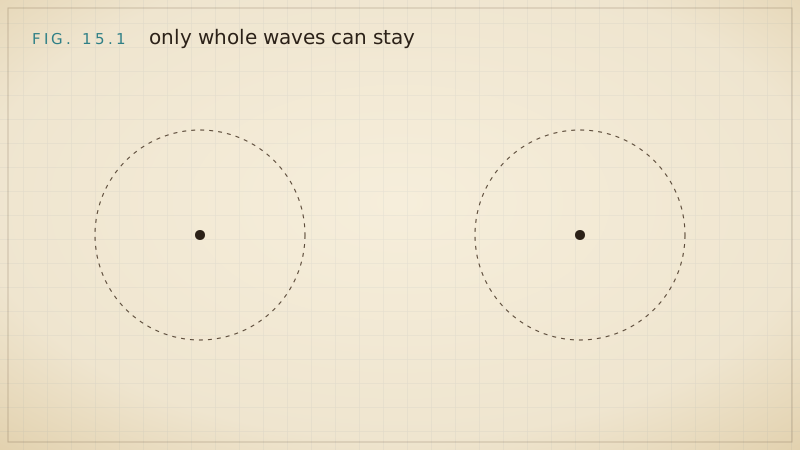
On the bridges of Paris a street violinist plays for coins. Pluck a string fixed at both ends and it does not wobble any old way. It vibrates in a standing wave: one hump, or two, or three, always a whole number, because each end must stay still. In between are points that never move at all; these are called nodes. A string cannot vibrate with two and a half humps.
De Broglie saw the electron in the same way. Bend the string into a ring around the nucleus. The wave must meet itself in step after one lap. If a whole number of wavelengths fits, the wave stands and the orbit is allowed. If not, each lap undoes the last and the wave destroys itself. Bohr's mysterious rule became the simple rule of a violin string.
A common mistake
Students ask why a cricket ball or a bicycle does not wave. It does, but the wave is far too short to notice. A cyclist and bicycle of 70 kg at 5 m/s have a momentum of 350 kg m/s. The wavelength is \(6.626 \times 10^{-34} / 350 = 1.9 \times 10^{-36}\,\mathrm{m}\). That is unimaginably smaller than an atom. Only very light particles, such as electrons, have waves as large as the things around them.
Margin
An idea in a thesis is only an idea. In 1927 Clinton Davisson and Lester Germer in New York, and George Paget Thomson in Aberdeen, sent electrons through crystals. The electrons spread into patterns of rings and spots, exactly as X-rays do. The waves were real. De Broglie received the Nobel Prize in Physics in 1929. I was glad that the new world opened in a Paris examination room.
From orbits to orbitals
If the electron is a wave, it cannot be a small ball on a thin circle. A wave is spread out. In 1926 Erwin Schrödinger in Zurich wrote an equation for the electron wave in an atom. I will not ask you to solve it. I will tell you what its answers mean.
Each answer is a standing wave in three dimensions, like the vibration of a drum skin, only filling space. Each one has a definite energy. These energies are Bohr's energy levels, so nothing you learned in Lesson 14 is lost. The new thing is the shape.
Max Born, also in 1926, explained what the wave measures. Where the wave is large, the electron is likely to be found. Where it is small, the electron is rarely found. Where it is zero, at a node, the electron is never found. The wave gives probability, not a path.
We call each of these three-dimensional standing waves an orbital. The word was proposed by Robert Mulliken in 1932, to sound like "orbit" while meaning something new. An orbital is a region of space around the nucleus where an electron of a given energy is likely to be found. When chemists draw an orbital, they draw the surface that holds about 90 or 95 per cent of the probability. My plates use 95.
An analogy from my Paris
Imagine a moth flying round a gas lamp on the boulevard at night. Leave a photographic plate open for an hour. The plate will not show one path. It will show a soft cloud, dense near the lamp where the moth spent most of its time, and fainter further out. You cannot say where the moth was at any instant, yet the cloud tells you exactly where it was likely to be.
An orbital is that cloud for an electron. The analogy has one flaw: the moth had a path we failed to record, while the electron, as far as we can tell, has none. The cloud is all there is.
Try it
Plate 15.1 draws the clouds. Each dot is one place where the electron might be found, scattered according to the real hydrogen orbitals. Choose 1s, then 2s, then a 2p orbital. Press Thin slice to cut the cloud through the nucleus: the nodes show as empty bands and planes. Drag the cloud to turn it. Press True sizes to see how much larger the third shell is than the first.
Four numbers for every electron
Every orbital is named by three whole numbers, and every electron in it by a fourth. These are the quantum numbers. Think of them as an address: the city, the street, the house and the room.
The principal quantum number, n. It is Bohr's n: 1, 2, 3 and so on. It tells the size and the main energy of the orbital. All orbitals with the same n form one shell. Larger n means larger orbitals, further from the nucleus.
The angular momentum quantum number, l. It tells the shape. For a shell with number n, l can take every whole value from 0 up to n − 1. Orbitals with the same n and the same l form a subshell. Each value of l has a letter:
- \(l = 0\) is an s subshell (spherical);
- \(l = 1\) is a p subshell (two lobes);
- \(l = 2\) is a d subshell (mostly four lobes);
- \(l = 3\) is an f subshell (more complicated still).
So shell 1 has only 1s. Shell 2 has 2s and 2p. Shell 3 has 3s, 3p and 3d. There is no 1p and no 2d, because l must be smaller than n.
The magnetic quantum number, \(m_l\). It tells which way the orbital points. It takes every whole value from −l to +l. For \(l = 1\) that is −1, 0, +1: three p orbitals, one along each axis. For \(l = 2\) it is −2, −1, 0, +1, +2: five d orbitals. In general a subshell has \(2l + 1\) orbitals.
The spin quantum number, \(m_s\). In 1925 two young Dutch physicists, George Uhlenbeck and Samuel Goudsmit, proposed that each electron spins like a tiny magnet. The spin can point only two ways, which we call up and down, with \(m_s = +\tfrac{1}{2}\) or \(m_s = -\tfrac{1}{2}\). This number belongs to the electron, not to the orbital.
Margin
The letters s, p, d and f are older than the quantum theory. Spectroscopists of the last century sorted the lines of the alkali metals into series they called sharp, principal, diffuse and fundamental. When the theory arrived, the first letters stayed on as names. Chemistry keeps many such fossils; I find them friendly.
Worked example 2
List the subshells and orbitals in the shell \(n = 3\). How many electrons can the shell hold?
- The values of l run from 0 to n − 1 = 2. So \(l = 0\), 1, 2: the subshells 3s, 3p and 3d.
- Orbitals in each: \(2l + 1\). For 3s, \(2 \times 0 + 1 = 1\). For 3p, \(2 \times 1 + 1 = 3\). For 3d, \(2 \times 2 + 1 = 5\).
- Total orbitals: \(1 + 3 + 5 = 9\).
- Each orbital holds two electrons (the reason comes in the next section). Electrons: \(9 \times 2 = 18\).
Check: the number of orbitals in shell n is always \(n^2\), here \(3^2 = 9\), and the number of electrons is \(2n^2 = 18\). The same counting gives 2 for shell 1, 8 for shell 2 and 32 for shell 4.
The shapes follow a simple count of nodes. An orbital has \(n - 1\) nodes in all. Of these, \(l\) are flat planes or cones through the nucleus, called angular nodes. The rest, \(n - l - 1\), are spheres, called radial nodes. A 2p orbital has one node, a plane. A 3s orbital has two nodes, both spheres. A 3d orbital has two nodes, both planes or cones.
A common mistake
The colours in the drawings are not positive and negative charge. An electron cloud is negative everywhere. The two colours mark the sign of the wave, the way the two sides of a violin string swing in opposite directions at the same instant. The sign will matter when we join orbitals into bonds in later lessons. For now, read the colours as "this side up, that side down".
Try it
Exercise 15.2 asks you to count orbitals, electrons and nodes, and to spot an address that cannot exist. Press New numbers for a fresh shell.
Three rules for filling
Now we build atoms. Hydrogen has one electron, helium two, lithium three, and so on up the table. Which orbitals do the electrons choose? Three rules decide.
The Aufbau principle
Aufbau is German for "building up". The rule: each new electron goes into the lowest-energy orbital that still has room. Electrons fill the ground floor before the stairs.
In hydrogen, every subshell of one shell has the same energy. In atoms with more electrons this is no longer true. The electrons push on one another, and an s electron, which spends some time very close to the nucleus, feels the nucleus more strongly than a p electron of the same shell. So within a shell, s lies lowest, then p, then d, then f.
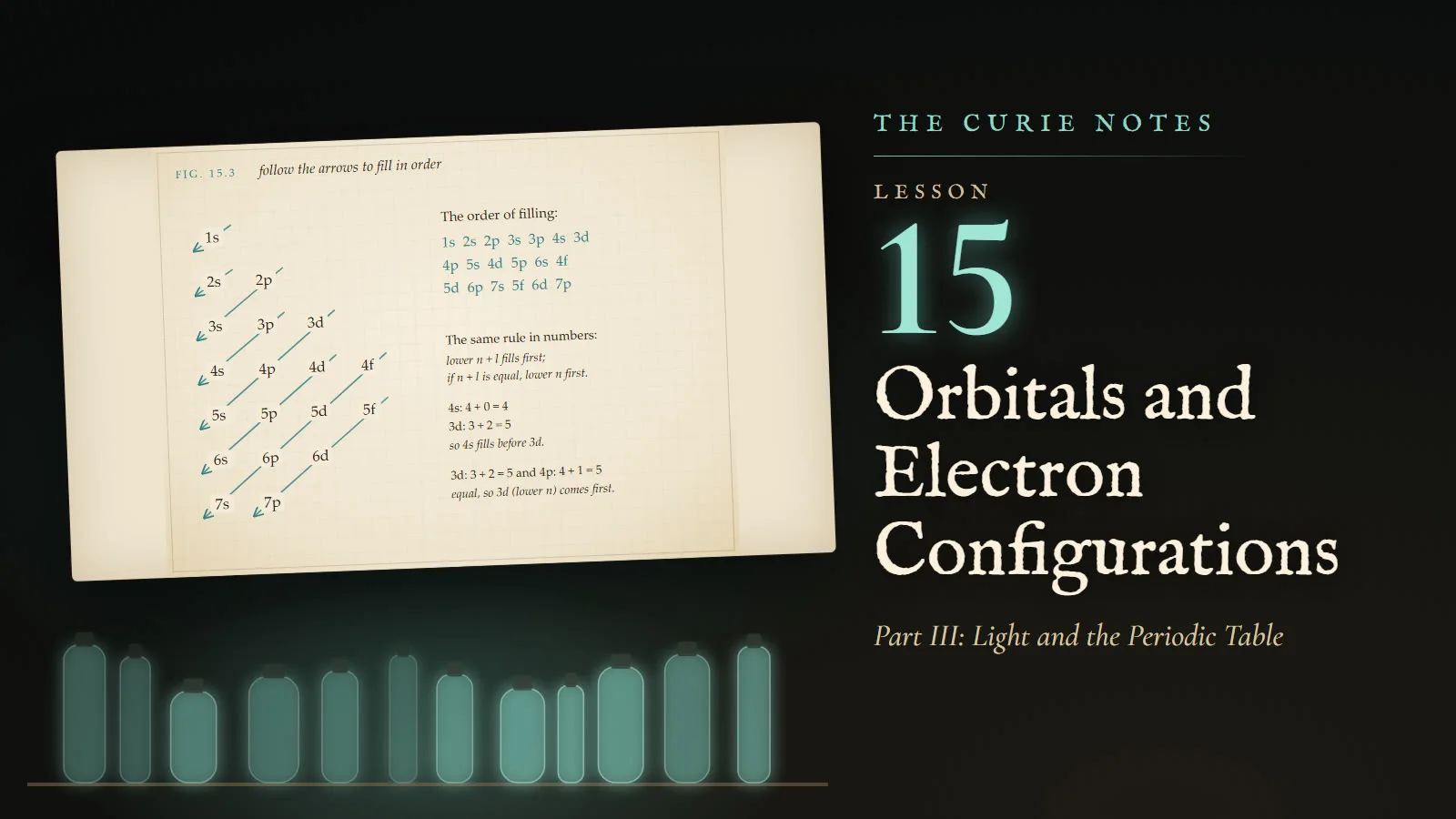
This creates one famous surprise. The 4s subshell lies a little lower than 3d, so 4s fills first. The full order is long, but there is a simple way to remember it. Write the subshells in rows, one row per shell, and read along the diagonals, as in Fig. 15.3.
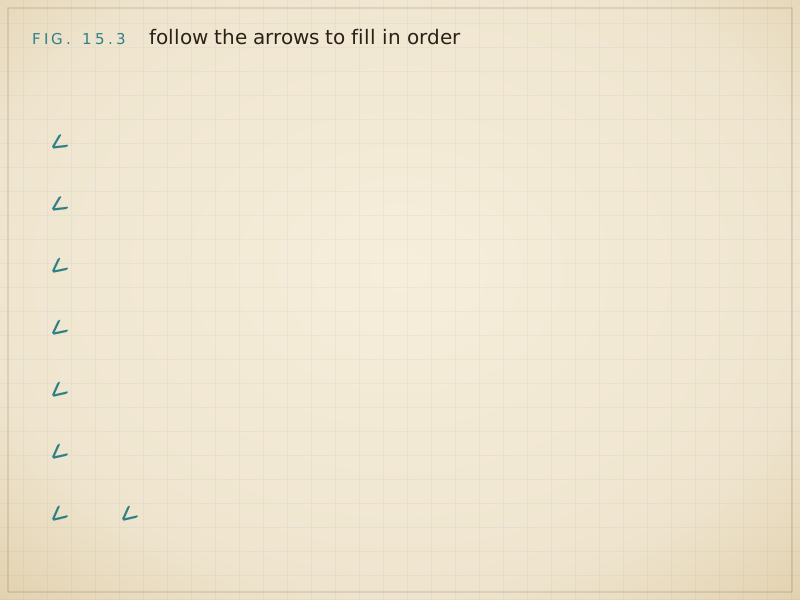
The same order follows from a small piece of arithmetic. Add n and l for each subshell. The subshell with the smaller sum fills first. If two sums are equal, the one with the smaller n fills first. For 4s, \(4 + 0 = 4\). For 3d, \(3 + 2 = 5\). So 4s comes before 3d. For 4p, \(4 + 1 = 5\), the same as 3d, and 3d has the smaller n, so 3d comes before 4p.
The Pauli principle
In 1925 Wolfgang Pauli, then in Hamburg, stated a rule that explained a great deal at once: no two electrons in one atom may have all four quantum numbers the same. Two electrons in the same orbital already share n, l and \(m_l\). So they must differ in spin: one up, one down. A third electron has nowhere to go. An orbital holds at most two electrons, and they must have opposite spins.
This is why the shells hold 2, 8, 18 and 32 electrons. It is why atoms do not all collapse into their 1s orbital. Without Pauli, every element would be chemically alike, and there would be no chemistry worth teaching.
Hund's rule
Friedrich Hund, in 1925, studied the spectra of atoms with partly filled subshells. He found that when several orbitals have the same energy, electrons spread out before they pair. Electrons enter empty orbitals of a subshell one at a time, with their spins pointing the same way, before any orbital receives a second electron. Two electrons in separate orbitals stay further apart and repel each other less, so this arrangement has lower energy.
An analogy from my Paris
Watch passengers climb into a Paris omnibus. The first takes an empty bench. So does the second, and the third, if there are three benches. Nobody sits beside a stranger while an empty bench remains. Only the fourth passenger, finding every bench taken, sits down next to someone. And two passengers sharing a bench sit facing a little apart, never both leaning the same way.
The benches are the orbitals of one subshell. The passengers are electrons. The empty benches first: that is Hund. At most two to a bench, turned opposite ways: that is Pauli.
Writing electron configurations
An electron configuration lists the occupied subshells in order, with the number of electrons in each written as a small raised number. For example, \(\mathrm{1s^{2}}\) means "two electrons in the 1s subshell". The raised number is a count, not a power.
The first atoms are simple. Hydrogen is \(\mathrm{1s^{1}}\). Helium is \(\mathrm{1s^{2}}\), which fills shell 1. Lithium is \(\mathrm{1s^{2}\,2s^{1}}\). Carbon, with six electrons, is \(\mathrm{1s^{2}\,2s^{2}\,2p^{2}}\). Neon, with ten, is \(\mathrm{1s^{2}\,2s^{2}\,2p^{6}}\), and shell 2 is full.
An orbital box diagram shows the same thing in more detail. Each orbital is a box; each electron is an arrow pointing up or down. The diagram shows Hund's rule at work, and lets you count unpaired electrons, those alone in an orbital.
Worked example 3
Write the electron configuration and the orbital box diagram of sulfur, \(Z = 16\). How many unpaired electrons does it have?
- A neutral sulfur atom has 16 electrons.
- Fill in order. 1s takes 2 (14 left). 2s takes 2 (12 left). 2p takes 6 (6 left). 3s takes 2 (4 left). 3p takes the last 4.
- Configuration: \(\mathrm{1s^{2}\,2s^{2}\,2p^{6}\,3s^{2}\,3p^{4}}\).
- Boxes: every box of 1s, 2s, 2p and 3s holds a pair. The 3p subshell has three boxes and four electrons.
- Hund: one electron in each of the three 3p boxes, spins up. The fourth electron pairs in the first box, spin down. The 3p boxes read: pair, single, single.
- Unpaired electrons: 2.
Check: the raised numbers add up to \(2 + 2 + 6 + 2 + 4 = 16\), which is Z. Always make this check.
Noble-gas shorthand
Long configurations repeat the same inner part again and again. Sulfur's first ten electrons, \(\mathrm{1s^{2}\,2s^{2}\,2p^{6}}\), are exactly the configuration of neon. So we write [Ne] for them: sulfur is \(\mathrm{[Ne]\,3s^{2}\,3p^{4}}\). This is the noble-gas shorthand. The bracket stands for the core electrons, the full inner shells; what follows are the outer electrons.
The cores you will use are [He] for 2 electrons, [Ne] for 10, [Ar] for 18, [Kr] for 36, [Xe] for 54 and [Rn] for 86. Always use the noble gas that comes just before the element.
Valence electrons
The valence electrons are the electrons in the outermost shell, the one with the largest n. They are the electrons that meet other atoms, so they decide most of an element's chemistry. Sulfur's outer shell is \(n = 3\), holding \(2 + 4 = 6\) electrons. Sulfur has six valence electrons, like oxygen above it, and that is why the two behave alike.
Worked example 4
Write iron (\(Z = 26\)) in noble-gas shorthand. Then write the ion \(\ce{Fe^3+}\), and count the unpaired electrons in each.
- The noble gas before iron is argon, \(Z = 18\). Write [Ar].
- Electrons left: \(26 - 18 = 8\).
- After argon comes 4s, which takes 2 (6 left). Then 3d takes the remaining 6.
- Iron: \(\mathrm{[Ar]\,4s^{2}\,3d^{6}}\).
- Boxes for 3d: five boxes, six electrons. One in each box (5), then the sixth pairs. Unpaired: 4.
- Now the ion. \(\ce{Fe^3+}\) has lost 3 electrons, so it has 23. Electrons leave the outermost shell first, and the outermost shell is \(n = 4\), even though 4s filled before 3d. Remove both 4s electrons, then one 3d electron.
- \(\ce{Fe^3+}\): \(\mathrm{[Ar]\,3d^{5}}\). Five d electrons in five boxes: 5 unpaired.
Check: \(18 + 5 = 23\) electrons, which is \(26 - 3\). Five unpaired electrons make the iron(III) ion strongly magnetic, as measurement confirms.
A common mistake
Students learn "4s fills before 3d" and conclude "4s empties after 3d". It is the other way round. Once the 3d subshell holds electrons, the 4s electrons lie further out and are the first to leave. So iron(II) is \(\mathrm{[Ar]\,3d^{6}}\), never \(\mathrm{[Ar]\,4s^{2}\,3d^{4}}\). Chemists write the configuration of a transition metal in either order, 4s then 3d or 3d then 4s; both are correct, so long as the counts are right.
Try it
Plate 15.3 is a ladder of orbital boxes. Tap a box to put in an electron with the spin you have chosen. Try to break the rules: put an electron in 2p before 2s is full, pair two electrons while a box stands empty, or give one box two arrows pointing up. The plate names the rule you broke. Then press Add by the rules and watch the table build itself, one electron at a time.
Exceptions and the noble cores
The rules work for most atoms. Two near the start of the transition metals disobey them, and you must know both.
Chromium, \(Z = 24\), should be \(\mathrm{[Ar]\,4s^{2}\,3d^{4}}\) by the rules. The real atom is \(\mathrm{[Ar]\,4s^{1}\,3d^{5}}\). One 4s electron moves into 3d, so that each of the five d orbitals holds exactly one electron.
Copper, \(Z = 29\), should be \(\mathrm{[Ar]\,4s^{2}\,3d^{9}}\). The real atom is \(\mathrm{[Ar]\,4s^{1}\,3d^{10}}\). Again one 4s electron moves, and the 3d subshell becomes full.
Why? The 4s and 3d levels are very close in energy here. A half-filled or completely filled d subshell has a special steadiness: its electrons are spread evenly and their spins line up in the most favourable way. The small cost of lifting one electron from 4s is repaid by that steadiness. Silver and gold, below copper, do the same thing; molybdenum, below chromium, does too. Further down the table there are more exceptions, but these two are the ones every student is asked.
In my laboratory
Now I can tell you, in the language of orbitals, why radium hid so faithfully inside barium for four years of crystallisations in the shed.
Barium, \(Z = 56\), is \(\mathrm{[Xe]\,6s^{2}}\). Radium, \(Z = 88\), is \(\mathrm{[Rn]\,7s^{2}}\). Each has a full noble-gas core with two s electrons outside it. Each gives up those two electrons to form an ion with charge 2+: \(\ce{Ba^2+}\) and \(\ce{Ra^2+}\). Their chlorides, \(\ce{BaCl2}\) and \(\ce{RaCl2}\), have the same formula and very nearly the same habits. Chemistry sees the outer electrons; the outer electrons are alike; so the chemistry is alike.
Radium therefore has two valence electrons, like barium, calcium and magnesium, which share one column of the periodic table. Polonium tells the same story. Polonium, \(Z = 84\), is \(\mathrm{[Xe]\,4f^{14}\,5d^{10}\,6s^{2}\,6p^{4}}\). Its outer shell, \(n = 6\), holds \(2 + 4 = 6\) electrons, just like tellurium, \(\mathrm{[Kr]\,4d^{10}\,5s^{2}\,5p^{4}}\), and like sulfur and oxygen. In 1898 we found polonium travelling with bismuth, its neighbour, and we had no orbitals to explain anything. We had only careful measurement. I find it moving that the explanation arrived thirty years later and fitted the measurements exactly.
Try it
Exercise 15.4 asks you to write configurations yourself. Type them plainly, as 1s2 2s2 2p6 or [Ne] 3s1; the line beneath the box shows them as they should look. The plate accepts 4s and 3d in either order. Several questions make new elements each time you press New numbers.
What to remember
- A moving particle has a de Broglie wavelength: \(\lambda = h/(mv)\). Only whole waves can stand in an atom.
- An orbital is a three-dimensional standing wave: a region where an electron of a given energy is likely to be found.
- Quantum numbers: \(n = 1, 2, 3, \ldots\); \(l = 0\) to \(n - 1\) (s, p, d, f); \(m_l = -l\) to \(+l\); \(m_s = +\tfrac{1}{2}\) or \(-\tfrac{1}{2}\).
- A subshell has \(2l + 1\) orbitals; a shell has \(n^2\) orbitals and holds \(2n^2\) electrons.
- An orbital has \(n - 1\) nodes: \(l\) angular and \(n - l - 1\) radial.
- Aufbau: fill the lowest energy first, in the order 1s 2s 2p 3s 3p 4s 3d 4p 5s 4d 5p 6s 4f 5d 6p.
- Pauli: at most two electrons per orbital, with opposite spins. Hund: one electron in each orbital of a subshell, spins alike, before pairing.
- Exceptions: chromium is \(\mathrm{[Ar]\,4s^{1}\,3d^{5}}\) and copper is \(\mathrm{[Ar]\,4s^{1}\,3d^{10}}\).
- Transition-metal cations lose their 4s electrons before their 3d electrons.
- Valence electrons are those in the outermost shell; elements with the same outer configuration behave alike.
Problems for your notebook
Problem 1. How many orbitals and how many electrons are there in the shell \(n = 4\)? Name its subshells.
Answer. The values of l are 0, 1, 2, 3, giving the subshells 4s, 4p, 4d and 4f. They have 1, 3, 5 and 7 orbitals: \(1 + 3 + 5 + 7 = 16\) orbitals, which is \(4^2\). With two electrons each, the shell holds 32 electrons.
Problem 2. Write the full configuration and the noble-gas shorthand of phosphorus, \(Z = 15\), and count its unpaired electrons.
Answer.
- Fill 15 electrons: 1s takes 2 (13 left), 2s takes 2 (11 left), 2p takes 6 (5 left), 3s takes 2 (3 left), 3p takes 3.
- Full: \(\mathrm{1s^{2}\,2s^{2}\,2p^{6}\,3s^{2}\,3p^{3}}\). Shorthand: \(\mathrm{[Ne]\,3s^{2}\,3p^{3}}\).
- Three 3p electrons in three boxes, one each with spins alike (Hund): 3 unpaired electrons.
Problem 3. Which of these subshells cannot exist: 4f, 2d, 3p, 1s? Explain.
Answer. 2d cannot exist. A d subshell has \(l = 2\), and l must be smaller than n. In shell 2, l can only be 0 or 1, so shell 2 has only 2s and 2p. The others are allowed: 4f has \(l = 3\) < 4, 3p has \(l = 1\) < 3, and 1s has \(l = 0\) < 1.
Problem 4. Write the configurations of manganese, \(Z = 25\), and of the ion \(\ce{Mn^2+}\). How many unpaired electrons does each have?
Answer.
- Manganese: [Ar] for 18 electrons; \(25 - 18 = 7\) left; 4s takes 2 and 3d takes 5. So \(\mathrm{[Ar]\,4s^{2}\,3d^{5}}\).
- Five 3d electrons in five boxes: 5 unpaired. The two 4s electrons are paired.
- \(\ce{Mn^2+}\) has lost 2 electrons, which leave from 4s: \(\mathrm{[Ar]\,3d^{5}}\), with 23 electrons.
- Still 5 unpaired electrons, all in 3d.
Problem 5. An electron is accelerated until its wavelength is 0.100 nm, about the size of an atom. What is its speed? (Mass of the electron \(9.109 \times 10^{-31}\,\mathrm{kg}\).)
Answer.
- Rearrange \(\lambda = h/(mv)\) to make \(v\) the subject: multiply both sides by \(v\), then divide both sides by \(\lambda\): \(v = h/(m\lambda)\).
- Convert: \(0.100\,\mathrm{nm} = 1.00 \times 10^{-10}\,\mathrm{m}\).
- Denominator: \(m\lambda = (9.109 \times 10^{-31}\,\mathrm{kg}) \times (1.00 \times 10^{-10}\,\mathrm{m}) = 9.109 \times 10^{-41}\,\mathrm{kg\,m}\).
- \(v = (6.626 \times 10^{-34}\,\mathrm{J\,s}) / (9.109 \times 10^{-41}\,\mathrm{kg\,m}) = 7.27 \times 10^{6}\,\mathrm{m/s}\).
Check: this is about 2.4 per cent of the speed of light, easily reached in a cathode-ray tube.
After my time
The filling order in Fig. 15.3 was known in practice when I was alive: Bohr built up the periodic table shell by shell in the early 1920s. The neat rule "lower n + l first" was written down in its tidy form only in the 1930s. Charles Janet in France had a version, and Erwin Madelung printed it in 1936, two years after my death. Chemists still call it the Madelung rule. It is a rule of thumb that works for almost all atoms, and the exceptions show that the real energies are subtle.
Since my time, machines have calculated the clouds of atoms with many electrons, and physicists have even made images of orbitals in single atoms and molecules. They look very like Plate 15.1.
If you would like another atom worked through slowly, box by box, come and ask me. In the next lesson, Lesson 16, The Periodic Table and Its Trends, we will see how these configurations explain the shape of Mendeleev's table, and why atoms grow and shrink across it.
Sources and liberties
The Curie Notes are a modern chemistry course written in Marie Curie's voice by Eternal Gardens. The chemistry is standard modern chemistry; dates, people, apparatus and quotations come from the sources below; the teaching, the analogies and the private remarks are our reconstruction.
- Marie Curie, Pierre Curie, with Autobiographical Notes (1923), Project Gutenberg.
- OpenStax, Chemistry 2e, chapter 6, Electronic Structure and Periodic Properties of Elements.
- NIST, ground-state electron configurations of the neutral atoms.
- NIST, CODATA fundamental physical constants (Planck constant, electron mass, Bohr radius).
- The Nobel Prize, Louis de Broglie, Physics 1929.
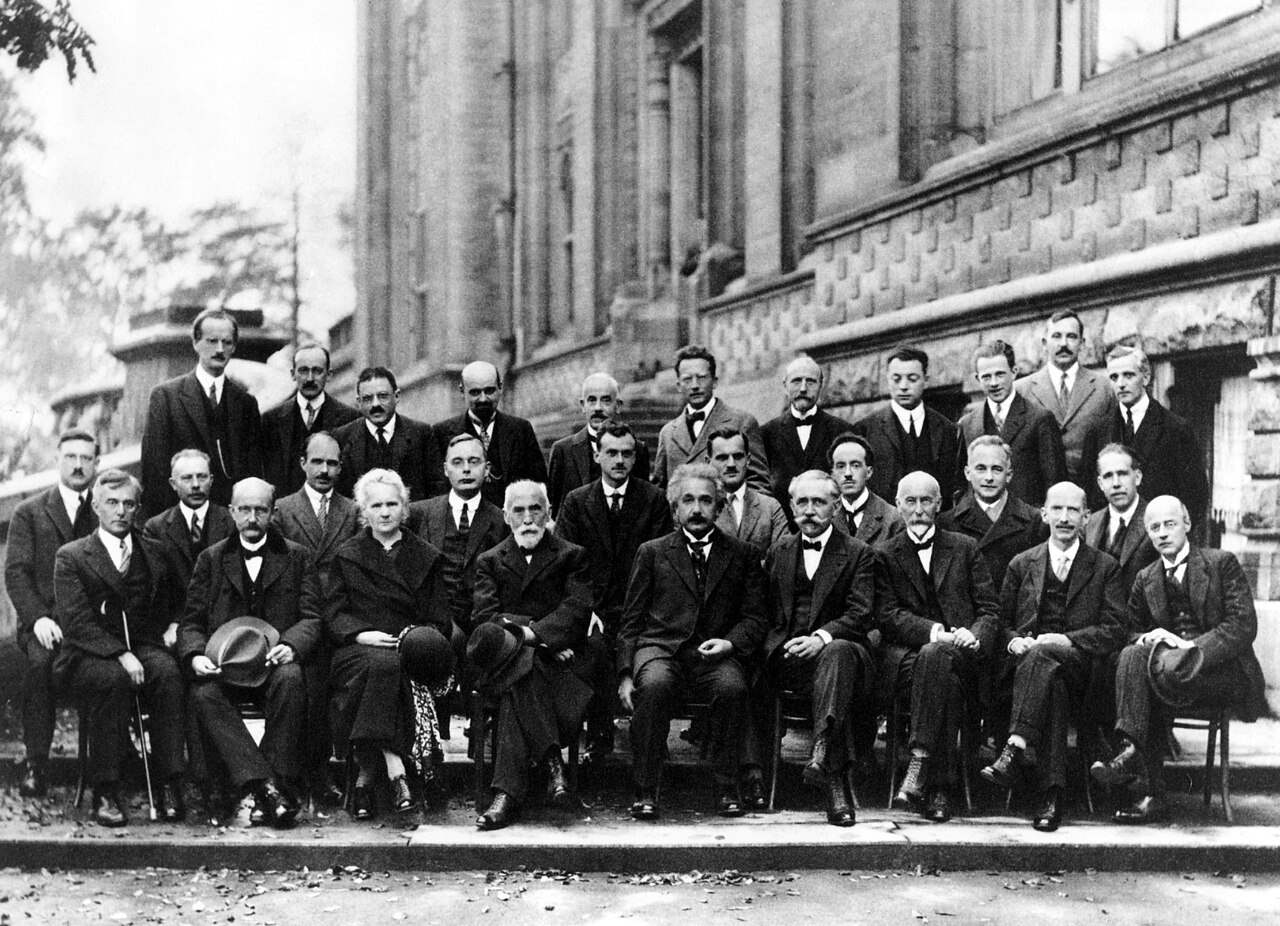
- Wikimedia Commons, Solvay conference 1927 (public domain).
- AIP Center for History of Physics, Marie Curie and the Science of Radioactivity.
Uncertain history in this lesson: the story of the war cars is our reconstruction, and the exact year Charles Janet first wrote his version of the filling rule is given only roughly.