 by Marie Curie

On my bench at the Radium Institute there is a shallow glass dish. A solution of barium chloride cooled in it overnight, and this morning its floor is covered with small clear crystals, each with flat faces and sharp edges. Beside it is a pinch of ordinary kitchen salt under a lens: little cubes, every one of them. Why should a white powder from the sea grow into cubes? Why does it melt only in a red-hot furnace, shatter under a hammer, and carry a current only when it is melted or dissolved? In this lesson we answer all of these with one idea: atoms that have given and taken electrons hold each other by electric attraction. By the end you will be able to predict the ions an atom forms, write and name the formula of any simple salt, estimate how strongly its ions hold together, and work the energy account that chemists call the Born and Haber cycle.
You cannot hope to build a better world without improving the individuals. To that end each of us must work for his own improvement, and at the same time share a general responsibility for all humanity, our particular duty being to aid those to whom we think we can be most useful.
Marie Curie, Autobiographical Notes, 1923
What you will learn
- Explain why atoms bond at all, in terms of energy.
- Predict the ion an element forms from its place in the periodic table, and write its electron arrangement.
- Use Coulomb's law to compare how strongly different pairs of ions attract.
- Define lattice energy and calculate it with a Born and Haber cycle.
- Write the formula and the name of an ionic compound, including those with many-atom ions and with metals that form more than one ion.
- Describe the salt lattice and explain why ionic solids are hard, brittle, high-melting, and conduct only when melted or dissolved.
What you need first: Lesson 4 (Inside the Atom), Lesson 5 (The Mole, or Counting Atoms by Weighing), Lesson 15 (Orbitals and Electron Configurations) and Lesson 16 (The Periodic Table and Its Trends), especially ionisation energy and electron affinity.
Why atoms bond at all
Most atoms in the world are not alone. The oxygen you breathe goes about in pairs. The sodium in the sea is never free metal: it is joined to chlorine. Free sodium metal, cut with a knife, tarnishes within seconds in air and burns violently in water. So the joined state must be in some sense easier, more settled, than the separate one. Our task is to say in what sense.
The answer is energy. A chemical bond is a lasting attraction between atoms that holds them together. Atoms bond when the joined arrangement has less energy than the separate atoms. The difference goes out into the surroundings, usually as heat. To pull the atoms apart again, you must pay that energy back. A stone at the bottom of a well is in the same position: it got there by itself, and you must work to lift it out.
We measure these energies in kilojoules per mole, written kJ/mol. One kilojoule is a thousand joules, about the energy to lift a litre of water one hundred metres. Per mole means for \(6.022 \times 10^{23}\) atoms, ions or bonds, as in Lesson 5. I shall use one sign rule all through this lesson. A positive energy, such as +496 kJ/mol, is energy we must put in. A negative energy, such as −349 kJ/mol, is energy that comes out.
Some atoms hardly bond at all. Helium, neon, argon and the others of group 18, the noble gases, form no compounds in ordinary conditions. Lord Rayleigh and William Ramsay found argon in the air only in 1894, precisely because it reacts with nothing and so had hidden in every chemist's flask. Their atoms have a full outer shell: two electrons for helium, eight for the rest. In Lesson 16 you saw that such atoms have very high ionisation energies and no wish for an extra electron. They are already settled.
In my laboratory
Radium gives off a gas, which we called the emanation; you now call it radon. I collected it for the hospitals during the war, in little sealed glass bulbs, and its chemistry was the easiest I ever knew: it had none. It passed through every reagent untouched, like argon, and it could be frozen out of the air with liquid air. Rutherford and Soddy found it as inert as argon, and it took its place among the noble gases. A full outer shell makes an atom chemically idle, and that is our clue to everything that follows.
Margin
In 1916, two papers took up this clue in the same year. Walther Kossel in Germany proposed that atoms of salts give and take electrons until each has the arrangement of a noble gas. Gilbert Newton Lewis in America proposed that other atoms share electrons to reach the same end; that is our next lesson. Neither man thought atoms have wishes. The phrase "an atom wants a full shell" is a convenience of speech. What is true is that the arrangement with full shells usually has less energy.
Ions and the octet
An ion is an atom, or a group of atoms, with an electric charge, because it has lost or gained electrons. A positive ion is a cation; a negative ion is an anion. The names come from Michael Faraday, who in 1834 watched them travel to the two plates of an electrolysis cell.
Metals on the left of the periodic table have only one, two or three electrons in their outer shell. Beneath that shell lies the full shell of the noble gas before them. When they lose the outer electrons, what remains has the noble gas arrangement. Non-metals on the right have five, six or seven outer electrons. When they gain three, two or one, they reach the eight of the noble gas after them. Eight outer electrons is called an octet. So:
- Group 1 (lithium, sodium, potassium) form ions of charge 1+: \(\ce{Na+}\), \(\ce{K+}\).
- Group 2 (magnesium, calcium, barium, radium) form 2+ ions: \(\ce{Mg^2+}\), \(\ce{Ba^2+}\), \(\ce{Ra^2+}\).
- Aluminium, in group 13, forms \(\ce{Al^3+}\).
- Group 15 non-metals form 3− ions when they form ions at all: \(\ce{N^3-}\), the nitride ion.
- Group 16 form 2− ions: \(\ce{O^2-}\) oxide, \(\ce{S^2-}\) sulfide.
- Group 17, the halogens, form 1− ions: \(\ce{F-}\), \(\ce{Cl-}\), \(\ce{Br-}\), \(\ce{I-}\).
The name of a simple anion takes the stem of the element and the ending -ide: chlorine gives chloride, oxygen gives oxide.
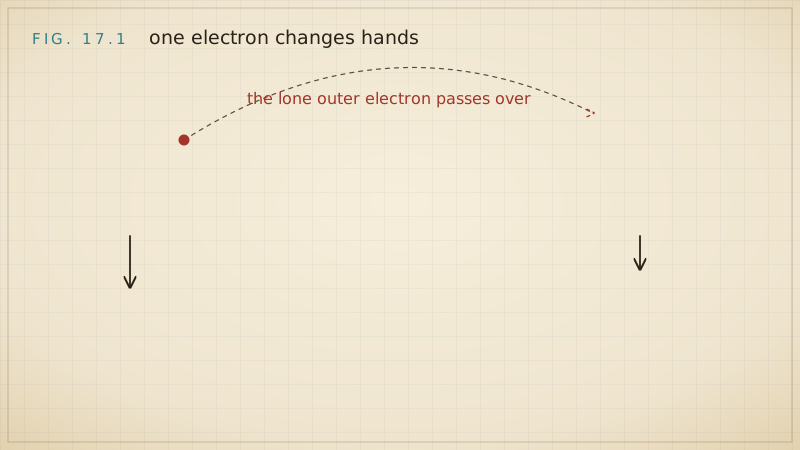
Fig. 17.1 shows the simplest case. Sodium has 11 electrons arranged 2, 8, 1. Chlorine has 17, arranged 2, 8, 7. One electron passes from sodium to chlorine. Sodium is left with 2, 8, the arrangement of neon. Chlorine now has 2, 8, 8, the arrangement of argon.
Worked example 1
Write the electron configurations of Mg, \(\ce{Mg^2+}\), O and \(\ce{O^2-}\). Which noble gas does each ion match?
- Magnesium has 12 electrons. Filling in the order of Lesson 15: \(\mathrm{1s^2\,2s^2\,2p^6\,3s^2}\).
- \(\ce{Mg^2+}\) has lost 2 electrons, so it has 10. The two lost are the outer ones, the 3s pair: \(\mathrm{1s^2\,2s^2\,2p^6}\).
- Oxygen has 8 electrons: \(\mathrm{1s^2\,2s^2\,2p^4}\).
- \(\ce{O^2-}\) has gained 2, so it has 10. They go into the partly filled 2p set: \(\mathrm{1s^2\,2s^2\,2p^6}\).
- Both ions have 10 electrons in the arrangement of neon. Particles with the same arrangement are called isoelectronic.
Check: 12 − 2 = 10 and 8 + 2 = 10. Neon has atomic number 10.
Losing or gaining electrons changes the size of an atom, as Lesson 16 showed. A cation is smaller than its atom. The sodium atom has a radius of about 186 pm, but \(\ce{Na+}\) only 102 pm, because the whole outer shell has gone and the remaining electrons are pulled in by the same nuclear charge. An anion is larger than its atom. The chlorine atom is about 99 pm in radius, \(\ce{Cl-}\) about 181 pm, because the extra electron pushes the others apart and the nucleus has no extra charge to hold them. So in salt the small ion is the metal and the large ion is the non-metal. Keep that picture; you will need it when we look inside the crystal.
A common mistake
Students often say that sodium "gives its electron gladly". It does not. Removing that electron costs the first ionisation energy, +496 kJ/mol. Chlorine, taking it, gives back only 349 kJ/mol, its electron affinity from Lesson 16. So making a mole of separate \(\ce{Na+}\) and \(\ce{Cl-}\) ions from separate atoms costs
\[ (+496) + (-349) = +147\ \mathrm{kJ/mol}. \]
The ions alone are worse off than the atoms. Something else must repay the 147 kJ/mol, and more, or salt would never form. That something is the electric attraction between the ions, and it is the real heart of the ionic bond.
Margin
Why does magnesium stop at 2+? Its third ionisation energy is about 7,730 kJ/mol, more than five times the second. The third electron would have to come out of the full neon shell beneath. No attraction in any crystal can repay so large a sum, so \(\ce{Mg^3+}\) is never found in salts. The noble-gas core is a wall.
The ionic bond is an electric pull
An ionic bond is the electric attraction between oppositely charged ions. Nothing more mysterious is needed. The law of that attraction was measured here in Paris.
An analogy from my Paris
In 1785 Charles-Augustin de Coulomb hung a very fine wire in a glass case and fixed a light needle to it, with a small charged ball at one end. He brought another charged ball near. The force between them twisted the wire, and the angle of twist measured the force. He found that if he halved the distance, the force grew four times. The forces that hold every salt together were first weighed in a small glass case, with a wire finer than a hair. I like to remember that when I hold a crystal.
Coulomb's law says that the force between two charges is proportional to the product of the charges and inversely proportional to the square of the distance between them:
\[ F = k\,\frac{q_1 q_2}{r^2} \]
Here \(q_1\) and \(q_2\) are the charges in coulombs, \(r\) is the distance between their centres in metres, and \(k = 8.988 \times 10^{9}\,\mathrm{N\,m^2\,C^{-2}}\). For chemistry the energy is more useful than the force. The energy of two charges at distance \(r\), counted from zero when they are far apart, is
\[ E = k\,\frac{q_1 q_2}{r} \]
Opposite charges give a negative product, so \(E\) is negative: energy comes out as the ions approach. The charge of an ion is a whole number \(z\) times the elementary charge \(e = 1.602 \times 10^{-19}\,\mathrm{C}\), so \(q = ze\).
Worked example 2
A sodium ion and a chloride ion touch when their centres are 283 pm apart (the sum of their radii, 102 pm and 181 pm). Find the energy of attraction for one pair, and for a mole of separate pairs.
- Write the charges: \(q_1 = +1.602 \times 10^{-19}\,\mathrm{C}\) and \(q_2 = -1.602 \times 10^{-19}\,\mathrm{C}\).
- Convert the distance: \(283\,\mathrm{pm} = 283 \times 10^{-12}\,\mathrm{m} = 2.83 \times 10^{-10}\,\mathrm{m}\).
- Multiply \(k\) by the charges: \(8.988 \times 10^{9} \times (1.602 \times 10^{-19})^2 = 2.307 \times 10^{-28}\,\mathrm{J\,m}\), with a minus sign because the charges are opposite.
- Divide by the distance: \(E = -2.307 \times 10^{-28} / 2.83 \times 10^{-10} = -8.15 \times 10^{-19}\,\mathrm{J}\) for one pair.
- Multiply by the Avogadro constant for a mole of pairs: \(-8.15 \times 10^{-19}\,\mathrm{J} \times 6.022 \times 10^{23}\,\mathrm{mol^{-1}} = -4.91 \times 10^{5}\,\mathrm{J/mol}\).
- So \(E = -491\,\mathrm{kJ/mol}\).
Check: 491 is larger than the 147 kJ/mol we owed. Even a single pair of ions, alone in space, more than repays the cost of making them.
Because we shall do this often, let us fold all the constants into one number. Multiplying \(k e^2\) by the Avogadro constant, and converting metres to picometres and joules to kilojoules, gives \(1.389 \times 10^{5}\,\mathrm{kJ\,pm/mol}\). So for a mole of separate ion pairs, with the distance \(d\) in picometres:
\[ E = -\,\frac{1.389 \times 10^{5} \times z_{+} \times z_{-}}{d}\ \mathrm{kJ/mol} \]
where \(z_{+}\) and \(z_{-}\) are the sizes of the two charges, written without signs. For sodium chloride: \(1.389 \times 10^{5} \times 1 \times 1 / 283 = 491\), as before.
Worked example 3
Magnesium oxide is made of \(\ce{Mg^2+}\) (radius 72 pm) and \(\ce{O^2-}\) (radius 140 pm). How many times stronger is the attraction of one pair than that of sodium chloride?
- Distance at touching: \(d = 72 + 140 = 212\,\mathrm{pm}\).
- Charge product: \(2 \times 2 = 4\).
- Energy: \(E = -1.389 \times 10^{5} \times 4 / 212 = -2{,}621\,\mathrm{kJ/mol}\).
- Ratio to sodium chloride: \(2{,}621 / 491 = 5.34\).
- Of this factor, 4 comes from the charges, and \(283/212 = 1.33\) comes from the smaller distance: \(4 \times 1.33 = 5.3\).
Check: doubling both charges should multiply the pull by four, and smaller ions should add a little more. They do.
This gives us the two rules that govern every ionic substance. Higher charges attract much more strongly, because the charges multiply. Smaller ions attract more strongly, because they come closer. Of the two, charge usually wins.
Try it
Plate 17.1 lets you choose any of seven positive ions and six negative ions, then slide them apart. The curve is the energy against distance. The blue dotted line is the pure Coulomb attraction, which would pull the ions into each other forever. The solid line adds the push of the electron clouds when the ions touch; it is that push which stops them and sets the distance. Try sodium chloride first, then magnesium oxide, then potassium iodide.
Lattice energy and the Born and Haber cycle
A real crystal is not a collection of separate pairs. Each ion is surrounded by many neighbours of opposite charge, and beyond them by neighbours of the same charge, and so on outward. The total energy of the whole arrangement is what matters.
The lattice energy of an ionic solid is the energy needed to separate one mole of it into its gaseous ions, far apart from each other. For sodium chloride:
\[ \ce{NaCl(s) -> Na+(g) + Cl-(g)} \qquad +787\ \mathrm{kJ/mol} \]
It is positive, because you must pay to pull the crystal apart. The same amount comes out when the gaseous ions fall together into the crystal. I shall quote lattice energies as positive numbers. Some books print them with a minus sign, meaning the energy given out; read the definition before you read the number.
Why is 787 larger than the 491 of a single pair? In the salt crystal each \(\ce{Na+}\) has six \(\ce{Cl-}\) neighbours at 282 pm. It also has twelve \(\ce{Na+}\) at 399 pm, which repel it, then eight \(\ce{Cl-}\) at 488 pm, and so on. The attractions win, because the nearest neighbours are always the opposite ones. Erwin Madelung summed this endless series in 1918; it comes to 1.748 times the single-pair value. The push of the electron clouds then takes back about a tenth. Max Born and Alfred Landé did the whole calculation in 1918 and came within about five per cent of the measured value.
But how do we measure a lattice energy? Nobody can pull a crystal apart into separate ions and catch the energy. Born and Fritz Haber, each in 1919, found the way round: go by a longer road whose every step can be measured.
An analogy from my Paris
Stand at the foot of Montmartre and look up at the white church on top. You may climb the stairs, or ride the funicular that has carried people up since 1900, or walk the winding streets round the back. However you go, when you stand at the top you are the same height above the Seine. Height depends only on where you are, never on the road. Energy is the same. The energy difference between sodium and chlorine on one side and salt on the other is fixed. So the sum of the energies along any road between them must be the same. If we know every step but one, the missing step is found by subtraction. Chemists call this principle Hess's law, after Germain Hess, who stated it in 1840; we shall meet it properly in Lesson 28.
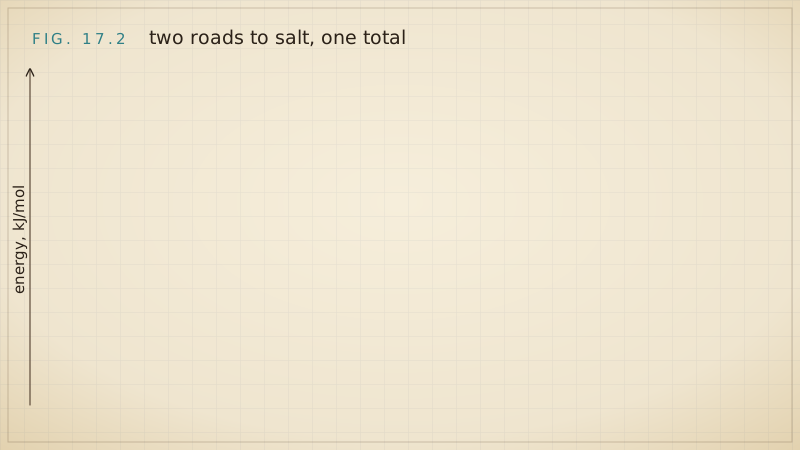
The Born and Haber cycle for sodium chloride compares two roads from the elements to the salt.
The short road is a single step, the formation of the salt from its elements, which can be measured by burning sodium in chlorine in a calorimeter:
\[ \ce{Na(s) + 1/2Cl2(g) -> NaCl(s)} \qquad -411\ \mathrm{kJ/mol} \]
The long road has five steps:
- Turn solid sodium into gaseous atoms: \(\ce{Na(s) -> Na(g)}\), +107 kJ/mol.
- Break half a mole of chlorine molecules into atoms: \(\ce{1/2Cl2(g) -> Cl(g)}\), +121 kJ/mol. (The whole \(\ce{Cl-Cl}\) bond energy is 242; we need only half.)
- Remove an electron from each sodium atom: \(\ce{Na(g) -> Na+(g) + e-}\), +496 kJ/mol, the first ionisation energy.
- Give the electron to each chlorine atom: \(\ce{Cl(g) + e- -> Cl-(g)}\), −349 kJ/mol, the electron affinity.
- Let the gaseous ions fall together into the crystal: \(\ce{Na+(g) + Cl-(g) -> NaCl(s)}\), which gives out the lattice energy, \(-U\).
Fig. 17.2 draws the two roads as a staircase, with energy upward.
Worked example 4
Use the cycle to find the lattice energy \(U\) of sodium chloride.
- Both roads must give the same total: long road = short road.
- Write the long road: \((+107) + (+121) + (+496) + (-349) + (-U)\).
- Add the four known steps: \(107 + 121 = 228\); \(228 + 496 = 724\); \(724 - 349 = 375\). So the long road is \(375 - U\).
- Set it equal to the short road: \(375 - U = -411\).
- Add \(U\) to both sides and add 411 to both sides: \(375 + 411 = U\).
- So \(U = 786\,\mathrm{kJ/mol}\).
Check: the tables give 787; the difference of one comes from rounding each step to a whole number. And the answer is large and positive, as a lattice energy must be.
Look at the staircase once more. Every step up is a cost: vaporising, breaking, ionising. The one great step down is the lattice energy. It is the electric attraction of the whole crystal that pays all the bills and leaves 411 kJ/mol over, given out as the heat and light when sodium burns in chlorine. This is the precise sense in which salt is "more settled" than its elements.
A common mistake
The signs. Students add the electron affinity as +349, or forget that the lattice step is energy given out. Draw the staircase before you add anything. Arrows up are positive, arrows down are negative, and the two roads must end at the same level.
The same rules of charge and size, measured this way, give a clear pattern in real lattice energies (in kJ/mol):
- Same charges, growing size: NaF 930, NaCl 787, NaBr 751, NaI 704.
- Same anion, growing cation: NaCl 787, KCl 717.
- Doubled charges: CaO about 3,400 and MgO about 3,800, against NaCl 787.
Different tables differ by a few kJ/mol, because the data they start from differ slightly. The pattern never changes.
Margin
Magnesium oxide holds a lesson. To make \(\ce{Mg^2+}\) costs both the first and second ionisation energies, 738 + 1,451 kJ/mol. To make \(\ce{O^2-}\) costs energy too, because the second electron is pushed onto an ion already negative. On the ions alone it is a terrible bargain. Yet magnesium burns with a dazzling white light that photographers used for their flash powder, because a lattice four or five times stronger than salt's repays everything. The second electron affinity of oxygen cannot be measured directly; it is found from cycles like this one, run backwards.
Writing formulas and names
An ionic compound has no overall charge. So the positive charges and the negative charges in its formula must cancel exactly. That single rule writes every formula.
An analogy from Warsaw
When I was a governess I taught village children their sums in secret, for Polish lessons were forbidden then. One puzzle they liked: you have a pile of three-kopek coins and a pile of two-kopek coins. What is the smallest sum you can make with each pile so that the two sums are equal? The answer is six kopeks: two coins of three, three coins of two. Aluminium ions carry three charges and oxide ions carry two. The smallest charge both can reach is six: two \(\ce{Al^3+}\) and three \(\ce{O^2-}\). The formula is the coin puzzle exactly.
So the method is:
- Write the two ions with their charges.
- Find the smallest number that both charges divide into (the lowest common multiple).
- Take enough of each ion to reach that number.
- Write the counts as subscripts, positive ion first. A count of one is not written.
Worked example 5
Write the formula of aluminium oxide.
- Ions: \(\ce{Al^3+}\) and \(\ce{O^2-}\).
- Smallest number divisible by 3 and by 2: 6.
- Six positive charges need two aluminium ions: \(2 \times 3 = 6\). Six negative charges need three oxide ions: \(3 \times 2 = 6\).
- Formula: \(\ce{Al2O3}\).
Check: \(+6 - 6 = 0\).
When both charges are the same, one of each is enough: \(\ce{Mg^2+}\) with \(\ce{O^2-}\) gives \(\ce{MgO}\), never \(\ce{Mg2O2}\). A formula for an ionic compound gives the smallest whole-number ratio of the ions. It is called a formula unit, for reasons the next section will make plain.
Some ions are groups of atoms bound tightly together, carrying one charge for the whole group. These polyatomic ions travel through reactions unchanged, like a sealed parcel. Learn these by heart:
- \(\ce{NH4+}\) ammonium, the one common positive group.
- \(\ce{OH-}\) hydroxide and \(\ce{NO3-}\) nitrate.
- \(\ce{SO4^2-}\) sulfate and \(\ce{CO3^2-}\) carbonate.
- \(\ce{PO4^3-}\) phosphate.
When a formula needs more than one of a polyatomic ion, put that ion in brackets and write the count outside: calcium hydroxide is \(\ce{Ca(OH)2}\). Without the brackets, \(\ce{CaOH2}\) would mean one oxygen and two hydrogens, which is a different thing.
Worked example 6
Write the formula of calcium phosphate, the mineral of bones.
- Ions: \(\ce{Ca^2+}\) and \(\ce{PO4^3-}\).
- Smallest number divisible by 2 and 3: 6.
- Three calcium ions give \(3 \times 2 = 6\) positive; two phosphate ions give \(2 \times 3 = 6\) negative.
- Phosphate is needed twice, so it goes in brackets: \(\ce{Ca3(PO4)2}\).
Check: count the atoms with the brackets: 3 Ca, 2 P, 8 O. Charges: \(+6 - 6 = 0\).
The name of an ionic compound is the name of the cation followed by the name of the anion: sodium chloride, calcium phosphate, ammonium sulfate. The metal keeps its own name; the simple anion takes -ide.
Some metals, especially iron and copper, form more than one ion: \(\ce{Fe^2+}\) and \(\ce{Fe^3+}\), \(\ce{Cu+}\) and \(\ce{Cu^2+}\). Then the name must say which, by a Roman numeral in brackets equal to the charge: iron(II) chloride is \(\ce{FeCl2}\), iron(III) chloride is \(\ce{FeCl3}\). To name such a salt from its formula, work out the metal's charge from the anions. In \(\ce{FeCl3}\), three chlorides carry three negative charges, so the iron must be 3+.
Worked example 7
Name the compounds \(\ce{FeCl3}\), \(\ce{Cu2O}\) and \(\ce{Al2(SO4)3}\).
- \(\ce{FeCl3}\): three chloride ions carry \(3 \times (-1) = -3\). One iron must carry +3 to cancel them. Iron forms more than one ion, so the name needs the numeral: iron(III) chloride.
- \(\ce{Cu2O}\): one oxide ion carries −2. Two copper ions share +2, so each is +1. Copper forms more than one ion: copper(I) oxide.
- \(\ce{Al2(SO4)3}\): the bracket holds the sulfate ion, \(\ce{SO4^2-}\), three times. Aluminium forms only \(\ce{Al^3+}\), so no numeral is needed: aluminium sulfate.
Check the charges: \(+3 - 3 = 0\); \(2 \times (+1) - 2 = 0\); \(2 \times (+3) + 3 \times (-2) = 0\).
A common mistake
Three errors appear in nearly every first notebook. The first is to write the charges into the formula, as in \(\ce{Na+Cl-}\): in a formula the charges have already cancelled, so we leave them out. The second is to forget to reduce: \(\ce{Ca2O2}\) has the right ratio but is written \(\ce{CaO}\). The third is to drop the brackets round a polyatomic ion, so that \(\ce{Ba(NO3)2}\) becomes \(\ce{BaNO32}\), which means nothing at all. Read your formula back atom by atom and you will catch all three.
Margin
In my student days we said ferrous and ferric, cuprous and cupric, the -ous ending for the smaller charge and -ic for the larger. You will still see these names on old bottles, and on some of mine. Alfred Stock proposed the Roman numerals in 1919, and they are much clearer: nobody has to remember which ending means which.
Try it
On Plate 17.2, choose a positive and a negative ion and add them one at a time. Each tile is as long as its charge. When the row of positive tiles is exactly as long as the row of negative tiles, the salt is neutral, and the plate writes its formula and its name. Try aluminium sulfate, and ammonium phosphate.
Crystals: the salt lattice
Where in a grain of salt is the molecule of sodium chloride? The surprising answer is: nowhere.
Margin
Two Frenchmen and two Englishmen settled this. In the 1780s the Abbé René Just Haüy, in Paris, broke crystals of calcite and found they always split into smaller pieces of the same shape. He guessed that a crystal is a pile of identical small units, repeated. In 1913 William Henry Bragg and his son William Lawrence Bragg shone X-rays on crystals of salt and read the pattern the rays made. The son showed that in rock salt each sodium is surrounded equally by six chlorines, and each chlorine by six sodiums. There is no pair that belongs together. My husband Pierre had spent his young years on the symmetry of crystals, and with his brother Jacques he discovered in 1880 that pressing certain crystals makes electric charges appear on their faces. He would have loved the Braggs' pictures.
A crystal lattice is a regular, repeating arrangement of particles in three directions. In sodium chloride the ions alternate along every row, every column and every depth: sodium, chloride, sodium, chloride. Fig. 17.3 shows a small cube of it. The smallest piece that, repeated in every direction, rebuilds the whole crystal is called the unit cell. For salt it is the cube in the figure, 564 pm along each edge.
The number of nearest neighbours of opposite charge is called the coordination number. In salt it is 6 for both ions. The edge of the cube, 564 pm, is two ion spacings, so the distance from a sodium centre to the next chloride centre is 282 pm. That agrees with the sum of the radii, 102 + 181 = 283 pm, which is how those radii were obtained in the first place.
An analogy from my Paris
Many Paris cafés have a floor of black and white tiles laid in a chequer. Ask which white tile is the partner of a given black tile, and there is no answer: each black tile has four white neighbours, all equal. Yet you can say exactly that the floor is half black and half white. The formula NaCl says the same of salt: one sodium for each chloride, but no pairs. Salt is the café floor built in three directions instead of two.
Worked example 8
From the unit cell, calculate the density of sodium chloride. The edge is 564 pm and the molar mass is 58.44 g/mol.
- Count the chloride ions in the cell. There is one at each of the 8 corners, but each corner is shared by 8 cubes, so each counts as \(\tfrac{1}{8}\). There is one at the centre of each of the 6 faces, shared by 2 cubes. Total: \(8 \times \tfrac{1}{8} + 6 \times \tfrac{1}{2} = 1 + 3 = 4\).
- Count the sodium ions. There is one on the middle of each of the 12 edges, each shared by 4 cubes, and one at the very centre, not shared. Total: \(12 \times \tfrac{1}{4} + 1 = 3 + 1 = 4\).
- So the cell holds 4 formula units of NaCl. Its mass is \(4 \times 58.44\,\mathrm{g/mol} \div 6.022 \times 10^{23}\,\mathrm{mol^{-1}} = 3.882 \times 10^{-22}\,\mathrm{g}\).
- The edge is \(564\,\mathrm{pm} = 5.64 \times 10^{-8}\,\mathrm{cm}\). The volume is \((5.64 \times 10^{-8}\,\mathrm{cm})^3 = 1.794 \times 10^{-22}\,\mathrm{cm^3}\).
- Density = mass divided by volume \(= 3.882 \times 10^{-22}\,\mathrm{g} \div 1.794 \times 10^{-22}\,\mathrm{cm^3} = 2.16\,\mathrm{g/cm^3}\).
Check: weighed salt crystals give \(2.165\,\mathrm{g/cm^3}\). A drawing of ions, a ruler of X-rays and the Avogadro constant together predict what the balance measures. I find that one of the most satisfying calculations in all of chemistry.
A common mistake
Do not speak of "a molecule of sodium chloride" in the solid. A molecule is a separate group of atoms joined to each other and to nothing else. In salt there is only one endless lattice. That is why chemists say formula unit for ionic compounds and keep the word molecule for the substances of the next lesson.
In my laboratory
For four years I separated radium from barium by fractional crystallisation. I dissolved the mixed chlorides in hot water, let them crystallise, and divided crystals from liquid, again and again, a great many times. Radium chloride is a little less soluble than barium chloride, so it gathered slowly in the crystals. Why could the two never be separated in one step? Because \(\ce{Ra^2+}\) has the same charge as \(\ce{Ba^2+}\) and is only a little larger. A radium ion fits into a barium ion's place in the lattice as a slightly larger egg fits into an egg box. The crystal does not refuse it. So the two came down together every time, and only the small difference in solubility, multiplied by patience, pulled them apart.
Properties of ionic solids
The lattice explains, one by one, the habits of salts.
They are hard and melt only when very hot. To melt a crystal you must shake the ions loose from their places, and every ion is held by its neighbours' strong electric attraction. Sodium chloride melts at 801 °C, a dull red heat. Magnesium oxide, with its doubled charges, melts at about 2,800 °C, and so it was used to line furnaces. Higher lattice energy, higher melting point: the same two rules of charge and size. Compare the melting points of a few salts with the lattice energies you met earlier:
- Sodium fluoride, lattice energy 930 kJ/mol, melts at 993 °C.
- Sodium chloride, 787 kJ/mol, melts at 801 °C.
- Potassium chloride, 717 kJ/mol, melts at 770 °C.
- Magnesium oxide, about 3,800 kJ/mol, melts at about 2,800 °C.
The order of one list is the order of the other. Melting points are easy to measure with a thermometer and a small furnace; lattice energies need a whole cycle of measurements. When two quite different measurements put substances in the same order, I begin to trust the explanation behind them.
They are brittle. Strike a crystal of salt and it does not bend; it shatters, often along flat planes. Fig. 17.4 shows why. Push one half of the crystal along by a single ion, and every positive ion on one side of the break now faces a positive ion on the other side. Attraction turns at once into repulsion, and the crystal splits cleanly.
From the shed
In the shed on rue Lhomond I stirred the boiling ore with an iron rod nearly as tall as myself. When I struck it on the rim of the basin it rang, but it never broke. When a cake of dried barium salts had to be broken up, one blow of a pestle sent it into fragments with flat shining faces. The iron is a metal, in which the atoms can slide past each other and stay bonded; we shall meet that in a later lesson. The salt is a lattice of charges, in which sliding by one place turns every attraction into a repulsion. Same hand, same blow, two entirely different answers, and each tells you what is inside.
They carry a current only when melted or dissolved. A current is moving charge. In the solid the ions are locked in place, so solid salt does not conduct. Melt it, and the ions are free to drift toward the plates: molten salt conducts well. In 1807 Humphry Davy passed a current through potash and soda, the first moistened and later molten, and so obtained potassium and sodium metal for the first time. Dissolve salt in water, and again the ions move freely. Svante Arrhenius argued in 1884 to 1887 that salts in water exist as separate ions even before any current flows, and he was right; Lesson 10 used his idea.
Many dissolve in water. Water molecules, as Lesson 9 showed, gather round each ion and draw it out of the lattice. Whether a salt dissolves depends on a contest between the lattice energy, which holds the ions in, and the attraction of water for the ions, which draws them out. That is why some salts, like barium sulfate, hardly dissolve at all; in Lesson 10 we used that fact to weigh them.
Try it
Exercise 17.3 asks eight questions: the ion an element forms, formulas and names (with fresh salts each time you press New numbers), the order of lattice energies, a Born and Haber cycle with real data, a Coulomb calculation, and two questions about crystals, one from my crystallising dishes.
What to remember
- Atoms bond when the joined state has less energy than the separate atoms; the difference goes out as heat.
- Metals lose electrons and non-metals gain them, usually until each reaches the arrangement of a noble gas: groups 1, 2, 13 give 1+, 2+, 3+; groups 15, 16, 17 give 3−, 2−, 1−.
- Making the ions alone costs energy (for Na⁺ and Cl⁻, +147 kJ/mol); the attraction between ions repays it.
- Coulomb: \(E = k q_1 q_2 / r\); for a mole of ion pairs, \(E = -1.389 \times 10^{5}\,z_{+} z_{-}/d\) kJ/mol with \(d\) in pm.
- Higher charges and smaller ions mean stronger attraction and larger lattice energy. Charge matters most.
- Lattice energy is the energy to separate one mole of an ionic solid into gaseous ions: NaCl 787 kJ/mol, MgO about 3,800.
- Born and Haber cycle: the long road from the elements (atomise, ionise, add electrons, form the lattice) equals the formation energy.
- Formulas: charges cancel, smallest whole-number ratio, brackets round polyatomic ions counted more than once; name the cation, then the anion; Roman numerals for metals with more than one ion.
- Salt is a lattice with coordination number 6 and no molecules; the formula is a ratio, the formula unit.
- Ionic solids are hard, high-melting and brittle, and conduct only when melted or dissolved.
Problems for your notebook
Problem 1. Which ions do calcium, sulfur, aluminium and bromine form? Which noble gas does each ion match?
Answer. Calcium, group 2, loses two: \(\ce{Ca^2+}\), with 18 electrons like argon. Sulfur, group 16, gains two: \(\ce{S^2-}\), 18 electrons, like argon. Aluminium, group 13, loses three: \(\ce{Al^3+}\), 10 electrons, like neon. Bromine, group 17, gains one: \(\ce{Br-}\), 36 electrons, like krypton.
Problem 2. Write the formulas of barium nitrate and iron(III) sulfate. Name \(\ce{CuSO4}\) and \(\ce{(NH4)2CO3}\).
Answer.
- Barium nitrate: \(\ce{Ba^2+}\) and \(\ce{NO3-}\). Two nitrates balance one barium: \(\ce{Ba(NO3)2}\).
- Iron(III) sulfate: \(\ce{Fe^3+}\) and \(\ce{SO4^2-}\). The smallest common number is 6: two irons (+6), three sulfates (−6): \(\ce{Fe2(SO4)3}\).
- \(\ce{CuSO4}\): one sulfate carries 2−, so the copper is 2+: copper(II) sulfate.
- \(\ce{(NH4)2CO3}\): ammonium carbonate. Ammonium has only one charge, so no numeral is needed.
Problem 3. Put KCl, CaO, NaCl and BaO in order of lattice energy, largest first, and give your reasons.
Answer. CaO, then BaO, then NaCl, then KCl. CaO and BaO have charges 2+ and 2−, so about four times the attraction of the others. \(\ce{Ca^2+}\) is smaller than \(\ce{Ba^2+}\), so CaO (about 3,400 kJ/mol) comes before BaO (about 3,050). Among the 1+ and 1− salts, \(\ce{Na+}\) is smaller than \(\ce{K+}\), so NaCl (787) comes before KCl (717).
Problem 4. Find the lattice energy of potassium chloride. Data in kJ/mol: solid potassium to gaseous atoms +89; first ionisation energy of potassium +419; half a mole of \(\ce{Cl2}\) to atoms +121; electron affinity of chlorine −349; formation of KCl from its elements −437.
Answer.
- Long road = short road: \(89 + 419 + 121 + (-349) - U = -437\).
- Add the known steps: \(89 + 419 = 508\); \(508 + 121 = 629\); \(629 - 349 = 280\).
- So \(280 - U = -437\), and \(U = 280 + 437 = 717\,\mathrm{kJ/mol}\).
- Check: smaller than sodium chloride's 787, as it should be, because \(\ce{K+}\) is larger than \(\ce{Na+}\).
Problem 5. Potassium chloride has the same lattice as sodium chloride, with a cubic unit cell 629 pm on each edge. Its molar mass is 74.55 g/mol. Calculate its density.
Answer.
- Same lattice, so the cell holds 4 formula units, counted exactly as in Worked example 8.
- Mass of the cell: \(4 \times 74.55\,\mathrm{g/mol} \div 6.022 \times 10^{23}\,\mathrm{mol^{-1}} = 4.952 \times 10^{-22}\,\mathrm{g}\).
- Edge \(= 6.29 \times 10^{-8}\,\mathrm{cm}\); volume \(= (6.29 \times 10^{-8}\,\mathrm{cm})^3 = 2.489 \times 10^{-22}\,\mathrm{cm^3}\).
- Density \(= 4.952 \times 10^{-22} \div 2.489 \times 10^{-22} = 1.99\,\mathrm{g/cm^3}\).
- Check: the measured density is about \(1.98\,\mathrm{g/cm^3}\). The larger potassium ion makes a larger cell, and the crystal is lighter for its size than salt.
After my time
The ionic radii I have used, 102 pm for sodium and 181 pm for chloride, come from a careful table that Robert Shannon published in 1976, built from thousands of crystal measurements. In my day the radii were rougher, and each author had his own. The idea was the same; the numbers became better.
Chemists also learned to say that no bond is purely ionic. Even in sodium chloride the electrons are not handed over completely. Linus Pauling's scale of electronegativity, which appeared in 1932, two years before my death, became the usual way to say how ionic a bond is; we shall use it in Lesson 20. Today lattice energies are also calculated directly from quantum mechanics by computers, and they agree with the Born and Haber cycle to within a few kilojoules.
And the noble gases, which I offered you as the model of chemical idleness, turned out not to be perfectly idle. In 1962 Neil Bartlett made a compound of xenon, and others soon followed. Radon, my old emanation, was found to form a fluoride too. The rule of the full shell is a strong habit of nature, not an absolute law. I am glad that someone kept testing it.
Ions and their lattices are half of the story of bonding. Most of the substances around you, water, sugar, the oxygen of the air, are made of atoms that share electrons instead of handing them over. That is the subject of the next lesson, Lesson 18: Covalent Bonding and Lewis Structures. If you would like another example first, come and ask me, and bring your own salt.
Sources and liberties
The Curie Notes are a modern chemistry course written in Marie Curie's voice by Eternal Gardens. The chemistry is standard modern chemistry; dates, people, apparatus and quotations come from the sources below; the teaching, the analogies and the private remarks are our reconstruction.
- Marie Curie, Pierre Curie, with her Autobiographical Notes, trans. C. and V. Kellogg (1923): Project Gutenberg
- Marie Curie, The Discovery of Radium, Vassar College lecture (1921): Project Gutenberg
- OpenStax, Chemistry 2e, chapters 7 (ionic bonding, lattice energy, the Born and Haber cycle) and 10 (ionic crystals): openstax.org
- American Institute of Physics, "Marie Curie and the Science of Radioactivity": history.aip.org
- R. D. Shannon, "Revised effective ionic radii", Acta Crystallographica A32 (1976): doi.org
- NIST Chemistry WebBook, thermochemical data for the alkali halides: webbook.nist.gov
- W. L. Bragg, "The structure of some crystals as indicated by their diffraction of X-rays", Proceedings of the Royal Society A 89 (1913): doi.org
- IUPAC, Nomenclature of Inorganic Chemistry (the Red Book): iupac.org
The scenes of the crystallising dish, the café floor, the pestle and the coin puzzle are our reconstruction; the exact year of Haüy's first broken calcite varies between accounts.