 by Marie Curie

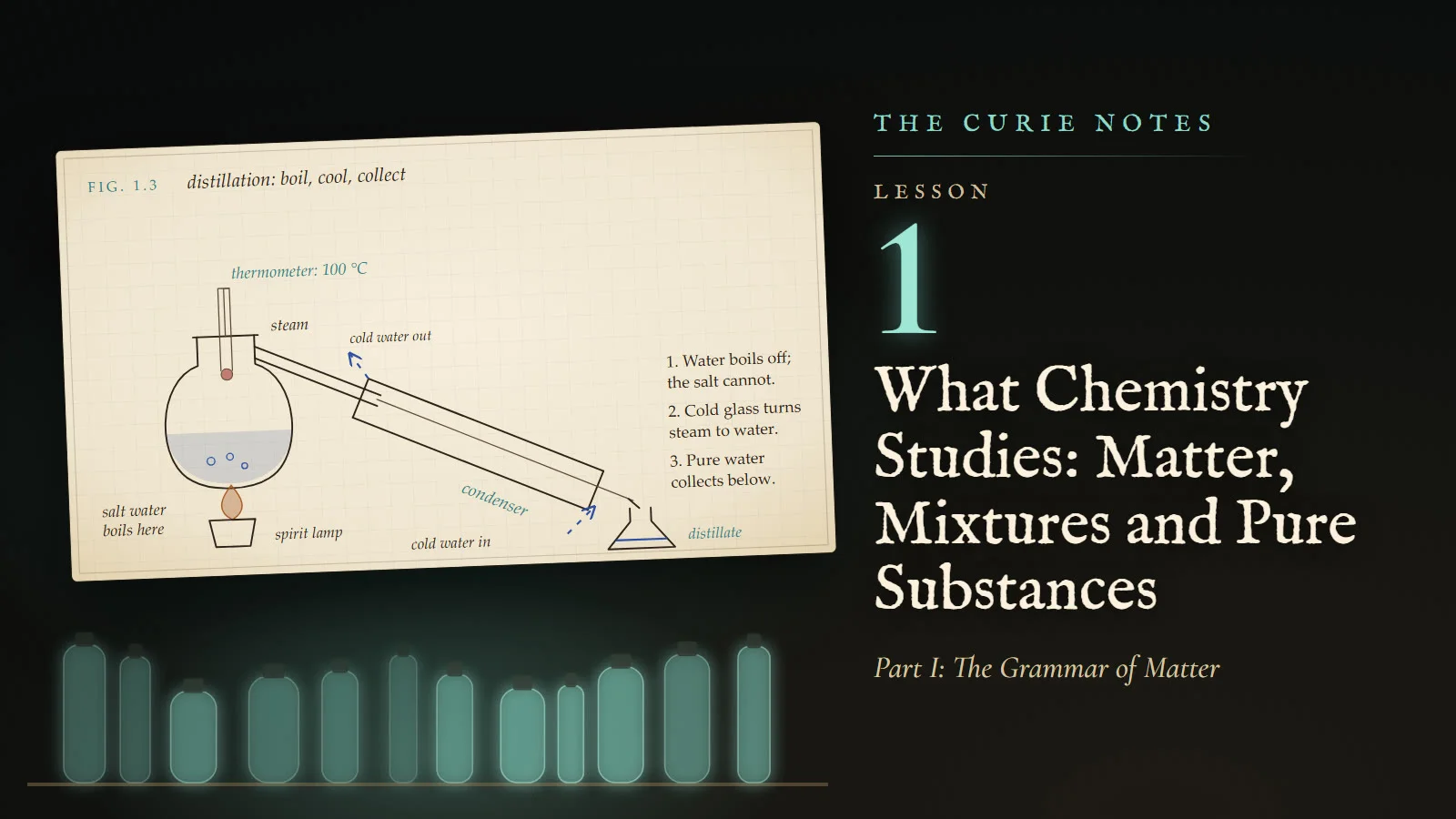
Come in and sit at the bench. It is cold in here; the shed on the rue Lhomond was never warm, and the stove does what it can. In front of you I have put five things: a brown sack of pitchblende from St Joachimsthal, a flask of water, a dish of kitchen salt, a little heap of iron filings and a lump of copper. They look like five unrelated objects. By the end of this first lesson you will be able to say what each one is in the language of chemistry, whether it is a single substance or a mixture of several, and how you would take a mixture apart with ordinary tools. That is where chemistry begins, and it is where my own work on radium began.
It was like a new world opened to me, the world of science, which I was at last permitted to know in all liberty.
Marie Curie, Autobiographical Notes, 1923
What you will learn
- Say what matter is, and tell mass from volume.
- Describe solids, liquids and gases as arrangements of tiny particles.
- Tell a physical change from a chemical change, and a physical property from a chemical one.
- Sort any sample into element, compound, homogeneous mixture or heterogeneous mixture.
- Choose a method to separate a mixture: magnet, filtration, decantation, evaporation, distillation, crystallisation or chromatography.
- Calculate density and use it to identify a substance.
What you need first: nothing. This is the first lesson. Bring a pencil and a notebook, and the habit of looking carefully.
Matter, mass and volume
Chemistry is the study of matter and of the changes it undergoes. So we must first say what matter is.
Matter is anything that has mass and takes up space. The salt in the dish is matter. The water in the flask is matter. The air in this shed is matter too, although you cannot see it: blow up a bladder and it pushes back, and a flask full of air weighs a little more than the same flask emptied by a pump.
Light, heat and sound are forms of energy, without mass; we shall meet them later.
Mass is the amount of matter in an object. We measure it on a balance, in grams (g) or kilograms (kg). A kilogram is a thousand grams. The mass of an object does not change when you carry it from Paris to Warsaw, or up a mountain.
Volume is the amount of space an object takes up. We measure it in cubic centimetres or in millilitres, which are the same size: \(1\,\mathrm{cm^3} = 1\,\mathrm{mL}\). A litre (L) is a thousand millilitres. Lesson 2 treats units with care; for now these few are enough.
Worked example 1
A small wooden box measures 5.0 cm long, 4.0 cm wide and 3.0 cm high. What is its volume in cubic centimetres and in millilitres?
- The volume of a box is length times width times height.
- Write the numbers with their units: \(V = 5.0\,\mathrm{cm} \times 4.0\,\mathrm{cm} \times 3.0\,\mathrm{cm}\).
- Multiply the numbers: \(5.0 \times 4.0 \times 3.0 = 60\).
- Multiply the units: \(\mathrm{cm} \times \mathrm{cm} \times \mathrm{cm} = \mathrm{cm^3}\).
- So \(V = 60\,\mathrm{cm^3}\). Since one cubic centimetre is one millilitre, \(V = 60\,\mathrm{mL}\).
Check: a teacup holds about 200 mL, so a box a third of a teacup is sensible for a small box.
A common mistake
Students mix up mass and size. A cork stopper can be larger than a lead shot and still have less mass. Mass tells you how much matter there is; volume tells you how much room it takes. Keep the two apart in your head from the first day. Later in this lesson we shall put them together, in density.
The three states of matter
Matter around us comes in three common forms, called the states of matter: solid, liquid and gas. Water shows all three in one winter: ice, water and steam.
We describe the states first by what we can see.
- A solid keeps its own shape and its own volume. A lump of copper is the same shape in a cup or on a plate.
- A liquid keeps its volume but takes the shape of its container. Pour 100 mL of water from a tall flask into a flat dish: it is still 100 mL, but now it is flat.
- A gas keeps neither. It spreads out to fill any container completely, whatever its size.
Why should matter behave like this? The answer is that all matter is made of very small particles, far too small to see even with the best microscope. In Lesson 3 you will meet them properly as atoms and molecules. Here we need only three ideas about them: they are always moving, they attract one another when close, and the hotter the matter, the faster they move.
- In a solid, the particles are packed close together in fixed places. They pull on each other strongly. They cannot move about; they only shake, or vibrate, where they are. That is why a solid keeps its shape.
- In a liquid, the particles are still close together, almost touching, so the volume stays nearly the same. But they slide past one another. That is why a liquid flows and takes the shape of its vessel.
- In a gas, the particles are far apart and move fast in straight lines until they hit something. The attractions between them hardly matter. That is why a gas fills every corner.
A number shows how far apart the particles of a gas are. One gram of liquid water fills about one millilitre. Turned into steam at 100 °C, the same gram fills about 1.7 litres, roughly 1,600 times more space. The particles are the same size as before; only the empty space between them has grown.
Changing from one state to another has names you should know. A solid melts to a liquid; a liquid freezes to a solid. A liquid evaporates or boils to a gas; a gas condenses to a liquid. Pure water at ordinary air pressure melts at 0 °C and boils at 100 °C.
An analogy from Warsaw
When I was a girl in Warsaw, the Vistula froze in winter, and we walked on it. In spring the ice broke into floes and floated away down the river. In summer the mist rose off the water in the early morning. It was the same water every time. Think of the river crowd on a feast day. In winter they stand in rows for a procession, each in a fixed place, shuffling their feet: that is the solid. In spring they mill about the market, close together, but every person can move past his neighbour: that is the liquid. On a summer evening they scatter over the whole city, each walking fast and far: that is the gas. The people are the same; only their arrangement and their speed have changed.
Try it
On Plate 1.1, move the temperature slider from cold to hot and watch the particles of water. Below 0 °C they hold their places and tremble. Between 0 °C and 100 °C they slide and settle at the bottom. Above 100 °C they fly to every wall. Press "Pour into a wide dish" to move the same particles into a wide vessel, and see which state keeps its shape.
Properties and changes
How do we tell one substance from another? By its properties: the things we can observe or measure about it. Chemists divide properties into two kinds, and the division is one of the most useful in the whole subject.
A physical property is one you can observe without turning the substance into something else. Colour, smell, hardness, melting point, boiling point, density, whether it dissolves in water, whether it conducts electricity, whether a magnet attracts it: these are physical properties. When you measure the melting point of ice, you still have water at the end.
A chemical property describes how a substance can change into other substances. Iron rusts in damp air. Wood burns. Chalk fizzes in vinegar and gives off a gas. To observe a chemical property, you must let the change happen, and then the original substance is gone, at least in part.
Changes divide the same way.
A physical change alters the form or state of a substance but not what it is made of. Melting, freezing, boiling, dissolving sugar in tea, grinding salt to a powder, bending a copper wire: in each case the same substance is there afterwards. Often you can undo it easily. Freeze the water again; evaporate the tea and the sugar is left.
A chemical change, also called a chemical reaction, produces one or more new substances with new properties. Burning coal, rusting iron, baking bread and souring milk are chemical changes.
Certain signs suggest that a chemical change has happened:
- a new colour appears (bright iron turns to brown rust);
- a gas is given off when nothing is being boiled (chalk fizzing in acid);
- a solid appears when two clear liquids are mixed;
- heat or light is given out (a burning candle);
- a new smell appears (milk turning sour).
These are signs, not proofs. The proof is a new substance with different properties.
An analogy from my Paris
Go into a boulangerie early in the morning. The baker has flour, water, salt and yeast. If he only mixes flour and salt, he can still sift them apart; that is a physical matter. If he kneads the dough and bakes it, the loaf that comes out of the oven smells new, tastes new and has a brown crust that was never in the sack. No baker in Paris can turn a loaf back into flour and water. Baking is a chemical change. The cut of the knife through the loaf, on the other hand, is a physical change: each slice is still bread.
Worked example 2
Decide whether each change is physical or chemical: (a) ice melting on a doorstep; (b) a silver spoon turning black in the air; (c) sugar dissolving in coffee; (d) a match burning.
- Ask one question each time: is there a new substance at the end?
- (a) Melted ice is liquid water. Same substance, new state. Physical.
- (b) The black film is a new substance (silver combined with traces of sulfur in the air). It has a new colour and does not rub back into bright silver. Chemical.
- (c) The sugar is still sugar, spread among the water; evaporate the coffee and it is there again. Physical.
- (d) The match gives light, heat, smoke and ash. Wood and air become new substances. Chemical.
Check: two of each, and every answer rests on the same test, a new substance or not.
A common mistake
Many students say that boiling water is a chemical change, because of the bubbles. But the bubbles in boiling water are only water in the gas state, steam. Hold a cold plate over the pan and the steam condenses back to water. No new substance has appeared. Bubbles mean a chemical change only when the gas is a new substance, as when chalk fizzes in vinegar.
Pure substances: elements and compounds
Now we can begin to sort matter. The first question is whether a sample is one substance or several.
A pure substance has a fixed composition and fixed properties, wherever it comes from. Pure water, whether it is distilled from the Seine, from a Polish well or from rain, has the same composition, freezes at 0 °C and boils at 100 °C at ordinary pressure. A pure substance melts or boils at one sharp temperature.
The word "pure" in a chemist's mouth is stricter than in a grocer's. "Pure orange juice" means nothing was added. To a chemist, orange juice is a mixture of water, sugars, acids and much else.
Pure substances come in two kinds.
An element is a substance that cannot be broken down into simpler substances by any chemical means. Copper, iron, oxygen, carbon, mercury and gold are elements. So are the two I found in pitchblende with my husband, polonium and radium. Heat copper, dissolve it, pass electricity through it: you may combine it with other things, but you will never get anything simpler out of it.
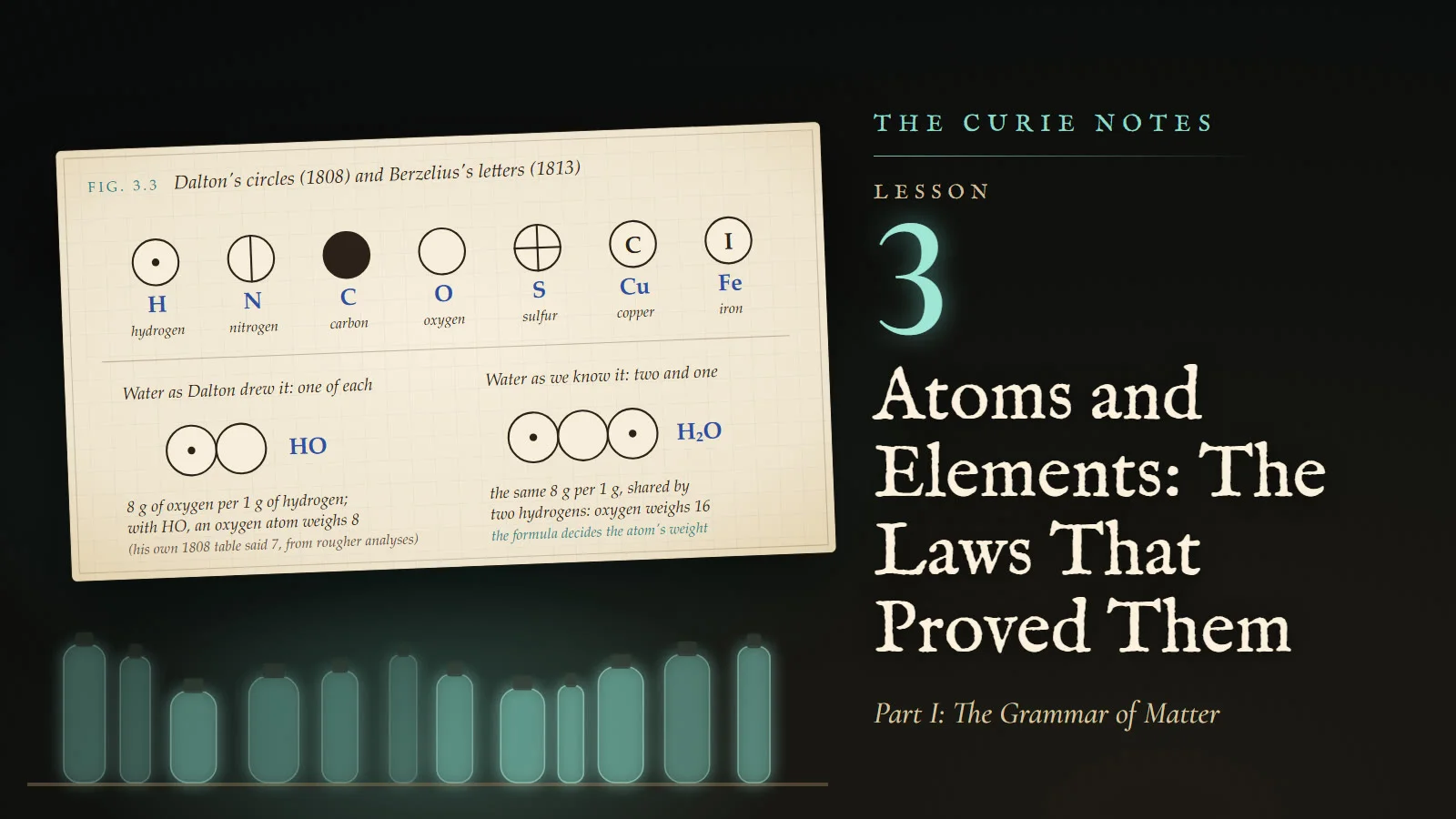
A compound is a substance made of two or more elements chemically joined in a fixed proportion. Water is a compound of hydrogen and oxygen. Pass an electric current through water (with a little acid in it to carry the current), and it splits into two gases, hydrogen and oxygen, always two volumes of hydrogen for one of oxygen. By mass, water is always 11.2 parts in a hundred hydrogen and 88.8 parts oxygen. We write water as \(\ce{H2O}\); you will learn to read such formulas in Lesson 6.
A compound usually looks nothing like its elements. Table salt, \(\ce{NaCl}\), is a compound of sodium and chlorine. Sodium is a soft silvery metal that reacts violently with water. Chlorine is a poisonous greenish-yellow gas. Joined together they make the harmless white crystals you put on your soup.
Worked example 3
You stir 7.0 g of iron filings with 4.0 g of yellow sulfur powder. Then you heat a second, identical portion strongly until it glows and leave it to cool. Which portion is a mixture and which is a compound, and how can you prove it?
- In the stirred portion, look through a hand lens: you still see grey filings and yellow grains side by side. Each keeps its own properties.
- Pass a magnet over it. The iron filings jump to the magnet and leave the sulfur behind. A physical method separates them, so this portion is a mixture.
- In the heated portion, the glow told you that heat was given out, a sign of a chemical change. The cold product is a dark grey solid with no yellow grains in it.
- Pass the magnet over it. Nothing is pulled out. The iron no longer behaves as iron. A new substance has formed, iron sulfide: \(\ce{Fe + S -> FeS}\).
- Iron and sulfur join in a fixed ratio by mass, close to 7 to 4. That is why I chose these masses: 7.0 g of iron and 4.0 g of sulfur give 11.0 g of iron sulfide, with nothing left over. The heated portion is a compound.
Check: the mixture could have any ratio of iron to sulfur, 1 to 1 or 10 to 1; the compound always has the same ratio. The total mass, 11.0 g, is the same before and after heating. Lesson 3 will show you why.
Margin
Antoine Lavoisier, in Paris, gave us the working definition of an element in 1789: a substance that no analysis has yet been able to divide. His list held thirty-three "simple substances". Some were true elements, such as oxygen, sulfur and mercury. Some, such as lime and magnesia, were later split by stronger methods and turned out to be compounds. And two, light and caloric (heat), are not matter at all. His definition was honest: an element is what we cannot yet divide. It has served chemistry ever since.
Mixtures
A mixture contains two or more substances that are mingled but not chemically joined. Three things mark a mixture:
- each substance in it keeps its own properties;
- the proportions can vary (a little salt or a lot in your water);
- the substances can be separated by physical methods.
Mixtures come in two kinds, and you tell them apart by looking.
A heterogeneous mixture is not the same throughout. You can see different parts with your eyes or a lens. Sand stirred in water, granite with its pink, white and black grains, iron filings with sulfur, soup with vegetables in it: all heterogeneous. Pitchblende, the ore I worked on, is heterogeneous too; break a lump and you see dark shining parts, veins of other minerals and grains of rock.
A homogeneous mixture is the same throughout, even under a good microscope. Every drop of it has the same composition. Salt water, sugar in tea, air and wine are homogeneous mixtures. So is brass, which is copper and zinc melted together. A homogeneous mixture is also called a solution. The substance present in the largest amount is the solvent (the water in salt water), and the substance dissolved in it is the solute (the salt). We study solutions fully in Lesson 9.
An analogy from my Paris
Sit at a café table on the boulevard Saint-Michel and drop a lump of sugar into your coffee. After a stir you cannot see any sugar at all. Yet every sip is sweet, the first as sweet as the last. The sugar is spread evenly through the coffee, particle by particle: a homogeneous mixture. Now drop in a spoonful of coffee grounds. They swirl and sink, and you can see every one: a heterogeneous mixture. Leave the cup in the sun for a day and the water evaporates, leaving a sticky brown crust with the sugar in it. Dissolving destroyed nothing.
Sorting matter, one question at a time
Put these definitions together and you have a way to sort any sample. Ask three questions in order.
- Is it one substance with a fixed composition, or several mingled together? One substance: a pure substance. Several: a mixture.
- If it is a pure substance, can a chemical change break it into simpler substances? No: an element. Yes: a compound.
- If it is a mixture, is it the same throughout? Yes: homogeneous. No: heterogeneous.
An analogy from my Paris
Have you seen the sorting room of a big Paris post office? A clerk does not read every address in full at once. First he asks one question: is this letter for Paris or for the provinces? Into one of two sacks it goes. Then he takes the Paris sack and asks a second question: which arrondissement? And so on. Each question divides the pile in two, and after a few questions every letter is in the right pigeonhole. The sorting tree works the same way. Never try to decide "element, compound or mixture" in one leap. Ask the first question, then the next.
Worked example 4
Sort these five samples: (a) a copper wire; (b) sea water that has been filtered clear; (c) distilled water; (d) granite; (e) the air in this room.
- (a) Copper: one substance, and no chemical change makes anything simpler from it. Pure substance, then element.
- (b) Filtered sea water: water with salts dissolved in it. Several substances, so a mixture. It is clear and the same in every drop, so homogeneous.
- (c) Distilled water: one substance with a fixed composition. Electricity splits it into hydrogen and oxygen, so it is a compound.
- (d) Granite: several minerals, and you can see the different grains. Mixture, heterogeneous.
- (e) Air: mostly nitrogen (about 78 parts in 100) and oxygen (about 21), with argon and a little carbon dioxide and water vapour. Several substances, so a mixture. It is the same throughout a room, so homogeneous.
Check: two of the answers, (b) and (e), are mixtures you cannot see into. A clear sample is not therefore a pure one.
Try it
Plate 1.2 gives you one sample at a time. Choose its box. The tree will light up the path to the right answer and say why. Try to get ten in a row.
Separating mixtures
The parts of a mixture are not chemically joined, so we can separate them by physical methods. Every method uses a difference in one physical property between the parts. Learn to ask: in what property do my substances differ? The answer tells you the method.
- Magnet. Uses the fact that iron, nickel and cobalt are attracted to a magnet and most other substances are not. It pulls iron filings out of sand.
- Decantation. Uses a difference in density. Let a heavy solid settle to the bottom of a liquid, then pour the liquid off gently, leaving the solid behind. Quick, but never perfectly clean.
- Filtration. Uses a difference in particle size. Pour the mixture through filter paper in a funnel. The dissolved particles and the liquid pass through the tiny pores; the undissolved solid stays on the paper. The solid left on the paper is the residue; the liquid that runs through is the filtrate.
- Evaporation. Uses a difference in boiling point. Heat a solution until the liquid has gone off as vapour; the dissolved solid is left in the dish. The liquid is lost to the air.
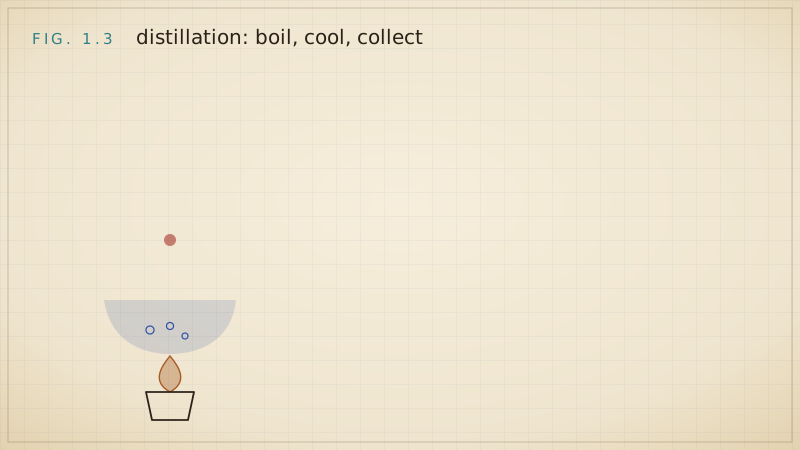
- Distillation. Also uses boiling points, but keeps the liquid. Boil the solution, lead the vapour through a cooled tube where it condenses, and collect the pure liquid, the distillate, in a second flask. With a tall column, the method separates two liquids that boil at different temperatures, such as alcohol (78 °C) and water (100 °C); this is fractional distillation.
- Crystallisation. Uses a difference in solubility. Dissolve the impure solid in a little hot water and let it cool slowly. The main substance comes out as pure crystals, and the impurities, present in small amounts, stay dissolved. Pour off the remaining liquid and dry the crystals.
- Chromatography. Uses a difference in how strongly substances cling to a surface. Put a spot of ink near the bottom of a strip of filter paper and stand the strip in water. As the water climbs, it carries each dye a different distance. The one ink spot spreads into bands of separate colours.
Worked example 5
A careless assistant has spilled a jar of iron filings into a dish of sand and salt. Plan how to recover all three, dry and separate.
- List the parts and their properties. Iron: magnetic, does not dissolve in water. Sand: not magnetic, does not dissolve. Salt: not magnetic, dissolves in water.
- Iron differs from the other two in being magnetic. Pass a magnet, wrapped in paper, over the dry mixture. The iron sticks to it. Pull off the paper over a jar to collect the filings.
- Salt differs from sand in dissolving. Add water to the sand and salt and stir until the salt has dissolved.
- Filter. The sand stays on the paper as the residue. The salt water passes through as the filtrate. Rinse the sand with a little clean water and let it dry.
- Evaporate the filtrate in a dish over a gentle flame. The water goes off as steam; white salt crystals remain.
Check: each step used one difference in one property, and nothing was chemically changed. Weigh the three parts at the end; together they should weigh what the mixture weighed at the start.
A common mistake
Students often filter salt water and expect the salt to stay on the paper. It does not. Dissolved salt is spread through the water as particles far smaller than the pores of the paper, and it runs straight through. Filtration separates a liquid from a solid that has not dissolved. To get a dissolved solid back, you must evaporate, distil or crystallise.
Try it
Plate 1.3 is a separation bench with the same spilled mixture of iron, sand and salt. Choose your tools in any order. The bench tells you what happens, including what goes wrong when the order is poor. Recover all three with as few steps as you can.
Margin
Chromatography was invented in Warsaw. Mikhail Tsvet, a botanist working there, washed an extract of green leaves down a glass tube packed with powdered chalk. The colour spread into separate bands, green and yellow. He described the method from 1903 and named it chromatography, "colour writing", in 1906.
In my laboratory
Pitchblende is a mixture, mostly an oxide of uranium with many other elements in it. In 1898 its rays were stronger than its uranium could explain, so I concluded that it held a new element in a small amount. Pierre and I separated it by ordinary methods: dissolving, precipitating, filtering, crystallising. After each step we measured the activity of every part with the electrometer, and followed the part that grew more active, as a hunter follows a track.
The last stage for radium was fractional crystallisation. Radium chloride is slightly less soluble than barium chloride, so each crop of crystals was a little richer in radium than the liquid it left. I crystallised, dissolved and crystallised again, for months. From about a tonne of pitchblende residues I obtained, in 1902, about a decigram of pure radium chloride: one part in ten million.
Density: a property you can measure
How can you tell a gold coin from a brass one that has been gilded? Or a lump of lead from a lump of grey iron painted to look the same? You weigh it and you measure its volume. The ratio of the two is a physical property called density, and it is different for nearly every substance.
Density is the mass of a substance per unit of volume. In words: density equals mass divided by volume. In symbols, with the Greek letter rho for density:
\[ \rho = \dfrac{m}{V} \]
If mass is in grams and volume in cubic centimetres, density is in grams per cubic centimetre, \(\mathrm{g/cm^3}\), which is the same as grams per millilitre, \(\mathrm{g/mL}\). A density of \(8.96\,\mathrm{g/cm^3}\) means that every cubic centimetre of the substance has a mass of 8.96 grams.
Some densities near room temperature, in \(\mathrm{g/cm^3}\), to keep in your notebook:
- air: about 0.0012
- alcohol (ethanol): 0.789
- ice: 0.917
- water: 1.00
- aluminium: 2.70
- iron: 7.87
- copper: 8.96
- lead: 11.3
- mercury: 13.5
- gold: 19.3
A substance with a smaller density than a liquid floats on it; a larger density sinks. Ice floats on water. A bolt of iron floats on mercury.
To find the volume of an irregular solid, such as a lump of ore, we use displacement. Put water in a graduated cylinder and read the level. Lower the solid in on a thread so that it is fully covered. The water rises by exactly the volume of the solid.
Worked example 6
A reddish metal lump has a mass of 53.6 g. Water in a measuring cylinder stands at 30.0 mL; with the lump in it, the level is 36.0 mL. Find the density and identify the metal.
- Volume of the lump: the rise of the water. \(V = 36.0\,\mathrm{mL} - 30.0\,\mathrm{mL} = 6.0\,\mathrm{mL} = 6.0\,\mathrm{cm^3}\).
- Write the formula in words: density is mass divided by volume.
- Put in the numbers with their units: \(\rho = \dfrac{53.6\,\mathrm{g}}{6.0\,\mathrm{cm^3}}\).
- Divide: \(53.6 / 6.0 = 8.93\), so \(\rho = 8.9\,\mathrm{g/cm^3}\). (Lesson 2 explains why we keep only two figures here: the volume, 6.0, has only two.)
- Compare with the list: copper is \(8.96\,\mathrm{g/cm^3}\). Iron (7.87) and lead (11.3) are far away. The metal is very probably copper, and its colour agrees.
Check: the unit came out as grams per cubic centimetre, as a density must. And a metal should be several times denser than water; 8.9 is.
Worked example 7
What mass of mercury fills a flask of 20.0 mL? And what volume do 100 g of gold take up?
- For the mercury we know the density and the volume and want the mass. Rearrange the formula: multiply both sides of \(\rho = m/V\) by \(V\), which gives \(m = \rho V\).
- \(m = 13.5\,\mathrm{g/cm^3} \times 20.0\,\mathrm{cm^3} = 270\,\mathrm{g}\). The \(\mathrm{cm^3}\) cancel and leave grams.
- For the gold we know the mass and want the volume. Rearrange again: divide both sides of \(m = \rho V\) by \(\rho\), which gives \(V = m/\rho\).
- \(V = \dfrac{100\,\mathrm{g}}{19.3\,\mathrm{g/cm^3}} = 5.18\,\mathrm{cm^3}\). The grams cancel and leave cubic centimetres.
Check: 20 mL of water would weigh 20 g; mercury is 13.5 times denser, so 270 g is right. And 100 g of gold is a little more than a teaspoon, about 5 mL. A small volume for a fortune.
A common mistake
"Lead is heavier than feathers." Is a kilogram of lead heavier than a kilogram of feathers? No: both have a mass of one kilogram. What students mean is that lead is denser. A kilogram of lead fits in your hand; a kilogram of feathers fills a pillowcase. Say "denser" when you mean more mass in the same volume.
Try it
Exercise 1.4 collects the whole lesson: physical or chemical, the sorting tree, the right separation, and density calculations with fresh numbers each time you ask.
What to remember
- Matter is anything with mass that takes up space. Mass is the amount of matter; volume is the space it fills.
- Solids keep shape and volume; liquids keep volume only; gases fill any container. Particles are fixed and vibrating, close and sliding, or far apart and fast.
- A physical change makes no new substance; a chemical change does.
- An element cannot be broken down by chemical means; a compound is elements joined in a fixed proportion.
- A mixture keeps the properties of its parts, has variable proportions and can be separated physically.
- A homogeneous mixture (a solution) is the same throughout; a heterogeneous one is not.
- Each separation uses a difference in one property: magnetism, density, particle size, boiling point, solubility, or clinging to a surface.
- Density is mass divided by volume: \(\rho = m/V\), so \(m = \rho V\) and \(V = m/\rho\).
- Find the volume of an irregular solid by displacement of water.
Problems for your notebook
Problem 1. Is each of these a physical or a chemical change? (a) Butter melting in a warm pan. (b) Butter burning black in a pan left too long on the fire. (c) Grinding coffee beans.
Answer. (a) Physical: melted butter is still butter and sets again when cool. (b) Chemical: a new black substance and a new smell appear, and cooling does not turn it back into butter. (c) Physical: the ground coffee is the same substance in smaller pieces.
Problem 2. Classify each sample as an element, a compound, a homogeneous mixture or a heterogeneous mixture: (a) oxygen gas; (b) brass; (c) table salt; (d) muddy water.
Answer. (a) Element: oxygen cannot be split into anything simpler. (b) Homogeneous mixture: copper and zinc melted together, the same throughout, and the proportions vary from one brass to another. (c) Compound: sodium and chlorine joined in a fixed proportion. (d) Heterogeneous mixture: the mud settles and you can see it.
Problem 3. Which method would you use for each? (a) To get drinkable water from sea water and keep the water. (b) To see whether a black ink is made of one dye or several. (c) To get chalk powder out of water in which it is stirred.
Answer. (a) Distillation: the water boils off, condenses and is collected; the salts stay behind. Evaporation would lose the water. (b) Chromatography: a spot of ink on filter paper, stood in water, spreads into its separate dyes. (c) Filtration: the undissolved chalk stays on the paper. (Decantation would also work, less cleanly.)
Problem 4. A grey metal block measures 2.0 cm by 3.0 cm by 5.0 cm and has a mass of 81 g. Find its density and say which metal in the list it could be.
Answer.
- Volume: \(V = 2.0\,\mathrm{cm} \times 3.0\,\mathrm{cm} \times 5.0\,\mathrm{cm} = 30\,\mathrm{cm^3}\).
- Density: \(\rho = m/V = 81\,\mathrm{g} / 30\,\mathrm{cm^3} = 2.7\,\mathrm{g/cm^3}\).
- Aluminium has a density of \(2.70\,\mathrm{g/cm^3}\). The block is probably aluminium.
Problem 5. A jeweller is offered a "gold" ring of mass 15.6 g. Lowered into water in a narrow cylinder, it raises the level from 10.00 mL to 11.50 mL. Is it solid gold? What volume would a solid gold ring of this mass have?
Answer.
- Volume by displacement: \(V = 11.50\,\mathrm{mL} - 10.00\,\mathrm{mL} = 1.50\,\mathrm{mL} = 1.50\,\mathrm{cm^3}\).
- Density: \(\rho = 15.6\,\mathrm{g} / 1.50\,\mathrm{cm^3} = 10.4\,\mathrm{g/cm^3}\).
- Gold is \(19.3\,\mathrm{g/cm^3}\). The ring is far less dense, so it is not solid gold. (10.4 is close to silver, 10.5, perhaps gilded.)
- A solid gold ring of the same mass would have \(V = m/\rho = 15.6\,\mathrm{g} / 19.3\,\mathrm{g/cm^3} = 0.808\,\mathrm{cm^3}\), little more than half the volume measured.
After my time
In my lifetime the particles of matter were a sure deduction, never a sight. Jean Perrin, my friend and neighbour, proved their reality in 1908 from the dance of tiny grains in water (Lesson 5). Since my death, physicists have built microscopes that show single atoms as tiny bumps on a surface.
The list of elements has also grown. When I died, a few places in the table, just before uranium in the order of the elements, were still empty. One of them, element 87, francium, was found in 1939 by Marguerite Perey, who had worked as my assistant at the Radium Institute. Today 118 elements are known; about ninety occur naturally on Earth, and the rest have been made in laboratories. And chromatography, once one botanist's tube of chalk, now separates hundreds of substances from a single drop.
The next lesson, Lesson 2, is about measurement: units, the difference between accuracy and precision, and how many figures to believe. If you would like another example first, or want to argue about whether milk is a solution, come and ask me.
Sources and liberties
The Curie Notes are a modern chemistry course written in Marie Curie's voice by Eternal Gardens. The chemistry is standard modern chemistry; dates, people, apparatus and quotations come from the sources below; the teaching, the analogies and the private remarks are our reconstruction.
- Marie Curie, Pierre Curie, with Autobiographical Notes, translated by Charlotte and Vernon Kellogg, Macmillan, 1923: Project Gutenberg
- Marie Curie, The Discovery of Radium, address at Vassar College, 14 May 1921: Project Gutenberg
- American Institute of Physics, "Marie Curie and the Science of Radioactivity": history.aip.org
- OpenStax, Chemistry 2e, chapter 1, "Essential Ideas": openstax.org
- The Nobel Prize in Chemistry 1911, Marie Curie: nobelprize.org
- Mikhail Tsvet and the history of chromatography: Wikipedia
- NIST Chemistry WebBook, densities and phase data: webbook.nist.gov
Sources differ on whether Tsvet's first printed description in Warsaw appeared in 1903 or 1905; the 1906 papers that named chromatography are not in doubt.