 by Marie Curie

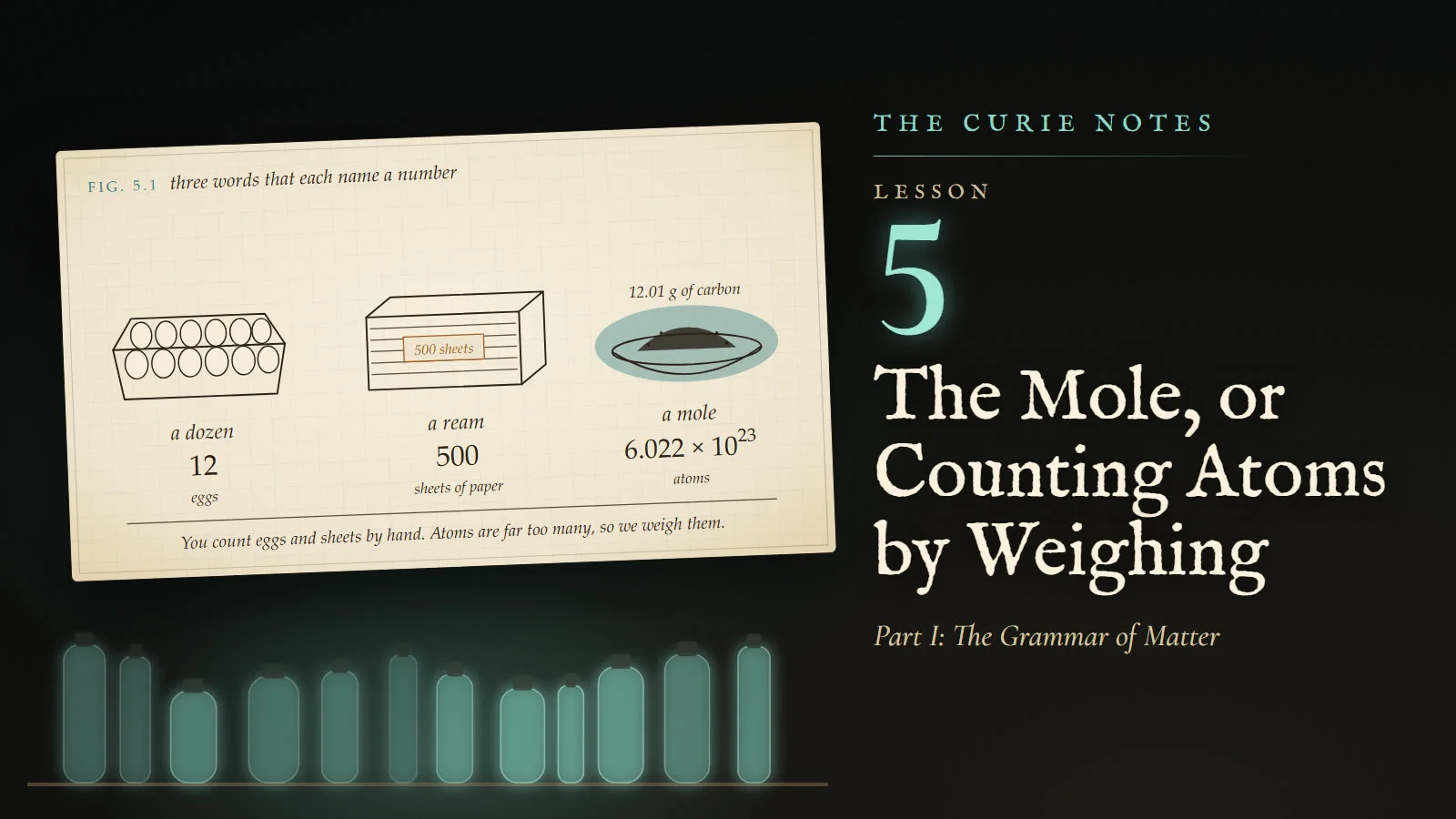
On my bench this morning there are two small porcelain dishes and a balance in its glass case. One dish holds a heap of black charcoal powder. The other holds red copper filings. Each heap contains more atoms than there are grains of sand on all the beaches of France, and nobody has ever counted them one by one. Nobody ever will. Yet by the end of this lesson you will be able to say how many atoms are in each dish, using nothing but the balance and a short table of numbers. Chemists count atoms by weighing them. This lesson teaches you how, and introduces the most useful counting word in chemistry: the mole.
...though I was taught that the way of progress is neither swift nor easy, this first trial confirmed in me the taste for experimental research in the fields of physics and chemistry.
Marie Curie, Autobiographical Notes, 1923
What you will learn
- Explain why chemists count atoms by weighing them, and when counting by weighing works.
- Use the atomic mass unit and read relative atomic masses from a table.
- Say what a mole is, and use the Avogadro constant, \(6.022 \times 10^{23}\,\mathrm{mol^{-1}}\).
- Work out the molar mass of any element or compound from its formula.
- Convert between grams, moles and numbers of particles, in either direction.
- Describe how Jean Perrin measured the number of atoms in a mole with a microscope.
What you need first: Lesson 2 (Measurement, Units and Significant Figures) for scientific notation and significant figures, Lesson 3 (Atoms and Elements: The Laws That Proved Them) for atoms and chemical symbols, and Lesson 4 (Inside the Atom: Electrons, Nuclei and Isotopes) for isotopes and average atomic mass.
Why we count by weighing
Atoms are very small. A single grain of table salt, the size of a pinhead, contains about a billion billion of them. You cannot see an atom with any microscope I ever owned. You cannot pick one up with tweezers. So you cannot count atoms the way a child counts marbles.
But you can weigh them. A balance does not care how small the pieces are. It weighs a million atoms or a billion billion atoms with the same ease. If we know how much one atom weighs, then weighing a heap tells us how many atoms are in it.
The idea is simple enough to say in one line: number of pieces = total mass ÷ mass of one piece. Everything in this lesson is that line, made exact.
An analogy from my Paris
Go into any boulangerie in the Latin Quarter early in the morning. The baker cuts dough for small rolls. He does not count the pieces of dough. He weighs each piece to 50 grams on his scale, because then every roll is the same.
Now suppose a restaurant orders 200 rolls. The baker does not count them into the basket either. He knows each roll weighs about 50 grams, so 200 rolls weigh about 10,000 grams, or 10 kilograms. He loads the basket on the big scale until it reads 10 kilograms, and he has his 200 rolls. Let us check: 10,000 grams ÷ 50 grams per roll = 200 rolls.
This works for one reason: all the rolls weigh the same, or nearly so. Counting by weighing needs pieces of a known, fixed mass. Atoms of one element are exactly such pieces, as long as we use their average mass.
An analogy from Warsaw
A bank clerk faces the same problem with coins. Counting ten thousand copper coins by hand takes all afternoon, and a tired clerk makes mistakes. So clerks in Warsaw, as in Paris, weighed coins by the bag. If one coin weighs 4 grams and the bag of coins weighs 2,000 grams, the bag holds 2,000 ÷ 4 = 500 coins. The balance does in a minute what the fingers do in an hour, and it does not lose count.
Margin
For most of the nineteenth century, chemists could not weigh a single atom. They could only compare atoms with each other. John Dalton and those who followed him worked out that an oxygen atom is about sixteen times as heavy as a hydrogen atom, and a carbon atom about twelve times. These were relative weights, like knowing that a loaf weighs as much as eight rolls without knowing what either weighs in grams. As you will see, relative weights turned out to be enough to count with.
The atomic mass unit and relative masses
Atoms are so light that the gram is a clumsy unit for them. It is like measuring grains of pepper in tonnes. So we use a tiny unit made for the purpose.
The atomic mass unit, symbol u, is one twelfth of the mass of one atom of carbon-12. (Carbon-12 is the common isotope of carbon, with 6 protons and 6 neutrons; you met isotopes in Lesson 4.) In grams it is very small:
\[ 1\,\mathrm{u} = 1.6605 \times 10^{-24}\,\mathrm{g} \]
On this scale a carbon-12 atom weighs exactly 12 u. A hydrogen atom weighs about 1 u, an oxygen atom about 16 u, and a copper atom about 63.5 u.
The number printed under each symbol in the periodic table is the element's relative atomic mass: the average mass of its atoms in atomic mass units, taking all its natural isotopes in their natural proportions. That is why chlorine shows 35.45 and not a whole number. Natural chlorine is a mixture of chlorine-35 and chlorine-37, as you calculated in Lesson 4. Here are the values we shall use in this lesson:
- hydrogen, H: 1.008
- helium, He: 4.003
- carbon, C: 12.01
- oxygen, O: 16.00
- sodium, Na: 22.99
- aluminium, Al: 26.98
- sulfur, S: 32.06
- chlorine, Cl: 35.45
- calcium, Ca: 40.08
- iron, Fe: 55.85
- copper, Cu: 63.55
- barium, Ba: 137.33
- gold, Au: 196.97
- radium, Ra: 226 (its longest-lived isotope)
Worked example 1
How many times heavier is an average copper atom than an average carbon atom?
- Read the relative atomic masses: copper 63.55 u, carbon 12.01 u.
- Divide the larger by the smaller: \(63.55\,\mathrm{u} \div 12.01\,\mathrm{u} = 5.29\).
- The units cancel, so the answer is a pure number: a copper atom is 5.29 times as heavy as a carbon atom.
Check: copper is in the fourth row of the periodic table and carbon in the second, so copper should be several times heavier. Five times is sensible.
Now notice something useful. If a copper atom is 5.29 times as heavy as a carbon atom, then 63.55 grams of copper and 12.01 grams of carbon must contain the same number of atoms. Each copper atom is heavier by the same factor that the copper heap is heavier. The same is true for any pair of elements. Masses in grams in the ratio of the atomic masses contain equal numbers of atoms. This is the key to the mole.
A common mistake
Students confuse the mass number with the relative atomic mass. The mass number belongs to one isotope and is always a whole number: it counts protons and neutrons, so chlorine-35 has mass number 35. The relative atomic mass belongs to the element as found in nature and is an average, usually not a whole number: chlorine is 35.45. For counting atoms in a real sample, always use the relative atomic mass from the table.
The mole and the Avogadro constant
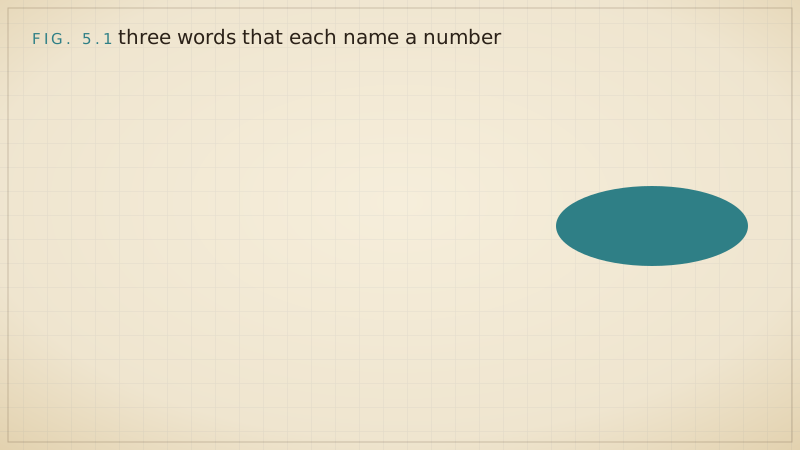
We have counting words for groups of a fixed size. A dozen is 12, whether of eggs or of oysters. A ream of paper is 500 sheets. A gross is 144. These words name numbers, nothing else. A dozen eggs and a dozen pianos have very different masses, but they have the same count.
Chemists have such a word for atoms. The mole (symbol mol) is a count of \(6.022 \times 10^{23}\) particles. The particles can be atoms, molecules, ions or anything else, as long as you say which. A mole of carbon atoms is \(6.022 \times 10^{23}\) carbon atoms. A mole of water molecules is \(6.022 \times 10^{23}\) water molecules.
The number of particles in one mole is called the Avogadro constant, written \(N_\mathrm{A}\):
\[ N_\mathrm{A} = 6.022 \times 10^{23}\,\mathrm{mol^{-1}} \]
The unit \(\mathrm{mol^{-1}}\) is read "per mole". It says: this many particles for every mole. The quantity we count in moles is called the amount of substance, written \(n\). When a chemist says "the amount of copper", she means the number of moles of copper, not its mass.
Why this strange number?
Why \(6.022 \times 10^{23}\) and not a round number like a million million million? Because this number makes the balance do our counting for us. It is chosen so that one mole of atoms has a mass in grams equal to the element's relative atomic mass in u.
Let us see this with carbon-12. One atom weighs 12 u. We ask: how many such atoms make exactly 12 grams?
- Mass of one carbon-12 atom in grams: \(12 \times 1.6605 \times 10^{-24}\,\mathrm{g} = 1.9926 \times 10^{-23}\,\mathrm{g}\).
- Number of atoms in 12 g: total mass ÷ mass of one atom.
- \(12\,\mathrm{g} \div 1.9926 \times 10^{-23}\,\mathrm{g} = 6.022 \times 10^{23}\).
There it is. Twelve grams of carbon-12 holds \(6.022 \times 10^{23}\) atoms, one mole. And by the argument at the end of the last section, 63.55 grams of copper holds the same number, and 1.008 grams of hydrogen, and 196.97 grams of gold. The rule is beautiful in its plainness: one mole of an element weighs its relative atomic mass in grams.
An analogy from my Paris
A stationer near the Sorbonne sells paper by the ream. A careful stationer does not count 500 sheets every time. He knows that a ream of his ordinary writing paper weighs, let us say, 2.5 kilograms, so he weighs it. A ream of heavy drawing paper weighs more, perhaps 5 kilograms, but it is still 500 sheets. The count is fixed; the mass depends on what each sheet weighs.
The mole is the chemist's ream. A mole of hydrogen atoms weighs 1.008 grams and a mole of gold atoms weighs 196.97 grams. Both are the same count.
Worked example 2
How many iron atoms are there in 2.50 mol of iron?
- Each mole holds \(6.022 \times 10^{23}\) atoms, so multiply the number of moles by \(N_\mathrm{A}\).
- \(N = n \times N_\mathrm{A} = 2.50\,\mathrm{mol} \times 6.022 \times 10^{23}\,\mathrm{mol^{-1}}\).
- \(2.50 \times 6.022 = 15.055\), so \(N = 15.055 \times 10^{23}\).
- Write it in proper scientific notation: \(N = 1.51 \times 10^{24}\) atoms (three significant figures, like 2.50).
Check: two and a half moles should be two and a half times \(6 \times 10^{23}\), which is about \(1.5 \times 10^{24}\). The unit mol cancels against per mole, leaving a plain count of atoms.
Margin
The name honours Amedeo Avogadro of Turin. In 1811 he proposed that equal volumes of different gases, at the same temperature and pressure, contain equal numbers of molecules. He had no way to know how many. His idea was neglected for half a century, until Stanislao Cannizzaro used it at the Karlsruhe congress of 1860 to settle the atomic weights. It was my friend Jean Perrin who, in 1909, proposed calling the number of molecules in a gram-molecule "Avogadro's constant". In my student days we said gram-molecule and gram-atom; the short word "mole" came from the German Mol of Wilhelm Ostwald, around the turn of the century.
Try it
Plate 5.1 is a balance with two pans. Weigh out any mass of one substance on the left. The plate puts the same number of particles of a second substance on the right, and the beam tips toward the heavier pan. Each pan shows twelve dots, the same count, but the dots are drawn larger for heavier particles. Press "One mole on the left" and read the count: it is always \(6.02 \times 10^{23}\).
Molar mass
We now give a name to the number that turns grams into moles. The molar mass of a substance, written \(M\), is the mass of one mole of it. Its unit is grams per mole, \(\mathrm{g/mol}\). For an element made of single atoms, the molar mass has the same number as the relative atomic mass:
- carbon: \(M = 12.01\,\mathrm{g/mol}\)
- iron: \(M = 55.85\,\mathrm{g/mol}\)
- gold: \(M = 196.97\,\mathrm{g/mol}\)
Some elements go about in pairs. Hydrogen gas, oxygen gas, nitrogen gas and chlorine gas are made of two-atom molecules: \(\ce{H2}\), \(\ce{O2}\), \(\ce{N2}\), \(\ce{Cl2}\). A mole of oxygen molecules holds two moles of oxygen atoms, so its molar mass is \(2 \times 16.00 = 32.00\,\mathrm{g/mol}\). Always say which particle you are counting.
The molar mass of a compound
A formula tells you how many atoms of each element are in one particle of a compound. The formula of water, \(\ce{H2O}\), says: two hydrogen atoms and one oxygen atom. So one mole of water molecules contains two moles of hydrogen atoms and one mole of oxygen atoms, and its mass is the sum of theirs.
The rule: multiply each atomic mass by the number of those atoms in the formula, and add.
\[ M(\ce{H2O}) = 2 \times 1.008 + 1 \times 16.00 = 18.02\,\mathrm{g/mol} \]
\[ M(\ce{CO2}) = 1 \times 12.01 + 2 \times 16.00 = 44.01\,\mathrm{g/mol} \]
Salts such as sodium chloride, \(\ce{NaCl}\), are not made of separate molecules. They are great orderly stacks of ions, and the formula gives only the ratio: one sodium for each chlorine. For them we count formula units: one \(\ce{Na}\) and one \(\ce{Cl}\) together. The arithmetic is the same: \(M(\ce{NaCl}) = 22.99 + 35.45 = 58.44\,\mathrm{g/mol}\). You will learn about ions and their stacks in Lesson 17.
Worked example 3
Find the molar mass of slaked lime, calcium hydroxide, \(\ce{Ca(OH)2}\).
- Read the formula carefully. The 2 after the bracket multiplies everything inside it. So one formula unit has 1 Ca, 2 O and 2 H.
- Calcium: \(1 \times 40.08 = 40.08\).
- Oxygen: \(2 \times 16.00 = 32.00\).
- Hydrogen: \(2 \times 1.008 = 2.016\).
- Add: \(40.08 + 32.00 + 2.016 = 74.096\).
- Round to two decimal places, like the least precise mass we added: \(M = 74.10\,\mathrm{g/mol}\).
Check: calcium alone is 40, and two OH groups add about 17 each, so the total is about 74.
Worked example 4
Find the molar mass of blue vitriol, copper sulfate crystals, \(\ce{CuSO4.5H2O}\).
The dot in this formula means that each copper sulfate unit carries five water molecules locked into the crystal. We add the water too.
- Copper sulfate part: \(63.55 + 32.06 + 4 \times 16.00 = 63.55 + 32.06 + 64.00 = 159.61\,\mathrm{g/mol}\).
- One water: \(2 \times 1.008 + 16.00 = 18.016\,\mathrm{g/mol}\).
- Five waters: \(5 \times 18.016 = 90.08\,\mathrm{g/mol}\).
- Total: \(159.61 + 90.08 = 249.69\), so \(M = 249.7\,\mathrm{g/mol}\).
Check: more than a third of the weight of the blue crystals is water. In Lesson 6 we will drive that water off with heat and weigh what is left.
A common mistake
The commonest error is to let a subscript or a bracket multiply the wrong thing. In \(\ce{Ca(OH)2}\) the 2 multiplies both O and H, giving 2 O and 2 H. Students who write 1 O and 2 H get 58.10 instead of 74.10. In \(\ce{CO2}\) the 2 belongs only to the oxygen. Before you add anything, write out the atom count for each element, as I did in step 1. It takes ten seconds and saves many wrong answers.
In my laboratory
Radium followed barium through all my crystallisations, because the two elements are chemical cousins, both in the second column of the periodic table. Both form chlorides with the same formula pattern: barium chloride \(\ce{BaCl2}\) and radium chloride \(\ce{RaCl2}\). Their molar masses are
\[ M(\ce{BaCl2}) = 137.33 + 2 \times 35.45 = 208.23\,\mathrm{g/mol} \]
\[ M(\ce{RaCl2}) = 226 + 2 \times 35.45 = 296.90\,\mathrm{g/mol} \]
So a mole of radium chloride is about 1.43 times as heavy as a mole of barium chloride. As I purified the radium, the same number of formula units weighed more and more. That change in weight was one of my proofs that a new, heavier element was really there. In Lesson 6 you will see how I turned such weighings into an atomic weight for radium.
Grams, moles and particles
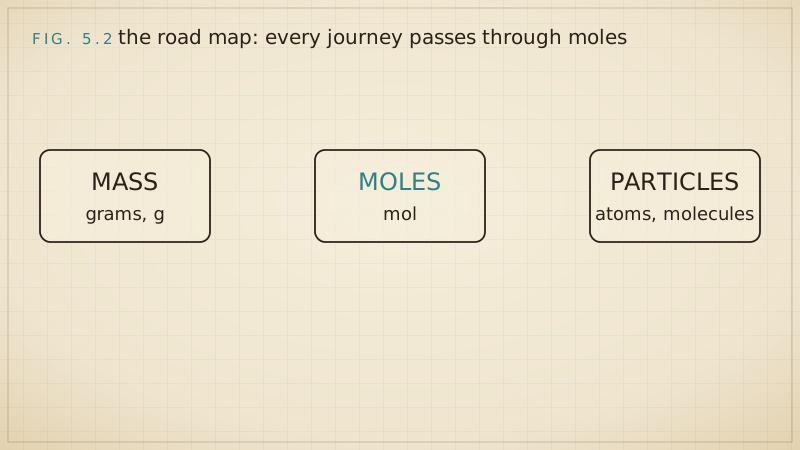
We can now travel freely between three ways of describing an amount of a substance: its mass in grams, its amount in moles, and its number of particles. There are two bridges, and the moles sit in the middle.
The first bridge joins grams and moles. Moles are grams divided by grams per mole:
\[ n = \frac{m}{M} \qquad \text{and so} \qquad m = n \times M \]
Here \(m\) is the mass in grams, \(M\) the molar mass in grams per mole, and \(n\) the amount in moles.
The second bridge joins moles and particles. Each mole holds \(N_\mathrm{A}\) particles:
\[ N = n \times N_\mathrm{A} \qquad \text{and so} \qquad n = \frac{N}{N_\mathrm{A}} \]
Here \(N\) is the number of particles, a plain count with no unit.
Worked example 5
I weigh 10.0 g of water. How many moles is that, how many water molecules, and how many hydrogen atoms?
- Molar mass of water, from above: \(M = 18.02\,\mathrm{g/mol}\).
- Grams to moles: \(n = m / M = 10.0\,\mathrm{g} \div 18.02\,\mathrm{g/mol}\).
- The grams cancel and moles remain: \(n = 0.555\,\mathrm{mol}\).
- Moles to molecules: \(N = n \times N_\mathrm{A} = 0.555\,\mathrm{mol} \times 6.022 \times 10^{23}\,\mathrm{mol^{-1}}\).
- \(0.555 \times 6.022 = 3.342\), so \(N = 3.34 \times 10^{23}\) water molecules.
- Each \(\ce{H2O}\) molecule has 2 hydrogen atoms, so hydrogen atoms \(= 2 \times 3.342 \times 10^{23} = 6.68 \times 10^{23}\).
Check: 10 grams is a bit more than half of one mole of water (18 grams), so 0.555 mol is right. And the hydrogen atoms must be exactly twice the molecules.
Worked example 6
How many grams of sodium chloride must I weigh to have 0.250 mol?
- Molar mass: \(M(\ce{NaCl}) = 22.99 + 35.45 = 58.44\,\mathrm{g/mol}\).
- Moles to grams: \(m = n \times M = 0.250\,\mathrm{mol} \times 58.44\,\mathrm{g/mol}\).
- The moles cancel and grams remain: \(m = 14.61\,\mathrm{g}\), or \(14.6\,\mathrm{g}\) to three significant figures.
Check: a quarter of a mole should weigh a quarter of 58 grams, which is about 15 grams.
Worked example 7
What is the mass of a single atom of gold, in grams?
- One mole of gold atoms weighs 196.97 g and holds \(6.022 \times 10^{23}\) atoms.
- Mass of one atom = mass of the mole ÷ number of atoms in it.
- \(196.97\,\mathrm{g} \div 6.022 \times 10^{23} = 3.271 \times 10^{-22}\,\mathrm{g}\).
Check: a single atom must weigh unimaginably little, so a large negative power of ten is right. We can also check by the atomic mass unit: \(196.97 \times 1.6605 \times 10^{-24}\,\mathrm{g} = 3.271 \times 10^{-22}\,\mathrm{g}\). Two roads, one answer. I always like to check by a second method.
A common mistake
Students multiply when they should divide, especially with \(N_\mathrm{A}\). Two quick tests catch almost every such slip. First, look at the size. A number of particles in any sample you can see is enormous, with a power of ten near \(10^{20}\) or more. The mass of one atom is tiny, near \(10^{-22}\,\mathrm{g}\). Second, look at the units. Write them in every line, and they must cancel to leave the unit you want. If you find \(\mathrm{g^2/mol}\) at the end, you multiplied where you should have divided.
From the shed
In 1902, after treating about a tonne of pitchblende residues, I held one decigram of pure radium chloride, about 0.1 g. To a merchant it would have looked like nothing: a pinch of white salt. Let us count it.
- Moles of radium chloride: \(n = 0.1\,\mathrm{g} \div 296.90\,\mathrm{g/mol} = 3.4 \times 10^{-4}\,\mathrm{mol}\).
- Formula units: \(N = 3.4 \times 10^{-4}\,\mathrm{mol} \times 6.022 \times 10^{23}\,\mathrm{mol^{-1}} = 2 \times 10^{20}\).
Two hundred billion billion units of \(\ce{RaCl2}\), each with one radium atom, in a pinch of salt. Four years of stirring and crystallising, and still every crystal held more atoms than a person could count in a billion lifetimes. That is how small atoms are.
Worked example 8
In 1911 I prepared the international radium standard: 21.99 mg of pure radium chloride sealed in a thin glass tube. How many radium atoms does it hold, and what mass of radium?
- Change milligrams to grams: \(21.99\,\mathrm{mg} = 0.02199\,\mathrm{g}\).
- Molar mass of radium chloride: \(M(\ce{RaCl2}) = 296.90\,\mathrm{g/mol}\).
- Moles: \(n = 0.02199\,\mathrm{g} \div 296.90\,\mathrm{g/mol} = 7.407 \times 10^{-5}\,\mathrm{mol}\).
- Each formula unit has one radium atom, so moles of radium atoms are also \(7.407 \times 10^{-5}\,\mathrm{mol}\).
- Radium atoms: \(7.407 \times 10^{-5} \times 6.022 \times 10^{23} = 4.460 \times 10^{19}\).
- Mass of radium: \(m = n \times M(\ce{Ra}) = 7.407 \times 10^{-5}\,\mathrm{mol} \times 226\,\mathrm{g/mol} = 0.01674\,\mathrm{g}\), or 16.74 mg.
Check: the radium is most of the weight of the salt (226 of every 296.90 parts), and 16.74 mg is indeed about three quarters of 21.99 mg.
Try it
Exercise 5.2 gives you eight questions on these bridges. Most of them make fresh numbers when you press "New numbers", so you can practise until the steps feel ordinary. Write large numbers as 6.02e23 or as 6.02 x 10^23.
How large is the Avogadro constant?
We write \(6.022 \times 10^{23}\) in a few strokes of the pen, and that makes it too easy to forget what it means. In words it is six hundred and two thousand billion billion. Let me try to make it felt.
Suppose you had a mole of grains of fine sand, each one a cube of one millimetre. The volume would be \(6.022 \times 10^{23}\,\mathrm{mm^3}\). A cubic metre holds \(10^9\) cubic millimetres and a cubic kilometre holds \(10^9\) cubic metres, so the sand would fill \(6.0 \times 10^{5}\) cubic kilometres. Spread over all of France, about 551,000 square kilometres, it would make a layer about 1.1 kilometres deep. Every town and every field would lie under a kilometre of sand.
Or suppose you tried to count one mole of atoms, one each second, day and night. It would take \(1.9 \times 10^{16}\) years. If every person on Earth around 1930, some two billion people, counted together, each would still need about 9.5 million years.
And yet a mole of carbon is 12 grams: a heap of charcoal powder that fits in a spoon. Hold those two facts side by side and you have understood how small an atom is.
An analogy from my Paris
Stand on the Pont Neuf and watch the Seine go by. The river carries something like 300 cubic metres of water past Paris every second. If we count a drop as a twentieth of a millilitre, the whole river in a whole year carries about \(2 \times 10^{17}\) drops past the bridge. That is a vast number, and it is still three million times too small to make one mole. The atoms in a spoonful of charcoal outnumber the drops of the Seine in a year by three million to one.
Try it
Plate 5.3 is a ladder of counts. Each tick up multiplies by ten. On it you will find a dozen, a ream, the people of Paris, the people of the world, the drops of the Seine, my decigram of radium chloride, a gram of water and, at the very top, one mole. Press the buttons to see what a mole of sand, paper, seconds or carbon would be. Move the slider to add counters, and watch each counter's share of the mole come down the ladder.
Jean Perrin counts the molecules
So far I have given you \(6.022 \times 10^{23}\) as a fact from a table. But how does anyone know it? Nobody can count to it. When I was a student, many serious scientists doubted that atoms were real at all. Some, like Wilhelm Ostwald and Ernst Mach, said atoms were only a convenient way of talking. The question was settled in Paris, by my friend Jean Perrin, who taught the children in our little cooperative school.
The dancing grains
In 1827 the botanist Robert Brown looked through his microscope at tiny particles from pollen grains floating in water. They jiggled about without rest, in little zigzags, and never stopped. This is called Brownian motion. For seventy years nobody could say for certain what caused it.
The answer is that the particles are being knocked about by water molecules. A grain a thousandth of a millimetre across is struck billions of times a second from every side. The blows almost cancel, but not quite. At each moment a few more hit from one side than the other, and the grain lurches. In 1905 Albert Einstein worked out exactly how far such a grain should wander, and he showed that the answer depends on the number of molecules in a mole.
Perrin's experiment
Perrin made the measurements in 1908 and 1909. He took gamboge, a yellow resin used by painters, and rubbed it into water to make a milky liquid of tiny grains. Then, by spinning the liquid in a centrifuge again and again, he sorted the grains until they were all the same size. It took him months. When I heard how patiently he sorted them, I thought of my own fractional crystallisations, repeated thousands of times.
He put a drop of these grains into a thin glass cell and looked at it from the side under a microscope. The grains do two things at once. Their weight pulls them down. The blows of the water molecules scatter them up again. The result is a balance, like the air above the earth, which is thickest at the ground and thins out as you climb. Perrin counted the grains at several heights. With every 30 micrometres upward, about half as many remained.
How fast the grains thin out depends on two things: the weight of one grain, which he could measure, and the energy of the molecular blows. That energy is shared among the molecules of a mole, so the rate of thinning gives the number of molecules in a mole. From the counts at different heights Perrin found about \(6.8 \times 10^{23}\). He also measured the zigzag paths of single grains, marking their positions every 30 seconds, and found nearly the same number by Einstein's formula.
Why it convinced us
One measurement can be wrong. What convinced the doubters was that many completely different methods gave the same number. Perrin's grains gave it. The blue colour of the sky, which comes from light scattered by air molecules, gave it. The charge on the electron, measured by Robert Millikan, gave it. Counting the flashes of alpha particles from radium, and measuring the helium they produce, gave it too. In his book Les Atomes of 1913, Perrin set these methods side by side, and they agreed. After that, even Ostwald accepted that atoms were real. Perrin received the Nobel Prize in Physics in 1926 for this work on the discontinuous structure of matter.
In my laboratory
Radium gave its own route to the number. Each alpha particle that radium shoots out becomes, once it picks up two electrons, one atom of helium. Rutherford and his co-workers counted the alpha particles from a known amount of radium, one by one, by the tiny flash each makes on a screen of zinc sulfide. Others collected and measured the helium. Number of particles divided by moles of helium: there is the Avogadro constant again, from an experiment that has nothing to do with resin grains. I was proud that our element, found in a shed, helped to show that atoms are real things that can be counted.
A common mistake
Students sometimes think the Avogadro constant is a law of nature, like the attraction of masses. It is better to think of it as the bridge between two units. It tells how many atomic mass units make a gram: \(1\,\mathrm{g} \div 1.6605 \times 10^{-24}\,\mathrm{g} = 6.022 \times 10^{23}\). Its size comes from our choice of the gram, and the great work of Perrin and the others was to measure that bridge, which had been invisible.
What to remember
- Chemists count atoms by weighing: number of pieces = total mass ÷ mass of one piece.
- The atomic mass unit is one twelfth of a carbon-12 atom: \(1\,\mathrm{u} = 1.6605 \times 10^{-24}\,\mathrm{g}\).
- A mole is a count: \(N_\mathrm{A} = 6.022 \times 10^{23}\) particles per mole. Always say which particles.
- One mole of an element weighs its relative atomic mass in grams.
- Molar mass of a compound: multiply each atomic mass by its count in the formula, then add. Brackets and hydrate dots count too.
- Grams to moles: \(n = m/M\). Moles to grams: \(m = n \times M\).
- Moles to particles: \(N = n \times N_\mathrm{A}\). Particles to moles: \(n = N/N_\mathrm{A}\).
- Grams never go straight to particles: stop at the moles.
- Check every answer by its size and by its units.
- Perrin measured the Avogadro constant from Brownian motion in 1908 and 1909, and many other methods agreed.
Problems for your notebook
Problem 1. Find the molar mass of carbon dioxide, \(\ce{CO2}\).
Answer. One carbon and two oxygens: \(M = 12.01 + 2 \times 16.00 = 12.01 + 32.00 = 44.01\,\mathrm{g/mol}\).
Problem 2. How many moles of sulfur atoms are in 5.00 g of sulfur, and how many atoms is that?
Answer.
- Moles: \(n = 5.00\,\mathrm{g} \div 32.06\,\mathrm{g/mol} = 0.156\,\mathrm{mol}\).
- Atoms: \(N = 0.15596\,\mathrm{mol} \times 6.022 \times 10^{23}\,\mathrm{mol^{-1}} = 9.39 \times 10^{22}\).
Keep the unrounded 0.15596 in your calculator for the second step, and round only at the end.
Problem 3. A flask holds \(1.50 \times 10^{23}\) molecules of oxygen gas, \(\ce{O2}\). What mass of oxygen is that?
Answer.
- Molecules to moles: \(n = 1.50 \times 10^{23} \div 6.022 \times 10^{23}\,\mathrm{mol^{-1}} = 0.2491\,\mathrm{mol}\).
- Molar mass of \(\ce{O2}\): \(2 \times 16.00 = 32.00\,\mathrm{g/mol}\). (Not 16.00: we are counting molecules.)
- Moles to grams: \(m = 0.2491\,\mathrm{mol} \times 32.00\,\mathrm{g/mol} = 7.97\,\mathrm{g}\).
Problem 4. Which holds more atoms, 10.0 g of aluminium or 10.0 g of copper? How many times more?
Answer.
- Aluminium: \(10.0\,\mathrm{g} \div 26.98\,\mathrm{g/mol} = 0.3706\,\mathrm{mol}\).
- Copper: \(10.0\,\mathrm{g} \div 63.55\,\mathrm{g/mol} = 0.1574\,\mathrm{mol}\).
- Aluminium has more, by \(0.37064 \div 0.15735 = 2.355\), or about 2.36 times.
Notice that the ratio is simply \(63.55 \div 26.98 = 2.36\), the same answer without finding any moles. For equal masses, the lighter atoms are the more numerous, in the inverse ratio of the atomic masses.
Problem 5. A lump of cane sugar in a Paris café weighs about 4.0 g. Sugar is \(\ce{C12H22O11}\). How many sugar molecules, and how many carbon atoms, are in the lump?
Answer.
- Molar mass: \(12 \times 12.01 + 22 \times 1.008 + 11 \times 16.00 = 144.12 + 22.176 + 176.00 = 342.30\,\mathrm{g/mol}\).
- Moles: \(n = 4.0\,\mathrm{g} \div 342.30\,\mathrm{g/mol} = 0.01169\,\mathrm{mol}\).
- Molecules: \(0.01169 \times 6.022 \times 10^{23} = 7.0 \times 10^{21}\).
- Each molecule has 12 carbon atoms: \(12 \times 7.04 \times 10^{21} = 8.4 \times 10^{22}\) carbon atoms.
Two significant figures, because the mass 4.0 g has two.
After my time
In my day chemists measured atomic weights on a scale where natural oxygen counted exactly 16. When I sat on the International Committee on Atomic Weights from 1930, that was our standard. Physicists, who could now weigh single isotopes, preferred oxygen-16 alone, and for some years the two scales differed slightly. In 1961 chemists and physicists agreed on one scale built on carbon-12 at exactly 12, the scale I have taught you. The atomic mass unit is now also called the dalton, after John Dalton.
The mole became one of the seven base units of the international system of units in 1971, decades after my death. In 2019 it was redefined once more. The Avogadro constant is now fixed by definition at exactly \(6.02214076 \times 10^{23}\,\mathrm{mol^{-1}}\), and the mole is simply that many particles, the way a dozen is twelve. One consequence is a small irony: a mole of carbon-12 now weighs not exactly 12 grams, but so close to it that no student's balance will ever tell the difference.
Perrin would have enjoyed this. He measured the number to two figures with a microscope and a great deal of patience. His successors measured it to eight figures and more, by counting the atoms in nearly perfect spheres of silicon, and then wrote it into the definition of the unit itself.
If you would like another example, or if one of the bridges still feels shaky, come and ask me. In the next lesson, Lesson 6, Chemical Formulas, Percent Composition and Empirical Formulas, we turn the method around: from the weights of the elements in a compound, we will work out its formula, as I did for radium chloride.
Sources and liberties
The Curie Notes are a modern chemistry course written in Marie Curie's voice by Eternal Gardens. The chemistry is standard modern chemistry; dates, people, apparatus and quotations come from the sources below; the teaching, the analogies and the private remarks are our reconstruction.
- Marie Curie, Pierre Curie, with her Autobiographical Notes, translated by Charlotte and Vernon Kellogg (Macmillan, 1923): Project Gutenberg
- Marie Curie, The Discovery of Radium, lecture at Vassar College, 14 May 1921: Project Gutenberg
- OpenStax, Chemistry 2e, chapter 3, "Composition of Substances and Solutions" (the mole and molar mass): openstax.org
- NIST, CODATA value of the Avogadro constant: physics.nist.gov
- IUPAC Commission on Isotopic Abundances and Atomic Weights, standard atomic weights: ciaaw.org
- BIPM, the SI Brochure and the 2019 redefinition of the mole: bipm.org
- Jean Perrin, biography and Nobel Prize in Physics 1926: nobelprize.org
- AIP Center for History of Physics, "Marie Curie and the Science of Radioactivity": history.aip.org
Uncertain or simplified history: the dates of Ostwald's first use of "Mol" are given variously in the 1890s and 1900s; Perrin's own figures ranged a little around the value quoted here depending on the method; the bakery, bank and stationer scenes are illustrations, not records, and the Seine figures are round estimates.