 by Marie Curie

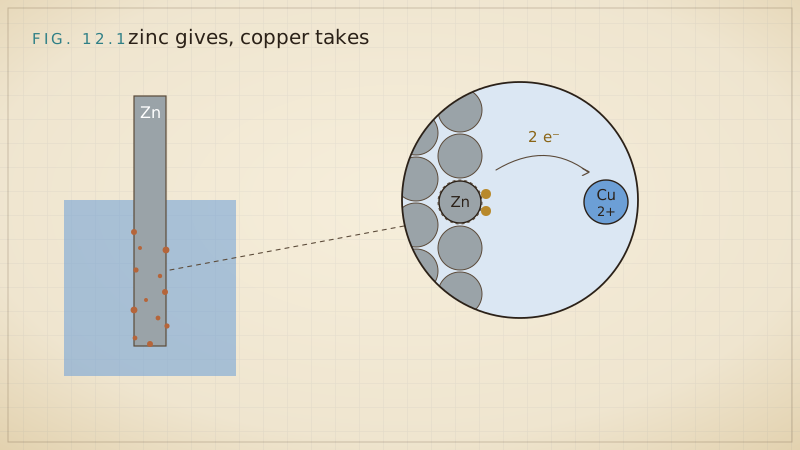
A strip of grey zinc stands in a glass of blue copper sulfate solution on my bench. Within a minute its surface darkens with a reddish-brown crust. Leave it an hour and the blue begins to fade. Nothing has been heated and nothing has been stirred, yet the zinc is going into the water and copper is coming out of it. Something has passed between them, too small to see. That something is the electron, and its passage from one substance to another is called oxidation and reduction. In this lesson you will learn to follow electrons by a simple bookkeeping, to balance the equations they make, to predict which metals will push others out of solution, and to understand why iron rusts.
But we must not forget that when radium was discovered no one knew that it would prove useful in hospitals. The work was one of pure science. And this is a proof that scientific work must not be considered from the point of view of the direct usefulness of it. It must be done for itself, for the beauty of science, and then there is always the chance that a scientific discovery may become like the radium a benefit for humanity.
Marie Curie, lecture at Vassar College, 14 May 1921
What you will learn
- Define oxidation and reduction as the loss and gain of electrons, and spot them in a reaction.
- Assign oxidation numbers with eight rules taken in order.
- Name the oxidising agent and the reducing agent in a reaction.
- Write half-reactions and balance redox equations in acid solution, checking both atoms and charge.
- Use the activity series to predict whether a metal will displace another metal or hydrogen.
- Explain rusting as a redox process, and how paint and zinc protect iron.
What you need first: Lesson 4 (Inside the Atom: Electrons, Nuclei and Isotopes) for electrons and ions, Lesson 7 (Chemical Equations and How to Balance Them), Lesson 10 (Reactions in Water: Precipitates and Net Ionic Equations) for net ionic equations, and Lesson 11 (Acids and Bases: A First Meeting).
Electrons change hands
The words are older than the electron. To Lavoisier, oxidation meant combining with oxygen: iron rusting, charcoal burning, mercury turning to a red powder when heated in air. Reduction was the metal-maker's word for the opposite: getting a metal back from its ore. When iron ore is heated with charcoal, a heavy lump of ore is reduced to a smaller mass of metal, and the oxygen goes off with the carbon.
After J. J. Thomson found the electron in 1897, chemists slowly saw what these reactions have in common. When magnesium burns, \(\ce{2Mg + O2 -> 2MgO}\), the product is made of ions, \(\ce{Mg^2+}\) and \(\ce{O^2-}\). Each magnesium atom has lost two electrons and each oxygen atom has gained two. The burning is a transfer of electrons. And the same transfer happens in many reactions with no oxygen in them at all, like the zinc in my glass.
So today we define the two words by electrons:
- Oxidation is the loss of electrons.
- Reduction is the gain of electrons.
Students in England remember this with the phrase "OIL RIG": Oxidation Is Loss, Reduction Is Gain. Use it; I do not mind.
The two always happen together. Electrons do not float free in a solution: if one substance loses them, another must take them at the same moment. That is why we speak of redox reactions, one word made of reduction and oxidation.
Worked example 1
Zinc metal is placed in copper(II) sulfate solution. Write the net ionic equation and say which substance is oxidised and which is reduced.
- The molecular equation: \(\ce{Zn(s) + CuSO4(aq) -> ZnSO4(aq) + Cu(s)}\).
- Copper sulfate and zinc sulfate are strong electrolytes. Split them into ions: \(\ce{Zn(s) + Cu^2+(aq) + SO4^2-(aq) -> Zn^2+(aq) + SO4^2-(aq) + Cu(s)}\).
- The sulfate ion is unchanged: it is a spectator. The net ionic equation is \(\ce{Zn(s) + Cu^2+(aq) -> Zn^2+(aq) + Cu(s)}\).
- Zinc goes from a neutral atom to \(\ce{Zn^2+}\): it has lost two electrons. Zinc is oxidised.
- The copper ion goes from \(\ce{Cu^2+}\) to a neutral atom: it has gained two electrons. Copper(II) ion is reduced.
Check: two electrons lost, two gained. The total charge is +2 on each side of the net equation.
Oxidation numbers
With ions it is easy to see who lost electrons. But in a molecule such as sulfuric acid, \(\ce{H2SO4}\), the electrons are shared in bonds, and nobody owns them outright. Chemists solved this with a piece of bookkeeping.
The oxidation number of an atom (also called its oxidation state) is the charge it would carry if every bond in the compound were ionic, with the shared electrons all given to the atom that holds them more strongly. It is an accountant's number, a convention. But it is a very useful one: an atom whose oxidation number rises has been oxidised, and an atom whose oxidation number falls has been reduced.
You do not need to know which atom holds electrons more strongly. Eight rules do the work for you, taken in order from the top. When two rules disagree, the higher one wins. When all the rules have been used and one element is left, its number comes from rule 3, the sum.
- An element on its own, combined with nothing else, has oxidation number 0: \(\ce{Fe}\), \(\ce{O2}\), \(\ce{Cl2}\).
- An ion of a single element has its charge: \(\ce{Na+}\) is +1, \(\ce{Fe^3+}\) is +3, \(\ce{S^2-}\) is −2.
- The oxidation numbers of all the atoms add up to the total charge: 0 for a neutral compound, the charge of the ion for a polyatomic ion.
- Fluorine is always −1 in its compounds.
- Group 1 metals (lithium, sodium, potassium) are +1; group 2 metals (magnesium, calcium, barium, radium) are +2; aluminium is +3.
- Hydrogen is +1, except beside a metal, as in sodium hydride \(\ce{NaH}\), where it is −1.
- Oxygen is −2, except in peroxides such as \(\ce{H2O2}\), where it is −1, and beside fluorine.
- Chlorine, bromine and iodine are −1, except when they are combined with oxygen or with a lighter halogen.
Worked example 2
Find the oxidation number of sulfur in \(\ce{H2SO4}\), manganese in \(\ce{KMnO4}\), nitrogen in \(\ce{NH4+}\), chromium in \(\ce{Cr2O7^2-}\), and oxygen in \(\ce{H2O2}\).
- \(\ce{H2SO4}\): the total is 0 (rule 3). Hydrogen is +1, two of them give +2 (rule 6). Oxygen is −2, four give −8 (rule 7). Sulfur is left: \(\mathrm{S} + 2 - 8 = 0\), so S = +6.
- \(\ce{KMnO4}\): the total is 0. Potassium is +1 (rule 5). Four oxygens give −8. Manganese: \(\mathrm{Mn} + 1 - 8 = 0\), so Mn = +7.
- \(\ce{NH4+}\): the total is +1, the charge of the ion. Four hydrogens give +4. Nitrogen: \(\mathrm{N} + 4 = +1\), so N = −3.
- \(\ce{Cr2O7^2-}\): the total is −2. Seven oxygens give −14. Two chromiums: \(2\mathrm{Cr} - 14 = -2\), so \(2\mathrm{Cr} = +12\) and each Cr = +6.
- \(\ce{H2O2}\): the total is 0. Hydrogen comes before oxygen in the list, so fix it first: two hydrogens give +2. Then \(2\mathrm{O} + 2 = 0\), so each O = −1. This is the peroxide exception, found by the rules themselves.
Check: in each case add up all the numbers and you recover the total charge. For dichromate: \(2(+6) + 7(-2) = 12 - 14 = -2\).
A common mistake
Students sometimes write the oxidation number of chromium in \(\ce{Cr2O7^2-}\) as +12, forgetting that there are two chromium atoms. The oxidation number belongs to one atom. Divide the total among the atoms. Another mistake is to forget the charge of an ion and set the sum to zero; in \(\ce{NH4+}\) that would give nitrogen −4, which is wrong.
Margin
Sometimes the rules give a fraction. In magnetite, \(\ce{Fe3O4}\), the black lodestone of the old compass makers, they give iron +8/3. No atom carries two-thirds of an electron: the crystal holds two iron atoms at +3 and one at +2, and the rule gives their average. When you meet a fraction, it means the atoms of that element are not all alike. When two different elements are left with no rule, as in fool's gold, \(\ce{FeS2}\), the rules alone cannot decide, and one must know more about the compound.
Try it
Plate 12.1 applies the rules for you, one rung at a time. Type any formula, with charges after a caret (for example Cr2O7^2-), or choose one of the buttons. Watch the order in which the rules are used, and try the exceptions: \(\ce{H2O2}\), \(\ce{NaH}\), \(\ce{OF2}\), and the magnetite fraction.
Oxidising and reducing agents
In every redox reaction one substance gives electrons and another takes them. We name them for what they do to the other.
- The reducing agent gives electrons to something else, and so reduces it. In doing so the reducing agent is itself oxidised.
- The oxidising agent takes electrons from something else, and so oxidises it. In doing so it is itself reduced.
This crossing of names confuses everyone at first. Hold on to one sentence: the agent is named for what it does to its partner, which is the opposite of what happens to itself. In the zinc and copper reaction, zinc is the reducing agent (it is oxidised) and the copper ion is the oxidising agent (it is reduced).
An analogy from my Paris
On the quays of the Seine the coal barges come in low in the water, heavy with their load. As the men carry the sacks ashore, the barge rises higher and higher. Think of electrons as the sacks. Because electrons carry negative charge, an atom that loses them rides higher: its oxidation number rises. That is oxidation. The cart on the quay that receives the sacks sinks a little on its springs: the atom that gains electrons has its oxidation number fall. That is reduction. The barge, by giving up its load, is the reducing agent; the cart, by taking it, is the oxidising agent.
Worked example 3
In a blast furnace, iron ore is reduced by carbon monoxide: \(\ce{Fe2O3 + 3CO -> 2Fe + 3CO2}\). Which element is oxidised, which is reduced, and what are the oxidising and reducing agents?
- Iron in \(\ce{Fe2O3}\): \(2\mathrm{Fe} + 3(-2) = 0\), so Fe = +3. Iron metal: 0. Iron falls from +3 to 0: it is reduced.
- Carbon in CO: \(\mathrm{C} - 2 = 0\), so C = +2. Carbon in \(\ce{CO2}\): \(\mathrm{C} - 4 = 0\), so C = +4. Carbon rises from +2 to +4: it is oxidised.
- Oxygen is −2 throughout. It is neither oxidised nor reduced.
- \(\ce{Fe2O3}\) takes electrons: it is the oxidising agent. CO gives electrons: it is the reducing agent.
Check: count the electrons. Two iron atoms each gain 3, so 6 electrons are gained. Three carbon atoms each lose 2, so 6 are lost. Lost equals gained.
Half-reactions and balancing in acid
A redox reaction can be split into two halves, one for each partner. A half-reaction shows the electrons openly, as if they were a reagent:
\[ \ce{Zn -> Zn^2+ + 2e-} \qquad \text{(oxidation)} \]
\[ \ce{Cu^2+ + 2e- -> Cu} \qquad \text{(reduction)} \]
In the oxidation half the electrons appear on the right, as a product. In the reduction half they appear on the left, as a reactant. Add the two halves and the electrons cancel, leaving the whole reaction.
Splitting a reaction this way has a great advantage: it lets us balance equations that are too hard to balance by inspection. A redox equation is balanced only when two things agree on each side: the atoms of every element, and the total charge. Charge is the new ledger, and electrons are how we keep it.
An analogy from my Paris
Every evening the central post office on the rue du Louvre balances its books. Each letter posted somewhere in Paris must be delivered somewhere else; the clerks count the letters in and the letters out, and the two counts must be equal. A redox equation is the same ledger. The electrons given up in the oxidation half must equal, exactly, the electrons received in the reduction half. If zinc gives 2 and aluminium gives 3, you must find a number of each that makes the post office balance.
Worked example 4
Aluminium displaces copper from copper(II) chloride. Balance \(\ce{Al + Cu^2+ -> Al^3+ + Cu}\).
- Oxidation half: \(\ce{Al -> Al^3+ + 3e-}\).
- Reduction half: \(\ce{Cu^2+ + 2e- -> Cu}\).
- Aluminium gives 3 electrons and copper takes 2. The smallest number both divide is 6.
- Multiply the oxidation half by 2: \(\ce{2Al -> 2Al^3+ + 6e-}\). Multiply the reduction half by 3: \(\ce{3Cu^2+ + 6e- -> 3Cu}\).
- Add and cancel the 6 electrons: \(\ce{2Al + 3Cu^2+ -> 2Al^3+ + 3Cu}\).
Check: atoms, 2 Al and 3 Cu on each side. Charge, \(3 \times (+2) = +6\) on the left and \(2 \times (+3) = +6\) on the right. Notice that the equation with all coefficients 1 has the right atoms but the wrong charge (+2 against +3). Atoms alone are not enough.
Many redox reactions happen in acid solution and involve oxygen-rich ions such as permanganate, \(\ce{MnO4-}\), or dichromate, \(\ce{Cr2O7^2-}\). For these, follow eight steps.
- Write the two half-reactions, oxidised species and reduced species separately.
- Balance all atoms except oxygen and hydrogen.
- Balance oxygen by adding \(\ce{H2O}\) to the side that lacks it.
- Balance hydrogen by adding \(\ce{H+}\) to the side that lacks it.
- Balance charge by adding electrons to the more positive side.
- Multiply each half so that the electrons are equal.
- Add the halves and cancel anything that appears on both sides.
- Check atoms and charge.
Worked example 5
Purple permanganate oxidises iron(II) to iron(III) in acid, and becomes nearly colourless \(\ce{Mn^2+}\). Balance \(\ce{MnO4- + Fe^2+ -> Mn^2+ + Fe^3+}\).
- Halves: \(\ce{Fe^2+ -> Fe^3+}\) and \(\ce{MnO4- -> Mn^2+}\).
- Iron and manganese are already balanced: one each side.
- Oxygen: four on the left of the manganese half, none on the right. Add \(\ce{4H2O}\) to the right: \(\ce{MnO4- -> Mn^2+ + 4H2O}\).
- Hydrogen: now eight on the right. Add \(\ce{8H+}\) to the left: \(\ce{MnO4- + 8H+ -> Mn^2+ + 4H2O}\).
- Charge in the manganese half: left \(-1 + 8 = +7\), right +2. Add 5 electrons to the left: \(\ce{MnO4- + 8H+ + 5e- -> Mn^2+ + 4H2O}\). Charge in the iron half: left +2, right +3. Add 1 electron to the right: \(\ce{Fe^2+ -> Fe^3+ + e-}\).
- Manganese takes 5 electrons, each iron gives 1. Multiply the iron half by 5: \(\ce{5Fe^2+ -> 5Fe^3+ + 5e-}\).
- Add and cancel the electrons:
\[ \ce{MnO4- + 8H+ + 5Fe^2+ -> Mn^2+ + 5Fe^3+ + 4H2O} \]
Check: atoms, 1 Mn, 4 O, 8 H and 5 Fe on each side. Charge, left \(-1 + 8 + 10 = +17\); right \(+2 + 15 = +17\). The oxidation numbers agree too: Mn falls from +7 to +2 (gains 5), and five irons each rise by 1 (lose 5).
This reaction is one of the most useful in the laboratory. Permanganate is its own indicator: the drop that is not used up leaves the flask faintly pink. So a titration with permanganate measures iron, just as a titration with sodium hydroxide measured acid in Lesson 11.
Worked example 6
Copper dissolves in dilute nitric acid, giving copper(II) ions and nitrogen monoxide gas, NO. Balance it.
- Halves: \(\ce{Cu -> Cu^2+}\) and \(\ce{NO3- -> NO}\).
- Copper and nitrogen are balanced.
- Oxygen: 3 on the left of the nitrogen half, 1 on the right. Add \(\ce{2H2O}\) to the right.
- Hydrogen: 4 on the right. Add \(\ce{4H+}\) to the left: \(\ce{NO3- + 4H+ -> NO + 2H2O}\).
- Charge: left \(-1 + 4 = +3\), right 0. Add 3 electrons to the left: \(\ce{NO3- + 4H+ + 3e- -> NO + 2H2O}\). Copper half: \(\ce{Cu -> Cu^2+ + 2e-}\).
- Electrons: 3 and 2. Use 6: multiply the copper half by 3 and the nitrogen half by 2.
- Add: \(\ce{3Cu + 2NO3- + 8H+ -> 3Cu^2+ + 2NO + 4H2O}\).
Check: atoms, 3 Cu, 2 N, 6 O, 8 H on each side. Charge, left \(-2 + 8 = +6\); right \(3 \times (+2) = +6\). Nitrogen falls from +5 to +2, three electrons for each of two nitrogens: 6 gained. Copper rises from 0 to +2 for three atoms: 6 lost.
Margin
Some reactions are carried out in basic solution, where there is almost no \(\ce{H+}\). Balance them first as if in acid. Then add as many \(\ce{OH-}\) ions to both sides as there are \(\ce{H+}\) ions; each \(\ce{H+}\) and \(\ce{OH-}\) on the same side join to make water, and you cancel the extra waters. The method is the same ledger, kept in a different currency.
Try it
Exercise 12.2 begins with oxidation numbers and agents, then asks you to balance three redox equations. Its ledger counts the atoms and also the charge, so you can see the moment the electrons agree.
The activity series
Why did zinc push copper out of solution? Because zinc gives up its electrons more readily than copper does. Put copper metal into zinc sulfate solution and nothing happens at all: copper will not give electrons to zinc ions.
Chemists have arranged the metals in order of how readily they give up electrons. This list is called the activity series. The most active metals, at the top, lose electrons most easily:
potassium, sodium, calcium, magnesium, aluminium, zinc, iron, nickel, tin, lead, (hydrogen), copper, silver, mercury, gold.
Hydrogen is placed in the list for a reason. Two rules come from it.
- A metal reduces the ions of any metal below it in the series, and is itself oxidised. Zinc displaces copper; iron displaces copper; copper displaces silver.
- A metal above hydrogen reduces the \(\ce{H+}\) of dilute acids and gives off hydrogen gas. Metals below hydrogen, such as copper, silver and gold, do not dissolve in dilute hydrochloric acid.
The metals at the very top, potassium, sodium and calcium, are so active that they react with water itself. Radium, my radium, belongs up there too, beside barium and calcium: it is a group 2 metal that gives up its two electrons with great readiness. Gold, at the bottom, keeps its electrons so firmly that it lies unchanged in the earth for ages, which is why men have always found it as a metal.
Worked example 7
Predict whether each mixture reacts, and write the net ionic equation if it does: (a) iron nail in copper sulfate; (b) copper in zinc sulfate; (c) zinc in dilute hydrochloric acid; (d) silver in dilute hydrochloric acid.
- (a) Iron is above copper, so it reacts: \(\ce{Fe(s) + Cu^2+(aq) -> Fe^2+(aq) + Cu(s)}\). The nail turns copper-coloured.
- (b) Copper is below zinc, so there is no reaction.
- (c) Zinc is above hydrogen, so it reacts: \(\ce{Zn(s) + 2H+(aq) -> Zn^2+(aq) + H2(g)}\). Bubbles of hydrogen rise.
- (d) Silver is below hydrogen, so there is no reaction.
Check: in (a) and (c), atoms and charge agree on each side (+2 and +2). In (c), each zinc atom gives 2 electrons, and two \(\ce{H+}\) ions take one each to make one \(\ce{H2}\).
Try it
On Plate 12.3, choose a metal and a solution. If the metal stands above the other in the series, you will see a coat of metal grow on the strip, or bubbles of hydrogen, and the close-up shows electrons crossing from a metal atom to an ion. The balanced equation and both half-reactions appear below. If the metal stands lower, nothing happens, and the plate tells you why.
Corrosion and electrolysis
Iron is above hydrogen in the series, so it gives up electrons readily. Left in damp air, it rusts. Corrosion is the slow oxidation of a metal by its surroundings, and rusting is the corrosion of iron. It needs both water and oxygen: iron kept in dry air, or in boiled water sealed from the air, hardly rusts at all.
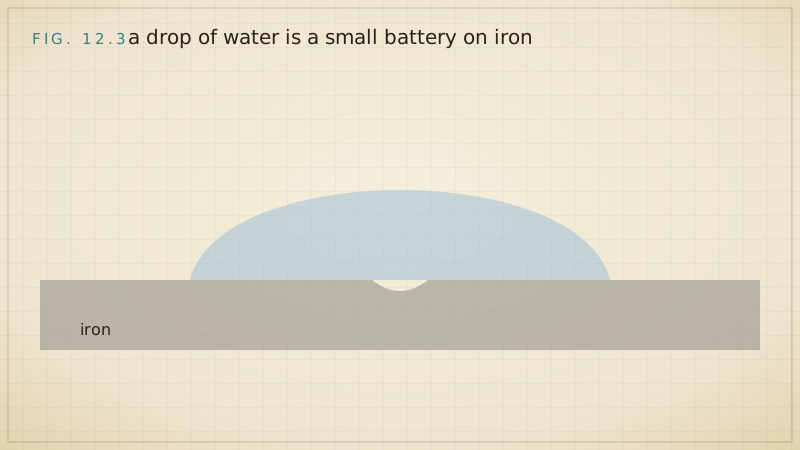
Look closely at a single drop of water on a sheet of iron. Under the middle of the drop, where little oxygen reaches, iron atoms lose electrons and go into the water as ions, leaving a small pit:
\[ \ce{Fe(s) -> Fe^2+(aq) + 2e-} \]
The electrons travel through the metal to the edge of the drop, where oxygen dissolves from the air. There they are taken up:
\[ \ce{O2(g) + 2H2O(l) + 4e- -> 4OH-(aq)} \]
Where the iron ions and the hydroxide ions meet, iron(II) hydroxide forms, and air oxidises it further to rust, a hydrated iron(III) oxide written \(\ce{Fe2O3} \cdot x\,\ce{H2O}\), because the amount of water in it varies. The drop is a small electric cell, with the iron as its wire. Salt dissolved in the water carries the current more easily, which is why iron rusts fastest by the sea and on salted roads.
An analogy from my Paris
Every few years the painters climb the Eiffel Tower with their pots and brushes to give its iron a fresh coat. They are not decorators; they are chemists without knowing it. Paint keeps water and air away from the iron, and without water and oxygen the drop cannot become a cell. Look up at the roofs of Paris and you will see the other remedy. Thousands of them are covered in sheets of zinc, which grows a thin grey skin that protects what lies beneath. Iron coated with zinc, called galvanised iron, lasts for years in the rain. Even where the coat is scratched, the zinc, being higher in the activity series, gives up its electrons first, and the iron is spared. A metal that corrodes in place of another is called a sacrificial metal. Ship builders bolt blocks of zinc to iron hulls for the same reason.
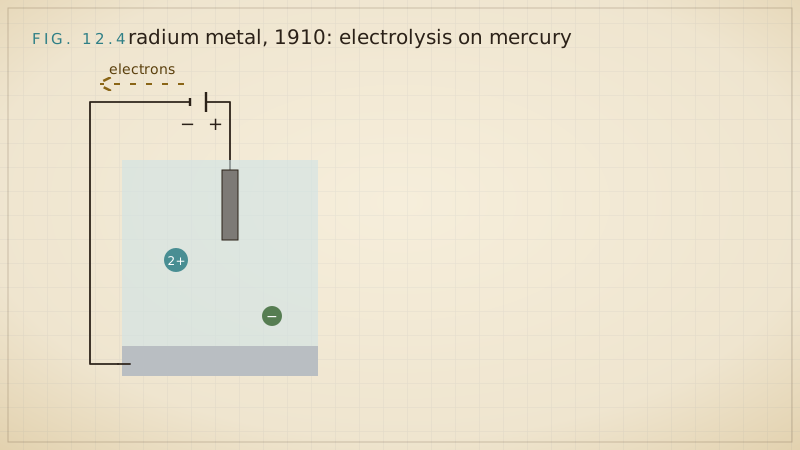
So far every reaction has run by itself, downhill, from the more active metal to the less active. Can we make a reaction run the other way, forcing electrons onto ions that do not want them? We can, with electricity. In electrolysis, an electric current from a battery pushes electrons into a solution at one electrode and pulls them out at the other. The electrode where electrons go in, and ions are reduced, is the cathode. The electrode where electrons come out, and substances are oxidised, is the anode. Reduction at the cathode, oxidation at the anode: some students remember "red cat, an ox". You will study electrolysis and cells properly in Lessons 40 to 42.
In my laboratory
In 1906 Lord Kelvin wrote to The Times that radium was perhaps no element at all, but a compound of lead and helium. I had measured its atomic weight, and Eugène Demarçay had seen its own lines in the spectroscope. But the surest proof that a substance is an element is to hold it as a metal in your hand. In 1910 André Debierne and I set out to do it.
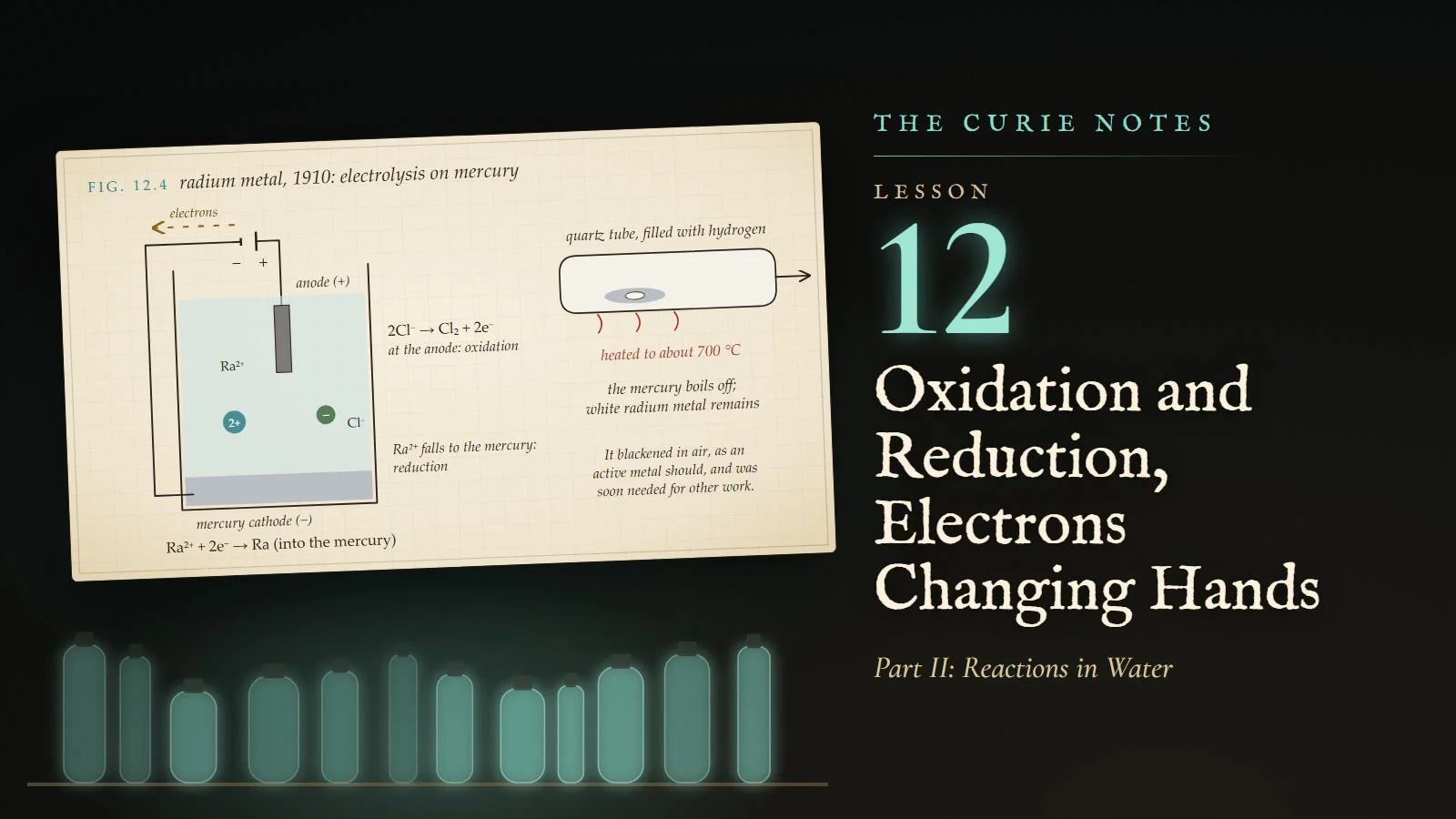
Radium sits near the top of the activity series. It gives up its electrons so readily that there is no easy chemical way to turn its ions back into metal, and in plain water any radium metal would react at once. So we used electrolysis. We passed a current through a solution of radium chloride, about a decigram of it, using a pool of mercury as the cathode. At the cathode each radium ion took two electrons:
\[ \ce{Ra^2+ + 2e- -> Ra} \]
The radium dissolved into the mercury as fast as it formed, making an amalgam, a solution of a metal in mercury, and the mercury protected it from the water. On mercury, hydrogen is also reluctant to form, so the current went to the radium. At the anode, chloride ions gave up electrons to become chlorine. Then we heated the amalgam in a tube of quartz filled with pure hydrogen. The mercury boiled away little by little, and when the heating reached about 700 °C, what remained was a shining white metal. It blackened in the air, as so active a metal must. I saw it at last, and I could not keep it in that state, for the radium was needed for further experiments.
What to remember
- Oxidation is loss of electrons; reduction is gain. They always happen together (OIL RIG).
- An oxidation number is a bookkeeping charge. A rise means oxidation; a fall means reduction.
- Rules in order: element alone 0; one-element ion its charge; the sum equals the total charge; F −1; group 1 +1, group 2 +2, Al +3; H +1; O −2; Cl, Br, I −1. The last element comes from the sum.
- The reducing agent gives electrons and is oxidised; the oxidising agent takes electrons and is reduced.
- Half-reactions show electrons openly. Make the electrons lost equal the electrons gained, then add.
- In acid: balance other atoms, then O with \(\ce{H2O}\), H with \(\ce{H+}\), charge with \(\ce{e-}\). Check atoms and charge.
- Activity series: K, Na, Ca, Mg, Al, Zn, Fe, Ni, Sn, Pb, (H), Cu, Ag, Hg, Au. A metal displaces the ions of metals below it; metals above H dissolve in dilute acid.
- Rusting needs water and oxygen; paint keeps them out; zinc protects iron by corroding first.
- Electrolysis drives redox with a current: reduction at the cathode, oxidation at the anode.
Problems for your notebook
Problem 1. Find the oxidation number of nitrogen in \(\ce{HNO3}\), sulfur in \(\ce{SO3^2-}\), chlorine in \(\ce{ClO-}\), and hydrogen in calcium hydride, \(\ce{CaH2}\).
Answer.
- \(\ce{HNO3}\): \(+1 + \mathrm{N} + 3(-2) = 0\), so N = +5.
- \(\ce{SO3^2-}\): \(\mathrm{S} + 3(-2) = -2\), so S = +4.
- \(\ce{ClO-}\): oxygen comes before chlorine in the list, so O = −2; then \(\mathrm{Cl} - 2 = -1\), so Cl = +1.
- \(\ce{CaH2}\): calcium is +2 (rule 5 comes before rule 6); then \(2 + 2\mathrm{H} = 0\), so H = −1, the metal hydride exception.
Problem 2. Magnesium burns: \(\ce{2Mg + O2 -> 2MgO}\). Which element is oxidised, which is reduced, and how many electrons are transferred for each molecule of oxygen?
Answer. Magnesium rises from 0 to +2: it is oxidised and is the reducing agent. Oxygen falls from 0 to −2: it is reduced and is the oxidising agent. Each \(\ce{O2}\) has two oxygen atoms, each gaining 2 electrons, so 4 electrons pass for each molecule of oxygen, given by two magnesium atoms.
Problem 3. Iron(III) ions oxidise iodide ions to iodine, \(\ce{I2}\), and become iron(II). Write the half-reactions and the balanced equation.
Answer.
- Oxidation: \(\ce{2I- -> I2 + 2e-}\).
- Reduction: \(\ce{Fe^3+ + e- -> Fe^2+}\), times 2.
- Overall: \(\ce{2Fe^3+ + 2I- -> 2Fe^2+ + I2}\). Charge: \(+6 - 2 = +4\) on the left, \(+4\) on the right.
Problem 4. Use the activity series. Does zinc react with iron(II) sulfate solution? Does iron react with zinc sulfate solution? Does magnesium react with dilute hydrochloric acid? Write net ionic equations for those that react.
Answer. Zinc is above iron, so it reacts: \(\ce{Zn + Fe^2+ -> Zn^2+ + Fe}\). Iron is below zinc, so iron in zinc sulfate shows no reaction. Magnesium is above hydrogen, so it reacts briskly: \(\ce{Mg + 2H+ -> Mg^2+ + H2}\).
Problem 5. Dichromate oxidises iron(II) in acid: \(\ce{Cr2O7^2- + Fe^2+ -> Cr^3+ + Fe^3+}\). (a) Balance the equation. (b) A 25.00 mL sample of iron(II) solution needs 20.00 mL of 0.02000 mol/L potassium dichromate. What is the concentration of iron(II)?
Answer.
- Reduction half: \(\ce{Cr2O7^2- -> 2Cr^3+}\); add \(\ce{7H2O}\) to the right for oxygen, \(\ce{14H+}\) to the left for hydrogen. Charge: left \(-2 + 14 = +12\), right +6, so add 6 electrons to the left: \(\ce{Cr2O7^2- + 14H+ + 6e- -> 2Cr^3+ + 7H2O}\).
- Oxidation half: \(\ce{Fe^2+ -> Fe^3+ + e-}\), times 6.
- (a) Overall: \(\ce{Cr2O7^2- + 14H+ + 6Fe^2+ -> 2Cr^3+ + 6Fe^3+ + 7H2O}\). Charge: \(-2 + 14 + 12 = +24\) left; \(6 + 18 = +24\) right.
- (b) Moles of dichromate: \(0.02000\,\mathrm{mol/L} \times 0.02000\,\mathrm{L} = 0.0004000\,\mathrm{mol}\).
- Six iron(II) for each dichromate: \(6 \times 0.0004000 = 0.002400\,\mathrm{mol}\).
- Concentration: \(0.002400\,\mathrm{mol} \div 0.02500\,\mathrm{L} = 0.09600\,\mathrm{mol/L}\).
After my time
The tidy rules for oxidation numbers that I have given you were gathered and standardised mostly after my death. In 1938 the American chemist Wendell Latimer published a book that set out the oxidation states of the elements together with the voltages of their half-reactions, and later the International Union of Pure and Applied Chemistry fixed the definitions. The ideas were in our hands in my lifetime; the clean bookkeeping came after.
Redox chemistry has since moved into every pocket. The batteries that power portable telephones and electric carriages are redox cells in which lithium gives up its electrons through a wire. The chemists who developed the lithium-ion battery received the Nobel Prize in Chemistry in 2019. The same half-reactions you have balanced today, written with different metals, run the world's portable machines.
If you would like another redox equation balanced with me, step by step, come and ask me. This lesson closes Part II, Reactions in Water. In the next lesson, Light and Spectra: The Fingerprints of the Elements, we leave the beaker for the spectroscope, and learn how the colours of a flame told us that radium was new.
Sources and liberties
The Curie Notes are a modern chemistry course written in Marie Curie's voice by Eternal Gardens. The chemistry is standard modern chemistry; dates, people, apparatus and quotations come from the sources below; the teaching, the analogies and the private remarks are our reconstruction.
- Marie Curie, Pierre Curie, with Autobiographical Notes (1923), Project Gutenberg.
- Marie Curie, The Discovery of Radium, lecture at Vassar College, 1921, Project Gutenberg.
- OpenStax, Chemistry 2e, chapters on oxidation-reduction reactions and electrochemistry.
- American Institute of Physics, Marie Curie and the Science of Radioactivity.
- The Nobel Prize, Marie Curie, Nobel Prize in Chemistry 1911.
- IUPAC, Gold Book entry for oxidation state.
The details of the 1910 isolation of radium (the amount of salt, the mercury cathode, distillation in hydrogen at about 700 °C) follow secondary accounts of the published note by Curie and Debierne; the exact apparatus is not certain. The scenes at the post office, on the quays and on the Tower are illustrations.