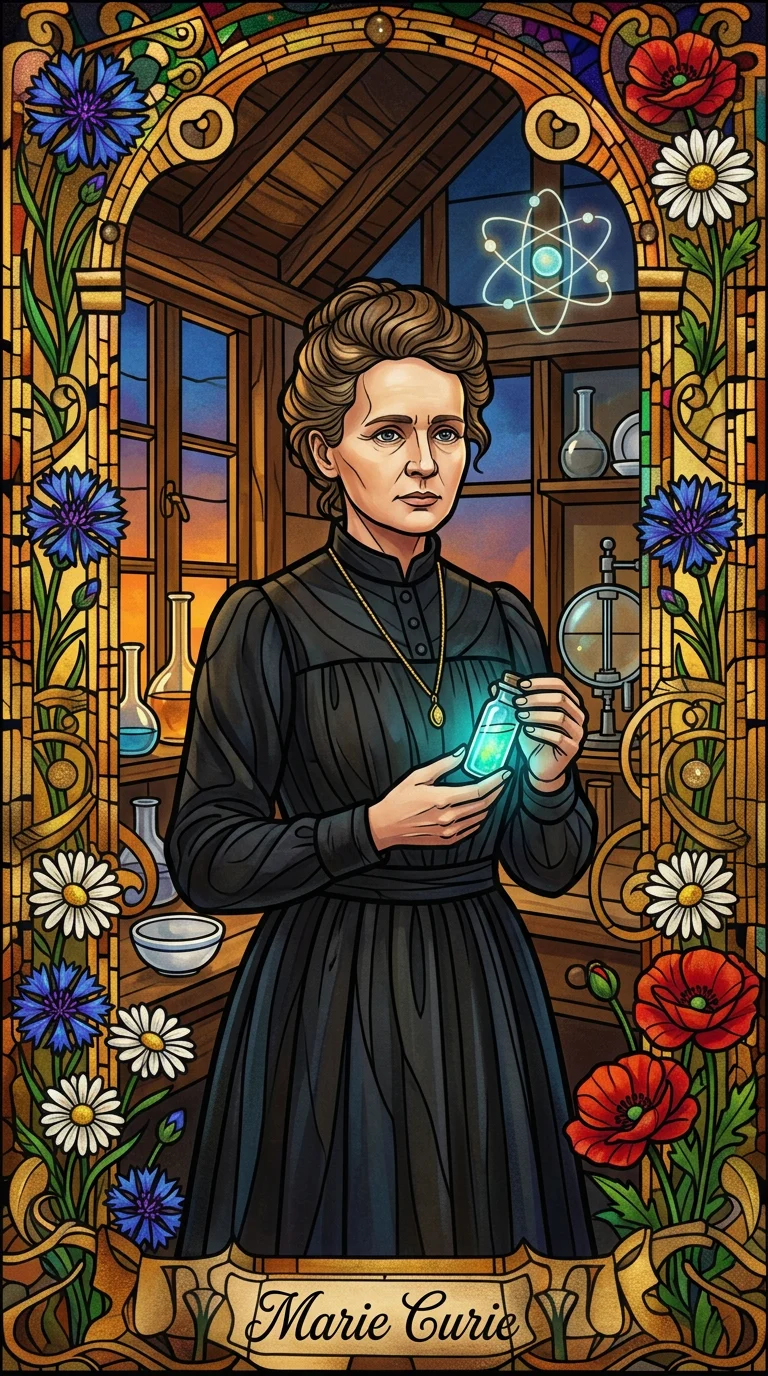
 by Marie Curie

On my table this evening there is a small glass dish of black uranium oxide, a pair of brass plates, and the electrometer that Pierre and his brother Jacques designed. In 1898 I used these to measure the faint rays that uranium gives off, and they told me something I did not expect: the rays come from inside the atom itself. That was a strange thing to say in a century that believed atoms could not be broken. In this lesson I open the atom with you. We will find the electron, then the nucleus, then the protons and neutrons inside it. By the end you will be able to read the symbol of any atom or ion, count its particles, and work out an element's average atomic mass from its isotopes.
It was necessary at this point to find a new term to define this new property of matter manifested by the elements of uranium and thorium. I proposed the word radioactivity...
Marie Curie, Pierre Curie, 1923
What you will learn
- Explain why the rays of uranium showed that something happens inside atoms.
- Describe the electron, the nucleus, the proton and the neutron, with their charges and masses.
- Explain how Rutherford's gold-leaf experiment revealed the nucleus.
- Read isotope symbols such as \(\ce{^{226}_{88}Ra}\) and count protons, neutrons and electrons in atoms and ions.
- Explain what isotopes are and how a mass spectrograph separates them.
- Calculate an average atomic mass from isotope masses and abundances, and work backwards to an abundance.
What you need first: Lesson 1 (What Chemistry Studies: Matter, Mixtures and Pure Substances), Lesson 2 (Measurement, Units and Significant Figures) for scientific notation, and Lesson 3 (Atoms and Elements: The Laws That Proved Them) for Dalton's atoms, chemical symbols and relative atomic masses.
Rays that come from the atom itself
In Lesson 3 we met Dalton's atoms: tiny, hard, and impossible to divide. That picture explained the laws of combination beautifully. Then, at the end of the century, it cracked.
In February and March of 1896, Henri Becquerel in Paris found that salts of uranium give off invisible rays. The rays passed through black paper and fogged a photographic plate wrapped inside it. They did this in the dark, without any sunlight to excite them, and they went on for months without weakening. Nobody knew where the energy came from.
At the end of 1897 I chose these uranium rays as the subject of my doctoral thesis. Photographic plates give only a rough answer, darker or lighter. I wanted a number. So I measured the rays another way.
The rays make air conduct electricity. They knock charges loose from the molecules of the air, so that a little current can flow through it. If you can measure that current, you can measure the strength of the rays. Such a current is very small: in my apparatus it was about \(10^{-11}\) ampere, a hundred-billionth of an ampere.
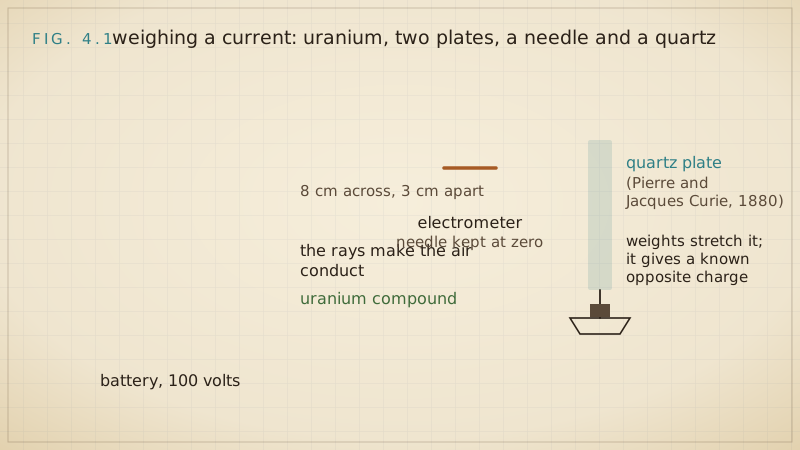
Fig. 4.1 shows the method. I spread a thin layer of the substance on the lower of two metal plates, 8 centimetres across and 3 centimetres apart, and a battery held that plate at 100 volts. The upper plate was joined to an electrometer, whose light needle moves when charge arrives. Instead of watching the needle drift, I held it still. A plate of quartz pulled by weights gives off a known charge: this is the piezoelectric effect that Pierre and Jacques Curie discovered in 1880. By adding weight at the right rate, I kept the needle at zero, and the weight and the time told me the current.
From the shed
Think of a baker's balance with a heap of flour on one pan. You do not guess the weight from how far the pan sinks. You add brass weights to the other pan until the pointer stands exactly at the middle, and then you read the weights. My electrometer worked like that balance. The rays poured charge into one side; the quartz poured the opposite charge into the other; the needle at zero meant the two were equal. A balance at zero is more trustworthy than a needle swinging, and I trusted it.
I measured uranium metal, its oxides and its salts, wet and dry, in light and darkness, warm and cold. The result was always the same. The current depended only on the amount of uranium in the layer. Double the uranium, and the current doubled. What the uranium was combined with made no difference at all. I wrote that the emission of rays is an atomic property: it belongs to the uranium atom itself, whatever compound the atom is in.
This was the first crack in Dalton's atom. A chemical reaction changes how atoms are joined; it does not change the atoms. If the rays did not care about the chemical joining, they had to come from inside the atom. I named the property radioactivity: the spontaneous giving off of rays by the atoms of certain elements.
Worked example 1
In April 1898 I reported these currents, in units of \(10^{-12}\) ampere: uranium metal (with a little carbon), 24; pitchblende ore from Joachimsthal, 67; natural chalcolite, 52; chalcolite I made myself from pure chemicals, 9. Why did these numbers point to a new element?
- Activity is an atomic property of uranium, so no uranium mineral should beat pure uranium, unless something else in it is active too.
- Pitchblende compared with uranium: \(67 \div 24 = 2.8\). The ore is almost three times as active as the metal.
- Pitchblende is an impure oxide of uranium mixed with other minerals, so it holds less uranium than the same layer of metal. It should be less active, and it is more active.
- Chalcolite, the natural mineral, compared with my artificial one: \(52 \div 9 = 5.8\). The two have the same formula and the same uranium content.
- The artificial chalcolite behaves as uranium should; the natural one is nearly six times stronger. The extra activity must come from another substance in the natural mineral, far more active than uranium.
Check: both ratios are well above 1, far more than any error of measurement could explain.
I wrote in that note: "This fact is most remarkable, and suggests that these minerals may contain an element much more active than uranium." That element turned out to be two elements: polonium, which Pierre and I named in July 1898 after my country, and radium, in December 1898.
Margin
Gerhard Schmidt in Germany found that thorium is radioactive a little before I did, in the same year; I did not know of his work. I confess too that Pierre and I were not sure at first that the energy came from within the atom. We even wondered whether unknown rays filled all of space and the uranium only caught them. The measurements decided it, slowly.
The electron, a piece of every atom
In 1897, the year I began my thesis, J. J. Thomson at Cambridge settled an old argument about cathode rays. These rays stream from the negative plate (the cathode) of a glass tube emptied of most of its air. Some said they were a kind of light; others said particles.
Thomson bent the rays with a magnet and with charged plates, which light never does. From the bending he found that the rays are a stream of tiny particles, all alike, each with a negative charge. Their mass, compared with their charge, was more than a thousand times smaller than for the lightest charged atom known, the hydrogen ion.
He also found that the particles were the same whatever metal the cathode was made of and whatever gas was left in the tube. So they must be a part of every kind of atom. We now call them electrons. An electron carries the smallest negative charge that exists, written \(-1\) in chemistry. Its mass is about 1836 times smaller than the mass of a hydrogen atom.
The beta rays from radium turned out to be electrons too, thrown out at great speed. Becquerel showed in 1900 that they bend in a magnet like cathode rays, and Pierre and I showed that they carry negative charge.
An atom is electrically neutral, so it must also contain positive charge equal to its electrons' negative charge. Where is that positive charge, and where is the mass? In 1904 Thomson imagined the atom as a ball of positive charge spread thinly through its whole volume, with the electrons dotted through it.
An analogy from my Paris
The English called Thomson's atom the plum pudding. In Paris I would say a brioche with raisins. The soft dough is the positive charge, spread evenly through the whole loaf. The raisins are the electrons, scattered here and there. The loaf as a whole is neutral, because the dough and the raisins balance. It was a sensible guess, and it was wrong.
The nucleus: Rutherford's gold leaf
Ernest Rutherford, who visited my shed in 1903, had shown that radium and its relatives give off alpha particles. These are heavy, fast, positively charged particles. By 1909 he and Thomas Royds had proved that an alpha particle is a helium atom stripped of its electrons, with a charge of \(+2\) and a mass about four times that of hydrogen.
Rutherford used alpha particles as tiny bullets to probe the atom. In his laboratory in Manchester in 1909, his assistant Hans Geiger and a young student, Ernest Marsden, aimed a narrow beam of alpha particles at a gold leaf. Gold can be beaten very thin; their leaf was less than a thousandth of a millimetre thick, yet still a thousand or so atoms deep.
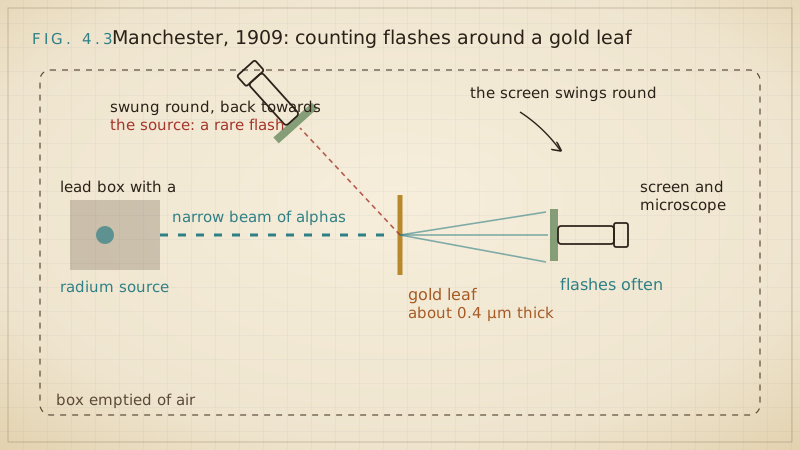
To see where the particles went, they used a screen coated with zinc sulfide. Each alpha particle that strikes it makes a tiny flash of light. In a darkened room they watched the screen through a microscope and counted the flashes, one by one, at different angles around the leaf.
If Thomson's brioche were right, the alpha particles should pass almost straight through. The positive charge in his atom is spread so thin that it can only nudge a fast, heavy particle by a tiny angle. The electrons are far too light to turn it: an alpha particle is about 7,300 times heavier than an electron.
Most particles did pass almost straight through. But a few were turned through large angles, and some came straight back towards the source. Geiger and Marsden reported that, from a plate of platinum, about one alpha particle in eight thousand bounced back. Nothing in Thomson's atom could do that.
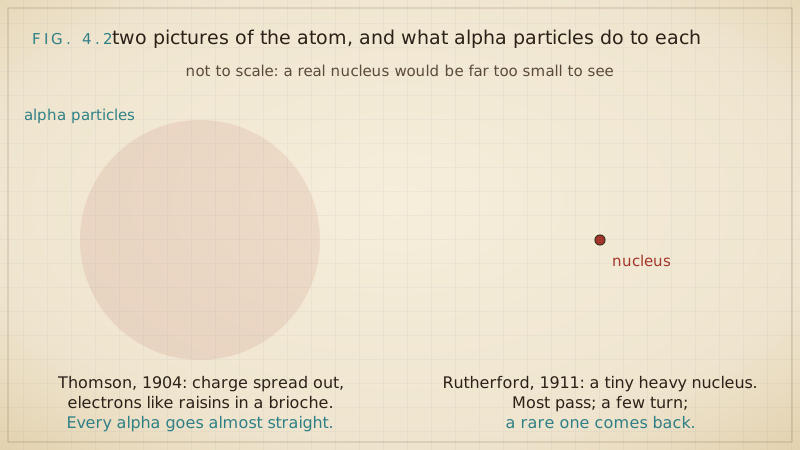
In 1911 Rutherford gave the explanation, shown in Fig. 4.2. All the positive charge of the atom, and nearly all its mass, is packed into a tiny centre, which he called the nucleus. The electrons occupy the large space around it. The atom is mostly empty. An alpha particle that passes far from a nucleus feels almost nothing and goes straight on. Only the rare particle that comes very close to a nucleus meets a strong repulsion, because two positive charges push each other apart, and is thrown sideways or back.
Rutherford also calculated how many particles should be turned through each angle. Geiger and Marsden's counts of 1913 fitted his formula.
Try it
Plate 4.1 shows one gold nucleus magnified enormously, with alpha particles flying past it. Aim a single shot at different distances from the centre line and read how far it is turned. Then widen the beam and watch how few particles come back. Switch to Thomson's atom to see the beam go straight through.
The plate measures distance in femtometres (fm); one femtometre is \(10^{-15}\) metre. A gold nucleus is about 14 femtometres across.
Worked example 2
A gold nucleus is about \(1.4 \times 10^{-14}\) m across, and a gold atom about \(2.9 \times 10^{-10}\) m. If the nucleus were a pea 1 cm across, how wide would the atom be?
- Find how many times wider the atom is than the nucleus: divide the two sizes.
- \[ \frac{2.9 \times 10^{-10}\,\mathrm{m}}{1.4 \times 10^{-14}\,\mathrm{m}} = \frac{2.9}{1.4} \times 10^{-10-(-14)} = 2.07 \times 10^{4} \]
- The metres cancel, so the answer is a pure number: the atom is about 20,700 times wider than its nucleus.
- Scale up the pea by the same factor: \(1\,\mathrm{cm} \times 2.07 \times 10^{4} = 2.07 \times 10^{4}\,\mathrm{cm}\).
- Convert to metres: \(2.07 \times 10^{4}\,\mathrm{cm} \div 100 = 207\,\mathrm{m}\).
Check: the metres cancel in the ratio. A pea inside a ball two hundred metres wide fits the words "mostly empty".
An analogy from my Paris
Put that pea on the ground beneath the Eiffel Tower, which has stood on the Champ de Mars since 1889. The whole gold atom would then be a ball about two hundred metres across, two thirds of the height of the tower. All that space would hold only the 79 electrons, and the pea would hold more than 99.9 per cent of the mass. The table under my hand is solid, and it is almost entirely empty. I still feel the strangeness of it.
Protons and neutrons
What is the nucleus made of? The first part was found by Rutherford again. In 1919 he fired alpha particles into nitrogen gas and found that hydrogen nuclei were knocked out. The hydrogen nucleus seemed to be a building block of other nuclei. In 1920 he named it the proton. A proton carries a charge of \(+1\), exactly equal and opposite to the electron's charge, and its mass is about 1836 times the electron's.
But protons alone could not explain the masses. Helium has a nuclear charge of \(+2\), so it has 2 protons, yet its mass is about 4 times that of hydrogen. Something in the nucleus added mass without adding charge.
The answer came from my own Institute, almost. In January 1932 my daughter Irène and her husband Frédéric Joliot bombarded beryllium with alpha particles from a strong polonium source. The beryllium gave off a penetrating radiation that knocked protons out of paraffin wax. They believed it was a gamma ray, a very penetrating kind of X-ray. A few weeks later, in February 1932, James Chadwick at Cambridge repeated the experiments and showed that the radiation was a stream of particles with no charge and a mass close to that of the proton. He called it the neutron.
In my laboratory
Irène and Frédéric had the right experiment and the wrong interpretation. They are fine experimenters, and in January 1934 they made radioactive atoms by their own hand. I tell the story because it is so common in science: the measurement is right before the idea is. Always ask of a result what else could explain it.
So the picture of the atom, as we have it now, is simple enough to write in a list. Protons and neutrons together are called nucleons, the particles of the nucleus.
- Proton: in the nucleus; charge \(+1\) (that is, \(+1.602 \times 10^{-19}\,\mathrm{C}\)); mass \(1.6726 \times 10^{-27}\,\mathrm{kg}\), or 1.00728 u.
- Neutron: in the nucleus; charge 0; mass \(1.6749 \times 10^{-27}\,\mathrm{kg}\), or 1.00866 u, a little more than the proton.
- Electron: around the nucleus; charge \(-1\) (that is, \(-1.602 \times 10^{-19}\,\mathrm{C}\)); mass \(9.109 \times 10^{-31}\,\mathrm{kg}\), or 0.000549 u.
The letter u stands for the unified atomic mass unit, defined as one twelfth of the mass of one atom of carbon-12. It equals \(1.6605 \times 10^{-27}\,\mathrm{kg}\). Lesson 5 treats this unit fully. For now, notice that a proton and a neutron each weigh about 1 u, and an electron almost nothing.
Worked example 3
An atom of carbon-12 has 6 protons, 6 neutrons and 6 electrons, and a mass of exactly 12 u. What percentage of its mass is carried by the electrons?
- Mass of the electrons: \(6 \times 0.000549\,\mathrm{u} = 0.003294\,\mathrm{u}\).
- Divide by the mass of the whole atom: \(0.003294\,\mathrm{u} \div 12\,\mathrm{u} = 0.000275\).
- Turn the fraction into a percentage: \(0.000275 \times 100 = 0.0275\,\%\).
Check: the units u cancel, as a percentage needs. The electrons carry less than three hundredths of one per cent; the nucleus carries the rest, more than 99.97 per cent.
A common mistake
Do not think the electrons are unimportant because they are light. All of chemistry, every reaction you will meet in this course, is done by the electrons. The nucleus gives the atom its mass and decides how many electrons it holds. The electrons decide how it combines.
Atomic number, mass number and isotopes
Mendeleev arranged the elements roughly in order of atomic weight, and for forty years nobody knew why his order worked. In 1913 Henry Moseley, a young man in Rutherford's school, found the reason.
Moseley made each element give off X-rays and measured their frequency, the number of waves that pass each second. From one element to the next, the square root of the frequency rose by the same step, like the rungs of a ladder. Each element's place was a whole number, set by the charge of its nucleus. He also found empty rungs, at 43, 61, 72 and 75. Hafnium (72) was found in 1923 and rhenium (75) in 1925, where he said. Moseley did not see it: he was killed at Gallipoli in August 1915, aged 27.
The number of protons in the nucleus of an atom is its atomic number, written \(Z\). The atomic number decides which element an atom is. Every atom with 1 proton is hydrogen. Every atom with 6 is carbon. Every atom with 88 protons is radium, and every atom with 84 is polonium. Change the number of protons and you change the element.
The total number of protons and neutrons in the nucleus is the mass number, written \(A\). It is a count, so it is always a whole number and has no unit. The number of neutrons, \(N\), is therefore the mass number minus the atomic number:
\[ N = A - Z \]
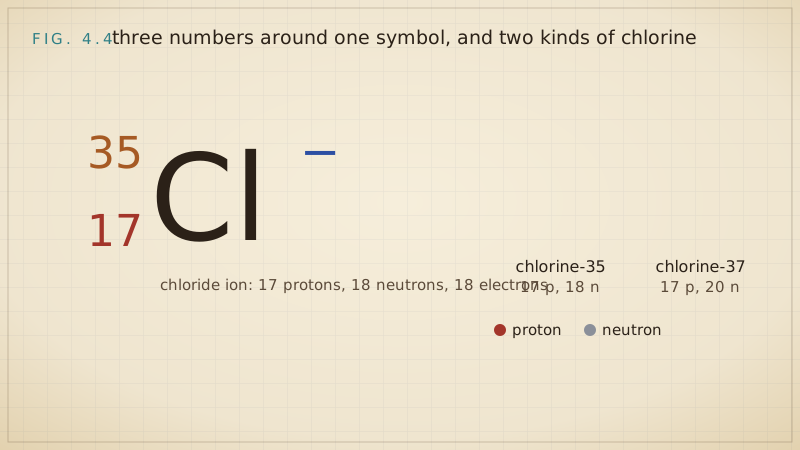
We write an atom with its mass number at the upper left of its symbol and its atomic number at the lower left. Radium with mass number 226 is written \(\ce{^{226}_{88}Ra}\), and we say "radium-226". The atomic number is often left out, since the symbol already tells it: \(\ce{^{226}Ra}\) means the same thing.
Worked example 4
How many protons, neutrons and electrons are in a neutral atom of radium-226, \(\ce{^{226}_{88}Ra}\), and in an atom of my polonium, \(\ce{^{210}_{84}Po}\)?
- Radium: the lower number is the atomic number, so there are 88 protons.
- Neutrons: \(N = A - Z = 226 - 88 = 138\).
- A neutral atom has as many electrons as protons: 88 electrons.
- Polonium: 84 protons; \(N = 210 - 84 = 126\) neutrons; 84 electrons.
Check: protons plus neutrons give back the mass number: \(88 + 138 = 226\) and \(84 + 126 = 210\).
Now the most surprising discovery of those years. In the radioactive families that Rutherford, Soddy, my laboratory and others traced, new "elements" kept appearing, each with its own rays. There were far too many to fit into the table, and some could not be separated from known elements by any chemistry at all.
In 1913 Frederick Soddy gave the answer: atoms of one element can have different masses. Such atoms have the same nuclear charge, so the same chemistry, but different masses. Soddy called them isotopes, from Greek words meaning "same place", because they share one place in the periodic table. Since 1932 we know where the difference lies: isotopes are atoms with the same number of protons and different numbers of neutrons.
In my laboratory
I knew this puzzle with my own hands. For four years I separated radium from barium by fractional crystallisation, and it worked because they are different elements: one dissolves a little less than the other. But mesothorium, sold as a cheap substitute for radium, could not be separated from radium by any treatment. Soddy showed in 1911 that the two are chemically identical. Mesothorium is radium-228; my radium is radium-226. No patience at the crystallising dish will part them, because chemistry belongs to the protons and electrons, and the two have the same.
An analogy from my Paris
Picture two barges on the Seine flying the same company's flag. They carry the same name and take the same route. But one carries more ballast in its hold and rides lower in the water. The flag is the number of protons: it tells you the company, which is to say the element. The ballast is the neutrons: it changes the weight and nothing else. Isotopes are such barges.
Thomson found the first isotopes of an ordinary element in 1913: neon atoms of mass 20 and mass 22. In 1914 chemists at Harvard and in Vienna found that lead taken from uranium minerals, born from the decay of uranium, has an atomic weight near 206 instead of 207.2: a different mixture of isotopes.
Try it
On Plate 4.2 you build an atom from its pieces. Change the protons and the element changes; change the neutrons and only the isotope changes; change the electrons and only the charge changes. The plate also says whether your isotope is found in nature.
A common mistake
Do not confuse the mass number with the atomic mass. The mass number of chlorine-35 is 35: a count of particles, a whole number, no unit. The mass of one chlorine-35 atom is 34.969 u: a measurement, with a unit, close to the mass number but not equal to it. In Lesson 46 you will learn why the masses are a little less than the sum of their parts.
Ions: when electrons are gained or lost
The nucleus is hard to change: only radioactivity and violent collisions alter it. The outer electrons move far more easily, and in chemical reactions atoms often give electrons away or take them in.
An atom that has gained or lost electrons is called an ion. Its protons are unchanged, so it is still the same element. But its charges no longer balance:
\[ \text{charge of the ion} = \text{number of protons} - \text{number of electrons} \]
- An atom that loses electrons has more protons than electrons. It becomes a positive ion, called a cation. A sodium atom that loses one electron becomes \(\ce{Na+}\).
- An atom that gains electrons has more electrons than protons. It becomes a negative ion, called an anion. A chlorine atom that gains one electron becomes the chloride ion, \(\ce{Cl-}\).
The charge is written at the upper right of the symbol: \(\ce{Mg^2+}\) has a charge of \(+2\), \(\ce{O^2-}\) a charge of \(-2\). When the charge is 1 we write only the sign.
Worked example 5
Count the protons, neutrons and electrons in the chloride ion \(\ce{^{35}_{17}Cl-}\), the magnesium ion \(\ce{^{24}_{12}Mg^2+}\) and the radium ion \(\ce{^{226}_{88}Ra^2+}\).
- Chloride: 17 protons. Neutrons: \(35 - 17 = 18\). The charge is \(-1\), so it has gained 1 electron: \(17 + 1 = 18\) electrons.
- Magnesium ion: 12 protons. Neutrons: \(24 - 12 = 12\). The charge is \(+2\), so it has lost 2 electrons: \(12 - 2 = 10\) electrons.
- Radium ion: 88 protons. Neutrons: \(226 - 88 = 138\). It has lost 2 electrons: \(88 - 2 = 86\) electrons.
Check with the rule: charge = protons \(-\) electrons. Chloride: \(17 - 18 = -1\). Magnesium: \(12 - 10 = +2\). Radium: \(88 - 86 = +2\). All agree with the symbols.
In my laboratory
When I dissolved radium chloride in water during my purifications, the solution held \(\ce{Ra^2+}\) ions and \(\ce{Cl-}\) ions, two chloride ions for each radium ion. Radium gives up two electrons just as barium, its neighbour in the same family, does. That likeness is why radium followed barium so faithfully through my crystallisations; Lessons 10 and 16 return to it.
A common mistake
A positive ion has lost electrons; it has not gained protons. Students reason that a positive charge means "something positive was added". The nucleus is untouched; negative electrons were taken away from the outside. Changing the protons would change the element, and that no chemical reaction can do.
Average atomic mass and the mass spectrograph
Now we can solve an old puzzle. In 1815 William Prout suggested that every atomic weight is a whole multiple of hydrogen's, as if all atoms were built of hydrogen. Many atomic weights did come out close to whole numbers: carbon 12, nitrogen 14, oxygen 16. But chlorine stubbornly came out at 35.5. Careful chemists measured it again and again, and it never moved. Prout's beautiful idea seemed dead.
Isotopes explain it. Chlorine is a mixture of chlorine-35 and chlorine-37, always in nearly the same proportion: about three atoms of the first to one of the second. A chemist weighing chlorine weighs the mixture, whose average mass lies between 35 and 37, nearer to 35.
The instrument that proved it is the mass spectrograph, built by Francis Aston at Cambridge in 1919. The atoms are turned into positive ions and sent through a magnetic field, which bends their paths. Heavier ions bend less, so each isotope lands on its own line on a photographic plate, and the darkness of the line shows how many atoms it holds. In 1920 Aston found the two lines of chlorine, at 35 and 37. He found isotopes in element after element and received the Nobel Prize in Chemistry in 1922.
An analogy from my Paris
A baker sells two sizes of roll from one basket. Three rolls in every four are small, weighing 35 grams; one in every four is large, weighing 37 grams. What does the average roll weigh? The middle value, 36 grams, is too high, because there are more small rolls. Take four rolls: three at 35 grams make 105 grams, one at 37 makes 37 grams, together 142 grams. Divide by 4 and the average roll weighs 35.5 grams. No single roll in the basket weighs 35.5 grams, yet that is what a sack of a thousand rolls weighs, per roll. Chlorine is that basket.
The average atomic mass of an element (also called its relative atomic mass or atomic weight, the number in the periodic table) is the average mass of its atoms, counting each isotope according to how common it is. An isotope's share of all the atoms is its abundance, usually given in per cent. Turn each percentage into a fraction by dividing by 100, multiply each isotope's mass by its fraction, and add:
\[ \text{average atomic mass} = m_1 f_1 + m_2 f_2 + m_3 f_3 + \cdots \]
Here \(m_1\) is the mass of the first isotope and \(f_1\) its fractional abundance, and so on. The fractions always add up to 1.
Worked example 6
Natural chlorine is 75.76% chlorine-35, with an atomic mass of 34.969 u, and 24.24% chlorine-37, with an atomic mass of 36.966 u. Find the average atomic mass of chlorine.
- Turn the percentages into fractions: \(75.76\,\% = 0.7576\) and \(24.24\,\% = 0.2424\).
- Check that they add to 1: \(0.7576 + 0.2424 = 1.0000\).
- Chlorine-35's share: \(34.969\,\mathrm{u} \times 0.7576 = 26.493\,\mathrm{u}\).
- Chlorine-37's share: \(36.966\,\mathrm{u} \times 0.2424 = 8.961\,\mathrm{u}\).
- Add the shares: \(26.493\,\mathrm{u} + 8.961\,\mathrm{u} = 35.454\,\mathrm{u}\), which rounds to \(35.45\,\mathrm{u}\).
Check: the answer lies between the two masses, nearer the commoner isotope, and matches the 35.45 in every periodic table.
We can also work backwards. If we know the average and the masses of two isotopes, we can find how common each one is.
Worked example 7
Boron has an average atomic mass of 10.81 u. Its two isotopes are boron-10 (10.013 u) and boron-11 (11.009 u). What percentage of boron atoms are boron-11?
- Let \(x\) be the fraction of boron-11. The two fractions add to 1, so the fraction of boron-10 is \(1 - x\).
- Write the average: \(10.81 = 10.013\,(1 - x) + 11.009\,x\).
- Multiply out the bracket: \(10.81 = 10.013 - 10.013\,x + 11.009\,x\).
- Collect the terms in \(x\): \(10.81 = 10.013 + 0.996\,x\).
- Subtract 10.013 from both sides: \(0.797 = 0.996\,x\).
- Divide both sides by 0.996: \(x = 0.797 \div 0.996 = 0.800\).
- As a percentage: \(0.800 \times 100 = 80.0\,\%\) boron-11, and so \(20.0\,\%\) boron-10.
Check: 10.81 is much nearer 11.009 than 10.013, so boron-11 should be the larger share. Put the answer back in: \(10.013 \times 0.200 + 11.009 \times 0.800 = 2.003 + 8.807 = 10.810\). It agrees.
Margin
In 1902 I found the atomic weight of radium to be 225, and in 1907, with more and purer material, about 226.4. The modern mass of radium-226 is 226.03 u. My radium came from uranium ore, where nearly all of it is radium-226, so I was weighing almost a single isotope. Every atomic weight in your table quietly assumes the element has its usual mixture of isotopes, which lead from uranium minerals does not.
Try it
Plate 4.3 is a small mass spectrograph. Choose an element and watch its ions land on the plate, one line for each isotope; the chart below gives each isotope's share and the average. For elements with two isotopes, the slider changes the mixture, and the average follows it.
Then test yourself on Exercise 4.4. Four of its questions make new numbers each time you ask.
What to remember
- Radioactivity is an atomic property: the rays depend only on the amount of the element, never on its compound. It was the first sign that atoms have an inside.
- Electrons (Thomson, 1897): charge \(-1\), mass 0.000549 u, found in every atom.
- The nucleus (Rutherford, 1911): tiny, positive, holding nearly all the mass. The atom is mostly empty.
- Protons: charge \(+1\), mass about 1 u. Neutrons (Chadwick, 1932): charge 0, mass about 1 u.
- Atomic number \(Z\) = number of protons; it fixes the element.
- Mass number \(A\) = protons + neutrons, a whole number; neutrons \(N = A - Z\).
- Isotopes (Soddy, 1913): same \(Z\), different \(A\); same chemistry, different mass.
- Ion charge = protons \(-\) electrons. Cations have lost electrons; anions have gained them.
- Average atomic mass = \(m_1 f_1 + m_2 f_2 + \cdots\), with each abundance written as a fraction.
Problems for your notebook
Problem 1. How many protons, neutrons and electrons are in the calcium ion \(\ce{^{40}_{20}Ca^2+}\)?
Answer. Protons: 20, from the atomic number. Neutrons: \(40 - 20 = 20\). The charge is \(+2\), so the atom has lost 2 electrons: \(20 - 2 = 18\) electrons. Check: \(20 - 18 = +2\).
Problem 2. Which two of these are isotopes of the same element: \(\ce{^{14}_{6}C}\), \(\ce{^{14}_{7}N}\), \(\ce{^{12}_{6}C}\), \(\ce{^{16}_{8}O}\)? Explain why the other pair with equal mass numbers are not isotopes.
Answer. Carbon-12 and carbon-14 are isotopes: both have 6 protons, with 6 and 8 neutrons. Carbon-14 and nitrogen-14 have the same mass number but 6 and 7 protons, so they are two different elements. Isotopes need the same atomic number; the mass number does not decide the element.
Problem 3. Gallium is 60.11% gallium-69 (68.926 u) and 39.89% gallium-71 (70.925 u). Find its average atomic mass.
Answer.
- Fractions: 0.6011 and 0.3989, which add to 1.
- \(68.926\,\mathrm{u} \times 0.6011 = 41.431\,\mathrm{u}\).
- \(70.925\,\mathrm{u} \times 0.3989 = 28.292\,\mathrm{u}\).
- Sum: \(41.431\,\mathrm{u} + 28.292\,\mathrm{u} = 69.723\,\mathrm{u}\), about \(69.72\,\mathrm{u}\). It lies nearer 69, the commoner isotope.
Problem 4. Copper has an average atomic mass of 63.55 u. Its isotopes are copper-63 (62.930 u) and copper-65 (64.928 u). What percentage of copper atoms are copper-65?
Answer.
- Let \(x\) be the fraction of copper-65: \(63.55 = 62.930\,(1 - x) + 64.928\,x\).
- Multiply out and collect: \(63.55 = 62.930 + 1.998\,x\).
- Subtract: \(0.620 = 1.998\,x\), so \(x = 0.620 \div 1.998 = 0.310\).
- Copper-65 is about \(31.0\,\%\) of the atoms, and copper-63 about \(69.0\,\%\). Check: the average is nearer 63, so copper-63 should be the majority. It is.
Problem 5. Magnesium has three isotopes: magnesium-24 (23.985 u, 78.99%), magnesium-25 (24.986 u, 10.00%) and magnesium-26 (25.983 u, 11.01%). Find its average atomic mass. Then say how many magnesium atoms have exactly that mass.
Answer.
- Fractions: 0.7899, 0.1000 and 0.1101, which add to 1.0000.
- \(23.985\,\mathrm{u} \times 0.7899 = 18.946\,\mathrm{u}\).
- \(24.986\,\mathrm{u} \times 0.1000 = 2.499\,\mathrm{u}\).
- \(25.983\,\mathrm{u} \times 0.1101 = 2.861\,\mathrm{u}\).
- Sum: \(18.946 + 2.499 + 2.861 = 24.306\,\mathrm{u}\), or \(24.31\,\mathrm{u}\) to four figures (tables give 24.305, from more exact data).
- No magnesium atom has that mass. Every atom is one of the three isotopes. The average describes the mixture, as the average roll describes the baker's basket.
After my time
In my day chemists measured atomic weights against oxygen, which they set at exactly 16, while physicists used the isotope oxygen-16. In 1961 both agreed on a single scale based on carbon-12, the one I have used in this lesson. The numbers barely changed, but the two sciences stopped speaking different dialects.
Protons and neutrons have since been found to have parts of their own. In 1964 Murray Gell-Mann and George Zweig proposed that each is made of three smaller particles, which Gell-Mann called quarks, and experiments at Stanford from 1968 saw signs of them. For a chemist, the proton, the neutron and the electron are still enough.
Four rungs of Moseley's ladder were still empty when I wrote these notes. Element 43, technetium, was made in 1937; element 87, francium, was found in 1939 by Marguerite Perey, who worked at my Institute; element 85, astatine, in 1940; and element 61, promethium, in 1945. Many elements beyond uranium have since been made in laboratories.
If any step here still feels shaky, or you want another example of counting particles, come and ask me. In the next lesson, Lesson 5, The Mole, or Counting Atoms by Weighing, we use these atomic masses to count atoms by the billion billion with nothing but a balance.
Sources and liberties
The Curie Notes are a modern chemistry course written in Marie Curie's voice by Eternal Gardens. The chemistry is standard modern chemistry; dates, people, apparatus and quotations come from the sources below; the teaching, the analogies and the private remarks are our reconstruction.
- Marie Curie, Pierre Curie, with her Autobiographical Notes, translated by Charlotte and Vernon Kellogg (Macmillan, 1923): Project Gutenberg
- Marie Curie, The Discovery of Radium, lecture at Vassar College, 14 May 1921: Project Gutenberg
- AIP Center for History of Physics, "Marie Curie and the Science of Radioactivity": history.aip.org
- OpenStax, Chemistry 2e, chapter 2, "Atoms, Molecules, and Ions": openstax.org
- IUPAC Commission on Isotopic Abundances and Atomic Weights, isotopic compositions and atomic weights: ciaaw.org
- NIST, atomic weights and isotopic compositions: nist.gov
- NIST, CODATA fundamental physical constants: physics.nist.gov
- The Nobel Prize, Francis W. Aston, Nobel Prize in Chemistry 1922: nobelprize.org
Uncertain or simplified history: the fraction of alpha particles reflected by platinum is the figure usually quoted from Geiger and Marsden's 1909 paper; her 1907 atomic weight of radium is quoted variously between 226.2 and 226.45; the thickness of the gold leaf is given approximately; the baker and barge scenes are illustrations, not records.