 by Marie Curie

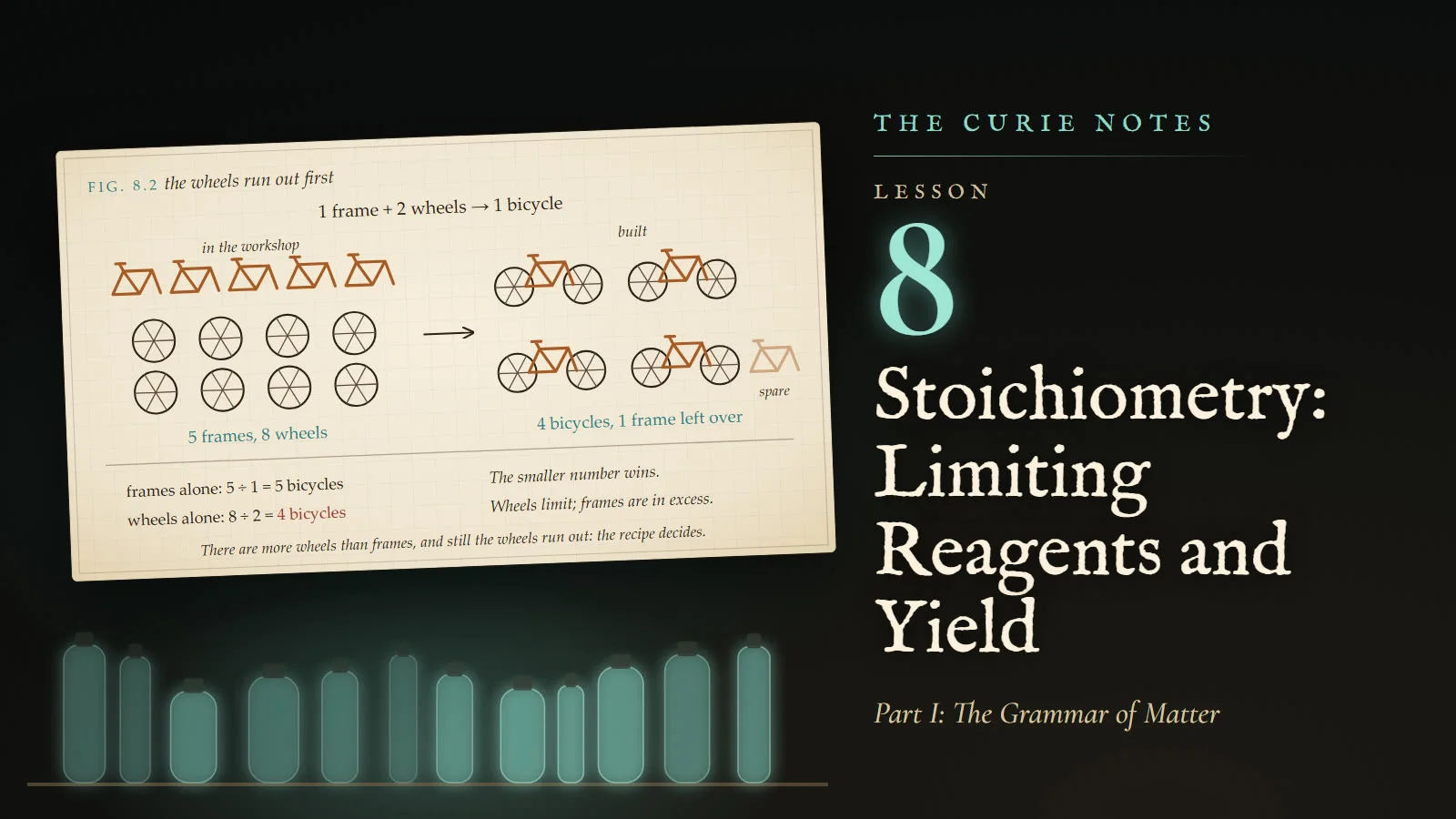
It is evening in the shed on rue Lhomond, and the stove has gone cold. On the bench stands a small glass dish with a few crystals at the bottom. They are the end of many weeks of boiling, dissolving, precipitating and crystallising, and they weigh very little. A chemist must always be able to say two things about such a dish: how much she should have obtained, and how much she really has. In this lesson you will learn to answer both. You will turn the coefficients of a balanced equation into a recipe in moles, use it to go from grams of one substance to grams of another, find which reagent runs out first, and measure your success as a percent yield.
Yet it was in this miserable old shed that we passed the best and happiest years of our life, devoting our entire days to our work.
Marie Curie, Autobiographical Notes, 1923
What you will learn
- Use the coefficients of a balanced equation as mole ratios.
- Convert the mass of one substance into the mass of another, by the road map grams to moles to moles to grams.
- Find the limiting reagent, the amount of product it allows, and the amount of the excess reagent left over.
- Calculate the theoretical yield, the actual yield and the percent yield.
- Combine the yields of several steps, and explain why real yields fall below 100 per cent.
What you need first: Lesson 5, The Mole, or Counting Atoms by Weighing (moles and molar mass); Lesson 6, Chemical Formulas, Percent Composition and Empirical Formulas (molar masses of compounds); and Lesson 7, Chemical Equations and How to Balance Them (balanced equations read in moles).
Coefficients as mole ratios
The word stoichiometry means the measuring of elements. It is the arithmetic of how much of each substance takes part in a reaction. Jeremias Richter gave it its name in 1792, from the Greek stoicheion, an element, and metron, a measure. It sounds grand. It is only careful bookkeeping with moles.
In Lesson 7 we saw that the coefficients of a balanced equation can be read as moles. Take the making of ammonia from nitrogen and hydrogen:
\[\ce{N2 + 3H2 -> 2NH3}\]
This says that 1 mol of nitrogen reacts with 3 mol of hydrogen to give 2 mol of ammonia. From it we can write a mole ratio between any two substances in the equation. A mole ratio is a fraction made from two coefficients, with units of moles on top and bottom. For example:
\[\frac{3\ \mathrm{mol\ H_2}}{1\ \mathrm{mol\ N_2}} \qquad \frac{2\ \mathrm{mol\ NH_3}}{1\ \mathrm{mol\ N_2}} \qquad \frac{2\ \mathrm{mol\ NH_3}}{3\ \mathrm{mol\ H_2}}\]
Each ratio is a true statement about this reaction, and each can be turned upside down. To use one, choose the ratio that has the substance you want on top and the substance you know on the bottom. Then the unit you know cancels, and the unit you want remains.
Worked example 1
How many moles of hydrogen are needed to react with 4.0 mol of nitrogen, and how many moles of ammonia form?
- We know nitrogen and want hydrogen. The ratio with hydrogen on top is 3 mol \(\ce{H2}\) per 1 mol \(\ce{N2}\).
- Hydrogen needed: \(4.0\,\mathrm{mol\ N_2} \times \dfrac{3\,\mathrm{mol\ H_2}}{1\,\mathrm{mol\ N_2}} = 12\,\mathrm{mol\ H_2}\).
- For ammonia, the ratio is 2 mol \(\ce{NH3}\) per 1 mol \(\ce{N2}\).
- Ammonia formed: \(4.0\,\mathrm{mol\ N_2} \times \dfrac{2\,\mathrm{mol\ NH_3}}{1\,\mathrm{mol\ N_2}} = 8.0\,\mathrm{mol\ NH_3}\).
Check: 4.0 mol is four times the recipe, so every amount is four times its coefficient: 4, 12 and 8. The units "mol \(\ce{N2}\)" cancelled each time.
An analogy from my Paris
The baker on our street makes her brioche from a recipe written on a card: for one batch, one kilogram of flour, six eggs, and so on, and the batch gives twelve loaves. If a customer orders thirty-six loaves, she does not think about the flour and the loaves directly. She thinks: thirty-six loaves is three batches. Three batches need three kilograms of flour and eighteen eggs. The batch is the middle step that joins everything. In chemistry the mole is that batch. The equation is the recipe card, and it is always written in moles.
From grams to grams: the road map
On the bench nobody hands you moles. You weigh grams, and you want to know how many grams of product to expect. The equation, however, speaks only in moles. So every calculation of this kind follows the same three steps, which I call the road map:
- Grams of the substance you know to moles of it: divide by its molar mass.
- Moles of the known substance to moles of the wanted substance: multiply by the mole ratio from the equation.
- Moles of the wanted substance to grams of it: multiply by its molar mass.
Written as one line, for a known substance A and a wanted substance B with coefficients \(a\) and \(b\):
\[m_\mathrm{B} = \frac{m_\mathrm{A}}{M_\mathrm{A}} \times \frac{b}{a} \times M_\mathrm{B}\]
Here \(m\) is a mass in grams and \(M\) is a molar mass in grams per mole. The middle step, the mole ratio, is the only place where the equation enters. There is no road from grams of A straight to grams of B.
Worked example 2
What mass of water forms when 10.0 g of hydrogen burns in plenty of oxygen? The equation is \(\ce{2H2 + O2 -> 2H2O}\).
- Molar masses: \(\ce{H2}\) is \(2 \times 1.008 = 2.016\,\mathrm{g\,mol^{-1}}\); \(\ce{H2O}\) is \(2 \times 1.008 + 15.999 = 18.015\,\mathrm{g\,mol^{-1}}\).
- Grams to moles: \(n(\ce{H2}) = \dfrac{10.0\,\mathrm{g}}{2.016\,\mathrm{g\,mol^{-1}}} = 4.960\,\mathrm{mol}\).
- Mole ratio: 2 mol \(\ce{H2O}\) per 2 mol \(\ce{H2}\), which is 1 to 1. So \(n(\ce{H2O}) = 4.960\,\mathrm{mol} \times \dfrac{2}{2} = 4.960\,\mathrm{mol}\).
- Moles to grams: \(m(\ce{H2O}) = 4.960\,\mathrm{mol} \times 18.015\,\mathrm{g\,mol^{-1}} = 89.36\,\mathrm{g}\).
- Round to three significant figures, like the 10.0 g we started from: 89.4 g of water.
Check: the water is heavier than the hydrogen because each water molecule adds a heavy oxygen atom to the two light hydrogen atoms. Per mole, 18.015 g against 2.016 g is about nine times, and 89.4 g is about nine times 10.0 g.
A common mistake
Students put the coefficients onto the grams. They reason: two hydrogens give two waters, so 10.0 g of hydrogen gives 10.0 g of water. This forgets that a molecule of water weighs nine times as much as a molecule of hydrogen. Coefficients count particles. Only after you have counted particles, in moles, may you weigh them.
In my laboratory
To find the atomic weight of radium, I dissolved radium chloride in water and added silver nitrate until all the chloride had fallen as silver chloride. Then I filtered, dried and weighed the silver chloride. Let us do the road map for the sample I used in 1902, with today's atomic weights.
What mass of silver chloride should 0.09192 g of radium chloride give? The equation is \(\ce{RaCl2 + 2AgNO3 -> 2AgCl + Ra(NO3)2}\).
- Molar masses: \(\ce{RaCl2}\) is \(226 + 2 \times 35.45 = 296.90\,\mathrm{g\,mol^{-1}}\); \(\ce{AgCl}\) is \(107.87 + 35.45 = 143.32\,\mathrm{g\,mol^{-1}}\).
- Grams to moles: \(n(\ce{RaCl2}) = \dfrac{0.09192\,\mathrm{g}}{296.90\,\mathrm{g\,mol^{-1}}} = 3.096 \times 10^{-4}\,\mathrm{mol}\).
- Mole ratio: 2 mol \(\ce{AgCl}\) per 1 mol \(\ce{RaCl2}\). So \(n(\ce{AgCl}) = 2 \times 3.096 \times 10^{-4}\,\mathrm{mol} = 6.192 \times 10^{-4}\,\mathrm{mol}\).
- Moles to grams: \(m(\ce{AgCl}) = 6.192 \times 10^{-4}\,\mathrm{mol} \times 143.32\,\mathrm{g\,mol^{-1}} = 0.08874\,\mathrm{g}\).
Check: each radium chloride unit gives two silver chloride units, but radium chloride is about twice as heavy per mole, so the two masses come out nearly equal. My balance gave 0.08890 g. We shall come back to that small difference in the section on yield.
The limiting reagent
So far we have always had "plenty" of the second reactant. On a real bench you weigh out both, and they are seldom in exactly the right proportion. One of them is used up first. When it is gone, the reaction stops, however much of the other is left.
The reactant that is used up first is the limiting reagent. It limits how much product can form. The reactant left over is the excess reagent.
An analogy from my Paris
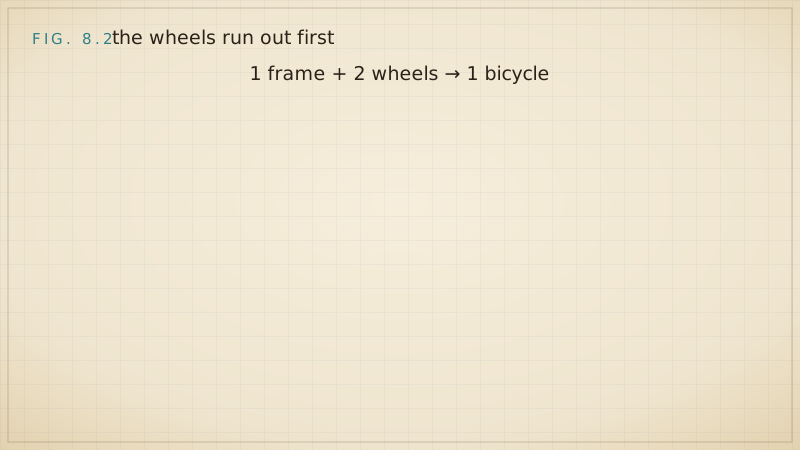
In the summer of 1895 Pierre and I bought two bicycles with a wedding present of money, and we rode them along the country roads. So think of a bicycle workshop. The recipe for one bicycle is one frame and two wheels:
\[1\ \text{frame} + 2\ \text{wheels} \longrightarrow 1\ \text{bicycle}\]
Suppose the workshop has 5 frames and 8 wheels. The frames alone would make 5 bicycles. The wheels alone would make only \(8 \div 2 = 4\) bicycles. So the workshop builds 4 bicycles and then stops, because it has no wheels left. The wheels are the limiting part, even though there are more wheels than frames. One frame is left over, the excess. Notice that you cannot decide by comparing 5 with 8. You must take the recipe into account.
How to find the limiting reagent
The surest method is the one I used for the bicycles. Ask of each reactant in turn: if this one were used up completely, how much product would it make? The reactant that gives the smaller amount of product is the limiting reagent, and that smaller amount is what you really get.
- Convert the mass of each reactant to moles.
- For each reactant, use the mole ratio to find the moles of product it could make.
- The smaller answer wins. Its reactant is limiting.
- To find the excess left over, work out how much of the excess reagent the limiting reagent uses up, and subtract.
Worked example 3
A flask holds 3.0 mol of hydrogen and 2.0 mol of oxygen, which react as \(\ce{2H2 + O2 -> 2H2O}\). Which is limiting? How much water forms, and how much of the excess is left?
- If all the hydrogen reacts: \(3.0\,\mathrm{mol\ H_2} \times \dfrac{2\,\mathrm{mol\ H_2O}}{2\,\mathrm{mol\ H_2}} = 3.0\,\mathrm{mol\ H_2O}\).
- If all the oxygen reacts: \(2.0\,\mathrm{mol\ O_2} \times \dfrac{2\,\mathrm{mol\ H_2O}}{1\,\mathrm{mol\ O_2}} = 4.0\,\mathrm{mol\ H_2O}\).
- The smaller is 3.0 mol, from hydrogen. Hydrogen is the limiting reagent, and 3.0 mol of water forms.
- Oxygen used by 3.0 mol of hydrogen: \(3.0\,\mathrm{mol\ H_2} \times \dfrac{1\,\mathrm{mol\ O_2}}{2\,\mathrm{mol\ H_2}} = 1.5\,\mathrm{mol\ O_2}\).
- Oxygen left: \(2.0\,\mathrm{mol} - 1.5\,\mathrm{mol} = 0.5\,\mathrm{mol}\).
Check: there was more hydrogen than oxygen, yet hydrogen ran out, because the recipe asks for twice as much hydrogen as oxygen. Count the oxygen atoms, in moles: 4.0 mol at the start (in 2.0 mol of \(\ce{O2}\)); at the end, 3.0 mol in the water plus 1.0 mol in the leftover 0.5 mol of \(\ce{O2}\), which is 4.0 mol. Everything is accounted for.
Worked example 4
Iron filings and powdered sulfur are mixed and heated. They react as \(\ce{Fe + S -> FeS}\). If 10.0 g of iron is heated with 8.00 g of sulfur, what mass of iron(II) sulfide forms, and what mass of which element is left over?
- Molar masses: Fe \(55.845\,\mathrm{g\,mol^{-1}}\); S \(32.06\,\mathrm{g\,mol^{-1}}\); FeS \(55.845 + 32.06 = 87.905\,\mathrm{g\,mol^{-1}}\).
- Moles of iron: \(\dfrac{10.0\,\mathrm{g}}{55.845\,\mathrm{g\,mol^{-1}}} = 0.1791\,\mathrm{mol}\).
- Moles of sulfur: \(\dfrac{8.00\,\mathrm{g}}{32.06\,\mathrm{g\,mol^{-1}}} = 0.2495\,\mathrm{mol}\).
- The ratio is 1 to 1, so iron could make 0.1791 mol of FeS and sulfur could make 0.2495 mol. The smaller is from iron: iron is limiting.
- Mass of FeS: \(0.1791\,\mathrm{mol} \times 87.905\,\mathrm{g\,mol^{-1}} = 15.74\,\mathrm{g}\), so 15.7 g.
- Sulfur used: 0.1791 mol, the same as the iron. Sulfur left: \(0.2495 - 0.1791 = 0.0704\,\mathrm{mol}\).
- Mass of sulfur left: \(0.0704\,\mathrm{mol} \times 32.06\,\mathrm{g\,mol^{-1}} = 2.26\,\mathrm{g}\).
Check: mass is conserved. The 18.0 g we started with should equal the product plus the leftover: \(15.74\,\mathrm{g} + 2.26\,\mathrm{g} = 18.00\,\mathrm{g}\). It does.
A common mistake
Do not choose the limiting reagent by looking at the masses. Here there was less sulfur than iron by mass (8.00 g against 10.0 g), but more sulfur by moles, because a sulfur atom is lighter than an iron atom. Do not choose it by comparing moles alone either, unless the coefficients are equal. In Worked example 3 there were more moles of hydrogen, and hydrogen still ran out. Always go through the recipe.
Try it
Try it on Plate 8.1. Choose a reaction and set how many particles of each reactant go into the flask with the two sliders. The plate shows the flask before and after. Product particles appear, and the leftover particles of the excess reagent stay behind, drawn faintly. The readout tells you how much product each reactant alone could make; the smaller one is the limit. Start with the bicycles, then try 6 hydrogen molecules with 5 oxygen molecules.
Theoretical, actual and percent yield
The amount of product that the equation promises, worked out from the limiting reagent, is the theoretical yield. It is what you would collect if every atom of the limiting reagent ended in the product and you lost nothing.
The amount you really collect and weigh is the actual yield. It is a measurement, and it is nearly always smaller than the theoretical yield.
The percent yield compares the two:
\[\text{percent yield} = \frac{\text{actual yield}}{\text{theoretical yield}} \times 100\%\]
Both yields must be in the same unit, usually grams. The percent yield tells you how well the work went, in one number that can be compared from one day to the next.
Worked example 5
In a small kiln, 50.0 g of pure limestone is heated until it no longer loses mass: \(\ce{CaCO3 -> CaO + CO2}\). The quicklime left weighs 25.2 g. What is the percent yield?
- Molar masses: \(\ce{CaCO3}\) is \(40.078 + 12.011 + 3 \times 15.999 = 100.086\,\mathrm{g\,mol^{-1}}\); \(\ce{CaO}\) is \(40.078 + 15.999 = 56.077\,\mathrm{g\,mol^{-1}}\).
- Moles of limestone: \(\dfrac{50.0\,\mathrm{g}}{100.086\,\mathrm{g\,mol^{-1}}} = 0.4996\,\mathrm{mol}\).
- Mole ratio 1 to 1: 0.4996 mol of CaO at most.
- Theoretical yield: \(0.4996\,\mathrm{mol} \times 56.077\,\mathrm{g\,mol^{-1}} = 28.0\,\mathrm{g}\).
- Percent yield: \(\dfrac{25.2\,\mathrm{g}}{28.0\,\mathrm{g}} \times 100\% = 90.0\%\).
Check: the yield is below 100 per cent, as it should be. Some quicklime was probably lost as dust when it was scraped out of the kiln, and a little may have stuck to the walls.
Why yields fall below 100 per cent
I have never obtained 100 per cent of anything, and neither will you. The reasons are always some of these:
- The reaction does not go to completion. Some reactions stop part of the way, with reactants and products side by side. This is chemical equilibrium, the subject of Lesson 35.
- Side reactions. Some of the reactants make a different product than the one you want.
- Losses in handling. Solid stays on the filter paper and on the walls of the beaker; liquid is left in the funnel; a little splashes.
- Losses in purifying. When you crystallise a product, part of it always stays dissolved in the liquid left behind, the mother liquor.
- Impure reactants. If the limestone is only 95 per cent calcium carbonate, the theoretical yield worked out for pure limestone is too large.
A yield above 100 per cent
Sometimes a student reports 104 per cent and is pleased. She should be worried. Matter cannot be created, so a yield above 100 per cent means that something else is being weighed with the product. Usually it is water that has not been dried off, or an impurity.
In my laboratory
Return to the silver chloride. The road map predicted 0.08874 g from my 0.09192 g of radium chloride, and my balance gave 0.08890 g. That is a percent yield of \(0.08890 \div 0.08874 \times 100\% = 100.2\%\). A careful chemist does not lose silver chloride and does not make extra. So the excess was telling me something. The most likely reason is a trace of barium chloride still hidden in my radium chloride. Barium chloride is lighter per mole, so one gram of it gives more silver chloride than one gram of radium chloride does. A sample with a little barium in it gives too much silver chloride, and so too low an atomic weight. My 1902 figure was 225. In 1907, with more and purer radium chloride, the figure rose to about 226, the value we use today.
Try it
Exercise 8.2 gives you eight problems: mole ratios, the road map from grams to grams, limiting reagents, the excess left over, percent yield and a chain of steps. Press New numbers to get a fresh version of each, and work them in your notebook before you type the answer.
Several steps in a row
Few useful substances are made in one step. A product is usually made, then purified, then changed into something else, then purified again. Each step has its own percent yield. The overall yield of the whole process is the product of the yields of the steps, each written as a fraction:
\[\text{overall yield} = y_1 \times y_2 \times y_3 \times \cdots\]
The reason is simple. Each step can only work on what the step before it handed on. If the first step keeps 90 per cent, the second step starts with only that 90 per cent, and keeps its own share of it.
Worked example 6
A product is made in three steps with yields of 90%, 80% and 75%. What is the overall yield? If the first step could in theory give 100 g of material, how much of the final product do you collect?
- Write each yield as a fraction: 0.90, 0.80 and 0.75.
- Multiply: \(0.90 \times 0.80 = 0.72\), and \(0.72 \times 0.75 = 0.54\).
- Overall yield: \(0.54 \times 100\% = 54\%\).
- Follow the material: after step 1, \(100\,\mathrm{g} \times 0.90 = 90\,\mathrm{g}\); after step 2, \(90\,\mathrm{g} \times 0.80 = 72\,\mathrm{g}\); after step 3, \(72\,\mathrm{g} \times 0.75 = 54\,\mathrm{g}\).
Check: the overall yield is smaller than the worst single step (75%), as it must be. Three steps that each look respectable have together lost almost half the material.
From the shed
Fractional crystallisation is a long chain of steps. I dissolved the radium-bearing barium chloride in hot water and let it cool. The crystals that formed were a little richer in radium than the liquid. I took the crystals forward and set the liquid aside to be worked again. Then I did it again, and again, a great many times. At every step some of the radium stayed behind in the liquid. If you lose even 5 per cent at each of a hundred steps, you keep only \(0.95^{100}\), which is less than 1 per cent. This is why I could never simply throw the liquids away. Each one was worked again in its turn, so that the losses of one series came back into another.
A common mistake
Do not confuse a percent yield with the richness of an ore. From about a tonne of pitchblende residues I obtained, in 1902, about a decigram of pure radium chloride. That is one part in ten million by mass. It was not a yield of one hundred-thousandth of a per cent in the sense of this lesson. The ore simply held very little radium: in good ore there is less than one part of radium in a million. A percent yield compares what you collect with what the equation and your starting material allow. The tonne-to-decigram figure compares what I collected with the whole heap of rock. I like to call it the yield of patience.
Try it
Plate 8.3 lets you build a chain of up to eight steps. Set the number of steps and the yield of each step, and watch the material shrink from bar to bar. Try eight steps of 90 per cent each, and before you look at the readout, guess the overall yield.
What to remember
- The coefficients of a balanced equation give mole ratios; put the substance you want on top.
- The road map: grams of A, divided by \(M_\mathrm{A}\), gives moles of A; times \(b/a\) gives moles of B; times \(M_\mathrm{B}\) gives grams of B.
- There is no road from grams to grams that skips the moles.
- The limiting reagent is the one that would make the least product; work out the product from each reactant and take the smaller.
- Excess left over = excess at the start minus the amount the limiting reagent uses.
- Theoretical yield comes from the limiting reagent; actual yield is what you weigh.
- Percent yield: \(\text{actual yield} \div \text{theoretical yield} \times 100\%\).
- Overall yield of several steps = the product of the step yields as fractions.
- A yield above 100 per cent means the product is wet or impure.
Problems for your notebook
Problem 1. In \(\ce{N2 + 3H2 -> 2NH3}\), how many moles of ammonia form from 0.60 mol of hydrogen with plenty of nitrogen?
Answer. The ratio with ammonia on top is 2 mol \(\ce{NH3}\) per 3 mol \(\ce{H2}\). So \(0.60\,\mathrm{mol} \times \tfrac{2}{3} = 0.40\,\mathrm{mol}\) of ammonia. Check: less ammonia than hydrogen, because 3 hydrogen molecules make only 2 ammonia molecules.
Problem 2. What mass of carbon dioxide forms when 25.0 g of methane burns completely, \(\ce{CH4 + 2O2 -> CO2 + 2H2O}\)?
Answer.
- \(n(\ce{CH4}) = 25.0\,\mathrm{g} \div 16.043\,\mathrm{g\,mol^{-1}} = 1.558\,\mathrm{mol}\).
- Ratio 1 mol \(\ce{CO2}\) per 1 mol \(\ce{CH4}\): 1.558 mol of \(\ce{CO2}\).
- \(m(\ce{CO2}) = 1.558\,\mathrm{mol} \times 44.009\,\mathrm{g\,mol^{-1}} = 68.6\,\mathrm{g}\).
Check: carbon dioxide is heavier per mole than methane (44 against 16), so more grams come out than went in, about 2.7 times.
Problem 3. 6.00 g of magnesium is burned in 5.00 g of oxygen: \(\ce{2Mg + O2 -> 2MgO}\). Which is limiting? What mass of magnesium oxide forms, and what mass of the excess is left?
Answer.
- \(n(\ce{Mg}) = 6.00 \div 24.305 = 0.2469\,\mathrm{mol}\); \(n(\ce{O2}) = 5.00 \div 31.998 = 0.1563\,\mathrm{mol}\).
- Product from magnesium: \(0.2469 \times \tfrac{2}{2} = 0.2469\,\mathrm{mol}\) MgO. Product from oxygen: \(0.1563 \times \tfrac{2}{1} = 0.3125\,\mathrm{mol}\) MgO. Magnesium gives less: it is limiting.
- \(m(\ce{MgO}) = 0.2469\,\mathrm{mol} \times 40.304\,\mathrm{g\,mol^{-1}} = 9.95\,\mathrm{g}\).
- Oxygen used: \(0.2469 \times \tfrac{1}{2} = 0.1234\,\mathrm{mol}\). Left: \(0.1563 - 0.1234 = 0.0328\,\mathrm{mol}\), which is \(0.0328 \times 31.998 = 1.05\,\mathrm{g}\).
Check: \(9.95\,\mathrm{g} + 1.05\,\mathrm{g} = 11.00\,\mathrm{g}\), the mass we started with.
Problem 4. A zinc strip of 5.00 g is left in plenty of copper sulfate solution: \(\ce{Zn + CuSO4 -> ZnSO4 + Cu}\). The copper collected, washed and dried, weighs 4.50 g. What is the percent yield?
Answer.
- \(n(\ce{Zn}) = 5.00 \div 65.38 = 0.07648\,\mathrm{mol}\). Ratio 1 to 1, so 0.07648 mol of copper at most.
- Theoretical yield: \(0.07648 \times 63.546 = 4.860\,\mathrm{g}\).
- Percent yield: \(4.50 \div 4.860 \times 100\% = 92.6\%\).
Problem 5. A preparation has four steps with yields of 85%, 90%, 70% and 95%. What is the overall yield? How much material must the first step be able to give in theory if you need 10.0 g at the end?
Answer. Overall: \(0.85 \times 0.90 \times 0.70 \times 0.95 = 0.5087\), about 50.9%. To end with 10.0 g you must start from \(10.0\,\mathrm{g} \div 0.5087 = 19.7\,\mathrm{g}\) of theoretical material. Check: about half survives, so you plan for about twice what you need.
After my time
In my day a chemist judged a preparation by its percent yield, and so we judged ourselves. Nearly sixty years after my death, chemists began to ask a second question: of all the atoms that go into a reaction, how many end up in the product you want? Barry Trost called this the atom economy in 1991. It is the molar mass of the wanted product divided by the total molar mass of all the reactants, times 100 per cent.
For my lime kiln, \(\ce{CaCO3 -> CaO + CO2}\), the atom economy is \(56.077 \div 100.086 \times 100\% = 56.0\%\). Even a perfect yield throws 44 per cent of the mass into the air as carbon dioxide. A reaction can have a fine percent yield and a poor atom economy. The two numbers measure different things, and modern "green chemistry", a name from the 1990s, asks for both to be high. I find it a good question. In the shed, every gram of residue I could not use was a gram I had to carry out of the door.
You can now plan a preparation: what to weigh, which reagent runs out, how much to expect and how honestly you did. In Lesson 9, Solutions and Concentration, we leave the dry balance and dissolve things in water, and you will learn to count moles by measuring volumes. If you want another problem on limiting reagents or yield worked with you, come and ask me.
Sources and liberties
The Curie Notes are a modern chemistry course written in Marie Curie's voice by Eternal Gardens. The chemistry is standard modern chemistry; dates, people, apparatus and quotations come from the sources below; the teaching, the analogies and the private remarks are our reconstruction.
- Marie Curie, Pierre Curie, with the Autobiographical Notes of Marie Curie (1923), Project Gutenberg.
- Marie Curie, The Discovery of Radium, address at Vassar College (1921), Project Gutenberg.
- OpenStax, Chemistry 2e, chapter 4, Stoichiometry of Chemical Reactions (reaction stoichiometry, limiting reactants and yields).
- American Institute of Physics, Marie Curie and the Science of Radioactivity.
- IUPAC, Periodic Table of the Elements and standard atomic weights.
- Barry M. Trost, The atom economy: a search for synthetic efficiency, Science 254 (1991).
Uncertain points: the masses 0.09192 g and 0.08890 g come from a modern teaching exercise built on her 1902 data; the 1907 atomic weight is quoted between 226.2 and 226.45 in different sources; and the cause of her low 1902 value is our reasonable reading, not her stated explanation.