 by Marie Curie

On my bench tonight there is a porcelain crucible, a bottle of blue crystals, and the balance in its glass case. Beside them lies my notebook from 1902, open at a page of weighings: a decigram of radium chloride, and the silver chloride I made from it. Those few numbers were enough to give radium its atomic weight. In this lesson I will show you how a handful of weighings becomes a chemical formula. You will learn to read a formula, to work out what share of a compound's mass each element carries, and to go the other way: from the masses on the balance to the formula of a substance nobody has named yet.
I had not expected a gift of this kind; I never had any other ambition than to be able to work freely for science.
Marie Curie, Autobiographical Notes, 1923
What you will learn
- Read a chemical formula: subscripts, brackets, and the dot of a hydrate.
- Tell a molecular formula from the formula of an ionic compound.
- Calculate the percent composition of any compound from its formula.
- Find an empirical formula from masses or percentages, in four steps.
- Find a molecular formula when the molar mass is known.
- Find the water in a hydrate by heating it to constant mass, and see how I weighed radium.
What you need first: Lesson 3 (Atoms and Elements: The Laws That Proved Them) for the law of definite proportions and chemical symbols, Lesson 4 (Inside the Atom: Electrons, Nuclei and Isotopes) for ions, and Lesson 5 (The Mole, or Counting Atoms by Weighing) for molar mass and converting grams to moles.
What a formula tells you
A chemical formula is a short way of writing which elements are in a substance and in what proportion. It uses the symbols you met in Lesson 3. Water is \(\ce{H2O}\). Carbon dioxide is \(\ce{CO2}\). Common salt is \(\ce{NaCl}\).
The small number written low after a symbol is a subscript. It tells you how many atoms of that element there are. In \(\ce{H2O}\) the 2 belongs to hydrogen: two hydrogen atoms. Oxygen has no number, and no number means one. So water has two hydrogen atoms and one oxygen atom.
Some substances are made of molecules: small groups of atoms held tightly together, each group the same. Water, carbon dioxide and sugar are like this. For them we write a molecular formula, which counts the atoms in one molecule. Glucose, the sugar of grapes, is \(\ce{C6H12O6}\): every molecule has six carbon atoms, twelve hydrogen atoms and six oxygen atoms.
Other substances are made of ions, the charged atoms or groups of atoms from Lesson 4. Common salt is a great stack of sodium ions, \(\ce{Na+}\), and chloride ions, \(\ce{Cl-}\), packed in a crystal. There is no separate "salt molecule". The formula \(\ce{NaCl}\) gives only the ratio: one sodium ion for each chloride ion. We call this smallest repeating group a formula unit. For calcium chloride, \(\ce{CaCl2}\), the formula unit is one calcium ion and two chloride ions, because the calcium ion carries a charge of 2+ and each chloride only 1−.
Brackets group atoms that travel together. Slaked lime is \(\ce{Ca(OH)2}\). The group OH is one block, and the 2 after the bracket doubles the whole block. So there are one calcium, two oxygens and two hydrogens.
A dot in the middle of a formula joins whole molecules of water held inside a crystal. Blue vitriol, the blue copper sulfate on my bench, is \(\ce{CuSO4*5H2O}\). Read it as "copper sulfate with five waters". A crystal that holds water in a fixed ratio like this is called a hydrate, and the water is its water of crystallisation. Count the atoms carefully: one copper, one sulfur, four plus five makes nine oxygens, and five times two makes ten hydrogens.
An analogy from my Paris
Sit at a café table on the boulevard Saint-Michel and order coffee. The waiter brings a place setting: one cup, one saucer, one spoon, two lumps of sugar. Every table that orders coffee gets the same setting. A formula unit is that place setting. It is the small group that repeats, again and again, through the whole crystal.
If you see "three settings" written on the waiter's slip, you know there are three cups and six lumps of sugar. The 3 in front counts settings. It does not change what a setting is. That is exactly the difference between a number in front of a formula and a subscript inside it.
A common mistake
Students sometimes think \(\ce{2H2O}\) and \(\ce{H2O2}\) are the same, because both contain four hydrogens and two oxygens. They are not the same. \(\ce{2H2O}\) means two separate water molecules. \(\ce{H2O2}\) is one molecule of hydrogen peroxide, a bleaching liquid that is quite another substance. A number in front, called a coefficient, counts molecules. A subscript is part of the molecule itself. You may change coefficients when you balance an equation in Lesson 7. You may never change a subscript to make the arithmetic easier, because then you are writing about a different substance.
Margin
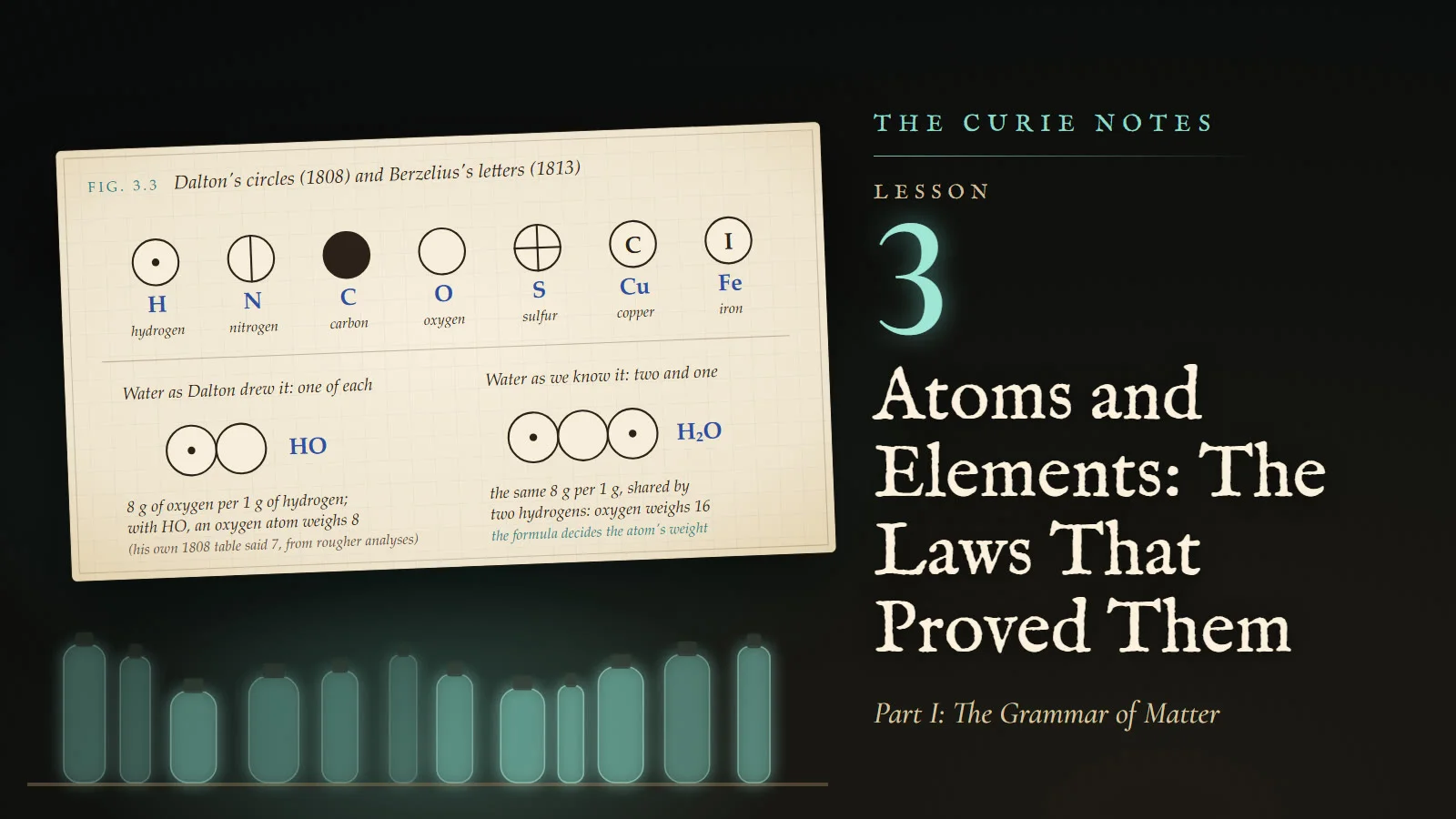
Our letters come from the Swedish chemist Jöns Jacob Berzelius, who proposed them in 1813 and 1814. He wrote the numbers above the line, so that the 2 of water stood raised beside the H. Chemists later moved the numbers down to the line, as subscripts, which is how I learned them and how you write them today.
Formula mass and molar mass
In Lesson 5 you learned to find the molar mass of a substance: add up the atomic masses of every atom in its formula. The formula mass is that same sum, in atomic mass units. The molar mass is the same number in grams per mole. For water the formula mass is 18.02 u, and one mole of water weighs 18.02 g.
I will use these atomic masses in this lesson: H 1.008, C 12.01, N 14.01, O 16.00, Mg 24.31, Al 26.98, S 32.06, Cl 35.45, Fe 55.85, Cu 63.55, Ag 107.87 and Ba 137.33. The plates use slightly fuller values, so their last digit may differ from mine.
Worked example 1
Find the molar mass of slaked lime, \(\ce{Ca(OH)2}\). Take calcium as 40.08.
- Count the atoms. The bracket is doubled: Ca 1, O 2, H 2.
- Calcium: \(1 \times 40.08 = 40.08\,\mathrm{g/mol}\).
- Oxygen: \(2 \times 16.00 = 32.00\,\mathrm{g/mol}\).
- Hydrogen: \(2 \times 1.008 = 2.016\,\mathrm{g/mol}\).
- Add them: \(40.08 + 32.00 + 2.016 = 74.10\,\mathrm{g/mol}\).
Check: the answer is bigger than calcium alone and much smaller than double it. It is sensible.
Worked example 2
Find the molar mass of blue vitriol, \(\ce{CuSO4*5H2O}\).
- Count the atoms, as we did above: Cu 1, S 1, O 9, H 10.
- Copper: \(1 \times 63.55 = 63.55\,\mathrm{g/mol}\).
- Sulfur: \(1 \times 32.06 = 32.06\,\mathrm{g/mol}\).
- Oxygen: \(9 \times 16.00 = 144.00\,\mathrm{g/mol}\).
- Hydrogen: \(10 \times 1.008 = 10.08\,\mathrm{g/mol}\).
- Add them: \(63.55 + 32.06 + 144.00 + 10.08 = 249.69\,\mathrm{g/mol}\), or about 249.7 g/mol.
Check another way: dry copper sulfate, \(\ce{CuSO4}\), is \(63.55 + 32.06 + 64.00 = 159.61\,\mathrm{g/mol}\). Five waters are \(5 \times 18.016 = 90.08\,\mathrm{g/mol}\). Together: \(159.61 + 90.08 = 249.69\,\mathrm{g/mol}\). The two methods agree.
Percent composition
The percent composition of a compound tells you what share of its mass belongs to each element. By the law of definite proportions from Lesson 3, this share is the same in every pure sample of the compound. A drop of water and a lake of water have the same percent of hydrogen.
Here is the idea in words. Take one mole of the compound. Find how many grams of the element are in it. Divide by the grams of the whole mole. Multiply by 100 to make a percent. As a formula, where \(n\) is the number of atoms of the element in the formula:
\[ \text{mass percent of an element} = \dfrac{n \times \text{atomic mass of the element}}{\text{molar mass of the compound}} \times 100\,\% \]
Worked example 3
What is the percent composition of water, \(\ce{H2O}\)?
- Molar mass: \(2 \times 1.008 + 16.00 = 18.016\,\mathrm{g/mol}\).
- Hydrogen in one mole: \(2 \times 1.008 = 2.016\,\mathrm{g}\).
- Percent hydrogen: \(2.016 \div 18.016 \times 100\,\% = 11.19\,\%\).
- Oxygen in one mole: \(16.00\,\mathrm{g}\).
- Percent oxygen: \(16.00 \div 18.016 \times 100\,\% = 88.81\,\%\).
Check: \(11.19\,\% + 88.81\,\% = 100.00\,\%\). The shares of all the elements must always add to 100 percent. Notice also that water has twice as many hydrogen atoms as oxygen atoms, yet hydrogen is only about a ninth of its mass. Counting atoms and weighing them give very different pictures.
Worked example 4
What percent of blue vitriol, \(\ce{CuSO4*5H2O}\), is copper, and what percent is water?
- From Worked example 2, the molar mass is \(249.69\,\mathrm{g/mol}\).
- Copper in one mole: \(63.55\,\mathrm{g}\). Percent: \(63.55 \div 249.69 \times 100\,\% = 25.45\,\%\).
- Water in one mole: five waters, \(5 \times 18.016 = 90.08\,\mathrm{g}\).
- Percent water: \(90.08 \div 249.69 \times 100\,\% = 36.08\,\%\).
Check: more than a third of those pretty blue crystals is water. If you heat 10 g of them until the water has gone, you should be left with about 6.4 g of white powder. We will do exactly that later in this lesson.
An analogy from Warsaw
When I was a governess at Szczuki, the family I worked for ran a sugar-beet factory. The question the factory asked of every cartload of beets was a percent: how much of this mass is sugar? A good beet might be one part sugar in six or seven. The percent did not depend on the size of the cart. One beet or a whole wagon, the share was the same, and the factory could say how much sugar a delivery would give before a single beet was crushed.
Percent composition works the same way. Once you know that blue vitriol is 25.45 percent copper, you know how much copper is in a gram, a kilogram or a barge-load of it.
Try it
Type any formula into Plate 6.1, or press one of the buttons, and watch the circle divide itself among the elements. Try \(\ce{RaCl2}\): radium is so heavy that it carries three quarters of the mass, though there are two chlorine atoms for each radium atom.
Empirical formulas from masses
Now we turn the problem around. A chemist has a new substance. She does not know its formula. She can only weigh: how many grams of each element are in a sample. From those masses she wants the formula.
The masses alone do not give the formula, because atoms of different elements have different masses. First we must turn grams into moles, which count atoms. Then the ratio of moles is the ratio of atoms.
What we get this way is the empirical formula: the simplest whole-number ratio of atoms in the compound. The word "empirical" means "found by experiment". It is the formula the balance gives you directly.
The method has four steps. Learn them in order:
- Grams. Write the mass of each element. If you are given percentages, imagine exactly 100 g of the compound, so that each percent becomes that many grams.
- Moles. Divide each mass by the element's atomic mass.
- Divide by the smallest. Divide every number of moles by the smallest of them. The smallest becomes 1.
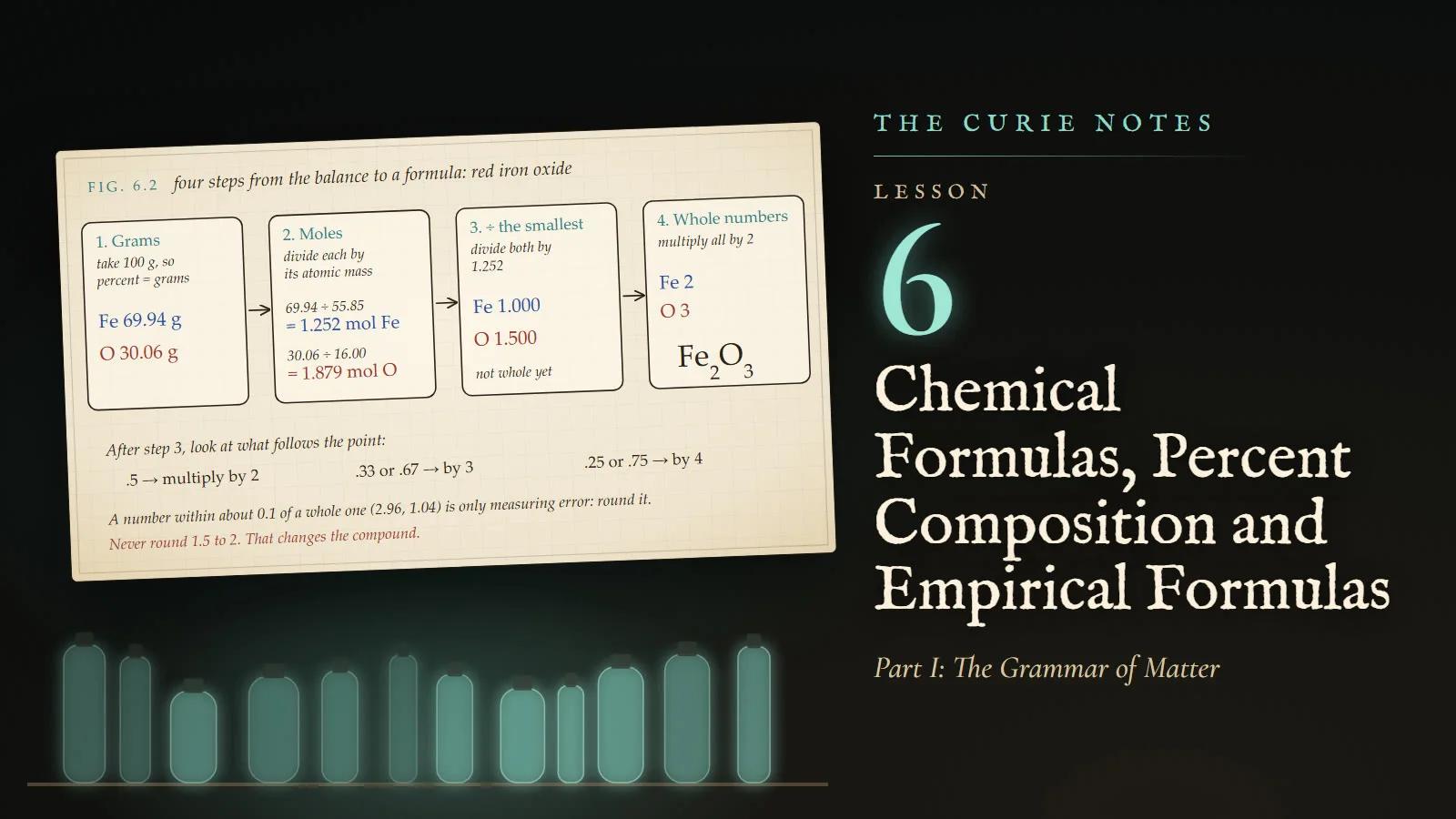
- Whole numbers. If the results are all close to whole numbers, round them. If one ends in about .5, multiply every result by 2. If one ends in about .33 or .67, multiply by 3. If one ends in about .25 or .75, multiply by 4.
Worked example 5
I burn 2.43 g of magnesium ribbon in air. The white ash weighs 4.03 g. Find the empirical formula of the ash.
- The ash is magnesium and oxygen. The oxygen it took from the air: \(4.03\,\mathrm{g} - 2.43\,\mathrm{g} = 1.60\,\mathrm{g}\).
- Moles of magnesium: \(2.43\,\mathrm{g} \div 24.31\,\mathrm{g/mol} = 0.1000\,\mathrm{mol}\).
- Moles of oxygen atoms: \(1.60\,\mathrm{g} \div 16.00\,\mathrm{g/mol} = 0.1000\,\mathrm{mol}\).
- Divide by the smallest, 0.1000: magnesium 1.00, oxygen 1.00.
- Both are whole. The empirical formula is \(\ce{MgO}\), magnesium oxide.
Check: the masses of magnesium and oxygen are not equal (2.43 g against 1.60 g), yet the numbers of atoms are. Each magnesium atom is heavier than an oxygen atom, by \(24.31 \div 16.00 = 1.52\) times, and that is exactly the ratio of the masses.
Worked example 6
Red iron oxide, the colour of rust and of the Venetian red first painted on the Eiffel Tower, is 69.94 % iron and 30.06 % oxygen by mass. Find its empirical formula.
- Imagine 100 g of the oxide. It contains 69.94 g of iron and 30.06 g of oxygen.
- Moles of iron: \(69.94\,\mathrm{g} \div 55.85\,\mathrm{g/mol} = 1.252\,\mathrm{mol}\).
- Moles of oxygen: \(30.06\,\mathrm{g} \div 16.00\,\mathrm{g/mol} = 1.879\,\mathrm{mol}\).
- Divide by the smallest, 1.252: iron \(1.252 \div 1.252 = 1.000\), oxygen \(1.879 \div 1.252 = 1.501\).
- 1.501 is not close to a whole number. It is close to one and a half, so multiply both by 2: iron 2.000, oxygen 3.002.
- Round: iron 2, oxygen 3. The empirical formula is \(\ce{Fe2O3}\).
Check: work forwards from the answer. The molar mass of \(\ce{Fe2O3}\) is \(2 \times 55.85 + 3 \times 16.00 = 159.70\,\mathrm{g/mol}\). Iron is \(111.70 \div 159.70 \times 100\,\% = 69.94\,\%\). That is the analysis we started from.
A common mistake
The worst mistake is to round 1.5 up to 2. That would give \(\ce{FeO2}\) or some other compound that is not on the bench. Only round numbers that are within about 0.1 of a whole number, such as 2.96 or 1.04. Those small differences come from the limits of the balance. A ratio of 1.50 is a real fact about the compound, and it is telling you to multiply.
The second mistake is to round too early. If you round 1.252 to 1.3 in step 2, the ratio becomes 1.45 and you may lose your way. Keep at least four figures until the last step.
An analogy from my Paris
Watch a barge being unloaded on the Seine at the Port de la Tournelle. Its papers say it carries 1,200 kilograms of flour in sacks and 900 kilograms of wine in casks. How many casks are there for each sack? The weights alone cannot tell you. You must know that a sack of flour weighs 100 kilograms and a cask of wine 225 kilograms. Then there are 12 sacks and 4 casks, three sacks for every cask.
Step 2 of our method is that division by the weight of one piece. An atom of iron is the cask, an atom of oxygen is the sack. Only after dividing by their masses can we compare their numbers.
Try it
Plate 6.2 is the four steps made into a machine. Choose an example, or type your own masses or percentages, and watch each step. The bars in step 3 show the ratios against whole-number marks, so you can see at once when a multiplier is needed.
From empirical formula to molecular formula
The empirical formula gives the ratio of atoms. It does not always give the real molecule. Glucose is \(\ce{C6H12O6}\), but the ratio 6 to 12 to 6 is the same as 1 to 2 to 1. So the empirical formula of glucose is \(\ce{CH2O}\). The acid of vinegar, acetic acid, is \(\ce{C2H4O2}\), and its empirical formula is also \(\ce{CH2O}\). Two quite different substances, one empirical formula.
To find the molecular formula, we need one more measurement: the molar mass of the substance. The molecule is a whole number of empirical units. In words: divide the molar mass by the mass of one empirical unit, and the answer tells you how many units are in the molecule.
\[ n = \dfrac{\text{molar mass of the substance}}{\text{mass of one empirical unit}} \]
Then multiply every subscript in the empirical formula by \(n\). For an ionic compound such as \(\ce{Fe2O3}\) there is no molecule, and the empirical formula is the formula we write.
Worked example 7
A white sugar is 40.00 % carbon, 6.71 % hydrogen and 53.29 % oxygen. Its molar mass is 180.2 g/mol. Find its molecular formula.
- Imagine 100 g: 40.00 g C, 6.71 g H, 53.29 g O.
- Moles: C \(40.00 \div 12.01 = 3.331\,\mathrm{mol}\); H \(6.71 \div 1.008 = 6.657\,\mathrm{mol}\); O \(53.29 \div 16.00 = 3.331\,\mathrm{mol}\).
- Divide by the smallest, 3.331: C 1.000, H 1.999, O 1.000.
- All whole. The empirical formula is \(\ce{CH2O}\).
- Mass of one unit: \(12.01 + 2 \times 1.008 + 16.00 = 30.03\,\mathrm{g/mol}\).
- Number of units: \(n = 180.2 \div 30.03 = 6.00\).
- Multiply each subscript by 6: the molecular formula is \(\ce{C6H12O6}\), glucose.
Check: \(6 \times 30.03 = 180.2\,\mathrm{g/mol}\), the molar mass we were given.
How chemists found the masses: burning
For a compound of carbon and hydrogen, the masses come from combustion analysis. You burn a weighed sample completely in oxygen. All its carbon leaves as carbon dioxide, \(\ce{CO2}\), and all its hydrogen as water, \(\ce{H2O}\). You catch both and weigh them. In 1831 Justus von Liebig, at Giessen, made this easy with a chain of glass bulbs filled with potash solution, which swallows the carbon dioxide; a tube of calcium chloride before it catches the water. Every organic chemist of my youth used his apparatus.
Each \(\ce{CO2}\) carries one carbon atom, so the carbon in the sample is the carbon in the carbon dioxide. Each \(\ce{H2O}\) carries two hydrogen atoms. Oxygen is found last, by difference.
Worked example 8
I burn 0.500 g of spirit of wine, which contains only carbon, hydrogen and oxygen. The potash bulbs gain 0.955 g of carbon dioxide and the calcium chloride tube gains 0.587 g of water. The molar mass is 46.07 g/mol. Find the molecular formula.
- Molar mass of \(\ce{CO2}\): \(12.01 + 2 \times 16.00 = 44.01\,\mathrm{g/mol}\). Carbon is \(12.01 \div 44.01\) of it.
- Mass of carbon: \(0.955\,\mathrm{g} \times 12.01 \div 44.01 = 0.2606\,\mathrm{g}\).
- Molar mass of \(\ce{H2O}\): \(18.016\,\mathrm{g/mol}\). Hydrogen is \(2.016 \div 18.016\) of it.
- Mass of hydrogen: \(0.587\,\mathrm{g} \times 2.016 \div 18.016 = 0.0657\,\mathrm{g}\).
- Mass of oxygen, by difference: \(0.500 - 0.2606 - 0.0657 = 0.1737\,\mathrm{g}\).
- Moles: C \(0.2606 \div 12.01 = 0.02170\); H \(0.0657 \div 1.008 = 0.06518\); O \(0.1737 \div 16.00 = 0.01086\).
- Divide by the smallest, 0.01086: C 1.998, H 6.00, O 1.000. Empirical formula \(\ce{C2H6O}\).
- One unit weighs \(2 \times 12.01 + 6 \times 1.008 + 16.00 = 46.07\,\mathrm{g/mol}\). So \(n = 46.07 \div 46.07 = 1\).
- The molecular formula is \(\ce{C2H6O}\), the alcohol in wine.
Check: the masses of carbon, hydrogen and oxygen add back to 0.500 g, as they must, because oxygen was found by difference. A better check is that 0.2606 g of carbon and 0.0657 g of hydrogen are about 52 and 13 percent of the sample, which is what tables give for this alcohol.
Margin
How did we know the molar mass, before mass spectrometers? For a substance that boils easily, Jean-Baptiste Dumas taught us in 1826 to weigh a flask full of its vapour: by Avogadro's hypothesis, equal volumes of gases hold equal numbers of molecules, so the vapour's density gives its molar mass. For a substance that dissolves, François-Marie Raoult at Grenoble showed in 1882 that it lowers the freezing point of a solvent in proportion to the number of dissolved molecules. You will meet his law in Lesson 26.
Hydrates and heating to constant mass
Many salts crystallise from water with water locked inside the crystal, in a fixed number of molecules per formula unit. Blue vitriol is \(\ce{CuSO4*5H2O}\). Epsom salt is \(\ce{MgSO4*7H2O}\). The barium chloride I crystallised for four years is \(\ce{BaCl2*2H2O}\).
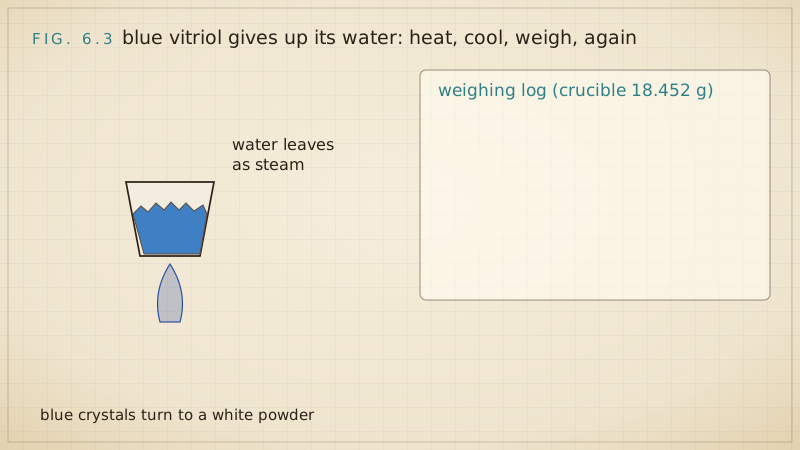
Heat a hydrate gently and the water leaves as steam. The salt that remains, with no water, is called anhydrous, meaning "without water". Blue vitriol shows this beautifully: the blue crystals crumble to a white powder. Drop water on the white powder and it turns blue again, and grows warm.
\[ \ce{CuSO4*5H2O(s) -> CuSO4(s) + 5H2O(g)} \]
To find how much water a hydrate holds, we weigh it, heat it, and weigh what is left. The difference is the water. But there is a difficulty. You cannot see when the last of the water has gone. A powder that looks dry may still hold some. So we heat to constant mass: heat, let it cool, weigh, and repeat, until two weighings in a row agree. While the mass is still falling, water is still leaving. When it stops falling, the change is finished.
The crucible must cool before you weigh it. A hot crucible warms the air in the balance case, the warm air rises, and the crucible seems lighter than it is. We cool it in a desiccator, a closed glass vessel with a drying substance at the bottom, so that the dry salt cannot take water back from the damp air while it cools.
An analogy from my Paris
Think of the laundresses on the quays, drying sheets beside a coal stove. A sheet that feels dry on the outside may still be damp in the folds. A laundress who wanted to be sure could weigh the sheet, dry it a while longer, and weigh it again. When it no longer grew lighter, it was dry. Nobody does this with sheets. In the laboratory we do it with every hydrate, because the eye is not a balance.
Worked example 9
I heat 2.443 g of barium chloride crystals, \(\ce{BaCl2}\cdot x\,\ce{H2O}\), to constant mass. The anhydrous salt weighs 2.083 g. Find \(x\).
- Water lost: \(2.443\,\mathrm{g} - 2.083\,\mathrm{g} = 0.360\,\mathrm{g}\).
- Moles of water: \(0.360\,\mathrm{g} \div 18.016\,\mathrm{g/mol} = 0.01998\,\mathrm{mol}\).
- Molar mass of \(\ce{BaCl2}\): \(137.33 + 2 \times 35.45 = 208.23\,\mathrm{g/mol}\).
- Moles of \(\ce{BaCl2}\): \(2.083\,\mathrm{g} \div 208.23\,\mathrm{g/mol} = 0.01000\,\mathrm{mol}\).
- Waters per formula unit: \(0.01998 \div 0.01000 = 2.00\).
- So \(x = 2\), and the crystal is \(\ce{BaCl2*2H2O}\).
Check: the hydrate's molar mass is \(208.23 + 2 \times 18.016 = 244.26\,\mathrm{g/mol}\), so water should be \(36.03 \div 244.26 = 14.75\,\%\) of it. And \(0.360 \div 2.443 = 14.74\,\%\). They agree.
A common mistake
Stopping too soon. If you weigh after only one heating, some water is still in the crystals. The water lost looks too small, and \(x\) comes out too small: perhaps 3.6 for blue vitriol instead of 5. The opposite mistake is to heat far too strongly. At a bright red heat copper sulfate itself begins to break up, giving off sulfur oxides and leaving black copper oxide. Then the mass keeps falling, and you will measure more "water" than there ever was. Heat gently, and repeat.
In my laboratory
Every one of my radium fractions was a chloride crystallised from water, and every weighing that mattered was of a salt dried until its mass no longer changed. Iron and coal dust drifted into my dishes in the shed, and a careless reading could undo weeks of work. I learned to trust only a mass that two weighings agreed on.
Try it
On Plate 6.3 you heat a crucible of crystals yourself. Press the button, watch the colour fade and the curve of masses bend down, and see what value of \(x\) you would report if you stopped at each point. Only when two weighings agree does the plate say "constant mass".
How I weighed radium
Now you have every tool you need to follow the most important weighing of my life.
Chemists in 1898 would not accept radium as an element on the evidence of its rays and one line in its spectrum. They wanted it weighed. In 1902, after almost four years of crystallisations, I had about a decigram, 0.1 g, of pure radium chloride. The task was to find the atomic weight of radium from it.
I dissolved the chloride in water and added silver nitrate. Every chloride ion in the solution joins a silver ion and falls as white silver chloride, which I filtered, dried and weighed:
\[ \ce{RaCl2(aq) + 2AgNO3(aq) -> 2AgCl(s) + Ra(NO3)2(aq)} \]
The silver chloride tells me how many moles of chlorine were in the radium salt. If I know the formula of the salt, that tells me how many moles of radium chloride I had. Grams divided by moles gives the molar mass.
Worked example 10
One pair of my weighings: 0.09192 g of radium chloride gave 0.08890 g of silver chloride. Assume the formula \(\ce{RaCl2}\). Find the atomic weight of radium.
- Molar mass of \(\ce{AgCl}\): \(107.87 + 35.45 = 143.32\,\mathrm{g/mol}\).
- Moles of \(\ce{AgCl}\): \(0.08890\,\mathrm{g} \div 143.32\,\mathrm{g/mol} = 6.203 \times 10^{-4}\,\mathrm{mol}\). Each carries one chlorine, so this is also the moles of chlorine.
- Each \(\ce{RaCl2}\) carries two chlorines, so moles of \(\ce{RaCl2}\) are half: \(3.101 \times 10^{-4}\,\mathrm{mol}\).
- Molar mass of \(\ce{RaCl2}\): \(0.09192\,\mathrm{g} \div (3.101 \times 10^{-4}\,\mathrm{mol}) = 296.4\,\mathrm{g/mol}\).
- Take away the two chlorines: \(296.4 - 2 \times 35.45 = 225.5\). The atomic weight of radium is about 225.5.
Check: radium chloride should be mostly radium, because radium is heavy. Here \(225.5 \div 296.4 = 76\,\%\), and Plate 6.1 gives 76 percent for \(\ce{RaCl2}\). It agrees.
With modern values for silver and chlorine, this one pair of weighings gives about 225.5. I published 225 in 1902.
The formula is an assumption
Look again at step 3. I halved the moles because I wrote \(\ce{RaCl2}\). Suppose radium chloride were \(\ce{RaCl}\), like common salt. Then the moles of salt would equal the moles of chlorine, the molar mass would be \(0.09192 \div (6.203 \times 10^{-4}) = 148.2\,\mathrm{g/mol}\), and radium would come out near 112.7. The same weighings would give a quite different element.
So the formula had to be chosen on chemical grounds. Radium had followed barium through every one of my separations. Its chloride, its bromide and its sulfate behaved like barium's, only a little less soluble. Barium chloride is \(\ce{BaCl2}\), so I wrote \(\ce{RaCl2}\), and that placed radium in Mendeleev's table below barium, in the column of calcium, strontium and barium, in an empty place waiting for it. The weighing and the chemistry agreed. That agreement, more than either alone, convinced the chemists.
Margin
In 1906 Lord Kelvin wrote in The Times that radium might be a compound of lead and helium. I answered with more radium and more weighings. In 1907, from about 0.4 g of chloride, I found a value about one unit higher; it is usually quoted as 226.45, though secondary sources give anything from 226.2 to 226.45. The modern value is 226. From 1930 I sat on the international committee that decides the atomic weights printed in your tables.
Try it
Exercise 6.4 gathers the whole lesson: percent composition, empirical and molecular formulas, a hydrate, and my silver chloride method tried on barium, whose answer you can look up. Press "New numbers" to practise each kind again with fresh data.
What to remember
- A subscript counts atoms in one molecule or formula unit; a coefficient in front counts molecules. Never change a subscript to make sums come out.
- A molecular formula counts the atoms in one molecule; an ionic formula gives the ratio of ions in a formula unit.
- Brackets multiply a whole group; the dot of a hydrate adds whole water molecules.
- Mass percent of an element: multiply the number of its atoms by its atomic mass, divide by the molar mass, and multiply by 100. The percents add to 100.
- Empirical formula in four steps: grams, moles, divide by the smallest, make whole numbers (a ratio ending in .5 needs doubling, .33 or .67 needs tripling, .25 or .75 needs multiplying by four).
- Molecular formula: divide the molar mass by the mass of one empirical unit to get \(n\), then multiply every subscript by \(n\).
- Combustion analysis: carbon from the \(\ce{CO2}\) caught, hydrogen from the \(\ce{H2O}\) caught, oxygen by difference.
- A hydrate's water is found by heating to constant mass: two weighings in a row must agree.
- An atomic weight found by weighing depends on the formula you assume.
Problems for your notebook
Problem 1. How many atoms of each element are in one formula unit of aluminium sulfate, \(\ce{Al2(SO4)3}\)? What is its molar mass?
Answer. The bracket is multiplied by 3, so there are Al 2, S 3 and O \(4 \times 3 = 12\), seventeen atoms in all. Molar mass: \(2 \times 26.98 + 3 \times 32.06 + 12 \times 16.00 = 53.96 + 96.18 + 192.00 = 342.14\,\mathrm{g/mol}\).
Problem 2. What percent of ammonium nitrate, \(\ce{NH4NO3}\), is nitrogen? Farmers buy it for its nitrogen.
Answer. There are two nitrogen atoms, one in each ion. Molar mass: \(2 \times 14.01 + 4 \times 1.008 + 3 \times 16.00 = 28.02 + 4.032 + 48.00 = 80.05\,\mathrm{g/mol}\). Percent nitrogen: \(28.02 \div 80.05 \times 100\,\% = 35.00\,\%\).
Problem 3. Lodestone, the magnetic iron ore, is 72.36 % iron and 27.64 % oxygen. Find its empirical formula.
Answer.
- In 100 g: 72.36 g Fe and 27.64 g O.
- Moles: Fe \(72.36 \div 55.85 = 1.2956\); O \(27.64 \div 16.00 = 1.7275\).
- Divide by the smallest: Fe 1.000, O \(1.7275 \div 1.2956 = 1.333\).
- 1.333 is one and a third, so multiply by 3: Fe 3.000, O 4.000. The formula is \(\ce{Fe3O4}\).
Problem 4. A gas is 85.63 % carbon and 14.37 % hydrogen. Its molar mass is 56.1 g/mol. Find its empirical and molecular formulas.
Answer.
- Moles in 100 g: C \(85.63 \div 12.01 = 7.130\); H \(14.37 \div 1.008 = 14.256\).
- Divide by the smallest: C 1.000, H 1.999. Empirical formula \(\ce{CH2}\).
- One unit weighs \(12.01 + 2 \times 1.008 = 14.03\,\mathrm{g/mol}\). Then \(n = 56.1 \div 14.03 = 4.00\).
- Molecular formula: \(\ce{C4H8}\).
Problem 5. I heat 5.00 g of Epsom salt, \(\ce{MgSO4}\cdot x\,\ce{H2O}\), to constant mass and 2.44 g of anhydrous magnesium sulfate remains. Find \(x\). What would you have found if you had stopped while 2.60 g still remained?
Answer.
- Water lost: \(5.00 - 2.44 = 2.56\,\mathrm{g}\); moles of water \(2.56 \div 18.016 = 0.1421\,\mathrm{mol}\).
- Molar mass of \(\ce{MgSO4}\): \(24.31 + 32.06 + 4 \times 16.00 = 120.37\,\mathrm{g/mol}\). Moles: \(2.44 \div 120.37 = 0.02027\,\mathrm{mol}\).
- Ratio: \(0.1421 \div 0.02027 = 7.01\), so \(x = 7\): \(\ce{MgSO4*7H2O}\).
- Stopping early: the water lost would seem to be \(5.00 - 2.60 = 2.40\,\mathrm{g}\), or 0.1332 mol. The salt is still 0.02027 mol, because that does not change. The ratio would be \(0.1332 \div 0.02027 = 6.57\), not a whole number, which is itself a warning that the heating was not finished.
After my time
The chemistry of this lesson has not changed, but the instruments have. Since the middle of the twentieth century, combustion analysis has been done by machines that burn a few milligrams of sample and measure the carbon dioxide, water and nitrogen automatically in minutes. Liebig's bulbs are in museums. Molar masses are now found by mass spectrometry, which weighs the molecules themselves after giving them a charge. Francis Aston was building the first such instruments while I was alive, but they became an everyday tool of chemists only after my death.
The atomic weights have changed their footing too. In my day they were measured by weighings like mine, on a scale where oxygen was given 16. Since 1961 the scale has rested on the carbon-12 atom, and most atomic weights are now worked out from the masses and abundances of each element's isotopes, measured in mass spectrometers. That is why your table gives figures to so many places. Radium's 226 is now known to belong to its longest-lived isotope, radium-226; I was weighing that isotope all along without knowing the word.
If you would like to work another formula with me, or ask how a weighing can be wrong, come and ask me. In the next lesson, Lesson 7, Chemical Equations and How to Balance Them, we put formulas together into reactions, and the balance will have to agree on both sides.
Sources and liberties
The Curie Notes are a modern chemistry course written in Marie Curie's voice by Eternal Gardens. The chemistry is standard modern chemistry; dates, people, apparatus and quotations come from the sources below; the teaching, the analogies and the private remarks are our reconstruction.
- Marie Curie, Autobiographical Notes, in Pierre Curie (Macmillan, 1923), translated by Charlotte and Vernon Kellogg: Project Gutenberg
- Marie Curie, The Discovery of Radium, lecture at Vassar College, 14 May 1921: Project Gutenberg
- AIP Center for History of Physics, "Marie Curie and the Science of Radioactivity" (radium chloride and its atomic weight, 1902; Kelvin's challenge, 1906): history.aip.org
- The Nobel Prize in Chemistry 1911, Marie Curie: nobelprize.org
- OpenStax, Chemistry 2e, chapter 3, "Composition of Substances and Solutions": openstax.org
- Commission on Isotopic Abundances and Atomic Weights (IUPAC), standard atomic weights: ciaaw.org
- Liebig's potash apparatus for combustion analysis (1831): Kaliapparat, Wikipedia
The weighing pair in Worked example 10 is quoted from a teaching exercise based on her 1902 paper, and we do not know which of her determinations it was; her 1907 value is reported differently by different sources, between 226.2 and 226.45. The other weighings in this lesson are invented for teaching and computed to be consistent.