

 by Marie Curie

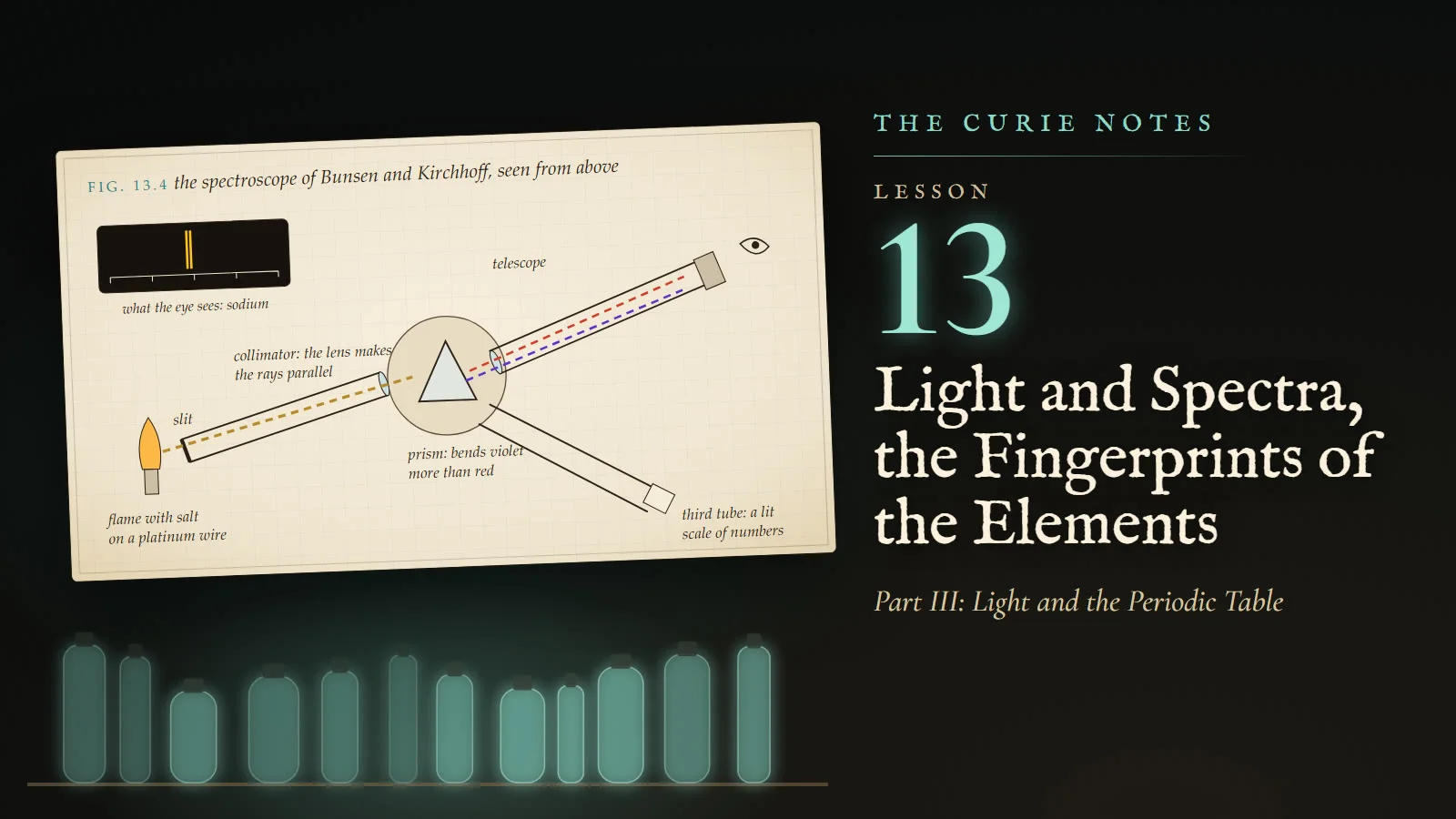
It is evening, and the gas lamps along the rue Lhomond are lit. On my bench there is a Bunsen burner with its pale blue flame, a loop of platinum wire, a dish of common salt and a small brass spectroscope. I dip the wire in the salt and hold it in the flame. At once the flame turns a strong yellow, the yellow of a street lamp. Through the spectroscope that yellow is two thin bright lines, side by side, always in the same place. Any sodium in the world, from the sea or from a mine in Poland, writes those two lines. In this lesson you will learn what light is, how to calculate its wavelength, frequency and energy, and how the lines in a spectrum let us name an element we cannot see. In December 1898 one such line told us that radium was real.
Thus one constructs a source of light, a very weak one to tell the truth, but one that functions without a source of energy.
Pierre Curie, Marie Curie and Gustave Bémont, Comptes rendus 127, 26 December 1898
What you will learn
- Describe a wave by its wavelength, its frequency and its speed, and use \(c = \lambda\nu\).
- Name the parts of the electromagnetic spectrum, from radio waves to gamma rays, in order.
- Calculate the energy of one photon with \(E = h\nu\), and the energy of a mole of photons.
- Tell a continuous spectrum, a bright-line spectrum and a dark-line spectrum apart, and say what makes each.
- Explain how a spectroscope works and how a flame test identifies an element.
What you need first: Lesson 2, Measurement, Units and Significant Figures (scientific notation, unit conversion); Lesson 4, Inside the Atom: Electrons, Nuclei and Isotopes; Lesson 5, The Mole, or Counting Atoms by Weighing.
Light is a wave
Before we can read the light of an element, we must know what light is. For two centuries the best minds argued about it. In the 1660s Isaac Newton passed sunlight through a glass prism and saw it spread into a band of colours, red at one end and violet at the other. He showed that white light is a mixture of all the colours. In 1801 Thomas Young in London made two narrow beams of light overlap, and saw bright and dark stripes where they met. Only waves do that: where two crests meet they add, and where a crest meets a trough they cancel. So light is a wave.
A wave is a disturbance that travels and carries energy, while the thing it travels through stays roughly where it was. A cork on a pond goes up and down as the ripples pass, but it does not travel with them.
Three numbers describe a steady wave.
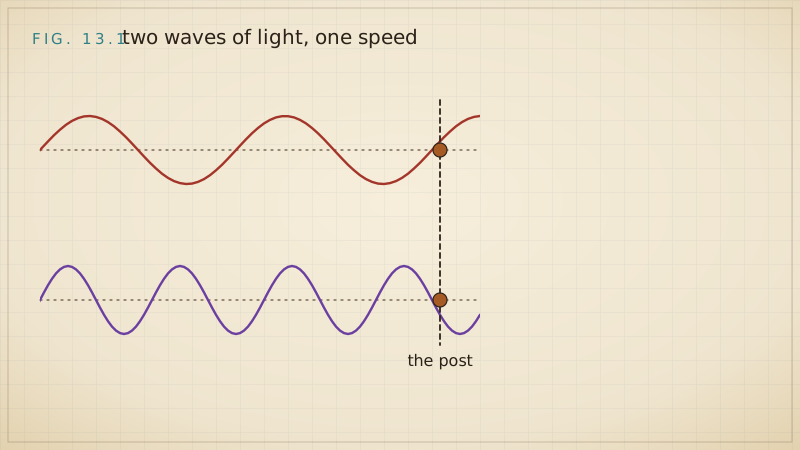
- The wavelength is the distance from one crest to the next. Its symbol is the Greek letter lambda, \(\lambda\). For light we measure it in nanometres: \(1\,\mathrm{nm} = 10^{-9}\,\mathrm{m}\), a millionth of a millimetre.
- The frequency is the number of crests that pass a fixed point in one second. Its symbol is the Greek letter nu, \(\nu\). Its unit is the hertz (Hz), which means "one per second", \(\mathrm{s^{-1}}\).
- The speed is how far a crest travels in one second, in metres per second.
An analogy from my Paris
Stand on a quay of the Seine when a barge has passed. Its wake rolls toward you in a row of crests. Suppose the crests are 2 metres apart, and you count 30 of them slapping the stones in one minute, which is half a crest each second. How fast are the crests moving? In one second, half a crest arrives, and each crest is 2 metres behind the one before. So the water pattern moves forward \(2\,\mathrm{m} \times 0.5\,\mathrm{s^{-1}} = 1\,\mathrm{m/s}\). That is the whole rule: the speed of a wave is its wavelength multiplied by its frequency.
Written for light, the rule is
\[ c = \lambda \nu \]
where \(c\) is the speed of light. In empty space every kind of light travels at the same speed, \(c = 3.00 \times 10^{8}\,\mathrm{m/s}\) to three figures. In air it is a tiny fraction slower, too little to matter in our calculations. Two Frenchmen measured it here in Paris: Hippolyte Fizeau in 1849 with a spinning toothed wheel, and Léon Foucault in 1862 with a spinning mirror.
Because \(c\) is fixed, wavelength and frequency are tied together. If one doubles, the other must halve. Long waves have low frequency; short waves have high frequency. To find one from the other we rearrange: \(\nu = c/\lambda\) and \(\lambda = c/\nu\).
Worked example 1
The yellow light of a sodium flame has a wavelength of 589 nm. What is its frequency?
- Write what we know: \(\lambda = 589\,\mathrm{nm}\) and \(c = 3.00 \times 10^{8}\,\mathrm{m/s}\).
- Put the wavelength in metres, so that the units match the speed: \(589\,\mathrm{nm} = 589 \times 10^{-9}\,\mathrm{m} = 5.89 \times 10^{-7}\,\mathrm{m}\).
- Choose the right form of the rule: \(\nu = c/\lambda\).
- Substitute: \(\nu = \dfrac{3.00 \times 10^{8}\,\mathrm{m/s}}{5.89 \times 10^{-7}\,\mathrm{m}}\).
- Divide the numbers: \(3.00 / 5.89 = 0.509\). Divide the powers of ten: \(10^{8} / 10^{-7} = 10^{15}\).
- So \(\nu = 0.509 \times 10^{15}\,\mathrm{s^{-1}} = 5.09 \times 10^{14}\,\mathrm{Hz}\).
Check: the metres cancel and leave "per second", which is a frequency. Five hundred million million crests pass each second. Every colour of visible light has a frequency between about 4 and 8 times \(10^{14}\,\mathrm{Hz}\), so the size is sensible.
Worked example 2
A wireless station sends its signal at a frequency of 1.00 MHz. What is the wavelength?
- One megahertz is a million hertz, so \(\nu = 1.00 \times 10^{6}\,\mathrm{Hz}\).
- The rule rearranged for wavelength: \(\lambda = c/\nu\).
- Substitute: \(\lambda = \dfrac{3.00 \times 10^{8}\,\mathrm{m/s}}{1.00 \times 10^{6}\,\mathrm{s^{-1}}}\).
- Numbers: \(3.00/1.00 = 3.00\). Powers: \(10^{8}/10^{6} = 10^{2}\).
- So \(\lambda = 3.00 \times 10^{2}\,\mathrm{m} = 300\,\mathrm{m}\).
Check: the seconds cancel, leaving metres. A wave three hundred metres long, about the height of the Eiffel Tower. The same rule covers waves of 589 nm and of 300 m.
A common mistake
Students forget to change nanometres into metres. If you divide \(3.00 \times 10^{8}\) by 589 instead of by \(5.89 \times 10^{-7}\), you get about \(5 \times 10^{5}\), which is wrong by a factor of a thousand million. Always put every quantity into the same system of units before you divide. Then look at the size of the answer and ask whether it is reasonable.
The electromagnetic spectrum
In 1865 James Clerk Maxwell showed with his equations that a changing electric force and a changing magnetic force can carry each other through space as a wave. He calculated its speed, and it came out equal to the speed of light. So light is an electromagnetic wave. In 1887 Heinrich Hertz made such waves with sparks in his laboratory at Karlsruhe, waves many centimetres long, invisible, yet travelling at the speed of light. These were the first radio waves made on purpose.
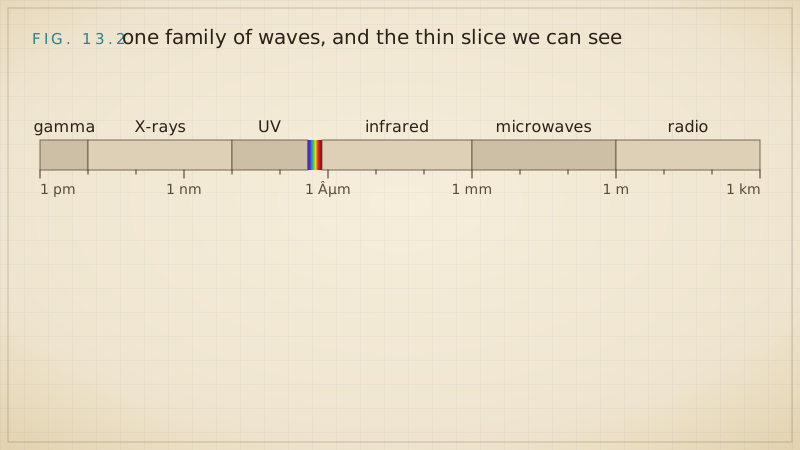
Our eyes see only a thin slice of this family, from about 380 nm (violet) to about 750 nm (red). The whole family is called the electromagnetic spectrum. From the longest waves to the shortest, it runs:
- radio waves, from about a metre to kilometres long;
- microwaves, from about a millimetre to a metre;
- infrared, from about 750 nm to a millimetre, found by William Herschel in 1800 with a thermometer placed beyond the red end of a prism's colours; we feel it as warmth;
- visible light, 380 to 750 nm: red, orange, yellow, green, blue, violet;
- ultraviolet, from about 10 nm to 380 nm, found by Johann Ritter in 1801 because it darkens silver chloride; it burns the skin;
- X-rays, from about 0.01 nm to 10 nm, found by Wilhelm Röntgen in 1895;
- gamma rays, shorter still, found by Paul Villard here in Paris in 1900 among the rays of radium.
The boundaries are not sharp. The names are labels for convenience, like the names of districts in a city whose streets run into one another.
From the war years
In the autumn of 1914 I fitted motor cars with X-ray tubes and a dynamo driven by the engine, and drove them to the hospitals behind the front. The soldiers called them the "petites Curies". X-rays are light, the same kind of wave as the yellow of the sodium flame. Their wavelength is about a tenth of a nanometre, some six thousand times shorter. That difference is everything. Visible light stops at the skin. X-rays pass through flesh and are stopped by bone and by metal, so a bullet or a shell fragment throws a shadow on the screen. The surgeon could see where to cut. You will understand why in the next section: a short wave carries its energy in much larger packets.
Light comes in packets: photons
The wave picture explains colours and stripes. Around 1900 it failed to explain two things.
The first was the glow of hot bodies. A poker in the stove glows dull red, then orange, then white as it heats. The wave theory predicted, absurdly, that a hot body should pour out endless energy as ultraviolet. In December 1900 Max Planck in Berlin found a formula that matched the measurements. To get it he had to suppose that a glowing body gives out light only in definite amounts of energy, never in between. He called each amount a quantum.
The second puzzle was the photoelectric effect. Light falling on a clean metal knocks electrons out of it. Red light, however bright, knocks out none from many metals. Violet or ultraviolet light, however faint, knocks some out at once. In 1905 Albert Einstein explained this. Light itself travels as packets of energy. One packet can free one electron, if it carries enough energy. A red packet is too small, and a million red packets do not add up, because each one acts alone. Today we call a packet of light a photon, a name the American chemist Gilbert Lewis gave it in 1926.
The energy of one photon depends only on the frequency of the light:
\[ E = h\nu \]
Here \(E\) is the energy of one photon in joules, \(\nu\) is the frequency in hertz, and \(h\) is Planck's constant, \(h = 6.626 \times 10^{-34}\,\mathrm{J\,s}\) (joule seconds). Since \(\nu = c/\lambda\), we may also write
\[ E = \frac{hc}{\lambda} \]
Read these two formulas as sentences. Higher frequency means bigger packets. Shorter wavelength means bigger packets. A violet photon carries more energy than a red one; an X-ray photon carries thousands of times more.
An analogy from my Paris
In a Paris café the sugar comes in lumps. You may take one lump, or two, or five, but never half a lump. Light energy is served the same way, in lumps. The odd thing is that the size of the lump depends on the colour. A red lump is small, a violet lump nearly twice as large, an X-ray lump enormous. Brighter light means more lumps per second, each of the same size. A dim violet lamp gives few large lumps; a bright red lamp gives many small ones. For freeing an electron or breaking a bond, what matters is the size of one lump, because a molecule takes them one at a time.
Worked example 3
What is the energy of one photon of sodium's yellow light, 589 nm? What is the energy of a mole of such photons?
- From Worked example 1, the frequency is \(\nu = 5.093 \times 10^{14}\,\mathrm{Hz}\). (I keep a fourth figure in the middle of a calculation and round at the end.)
- Use \(E = h\nu\): \(E = (6.626 \times 10^{-34}\,\mathrm{J\,s}) \times (5.093 \times 10^{14}\,\mathrm{s^{-1}})\).
- Numbers: \(6.626 \times 5.093 = 33.75\). Powers: \(10^{-34} \times 10^{14} = 10^{-20}\).
- So \(E = 33.75 \times 10^{-20}\,\mathrm{J} = 3.375 \times 10^{-19}\,\mathrm{J}\), or \(3.37 \times 10^{-19}\,\mathrm{J}\) to three figures.
- A mole of photons is \(6.022 \times 10^{23}\) of them (Lesson 5). Multiply: \(3.375 \times 10^{-19}\,\mathrm{J} \times 6.022 \times 10^{23}\,\mathrm{mol^{-1}} = 2.032 \times 10^{5}\,\mathrm{J/mol}\).
- Divide by 1000 for kilojoules: \(203\,\mathrm{kJ/mol}\).
Check: the seconds cancel, leaving joules. One photon is a fantastically small amount of energy. A mole of them is about 200 kJ, which is the same size as the energy needed to break a mole of chemical bonds. That is why light can do chemistry: it darkens a photographic plate and drives the leaves of plants.
Worked example 4
An X-ray from one of my war cars has a wavelength of 0.100 nm. How much more energy does one of its photons carry than one photon of sodium yellow?
- Wavelength in metres: \(0.100\,\mathrm{nm} = 1.00 \times 10^{-10}\,\mathrm{m}\).
- Use \(E = hc/\lambda\). First the top: \(hc = (6.626 \times 10^{-34}\,\mathrm{J\,s})(3.00 \times 10^{8}\,\mathrm{m/s}) = 1.988 \times 10^{-25}\,\mathrm{J\,m}\).
- Then divide: \(E = \dfrac{1.988 \times 10^{-25}\,\mathrm{J\,m}}{1.00 \times 10^{-10}\,\mathrm{m}} = 1.99 \times 10^{-15}\,\mathrm{J}\).
- Compare with sodium: \(\dfrac{1.988 \times 10^{-15}\,\mathrm{J}}{3.375 \times 10^{-19}\,\mathrm{J}} = 5890\).
Check: the energy goes as one over the wavelength, so the ratio of energies should equal the ratio of wavelengths turned upside down: \(589\,\mathrm{nm} / 0.100\,\mathrm{nm} = 5890\). The two methods agree. Each X-ray photon carries nearly six thousand times the energy of a yellow one. That is why it can pass through flesh, and why it can also harm the body that it passes through.
Try it
Plate 13.1 puts the whole spectrum under one slider. Move it and watch three things change together: the wave grows longer, the cork at the post bobs more slowly, and the bar for the energy of one photon shrinks. Two marks on that bar show the energy needed to break a typical chemical bond and to tear an electron out of a hydrogen atom. Find where along the spectrum light becomes strong enough to do each.
Margin
Is light a wave or a stream of particles? Young's stripes say wave. Einstein's photoelectric effect says packets. For twenty years this troubled everyone. When I sat with Planck, Einstein and the others at the Solvay meetings in Brussels, no one had a clean answer. The present view is that light behaves as a wave when it travels and spreads, and as packets when it gives up its energy to a single atom. We use whichever picture fits the question. I give you both, because both are measured.
Now practise the arithmetic. Exercise 13.2 gives you fresh numbers each time you ask, from real spectral lines.
Three kinds of spectrum
A spectrum is light spread out by wavelength, so that we can see how much of each wavelength is present. A prism does it because glass bends violet light more than red light. In 1814 Joseph von Fraunhofer, an optician in Munich, looked at the spectrum of sunlight through a fine telescope. He saw that the rainbow is crossed by many thin dark lines. He mapped more than five hundred of them and labelled the strongest with letters. A strong pair in the yellow he called D. Nobody knew what they were.
In 1859 and 1860, at Heidelberg, the chemist Robert Bunsen and the physicist Gustav Kirchhoff solved the puzzle. Kirchhoff summed up what they found in three rules.
- A hot solid, liquid or dense gas gives a continuous spectrum. All colours are present, with no gaps: the glowing filament of a lamp, white-hot iron, the glowing surface of the sun. The colours shift toward violet as the body gets hotter, but there are no lines.
- A hot, thin gas or vapour gives a bright-line spectrum. It emits light only at a few sharp wavelengths. Those wavelengths belong to the element and to no other. This is an emission spectrum.
- A cool gas in front of a hotter source of white light gives a dark-line spectrum. The gas absorbs exactly the wavelengths it would emit if it were hot. The rainbow appears with dark gaps at those places. This is an absorption spectrum.
Kirchhoff tested the third rule directly. He passed sunlight through a sodium flame and saw Fraunhofer's dark D lines grow darker. Sodium vapour absorbs at 589.0 and 589.6 nm, exactly where it emits. So the dark D lines in sunlight mean there is sodium in the cooler outer gas of the sun. For the first time, a chemist could analyse a body he could never touch.
A common mistake
Students think the dark lines of an absorption spectrum are at different places from the bright lines of the same element. They are at exactly the same places. An atom that can give out light of 589.0 nm can also take in light of 589.0 nm, and no other nearby wavelength. Why this is so you will see in the next lesson, where we look inside the atom. For now, remember: bright or dark, the positions are the element's fingerprint.
An analogy from Warsaw
In the Old Town of Warsaw each church has its own bells, and each bell rings its own note. A child who grew up there could stand blindfolded in the square and name the church from the sound. Strike the bell of St John's and you hear its notes, and only those. An atom is like a bell. Heat it and it rings, at its own few wavelengths. Send white light past it, which is like a noise of every note at once, and it takes up only its own notes. The spectroscope is the trained ear.
The spectroscope and the flame test
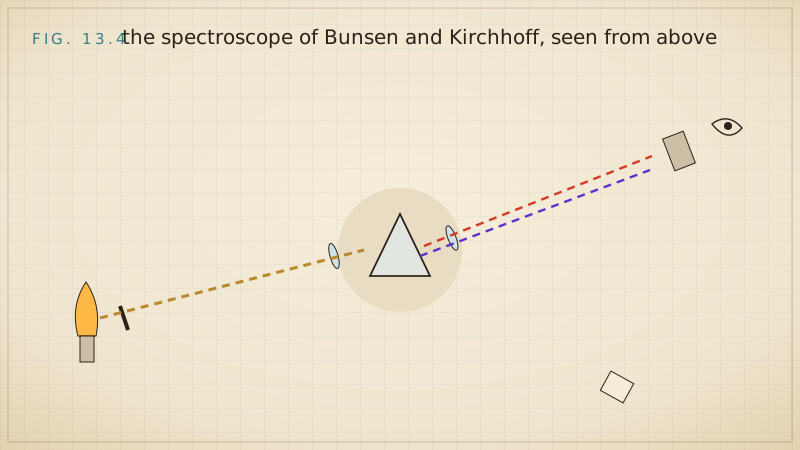
The instrument of Bunsen and Kirchhoff is simple. I describe it as you would see it from above.
- The light to be studied, often a flame coloured by a salt, shines on a narrow slit at the end of a tube.
- A lens at the other end of that tube, the collimator, makes the rays from the slit parallel.
- The parallel rays pass through a glass prism, which bends each wavelength by a different amount: violet most, red least.
- A small telescope gathers the rays of each wavelength into its own image of the slit. Each image is a thin bright line. That is why we speak of spectral "lines": each line is a picture of the slit, in one colour.
- A third tube holds a scale of numbers, lit from behind, whose reflection in the prism appears in the telescope beside the lines. With it the observer reads the position of each line.
Bunsen's burner helped. It mixes gas with air before burning, and gives a hot flame that is almost colourless. Into such a flame you can put a trace of a salt on a clean platinum wire, and the colour you see belongs to the metal. This is the flame test. Sodium gives yellow, lithium crimson, potassium lilac, barium pale green, copper green-blue, strontium scarlet. The metal is what matters. Sodium chloride, \(\ce{NaCl}\), and sodium carbonate, \(\ce{Na2CO3}\), give the same yellow, because in the flame the sodium is freed as hot sodium atoms.
The eye can be fooled by a flame. A trace of sodium, which is in almost everything we handle, hides the lilac of potassium under its yellow. The spectroscope is not fooled. It shows sodium's lines at 589 nm and potassium's red pair at 766.5 and 769.9 nm and its violet pair near 404 nm, each in its place. Bunsen and Kirchhoff found that it could detect a few millionths of a milligram of sodium.
New elements by their light
The spectroscope soon found what chemists had missed. In 1860 Bunsen and Kirchhoff saw two blue lines that belonged to no known element in the residue of a mineral water from Dürkheim. They named the new metal caesium, from the Latin for sky blue. In 1861 dark red lines gave them rubidium, from the Latin for deep red. William Crookes found thallium by its green line in 1861. In 1868, during an eclipse, Jules Janssen and Norman Lockyer saw a yellow line in the sun at 587.6 nm, close to sodium's pair but distinct from it. Lockyer named the unknown element helium, from the Greek for the sun. William Ramsay found it on Earth in 1895. In 1875 Paul-Émile Lecoq de Boisbaudran, a Frenchman, found gallium by two violet lines; it was the eka-aluminium that Mendeleev had predicted. And in 1898, the year of polonium, Ramsay and Morris Travers found neon, krypton and xenon in liquefied air, each recognised by its spectrum.
Try it
On Plate 13.3 an unknown sample shines into the spectroscope. Choose a reference element until every line of the unknown sits exactly on a line of the reference, then press "It is this one". Press "Dark lines" to see the same elements as absorption spectra: the lines stay where they were. Then press "Radium in barium" and do what Demarçay did with our barium chloride: raise the radium and watch for lines that barium never gives.
In my laboratory
In the autumn of 1898 Pierre and I, with Gustave Bémont, had a barium chloride from pitchblende that was dozens of times more active than uranium, and by fractionation we brought it to some nine hundred times. Ordinary barium is not radioactive at all. We were sure a new element was hiding in it. But chemists believe what they can weigh, or at least what they can see in a spectroscope. We gave our samples to Eugène Demarçay, the finest spectroscopist in Paris. He found a line that belonged to no known element, in the violet near 381 nm, close to the edge of what the eye can see. As our samples grew more active, his line grew stronger. That was the second witness we needed, and on 26 December 1898 we proposed the name radium.
Polonium was harder. In July 1898 Demarçay had looked at our polonium samples and found no new line at all. The quantity was too small, and polonium decays away, losing half its activity in about 138 days. So for years some chemists doubted it. I learned from this to want two independent proofs of everything: the electrometer measured the activity, and the spectroscope, or the balance, had to agree.
What to remember
- A wave has a wavelength \(\lambda\) (crest to crest), a frequency \(\nu\) (crests per second, in Hz) and a speed.
- For all light: \(c = \lambda\nu\), with \(c = 3.00 \times 10^{8}\,\mathrm{m/s}\). Convert nm to m first: \(1\,\mathrm{nm} = 10^{-9}\,\mathrm{m}\).
- The spectrum, from long to short waves: radio, microwave, infrared, visible (750 to 380 nm), ultraviolet, X-rays, gamma rays.
- Light gives up its energy in packets called photons: \(E = h\nu = hc/\lambda\), with \(h = 6.626 \times 10^{-34}\,\mathrm{J\,s}\).
- Shorter wavelength means higher frequency and more energy per photon.
- For a mole of photons, multiply the energy of one by \(6.022 \times 10^{23}\,\mathrm{mol^{-1}}\).
- Hot solid: continuous spectrum. Hot thin gas: bright lines. Cool gas before white light: dark lines at the same places.
- Each element has its own set of lines: its fingerprint. The flame test and the spectroscope read it.
Problems for your notebook
Problem 1. The blue-green line of hydrogen has a wavelength of 486.1 nm. What is its frequency?
Answer. \(\lambda = 486.1 \times 10^{-9}\,\mathrm{m} = 4.861 \times 10^{-7}\,\mathrm{m}\). Then \(\nu = c/\lambda = (3.00 \times 10^{8}\,\mathrm{m/s}) / (4.861 \times 10^{-7}\,\mathrm{m}) = 6.17 \times 10^{14}\,\mathrm{Hz}\). It lies between 4 and 8 times \(10^{14}\,\mathrm{Hz}\), as visible light must.
Problem 2. Some light has a frequency of \(1.20 \times 10^{15}\,\mathrm{Hz}\). Find its wavelength in nanometres, name the part of the spectrum, and find the energy of one photon.
Answer.
- \(\lambda = c/\nu = (3.00 \times 10^{8}\,\mathrm{m/s}) / (1.20 \times 10^{15}\,\mathrm{s^{-1}}) = 2.50 \times 10^{-7}\,\mathrm{m} = 250\,\mathrm{nm}\).
- 250 nm is shorter than 380 nm, so it is ultraviolet.
- \(E = h\nu = (6.626 \times 10^{-34}\,\mathrm{J\,s})(1.20 \times 10^{15}\,\mathrm{s^{-1}}) = 7.95 \times 10^{-19}\,\mathrm{J}\).
Problem 3. Lithium's crimson line is at 670.8 nm and potassium's violet line at 404.4 nm. Which photon carries more energy, and how many times more?
Answer. The shorter wavelength carries more energy, so potassium's violet photon. With \(hc = 1.988 \times 10^{-25}\,\mathrm{J\,m}\): lithium, \(E = 1.988 \times 10^{-25} / 6.708 \times 10^{-7} = 2.96 \times 10^{-19}\,\mathrm{J}\); potassium, \(E = 1.988 \times 10^{-25} / 4.044 \times 10^{-7} = 4.92 \times 10^{-19}\,\mathrm{J}\). The ratio is \(4.915/2.963 = 1.66\). Check by the shortcut: \(670.8/404.4 = 1.66\).
Problem 4. Breaking the bond in a mole of oxygen molecules, \(\ce{O2}\), takes 498 kJ. What is the longest wavelength of light whose photons can each break one such bond?
Answer.
- Energy for one molecule: \(498\,000\,\mathrm{J/mol} \div 6.022 \times 10^{23}\,\mathrm{mol^{-1}} = 8.27 \times 10^{-19}\,\mathrm{J}\).
- A photon must carry at least this much. Rearrange \(E = hc/\lambda\) to \(\lambda = hc/E\).
- \(\lambda = (1.988 \times 10^{-25}\,\mathrm{J\,m}) / (8.27 \times 10^{-19}\,\mathrm{J}) = 2.40 \times 10^{-7}\,\mathrm{m} = 240\,\mathrm{nm}\).
- Longer waves have smaller photons and cannot do it. Only ultraviolet shorter than 240 nm splits oxygen molecules.
Problem 5. A powder held in the flame shows lines at 589.0, 589.6, 670.8 and 610.4 nm. What does it contain?
Answer. The pair at 589.0 and 589.6 nm is sodium. The strong line at 670.8 nm with a weaker one at 610.4 nm is lithium. The spectrum of a mixture is the two spectra laid on top of each other, so the powder contains both sodium and lithium. A flame alone would look yellow and might hide the lithium; the spectroscope separates them.
After my time
The spectroscope did not stop at naming elements. In 1960 the metre itself was defined by the wavelength of an orange line of krypton, one of the gases found by its spectrum in 1898. In 1967 the second was defined by the frequency of a line of caesium, Bunsen's sky-blue metal: exactly 9 192 631 770 periods of that radiation make one second. Since 1983 the speed of light has been fixed by definition at exactly 299 792 458 m/s, and the metre is the distance light travels in a set fraction of a second. So the units we measure with now come from spectral lines.
If you would like another example, or want to know how one line could convince the chemists of 1898, come and ask me. In the next lesson, The Bohr Atom and Energy Levels, we ask the question this lesson leaves open: why does each atom give out only its own few wavelengths?
Sources and liberties
The Curie Notes are a modern chemistry course written in Marie Curie's voice by Eternal Gardens. The chemistry is standard modern chemistry; dates, people, apparatus and quotations come from the sources below; the teaching, the analogies and the private remarks are our reconstruction.
- Marie Curie, Pierre Curie, with Autobiographical Notes (1923), Project Gutenberg
- Marie Curie, The Discovery of Radium, Vassar College lecture (1921), Project Gutenberg
- American Institute of Physics, Marie Curie and the Science of Radioactivity
- OpenStax, Chemistry 2e, chapter 6: Electromagnetic Energy
- NIST Atomic Spectra Database (line wavelengths)
- NIST, CODATA values of the fundamental physical constants
The exact wavelength Demarçay reported for radium's first line is given slightly differently in different sources (about 381.4 to 381.5 nm), and the line strengths drawn on Plate 13.3 are sketched by eye rather than measured.