 by Marie Curie


Florence, the winter of 1507 to 1508, in the house of Piero di Braccio Martelli, where I am lodged while the lawyers argue over my uncle's will. My brothers want the little farm, and I want time, which no court gives. So in the evenings I sit with the loose sheets of my book on water, folded in pairs, and I put in order what I have seen of the earth and the sea and the moon. Two questions have been knocking at me for years, and tonight I give them their pages. How did the shells of the sea come to be in the hills of Lombardy and Tuscany, a hundred miles and more from any shore? And why does the dark part of the new moon shine faintly, when the moon has no light of its own?
Since things are much more ancient than letters, it is no marvel if, in our day, no records exist of these seas having covered so many countries ... But sufficient for us is the testimony of things created in the salt waters, and found again in high mountains far from the seas.
Leonardo da Vinci, Codex Leicester, trans. J. P. Richter (1883), §984
Florence, winter 1507. A sack of shells from the mountains of Parma
I begin with a memory, because the question began there. When I was in Milan working on the great horse, some peasants from the hills of Parma and Piacenza came to my workshop in the Corte Vecchia with a sack on a mule, and emptied it on the floor among the clay and the iron. Shells. Cockles, oysters, sea-snails, pieces of coral full of little holes, all dug from their fields and the banks of their streams far up in the mountains. I have written it down so that I remember it exactly:
When I was making the great horse for Milan, a large sack full was brought to me in my workshop by certain peasants; these were found in that place and among them were many preserved in their first freshness.
Codex Leicester, trans. J. P. Richter (1883), §989
In their first freshness. Some still had the colour on the inside, the mother-of-pearl, and the oysters were still joined, the two halves shut on each other like a book. The peasants wanted to know whether they were worth anything. I paid them a few soldi for the sack because I wanted to look at them, and I have been looking at them, in one way or another, ever since.
Observation 1
The shells are everywhere I have walked in the hills. In the red marble of the mountains of Verona, cockles turned to stone. Above Monferrato in Lombardy, corals with the holes of worms in them, sticking to the rocks the rivers have laid bare. Around Florence, in the bank at Colle Gonzoli near Castel Fiorentino, which the Arno is eating away from below, the layers of shells show plainly in a clay of a bluish colour. On the summit of San Miniato al Tedesco the hillsides are full of shells and oysters. And in the Lombard hills I have counted four levels of them, one above another, everywhere I looked, as if the work had been done four times over.
Observation 2
Where the valleys were never covered by the salt sea, there are no shells. Above the gorge of the Gonfolina, in the great valley of the Arno toward Arezzo, the rivers falling from Prato Magno have cut deep channels through the earth, and in those cuts there is no vestige of any shell or any marine soil. I looked for an afternoon and found none. This is as important as the shells themselves. A thing that is everywhere proves nothing; a thing that is here and not there tells you where the sea was.
Reflection
Everyone who has a field in the hills knows about the shells, and everyone has an answer ready. The priest says the Flood. The man who reads the astrologers says the stars made them there, by some virtue of the heavens working on the soil, the way the heavens make worms in cheese. The peasant says nothing and puts them in a sack. Of the three, the peasant is the wisest, because he brought them to someone who would look.
Florence, early 1508. Against those who say the Flood carried them
I set out the arguments as a lawyer would, the adversary's case first and then my answers, numbered, so that I can see that each one stands on its own legs. And first the doubt, which I will state plainly whatever the friars say. We have it in the Bible that the Flood lasted forty days and forty nights of universal rain, and rose ten cubits above the highest mountains. If the water covered the whole globe evenly, its surface was everywhere the same distance from the centre, and water does not move unless it falls. Then where did it go?
Here, then, natural reasons are wanting; hence to remove this doubt it is necessary to call in a miracle to aid us, or else to say that all this water was evaporated by the heat of the sun.
Codex Leicester, trans. J. P. Richter (1883), §986
I leave the miracle to those whose trade it is. I speak only of the shells.
First argument: the shells are too low, and in layers
If the Flood rose above the highest mountains, as he who measured it has written, the shells, which live near the shore, should have been left high on the mountains. Instead they lie a little way above the foot of the hills, all at one level, and in layers upon layers. One flood makes one confusion. It does not lay things down in order, one bed on another with clean clay between, four times over.
Second argument: the cockle cannot walk so far
Here the adversary says: the shells followed the rising water, keeping always near its edge, as they like to do, and so were carried up the mountains living. I answer with the speed of the cockle. I have watched them in the shallows at the mouth of the Arno.
the cockle is an animal of not more rapid movement than the snail is out of water, or even somewhat slower; because it does not swim, on the contrary it makes a furrow in the sand by means of its sides, and in this furrow it will travel each day from 3 to 4 braccia
Codex Leicester, trans. J. P. Richter (1883), §987
And from the Adriatic to Monferrato in Lombardy is 250 miles, which the creature would have to cover in the forty days of rain.
Calculation
- We reckon 3,000 braccia to the mile. 250 miles is \( 250 \times 3{,}000 = 750{,}000 \) braccia.
- To cover that in 40 days the cockle must go \( 750{,}000 \div 40 = 18{,}750 \) braccia a day, more than six miles, as far as a man walks between breakfast and supper.
- It goes 4 braccia a day at the most. So it is too slow by \( 18{,}750 : 4 \), nearly 4,700 times.
- Going on at its own pace, it would need \( 750{,}000 \div 4 = 187{,}500 \) days, which is more than 500 years; at 3 braccia a day, nearly 700. The rain lasted forty days.
Third argument: they are heavy
Here the adversary says: the waves carried them, dead and empty. I answer that things heavier than water do not float. A shell rolls along the bottom only where the bottom slopes and the water moves strongly; the waves of the surface cannot lift it. And a flood made of rain runs down to the sea, carrying things from the mountains to the shore. It does not carry the dead things of the shore up into the mountains against its own current.
Fourth argument: the living and the dead lie apart
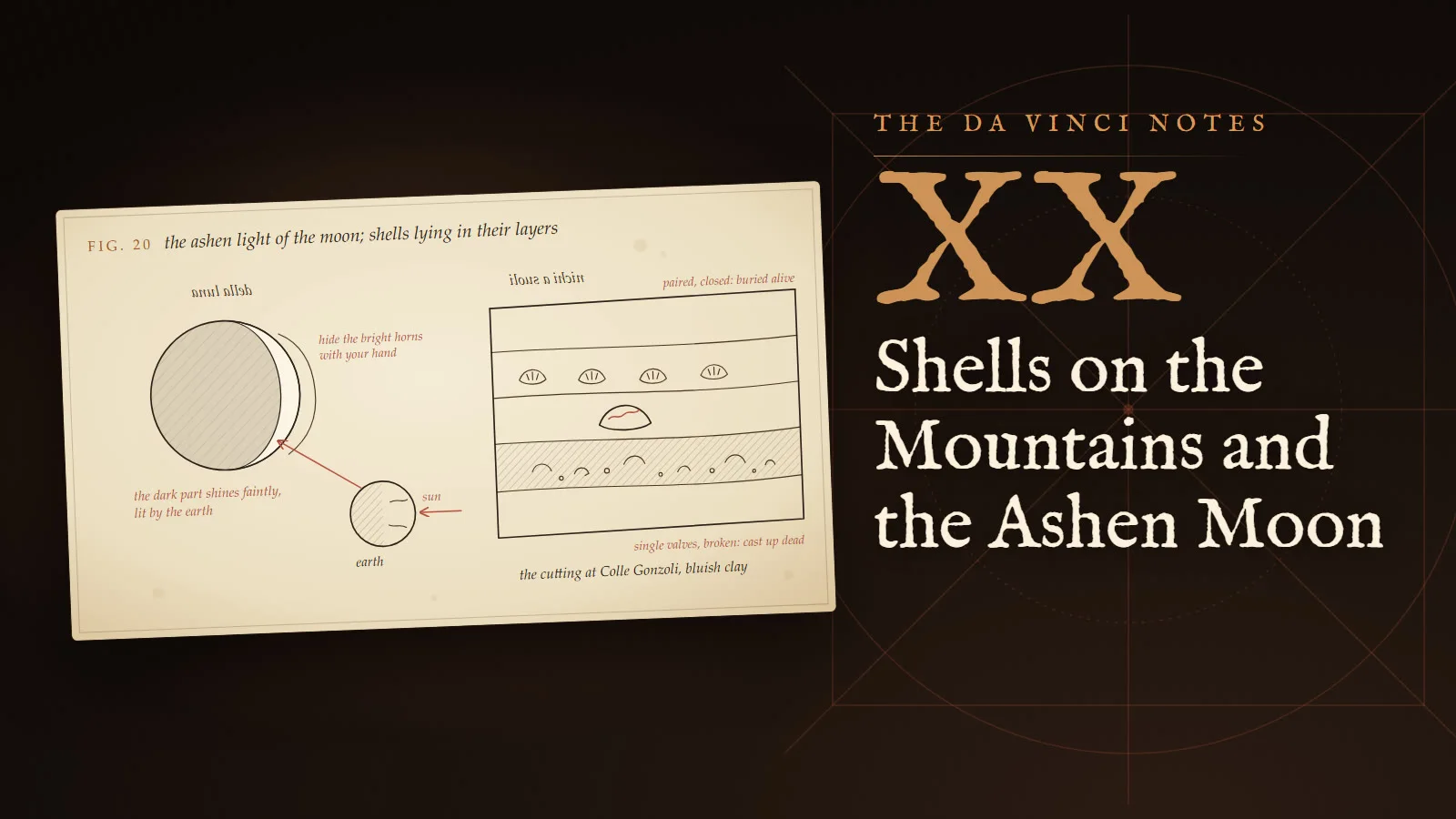
This is the argument I like best, because it needs no reasoning, only eyes. In one layer the shells are found in pairs, closed, the two valves still joined, few, and lying as they lived, in the mud where the sea buried them alive. A little higher, in another layer, all the shells are single, broken, separated, mixed with gravel and fragments, as we see them every day where the sea throws them on the beach. Living cockles keep their two halves together; the dead fall apart. A flood would have mixed the living with the dead in one heap. What I find is the order of a seashore, kept in stone.
Margin
The Loire in France covers eighty miles of plain when the sea rises, and they find shells eighty miles from the sea. Someone will throw this at me. I answer that our sea, the Mediterranean, hardly rises at all: at Genoa not at all, at Venice a little. Where the tide is small, the sea covers little land. Ask a Venetian how far the water comes in.
Milan, about 1508. The years numbered on their shells
Back in Milan for the French, with the sack of Parma shells on a shelf in my room. Now the astrologers' argument, that the heavens made the shells where they lie, by some influence of the place. To them I answer with the shells themselves, which carry their own account books.
such an opinion cannot exist in a brain of much reason; because here are the years of their growth, numbered on their shells, and there are large and small ones to be seen which could not have grown without food, and could not have fed without motion
Codex Leicester, trans. J. P. Richter (1883), §989
Trial No. 1
I bought a basket of cockles in the fish market and set them beside the cockles from the Parma sack. Under a lens, and by the window at noon, I counted on each shell the ridges of growth that run round it parallel to the lip, the larger ones that mark the years and the finer ones between, as we count the years in the horns of oxen and in the rings of a branch that has never been cut. The fresh shells from the market: three, four, five large bands. The stone shells from the mountain: the same, three to six, and the finer lines between them just as in the living. Some are small and young, some large and old, lying together. Creatures that took five years to grow did not grow in forty days of rain; and creatures that were made in the rock by the stars would not have been made young and old, broken and whole, some with their lids and some without.
Observation 3
On some shells there are other shells stuck fast, small ones that lived on the big ones as limpets live on the rocks. On others, the track of a worm that crawled over the shell and ate its way, like the worm in wood, and left the furrow on the outside. Inside some large snail shells that stand open there is sea sand, and fragments great and small of other shells, as the waves pack them in on a beach. There are claws of crabs without the rest of the crab, and the teeth of fishes, which some call arrows and others serpents' tongues. All of it was thrown together on a seashore, and lies where the sea left it.
Reflection
Why do the layers matter so much to me? Because each layer is a time. The sea laid down one bed of mud with the cockles living in it; a river in flood brought gravel over it and killed them; the sea laid down another. If you want a flood for each layer, you must have a flood every year, which is no longer the Flood but only the ordinary floods of the rivers, which I can watch any spring from the bridges of Florence. Then the earth is old, much older than the books that speak of it, and the books are young, and that is why they say nothing of these seas.
Milan, about 1509. Where the sea was, and why the earth rises
If the shells were born where they lie, then the sea was where the hills are. I set down what I believe happened, to be proved later or corrected.
- Of old, the plains of Italy were covered by salt water. The Apennines poured their rivers into it, and where the fresh water met the salt, there the shells were most abundant, because there the water is less salt and the feeding is good. This is why the shells are thickest in the valleys that open toward the sea.
- The Arno did not always pass Florence as it does now. A bank of rock at the Gonfolina, once joined to Monte Albano, held it back, and above it there were two great lakes: one where Florence, Prato and Pistoia now stand, the other in the upper valley toward Arezzo, forty miles long. Below the Gonfolina the river fell into the sea, which then came up as far as the hills of San Miniato.
- When the turbid Arno poured into that sea, it laid down first its gravel, which is now the hard conglomerate near Montelupo, then a tufa, then the fine mud in which the cockles lived; and as the floods came year after year the bottom rose in layers.
- The sea drained away westward through the rift between Gibraltar and Ceuta, and the land was left high.
Proportion
And the earth rose. Here is my reason, which I hold as a probable thing. The earth floats in the sphere of its elements as a balance, its centre of weight at the centre of the world. Where the rivers wash the mountains down and carry the soil away to the sea, that side of the earth becomes lighter; where the sea lays the soil down, the other side becomes heavier. A balance that loses weight on one arm rises on that arm. So the part of the earth that is lightened rises toward the sky, carrying its old sea floor up with it, shells and all, and the summits of the mountains, as I have written elsewhere, rise constantly. The more weight the water takes from our hemisphere, the higher our hemisphere stands. As the loss is to the gain, so the rising of the one side is to the sinking of the other.
Reflection
I have written at the beginning of my treatise on water that the ancients called man a world in miniature, and that the comparison runs both ways:
as man has in him a pool of blood in which the lungs rise and fall in breathing, so the body of the earth has its ocean tide which likewise rises and falls every six hours, as if the world breathed
Treatise on water, trans. J. P. Richter (1883), §929
If the earth breathes, it also grows old and renews itself. The mountains are worn down by the rivers and carried into the sea; the sea floor is lifted and becomes mountain; the shells of one age are the stones of the next. The body of a man lasts seventy years. The body of the earth is measured in years no one has counted. I would like to count them.

Draftsman's note
When I draw a hill now I draw its beds. The rock does not break at random: it parts along the layers in which it was laid down, and the layers on one side of a river valley match the layers on the other side, bed for bed, because the river cut through them after they were made. A landscape painted without this knowledge is a stage set. With it, every hill tells its age.
Milan, about 1508. The old moon in the arms of the new
The same book, the same sheets. On the second leaf, beside the sea, I have put the moon, because I believe they are one question.
Everyone has seen it: two or three evenings after the new moon, low in the west after sunset, the thin bright crescent, and inside its horns the rest of the round, faint, the colour of ashes, so that the whole disc can be seen, the old moon held in the arms of the new. The old explanation is that the moon has a little light of its own. I say it has none.

Draftsman's note
On this leaf, in the margins of the text: the sun, large, at one side; the earth; the moon at the other side, small; the straight rays between them in fine pen. Below, the moon drawn round, its edge lit, its face shaded with a wash so that the eye takes it for a ball and not a coin. I drew it as I see it on those evenings, with the bright rim and the dim inside.
Reasoning
When the moon is new and near the setting sun, the sun is behind it and lights the half that faces away from us; we see only the thin edge of the lit half. But turn the figure round and stand on the moon. From there, looking back at the earth, you see the earth almost wholly lit, because the sun is behind you and shines full on the side of the earth that faces you. Our seas, lit by the sun, then do for the dark side of the moon what the full moon does for us at midnight.
And that brightness at such a time itself is derived from our ocean and other inland-seas. ... the sea then fulfils the same function to the dark side of the moon as the moon at its fifteenth day does to us when the sun is set.
Leonardo da Vinci, on the moon, trans. J. P. Richter (1883), §902
So the two are complementary. When the moon shows us a thin crescent, the earth shows the moon almost a full face; when the moon is full for us, the earth is dark for the moon, and the moon's face gets no light from us at all, and needs none. At the quarters each shows the other half its face. I have written for myself: "Here you must prove that the earth produces all the same effects with regard to the moon, as the moon with regard to the earth." (Richter §897.) And the faint light is strongest exactly when it is easiest to see: at the thin crescent, when the bright part is small and does not dazzle the eye.
Calculation
Why should the light of the earth be strong enough to be seen at all, from so far?
- The astronomers say the earth is about 39 times the moon in bulk. The side of a cube 39 times another is a little less than three and a half times its side, since \( 3.4 \times 3.4 \times 3.4 = 39.3 \). So the earth's breadth is about three and a half times the moon's.
- Faces seen at the same distance are as the squares of their breadths: \( 3.4 \times 3.4 \), nearly 12. Seen from the moon, the earth shows a face almost twelve times the face the moon shows us.
- And the earth is covered more than half with water, which shines brightly in the sun where its waves catch the light, as anyone sees who looks at the sea at sunset from a hill.
- Therefore the full earth must light the moon's night many times more than the full moon lights ours. Many times, and I cannot say how many: I have no measure for light except the eye, and the eye is a poor judge of brightness in the dark.
Experiment No. 1
An old objection: the faint disc is an illusion of contrast, the dark sky beside the bright horns. Where the disc touches the bright part it looks darker than it is, and at its outer edge, against the black, it looks lighter than it is, so that many take it for a ring of new light completing the circle. To separate the light from the illusion I wrote out the trial:
If you want to see how much brighter the shaded portion of the moon is than the background on which it is seen, conceal the luminous portion of the moon with your hand or with some other more distant object.
Leonardo da Vinci, on the moon, trans. J. P. Richter (1883), §902
I did it from the loggia, on the third evening after the new moon, the sky still blue at the bottom and black above, with the edge of the neighbour's roof for the more distant object, standing so that the roof hid the horns exactly. With the bright crescent hidden, the rest of the moon stayed, a grey round, plainly brighter than the sky around it. So the light is in the moon itself; and since the moon makes none, it comes from somewhere else; and there is nothing else on that side of the moon to give it except the earth.
Margin
I tried to finish the sentence on the proportion and could not. I wrote that the small light which the dark side of the moon receives bears to the light of its lit side the same proportion as... and there I stopped, and wrote the rest in the margin about the hand. I believe the answer is: as the light of the full moon on our fields at midnight is to the light of the sun on them at noon. But I cannot measure either, and a proportion without its numbers is a promise. Leave it open.
I have drawn the whole thing as Plate XX: move the moon round the earth and see the crescent with its ashen part as we see it, and the earth as the moon sees it, the one waxing while the other wanes.
Milan, about 1509. Of the spots on the moon
If the moon is lit by the earth's seas as the earth by the moon, then the moon must have seas too, and the spots are its lands. I have answered, one by one, those who explain the spots otherwise.
- Some say vapours rise from the moon like clouds, between it and our eyes. Then the spots would never keep their place or their shape, and they do.
- Others say, with Aristotle, that the moon is made of more and less transparent parts, like alabaster and crystal. Then the spots would change with the angle of the sun, dark when the sun is beside the moon, vanishing when the sun shines straight into the hollows at full moon. They do not change.
- Others say the moon is thin in places and dense in others. Then in an eclipse of the sun the moon would let the sun through its thin places, like a sieve. It does not.
- Others say the moon is a polished mirror and the spots are our own earth reflected in it. Then the spots would change as the moon moves from east to west over different lands, and they never change; and a convex mirror shows a reflected thing small, in one little part of itself.
What remains is my own opinion: that the moon is like the earth, with water and land, and that its light is the sun mirrored in the waves of its seas. A smooth ball of gold in the sun shows one bright spot; a ball rough like a mulberry shows a thousand little suns, which from far off join into one even light. The moon shows an even light, so its seas are ruffled.
Margin
Yet I have watched the details of the spots for many nights, and drawn them, and they do vary somewhat; "this I myself have proved by drawing them" (Richter §906). I put this down to clouds rising from the waters of the moon and shading them. I note too, as a thing to do: construct glasses to see the moon magnified. With a lens good enough I could settle the matter of the seas in one night.
Reflection
Strange, that the same book holds the shells and the moon. They are one thought. In the hills, the earth shows that it has been sea and will change again; in the sky, the moon shows that it is an earth, lit as ours is lit, with the same sun on the same water. There is no crystal heaven over our heads and no earth that stands still in its age under our feet. Everything I look at turns out to be made of the same few things, water, earth, light and time, worked in different proportions. If I stood on the moon, I would see our earth in the sky, a great bright ball with dark lands on it, and I would see it wax and wane; and some man there would ask why the dark part of the crescent earth glows, and the answer would be the moon.
Problems I set myself
1. The cockle goes 3 braccia a day. The sea once came up to the hills of San Miniato al Tedesco, which are now about 30 miles from the mouth of the Arno, reckoning 3,000 braccia to the mile. How long would a cockle take to walk from the river's mouth to San Miniato?
Answer. 30 miles is \( 30 \times 3{,}000 = 90{,}000 \) braccia, and \( 90{,}000 \div 3 = 30{,}000 \) days, about 82 years. A cockle lives a few years. Even this short journey is far beyond it, let alone 250 miles in forty days.
2. In the cutting at Colle Gonzoli the clay with its layers of shells stands 30 braccia high. If the turbid river laid down one oncia of mud in a year (twelve once to the braccio), how many years did the bank take to build?
Answer. 30 braccia is \( 30 \times 12 = 360 \) once, so at one oncia a year it took 360 years. At half an oncia a year, 720. However the rate is chosen, it is centuries, against forty days; and the four levels of shells mean four separate times when the sea floor was alive.
3. The moon is three days past new and shows us one tenth of its face lit. How much of the earth's lit face does the moon see? And if the earth is three and a half times as broad as the moon, how many times larger does the earth look from the moon than the moon from the earth?
Answer. The two phases are complementary, so the moon sees nine tenths of the earth lit: a nearly full earth. In breadth the earth looks 3.5 times larger, in face \( 3.5 \times 3.5 = 12.25 \) times. (The true ratio of breadths is 3.67, so the earth looks from the moon about 13.5 times larger in face than the moon from the earth, about 1.9 degrees across against half a degree.)
To the student who reads this later
On the shells I was right in the essentials and wrong in the mechanism. The Danish anatomist Nicolaus Steno, in his Prodromus of 1669, set out the rules I was groping for: that beds are laid down level, that the lower bed is older than the upper, and that a bed cut by a valley continues on the other side. Robert Hooke argued in the 1660s that fossils are the remains of living things. It took until the eighteenth and nineteenth centuries, with Hutton and Lyell, for the age of the earth to be measured in more than thousands of years. The blue clays of Colle Gonzoli and the Elsa valley are marine sediments of the Pliocene, laid down some two to five million years ago, when the sea came into Tuscany; the hills rose with the slow folding and uplift of the Apennines. My balance of the lightened earth has a distant cousin in your isostasy (Airy and Pratt, 1855), by which the crust floats and rises where it is unloaded, but the force that builds mountains is the motion of plates, which I could not imagine. The paleontologist Andrea Baucon has pointed out (in Palaios, 2010) that my notes on the worm tracks and borings on shells are among the first descriptions of trace fossils. Stephen Jay Gould, in his essay "The Upwardly Mobile Fossils of Leonardo's Living Earth" (1998), warns you against making me a modern geologist: my shells served a theory of a living earth that rises and breathes, and you should read them in that light.
On the moon I was right about the cause and wrong about the mirror. The ashen light is sunlight reflected by the earth onto the moon and back to you, your earthshine. Johannes Kepler, in his optics of 1604, gave the explanation and credited his teacher Michael Maestlin; Galileo argued it in the Sidereus Nuncius of 1610; my pages were unknown to them. But the sea is the darkest part of the earth seen from space: it reflects only about six parts in a hundred, except where the sun glints in it. The light that reaches the moon comes mostly from clouds, with ice and desert. The earth reflects about thirty parts in a hundred of the sunlight that falls on it, and astronomers measure this, and its changes with the weather of the whole planet, by measuring the ashen light, as André Danjon did at Strasbourg from the 1920s and the Big Bear Solar Observatory in California has done since 1998. The moon has no water seas; its dark "seas" are plains of basalt, and its light is sunlight scattered from dust and rock, which is why it looks evenly bright, the very thing I explained by ruffled waves.
The geometry of Plate XX in your terms: if \( \varphi \) is the angle between the sun and the moon seen from the earth, the lit fraction of the moon's disc is \( k_m = \tfrac{1}{2}(1 - \cos\varphi) \) and the lit fraction of the earth seen from the moon is
\[ k_e = \tfrac{1}{2}(1 + \cos\varphi) = 1 - k_m. \]
For a sphere that scatters light evenly in every direction (a Lambert sphere), the light it sends out at phase angle \( \alpha \) is proportional to \( \Phi(\alpha) = \tfrac{1}{\pi}\left[\sin\alpha + (\pi - \alpha)\cos\alpha\right] \). The earthlight on the moon is greatest at new moon, when the earth shows the moon its full face, and is then about forty times the light of our full moon. Your measurements put the earthshine at roughly one ten-thousandth of the sunlight on the moon, which is the proportion I could not finish.
What to try: two to four evenings after the new moon, find the crescent low in the west in twilight, and stand so that a chimney or the edge of a roof hides the bright horns. The grey round remains. Then try it with binoculars, held still against a post. And at a table: a white ball, a lamp, and a sheet of white paper held beside the ball on its dark side. The dark side brightens. The paper is the earth.
These notes go on; the book on water is still loose sheets, and I have more of them than of anything. If you want to ask me about the shells, the moon or the age of the world, come and ask me. I will be at my table, with the window open, and the next sheet already folded.
Sources and liberties
The Da Vinci Notes are a modern reconstruction written in Leonardo da Vinci's voice by Eternal Gardens. Dates, places, manuscripts, drawings and quotations come from the sources below; the order of the working, the private reflections, the plates and the sketches are ours.
- J. P. Richter, The Notebooks of Leonardo da Vinci (1883; Project Gutenberg edition): the shells and the Flood §§984 to 994 (from the Codex Leicester), the treatise on water §929, the moon §§892 to 910, with the ashen light §902 and Richter's note that Maestlin and Kepler were credited with the discovery a century later: gutenberg.org/ebooks/5000
- Edward MacCurdy, Leonardo da Vinci's Note-Books (Duckworth, 1906): the same shell passages with Codex Leicester references, and the spots on the moon from Manuscript F, ff. 84v and 85r.
- Codex Leicester, sheet 2A, ff. 2r and 35v, collection of Bill Gates: Wikimedia Commons; Museo Galileo, "Water as Microscope of Nature: Leonardo da Vinci's Codex Leicester": mostre.museogalileo.it
- Domenico Laurenza and Martin Kemp, Leonardo da Vinci's Codex Leicester: A New Edition (Oxford University Press, 2019).
- A hillside with an outcrop of stratified rock, Royal Collection Trust RCIN 912394: Royal Collection Trust
- Stephen Jay Gould, "The Upwardly Mobile Fossils of Leonardo's Living Earth", in Leonardo's Mountain of Clams and the Diet of Worms (Harmony Books, 1998).
- Andrea Baucon, "Leonardo da Vinci, the founding father of ichnology", Palaios 25 (2010).
- P. R. Goode and colleagues, "Earthshine observations of the Earth's reflectance", Geophysical Research Letters 28 (2001), on the Big Bear measurements; earthshine and Leonardo's sketch: Earthshine, Wikipedia
The visit of the peasants with the sack is Leonardo's own record; its details (the mule, the soldi) are ours, as are the counting of growth bands, the trial from the loggia and the arithmetic of the earth's size, which follows the medieval estimate that the earth is about 39 times the moon in bulk. Leonardo's sentence on the proportion of the earthlight breaks off in the manuscript; the completion offered in the margin is ours.