





 by Marie Curie

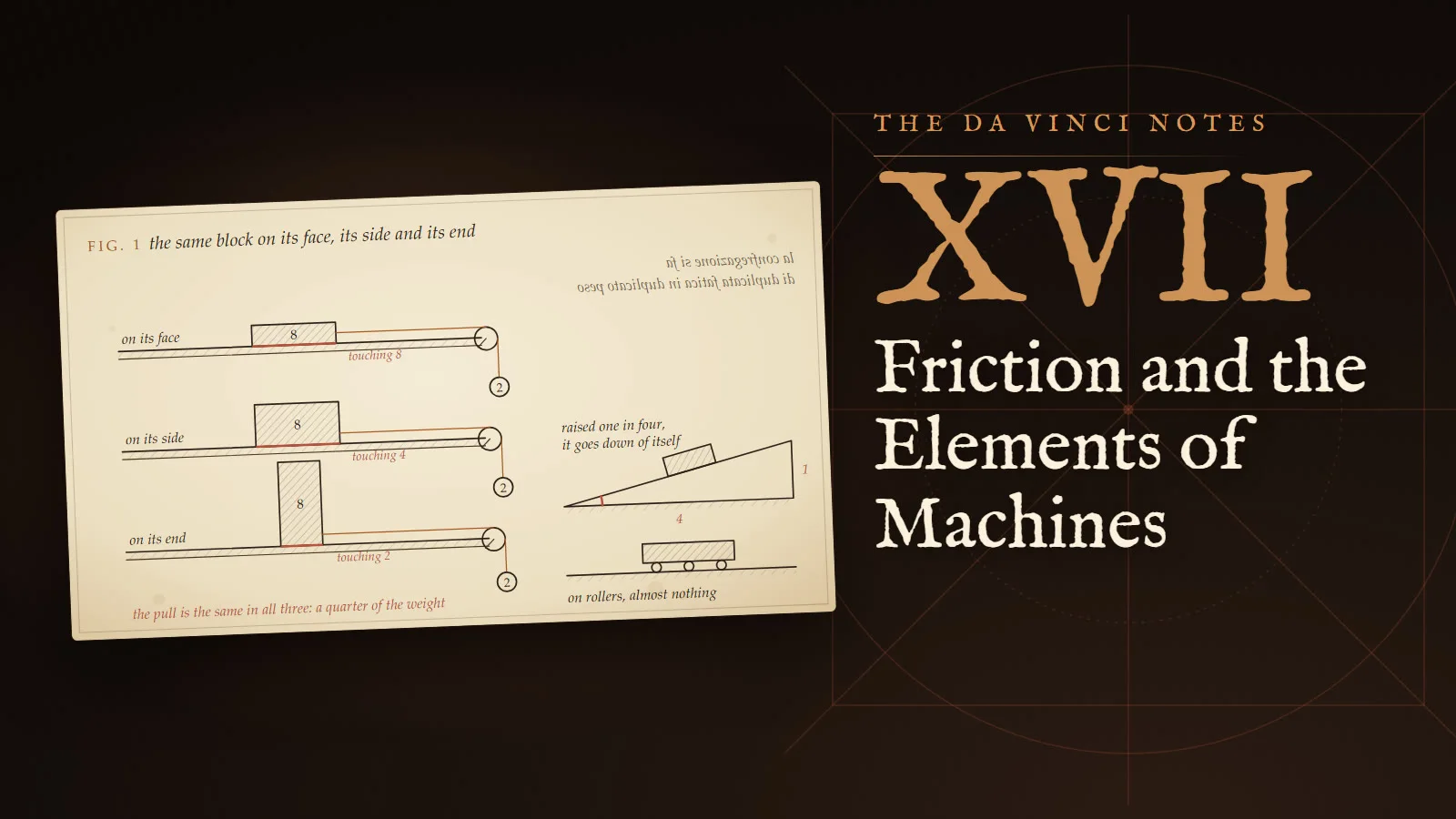

Milan, the Corte Vecchia, the winter of 1493, with the clay horse standing in the yard under its roof of boards and every cart in the city, it seems, carrying something to it or away from it. This week I watched four oxen fail to move a block of marble until the carter threw ashes under the runners. Every machine I draw for the Duke is beaten in the end by the same enemy, which takes a share of every effort and gives back nothing but heat and noise and worn iron. The carters call it the rubbing. I call it confregazione, the rubbing together, and I want to know its measure. How much of a weight's labour does it take? Does a broad face rub more than a narrow one? And if it can be measured, can it be written into the rules of the lever, the wheel and the screw, so that a man may know before he builds how much force his machine will lose?
Mechanics are the Paradise of mathematical science, because here we come to the fruits of mathematics.
Leonardo da Vinci, trans. J. P. Richter (1883), §1155
Milan, about 1489. Why the cart with thin axles goes easily
I begin with what every carter knows and no carter can explain.
In the yard of the Corte Vecchia there are two carts. One is the old wagon of the household, with heavy wheels on an axle of oak as thick as a man's calf. The other is a small cart that a smith made for the bronze workers, with wheels of the same height on an axle of iron no thicker than two fingers. Loaded with the same sacks of clay, the small cart goes after one boy; the wagon wants two men and complains in its hubs. The wheels are the same. The road is the same. Only the axles differ.
Margin
Beside two wheels drawn on the same page I first wrote that the small axle goes more easily because its underside stands farther above the ground. Later, in another ink: that is wrong. The axle rubs inside the hole of the hub, all the rubbing of a cart is in that small circle, and the wheel is a lever that overcomes it. Between wheels of equal size, the one whose axle goes the most times into its diameter moves the most easily.
Trial No. 1
A rope of hemp, eight braccia long, as thick as my thumb. Stretched out straight on the dry floor of the hall, it wants a good pull to drag it along by one end. The same rope coiled into a ball and tied wants less. So the stretched rope, which lies along more of the floor, rubs more than the coiled one. This seemed to me at first to prove that the larger the part that touches, the more the rubbing. I have since begun to doubt it, for a rope is soft and lies down into every hollow of the floor, and a ball of rope rests on a few turns. Write this down as a question, and keep it until a harder body answers it.
Milan, about 1493. Double the weight, double the labour
I carry at my belt a little book no larger than my palm, a sixth of a braccio tall and a little more than a tenth wide. I use red chalk in it, because chalk does not need an inkpot. Today, standing at the bench in the long room, I drew in it the experiment I have been turning over all winter, and I wrote the conclusion across the middle of the page in large letters so that I cannot lose it.
Experiment No. 1
A board of walnut, planed smooth and laid level, with a small pulley of boxwood at its far end. Three square blocks of the same wood, as alike as the joiner could make them. A cord tied to the lowest block, run over the pulley to a little pan, into which I put lead an ounce at a time until the blocks move.
First the three blocks stand one upon another in a tower, the weight of three on one face. Then they lie in a row, touching, the cord tied to the first, the weight of one on each of three faces. The tower and the row begin to move with the same weight in the pan, within the ounce by which no two trials agree. Ten blocks lying end to end want ten times what one block wants, in a row or in a stack. And so the rule I wrote across the leaf in red: the rubbing makes double labour for double weight.
Proportion
I drew the rule beneath the blocks as I draw every rule of proportion, with a pyramid. Take a triangle standing on its base, and cut it through the middle with a line parallel to the base. The small triangle above the line is like the whole, and its base is half the whole base, as its height is half the whole height. Let the height stand for the weight, and the base for the labour of the rubbing. Then as the weight is to the weight, so is the rubbing to the rubbing:
\[ \text{weight } A : \text{weight } B \; = \; \text{rubbing } A : \text{rubbing } B . \]
Calculation
What part of the weight is the rubbing? On that leaf I set down what I found: the stack of three blocks weighed five ounces, and it moved when there were two ounces in the pan with the pan itself. Two parts in five. The two triangles I drew below the blocks give, by the slope of their sides, one part in two and one part in three. I have three numbers where I wanted one, and the differences come from the boards and the blocks: a block that has been handled is easier than one fresh from the plane, and the board is easier along the grain than across it.
\[ 2 : 5 \qquad 1 : 2 \qquad 1 : 3 \]
What I am sure of is the proportion. Whatever the part is, the same part holds for the heavy and for the light.
Margin
Months later, in black chalk, I drew over the top of this leaf the head of an old woman with her mouth fallen in, and wrote under it the line of Petrarch that mortal beauty passes and does not last. The blocks are still there under her chin. Whoever reads this after me: the line is Petrarch's, and it was about a woman.
Milan, about 1495. The same block on its face and on its end
The stack and the row were three blocks. The doubt that remains is whether the same block, turned so that it rests on a smaller face, will rub less. In the stack, after all, three faces became one, but the weight also went with them. I want one body, one weight, three faces.
Experiment No. 2
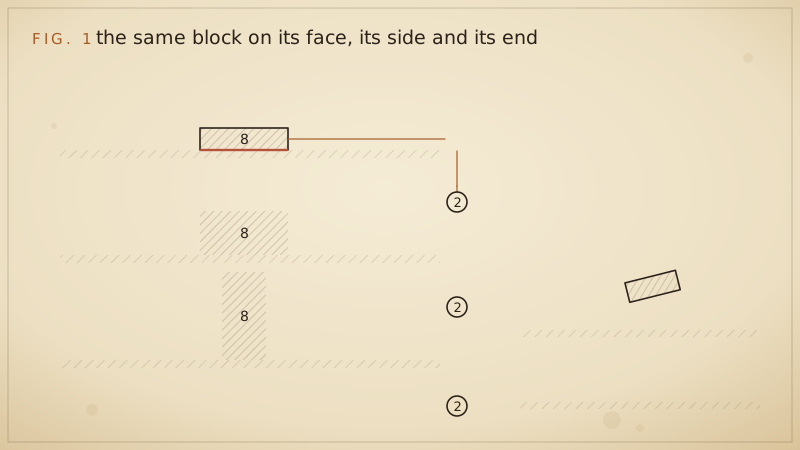
I had the joiner make a block of walnut four eighths of a braccio long, two eighths wide and one eighth thick. It weighs eight libbre on the steelyard. It has three kinds of face: the broad face of four by two, which is eight square eighths; the side of four by one, which is four; and the end of two by one, which is two. Laid on the level board and drawn by the cord over the pulley, it begins to move:
- on its broad face, with two libbre in the pan;
- on its side, with two libbre in the pan;
- standing on its end, with two libbre in the pan, though it rocks and wants to tip if the cord is tied high, so I tie it low, close to the board.
Two libbre each time. A quarter of the weight, for this walnut on this board, smooth and greased with a little tallow as the joiners grease their planes.
Calculation
Why should the small face rub as much as the large? Because what it lacks in parts it makes up in pressure. Divide the weight by the parts that bear it:
- On its broad face the block rests on eight square eighths, and each carries one libbra.
- On its side it rests on four, and each carries two libbre.
- On its end it rests on two, and each carries four libbre.
Each part rubs in proportion to the weight upon it, by the rule of the first experiment. So eight parts each rubbing like one libbra make the same as four parts each rubbing like two, and the same as two parts each rubbing like four:
\[ 8 \times 1 \; = \; 4 \times 2 \; = \; 2 \times 4 \; = \; 8 . \]
The labour is the same in the motion made by a small and heavy contact as in that made by a large and light one. The face does not matter. The weight does.
I have drawn all of this as Plate XVII, so that whoever reads may work the board himself. Put weight in the pan until the block moves; turn it on its face, its side or its end and see that nothing changes but the pressure on each part; then raise the board and find the slope at which the block goes down of its own accord.
Trial No. 2
The same block, the same board, different skins.
- Board and block both planed and greased with tallow: two libbre move it. A quarter.
- Both planed and dry, the grease scraped off and the wood washed and dried in the sun: four libbre, and sometimes a little more. Near a half.
- The face of the block roughened with the rasp: more than four, and it moves by jerks, catching and letting go.
- The board soaped as the women soap a stuck drawer: less than two.
So I must correct myself: bodies of different surfaces have different rubbings. The proportion holds for each kind of surface: double the weight, double the rubbing. But the part, the quarter or the half, belongs to the surfaces and the grease, and I must always say which surfaces I mean.
Margin
A reader of these books will find a half in one place, a third in another and an eighth in a third, and think me careless. They were different woods and greasings, and I did not write which. From now on, when I reckon, I will take a quarter for smooth wood well greased, which is what the walnut gives me and what most machines have in their bearings, and I will write it as a quarter so that anyone may change it who has a different wood. Drawn in the little book this year: a block marked 4 and a cord marked 1, and the words that for every weight drawn sliding, the fourth part of its heaviness is what gives labour to its motion.
Experiment No. 3
The board raised. With the walnut block on its face and nothing in the pan, I lift the far end of the board a finger at a time by wedges. With the board standing over four braccia of floor, the block holds until the end is raised one braccio, and then it slips and goes down of itself. When the board is dry, it holds until the end is raised two braccia. One part of rise in four of run for greased wood; one in two for dry. The same parts as the pan gave me. This is a second way of finding the rubbing, without cord or pulley, and it agrees with the first.
Of rubbing between bodies of the same weight and roughness, the one that lies more level is the more difficult to move, and the one that lies more slanting is easier; and at a certain slant it needs nothing at all.
Milan, about 1497. Rollers, balls and wheels without an axle
If the rubbing is the enemy, what can be put between the two bodies to disarm it?
Experiment No. 4
Under the block of eight libbre I put, in turn:
- a film of tallow: two libbre move it, as before;
- a scattering of millet seed, which rolls: less than one libbra;
- three rods of beech as thick as my finger, laid across the board as rollers: a few ounces;
- three rollers as thick as a broom handle: fewer ounces still.
Everything interposed between bodies that rub together, however thin, lightens the difficulty, and the thing that rolls lightens it far more than the thing that only greases. And the larger the roller, the easier the motion, as the larger wheel goes more easily on the same axle.
Proportion
Why does a round thing go so easily? Imagine a perfectly round wheel on a perfectly flat plane. They touch at a point, and the whole weight stands over that point like a balance on its pivot. Let there hang on one side of the wheel nine hundred thousand libbre, and on the other side nine hundred thousand libbre; the wheel is balanced. Add to one side one nine-hundred-thousandth part of a libbra and it turns. An almost infinite weight is moved by an almost infinite smallness. In the world nothing is perfectly round or perfectly flat, and the point becomes a small patch that the weight presses into, so a little force is wanted. But it is very little.
Draftsman's note
For mills and the turntables of cranes I have drawn the rubbing taken out of the pivot. A ring of bronze whose groove holds balls of hard metal, each kept from its neighbour in a little cage so that they do not rub as they turn. A pivot standing on a single ball. A wheel with no axle at its centre at all, running inside a ring on small rollers at its rim.

Calculation
The cart again, now with numbers. A cart whose wheels are forty times the diameter of their axles. Let the rubbing at the axles be forty libbre. Since the wheel is a lever of forty against one, one libbra at the rim overcomes forty at the axle:
\[ 40 : 1 \; = \; 40 \text{ libbre at the axle} : 1 \text{ libbra at the rim} . \]
Now lock the wheels so that they cannot turn, and drag the cart as a sledge. The whole weight rubs on the ground. If the weight is forty libbre and the rubbing a third of it, as I reckoned that day, the pull is thirteen libbre and a third. One libbra against thirteen and a third: this is what the wheel is worth.
Milan, about 1497. The elements of machines
Every machine that men have made, the mill, the crane, the clock, the press for coins, the saw that goes by water, is made of a few parts repeated in different orders, as all words are made of a few letters. I am writing a book of those letters before I write the book of the words.
The Book of the science of Mechanics must precede the Book of useful inventions.
Leonardo da Vinci, trans. J. P. Richter (1883), §7
The elements, as I list them on the first leaves of this book:
- the lever and the counterlever, which are the roots of all;
- the wheel and its axle, and the rubbing between them;
- the teeth of wheels: how many, of what shape, how they enter and leave one another without striking, and the lantern pinion and the crown wheel;
- the screw, the female screw and the endless screw that drives a wheel;
- the spring: the coiled spring in its drum, and the device that makes its force even;
- chains of plates and pins, for drawing and for winding;
- the pivots, the bearings, the balls and the rollers;
- the means of stopping and letting go: the ratchet, and the crown wheel with its pallets that lets the wheel of a clock go one tooth at a time;
Each element I draw by itself on its own leaf, with the reason for its action below, so that a master can take the parts he needs as a builder takes stones from a heap.
Experiment No. 5
The screw is an inclined plane wound round a column. I proved it to myself with a triangle of paper: cut a right triangle whose base is long and whose height is short, and roll it round a pencil with the height along the pencil. The slanting side becomes the thread of a screw. So whoever knows how great a weight raises a hundred libbre up a given slope knows the power of the screw that has that slope in its thread.
And the rubbing follows the screw as it follows the slope. A screw whose thread is steep turns easily and slips back of itself when you let it go, as the block goes down the board raised beyond one in four. A screw whose thread is flat holds its load without a pawl, because its rubbing is greater than the push of the weight down its slope. This is why the presses for grapes and for coins have flat threads.
Draftsman's note
The spring in its drum. A long band of tempered steel coiled tight inside a drum of brass. When it is wound full it pulls hard; when it is nearly run down it pulls weakly. A clock or a carriage driven by it would race at first and crawl at the end. To make the pull even I have drawn the drum geared to a cone, so that the force of the spring acts at a small radius of the cone when the spring is strong and at a large radius when it is weak, and what comes out at the shaft is the same from beginning to end. The cone is studded with teeth at every height. The page below shows it, with the drum marked b.

Reflection
Men come to the Corte Vecchia with drawings of a wheel hung with balls on hinges, which will turn for ever, they say, because the balls on one side hang farther from the centre. I show them that the far side has fewer balls, and that the wheel will rock and settle like a pendulum. I have drawn a dozen such wheels myself and found the flaw in each. And if there were no flaw in the weights, there would still be the rubbing, which takes its share of every turn and gives nothing back. A wheel that turns for ever would have to pay its rubbing out of nothing.
Oh! speculators on perpetual motion how many vain projects of the like character you have created! Go and be the companions of the searchers for gold.
Leonardo da Vinci, Codex Forster II f. 92v (Victoria and Albert Museum), trans. J. P. Richter (1883), §1206
Margin
Every instrument must be made by experience. I can reckon teeth and threads at my table; the grease, the dust and the swelling of oak in a wet March I must try. So every element in the book will have, beside its reasons, a trial, and the trial will be repeated before it is believed.
Florence, about 1504. A rule for any weight
The Duke has lost his state, and I am back in Florence among the engineers of the Signoria, who move cannon and stone and want to know before they harness the oxen how many oxen to harness. So I have made the quarter into a rule.
Calculation
A wagon wheel twenty-four times the diameter of its axle, the axle of iron, the hole in the hub of bronze, greased. Let the load on the axle be ninety-six libbre.
- The rubbing of the weight upon the part of the hole is a quarter of the weight: ninety-six libbre become twenty-four.
- By the lever of the wheel, twenty-four against one, one libbra at the rim overcomes twenty-four at the axle.
- So one libbra of force draws ninety-six libbre of load on level ground.
- Now by the rule of three. If ninety-six is drawn by one, what draws six thousand? Multiply one by six thousand and divide by ninety-six: sixty-two libbre and a half.
\[ 96 : 1 \; = \; 6000 : 62\tfrac12 . \]
That is the foundation of the rule: know the part of the rubbing, know how many times the axle goes into the wheel, and the rule of three gives the force for any weight.
Margin
Not every case comes out so clean. A shaft lies in a half-hole, and a counterweight hangs from a cord wound on it: how much will make it turn? With a shaft of a hundred libbre I first said a quarter, twenty-five; then I saw that shaft and counterweight together press the hole, and wrote that it is wrong, because the counterweight adds to the pressure it is meant to overcome, and the more I add, the more I must add. Later I found that a shaft of four libbre wants four thirds of a libbra: one for its own rubbing, which is a quarter of four, and a third for the rubbing of the counterweight itself, which is a quarter of four thirds. And four and four thirds together make sixteen thirds, of which a quarter is four thirds again. So the proof is good. But I came to it by trying numbers, and I do not have a rule that would find it at once for any weight.
Reflection
Twenty years I have been at this, and I write a quarter so often that whoever reads me will think I believe the quarter is in the nature of things, as the pyramid is in the nature of sight. I do not. A quarter is what my greased walnut gives, and it is a number easy to work with, and I write it where another man would leave a blank to be filled. Write in the margin of every rule the woods and the greases it was found with.
Problems I set myself
1. A block of oak weighs twelve libbre and, lying on its broad face on a greased board, begins to move when three libbre are in the pan. Turned on its end, which is a sixth of the broad face, how much will move it? And two such blocks stacked on that end?
Answer. The rubbing is three parts in twelve, a quarter, and does not depend on the face, so on its end it still moves with three libbre, though each part of the end now carries six times the weight. Two blocks stacked weigh twenty-four libbre and want a quarter of that: six libbre.
2. A board stands over four braccia of level floor. Greased walnut slides down it of itself when the end is raised one braccio. How high must the end be raised for dry oak, whose rubbing is a half of its weight? And what angle is that, against the level?
Answer. The block goes down of itself when the rise is to the run as the rubbing is to the weight. For a half, the rise must be half the run: two braccia over the four braccia of floor. The angle whose rise is half its run is about twenty-six and a half degrees; for greased walnut, one in four, it is about fourteen degrees.
3. A gun carriage carries eight thousand libbre on wheels two braccia and a half across, turning on axles a quarter of a braccio thick. Take the rubbing as a quarter. What pull draws it on the level? What pull, if the wheels are chained and it must be dragged?
Answer. At the axles the rubbing is a quarter of eight thousand, two thousand libbre. The wheel is ten times its axle, so the pull at the rim is a tenth of that: two hundred libbre. Dragged with chained wheels, the whole weight rubs on the ground, and the pull is a quarter of eight thousand, two thousand libbre, ten times as much. In modern measure the load is 2.6 tonnes and the two pulls are about 65 and 650 kilograms of force.
To the student who reads this later
You write my rule in one line, with a letter where I wrote a quarter. The friction force \(F\) is proportional to the force \(N\) pressing the surfaces together, and the constant of proportion, your coefficient of friction, belongs to the pair of surfaces:
\[ F = \mu N . \]
On a board tilted at an angle \(\theta\), the weight \(W\) presses the board with \(W\cos\theta\) and pushes down the slope with \(W\sin\theta\), so a block slides of itself when \(W\sin\theta \gt \mu W\cos\theta\), that is, when
\[ \tan\theta \gt \mu . \]
For my quarter, \(\theta = \arctan 0.25 \approx 14^\circ\). For the wheel, a pull at the rim of radius \(R\) overcomes friction at an axle of radius \(r\) when \(P \approx \mu W r / R\), which is my rule of the axle that goes many times into the wheel.
Nobody read my notes on friction for centuries. Guillaume Amontons found the same two rules again and read them to the Académie Royale in Paris in 1699: friction proportional to the load and independent of the apparent area. He found about a third for iron, copper, lead and wood, and he greased his samples with old pork fat, as I greased my walnut with tallow. Antoine Parent gave the true account of the inclined plane and the screw in 1704. Charles-Augustin de Coulomb, in 1785, separated the friction that holds a body at rest from the smaller friction of a body already moving. He measured dry oak, elm and pine on wood at about 0.43 to 0.67, and greased with tallow at 0.1 to 0.2. My quarter sits among the greased values, which is one reason Ian Hutchings of Cambridge, who in 2016 put all my notes on friction in their order, argues that my trials were made with greased surfaces. In 2014 Angela Pitenis, Duncan Dowson and Gregory Sawyer repeated my blocks with wood and found between 0.7 and 0.4 for clean smooth wood, and as low as 0.25 for rough wood soiled with the grease of fingers.
Why does the area not matter? It took until the twentieth century to say. Frank Bowden and David Tabor, working in Cambridge after the Second World War, showed that two flat surfaces touch only at the tips of their roughnesses, and that the true area of contact is a tiny fraction of the apparent one. Press harder and the tips flatten until they bear the load, so the true area grows in proportion to the weight, whatever the size of the face. Turn my block on its end and the apparent face shrinks, but the tips that truly touch carry the same weight on the same true area. My reasoning of eight parts bearing one against two parts bearing four was the right reasoning about the wrong parts.
Where I was wrong. I never managed the inclined plane: for twelve libbre drawn up a slope I found seven libbre, where a correct account with my own friction gives nearly twelve. I solved the shaft with a counterweight only by trying numbers, and I never wrote down a rule for it. I did not distinguish the friction at rest from the friction in motion, though I saw the rasped block move by jerks. And my rope on the floor is a real exception: soft surfaces, whose roughness bends under pressure, do not obey the rule, as rubber and tyres do not obey it today. The drawings of my blocks on slopes and on a roller that you see reproduced in books of friction were made years after I had my rules, on pages left unfinished; the first page, the little red-chalk leaf of about 1493, is the one that shows how I found them.
What to try. Take a book, a rubber band and a ruler. Pull the book across a table with the band and measure how far the band stretches just before the book moves; then put a second, identical book on top and pull again: the stretch doubles. Stand the book on its spine and pull: the stretch stays. Then tilt a tray with the book on it until it slides, and measure the rise and the run: their ratio is your coefficient. Rub a little soap on the tray and do it again.
If you want to argue with me about the quarter, the pan of lead or the screw that will not run back, come and ask me.
Sources and liberties
The Da Vinci Notes are a modern reconstruction written in Leonardo da Vinci's voice by Eternal Gardens. Dates, places, manuscripts, drawings and quotations come from the sources below; the order of the working, the private reflections, the plates and the sketches are ours.
- J. P. Richter, The Notebooks of Leonardo da Vinci (1883), §7, §1155, §1206 and §651: Project Gutenberg
- Ian M. Hutchings, "Leonardo da Vinci's studies of friction", Wear 360 to 361 (2016), 51 to 66, the chronology and readings used throughout (Forster III f. 72r; MS A f. 9r; MS B f. 99r; Madrid I ff. 73r, 74r, 86v, 122r, 139v, 173v, 176r; Forster II ff. 87r, 124v, 125r, 131v, 132r; Codex Atlanticus ff. 198r, 525r, 561r, 1015v; Madrid II f. 46r; Codex Arundel ff. 41r, 187r): author's manuscript, University of Cambridge, journal version
- Codex Madrid I (Biblioteca Nacional de España, Ms. 8937), ff. 14r and 16r: f. 14r, f. 16r on Wikimedia Commons
- Ladislao Reti (ed.), The Madrid Codices (McGraw-Hill, New York, 1974), and Reti, "Leonardo on Bearings and Gears", Scientific American 224, no. 2 (1971).
- Edward MacCurdy, Leonardo da Vinci's Note-Books (Duckworth, London, 1906), for the folio of the perpetual-motion passage.
- A. A. Pitenis, D. Dowson and W. G. Sawyer, "Leonardo da Vinci's friction experiments: an old story acknowledged and repeated", Tribology Letters 56 (2014), 509 to 515.
- G. Amontons, "De la résistance causée dans les machines", Mémoires de l'Académie Royale des Sciences (1699); C.-A. Coulomb, "Théorie des machines simples", Mémoires de mathématique et de physique 10 (1785); F. P. Bowden and D. Tabor, The Friction and Lubrication of Solids (Clarendon Press, Oxford, 1950).
- Martin Kemp, Leonardo da Vinci: Experience, Experiment and Design (V&A Publications, London, 2006); Walter Isaacson, Leonardo da Vinci (Simon & Schuster, New York, 2017).
The apparatus, woods, greases and trial weights are our reconstruction from the sketches and statements Hutchings dates; Leonardo recorded conclusions and numbers, rarely procedures, and whether the drawings show trials he performed is debated (Hutchings thinks they very probably do, with greased surfaces). The block of 4 by 2 by 1 eighths weighing 8 is from CA f. 198r of about 1508, and the reasoning about its parts is from that page; we have moved it earlier. The earliest friction sketch is Forster III f. 72r (1493 to September 1494); the often-reproduced roller-and-slope drawing of Codex Arundel f. 41r is later, about 1500 to 1505. Richter's "What is fair in men, passes away, but not so in art" (§651) is a misreading of Petrarch's line "cosa bella mortal passa e non dura" on that same Forster leaf, and is not a saying of Leonardo's.