 by Marie Curie

Milan, the first winter, about 1483. I came over the mountains from Florence with Atalante Migliorotti and a lyre, and I am thirty years old, and I have no house of my own here, no patron and no wall to paint. Lorenzo sent me with an instrument and a recommendation; the court of the Lord Ludovico Sforza, who governs this state for his young nephew, is full of soldiers, engineers, astrologers and men who sing, and a Florentine who paints is one more mouth. So I have written a letter in which I offer him engines of war, ten kinds of them, and only at the end painting and a horse of bronze. Tonight I want to set down plainly what I promised, what I have drawn, and what I could build if he took me at my word. And I want to write down, for myself, what I think of the trade I am offering him.
Animals will be seen on the earth who will always be fighting against each other with the greatest loss and frequent deaths on each side.
Leonardo da Vinci, Prophecies, "Of the Cruelty of Man", trans. J. P. Richter (1883), §1296
Milan, about 1483. Ten things I can make for the Lord Ludovico
The letter is finished and sent. I did not write the fair copy in my own hand. A duke's secretary does not read with a mirror, and my ordinary hand runs from right to left, so the draft that stays with me is written the other way, from left to right, by a hand that writes as other men do, with my corrections in it, and the numbers of the paragraphs changed where I moved them about. I keep it among my papers so that I know what I have promised.
It begins with a bow to every other contriver in the city, and then a quiet insult to all of them:
Most illustrious Lord, Having now sufficiently considered the specimens of all those who proclaim themselves skilled contrivers of instruments of war, and that the invention and operation of the said instruments are nothing different to those in common use
Draft of a letter to Ludovico Sforza, Codex Atlanticus f. 1082r, trans. J. P. Richter (1883), §1340
Then the list. I set it out here again in short, in the order the draft now has it, so that I can tick each item when I have a drawing for it.
- Bridges, very light and strong, easy to carry, for pursuing the enemy or escaping him; others that fire and battle cannot destroy; and ways of burning the enemy's bridges.
- In a siege, ways to take the water out of the ditches, and endless bridges, covered ways and ladders.
- Where the banks are too high or the place too strong for bombardment, ways of destroying any fortress, even one founded on rock.
- Mortars, easy to carry, that throw small stones like a storm, with smoke that terrifies the enemy.
- Mines and secret winding passages, dug without noise, even under a ditch or a river.
- Covered cars, safe and unattackable, that break into the enemy with their artillery, with infantry following behind.
- Bombards, mortars and light pieces of fine and useful forms, out of the common type.
- Where bombardment fails, catapults, mangonels, trabocchi and other machines not in common use.
- At sea, machines for attack and defence, and ships that will resist the largest guns, powder and fumes.
- In peace, architecture public and private, and the guiding of water from one place to another.
The sixth I wrote out more fully than the others, because I believe in it most:
Item. I will make covered chariots, safe and unattackable which, entering among the enemy with their artillery, there is no body of men so great but they would break them. And behind these, infantry could follow quite unhurt and without any hindrance.
Codex Atlanticus f. 1082r, trans. J. P. Richter (1883), §1340
After the ten comes the eleventh thing, which is the thing I can certainly do, set down in two lines as if it were an afterthought: that I can carry out sculpture in marble, bronze or clay, and painting, as well as any other, be he whom he may. And after that the horse, which is the true bait:
Again, the bronze horse may be taken in hand, which is to be to the immortal glory and eternal honour of the prince your father of happy memory, and of the illustrious house of Sforza.
Codex Atlanticus f. 1082r, trans. J. P. Richter (1883), §1340
Reflection
Why war first and painting last? Because I have looked at this court. The Sforza are captains. Francesco, the father, took Milan with a sword and a marriage, and the son wants his father on a horse twelve braccia high in the middle of the city. The men who are paid here are the engineers of the castle and the masters of the bombards; painters are many and are paid by the piece. A man who arrives with a lyre is asked to play it at supper. A man who arrives with a covered car is asked into the room where they talk of the Venetians.
And because, if I am honest with this page, I have more drawings of machines than of saints. The step from a crane to a catapult is short: the trabocco is a lever, the mine is a well that walks sideways, the covered car is a cart with a roof. I know the levers. I have never seen a battle.
Margin
I closed with "I am most ready to make the experiment in your park, or in whatever place may please your Excellency". A brave sentence for a man who has built none of these things. If he calls my bluff, I must have one of them ready to roll across the grass of the park behind the castle. I will begin with the cars.
To do
- Ask Maestro Antonio how mortars are set on the bastions, by day and by night.
- See the crossbow of Maestro Gianetto, and shoot it.
- Get the friar at Brera to show me the book on weights.
- Find Valturio's book on the art of war, in the Italian.
- Measure the walls of the castle on the side of the park.
Milan, about 1485. The covered car and the chariots with scythes
Three drawings on one sheet, done in pen and brown ink, small, fast, with the hatching laid on from the upper left down to the lower right as my hand likes to go.

Draftsman's note
Above: a horse at the gallop with its rider, harnessed in the middle of a long pole. At the front of the pole a frame carrying four curved blades like the scythes of the haymakers, turned outward; at the back a pair of wheels, and from the hub of the wheels more scythes, which the wheels turn as they roll, so that they sweep round like the sails of a mill laid on their side. Below the drawing I wrote that when the machine passes among our own people the scythes must be lifted, so that it does not sometimes harm its own.
Below, on the right: the car seen from the side as it goes into the enemy. It looks like the lid of a pot, or the roof of a round pavilion, or a tortoise: a low cone of planks with a little lantern at the top, open, from which one man can see and give the orders. All round the rim the mouths of the guns stick out, and I drew them firing, with the smoke blowing back over the roof, so that a man looking at it understands at once that it has no front and no back: it fires every way at once. Beside it I wrote that it is good for breaking the ranks, but it wants following.
Below, on the left: the same car with the roof taken off, so that the wheels show. Four wheels, set across the frame, and between them the cranks and the lantern wheels that turn them. Under it I wrote that eight men will work it, and those same men will turn the car about and follow the enemy.
Calculation
Why men and why not horses? I worked it in my head and then on the paper.
- A horse inside a closed car, with the guns going off a braccio from its ears, will kick the car to pieces before the enemy does. Put the horses outside, and they are the first thing the enemy shoots. So the car must move by men.
- A man turning a crank for a long time can push it, I judge, with the weight of about 25 libbre. Eight men give some 200 libbre at their handles.
- The car with its planks, plates, guns, powder and men will weigh more than a loaded wagon, and a battlefield after rain is the worst ground there is. On ploughland in mud I have seen four oxen stop.
- Therefore the crank must be geared down: the hand goes round many times for one turn of the wheel, and the car goes as fast as a man walks, or slower. It need only arrive.
Margin
Ditches stop it, steep banks stop it, a sunken lane stops it, and the enemy will learn in one battle where to stand. Alone, it is a hut full of frightened men. With infantry behind it, it is a moving wall with a door.
Draftsman's note
The chariots I drew again on another sheet, now at Windsor among the drawings I keep together. A horse pulling a light two-wheeled car, and on the car a beam carrying chains with weights on their ends, which the turning of the wheels throws round and round like the flails of threshers; a second car with flails set with spikes; a horseman carrying three lances at once, couched under his arm and fixed to his saddle; a crossbowman who shoots from behind a great shield with the bow fixed to it. These are old ideas: the scythed chariot is in the ancient historians and in Valturio's book. I made them into machines whose wheels do the work. I do not think they are good machines.

Reflection
When I drew the scythes turning I saw, as in a dream that cannot be stopped, what they would do. I drew the legs of men in front of the blades and then I did not draw what follows. The pen knows how. I do not want my hand to learn it. Let the Duke's captains imagine the rest, since that is their trade.
Milan, about 1486. The great crossbow
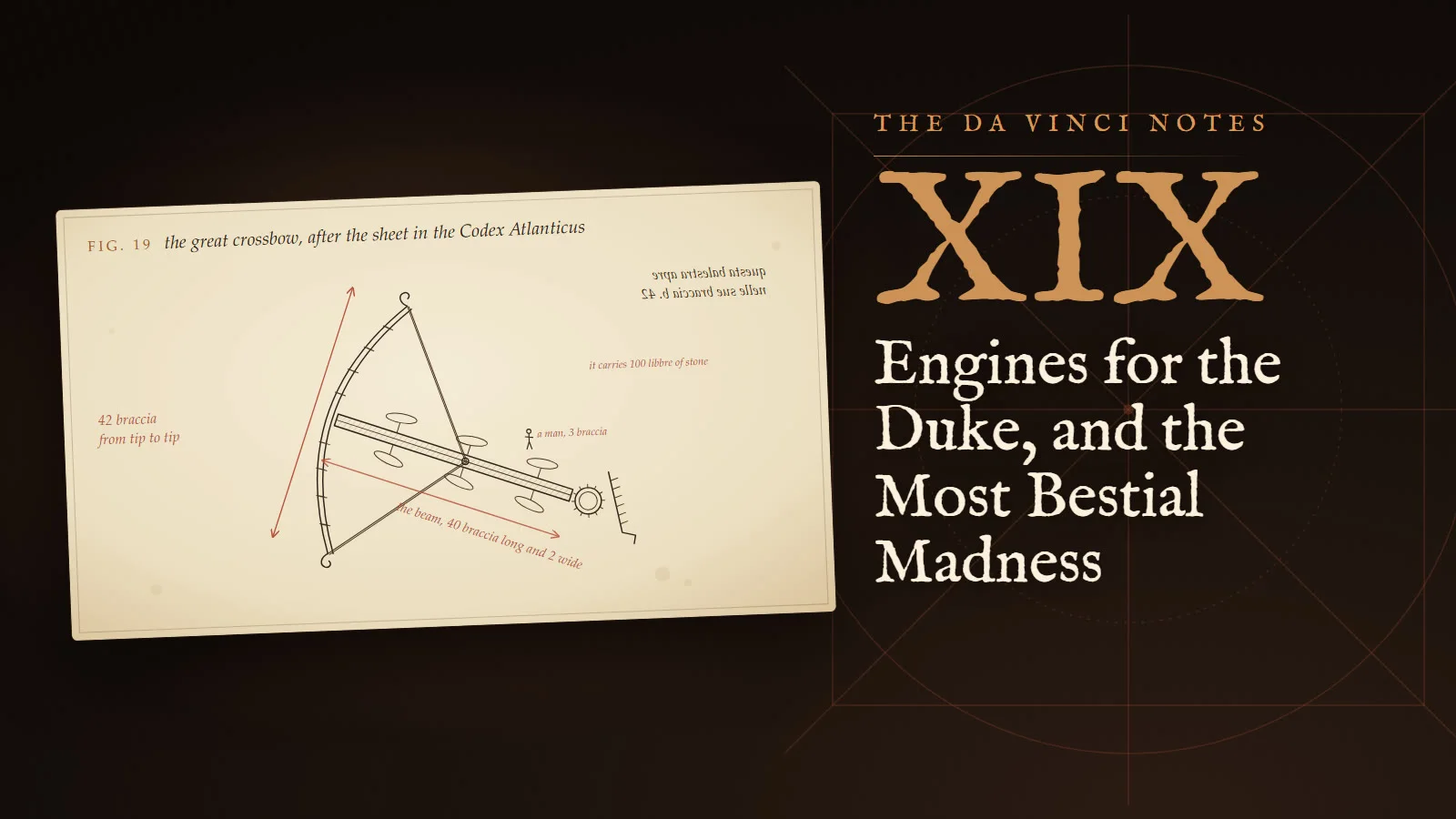
Today I finished the sheet I have been carrying in my head since I read the ancient engines in Valturio: a crossbow so large that the wheels it rides on are taller than a man and the man who looses it stands on the stock like a sailor on a deck.

Draftsman's note
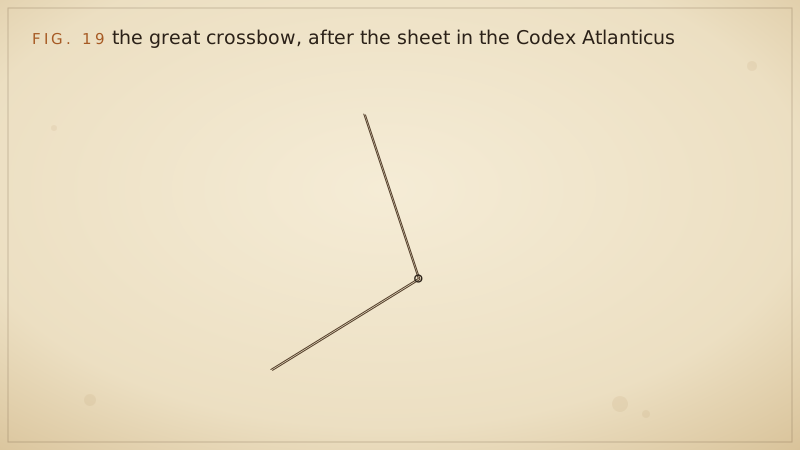
The crossbow is drawn from above and a little behind, the bow spreading across the leaf from edge to edge and the stock running down toward the lower right corner, foreshortened. The bow is built of pieces, thick at the middle and thinning toward the tips, each joint bound round with cord, the whole washed brown so it reads as wood. The string is a rope, twisted, drawn back to the nut. The stock lies in a channel along a long beam, and the beam rides on six wheels, three on each side, and the wheels lean outward at the top so that the whole thing stands wide on the ground and will not roll over when the bow is loosed. At the rear, the winding: a screw with a crank turning a toothed wheel, which hauls the string back. A small man stands on the beam by the trigger, and I made him small on purpose: he is the scale.
To the left, two drawings of the release: the nut that holds the string, in its box, shown closed and then opened, and the mallet that strikes it free. In the margin to the right, in my own hand, the measures. The bow opens in its arms, where the cord is fastened, 42 braccia. The beam is 2 braccia wide and 40 long. It carries a stone of 100 libbre.
Forty-two Milanese braccia is more than the width of the nave of a great church. A crossbow of that size frightens before it shoots; and if it never shoots, it has done half its work in the drawing. That is the most honest sentence I can write about it.
Calculation
How big is a stone of 100 libbre? The gunners know the weight of their balls and never their size; the masons know the size of their blocks and never their weight. I want both.
- A small block of the grey stone from the works of the cathedral, a sixth of a braccio on each side, weighed on the scale of the apothecary nearly 8 libbre. A block of a whole braccio has six times six times six of these in it, which is 216, so it would weigh about 1,670 libbre. I take this as my measure.
- Archimedes shows that a sphere is two thirds of the cylinder that encloses it. A cylinder is to the cube on the same side as the circle is to the square, which is as 11 to 14. So the sphere is \( \tfrac{2}{3} \times \tfrac{11}{14} = \tfrac{11}{21} \) of the cube that encloses it.
- A stone ball of 100 libbre therefore fills a cube that would weigh, if it were solid, \( 100 \times \tfrac{21}{11} \), about 191 libbre.
- That cube is to the cube of one braccio as 191 is to 1,670, which is nearly 0.114, about one ninth. The side of a cube that holds one ninth of a cubic braccio is the number which multiplied by itself twice gives 0.114. I find it by trial: 0.5 gives 0.125, too much; 0.48 gives 0.111, too little; 0.485 gives 0.114.
- So the ball is a little less than half a braccio across, about as wide as a man's chest is deep. Not so very big, for so big a bow.
Trial No. 1
I cannot shoot the great crossbow. I can shoot Maestro Gianetto's, which is of steel, and learn from it how a thing thrown flies. In the park behind the castle, on a calm morning, a boy ran out to stand where each bolt fell and I measured with a cord of 10 braccia. The elevation was set by a plumb line on a quarter-circle of wood marked in ninety parts, as the astronomers mark theirs.
- Laid level: 120 braccia.
- Raised 15 parts: 330 braccia.
- Raised 30 parts: 440 braccia.
- Raised 45 parts, halfway: 470 braccia.
- Raised 60 parts: 410 braccia.
- Raised 75 parts: 240 braccia.
The longest shot is near the middle, a little below it, perhaps. And the shots on either side of the middle are not equal: 30 parts went farther than 60, though both are fifteen from the half. Something is taken from the high shots that is not taken from the low ones. They stay longer in the air, and the air takes its toll the longer they stay.
I have drawn this as Plate XIX: set the angle of the beam, the speed of the stone and its weight, and watch two paths, the one the stone would follow through empty space and the one it follows through our air. Beside it the crossbow is drawn to scale, seen from above, with a man standing by it.
Margin
The schoolmen say that the bow gives the stone an impetus, which carries it straight along the line of the shot until it is spent, and then the stone falls straight down, with a little curve between. I watched the bolts against the sky from the side of the range, lying on my back on the grass. I could not find the straight part. The path bends from the moment it leaves the bow, gently at first and then more, and the fall is steeper than the rise. I have drawn it as I saw it, and I leave the schoolmen their straight line until I can prove them wrong with a measure. Write a chapter on the bent path of things thrown, and say how the weight and the air share the bending between them.
Milan, about 1487 to 1490. The storm of stones and the bombards
The fourth item of my letter promised mortars that would "fling small stones almost resembling a storm". I have drawn them now: a mortar set at a steep angle, throwing a ball that breaks in the air into many small balls, each with its own little arc, so that the paths spread like the water of a fountain falling back into its basin. The drawing pleased me more than the idea. The curves are beautiful. Each one is the same curve, cut off at a different place.
Maestro Antonio showed me how the gunners lay a bombard: by eye, by a wedge under the breech, by the memory of the last shot. Their whole science is the second shot. A man who knew the true path of the ball would hit the gate with the first.
If any man could have discovered the utmost powers of the cannon, in all its various forms and have given such a secret to the Romans, with what rapidity would they have conquered every country and have vanquished every army, and what reward could have been great enough for such a service!
Leonardo da Vinci, notes on Archimedes, trans. J. P. Richter (1883), §1476
I wrote that thinking of Archimedes at Syracuse, whom the Romans honoured though he had killed so many of them. In my small book of machines I have drawn a gun of copper that throws its ball by the force of steam: a little water let into a red-hot chamber behind the ball, which turns to smoke and drives it out. I gave the invention to Archimedes and called it the architronito, because I read that he made such a thing. Whether he did or not, the steam is real. I have seen a pot lid fly.
Reflection
What has been built of all I offered? I write the list again honestly, because no one else will.
- The bridges: some drawings. None built.
- The covered car: one sheet. Not built.
- The scythed chariots: two sheets. Not built, and better so.
- The great crossbow: one sheet, finished with wash, the handsomest of all. Not built. I doubt it could be built at that size; the bow of 42 braccia would bend under its own weight before it bent under the string, and the joints would part.
- The horse: the clay model is in hand, and a great deal more of my life is going into it than into any engine.
The Duke has never asked me to roll anything across his park. He asks for festivals, for the painting of his rooms, for the horse, for the canal. The engines remain in the book, where they can do no harm, and where I return to them on winter nights because they are beautiful to draw.
Milan, 1494 to 1499. The bronze goes to Ferrara, and the Duke loses his state
November 1494. The French king has come down into Italy, and the Duke has sent the bronze that was gathered for my horse to his father-in-law at Ferrara, to be cast into cannon: the metal I had reckoned by the libbra, weighed, stored and waited for. It will now be in the shape of guns. So the horse has been turned into the very thing I offered first in my letter, and painting and sculpture, which I offered last, are left with nothing.
I have written a draft to the Duke about my wages, which I will perhaps send and perhaps not. It says "I had to feed 6 men for 56 months, and have had 50 ducats". And it says, about the great work, "Of the horse I will say nothing because I know the times." I know the times.
Margin, later, 1499
The French are in Milan. The Duke has fled to the Germans. The archers of the king have been shooting at my clay horse in the courtyard of the Corte Vecchia for practice, so I am told; I do not go to look. On the cover of a little book I wrote the news down in a list, as one writes a list of expenses, the buildings of Bramante, the governor of the castle made a prisoner, the Visconti carried away, and at the end:
The Duke has lost the state, property and liberty and none of his entreprises was carried out by him.
Leonardo da Vinci, Manuscript L, cover, trans. J. P. Richter (1883), §1414
None of his enterprises, and none of mine for him. Seventeen years in this city, and the things that will remain of me here are a supper painted on the wall of the friars, already beginning to flake, and a great many drawings. I am packing my books. Pacioli comes with me. We go to Mantua, and then to Venice, where they want an engineer against the Turks.
Florence, 1505. The most bestial madness, and what I will not write down
I am painting a battle now, on a wall of the great council hall of the Palazzo della Signoria: Anghiari, where the Florentines beat the Milanese sixty-five years ago. I have spent months with the riders fighting for the standard, the horses biting each other, the mouths of the men open in the same shape as the mouths of the horses. And in the notes I keep for the painter, when I came to write of how a battle must be composed, how the bodies must twist and fold and be foreshortened because in a battle every body is thrown out of its proper shape, the word I wrote for what they are doing is discordia, and then I corrected myself: o vo' dire pazzia bestialissima. Discord, or I should say, most bestial madness.
Long ago, in Milan, I wrote out for painters how to represent a battle, beginning with the smoke of the artillery mingling with the dust thrown up by the horses, and ending:
And there must not be a level spot that is not trampled with gore.
Leonardo da Vinci, Manuscript A, "Of the way of representing a battle", trans. J. P. Richter (1883), §602
I wrote it as a painter, for the composition. I meant it as a man.
Reflection
Here the adversary says: you, who call it madness, offered the madman his instruments. You drew the car and the crossbow and the scythes for Ludovico, and for Cesare Borgia you walked the walls of the Romagna and drew maps for his campaigns, and you would draw again tomorrow for whoever paid. I answer that a city must defend itself, and that the walls I drew were walls, and that a man who knows the engines can show how to resist them. That is true. It is also convenient. I do not know a better answer, and I will not invent one for the sake of this page.
Margin, later, about 1508
There is one thing I have kept back, and I set it down here so that the reason is written with it. I have thought for a long time how a man may stay under water, and I have a way, and I know how long a man can remain below without eating. In my book on water I wrote the heading for it among the cases I mean to treat, and then I wrote why the case will stay empty:
And I do not publish nor divulge these, by reason of the evil nature of men, who would use them for assassinations at the bottom of the sea by destroying ships, and sinking them, together with the men in them.
Leonardo da Vinci, Codex Leicester f. 22v, trans. J. P. Richter (1883), §1
The other methods, where the mouth of the tube by which you breathe stays above the water on bags of air or cork, I will give to anyone: they are safe, because the float shows where the man is. The one that leaves no trace on the surface I keep. It is a small thing to withhold, against all I offered the Duke. It is the one refusal I can make with a whole heart.
To do
- Finish the standard and the four riders before the plaster dries.
- Write the chapter on the bent path of things thrown.
- Burn nothing. Lock the drawings of the scythes in the chest with the anatomy.
Problems I set myself
1. A stone is thrown from level ground, and in empty space, with no air to hinder it, it lands 270 braccia away when the beam is raised to the half of a right angle. Where does it land when the beam is raised 30 parts, and where when it is raised 60 parts, the speed being the same?
Answer. Without air the range is proportional to the sine of twice the angle: at 45 degrees twice the angle is 90 and the sine is 1, so 270 braccia is the greatest range. At 30 degrees twice the angle is 60, whose sine is 0.866, and the range is \( 270 \times 0.866 = 234 \) braccia. At 60 degrees twice the angle is 120, whose sine is also 0.866, so the range is again 234 braccia. In empty space angles equally above and below the half land at the same place; through air the higher shot falls short, as the trial in the park showed (440 against 410 braccia).
2. A cube of our stone one braccio on a side weighs 1,670 libbre. How wide is a ball of the same stone that weighs 25 libbre?
Answer. The ball is \( \tfrac{11}{21} \) of the cube on its diameter, so that cube would weigh \( 25 \times \tfrac{21}{11} = 47.7 \) libbre, and it is \( 47.7 / 1{,}670 = 0.0286 \) of the braccio cube. The side whose cube is 0.0286 is about 0.306 braccio (since \( 0.306 \times 0.306 \times 0.306 = 0.0287 \)). The ball is about three tenths of a braccio across, 18 centimetres. A quarter of the weight gives a ball with 0.63 of the width, because the width goes as the cube root of the weight.
3. Maestro Gianetto's crossbow is laid level on a trestle 2 braccia high and the bolt strikes the ground 40 braccia away. A stone dropped from 2 braccia reaches the ground in very nearly half a second. How fast did the bolt leave the bow?
Answer. The bolt falls the 2 braccia in the same time as the dropped stone, because its forward speed does not change how fast it falls. In that half second it travels 40 braccia forward, so its speed is 80 braccia a second, about 48 metres a second. (Check: 2 braccia is 1.19 m; the time to fall is \( \sqrt{2 \times 1.19 / 9.81} = 0.49 \) s, and \( 40 \times 0.595 / 0.49 = 48.6 \) m/s.) Air slows a bolt only a little over so short a flight.
To the student who reads this later
The bent path I watched from the grass was given its law after my time. Niccolò Tartaglia, in his Nova scientia of 1537, still drew the shot as straight, then curved, then falling, but argued that the greatest range comes at half a right angle. Galileo, in his Two New Sciences of 1638, proved that a body thrown in empty space moves forward evenly while it falls with a speed growing evenly in time, and that the two together make a parabola. In your notation, with launch speed \(v\) at angle \(\theta\) from level ground,
\[ R = \frac{v^2 \sin 2\theta}{g}, \qquad H = \frac{v^2 \sin^2\theta}{2g}, \qquad T = \frac{2v\sin\theta}{g}. \]
Air is another matter. Newton treated resistance in the Principia (1687), and Benjamin Robins, measuring musket balls with his ballistic pendulum in 1742, showed that the air can take away most of the range of a small fast ball. For a smooth sphere at the speeds of my crossbow the drag force is close to \( F = \tfrac{1}{2}\rho C_d A v^2 \), with \( C_d \approx 0.47 \), and because the weight grows as the cube of the ball's size while the area facing the air grows only as the square, a heavy stone is hindered less than a light one. That is the asymmetry I saw in the park, and it is what Plate XIX computes step by step: there is no simple formula for the path through air.
On the engines, the plain account. Nothing in this chapter was built in my lifetime that I know of. The giant crossbow has been built many times since as a model; there is one in the Museo Nazionale della Scienza e della Tecnologia in Milan. The covered car on the British Museum sheet has been built full size for television, and when people examined the cranks in my drawing they found that, as I drew the gearing, the front and rear wheels would be driven in opposite directions, so the car would not move. Was it carelessness in a quick sketch, a simplification, or a deliberate fault to keep the true mechanism from a copyist? I cannot tell you, because I did not write it down. The idea that I sabotaged it on purpose because I hated war is a modern story with no evidence behind it; the honest confidence for it is low. The armoured car is often called the first tank. The tanks of 1916 owed nothing to it, and the "working tank of Leonardo" is a legend.
The letter to Ludovico is in the Codex Atlanticus at the Biblioteca Ambrosiana, folio 1082r in the modern numbering (391r-a in the old). It is not in my hand, and its date is argued: most put it about 1482 to 1485. And my refusal about the underwater method should not make me a saint of peace: I offered the Duke all the rest, and in 1502 I served Cesare Borgia as his architect and general engineer. The phrase "pazzia bestialissima" is mine, in the notes on painting that Melzi copied into the book now in the Vatican (Codex Urbinas Latinus 1270); the original sheet is lost.
What to try at a table: roll a marble off the edge and, at the same instant, drop a second one from the same height. Listen: they hit the floor together. That is Problem 3 in your hands. Then throw a ping-pong ball and a golf ball alike: the light ball falls short and comes down steeply, the path I drew.
If you want to argue with me about the letter, the crossbow, or how a man can draw such things and hate them, come and ask me.
Sources and liberties
The Da Vinci Notes are a modern reconstruction written in Leonardo da Vinci's voice by Eternal Gardens. Dates, places, manuscripts, drawings and quotations come from the sources below; the order of the working, the private reflections, the plates and the sketches are ours.
- J. P. Richter, The Notebooks of Leonardo da Vinci (1883; Project Gutenberg edition): the letter to Ludovico §1340 (with Richter's note that the draft is written left to right and probably not autograph), the memoranda §1448, §1476 on the cannon and Archimedes, §1414 (MS L, cover), §723 and §1344 on the horse and wages, §601 and §602 on representing a battle (MS A), §1296 the prophecy "Of the Cruelty of Man", §1 and §1114 on the underwater method: gutenberg.org/ebooks/5000
- Leonardo, Trattato della pittura, part II, chapter 173, "Del comporre le istorie" ("discordia, o vuoi dire pazzia bestialissima" in this edition, "o vo' dire" in Vecce's reading; Libro di pittura §177 in the Pedretti and Vecce edition, from Codex Urbinas Latinus 1270): Wikisource
- Carlo Vecce, "Leonardo, arte (e follia) della guerra", Cromohs 19 (2014), on the passage and its date (about 1505 to 1510): Firenze University Press
- Edward MacCurdy, Leonardo da Vinci's Note-Books (Duckworth, 1906), introduction, which renders the phrase "bestial frenzy".
- The giant crossbow, Codex Atlanticus, Biblioteca Ambrosiana, Milan (old f. 149r; the measures are read from the mirror-written note on the sheet): Wikimedia Commons and Biblioteca Ambrosiana
- Studies of a scythed chariot and an armoured car, British Museum 1860,0616.99 (the notes on the sheet are read from the drawing): British Museum
- Designs for chariots and weapons, Royal Collection Trust RCIN 912653: Royal Collection Trust
- Giorgio Vasari, Lives (1568), trans. G. du C. de Vere (1912), on the silver lyre; the Anonimo Gaddiano on Leonardo's going to Milan with Atalante Migliorotti.
- Martin Kemp, Leonardo da Vinci: The Marvellous Works of Nature and Man (Oxford University Press, revised edition 2006).
The trial with Maestro Gianetto's crossbow, its figures, the weighing of the stone, the arithmetic of the car's cranks and of the guns, and all the reflections are our reconstruction; the memorandum names Gianetto's crossbow but records no trial. The "working tank" is a legend, and the claim that Leonardo reversed the car's gearing to sabotage it is a modern guess. The archers shooting at the clay horse rest on a later report and are given here as hearsay.