



 by Marie Curie
Milan, the Corte Vecchia, the night of the twentieth of December 1493. The great horse stands in the yard under its roof of boards, twelve braccia of clay from the ground to the nape of its neck, and in the lamplight it seems to move. All of Milan has walked round it this month: the Duke, the ambassadors who came for the wedding of the Lord Ludovico's niece to the King of the Romans, the poets who have already written verses about it, the boys who climb its iron feet when the watchman sleeps. They say it is finished. It is the beginning. A horse of clay is a promise, and what it promises is bronze: some two hundred thousand libbre of metal, melted in furnaces that do not yet exist, run into a mould that has not yet been made, in a pit that cannot be dug where I first wanted it. Tonight I have decided how it will be done, and I have written the decision at the top of a clean leaf so that I cannot go back on it. Before I write how, I want to set down how I came here, because the road has been long, and I have been wrong on it more than once.
On the 23rd of April 1490 I began this book, and recommenced the horse.
Leonardo da Vinci, Paris Manuscript C f. 15v, trans. J. P. Richter (1883), §720
Milan, about 1485 to 1489. The horse that rears
When I came to Milan from Florence I wrote to the Lord Ludovico a long letter listing what I could do for him: bridges, mines, cannon, chariots, and at the end, painting and sculpture. And at the very end, the thing that I most wanted.
Again, the bronze horse may be taken in hand, which is to be to the immortal glory and eternal honour of the prince your father of happy memory, and of the illustrious house of Sforza.
Draft letter to Ludovico Sforza, Codex Atlanticus f. 1082r, trans. J. P. Richter (1883), §1340
The horse was an old wish of this house. Duke Galeazzo Maria wanted a bronze rider for his father Francesco, the soldier who took Milan, and nothing came of it. His brother Ludovico, who rules for his nephew, wants it more, because a man whose title is uncertain needs his father in bronze in front of the castle more than a man whose title is sure.
Draftsman's note
My first horse rears. The rider sits back, his baton raised, and the horse stands on its hind legs over a fallen soldier, who lifts his shield against the hooves. I drew it many times on blue prepared paper with the silver point, which forgives nothing, and each time the horse came alive and the bronze died. For the drawing does not have to stand. A horse in bronze, rearing, has the whole weight of its body, its rider and its own forelegs carried in the air on two hind legs and on whatever the fallen man can hold up. I made the fallen soldier hold it, and then I looked at him and saw that he had become a column with a face.

Reflection
There is a second trouble with the rearing horse, and it belongs to the eye. A figure caught in motion, seen from all sides in the round, keeps the motion for ever and so seems never to finish it.
Sculptured figures which appear in motion, will, in their standing position, actually look as if they were falling forward.
Leonardo da Vinci, trans. J. P. Richter (1883), §709
In the square, under the sky, a horse that leaps is a horse about to fall on the people below. I said this to myself a long time before I believed it, because the rearing horse was the more beautiful.
Margin
July 1489. I hear that the Lord Ludovico has written to Florence, to the Magnificent Lorenzo, asking whether he has a master or two who could make such a work, because the commission is given to me but it does not seem to him that I know how to carry it through. I do not blame him. I have shown him drawings and a model in wax, and no furnace. He will see it. But first I must make a horse that can stand.
Milan, 23 April 1490. I begin again, and the horse walks
Today I began a new book, and began the horse again from the beginning. The rearing horse is put away. The new horse walks: three hooves on the ground and one foreleg raised, the head turned a little, the rider upright. So go the great bronze riders in Rome, Padua and Venice, for a reason. Three legs on the ground make a triangle, and a body standing on a triangle stands.
Trial No. 1
I am measuring the horses of Milan. The best horses of the city are in the stables of the Duke and of his captains, and I go from stable to stable with my measuring rod and my book, and the grooms laugh at me and hold the horses still. I write down the length of the head, from the poll to the lip, and then every other part as so many heads, as I do for the man: the neck, the depth of the chest, the length of the barrel, the height at the withers, the forearm, the cannon, the pastern. Of all of them two have stayed with me as the measure of the rest:
- Messer Galeazzo's big genet, a Spanish horse, which I drew from in front and from the side with every measure written on him;
- Messer Galeazzo's Sicilian horse, whose legs I measured from the shoulder to the hoof.
Calculation
Now the size. A great horse of life size stands about four braccia from the ground to the nape of its neck. The monument must be seen from across the square, above the heads of the crowd and of men on horseback, and I want it to be twelve braccia to the nape, three times the life. What does three times mean?
- Every length is three times: the leg, the neck, the head, the tail.
- Every surface is three times three, nine times: the skin of the horse, the outside of the mould, the cross of each leg where it bears.
- Every bulk is three times three times three, twenty-seven times: the clay, the metal, and therefore the weight.
\[ 3 : 9 : 27 . \]
This is Euclid's rule that like solids are to one another in the triplicate ratio of their like sides, and every founder knows it in his hands even if he has never read it: a bell twice as tall weighs eight times as much. But here is what follows, which the founders do not say. The weight that the legs carry grows twenty-seven times, and the legs that carry it grow only nine times in their cross. Each part of each leg therefore carries three times what it carried at life size. Make the horse three times larger and you have made its legs three times weaker.
Draftsman's note
I have made this into Plate XVIII so that the reader may grow the horse himself. Slide its size from life to many times life; give it clay or solid bronze or bronze cast hollow with a wall of so many fingers; let it walk or rear; and watch the pressure in the legs rise as the size rises, until the legs that bear it turn red.
Proportion
From this I draw two rules. The clay model, which is soft, cannot stand at twelve braccia on legs of clay alone, and must stand on legs of iron set into its foundations, with the clay laid over them. And the bronze, which is many times stronger than clay, will stand easily on its legs if it is cast hollow, with a wall of even thickness, because a hollow horse grows in weight as its surface grows, nine times, and its legs grow nine times too. A solid horse would be a mountain of metal, and no furnace in the world would melt it.
Milan, July to November 1493. The great model in clay
The model is going up in the Corte Vecchia, where there is a yard large enough and a roof high enough. I have men building the armature of iron: bars as thick as my wrist, bolted and bound, rising out of a foundation of stone, with a cage of lighter irons for the body and the neck. Over the irons go bundles of straw and tow bound with wire, and over the straw the clay, laid on in coats and left to dry layer by layer, and the clay is mixed with shearings of cloth and with hair so that it does not crack as it dries.
Make the horse on legs of iron, strong and well set on a good foundation; then grease it and cover it with a coating, leaving each coat to dry thoroughly layer by layer.
Leonardo da Vinci, trans. J. P. Richter (1883), §711
Calculation
How much does the model weigh? A great horse of life size is about one thousand seven hundred libbre of flesh and bone, which is near enough the weight of the same bulk of water. Wet clay is about once and four fifths as heavy as water. The model at twelve braccia is twenty-seven times the bulk. So:
\[ 1700 \times 27 \times 1\tfrac45 \approx 82\,600 \text{ libbre} . \]
Some eighty thousand libbre of clay, though the straw and the hollows inside will make it lighter. Carried on four legs, or on three while one is raised. Without the irons, the legs of clay would be pressed by about one and a half times what clay can bear before it crumbles, and they would sink into themselves in a wet week. With the irons, the clay is only skin.
Margin
A household note, among the notes on horses.
Caterina came on 16th day of July, 1493.
Leonardo da Vinci, Codex Forster III f. 30r (Victoria and Albert Museum), trans. J. P. Richter (1883), §1384
On the same page I have written down the horses I still want to see: Messer Mariolo's Morel the Florentine, which has a big horse with a fine neck and a beautiful head, and the white stallion belonging to the falconer, which has fine hind quarters and is kept behind the Porta Comasina. I go on looking at horses.
Trial No. 2
Seen from twelve braccia below, the head looks small. The eye that looks up at a tall thing sees its top part foreshortened, as the parts of a tower diminish to the eye at its foot. I raised the head and the crest of the neck by a little, and lengthened the face by a finger and a half, and walked to the four corners of the yard to judge. From the gate, where the crowd will stand, it now looks as a horse should look. From the scaffold beside the head it looks wrong, and that is right, because nobody will see it from the scaffold.
Reflection
At the end of November Bianca Maria, sister of the young Duke and niece of the Lord Ludovico, was married to the King of the Romans, and the city was hung with cloth, and men came from the courts of Germany and of all Italy to look at the horse. The poets of the court have praised it in verse. They do not know, and I do not tell them, that I have not yet solved the one problem that matters, which is how to make it bronze. Those who praise the model praise the clay. The clay is the easy part.
Milan, 20 December 1493. I resolve to cast it lying down
The first plan was this. Dig a pit in the yard beside the model, deeper than the horse is tall; set the mould in it upside down, the hooves uppermost and the back at the bottom; pour the metal in through the hooves and the belly from furnaces around the edge, so that it runs down into the deepest part first and drives the air up before it. Upside down, the metal fills the back and the body under the full weight of what stands above, and the casting comes sound and close.
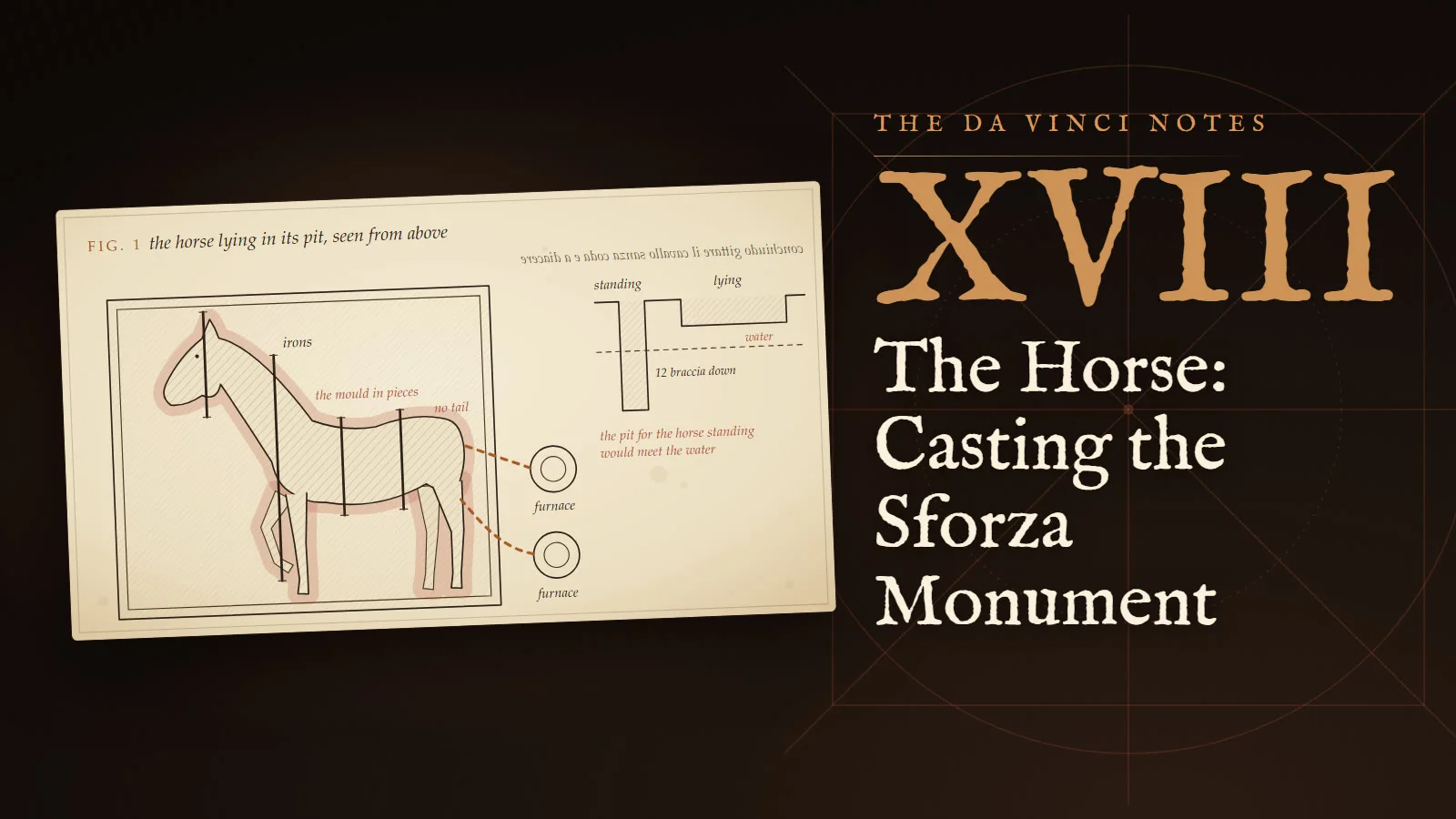
But the pit for a horse of twelve braccia standing on its back would have to go down more than twelve braccia, and in this yard, one braccio below the ground, you meet water. The ground of Milan is full of water; every well in the city proves it. A mould of baked clay in a pit that fills with water will crack, and the steam from it will blow the metal out of the mould and kill the men around it. So I have resolved tonight to cast the horse without its tail, and lying on its side, in a pit no deeper than the horse is broad. The tail I will cast separately and join afterwards.

Draftsman's note
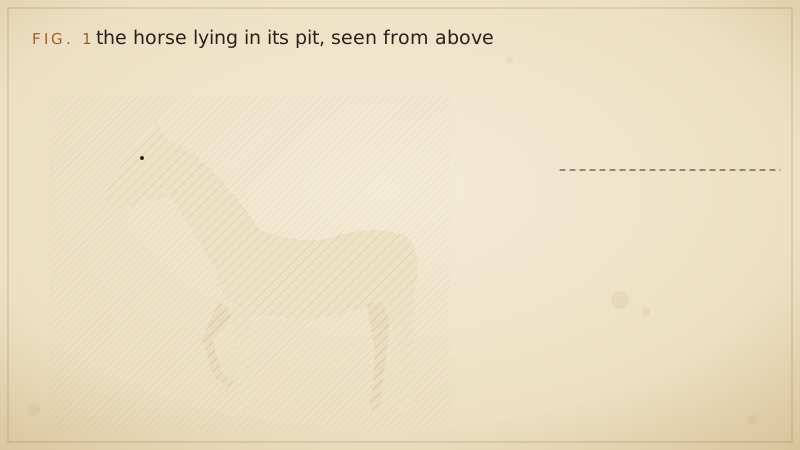
Fig. 1 is the pit seen from above. The horse lies on its side with its legs towards the furnaces, the mould around it in pieces like the plates of a turtle, bound across by bands of iron. Two furnaces stand at the edge of the pit, one at the head and one at the legs, each with its runner of baked clay going down into the mould. Beside it, a section of the ground: the pit as it would have to be for the horse standing, going down below the line where the water is, and the shallow pit for the horse lying, which stays dry.
Experiment No. 1
The mould is the whole art. This is the order of the work as I have written it down for the founders:
- Draw on the finished clay horse all the pieces of the mould, and cut the clay of the mould along those lines as you lay it on, so that each piece can come away and be put back in its place by its joins.
- Take off the mould of clay, and inside it lay a coat of wax or of clay as thick as the bronze is to be. That thickness is the thickness of the metal.
- Make the core: fill the mould by degrees with a mixture of clay, ash and brick dust, and bind it with its irons, so that when the thickness is taken out, the core stands inside the outer mould with an empty space all round it of the same breadth.
- Hold the core away from the outer mould with small square blocks of bronze set through both, so that the space does not close when the metal comes in; they will melt into the casting and become part of it.
- Bake the moulds where they will touch the bronze, wet the inside with linseed oil, and pitch the outside so that the damp of the ground does not reach it.
- Make the outside mould of plaster and bind it with irons. Half a boat load of plaster will serve.
Draftsman's note
The head and neck are the hardest piece, because they stand out from the body and the metal must climb into them. I have drawn the ironwork that holds their mould: a lattice of bars bent to the shape of the neck, with hooks to take the mould pieces, and lugs by which the whole can be lifted by the cranes and lowered into the pit.

Calculation
The metal. A great horse of life size has about fifteen and a half square braccia of skin, measured over the body, the neck and the legs as a tailor measures for a caparison. At twelve braccia that is nine times as much, some one hundred and forty square braccia. With a wall of bronze six fingers thick, a quarter of a braccio, the metal is about thirty-five cubic braccia. Bronze weighs about eight times and four fifths as much as water, and a cubic braccio of water weighs some six hundred and forty libbre. So:
\[ 35 \times 640 \times 8\tfrac45 \approx 197\,000 \text{ libbre} . \]
Near two hundred thousand libbre, before the runners and the metal that every founder must melt more than he pours. No furnace in Milan melts a tenth of that.
Observe in alloying how many hours are wanted for each hundredweight.
Leonardo da Vinci, trans. J. P. Richter (1883), §710
Margin
Several furnaces, then, all fired together, each feeding its own part of the mould, so that the metal arrives everywhere at the same heat. And each must hold exactly its share: weigh the clay of each part of the mould, from it know the metal that part will take, and give so much to the furnace that feeds it, so that the furnace for the legs when filled may not have to furnish metal from the legs to help out the head, which would be impossible. Four furnaces, perhaps, around the pit; I have drawn them in plan and in section, with the channels from each.
Reflection
I have talked of the casting with Giuliano da Sangallo, who came from Florence to bring the Lord Ludovico a model for a palace. He gave me good counsel. A man who works alone at such a thing must hear every master who will speak to him, and then decide alone.
Milan, November 1494. The metal goes to Ferrara
The King of France has come over the mountains with his army and his cannon, and the Duke, who called him into Italy, now fears what he has called. The bronze that was gathered for the horse has been sent to Ferrara, to Duke Ercole, the Lord Ludovico's father-in-law, to be made into cannon. A horse is a work of years. A cannon is wanted this month.
Reflection
I do not complain of it in these pages, and I will not complain of it in letters. I see the reason, as anyone would who has seen the French guns on the road. But I write down that the metal for the horse, which took a year to gather, went away in a week, and that I do not believe it will come back.
Of the horse I will say nothing because I know the times.
Draft letter to Ludovico Sforza, trans. J. P. Richter (1883), §723
Calculation
The accounts, which the Duke's officers do not like to read:
I had to feed 6 men for 56 months, and have had 50 ducats.
Draft letter to Ludovico Sforza, trans. J. P. Richter (1883), §1344
Three hundred and thirty-six months of a man's keep for fifty ducats. Meanwhile I paint for the friars at Santa Maria delle Grazie, I make the festivals, I design the rooms of the castle, and the clay horse stands in the yard under its roof of boards, and the swallows nest in it.
Margin
In a draft to the overseers of the cathedral doors at Piacenza I wrote down what is said of me: that Leonardo the Florentine, who has to do the bronze horse of the Duke Francesco, has work for all his lifetime, and that being so great a work, he may never finish it. They are right about the work. They are wrong about which part of it will defeat me. The horse is modelled, the mould is planned, the furnaces are drawn. It is the metal that I do not have.
Milan, 1499 to 1500. Crossbowmen in the Corte Vecchia
On the ist of August 1499, I wrote here of motion and of weight.
Leonardo da Vinci, trans. J. P. Richter (1883), §1371
I wrote of motion and of weight while the army of the King of France, the new king Louis, was gathering on the borders with the Lord Gian Giacomo Trivulzio at its head, a Milanese who hates the Sforza. At the beginning of September the Duke fled to the Germans. A few days later Trivulzio rode into Milan, and the French came after him, and the city opened its gates.
Reflection
They lodged their soldiers in the Corte Vecchia, and the soldiers found the horse. It is the size of a house and the colour of the earth, and it stood there in the yard of the palace of the Sforza, and they used it for a target. I am told it was the Gascon crossbowmen, who shoot at whatever is large and does not move. I have not been to look. A thing of clay can stand six years under a roof; it cannot stand a winter with its roof broken and its skin full of bolts, and the rain in the holes.
Those who saw the great model that Leonardo made in clay vow that they have never seen a more beautiful thing, or a more superb; and it was preserved until the French came to Milan with King Louis of France, and broke it all to pieces.
Giorgio Vasari, Lives (1568), trans. Gaston du C. de Vere (1912)
Margin
On the cover of a small book, the account of a fall.
The Duke has lost the state, property and liberty and none of his entreprises was carried out by him.
Leonardo da Vinci, Paris Manuscript L, cover, trans. J. P. Richter (1883), §1414
None of his enterprises, and none of mine for him. I have sent money to Florence to be kept at Santa Maria Nuova, and in December I leave for Mantua with Fra Luca Pacioli, who has been my master in the proportions these three years, and whose book about them I drew for. Pacioli wrote in that book that the horse is twelve braccia from the nape to the ground. He wrote it as if it would stand for ever.
Problems I set myself
1. A great horse of life size weighs about one thousand seven hundred libbre, and bronze is about nine times as heavy as the same bulk of flesh. What would the horse weigh at twelve braccia if it were cast solid?
Answer. Twelve braccia is three times the life, so the bulk is twenty-seven times: forty-five thousand nine hundred libbre in flesh. Nine times that in bronze is about four hundred and thirteen thousand libbre, some 135 tonnes in modern measure (Plate XVIII, with bronze at 8.8 times water, gives 131). The hollow horse with a wall of six fingers is about half of that, which is why the hollow cast is the only possible one.
2. The legs of a clay horse of life size are pressed by half of what clay can bear. At what size will they crush? And at twelve braccia, how much thicker must they be to stand?
Answer. The pressure in the legs grows as the size, so at twice the life it reaches what clay can bear, and they crush. At three times the life it is one and a half times what clay can bear, and the legs must have one and a half times the cross: thicker by the side of a square whose area is one and a half, about a fifth. On paper that would just do; with nothing to spare and a wet winter, I put the clay legs on iron.
3. Years later I reckoned that a courser of life size with its rider, cast in bronze, needs five hundred ducats of metal. Using that figure, what would the metal for a horse three times life have cost, cast hollow with the same thickness of wall, and cast solid?
Answer. With the same wall, the metal grows as the surface, nine times: four thousand five hundred ducats. Cast solid, the metal would grow as the bulk, twenty-seven times: thirteen thousand five hundred ducats, and it could never be melted at once.
To the student who reads this later
You call my three, nine and twenty-seven the square-cube law. If a body of weight \(W\) is scaled by a factor \(k\) in every length, its weight grows as \(k^3\) and the cross-section \(A\) of its legs as \(k^2\), so the compressive stress in the legs,
\[ \sigma = \frac{W}{A} \propto \frac{k^3}{k^2} = k , \]
grows in simple proportion to the size. Galileo Galilei put this into print in 1638, in his Two New Sciences, and used it to explain why giants and enormous trees cannot exist with the proportions of small ones. I worked the same reasoning out on a horse and never published it.
In numbers. Take a life-size horse of 0.55 cubic metres and the legs of Plate XVIII. At three times life, a clay model weighs about 27 tonnes, and the pressure in each standing leg is about 2.9 megapascals, more than a soft modelling clay will bear, so my iron armature was necessary. A hollow bronze with a wall of six fingers, about 15 centimetres, weighs about 65 tonnes, close to the seventy tonnes of metal usually given for the monument; even rearing on two legs, its legs carry about 10 megapascals, a thirteenth of what cast bronze will bear in compression. So the bronze would have stood on its legs. The real dangers of a large bronze are elsewhere: a load that does not run straight down the leg bends it, and bending stresses are many times larger than plain compression; the joints of an armature and the holes and cold shuts of a casting fail first. The rearing horse I gave up would have had all these troubles together.
Could it have been cast? Historians of founding who have studied the Madrid pages have generally judged the method sound: piece moulds, a core held by bronze chaplets, a casting on its side in a shallow pit, several furnaces fired together. Nothing of the kind on that scale had been tried since antiquity, and the whole horse in one pour, as I planned, would have been at the very edge of what could be done. Vasari says that people believed the difficulty of casting it in one piece was why it was never finished. The pages show a plan that was ready; the metal went to war.
The casting pages were lost until the two Madrid codices were rediscovered in the Biblioteca Nacional in the 1960s; before that the horse was known from my drawings at Windsor and from the stories.
And the stories. The Gascon crossbowmen come from a later writer, Sabba da Castiglione, whose Ricordi of 1546 recall the model shot at by the French archers; Richter, who quotes him, warns that he is not always trustworthy, and Sabba is also the one who says I spent sixteen years on the horse, which is too many. Vasari says only that the French broke it to pieces. A later anonymous Florentine life, the Anonimo Gaddiano, tells how Michelangelo, meeting me in front of Santa Trinita, told me to explain a passage of Dante myself, since I was the one who had made a model of a horse to cast in bronze, could not cast it, and gave it up in shame; and that I went red. Treat that story as a story: it was written down decades later by someone who was not there.
The horse was made at last. In 1977 an American pilot and collector, Charles Dent, read about my horse and decided to give it to Italy. He died in 1994 before it was finished; the sculptor Nina Akamu modelled a new horse from my drawings, and it was cast in bronze at the Tallix foundry in Beacon, New York, in seven parts, and assembled in Milan. It stands 24 feet high, about 7.3 metres, my twelve braccia, and weighs about 15 tonnes with a skeleton of stainless steel inside it, as my clay horse stood on iron. It was unveiled at the San Siro hippodrome on 10 September 1999, five hundred years after the French came into Milan. It walks.
What to try. Make two small horses, or two simple stools, of modelling clay, one with legs as thick as a pencil and a body the size of an egg, the other exactly twice as large in every measure. Leave them overnight. The large one, eight times as heavy on legs only four times as thick, will sag or crack first. Then push a piece of wire up each leg of the large one and make it again: you have built my armature.
If you want to ask me how I meant to pour two hundred thousand libbre of bronze into one mould, come and ask me.
Sources and liberties
The Da Vinci Notes are a modern reconstruction written in Leonardo da Vinci's voice by Eternal Gardens. Dates, places, manuscripts, drawings and quotations come from the sources below; the order of the working, the private reflections, the plates and the sketches are ours.
- J. P. Richter, The Notebooks of Leonardo da Vinci (1883), §709 to §711, §716, §717, §720, §722, §723, §725, §1340, §1344, §1371, §1384, §1414, and the introduction to the notes on sculpture (Sabba da Castiglione, Paolo Giovio): Project Gutenberg
- Giorgio Vasari, Lives of the Most Eminent Painters, Sculptors and Architects (1568), lives of Leonardo and of Giuliano da Sangallo, trans. Gaston du C. de Vere (1912): Project Gutenberg, volume 4
- Edward MacCurdy, Leonardo da Vinci's Note-Books (Duckworth, London, 1906), on the model as a target and the departure with Pacioli.
- Carl Frey (ed.), Il codice Magliabechiano (Berlin, 1892), the Anonimo Gaddiano's life of Leonardo, for the Michelangelo story.
- Codex Madrid II (Biblioteca Nacional de España, Ms. 8936), ff. 149r, 149v, 151v, 154r, 155v, 157r and 157v, in Ladislao Reti (ed.), The Madrid Codices (McGraw-Hill, New York, 1974); the pages used here: f. 151v and f. 157r on Wikimedia Commons
- Royal Collection Trust, RCIN 912358, a design for an equestrian monument: collection page, Wikimedia Commons
- Andrea Bernardoni, Leonardo e il monumento equestre a Francesco Sforza (Giunti, Florence, 2007); Martin Kemp, Leonardo da Vinci: The Marvellous Works of Nature and Man (Oxford University Press, revised 2006).
- Galileo Galilei, Discorsi e dimostrazioni matematiche intorno a due nuove scienze (Leiden, 1638), second day.
The weights, areas and leg strengths in the calculations are ours, from a horse of 0.55 cubic metres and the Milanese braccio of 0.595 m and libbra of 0.327 kg; Leonardo's own estimate of the metal does not survive in a form we could check, and the figure of about 200,000 libbre is the one usually reported from Pacioli. The reading of the note of 20 December 1493 on Madrid II f. 151v (casting without the tail and lying down, because of the water) is ours from the manuscript, following Reti. Where the model was shown during the wedding festivities of November and December 1493 is uncertain. The Lord Ludovico's 1489 letter asking Lorenzo de' Medici for founders survives in the Florentine archives through the ambassador Pietro Alamanni; Leonardo's knowledge of it is our liberty. The story of the Gascon crossbowmen rests on Sabba da Castiglione, whom we know only through Richter's summary; the Michelangelo exchange rests on the Anonimo Gaddiano alone.