 by Marie Curie


Milan, the Corte Vecchia, in the summer of 1492. The heat comes in at the window with the noise of the court, and on the table lies the book I have been filling these two years with the eye, the light, the shadows and the motions of water, which I mean one day to cut into the parts of a treatise on painting. Today I will put into order what I have written on the first part of that treatise, which is perspective. It is the part on which all the others stand, and I have worked at it since I was a boy in Andrea's shop, drawing the pavements of other men's pictures with a rule and a thread. I have made mistakes in it. Some I have found, and some are without doubt still waiting in the pages. So I will go back over the whole road with the glass, the thread and the measuring rod, and set down what I can prove and what I only believed.
Perspective is a rational demonstration, confirmed by experience, that all objects transmit their image to the eye by a pyramid of lines.
Leonardo da Vinci, Paris Manuscript A, f. 10r (Institut de France), Milan, about 1490 to 1492, trans. J. P. Richter (1883), §52
Florence, about 1478 to 1480. A man drawing a sphere through a glass
I had my own workshop by then, or what I called one: a room, two boys, an altarpiece for the chapel of San Bernardo in the Palazzo della Signoria that I had not finished, and more ideas than walls. On a sheet I was filling with engines for lifting water I drew, at the bottom, a man sitting before an upright pane of glass. Beyond the glass stands an armillary sphere, the rings of the heavens made in brass. The man's eye is held at a small sight fixed on a rod, so that it cannot wander, and he draws on the glass what he sees through it, ring by ring, as if the sphere were lying on the glass itself.
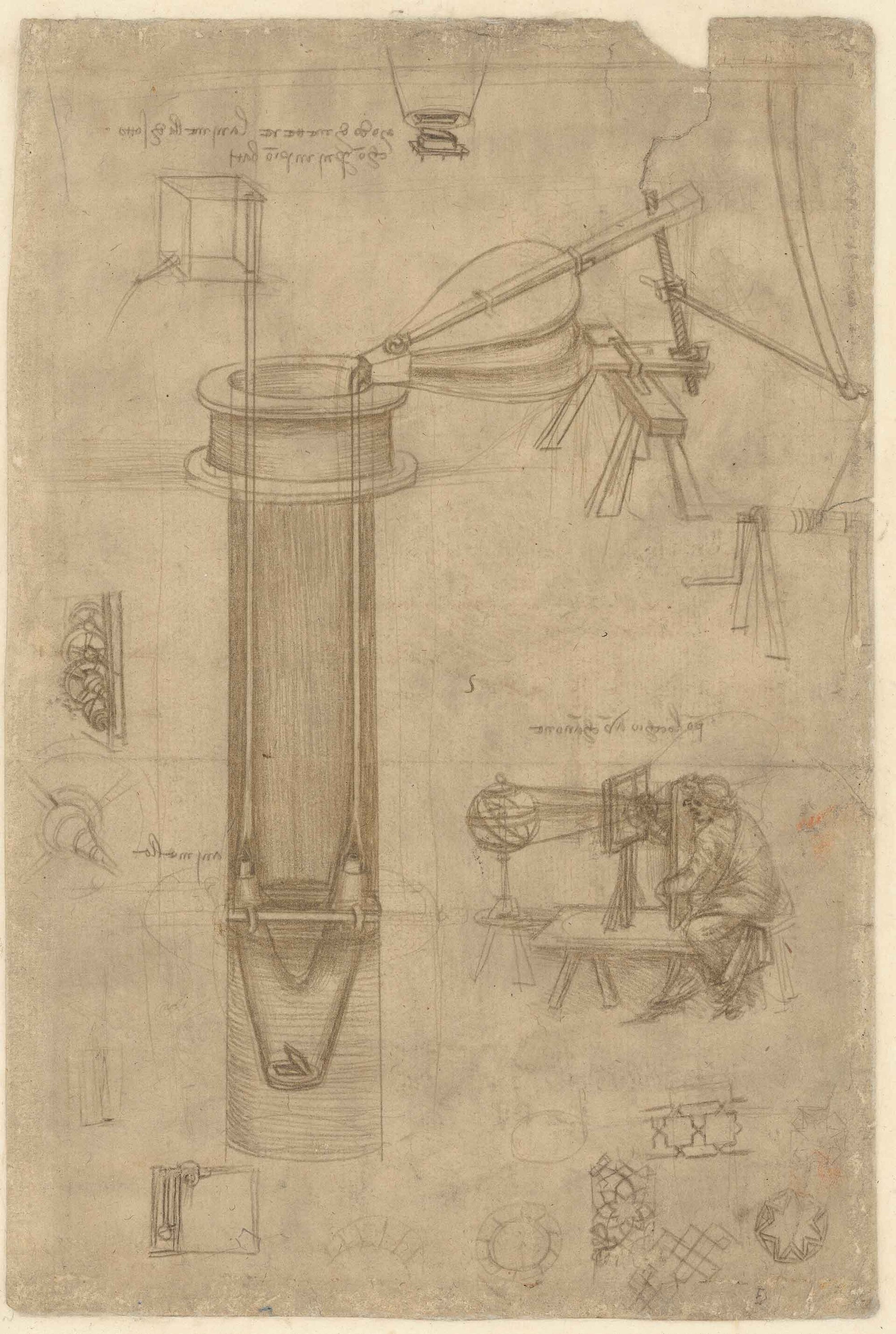
Why a sphere? Because a sphere of rings is the hardest thing in the world to draw by eye. Every ring is a circle, every circle seen aslant becomes a long round figure, each ring slants at its own angle, and where they cross the eye is always lying to the hand about which is in front. With the glass, any boy in the shop could draw it.
Draftsman's note
- The eye must not move. If the head moves by a finger, the near things slide across the far ones on the glass and no line will meet its fellow. Hence the sight, with a hole no bigger than a grain of millet.
- One eye only. With two, each eye sees the sphere in a different place on the glass, and the hand draws between them.
- The glass must stand upright and stay where it is. If it leans, the pyramid is cut aslant, and the drawing is false for any upright wall.
Later, in Milan, I wrote the practice out for the young men.
Have a piece of glass as large as a half sheet of royal folio paper and set thus firmly in front of your eyes that is, between your eye and the thing you want to draw; then place yourself at a distance of 2/3 of a braccia from the glass fixing your head with a machine in such a way that you cannot move it at all. Then shut or entirely cover one eye and with a brush or red chalk draw upon the glass that which you see beyond it
Leonardo da Vinci, Of a mode of drawing a place accurately, trans. J. P. Richter (1883), §523
Experiment No. 1
The trial: a pane from the shop window in a frame of two boards; my head against a board with a hole in it, two thirds of a braccio from the glass; the well-head in the courtyard with its bucket. I drew in red chalk on the glass, then pressed a damp sheet against it and lifted the chalk onto paper.
First result. The well-head was much smaller than I would have drawn it by eye, and it was right. The mind knows how big a well is and tells the hand, and the hand obeys the mind before the eye. Second result. The round mouth of the well came out as an oval nearly four times as wide as it was deep. When I stood up and looked again, I saw it so, and I had never seen it so before. Third result, which troubled me. Looked at from another place, the drawing was a little wrong. It is true only for the eye at the place where the eye was. I underlined that, and I have remembered it on every wall since.
Margin
The glass is a good trick, and a crutch. With it one can copy. Without knowing why it works, one cannot draw a building not yet built, or angels that never stood in front of any window. For that I need the rule by which the glass receives what it receives.
Florence, about 1479. Ser Filippo's panel and Messer Battista's window
The beginning of the rule I learned from the dead. Before I was born, Filippo di ser Brunellesco, who raised the cupola of the cathedral, made two small paintings that every painter in Florence has heard of and none of my generation has seen working. The old men still tell it, and Antonio di Tuccio Manetti, who is writing his life, tells it best. Ser Filippo took a panel about half a braccio square and painted on it the church of San Giovanni as it is seen from a little inside the middle door of Santa Maria del Fiore. Where the sky should be he laid burnished silver, so that the real sky and its clouds were reflected there, moving in the wind. At the point on the panel directly opposite his eye he bored a hole, small as a lentil at the front and wide at the back. The spectator put his eye to the back of the panel and held up a mirror at arm's length, so that he saw the painting in the mirror through the hole, and then, they say, the painted church and the real one could not be told apart.
Reflection
Old men improve old stories. Yet every part of this one fits the three conditions I found at my glass. The hole fixes the eye where the painter's eye was. The hole allows one eye only. The mirror holds the painting upright at the distance the painter held it. And the silver is the cleverest part: he knew the sky has no surface and no distance, so he let it paint itself.
The second master is Messer Battista Alberti, who wrote a book on painting in Latin and put it into our tongue, addressing the Italian copy to Ser Filippo himself; copies go about the shops, and I have read one, with difficulty and with profit. The painter, he says, marks on his panel a rectangle as large as he likes, to be thought of as an open window through which the story is seen. The rays between the eye and the thing seen make a pyramid, and a picture is that pyramid cut by a plane. The point where the ray from the eye strikes straight he calls the centric point, and he would have it no higher than the painted men, so that the spectator's eye and theirs are on one level. Between the eye and the thing he sets a thin cloth divided into squares by thicker threads, which he calls the veil.
Margin
- His veil is my net of threads. I add a pellet of wax on one thread to cover the pit of the model's throat, so the eye always returns to one place.
- His window is my glass. He says the picture is a window; I say it is a glass in the window, on which the things beyond are drawn.
- Where we differ: he speaks of rays going out from the eye, as the ancients do. I do not believe they go out. I will prove it below.
Florence, March 1481 to 1482. The pavement for the monks of San Donato
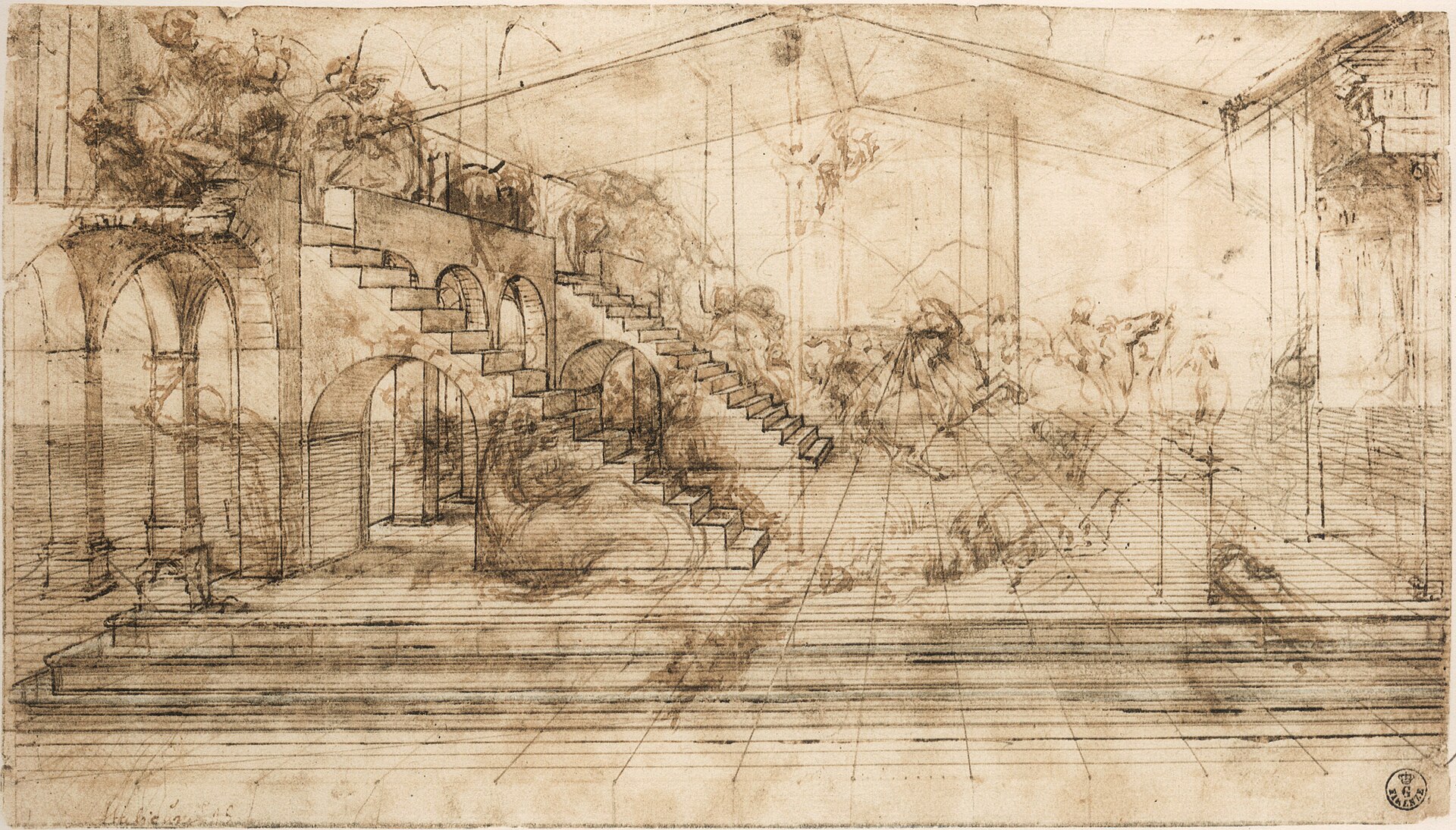
In March 1481 the canons of San Donato a Scopeto, outside the walls, contracted with me for an altarpiece of the Adoration of the Magi, to be finished in twenty-four months or at most thirty. My father is their notary, which is how I came by it. Behind the kings and the crowd and the horses I wanted a ruined building of the old world, with stairs climbing into nothing and arches broken open to the sky, and I wanted it to stand solidly where it stood. So I drew the whole place first in perspective, on a separate sheet, as a mason draws a plan.
Draftsman's note
- The horizon drawn across at the height of a standing man's eye, as Alberti says, and on it the point of the eye, a little right of the middle, where the ruin opens.
- The base of the pavement divided equally with the compass, and from each division a line ruled to the point with the stylus, pressed into the ground so it can be found again under the ink.
- The cross lines, each nearer the last as they go back, found from a side view: the eye set at its distance to one side, lines drawn from it to each division of the base, and where they cut an upright line, there the cross line passes.
- Then the building, every corner on a crossing of the grid; last the figures and horses with the pen, their feet on the pavement and, for those standing, their heads on the horizon wherever they stand.
Calculation
That last rule is the most useful thing in this book. If my eye is at the height of a man's eye, every standing man in the picture has his eyes on the horizon, and only his feet move up the sheet as he goes back. So I need not calculate his size: the pavement does it. A man whose feet are half as far below the horizon as the first man's is drawn half as tall, because he is twice as far away. And I found the danger too: with forty cross lines the farthest squares grow so thin that the stylus cuts two lines into one. A pavement going back without end ends at the point of the eye, and nothing can be drawn there.
Margin
The panel stands in the house of Amerigo de' Benci, the figures laid in brown and the ruin behind them, unfinished. The monks have stopped writing. In 1482 I went to Milan with a lyre for the Lord Ludovico, and I did not come back to finish it. I am sorry for the monks; I am not sorry for the drawing, which taught me more than the finished panel could have.
Milan, about 1490 to 1492. The pyramid of lines and the plane of glass
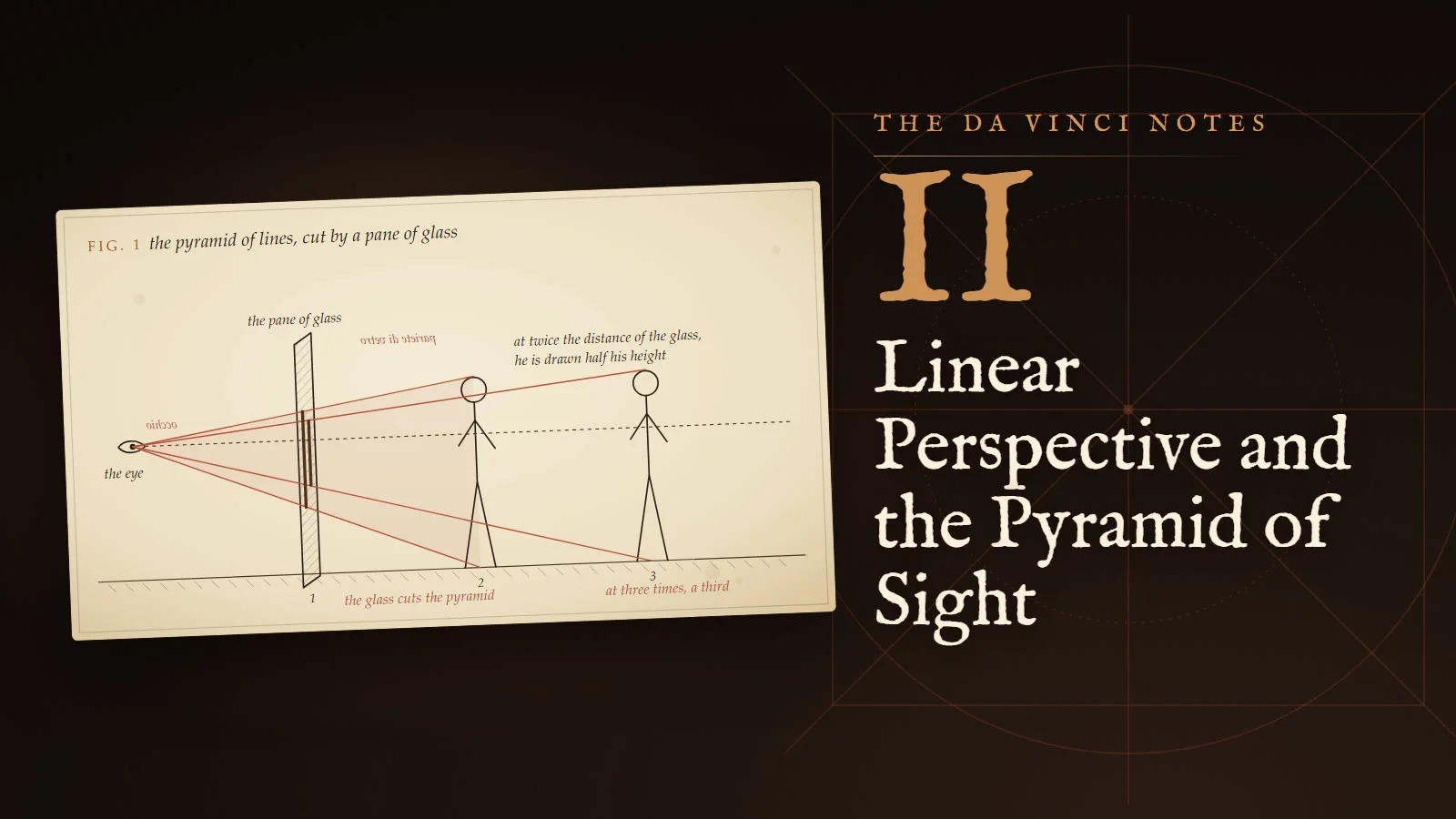
Here I have tried to say in words, as a geometer would, what the glass and the pavement showed me in practice. Every body that is seen sends its likeness to the eye along straight lines from all the points of its surface, and those lines, coming from the edges of the body and drawing together from a distance, meet in one point, and that point is in the eye. So between the eye and each thing it sees stands a pyramid whose base is the thing and whose point is in the eye. Now set a plane of glass between. It cuts every pyramid, and where it cuts it receives a small figure of each thing, exactly as large as the pyramid is wide at that place.
Perspective is nothing else than seeing place [or objects] behind a plane of glass, quite transparent, on the surface of which the objects behind that glass are to be drawn. These can be traced in pyramids to the point in the eye, and these pyramids are intersected on the glass plane.
Leonardo da Vinci, Of the plane of glass, trans. J. P. Richter (1883), §83
Calculation
How large is the figure on the glass? In the side view the eye is a point, the man an upright line of height \( H \) at distance \( d \), and the glass an upright line at distance \( p \). The lines from his head and feet to the eye make a triangle, and the glass cuts it parallel to its base, so the small triangle is the large one made smaller in every part in the proportion of \( p \) to \( d \):
\[ h = H \cdot \frac{p}{d} \]
This is only the rule of three that every merchant's boy learns at the abacus. I wrote the same in words.
And the objects thus drawn would be smaller than the originals, in proportion as the distance between the glass and the eye was smaller than that between the glass and the objects.
Leonardo da Vinci, Perspective, trans. J. P. Richter (1883), §85
A man three braccia tall, with the glass one braccio from my eye: at three braccia he is drawn \( 3 \cdot \tfrac13 = 1 \) braccio on the glass; at six, half a braccio; at twelve, a quarter. At twice the distance, half; at three times, a third; at ten times, a tenth. The size on the glass goes as one over the distance.
In the plate I have set it up as a machine. Drag the eye, the glass or the first man; choose equal steps between the men, or the doubling distances of four, eight, sixteen and thirty-two braccia; and press the last button to see the first rule I wrote, which I must now confess.
Milan, about 1492. Where my first rule went wrong
Now the confession. Early in this book, before I had measured enough, I wrote a rule of diminution and copied it out fair. I copy it again without changing a letter, to look at it with a cold eye.
I find by experience that if a second object is as far beyond the first as the first is from the eye, although they are of the same size, the second will seem half the size of the first and if the third object is of the same size as the 2nd, and the 3rd is as far beyond the second as the 2nd from the first, it will appear of half the size of the second; and so on by degrees, at equal distances, the next farthest will be half the size of the former object.
Leonardo da Vinci, MS 2038 (from Paris Manuscript A), f. 23r, Of linear perspective, trans. J. P. Richter (1883), §99
Calculation
The first half is good: the second man stands at two steps where the first stands at one, and two being twice one, he is drawn half the first. The second half is false. The third man stands at three steps, so by the pyramid he is a third of the first, and the second was a half; the third is therefore two thirds of the second:
\[ \frac{1/3}{1/2} = \frac{2}{3} \]
Set the two rows side by side for men at one, two, three and four steps: by the pyramid, 1, 1/2, 1/3, 1/4; by my first rule, 1, 1/2, 1/4, 1/8. At the fourth man the rule already makes him half as tall as he should be, and at the tenth a fifty-first part of what the pyramid gives. A row of columns drawn by it would vanish into a needle before the loggia was half built.
I made the rule from two measurements and a hope. I found a half at the first step and supposed each equal step would take off another half. But halving belongs to doubling: a man halves each time his distance doubles, at four, eight, sixteen, thirty-two braccia. Equal steps give a half only once, and then two thirds, three quarters, four fifths, so that a row of men at equal steps diminishes more and more slowly and never ends at all.
Experiment No. 2
In the long hall Salaì, Marco and two grooms stood in a line, three braccia apart, the first three braccia from my eye, the glass one braccio in front of it, my head in the board. I marked each man's head and feet on the glass in chalk and measured the marks with a rule divided into twelfths of a braccio. Result. The first, about one braccio, less a little, because Salaì is short; the second, half that; the third, a third; the fourth, a quarter, within the width of the chalk. The grooms laughed at Salaì for being the biggest man in the hall on the glass and the smallest out of it. Then the doubling, at three, six, twelve and twenty-four braccia: each mark half the one before. So I wrote the rule again in its right form.
If you place the vertical plane at one braccio from the eye, the first object, being at a distance of 4 braccia from your eye will diminish to 3/4 of its height at that plane; and if it is 8 braccia from the eye, to 7/8; and if it is 16 braccia off, it will diminish to 15/16 of its height and so on by degrees, as the space doubles the diminution will double.
Leonardo da Vinci, Of the degrees of diminution, trans. J. P. Richter (1883), §100
"Diminish to 3/4" means that three quarters of the height are lost and a quarter remains, which is the pyramid exactly: glass at one, man at four, figure a quarter. At eight an eighth remains, at sixteen a sixteenth.
Calculation
The old chapter has numbers too. I wrote that beyond twenty braccia figures lose a part of their size at twenty braccia, nine tenths at forty and nineteen twentieths at sixty, "if the picture plane is distant from you twice your own height". If a figure at distance \( d \) keeps the part \( p/d \), the part kept tells me where the glass stood: \( p = d \times \) (part kept). At forty it keeps a tenth, so \( p = 40 \times \tfrac{1}{10} = 4 \) braccia. At sixty it keeps a twentieth, so \( p = 3 \). At twenty the copies disagree: if it loses four fifths, \( p = 20 \times \tfrac15 = 4 \); if it loses half, \( p = 10 \). And twice my height is six braccia. So none of the numbers agrees with the condition beside them, and the last disagrees with the others. I must have taken them from different trials with the glass in different places and written them as one. I leave them as they stand, with this note, so that the reader sees the mistake and the mending together.
Reflection
It is a strange thing to be corrected by oneself. The man who wrote the first rule had the glass that refutes it at hand all along, and did not use it because he thought he already knew. Experience never errs; only our judgements err. And the trials taught me one thing more, which I wrote down so as not to lose it.
if the first is at 1 braccia from the eye and the 2nd at two braccia, two being twice as much as one, the first object will look twice as large as the second. But if you place the first at a hundred braccia from you and the second at a hundred and one, you will find that the first is only so much larger than the second as 100 is less than 101
Leonardo da Vinci, Perspective, trans. J. P. Richter (1883), §106
A braccio of distance close by is worth a hundred braccia far away. So the painter must take the greatest care with the nearest figures, where a small error of place is a large error of size, and may be easier with the farthest, which may stand ten braccia nearer or farther and nobody will know.
To do
- Find how much a man diminishes at one distance, then at twice it and at three times, and so make the general rule. Never write a number again without the place of the glass beside it.
- Give the degrees of diminution on spaces of twenty braccia, as a musician divides the voice into notes.
Milan, about 1492. The point of diminution and the furrows of a field
The figures diminish; where do they go? The lines of the pavement that run straight away from the eye are parallel on the floor and run together on the glass. Every point on such a line, as it goes farther, is seen along a ray that comes nearer to the line from the eye that strikes the glass squarely; at an endless distance it would be that line itself. So every line on the floor that runs straight away from me ends on the glass at the one point straight opposite my eye.
n the point of diminution which is always in a straight line opposite the eye and always moves as the eye moves
Leonardo da Vinci, trans. J. P. Richter (1883), §56
Calculation
Let my eye stand \( E \) braccia above the floor and the glass \( p \) braccia in front of it. A point on the floor at distance \( d \) lies \( E \) below the level of my eye, so by the same rule of three it is drawn \( E \cdot p/d \) below the horizon. With my eye at two and three quarter braccia and the glass at one, a stone at eleven braccia is drawn a quarter of a braccio below the horizon; at a hundred and ten, a fortieth; at three thousand, less than the thickness of my pen. It comes ever nearer the horizon and never crosses it. As the eye rises the horizon rises with it and the floor opens out, as from a bell tower; with the eye on the floor, the floor is a single line.
Experiment No. 3
The proof I give to anyone who asks: walk beside a ploughed field and look at the furrows that come down with their ends to the road; each pair seems to draw together at the far end. This spring, on the road towards the Porta Vercellina, I held a straight rod at arm's length and laid it along one furrow, then another, then walked twenty paces and did it again. Result. The furrows met at a point on the level of my eye, a little above the far hedge, and after twenty paces they met again on that level, twenty paces along: the point had come with me, as a shadow goes with a body. The furrows that ran slantwise met somewhere else on the same level. So each family of parallel lines has its own point, and all that lie flat on the ground have their points on the horizon. That I had not expected, and I must think about it.
Milan, about 1492. Three perspectives, and the eye that sends out nothing
What I have written so far is the part of perspective that measures. When I divided the subject for the book on painting, I divided it into three.
There are three branches of perspective; the first deals with the reasons of the (apparent) diminution of objects as they recede from the eye, and is known as Diminishing Perspective. The second contains the way in which colours vary as they recede from the eye. The third and last is concerned with the explanation of how the objects [in a picture] ought to be less finished in proportion as they are remote (and the names are as follows): Linear Perspective. The Perspective of Colour. The Perspective of Disappearance.
Leonardo da Vinci, On the three branches of perspective, trans. J. P. Richter (1883), §14
Linear perspective is this chapter. The perspective of colour is why a far mountain is blue, a matter of the air between, which needs a book of its own. The perspective of disappearance is why a man at a hundred braccia has no eyelashes and a man at a mile has no face: the painter must not paint what the eye cannot receive. A picture made with the first perspective alone looks like a carpenter's model; one made with all three looks like the world.
Margin
Whether the eye sends out rays or receives them. The old writers speak of rays going out from the eye to feel the thing seen, as a blind man feels with his staff. I say they come in.
It is impossible that the eye should project from itself, by visual rays, the visual virtue, since, as soon as it opens, that front portion [of the eye] which would give rise to this emanation would have to go forth to the object and this it could not do without time.
Leonardo da Vinci, trans. J. P. Richter (1883), §68
Going out, the eye could not reach the sun in a month; yet I open my eyes and it is there at once. For the painter it makes no difference, the lines being the same whichever way they run; for the truth it makes all the difference. The eye has been defined by an infinite number of authors as one thing, and I find by experience that it is quite another.
Draftsman's note
- The drawing is true only for the eye that made it. A spectator too near a large picture sees the edges, which the pyramid cuts aslant, stretched and swollen. He must go to a distance of at least 3 times the height of the object he sees.
- Where many people look from many places, as in a church, there is no one place for the eye, and a perspective that tricks a single eye at a single hole looks like confusion to all the others. I wrote it plainly: "It is well therefore to avoid such complex perspective and hold to simple perspective" (Richter §108).
Reflection
Perspective is the bridle and rudder of painting; I wrote that on a page of this same book, and I believe it more after this summer. The painter who knows no perspective draws where his opinion takes him, and his opinion is always that things are as large as he knows them to be. The glass corrects his opinion, the pyramid explains the glass, and the numbers check the pyramid. When they disagree, as with my first rule, the numbers and the glass win, and the man who wrote the rule makes a note in the margin.
Problems I set myself
1. The glass stands one braccio from my eye. Three men, each three braccia tall, stand at six, twelve and eighteen braccia. How tall is each on the glass, how does the third compare with the second, and what would my first rule have said?
Answer. Each figure is three braccia times one over its distance: half a braccio, a quarter, a sixth. The second is half the first, because twelve is twice six. The third is two thirds of the second, since \( \tfrac16 \div \tfrac14 = \tfrac23 \). My first rule would have made the third an eighth of a braccio instead of a sixth, too small by a quarter of its height, because only the first equal step doubles the distance.
2. I sit with my eye two braccia above a tiled floor and the glass one braccio in front of my eye. The tile edges cross the floor at two, three, four and six braccia. How far below the horizon does each fall on the glass? And an edge a thousand braccia away?
Answer. Each falls two braccia over its distance below the horizon: one braccio, two thirds, a half, a third. The bands crowd towards the horizon, and the two braccia of floor from four to six take only a sixth of a braccio of glass. At a thousand braccia the edge is a five-hundredth of a braccio below the horizon, about one millimetre in your measure. The floor reaches the horizon only at an endless distance.
3. With my glass two thirds of a braccio from the eye, I draw a campanile sixty braccia high, three hundred braccia away. How tall is it on the glass, and where must it stand to fill a half sheet about half a braccio high?
Answer. Sixty times two thirds divided by three hundred: \( 60 \times \tfrac23 \div 300 = \tfrac{2}{15} \) of a braccio, about eight centimetres. To be half a braccio tall it must stand at sixty times two thirds divided by one half, that is eighty braccia from my eye.
To the student who reads this later
You have a formula for all of this. Put the eye at the origin, the picture plane at distance \( f \), and a point at height \( Y \) and depth \( Z \); its image falls at height \( y = f\,Y/Z \). Your cameras do it with lenses in place of my pane, your computers do it billions of times a second for the pictures in your games, and the division by depth, which your engineers call the perspective divide, is the pyramid of lines.
On what came before me. Brunelleschi's two panels, the Baptistery and the Palazzo dei Signori, were made around 1413 to 1425; both are lost, and we know them almost entirely from the Life of Brunelleschi attributed to Antonio di Tuccio Manetti, written in the 1480s, whose details I followed. Alberti wrote De pictura in 1435 and the Italian Della pittura in 1436, dedicated to Brunelleschi. Piero della Francesca wrote the most rigorous perspective book of the century, De prospectiva pingendi, in the 1470s or 1480s; I never mention him in what survives. And the optics of the schools, which I read in Pecham and Witelo, also called itself "perspective", so the word in my books means sometimes the art of drawing and sometimes the science of sight.
On my notebook. The pages on the pyramid and the glass are in Paris Manuscript A at the Institut de France, written in Milan about 1490 to 1492. In the 1840s Guglielmo Libri cut leaves out of it; they went to Lord Ashburnham, came back to Paris in 1888, and are cited as MS 2038, the reference for my first rule (f. 23r) and for "the bridle and rudder of painting" (f. 13r). The Adoration study is in the Uffizi, inv. 436 E, and so is the unfinished panel, whose long restoration was completed in 2017.
On my mistake, and the text. Heinrich Ludwig, editing the Treatise on Painting, thought my first rule so disfigured that I could not be held responsible; Richter answered that the old copies agree with the original and that later chapters show I corrected myself. The two free English editions disagree on the number at twenty braccia: Richter (1883) prints "will lose 2/4", McCurdy (1906) "will lose four-fifths of its size". McCurdy's reading fits the glass at four braccia, like the number for forty, which makes me think it the better one.
On later geometry. In 1639 Girard Desargues treated parallel lines as lines meeting at a point at infinity and from that built the geometry you call projective. In 1715 Brook Taylor wrote a book of linear perspective in English, and the name "vanishing point" is usually traced to him. My name for it was the point of diminution.
What to try today. Shut one eye, rest your head against a window frame, and draw on the glass with a washable marker the outline of what you see outside. Move your head a hand's breadth and look again. Then measure a doorway two rooms away on the glass and work out from its real height how far away it is. And walk beside a car park with painted lines, and watch the point where they meet walk along with you.
If you want to ask me about the glass, the pyramid or the mistake I made, come and ask me.
Sources and liberties
The Da Vinci Notes are a modern reconstruction written in Leonardo da Vinci's voice by Eternal Gardens. Dates, places, manuscripts, drawings and quotations come from the sources below; the order of the working, the private reflections, the experiments as narrated, the plates and the sketches are ours.
- J. P. Richter, The Literary Works of Leonardo da Vinci (1883), English text at Project Gutenberg as The Notebooks of Leonardo da Vinci: gutenberg.org/ebooks/5000. Quoted: §14, §52, §56, §68, §83, §85, §99 (with Richter's footnote on Ludwig), §100, §106, §108, §523, and the phrase from §86. Paraphrased: §21, §104, §102, §1153.
- Edward McCurdy, Leonardo da Vinci's Note-Books (London: Duckworth, 1906), "Of Perspective" and "Of Linear Perspective": folio references for the pyramid of lines (A 10r), "Perspective is the bridle and rudder of painting" (MS 2038 Bib. Nat. 13r) and the first rule of diminution (MS 2038 Bib. Nat. 23r), and the reading "four-fifths".
- Biblioteca Ambrosiana, Codex Atlanticus f. 5r, about 1478 to 1480: ambrosiana.it
- Uffizi, inv. 436 E, perspective study for the Adoration of the Magi; the Adoration, commissioned by San Donato a Scopeto in March 1481: Wikipedia, Adoration of the Magi (Leonardo)
- Giorgio Vasari, Lives, trans. G. du C. de Vere (1912), Life of Leonardo (the unfinished Adoration in the house of Amerigo Benci): gutenberg.org/ebooks/28420
- Leon Battista Alberti, De pictura (1435) and Della pittura (1436): the window, centric point, pyramid and veil; paraphrased.
- Antonio di Tuccio Manetti, Vita di Filippo Brunelleschi (1480s), on the perspective panels; paraphrased.
- Paris Manuscript A and the Libri leaves (Ashburnham 2038): Wikipedia, Paris Manuscripts
The trials in the shop, the hall and the field are our reconstruction of the kind of experiments his notes describe; the boys and grooms, the well-head and the Porta Vercellina road are invented, and in §14 Richter's dash after "Diminishing Perspective" is given as a full stop. Brunelleschi's panel is told as Manetti tells it, decades after the event. That Leonardo read Della pittura is assumed from the closeness of their ideas; he does not cite it in these passages. Whether he built the device on Codex Atlanticus f. 5r, often called his perspectograph, or only drew it, is unknown. The rule that an object at twice the distance appears half is his and is correct; the popular claim that he discovered linear perspective is mistaken, since Brunelleschi and Alberti came first.