 by Marie Curie

Milan, the end of a dry summer, about 1490, and from a high window in the north of the city the mountains have come out again after a week of haze. The near hills of the Brianza are green and brown, as they are when you walk in them. Behind them the higher ridges are a dull blue, like the flesh of a bruise. Behind those again the great mountains stand up in a blue so pale that it is almost the colour of the air above them, and their snows are whiter than anything in the city. They have been there all my life and I have looked at them as a child looks at the sky, without asking anything. Today I ask. Why does a hill change its colour when it goes far away, when I know that the grass on it is as green as the grass in my courtyard? And if the air between us is what changes it, why does the air make it blue, and then, farther still, white?
When the smoke from dry wood is seen between the eye of the spectator and some dark space [or object], it will look blue. Thus the sky looks blue by reason of the darkness beyond it.
Leonardo da Vinci, Manuscript F, f. 18r (Institut de France, Paris), trans. J. P. Richter (1883), §302
Milan, about 1490. Three perspectives, and the second is of colour
I have divided the science of seeing into three parts and I write the division here again, so that I do not forget the order when I come to make the book. The first is the perspective of diminution, which says how much smaller a thing seems as it goes farther from the eye: I have measured it with the pane of glass and the pyramid of lines, and it is the part every workshop now pretends to know. The second is how colours vary as they recede. The third is how the outlines and the small parts are lost, so that the far things ought to be less finished than the near.
Linear Perspective. The Perspective of Colour. The Perspective of Disappearance.
Leonardo da Vinci, the plan of the book on painting, trans. J. P. Richter (1883), §14
The first of these can be drawn with a ruler. The other two cannot, and that is why the painters leave them out. They colour a far mountain the same green as the meadow in front, so that it stands on the meadow like a stage set. The eye knows at once that something is wrong, and it cannot say what.
The two lesser perspectives belong together, because the same thing works both of them: the air. Between the eye and anything it sees there is a body of air, thin near at hand and very thick at a great distance, and this body has two powers. It veils the edges of things and it tints them with its own colour.
Experiment No. 1
This is the way to put the perspective of colour into practice, which I have done twice now outside the Porta Comasina, where the road runs straight between fields for a long way. I take a plate of good clear glass, a little larger than a sheet of royal paper, and fix it upright on a stick driven into the ground, with a second stick behind it to hold my chin, so that the eye cannot wander.
observe at every hundred braccia some objects standing in the landscape, such as trees, houses, men and particular places.
Leonardo da Vinci, on the practice of the perspective of colour, trans. J. P. Richter (1883), §294
- I choose a tree about a hundred braccia away (the Milanese braccio, a little under sixty centimetres of the French measure, so some sixty paces). Through the glass I trace its outline with a fine brush.
- Then I move the glass to one side, until the real tree stands just beside the tree I have drawn, and I colour my drawing until, with one eye shut, the two seem painted on the same glass at the same distance.
- Then a second tree at two hundred braccia, and a third at three hundred, each on its own glass.
- I keep the glasses. They are my rulers of colour, as the pane with the pyramid is my ruler of size, and when I paint a landscape I can lay them beside the picture and see whether the third tree has gone far enough into the air.
Result, written on the spot: the first tree is the green of the tree. In the second, the shadows between the leaves have lost their black and turned a dark grey with something cold in it. The third differs from the second only in its shadows, which are greyer still. A hundred braccia is nothing to the air. The air needs miles.
Margin
In the margin, later: the glasses tell me more about the shadows than about the lights. The lit side of a tree keeps its green for a long way; the shaded side changes first. Remember this. It is the beginning of the whole matter.
Milan, about 1490 to 1492. Five times as far, five times as blue
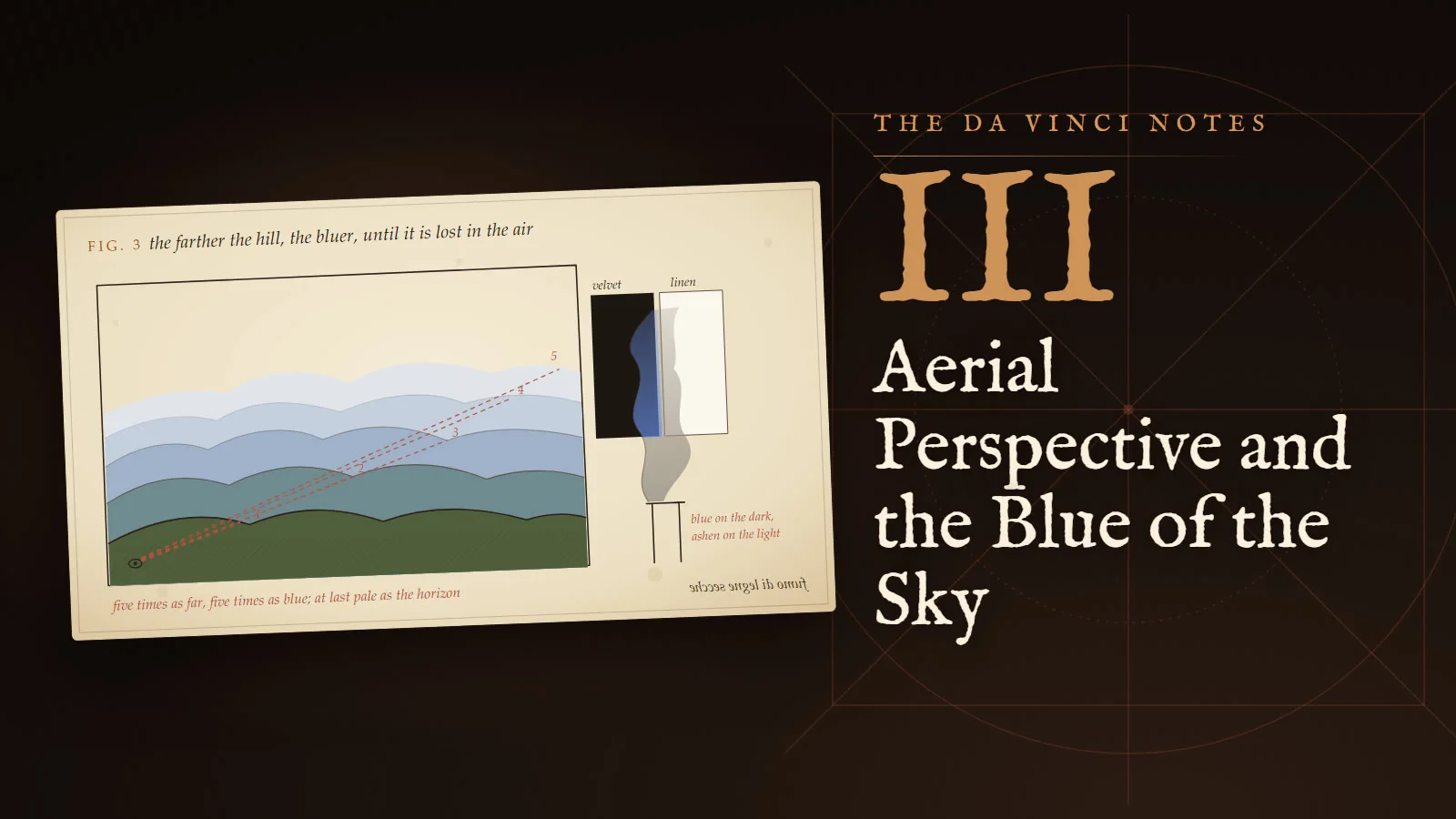
The case that taught me most is the simplest. From the top of the old wall near Sant'Ambrogio you see beyond it the roofs and towers of several buildings, standing one behind another at different distances, and above the line of the wall they all look much the same size. The perspective of lines cannot help me here. If I paint them the same height they will look the same distance. How then does the eye know that one is farther than another? By the air.
Those you wish should look farthest away you must make proportionately bluer; thus, if one is to be five times as distant, make it five times bluer.
Leonardo da Vinci, Paris, MS 2038 (leaves of Manuscript A), f. 25r, trans. J. P. Richter (1883), §295
Proportion
I set it out as I would set out a rule of diminution, so that a pupil can use it without me.
- The nearest building above the wall is painted in its own colour: brick red, the stone white, the shadows under the eaves dark.
- A building twice as far away receives twice as much of the blue of the air mixed into its colour.
- So the blue I add to the first is to the blue I add to the second as the first distance is to the second distance.
- A building five times as far away is five times as blue, and its edges are five times less sharp, so that the perspective of colour agrees with the perspective of size and of disappearance, and none of the three contradicts the others.
A thing that is small, soft at the edges and bluish looks like a large thing far away. The eye reads all three perspectives together, and if one of them lies the picture lies.
Margin
In the margin, a doubt, which I put here so that the adversary does not find it first. My rule cannot run on forever. If the blue goes on growing with the distance, then the farthest mountains, at fifty or a hundred times the distance of the first, ought to be fifty or a hundred times bluer, deeper than ultramarine, deeper than the sapphire. They are not. The farthest mountains are pale: blue, but a thin blue, like milk with a little ink in it, and along the horizon the air itself has lost its blue and is between the colour of smoke and the colour of dust. So the blue grows at first with the distance and then it stops growing and turns towards white. My rule holds for the near and middle distance. Beyond that I do not yet have the rule. Find it.
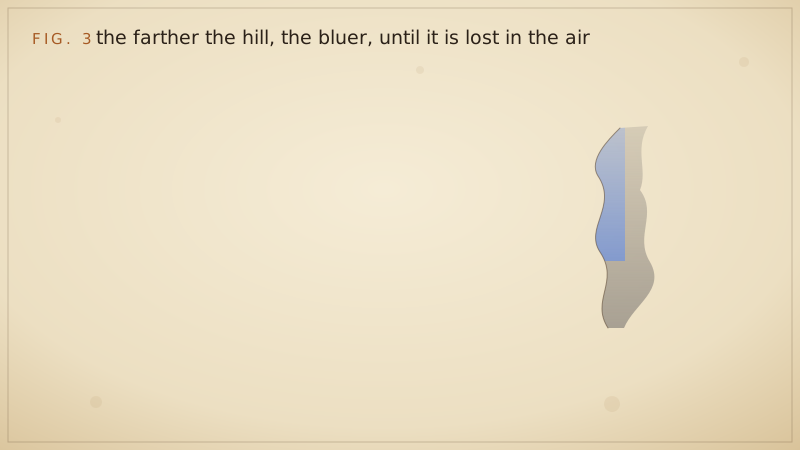
I have drawn the case as Plate III, with numbers taken from the air as it is. Move the farthest hills away and watch them turn first blue and then the colour of the sky; thicken the haze and watch the blue drown in white.
Experiment No. 2
To see which colours go blue first. I painted four boards, each a braccio square, one black, one dark green like a wood in shadow, one yellow ochre, one white with lead, and had a boy from the workshop carry them out along the road and set them against a wall, all four together, while I walked back from them and wrote at each two hundred paces.
- At two hundred paces all four are themselves.
- At six hundred, the black has a faint coldness on it; the others are unchanged.
- At a thousand, the black is a dark slate blue and the green is a blue-green; the yellow and the white keep their colours, a little dimmed.
- At a mile, the black and the green are hard to tell apart and both are bluish; the yellow has become a dull straw; the white is still white.
Of various colours which are none of them blue that which at a great distance will look bluest is the nearest to black
Leonardo da Vinci, on painting, trans. J. P. Richter (1883), §307
So the blue of the distance is something added to the thing, and it shows most where the thing has least light of its own to cover it. Over black it is plain. Over white it is drowned. This agrees with my glasses, where the shadows of the trees turned first. The blue is laid over everything at the same strength, and only the dark things let you see it.
Draftsman's note
For the mountains in a picture. The air is thickest near the ground and thinner as it rises, so the line of sight to the foot of a far mountain runs its whole length through thick air, while the line to its summit rises into thinner air. Paint the foot of each range paler and mistier than its top, the more so the farther the range.
Hence, O Painter! when you represent mountains, see that from hill to hill the bases are paler than the summits
Leonardo da Vinci, Paris, MS 2038 (leaves of Manuscript A), f. 18r, trans. J. P. Richter (1883), §299
To do
- Ask the falconers on which mornings the mountains are clearest. I think after rain with a north wind.
- Look at the mountains at sunrise and at sunset from the same window; write the colours.
Florence, about 1503 to 1506. The blue behind the portrait
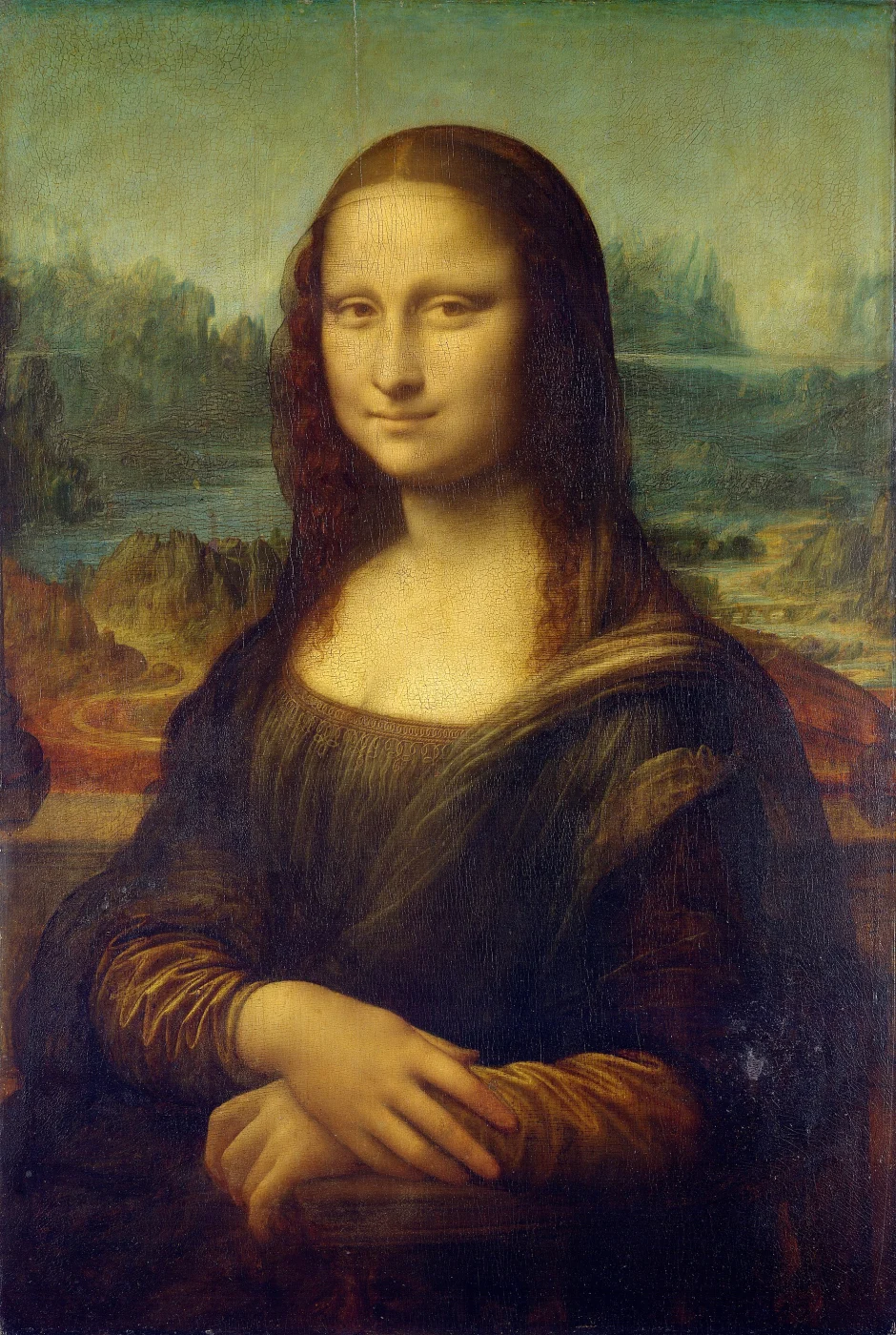
I am painting Francesco del Giocondo's wife against a country that does not exist, made of rocks and water and a road and a bridge, and I have been putting into it everything I learned in Milan about the air. The near rocks at her shoulders are brown and green, warm, with their edges still firm. The middle country, where the road winds, is a greenish blue. The far mountains are a pale blue-grey, the colour of the sky at the horizon, with the lights on their peaks a little warmer and their feet lost in mist, as the rule of the bases requires. Between the near and the far there is no line. One goes into the other by degrees, as it does in nature.
Draftsman's note
How the blue is laid. A blue mixed into the colour of a far mountain makes it look like a blue mountain close at hand, hard and heavy. So I paint the far mountains first in their own colour, dark where they are in shadow, and when this is dry I go over them with a very thin veil of white with a little blue in it, so thin that the dark shows through. Over the dark parts the veil looks blue of its own accord, and over the light parts it only pales them, which is what the air does to the mountains. For the farthest range, two veils. For the horizon, three, until the mountain and the sky are of one body.
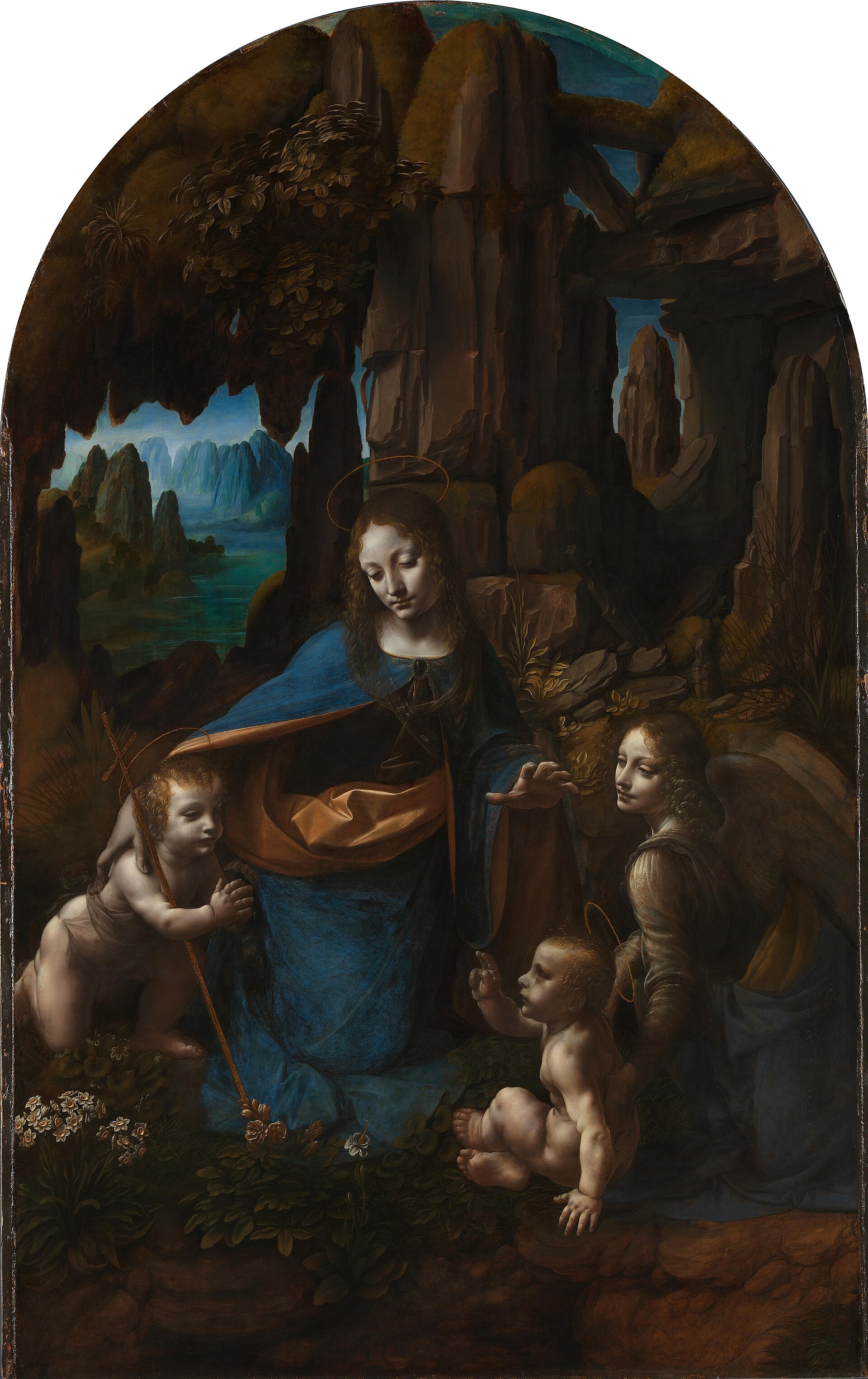
The panel for the brothers of the Immaculate Conception in Milan is the older place where I tried this. Its rocks are dark and close, and through the openings between them you see pinnacles of rock going back into a blue so cold and pale that they look made of the air itself. That picture is still owed to them, after years of quarrelling over the price, and I shall have to go back and finish it.
Milan, 1508. The smoke of dry wood
I am back in Milan with the French, and I have begun a small book for the questions that will not leave me alone. The first of them is the oldest. I have known for twenty years how to paint the blue of distance. I do not know what it is.
Here is what I have seen, over many winters, at the chimneys of this city. The smoke of old dry wood, as it comes out of the chimney, looks a strong blue when there is a dark roof or the shadow of a wall behind it. As it rises above the roofs and has the bright sky behind it, it turns at once an ashen grey. It is the same smoke; only what lies behind it has changed. And the smoke of green wood, thick with moisture, is never blue at all: it is white or grey, with lights and shadows like a cloud.
Experiment No. 3
Apparatus: a small brazier of charcoal on the roof, with shavings of seasoned walnut, very dry, to make a thin smoke; a piece of black velvet a braccio and a half long, stretched on a frame; a piece of white linen of the same size; and the sun.
place behind the smoke a piece of black velvet on which the sun does not shine, you will see that all the smoke which is between the eye and the black stuff will appear of a beautiful blue colour.
Leonardo da Vinci, Codex Leicester, trans. J. P. Richter (1883), §301
- With the velvet behind the smoke, in the shadow of the parapet so that no sun falls on it: the smoke is a clear and beautiful blue, the blue of the far hills exactly.
- With the white linen behind it in place of the velvet: the same smoke is the colour of ashes.
- Half velvet, half linen, side by side behind the same column of smoke: the column is blue on the left and grey on the right, divided by the edge of the cloth as if it were two smokes.
- Too much smoke, with green leaves thrown on: the blue is lost and the smoke turns whitish even before the velvet. Too little: the blue is too faint to be sure of. A moderate smoke gives the finest blue.
- With the velvet behind but the brazier in the shadow of the chimney, so that no sun falls on the smoke: there is no blue at all. The smoke is a dull dark grey, hardly seen.
So the blue needs three things together: something very fine and thin floating in the air, the sun falling on it, and darkness behind it. Take away any one of the three and the blue is gone.
Experiment No. 4
The same again in a dark room, to be sure it is not something of the open air. I closed the shutters of the room on the north side, leaving a single crack a finger wide where the sun comes in, and in the beam:
- Dust beaten out of a cloth: the motes shine ash grey in the beam, each one a bright point.
- Thin smoke from a taper just blown out: the beam, where it passes through the smoke, is a most beautiful blue against the dark of the room.
- Water blown in a fine spray from the mouth, as the plasterers do, across the beam: blue again, and bluer still with water that has been distilled through the alembic, which leaves its earthiness behind.
Dust is coarse and shows its own colour. Smoke of dry wood and fine spray are made of parts too small to see, and they shine blue. The finer the parts, the bluer, so long as there is darkness beyond.
Experiment No. 5
A final proof, which anyone can make at a table. I painted a board with stripes of several colours, among them a strong black of burnt ivory, and when it was dry I laid over the whole board one coat of lead white ground very fine and thinned with oil until it was almost transparent. Over the yellow and the red the white only pales them. Over the black it makes a blue more beautiful than azure, as if a piece of sky had been let into the board. It must be very thin and very finely ground; a thick white simply covers the black and makes it grey.
Margin
Here, I think, is the answer to the doubt I wrote eighteen years ago against my own rule of five times bluer. One shaving on the brazier gives a faint blue before the velvet; four give a full blue with the nap still seen through it; sixteen hide the velvet, and the smoke turns whitish. So the blue grows with the smoke at first, as my rule said, and then stops growing and turns white, as the farthest mountains turn pale. Every braccio of air adds its own light, but it also hides what lies behind it, and at a great distance it hides the darkness itself. A mountain cannot be bluer than the air would be if the mountain were not there at all.
Milan, about 1508. What I saw on Monboso
I write the whole argument now in one place, in the book I have been filling with water and the earth and the moon, because the blue of the sky is a question of the elements and belongs with them.
I say that the blueness we see in the atmosphere is not intrinsic colour, but is caused by warm vapour evaporated in minute and insensible atoms on which the solar rays fall, rendering them luminous against the infinite darkness of the fiery sphere which lies beyond and includes it.
Leonardo da Vinci, Codex Leicester, f. 4r, trans. J. P. Richter (1883), §300
This is the proposition. Now the experience that proves it, which I had with my own body on Monboso, a peak of the Alps between France and Italy, at whose foot the four rivers rise that run in four directions through the whole of Europe. No mountain has its base so high. It rises almost above the clouds; snow seldom falls there, only hail in summer, and the hail lies there, so that in the middle of July I found the ice very considerable.
There I saw above me the dark sky, and the sun as it fell on the mountain was far brighter here than in the plains below, because a smaller extent of atmosphere lay between the summit of the mountain and the sun.
Leonardo da Vinci, Codex Leicester, f. 4r, trans. J. P. Richter (1883), §300
As I went up, the sky above me grew darker, which is the opposite of what it would do if blue were the colour of the air itself. The higher I was, the less air was left above me, and the less air, the less blue and the more dark, so that if a man could go up to the end of the air he would find darkness. And the sun on the rocks was fiercer than any sun in Lombardy, because there was less air between it and me to take its light away.
Here the adversary says: the air is blue as wine is red, and you see more blue where there is more air, as you see a deeper red through a deeper glass of wine. I answer him with his own example. If the blue were the air's own colour, then where more air lies between the eye and the darkness above, the blue would be deeper, as it is in blue glass and in sapphires, which are darker the thicker they are. But the air does the opposite. Where the most air lies between the eye and the sphere of fire, which is towards the horizon, the sky is whitest; where the least air lies, straight overhead and on the high mountains, it is the deepest blue, going to dark. So the blue lives in the air in another way than the red lives in the wine: it is made in the air, by the sun on its finest parts, and it can only be seen against darkness.
The same reason gives the colour of the whole sky. Overhead, the eye looks out through the least air; a hand's breadth above the horizon it looks through many times as much, slantwise, as I count among the problems below. A little lit air before the darkness is blue, and a great deal is white, as the sixteen shavings were white on the roof. The gradation of the sky from the deep blue above me to the pale band at the edge of the land is the gradation of the smoke on my roof, laid out in a single glance.
Reflection
Of all my proofs, the board and the brazier are the ones anyone can make, and the mountain is the one I keep. My legs remember it better than my notes. Above the ice the sky was the colour of ink diluted in water. I have never painted that colour. I do not think a painting could hold it.
Problems I set myself
1. A wooded hill four miles away keeps four fifths of its own colour; the rest is the colour of the air. Suppose every further four miles takes away a fifth of what reached the end of the four miles before, as each new braccio of smoke hides a share of what is behind it. How much of its own colour does a like hill keep at eight, twelve and twenty miles? Compare with the straight rule, by which it would lose a fifth for every four miles.
Answer. At eight miles it keeps four fifths of four fifths, \( \tfrac{16}{25} \), which is 64 parts in a hundred. At twelve, \( \tfrac{64}{125} \), about 51. At twenty, \( (\tfrac45)^5 = \tfrac{1024}{3125} \), about 33. By the straight rule it would keep 60 at eight miles, 40 at twelve and nothing at twenty. The two rules nearly agree for the first steps and part company afterwards: the share rule never reaches nothing, it only grows smaller and smaller, which is why the far mountains go on being faintly seen when the straight rule says they should have vanished.
2. Two towers stand beyond a wall. Above its top, the first, at 300 braccia, shows the same height as the second, at 900 braccia. If the eye is level with the top of the wall, how much taller above the wall is the second tower in truth, and by the rule of five times bluer, how much bluer must it be painted?
Answer. By the perspective of diminution the apparent size goes inversely as the distance, so a tower three times as far that looks the same height must be three times as tall above the line of the wall: if the first rises 20 braccia above it, the second rises 60. By the rule of colour, three times as far is three times as blue. The two rules together let the eye see at once that the second tower is both farther and larger, which the outline alone could never tell it.
3. Taking the air as a layer of equal thickness over a flat earth, how many times its thickness does the eye look through at an elevation of one right angle (straight up), half a right angle, a third of a right angle, and a twelfth of a right angle?
Answer. The slant length is the thickness divided by the sine of the elevation. Straight up, one thickness. At half a right angle (45 degrees), \( 1/\sin 45^\circ \approx 1.41 \). At a third (30 degrees), exactly 2. At a twelfth (7½ degrees), \( 1/\sin 7.5^\circ \approx 7.7 \). So the sky a hand's breadth above the horizon is seen through nearly eight times the air of the sky overhead, and that is why it is pale.
To the student who reads this later
I was right about the darkness and wrong about the moisture. The blue of the sky is sunlight scattered sideways by the air and seen against the black of space, which is the "darkness beyond" I wrote of; the balloonists who rose above fifteen kilometres in the 1930s saw the sky go almost black at noon, as I saw it darken on the mountain. What scatters the light is chiefly the air itself, its molecules, and the sky would be as blue over a desert with no vapour at all. My smoke and my spray were the right experiment for the wrong reason: they show blue because their particles are much smaller than a wave of light, and very small things scatter short waves far more than long ones.
John Tyndall, who from 1859 had studied how gases and vapours take up radiant heat, made blue "skies" in glass tubes in 1868 and 1869 by letting light break vapours into clouds of particles finer than any dust, and found their scattered light blue and polarised like the sky's: my dark room, done with a lamp and a tube. In 1871 John William Strutt, Lord Rayleigh, gave the law. A particle much smaller than the wavelength \( \lambda \) scatters light in proportion to
\[ \beta(\lambda) \propto \frac{1}{\lambda^{4}}, \]
so blue light of 465 nanometres is scattered about \( (610/465)^4 \approx 3 \) times as strongly as red light of 610. In 1899 Rayleigh showed that the molecules of the air alone are enough to make the sky as bright and as blue as it is, and Smoluchowski (1908) and Einstein (1910) traced the scattering to the tiny unevenness of the air's density. The sky is not violet, though violet is scattered most, because sunlight carries less violet and your eye is less sensitive to it.
For the distant hills, my rule and its failure fit in one line. If \( L_0 \) is the light leaving the hill, \( \beta \) the share scattered away in each kilometre, \( d \) the distance and \( L_{\text{air}} \) the brightness of the horizon sky, then
\[ L(d) = L_0\, e^{-\beta d} + L_{\text{air}}\left(1 - e^{-\beta d}\right). \]
The first term is the hill's own light, dying away by equal shares; the second is the light of the air, growing. For a short distance \( 1 - e^{-\beta d} \approx \beta d \): the air-light grows in proportion to the distance, which is my "five times as far, five times as blue". Far off, the hill's own light is gone and only \( L_{\text{air}} \) is left: the pale horizon. In clean air at sea level \( \beta \) is about 0.012 per kilometre for green light, so a dark hill 40 kilometres off keeps about 62 per cent of its green, 39 per cent of its blue and 73 per cent of its red. Haze adds a share nearly the same for every colour, which is why my green-wood smoke and the misty days are white. Harald Koschmieder in 1924 turned this into a rule for how far one can see: a dark object is lost against the horizon at about \( V = 3.9/\beta \). There is no sphere of fire above the air, and shadow has no colour of its own; the shaded sides of mountains look bluer because they have less of their own light to cover the air-light, as I said.
Try it today. Put a glass of water on a dark cloth, stir in a few drops of milk, and shine a torch through it from the side in a dark room: from the side the water looks bluish, and looking along the beam the torch looks orange, like the sun at sunset through a long path of air. Blow out a candle in a sunbeam and hold black card behind the smoke, then white card.
If you want to argue with me about the smoke, the velvet or the mountain, come and ask me.
Sources and liberties
The Da Vinci Notes are a modern reconstruction written in Leonardo da Vinci's voice by Eternal Gardens. Dates, places, manuscripts, drawings and quotations come from the sources below; the order of the working, the private reflections, the plates and the sketches are ours.
- J. P. Richter (ed. and trans.), The Notebooks of Leonardo da Vinci (1883), §14 (the three perspectives), §294 (the glass at every hundred braccia), §295 (aerial perspective, five times bluer), §§298 to 307 (the density and colour of the atmosphere, the smoke, the velvet, Monboso): Project Gutenberg
- Edward MacCurdy (trans.), Leonardo da Vinci's Note-Books (Duckworth, 1906), for the manuscript locations: Codex Leicester for the colour of the atmosphere (Richter §300), Manuscript F f. 18r (§302), MS 2038 f. 25r (§295): Internet Archive
- Edward MacCurdy, The Notebooks of Leonardo da Vinci (Jonathan Cape, 1938), vol. I, chapter on the atmosphere, giving Leic. 4r for the passage on Monboso: Internet Archive
- The British Library and Google Arts and Culture, "Ahead of His Time: Leonardo and the Codex Leicester" (the smoke and black velvet experiment on f. 36r): Google Arts and Culture
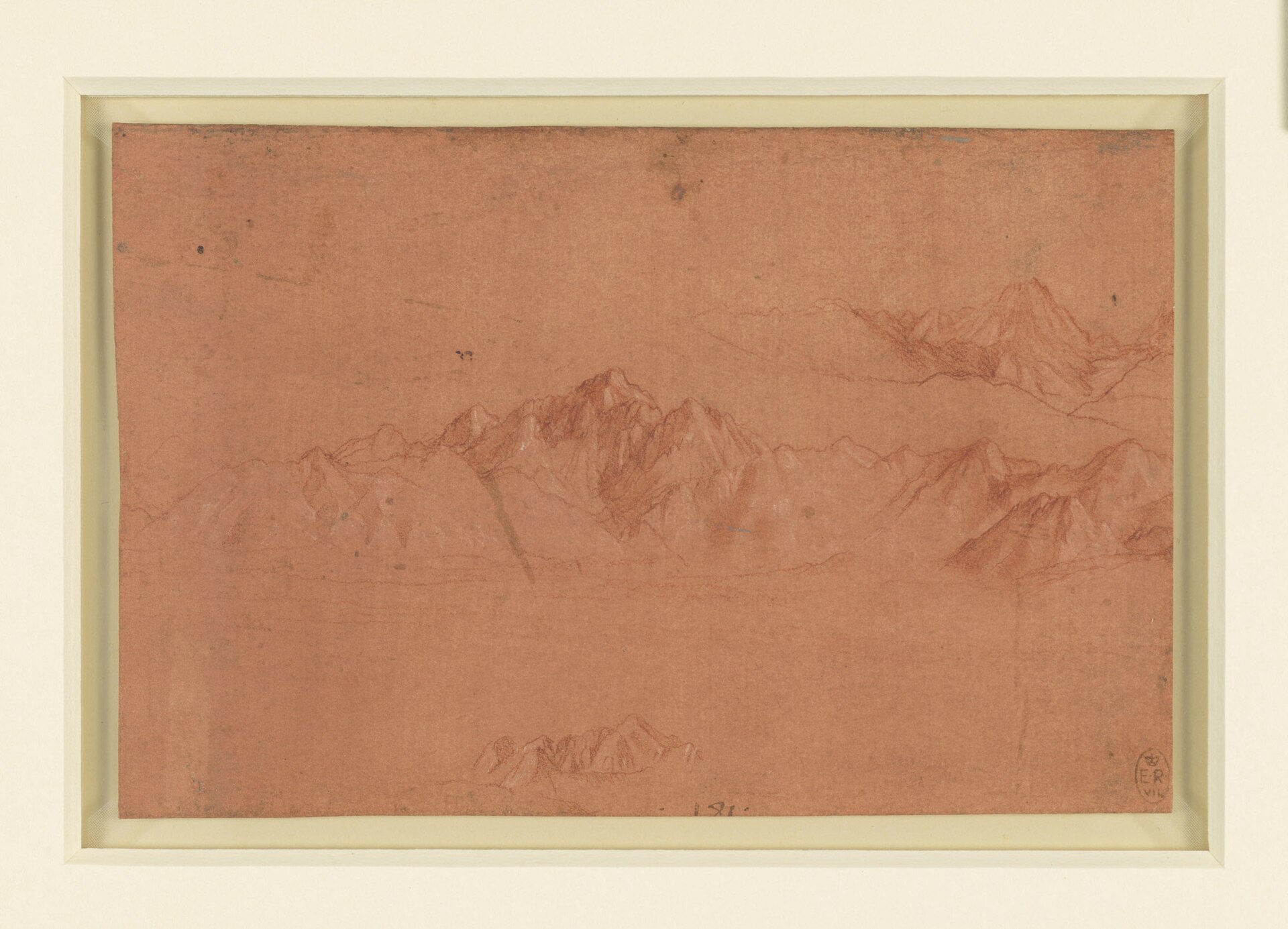
- Royal Collection Trust, RCIN 912410, The Alps seen from Milan: rct.uk
- The National Gallery, London, The Virgin of the Rocks, NG1093: nationalgallery.org.uk
- Musée du Louvre, Mona Lisa, INV 779: collections.louvre.fr
- J. Tyndall, "On the blue colour of the sky, the polarization of skylight, and on the polarization of light by cloudy matter generally", Proceedings of the Royal Society of London 17 (1869), 223 to 233; Lord Rayleigh, "On the light from the sky, its polarization and colour", Philosophical Magazine 41 (1871), 107 to 120 and 274 to 279; Lord Rayleigh, "On the transmission of light through an atmosphere containing small particles in suspension, and on the origin of the blue of the sky", Philosophical Magazine 47 (1899), 375 to 384.
The place of the Monboso passage is given by MacCurdy as Codex Leicester f. 4r and the velvet experiment by the British Library as f. 36r; Richter's printed text does not give folios. Which mountain Monboso was is uncertain (Monte Rosa is the usual reading; Richter himself could not decide), and the date of the climb is unknown beyond Leonardo's "the middle of July". The four painted boards, the trials outside the Porta Comasina, the counts of shavings and the remarks about Lisa's horizons are our reconstruction; the smoke, the velvet, the spray in the dark room and the thin white over black are his.