 by Marie Curie

Milan, April 1490, in the old palace by the cathedral where the Duke lets me work on his horse. The clay model stands under its scaffold in the courtyard, and every afternoon the sun goes round it and does to it what no sculptor can do: it makes the belly dark, then the flank, then the neck, and lays on the paving a second horse made of nothing, long and blue and soft at its edges, which moves when the sun moves. I have drawn shadows all my life as every painter draws them, darker where the thing turns away, and I have never asked what a shadow is or why its edge is sharp in one place and lost in another. I begin a new book today, and I give the first part of it to shadow.
Therefore, O Painter, make your shadow darkest close to the object that casts it, and make the end of it fading into light, seeming to have no end.
Leonardo da Vinci, on the nature of shadow, trans. J. P. Richter (1883), §122
Milan, 23 April 1490. A new book, and what shadow is
On the 23rd of April 1490 I began this book, and recommenced the horse.
Leonardo da Vinci, Manuscript C, f. 15v (Institut de France, Paris), trans. J. P. Richter (1883), §720
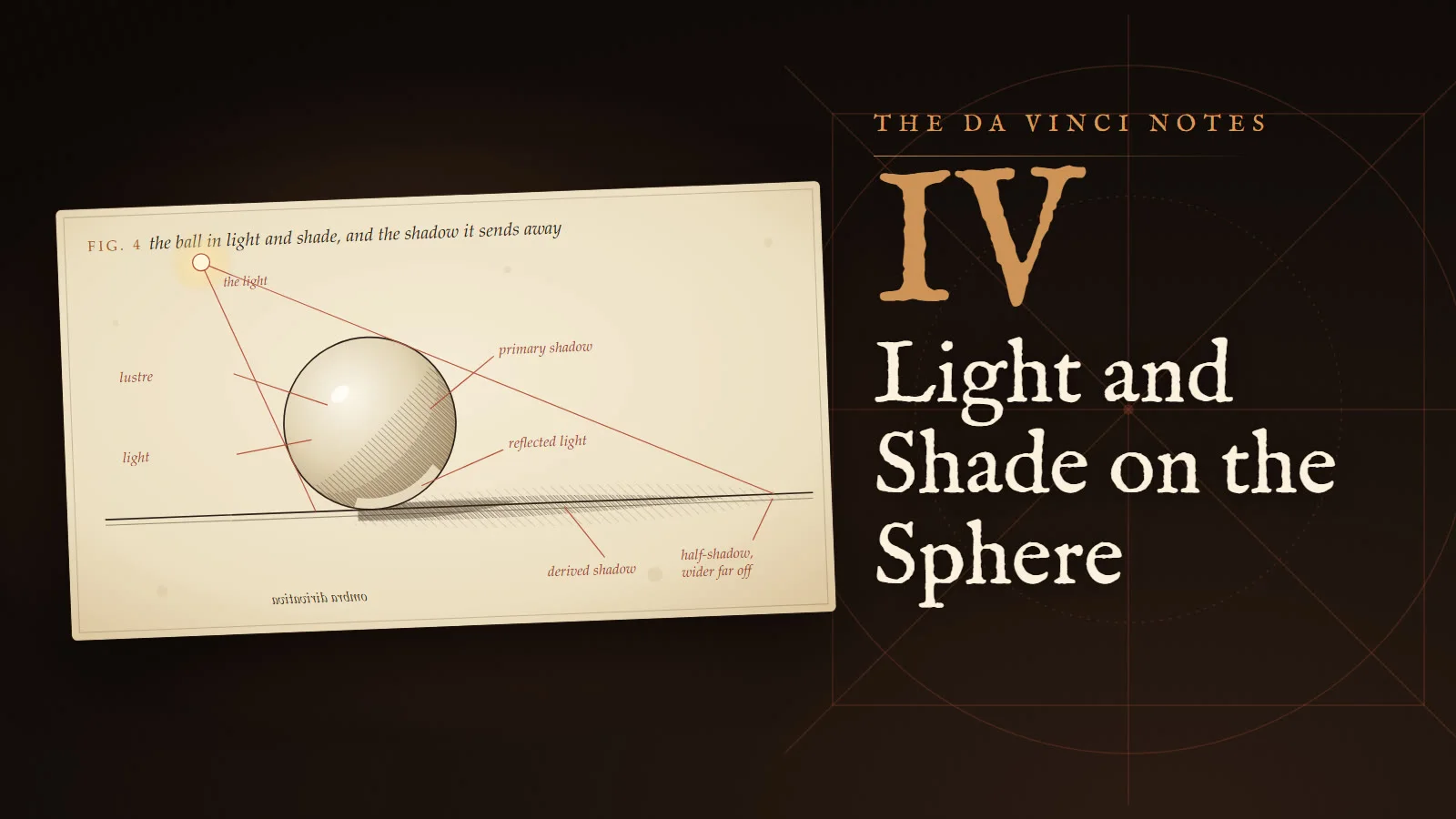
This is a fine book, of large sheets, and I mean to fill it with light and shade and nothing else, in order, as a geometer fills his book with lines. Most painters think of shadow as a colour, a brown or a black that they keep in a pot and lay on the side of a thing away from the window. That is the error from which all the others come. A shadow is a quantity of light, less than full, and every degree of it has a cause that can be found. So I start with names, because without names I cannot write the propositions.
Darkness is absence of light. Shadow is diminution of light. Primitive shadow is that which is inseparable from a body not in the light. Derived shadow is that which is disengaged from a body in shadow and pervades the air.
Leonardo da Vinci, Manuscript C, f. 14v, trans. J. P. Richter (1883), §123
Two shadows, then, and the whole art is in keeping them apart. The primary shadow is on the body, on the side the light cannot see. The derived shadow is thrown off the body, through the air, and is only seen where it falls on something: a wall, the ground, another body. The first belongs to the thing, as its skin belongs to it. The second goes away from it, as a smell goes away from a flower.
Margin
In the margin: shadow is the stronger of the two powers. Light can never drive all the shadow from a solid body, since some side of it always faces away; shadow, given a body large enough and near enough, can take all the light from another. Seven books, then, from the shadow on the body to the shadows seen from far away. I will write the first three here and see.
Milan, May 1490. The three forms of shadow
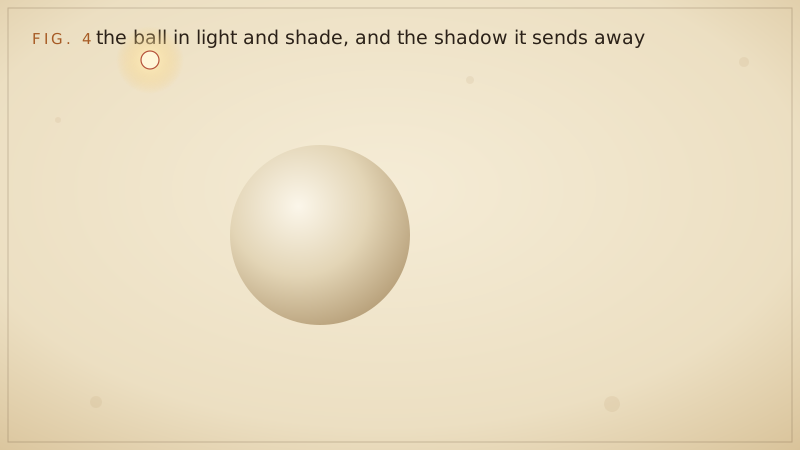
To see a shadow without the confusion of a whole figure I need the simplest body there is, which is the ball. A ball has no front and no back; every part of it turns to the light by its own degree; and it throws the same shadow whichever way it lies. So I had the turner in the Borgo make me a ball of pear wood half a braccio across, and I covered it with gesso, three coats, rubbed smooth, so that it is as white as a sheet of paper and shows every degree of light without any colour of its own.
Experiment No. 1
In my room at night, the shutters closed, the walls hung with dark cloth so that they send back no light. A single candle on the table; the ball on a stand at the height of the flame; behind the ball, a board covered with white paper, set upright, which I can slide nearer or farther.
- Candle two braccia from the ball, board one braccio behind it. The shadow on the board is round, darker than anything else in the room, and its edge is sharp enough to trace with a pen.
- Board moved to three braccia behind the ball. The shadow is larger, much larger, and still round and still dark. Its edge is a little less sharp, softened over the width of a finger.
- Candle moved nearer, to half a braccio from the ball. The shadow on the board is now enormous, wider than the board itself. A body near the light throws the largest shadow.
- Candle replaced with a great lamp of six wicks in a row, wider than the ball. Now the shadow behind the ball comes to a point, as a pyramid does, a short way behind it. Beyond the point the board is only dimmed, nowhere dark.
But if the body is smaller than the light, the shadow will resemble a pyramid and come to an end, as is seen in eclipses of the moon.
Leonardo da Vinci, Manuscript C, f. 7v, trans. J. P. Richter (1883), §160
So the forms of the derived shadow are three, and the light decides which. If the light is smaller than the body, as the candle is smaller than the ball, the shadow grows wider as it goes, without end: a pyramid turned with its point towards the light. If the light is equal to the body, the shadow is a column, of the same width as far as you like. If the light is larger than the body, as the sun is larger than the earth, the shadow is a pyramid with its point away from the light, and it comes to an end, as the earth's shadow ends somewhere far beyond the moon.
Proportion
For the candle, which is nearly a point, the size of the shadow is found as the size of an image is found in perspective. Draw from the flame two lines touching the ball on either side, and carry them on to the board. The width of the shadow is to the width of the ball as the distance from the flame to the board is to the distance from the flame to the ball. Two braccia to the ball, three more to the board: the whole line is five, the part two, and the shadow is two and a half times as wide as the ball. I measured it on the board at a braccio and a quarter, which is the half braccio of the ball taken two and a half times. The rule and the board agree.
Milan, summer 1490. The half-shadow, and why it widens
That finger's width of softness at the edge of the candle shadow has troubled me for a month. A point would give an edge as sharp as a knife. The candle is a flame, a finger wide, and that finger's width is the whole cause. From the middle of the board's shadow, the whole flame is hidden behind the ball. From a place outside the shadow, the whole flame is seen. Between the two there is a band from which the ball hides part of the flame and leaves part of it showing, and in that band the board is half lit: the more of the flame it sees, the lighter.
In proportion as the source of light is larger, the luminous and shadow rays will be more mixed together.
Leonardo da Vinci, Manuscript C, f. 4r, trans. J. P. Richter (1883), §217
Experiment No. 2
The ball carried to the window of the room on the courtyard, the shutters open to the width of one braccio and the rest covered, so that the window is a single lit opening, twice as wide as the ball, with the bright sky in it and no sun. The ball a braccio and a half inside the window; the board behind the ball as before.
- Board close behind the ball, a quarter of a braccio: the shadow is dark in its middle and its edge goes from dark to light over a band about a hand wide.
- Board at one braccio: the dark middle is smaller, and the soft band is wider, more than half a braccio.
- Board at two braccia: no dark middle at all. The whole shadow is a soft grey blot, with no place in it where the window is wholly hidden, and its edges cannot be found.
The greater the difference between a light and the body lighted by it, the light being the larger, the more vague will be the outlines of the shadow of that object.
Leonardo da Vinci, on derived shadow, trans. J. P. Richter (1883), §194
So the derived shadow is most sharp next to the body that casts it and most confused far from it. This is why the shadow of a man on the ground is sharp at his heel and soft at his head. The painter who gives a cast shadow the same edge along its whole length has painted a shadow that never existed.
Proportion
How wide is the soft band? Draw two lines from the two edges of the window, crossing over the one edge of the ball, and carry them on to the board. Between them lies the half-shadow. The width of the half-shadow on the board is to the width of the window as the distance from the ball to the board is to the distance from the window to the ball. So the half-shadow begins at nothing, at the ball itself, and grows as the board goes back, in proportion to the distance behind the ball. Double the distance, double the band. And the dark middle, which is the pyramid of the third form, shrinks as the bands grow, until the two half-shadows meet in the middle and the pyramid ends.
Plate IV has the ball and its light. Drag the light, make it a candle or a great window, and see the half-shadow on the floor widen towards its far end while it stays narrow at the ball; the readout gives its width near the ball and far away, and says which of the three forms the full shadow has taken.
Margin
Giacomo came to live with me on the feast of the Magdalen, 22 July, ten years old. The second day I had two shirts cut for him, a pair of hose and a jerkin, and when I put aside the money to pay for them he stole four lire out of the purse. I could not make him confess it, though I was quite certain. The next day, at supper with Giacomo Andrea, he ate for two and broke three cruets.
Thief, liar, obstinate, glutton.
Leonardo da Vinci, Manuscript C, f. 15v, trans. J. P. Richter (1883), §1458
He has a face of curls such as I could draw for an angel. I shall keep him.
Milan, autumn 1490. Window light and the equal angles
The candle in the dark room teaches the geometry, and it is a bad light to paint by. It makes the shadows black and their edges hard. There are two kinds of light, and the painter must choose between them before he picks up a brush.
The restricted is that which being admitted through an opening or window illuminates them on that side only.
Leonardo da Vinci, on the two kinds of light, trans. J. P. Richter (1883), §127
The other is the free light, of the open sky, which falls on a thing from everywhere at once, so that it has almost no shadow and no relief. The restricted light from a window, if the window is large and high and the walls of the room are not too bright, gives the most beautiful relief there is: it comes from one side, so that the form turns from light into shadow; and it comes from a wide opening, so that the turn is gradual and the edges soft. For this reason I want for portraits a courtyard ten braccia wide, twenty long and ten high, with walls tinted black and a linen awning over it, or else to paint as evening falls.
Note in the streets, as evening falls, the faces of the men and women, and when the weather is dull, what softness and delicacy you may perceive in them.
Leonardo da Vinci, on selecting the light which gives most grace to faces, trans. J. P. Richter (1883), §520
Experiment No. 3
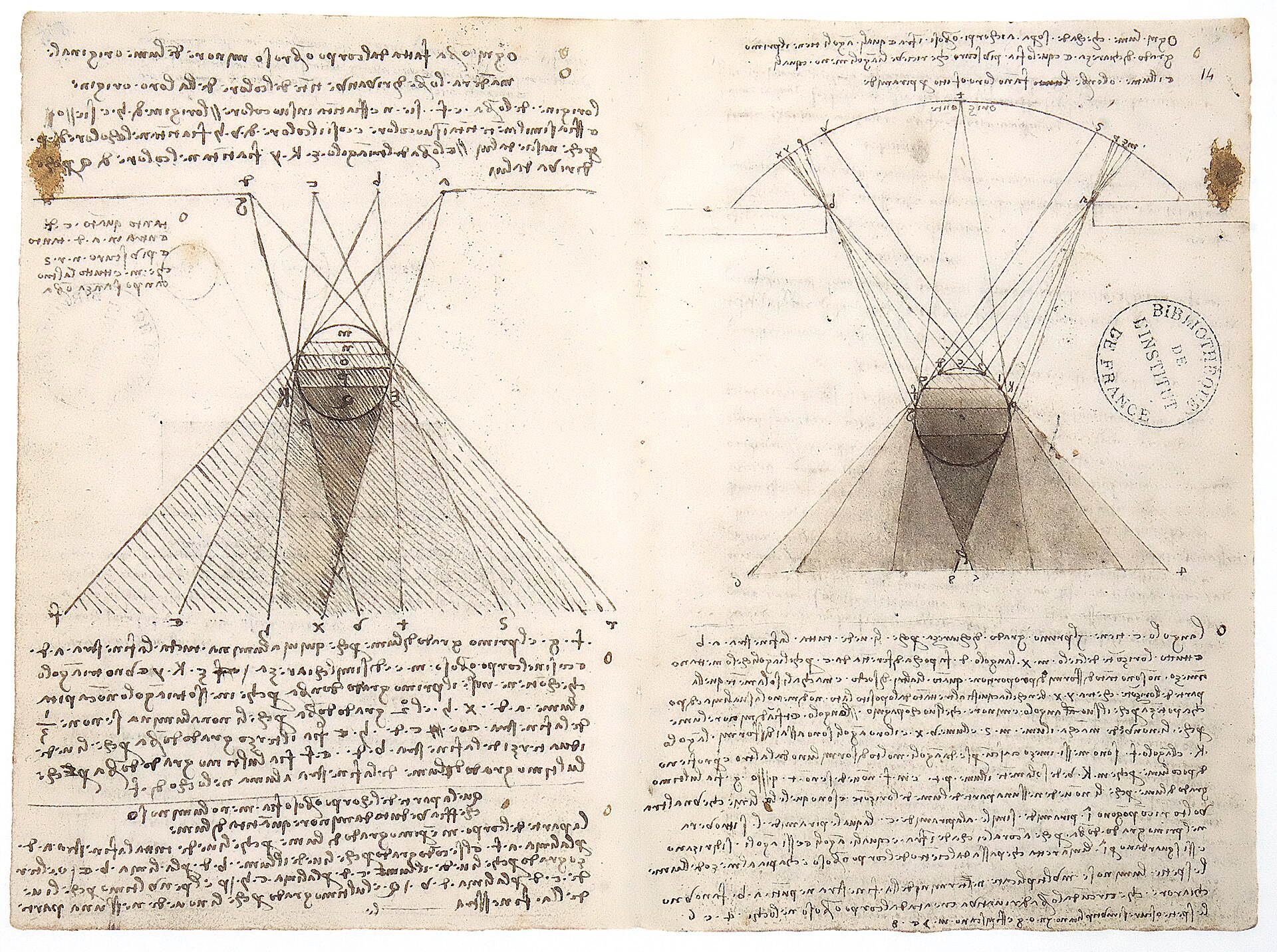
Where on the ball is it brightest, and by what rule does the light fall off across it? The white ball in the window light, the window to its left. I drew round the ball a meridian of red chalk, as on a globe, marked at every sixth part of a right angle from the point that looks straight at the window.
- The brightest place is the point that faces the middle of the window squarely, where the rays strike the surface at equal angles on either side.
- At the first and second marks the light is hardly less. The eye cannot see the change.
- From the third mark, at half a right angle, the light falls more quickly; at the fourth it is plainly half shaded; at the fifth dark.
- At the sixth mark, where the rays only graze the ball, the light should be none. It is not quite none, because part of the window can still see past the curve. The line between light and shade is a soft band, a little past the sixth mark.
That part of a body which receives the luminous rays at equal angles will be in a higher light than any other part of it.
Leonardo da Vinci, on painting, trans. J. P. Richter (1883), §147
Calculation
The light grows weaker with distance from the window too. I wrote this rule, which I give here as I wrote it, so that whoever comes after can test it.
the proportion of the light will be the same as that of the length of the lines between them
Leonardo da Vinci, on the darkness of the shadows, trans. J. P. Richter (1883), §548
That is, a body twice as far from the light is twice as dark, or receives half the light. By this rule the gradations of light on a continuous surface are infinite, since the lines from the light to each part of it are infinitely many and each a little longer than the last; and the practical painters who use four degrees, a dark ground, a middle tint, a light and a highest light, have taken four steps out of an infinite slope.
Margin
In the margin, later: the ball at two braccia from the candle, and a second ball at four braccia, side by side in my eye. The second looks darker than my rule allows. I have not found a way to measure light, only to compare it. Find a way. A candle moved until two of them light a paper as one did, perhaps.
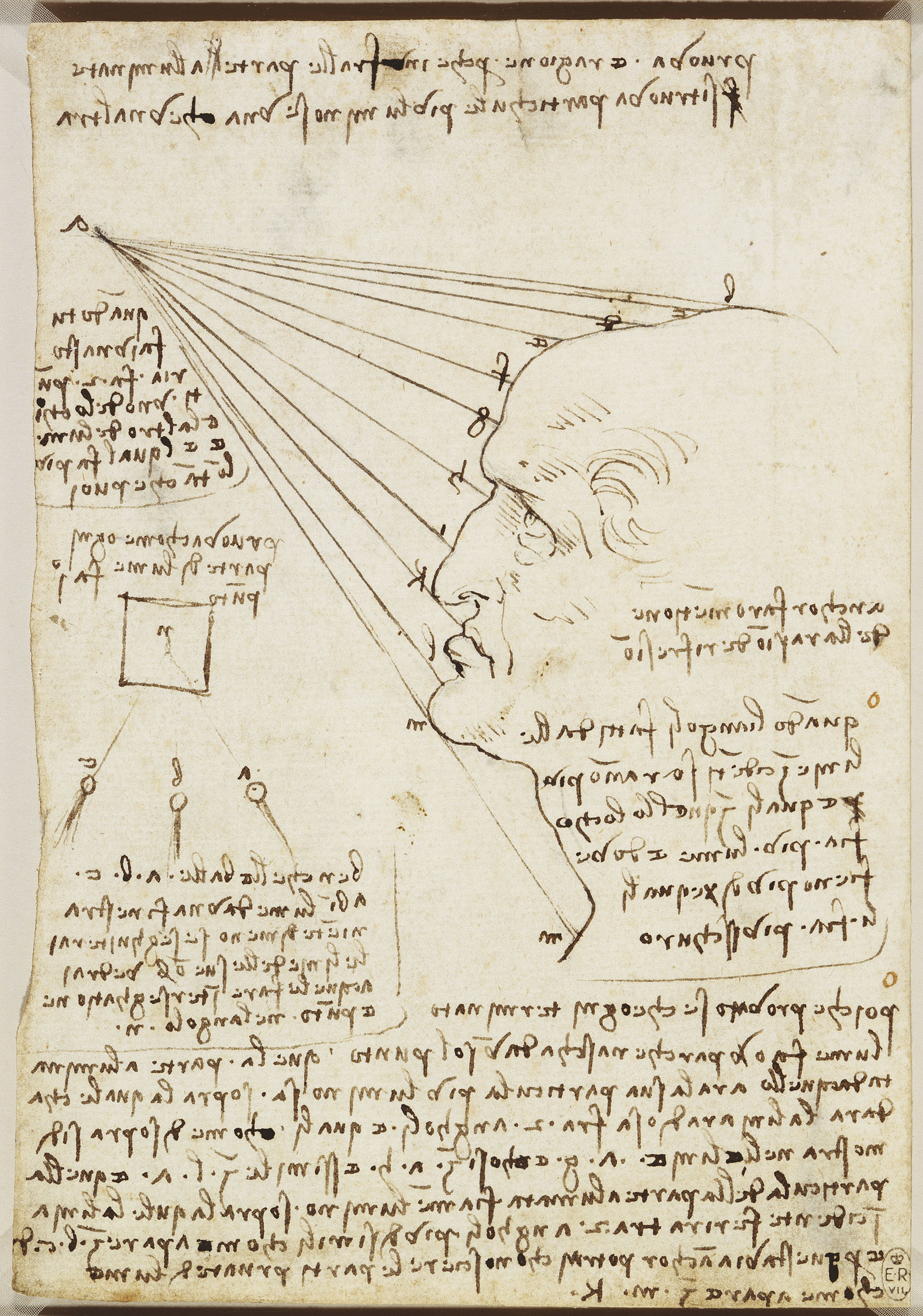
Milan, about 1491. The light that comes back
When the ball stood on the white board in the window, its shadow side was never dark. Along its lower edge, just above the floor, there was a pale crescent, lighter than the middle of the shadow, as if a second, weaker window were below. There is a second window below. It is the floor. The floor is lit by the window and sends part of that light back up, as a wall throws back a ball, into the shadow of the body that stands on it.
Experiment No. 4
- The ball on white linen in the window light: a clear crescent of reflected light along the lower part of the shadow, and the darkest part of the shadow lies in a band in the middle, between the edge of the direct light and the reflection.
- The same ball on black velvet: the crescent is gone. The shadow is dark to its bottom edge and the ball seems to float above the velvet without weight.
- On a sheet of red cloth: the crescent comes back, and it is red. The shadow of the white ball is tinted by the floor it stands on.
- On linen again, with a red cloth hung beside the ball on its dark side: the reflection is red on that side and white below. Each reflection carries the colour of the thing that sends it.
always show the cause of the shadow, and the same with reflections
Leonardo da Vinci, on shadows on bodies, trans. J. P. Richter (1883), §556
So the darkest place of the primary shadow lies inside it, a little way from its edge, and its lower part is brightened by what stands near it. A painter who makes the shadow darkest at the bottom of a ball resting on a pale floor has not looked. And a painter who puts a bright reflection into every shadow, whether or not there is anything near to send it, has looked at other paintings in place of the world. There are many painters on both sides of this quarrel.
Many painters neglect this observation, while others attend to and deduce their practice from it.
Leonardo da Vinci, Treatise on Painting, ch. CCXVI, trans. J. F. Rigaud (1835)
Margin
In the margin: the reflection must always be weaker than the light it comes from, since the floor gives back only part of what it receives. A reflection as bright as the lit side makes the ball look like glass. Keep it under the half-tint.
Reflection
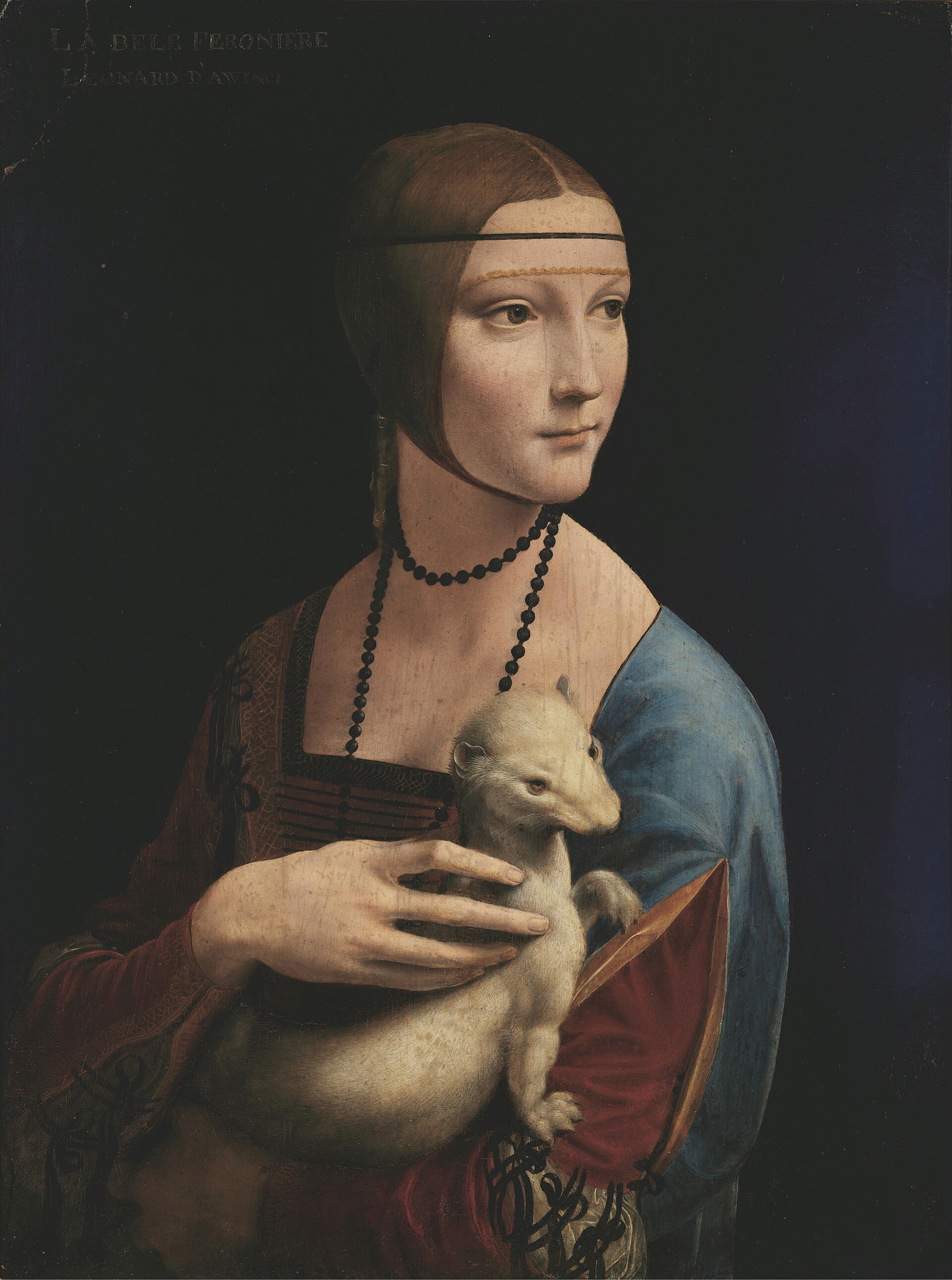
There is a third light on the ball, smaller than the other two. On the lit side, a little towards me from the brightest place, a small spot shines brighter than the gesso can be. It is the lustre. Light is the colour of the thing lit; the lustre is the colour of the window. When I move my head, the light on the ball stays where it is, and the lustre moves with my eye. On the dry gesso the lustre is weak and wide. When I wet the ball, it is sharp and small, like a star.
lustre is not included among colours, but is saturation of whiteness, and derived from the surface of wet bodies
Leonardo da Vinci, of the difference between light and lustre, trans. J. P. Richter (1883), §132
So there are two kinds of light on a body that the painter must keep apart: the lume, which is the thing in its colour, lit, and does not move when you move; and the lustro, which belongs to the eye and the light together, and moves when either moves. I put both in the portrait of Cecilia, the Duke's lady, with her ermine. The light on her face is lume, soft, from a window on her right. The points in her eyes and on the beads at her neck are lustro, small and white.
Milan, about 1492. Smoke at the edges
All of this is for one thing, which is to paint a body that stands out from the panel as the ball stands out from the table. It is made of the half-shadows. A painted figure with hard edges to its shadows looks cut from wood and stuck on. A painted figure in which every shadow passes into light by degrees, so that no one can say where the light ends, looks round, and seems to breathe.
that your light and shade blend without strokes and borders [but] looking like smoke.
Leonardo da Vinci, Paris, MS 2038 (leaves of Manuscript A), f. 27v, trans. J. P. Richter (1883), §492
Like smoke: I mean the way smoke from a chimney goes into the air, thick at the mouth and thinner and thinner, so that you cannot point to the place where it ends. The shadow on a cheek must end in this way, and the shadow of a nose on the lip, and the turn of a chin into its own shade. And for a young face more than an old one.
in youthful figures you should not make the shadows end like stone, for the flesh retains a slight transparency
Leonardo da Vinci, Paris, MS 2038, f. 31v, trans. E. MacCurdy (1906)
And when a shadow is so faint that I cannot find its edge with my eye, I must not invent one for it with my brush. If I cannot see where it ends, the picture must not know either; otherwise the work will seem wooden.
Draftsman's note
How the smoke is laid. The paint must be thin and the layers many. I put down the shadow first in a warm dark, and over it, when it is dry, a glaze of the flesh colour so thin it is almost only oil, and another, and another, each one ending a little short of the last, so that the edge of each layer is never seen and the shadow deepens by steps too small for the eye. A soft brush, almost dry, drawn across the boundary while it is wet, unmakes whatever edge is left.
For the folds of drapery I model small figures in clay and lay over them thin cloth dipped in clay, so that the folds stay still for as long as I need, and I draw them on fine linen with the point of the brush, in black and white, under the window. The clay cloth is white and dull, without lustre, and it shows the half-shadows as the gesso ball does.
To do
- Make a second ball of black wood and compare its reflected light with the white one on the same floor.
- Find how many candles at four braccia light a paper as one does at two.
- Draw the shadow of the horse in the courtyard at the third hour and at the ninth, and measure the half-shadow at its hoof and at its head.
- Ask the glass makers whether a ball of clear glass throws a shadow with a bright point in it.
Problems I set myself
1. A candle stands two braccia from a ball half a braccio across. A wall stands three braccia beyond the ball. How wide is the shadow on the wall?
Answer. Taking the candle as a point, the width of the shadow is to the width of the ball as the distance from the candle to the wall is to the distance from the candle to the ball: \( \tfrac12 \times \tfrac{2+3}{2} = 1\tfrac14 \) braccia. The shadow is two and a half times as wide as the ball.
2. A window two braccia wide lights a ball half a braccio across from eight braccia away. How wide is the half-shadow on a wall four braccia behind the ball, and how far behind the ball does the full shadow end?
Answer. The half-shadow is to the window as the distance from ball to wall is to the distance from window to ball: \( 2 \times \tfrac48 = 1 \) braccio on each side. The full shadow is a pyramid that ends where the lines from the two edges of the window, crossing at the edges of the ball, meet again: at a distance \( \tfrac12 \times \tfrac{8}{2 - \frac12} = 2\tfrac23 \) braccia behind the ball. On a wall at four braccia there is no full shadow at all, only a grey blot of half-shadow, as I saw at the window.
3. By my rule that light goes as the length of the lines, how much light does a ball at four braccia from a candle receive compared with one at two? And how much does a part of the ball receive where the rays strike it two thirds of a right angle away from the equal angles?
Answer. By my rule, half. The true answer, which I did not know, is a quarter: the light spreads over a surface that grows as the square of the distance, so \( (\tfrac24)^2 = \tfrac14 \). For the slanting rays, the light on a surface goes as the width of the beam that it catches, which at two thirds of a right angle (60 degrees) from square is \( \cos 60^\circ = \tfrac12 \) of the full light. So my "equal angles" are the place of the greatest light, as I said, and the falling off from them goes as the cosine.
To the student who reads this later
My names are still yours. Painters and engineers who draw shadows by computer call my primary shadow the attached shadow and my derived shadow the cast shadow; the dark core of a cast shadow is the umbra and the soft band is the penumbra, from the Latin for "almost shadow". My three forms are right, and the third is the one that holds the eclipses: the sun is larger than the earth, so the earth's umbra is a cone about 1.4 million kilometres long, comfortably past the moon at 384,000.
The width of the penumbra is my proportion. If a light of diameter \( D \) is at distance \( a \) from the edge of the body and the surface is a further \( b \) behind, the penumbra is
\[ w = D\,\frac{b}{a}. \]
The sun is about half a degree across, \( D/a \approx 0.0093 \), so every shadow it throws gains about 0.93 centimetres of soft edge for each metre it travels. Stand in the sun and look at the shadow of your own foot and of your head: the foot is sharp and the head is not.
The law of the light on a surface was written by Johann Heinrich Lambert in his Photometria of 1760. A small source of intensity \( I \) at distance \( r \), striking at angle \( \theta \) from the perpendicular, gives
\[ E = \frac{I \cos\theta}{r^{2}}. \]
The \( \cos\theta \) is my rule of the equal angles, made exact. The \( r^2 \) is where I went wrong: Johannes Kepler had argued in 1604 that light weakens as the square of the distance, because it spreads over a sphere whose area grows as the square of the radius, and Lambert built his measures of light on it. A matte surface that sends light equally in all directions, as my gesso ball nearly does, is still called a Lambertian surface. A large light is the sum of many small ones, which is why the line between light and shade on the ball softens when the window grows: each part of the window has its own grazing line, and the band between the first and the last is the soft terminator. Plate IV computes exactly this.
The light that comes back from the floor is what computer graphics calls indirect light or global illumination. The method called radiosity, developed at Cornell in 1984, asks how much of every patch of surface each other patch can see (the form factor) and lets the light bounce until it settles: my floor lighting my ball, done for a whole room. The lustre is specular reflection: it sits where the angle to the light equals the angle to the eye, so it moves when you move, as I saw.
The smoke at the edges has the name sfumato, from fumo, smoke; it is a word the painters and historians gave to my method, and I do not use it as a noun in my notes. Giorgio Vasari wrote of my dark manner that I "sought for blacks which might make deeper shadows and be darker than other blacks, that by their means he might make his lights the brighter". In 2010 a team at the Louvre's laboratory measured the faces of my paintings with X-ray fluorescence and found the shadows built from many glazes, each only a few thousandths of a millimetre thick, darkened by degrees with iron and manganese browns: the layers I describe above, counted.
Try it today. Put an orange on a sheet of white paper in a dark room and light it with a phone torch from a metre away. The cast shadow is sharp. Now light it from a window on an overcast day, or through a sheet of baking paper held close to the torch: the shadow goes soft and its core shrinks. Lay a red cloth beside the orange and watch its dark side turn red.
If you want to ask me why the edge of a shadow softens as it travels, or how I painted the smoke on a cheek, come and ask me.
Sources and liberties
The Da Vinci Notes are a modern reconstruction written in Leonardo da Vinci's voice by Eternal Gardens. Dates, places, manuscripts, drawings and quotations come from the sources below; the order of the working, the private reflections, the plates and the sketches are ours.
- J. P. Richter (ed. and trans.), The Notebooks of Leonardo da Vinci (1883), §§111 to 217 (light and shade: definitions, the three forms of shadow, derived shadows, reflections), §127 (restricted and diffused light), §§132 to 135 (lustre), §147 (equal angles), §492 (light and shade blending like smoke), §520 (the courtyard and faces at evening), §548 (light and the length of the lines), §556, §720 (the opening of Manuscript C) and §1458 (Giacomo): Project Gutenberg
- Edward MacCurdy (trans.), Leonardo da Vinci's Note-Books (Duckworth, 1906), for MS 2038 f. 31v (youthful figures) and f. 14v (shadows not sharply defined), and for the folios of Manuscript C: Internet Archive
- J. F. Rigaud (trans.), A Treatise on Painting by Leonardo da Vinci (1835), ch. CCXVI, on the reflected lights round shadows: Project Gutenberg
- Giorgio Vasari, Lives of the Most Eminent Painters, Sculptors and Architects, trans. G. du C. de Vere (1912 to 1915), life of Leonardo, on the clay-dipped cloth and the deep blacks: Project Gutenberg
- Royal Collection Trust, RCIN 912604, The fall of light on a face: rct.uk
- J. H. Lambert, Photometria, sive de mensura et gradibus luminis, colorum et umbrae (Augsburg, 1760); J. Kepler, Ad Vitellionem paralipomena (Frankfurt, 1604).
- C. M. Goral, K. E. Torrance, D. P. Greenberg and B. Battaile, "Modeling the interaction of light between diffuse surfaces", Computer Graphics (SIGGRAPH '84) 18 (1984), 213 to 222.
- L. de Viguerie, P. Walter, E. Laval, B. Mottin and V. A. Solé, "Revealing the sfumato technique of Leonardo da Vinci by X-ray fluorescence spectroscopy", Angewandte Chemie International Edition 49 (2010), 6125 to 6128.
Manuscript C was begun on 23 April 1490 and contains the definitions, the three forms of shadow and the mixing of luminous and shadow rays; the folios given here for it follow MacCurdy. The plan of seven books is from the Codex Atlanticus (Richter §111), which we have set in the same spring. The pear-wood ball, the turner, the six-wick lamp, the measured distances, the coloured cloths and the courtyard horse's shadow are our reconstruction of experiments his propositions describe; the clay-dipped drapery is from Vasari. The word "sfumato" is not his noun in the notebooks, and the often-quoted line describing it as "without lines or borders, in the manner of smoke or beyond the focus plane" is a modern paraphrase: the last four words are not his.