 by Marie Curie

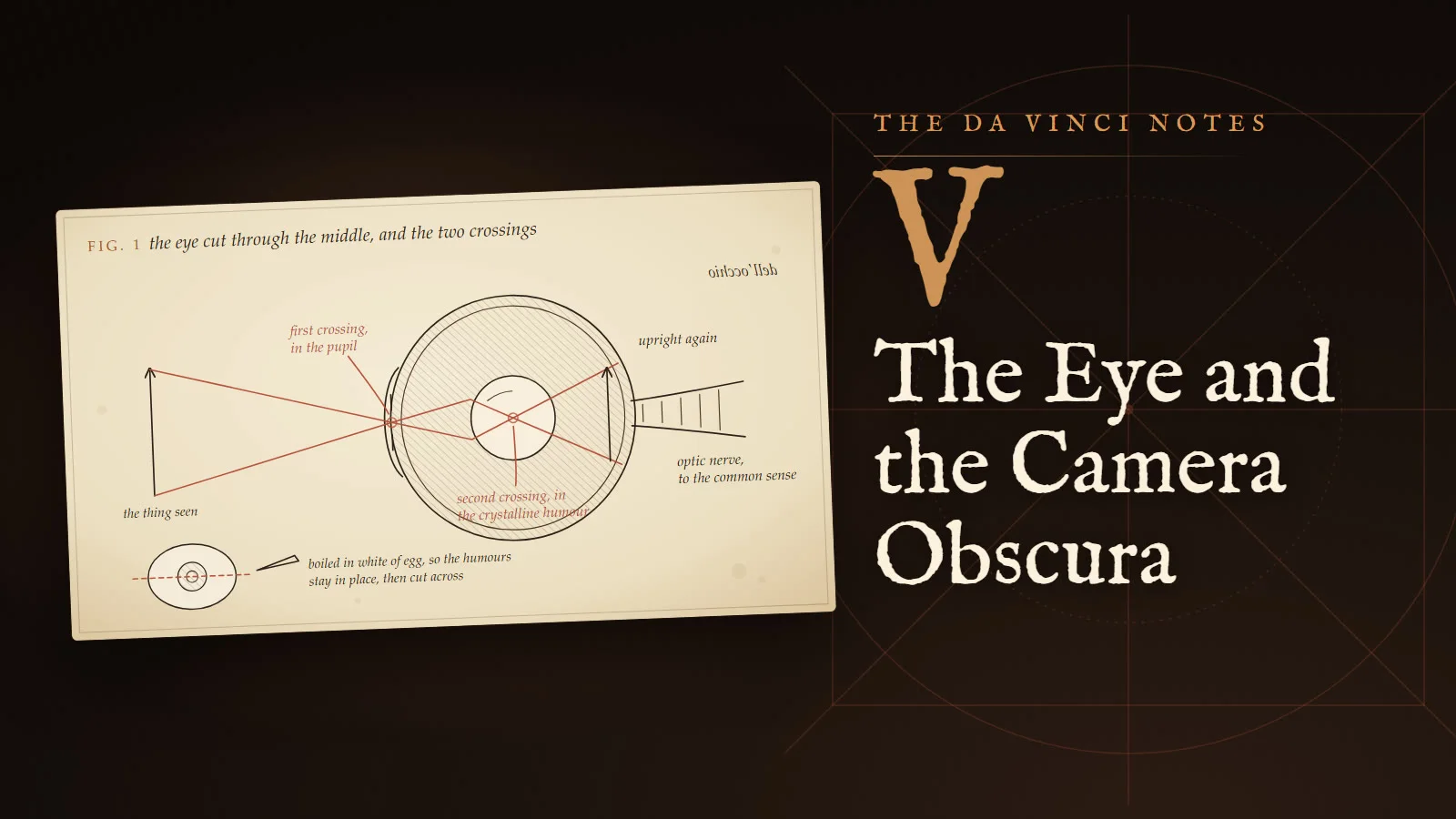
Florence, the spring of 1508, a room on the upper floor of Piero di Braccio Martelli's house, with one shutter that I have bored through with an auger and plugged with a wad of linen. My sheets are in disorder, and this year I mean to make order in at least one subject. I have chosen the eye, because every other subject passes through it. For sixteen years I have written about it in the margins of perspective, of light and shade, of painting. Now I want a small book that holds only the eye, and in it one question that has followed me since I first darkened a room in the Corte Vecchia in Milan: if the world comes into the eye through a hole as small as a lentil, and every image that passes through a small hole is turned upside down, why do we see the world the right way up?
Who would believe that so small a space could contain the images of all the universe? O mighty process!
Leonardo da Vinci, Codex Atlanticus f. 345v-b, trans. Edward McCurdy, Leonardo da Vinci's Note-Books (1906)
Milan, 1492. Against the rays that go out of the eye
I begin with the old error, so that I can stand on its ruins. The ancients say that the eye sees by sending out a visual virtue that goes to the thing and touches it, as a blind man touches a wall with his stick. Euclid draws his lines of sight going out from the eye, and here in Milan Bramantino says the same to anyone who will listen.
I say that this is impossible, and I prove it by time.
Proportion
- If the eye sent out a virtue to the thing seen, that virtue would have to travel from the eye to the thing, and nothing travels without time.
- When I open my eyes at dawn I see the sun as quickly as a candle at one braccio. Yet the sun is many thousands of times farther than the candle, and if the virtue went at the pace of anything I know, a bird, a stone from a sling, an arrow, the time for the sun would be to the time for the candle as the distance of the one is to the distance of the other.
- Therefore the virtue would arrive at the sun late, by days or months, and I should see the sun long after I opened my eyes. This does not happen. Therefore the eye sends nothing out, and the images come in.
I wrote it down in the form that pleased me best: the virtue going out of the eye "could not travel so high as the sun in a month's time when the eye wanted to see it" (Richter §68). And the wind would bend such a virtue as it bends a perfume, yet a strong wind never moves the things I see.
Margin
Here the adversary says: then how does a whole city get into a hole the size of a lentil? I answer with the stone thrown into a pond. It becomes the centre of many circles, which cross one another without breaking. So every thing in the lit air fills it with images of itself, the whole everywhere and the whole in every smallest part, and the eye, wherever it is put, takes them in by a single point. What happens to them after the point is the question of this book.
Reflection
The eye, whose function we know so certainly by experience, has been defined by an infinite number of authors as one thing, and I find by experience that it is quite another (Richter §21). I am a man without letters, they say, and cannot read the Greeks in their own tongue. The Greeks never put their eye to a hole in a shutter.
To do
- "Try to get Vitolone, which is in the library at Pavia" (Richter §1448). Witelo has, I am told, more than eight hundred conclusions in perspective. See what he says of the crossing of the rays.
- Ask the friars at San Francesco whether they have Pecham's Perspective in a copy that can be lent.
- Find out from the Marliani whether their father's books contain anything on the eye.
Milan, about 1490 to 1494. A dark room in the Corte Vecchia
The experiment that made me certain was simple, and anyone with a shutter can make it.
Experiment No. 1
Apparatus: a room on the upper floor of the Corte Vecchia, where I have my workshop and where the great clay horse stands. Its one window faces the open space towards the cathedral works, which the sun lights from late morning. I closed the shutter, stopped every crack with rags and paste, and with a gimlet made one round hole through the board about as wide as a grain of millet. I hung a white cloth on the opposite wall, eight braccia from the shutter (Milanese braccia; about four and three quarter metres).
Procedure: I waited in the dark for as long as it takes to say the Miserere twice, so that the pupils might open, and then looked at the cloth.
Result: the whole piazza was on the cloth, the scaffolding of the cathedral, a cart with two oxen, the masons on their ladders, all in their proper colours and all upside down, the oxen walking with their feet in the air. When the cart moved from my right to my left as I looked out of the window, its picture moved from my right to my left as I looked at the cloth with my back to the shutter. When I opened a second hole a span from the first, a second piazza appeared beside the first, equally complete.
I wrote the experiment out properly later, so that a stranger could repeat it.
if, in the front which does not face the sun, you make a small round hole, all the illuminated objects will project their images through that hole and be visible inside the dwelling on the opposite wall which may be made white; and there, in fact, they will be upside down
Leonardo da Vinci, trans. J. P. Richter (1883), §70
And from the second hole I drew the conclusion I had been looking for since the pond: if a second hole gives a second complete picture, and a third a third, then the images of all the things in the piazza were already present at the place of each hole before I made it, all of them in every point of the shutter. The hole only chooses among them.
Calculation
Why upside down. The rays are straight lines, as the shadows prove, which are always cut by straight edges. Take the top of the tallest scaffold and its foot. The ray from the top comes down to the hole and, being straight, goes on downwards after it, and strikes the cloth low. The ray from the foot comes up to the hole and goes on upwards, and strikes the cloth high. So the top is at the bottom and the foot at the top, and every part between them in its place reversed. The rays cross at the hole as two sticks cross when you hold them in one fist.
And the size. The scaffold and its picture are the bases of two similar pyramids whose common apex is the hole, so \( h : H = f : u \), where \(H\) is the height of the scaffold, \(u\) its distance, \(f\) the distance of the cloth and \(h\) the picture. The scaffold is near sixty braccia high and about two hundred braccia from the shutter; the cloth is at eight. So the picture is \( 60 \times 8 \div 200 = 2\tfrac{2}{5} \) braccia, and so it was within a finger when I measured it with a rod.
Margin
Later, in Ms C, I noted a stranger thing: the thin moon sent through a small hole makes on the paper the shape of the moon. "The moon, shaped like a boat, if transmitted through a hole is figured in the surface [it falls on] as a boatshaped object" (Richter §214). A round hole paints what is outside, whatever its own shape.
Experiment No. 2
The size of the hole. I bored the shutter with three augers, the smallest a needle heated in the fire, the middle one as wide as a lentil, the largest as wide as my little finger, and stopped the two that were not in use with wax.
- With the needle's hole the picture was so dim that I could barely make out the tower, even after a long time in the dark, and only the brightest parts, the sunlit stone and the sky, could be told apart. I could not say whether it was sharper, because I could hardly see it.
- With the lentil, the picture was clear and bright enough to see the masons, but their edges were a little soft, as a drawing in red chalk is soft when rubbed with the finger.
- With the finger, the cloth was bright, but the picture had melted: the tower was a pale stripe, the oxen a brown smudge, the masons gone.
So the small hole gives a sharp picture and little light, and the large hole much light and no picture. Between them there is a hole that gives the most that can be had of both, and it depends on the distance of the cloth. I must find the rule.
Florence, 1508. The little hole in a thin plate of iron
Here in Martelli's house I have repeated the dark room with more care, and written it so that the experiment will serve both the painter and the anatomist.
Then, receive these images on a white paper placed within this dark room and rather near to the hole and you will see all the objects on the paper in their proper forms and colours, but much smaller; and they will be upside down by reason of that very intersection.
Leonardo da Vinci, trans. J. P. Richter (1883), §71
The improvements over the room in Milan: the hole is made in a very thin plate of iron, because a thick board makes a little passage whose sides cut off the slanting rays and darken the edges of the picture; and the paper is extremely thin, oiled a little and stretched on a frame, so that I may look at it from behind. Seen like that, the picture is painted in light as if by a miniaturist, so true that I could trace it.
Margin
From inside the room, with my back to the hole, the picture is upside down and left and right are as they are outside. From behind the paper they change places too, so that the scene is turned a half circle, as if I had turned the sheet in my hands. The second reversal is only a matter of where I stand.
Proportion
The rule for the hole, worked from the pyramids, one step at a time.
- Every point of the tower sends its image to every point of the hole. So a single point arrives at the paper as a little patch of light, the base of a pyramid whose apex is the point on the tower and whose waist is the hole. When the tower is far and the paper near, the patch is very nearly as big as the hole.
- The patches of neighbouring points lie on top of each other, so every edge is smeared over the breadth of the hole: the softness I saw with the lentil, the melting with the finger.
- The picture grows with the distance of the paper and the patches hardly grow at all. So the softness, judged against the picture, is as the breadth of the hole is to the size of the picture, and doubling the distance of the paper halves it.
- Now the light. It comes in as the area of the hole, which goes as the square of its breadth, and is spread over the picture, whose area goes as the square of the distance of the paper. So the brightness of the paper is as the square of the breadth of the hole divided by the square of the distance of the paper: \( b_1 : b_2 = (d_1 : d_2)^2 \) for the same paper, and \( b_1 : b_2 = (f_2 : f_1)^2 \) for the same hole.
- So to move the paper twice as far and keep the same brightness, I must make the hole twice as wide; and then the smearing, judged against the picture, is exactly as before. A painter who knows this can choose his room.
Calculation
For my room here. The campanile of Santa Maria del Fiore is in my view across the roofs; I judge it at about two hundred and fifty braccia from the shutter and a hundred and forty-five braccia high (Florentine braccia, here and below; a braccio is about fifty-eight centimetres). The paper at three braccia from the hole gives a picture \( 145 \times 3 \div 250 \), a little less than \( 1\tfrac{3}{4} \) braccia tall. A hole the breadth of a lentil, about a hundred-and-twentieth of a braccio, smears every edge by one part in two hundred of the picture: as fine as my thinnest pen line on a sheet the length of my forearm. A hole the breadth of my finger, a fortieth of a braccio, smears it by one part in seventy, and soft. The finger with the paper at one braccio gives a picture four tenths of a braccio tall, smeared by one part in twenty-three: patches.
I have drawn it as Plate V. Make the hole larger or smaller, move the paper nearer or farther, and watch the picture of the tower change: it grows with the distance of the paper, it melts when the hole is wide, it darkens when the hole is small or the paper far. The button below the drawing shows it from behind the paper, as I look at it.
To do
- Have the smith beat a plate of iron as thin as a knife's edge, a span square, and drill holes in it of a twelfth, a twentieth, a fortieth and a sixtieth of a braccio. Mark each.
- Measure the campanile with the quadrant from the piazza before trusting the hundred and forty-five braccia.
Florence, 1508. The eye is such a chamber
"And the same takes place inside the pupil." I wrote those words at the end of the experiment with the iron plate (Richter §71), and they are the hinge of the whole book. The eye is a dark chamber; the pupil is the hole; the back of the eye is the paper. Then the picture in the eye must be upside down. And yet I see the tower standing on its foot.
There are two ways out. Either the picture in the eye is upside down and something after the eye turns it, or the eye itself turns it a second time before the picture is taken. I could not believe the first. The senses send their images to the common sense, the senso comune, where judgement is made, by way of the nerves, and I cannot see how a picture could be turned over in a nerve. So I chose the second, and built the eye to do it.
No image, even of the smallest object, enters the eye without being turned upside down; but as it penetrates into the crystalline lens it is once more reversed and thus the image is restored to the same position within the eye as that of the object outside the eye.
Leonardo da Vinci, trans. J. P. Richter (1883), §78
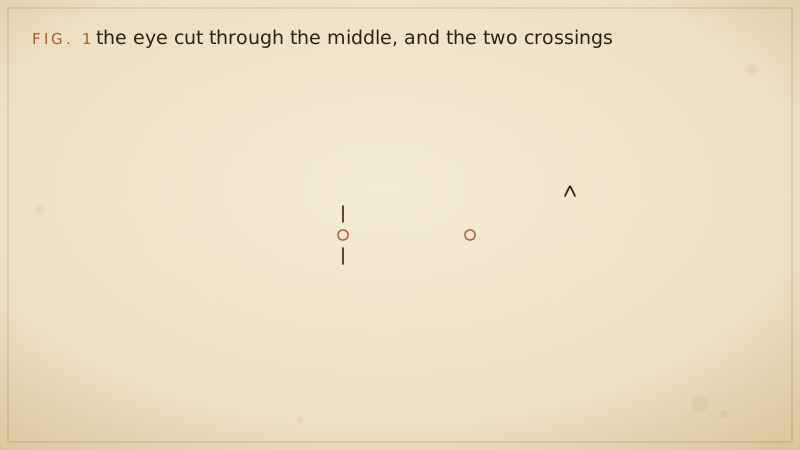
The first crossing is in the pupil, as in the hole of the shutter. Then the rays go on, reversed, to the crystalline humour, which I place in the middle of the eye as a round ball of clear matter. There they are bent, passing from a rarer body into a denser, as a stick seems broken at the surface of water, and cross a second time, and so arrive upright at the nerve that carries them to the senso comune.
Draftsman's note
Fig. 1 as I want it: the ball a full circle with its coats as two lines, the lower half hatched lightly; the crystalline a small white circle at the very centre; the rays in red chalk, with small red circles at the two crossings; the nerve a tube going away to the right; under it all the egg, cut across, with the eye inside.
Experiment No. 3
The anatomy of the eye is the most difficult of all, because when you cut an eye the humours run out and you see a little bag of skin and nothing of its order. So I took the eye of an ox from the butcher at the Mercato Vecchio, set it whole in a small pot, covered it with the whites of a dozen eggs, and put the pot on the fire until the whites set hard. Held in the hard white, the eye does not collapse. Then I cut the whole egg across with a thin knife.
Result: the eye in section, all its parts in place. The coats like the coats of an onion; the clear humour of the front; the black of the uvea round the pupil; and towards the middle the crystalline, turned white and hard by the boiling, round like a pea. Behind it the vitreous, clouded by the heat, and the nerve going away at the back, a little to one side of the middle.
Margin
A doubt, written the next morning. The fire turns the white of an egg from clear to white. It has done the same to the crystalline. Has it also changed its shape, made it rounder, moved it towards the middle? In the living eye it is clear, and I cannot see it without cutting. Write it down as a doubt and do not hide it.
Reflection
I have come to the crystalline from two sides, from the dark room and from the knife, and yet I am not content. The dark room taught me that a picture made by a small hole is upside down. My reason told me that a picture cannot be turned over in a nerve. So I gave the crystalline the task of turning it back, because it is there, and round, and bends the rays. I have seen the first crossing on the paper with my own eyes. The second I have only reasoned.
Margin
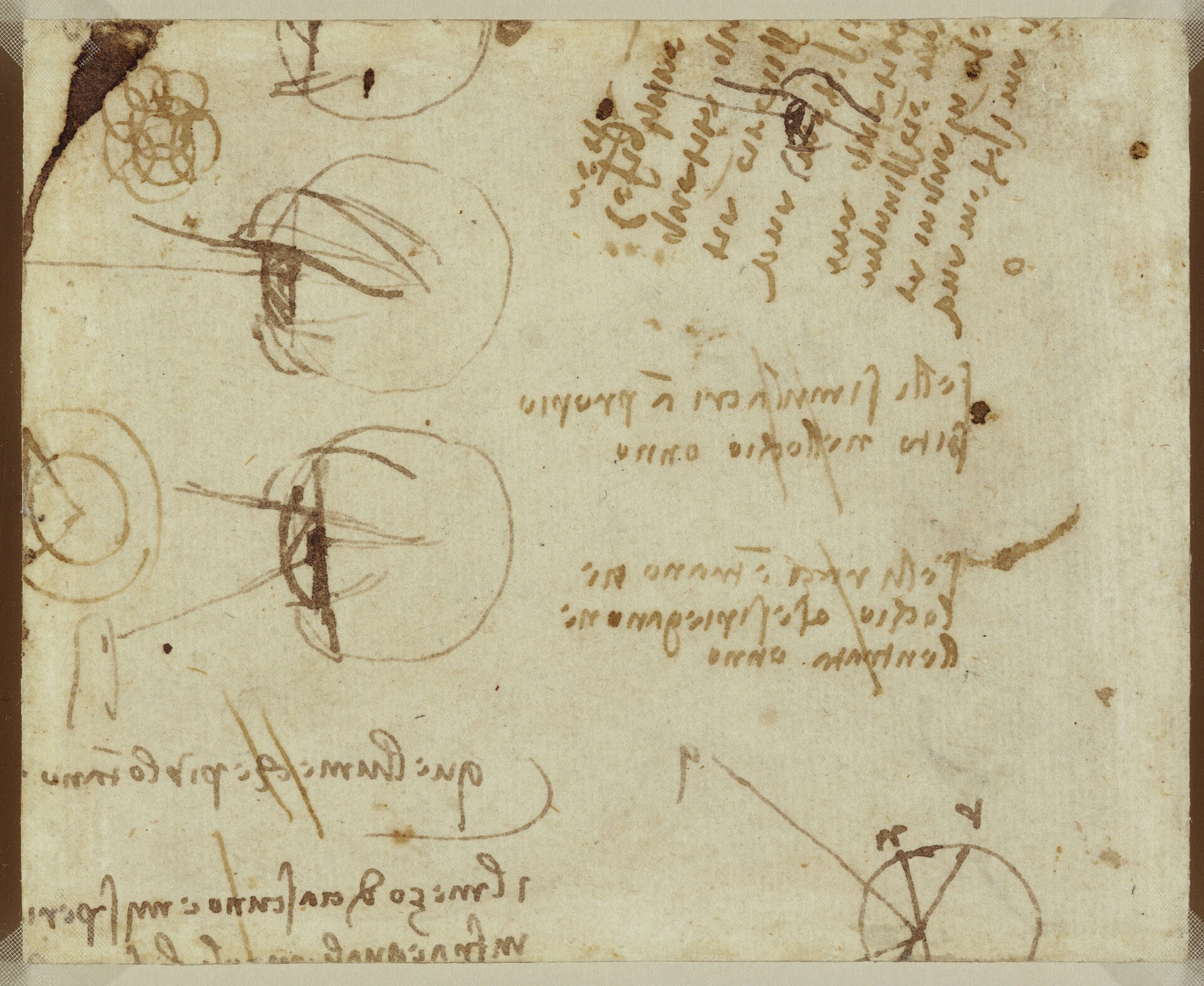
On an old sheet from Milan I find the same eye drawn eighteen years ago, a circle with the rays going in at the pupil, and beside it notes I no longer agree with. I was already drawing the eye as a chamber. I had not yet asked what turns the picture.
To do
- Make an eye of glass: a large clear globe full of water, with a small ball of crystal in the middle, and look through it at the window, to see whether the picture comes out upright behind it.
- Get the eyes of an owl, of a cat and of a man, when the hospital of Santa Maria Nuova allows it, and boil them in the same way.
Florence, 1508. The pupil that opens and closes
If the eye is a dark room, then its hole is not of fixed size, for the pupil grows and shrinks, and by the rule of Plate V the brightness of the picture inside must change as the square of its breadth. I have watched it for years, in my own eye in a mirror and in the eyes of cats.
Observation 1
The pupil of the eye contracts in proportion to the light that falls on it, and expands as the light diminishes. In the cat, the owl and the other creatures of the night the change is far greater, from a line to a full circle (Richter §24).
Observation 2
When you come out of the sunlight into a church, everything is black at first, and then by degrees the chapels and the pictures come out of the dark. The pupil, which was small in the light, takes time to open. And in the same way, coming from the dark into the sun, you are dazzled until it closes. I learned this in the hardest way a painter can.
since it takes some time to dilate and contract, it cannot see immediately on going out of the light and into the shade, nor, in the same way, out of the shade into the light, and this very thing has already deceived me in painting an eye, and from that I learnt it.
Leonardo da Vinci, trans. J. P. Richter (1883), §36
The eye I spoiled was in a portrait in Milan. I drew the pupil from the sitter while she sat by the window, and painted its colour after she had sat a long time in the shade of the room, and the two did not agree: the pupil too small for the darkness of the iris around it, as if she were staring at the sun. Since then I draw the pupil and paint it in the same light.
Calculation
How much the pupil changes. In the sun at noon I measure my own pupil in the mirror, against a scale held beside the eye, at about a twenty-fourth of an oncia; in my dark room after the Miserere it is nearly a sixth (Milanese once; an oncia is a twelfth of a braccio, about five centimetres). Four times the breadth, and so sixteen times the light, without my asking.
Reflection
People call the eye the window of the soul. I wrote it myself in the book on painting, where I praised the painter against the poet:
The eye, which is called the window of the soul, is the principal means by which the central sense can most completely and abundantly appreciate the infinite works of nature
Leonardo da Vinci, trans. J. P. Richter (1883), §653
"Which is called": I set it down as a common saying, the way one cites a proverb. Tonight, with the boiled eye in its egg on my table, I find it truer than I thought, and stranger. A window: a little hole in a dark wall, through which the images of the whole hemisphere, the sun in the east and the moon in the west together, pass by one point and cross there without mingling, to be judged on the other side.
Problems I set myself
1. A tower forty braccia high stands one hundred and twenty braccia from a shutter with a small hole. The paper is set two braccia behind the hole. How tall is the picture of the tower, and which way up?
Answer. The tower and its picture are the bases of two similar pyramids with their apex in the hole, so the picture is to the tower as two is to a hundred and twenty: \( h = 40 \times 2 \div 120 = \tfrac{2}{3} \) of a braccio, about 39 centimetres, upside down. Move the paper to four braccia and the picture is one and a third braccia; the size goes in exact proportion to the distance of the paper.
2. A hole the breadth of a lentil gives a picture bright enough to paint by when the paper is at one braccio. I want the paper at three braccia, to have a larger picture. How wide must I make the hole to keep the same brightness, and what happens to the softness of the edges?
Answer. The brightness goes as the square of the breadth of the hole divided by the square of the distance of the paper. Tripling the distance divides it by nine, so the area of the hole must be multiplied by nine, and its breadth by three: three lentils wide. The picture is three times as tall and every point is smeared over three times the breadth, so the softness, judged against the picture, is exactly as before.
3. A campanile a hundred braccia high stands two hundred braccia away and the paper is at four braccia. I want no edge smeared by more than one part in two hundred of the picture. How wide may the hole be?
Answer. The picture is \( 100 \times 4 \div 200 = 2 \) braccia tall. One part in two hundred of it is a hundredth of a braccio. Each point of the campanile lands as a patch a little wider than the hole, by the factor \( 1 + 4 \div 200 = 1.02 \), so the hole may be about a hundredth of a braccio, a little less than six millimetres in a Florentine braccio of 58.4 centimetres. At four braccia, about 2.3 metres, this is far above the smallest useful hole of the last section, about 1.8 millimetres, so here geometry alone rules.
To the student who reads this later
On the dark room I was right, and I was not the first. Ibn al-Haytham, whom the Latins called Alhazen, described in his Book of Optics, written about 1011 to 1021, how the light of several candles passes through one hole into a dark place and makes a separate spot for each candle, crossing without mixing. Pecham and Witelo carried his work into Latin. What I added was the use of the chamber to explain the eye, and the habit of measuring.
On the eye I was wrong twice, each time for a good reason. The crystalline lens hangs just behind the iris, far from the centre, and in the living eye it is a flattened lens, convex on both faces, about four millimetres thick and nine across; my boiled specimens made it a white ball and may have shifted it. And there is no second crossing. Felix Platter in Basel argued in 1583 that the retina is the seat of sight. Johannes Kepler showed in 1604, in his Ad Vitellionem paralipomena (a supplement to the Witelo I wanted to borrow), that the lens focuses the rays to an inverted picture on the retina. Christoph Scheiner, about 1619 to 1625, cut away the back of an ox's eye and saw the little inverted picture, and Descartes drew the same experiment in his Dioptrique of 1637. The upright world is made in the brain, which has never been told which way up its picture is, and learns from the hand and the foot where up is. My objection, that a picture cannot be turned in a nerve, was right in its way: nothing turns it, and the brain reads it as it lies.
The pinhole in the iron plate you can now treat with exact formulas. For a pinhole of diameter \(d\), an object at distance \(u\) and a screen at distance \(f\), the picture has magnification \(f/u\), and each point is spread by the geometry into a disc of diameter
\[ b_{\text{geo}} = d\left(1 + \frac{f}{u}\right). \]
Light is a wave, which I did not know (Grimaldi named diffraction in 1665, and Young and Fresnel explained it in the 1800s), and a very small hole spreads it again, into an Airy disc of diameter
\[ b_{\text{diff}} \approx \frac{2.44\,\lambda f}{d}, \]
with \(\lambda\) about 550 nanometres for green light. The two pull in opposite directions, and the blur is least when they are about equal, at
\[ d_{\text{best}} \approx \sqrt{2.44\,\lambda f}, \]
about 1.2 millimetres for a screen at one metre and 1.8 millimetres at my four braccia. Lord Rayleigh worked out this optimum for pinhole photography in 1891 and found a similar rule with a somewhat larger constant. My needle-hole picture, which I could not judge, was blurred by this second effect as well as darkened. The brightness: a white screen behind a pinhole receives a fraction
\[ \frac{E_{\text{screen}}}{E_{\text{scene}}} = \frac{1}{4N^2}, \qquad N = \frac{f}{d}, \]
of the illumination on the sunlit scene. With a one-millimetre hole and a screen at one metre, \(N = 1000\) and the paper gets one part in four million: you need a very dark room and eyes that have waited, as I waited through two Misereres. Your photographers call \(N\) the f-number, and the eye's own is between about 2 and 8 as the pupil goes from 8 millimetres to 2: sixteen times the light, as I reckoned.
What to try at a table. Tape kitchen foil over one end of a shoebox and tracing paper over the other. Prick the foil with a fine needle, then a thick one, then a pencil point, and from a dark room, with a coat over your head, look at the tracing paper from behind with the box pointed at a lit window: my three augers. Measure the box's length and the window's size and distance, and test \(h : H = f : u\). Then darken a real room with cardboard over the window and a hole of about a centimetre for a picture across the whole wall. Never look at the sun through the hole, and never look at the sun at all; the picture of the sun on the paper is safe, the sun in the eye is not.
If you want to argue with me about the second crossing, or tell me what the brain does with a picture that is upside down, come and ask me.
Sources and liberties
The Da Vinci Notes are a modern reconstruction written in Leonardo da Vinci's voice by Eternal Gardens. Dates, places, manuscripts, drawings and quotations come from the sources below; the order of the working, the private reflections, the plates and the sketches are ours.
- J. P. Richter, The Notebooks of Leonardo da Vinci (1883; Project Gutenberg ebook 5000): §21, §24, §36 (the eye and the pupil), §66 to §71 (images in the air, the dark chamber, the refutation of rays from the eye, which Richter dates to Milan, 1492), §78 (the two intersections), §214 (the moon through a hole), §653 (window of the soul), §1448 (Vitolone at Pavia): Project Gutenberg
- Edward McCurdy, Leonardo da Vinci's Note-Books (Duckworth, London, 1906), for Codex Atlanticus f. 345v-b ("Who would believe that so small a space..."): Internet Archive
- Paris, Bibliothèque de l'Institut de France, Manuscript D (about 1508), Leonardo's short treatise on the eye, with the camera obscura and the double intersection; and the late anatomical note on boiling the eye in white of egg before cutting it, which we paraphrase rather than quote.
- Royal Collection Trust, RCIN 912447, recto a grotesque old woman, verso studies of optics, about 1490, a fragment of the Codex Atlanticus: rct.uk
- Ibn al-Haytham, Kitāb al-Manāẓir (Book of Optics), about 1011 to 1021; Johannes Kepler, Ad Vitellionem paralipomena (Frankfurt, 1604); Christoph Scheiner, Oculus (Innsbruck, 1619); René Descartes, La Dioptrique (Leiden, 1637); Lord Rayleigh, "On pin-hole photography", Philosophical Magazine 31 (1891).
- Martin Kemp, Leonardo da Vinci: The Marvellous Works of Nature and Man (Oxford University Press, revised edition 2006), on the optics of Manuscript D.
The experiments in the Corte Vecchia and in Martelli's house, the measurements, the spoiled portrait and the ox's eye are our reconstruction from his written procedures; Leonardo describes the methods; these particular trials are ours. "Window of the soul" is an old commonplace that he cites as such ("which is called"). Leonardo is often credited with inventing the camera obscura; he did not, though he was among the first to use it to explain the eye.