 by Marie Curie

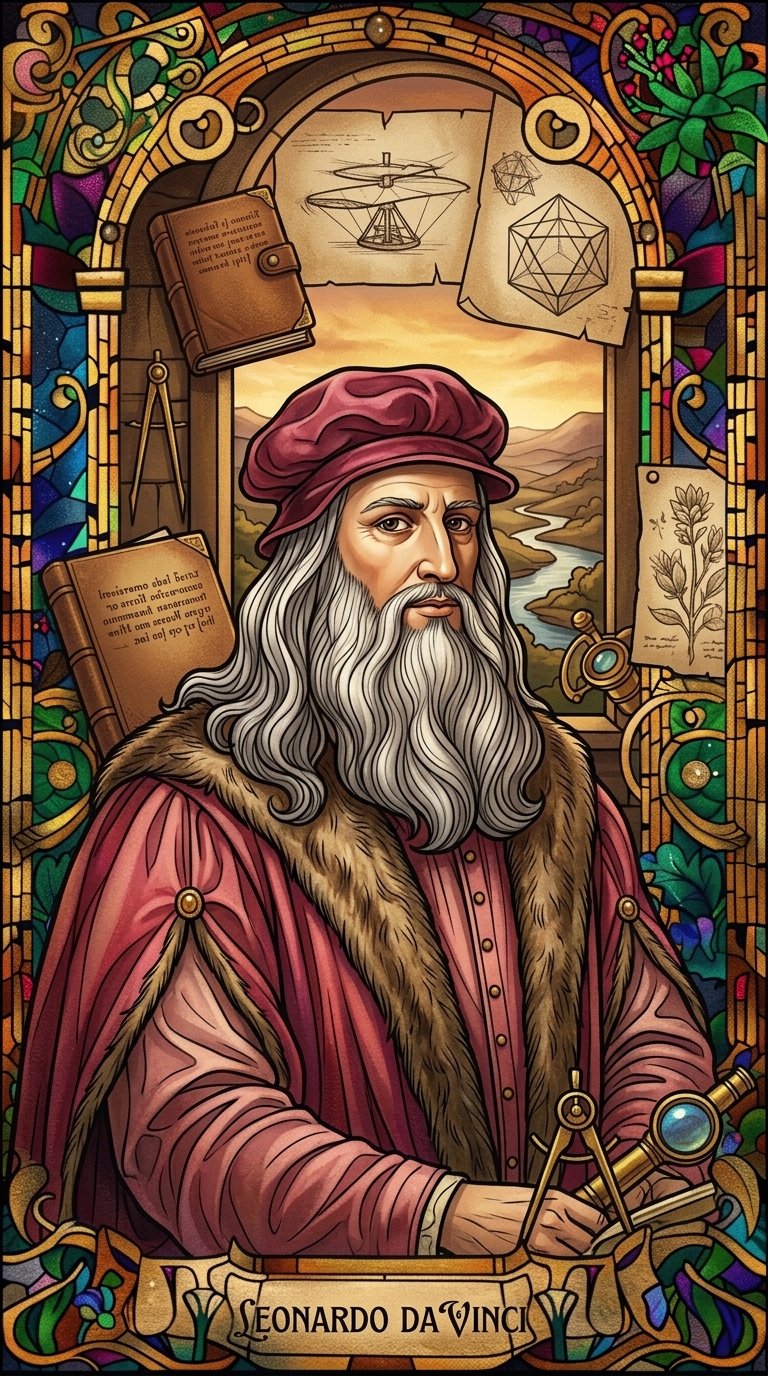
Milan, the spring of 1489. On the table in front of me is a human skull, cleaned and dry, with the jaw tied on by a cord so that it does not fall when I turn it. Painters have drawn skulls for a hundred years as a warning to the living, a grin at the foot of a cross. I want something else from this one. Every face I shall ever paint is built over a skull like it, every look of the eyes comes from behind it, and somewhere in the dark inside it the five senses bring what they have gathered to a single judge. The philosophers call that judge the senso comune, the common sense, and they say where it lives without ever having looked. I mean to look. First I must measure the case, the way I would measure a building before I ask what goes on in its rooms.
The soul seems to reside in the judgment, and the judgment would seem to be seated in that part where all the senses meet; and this is called the Common Sense.
Leonardo da Vinci, Windsor, Anatomical MS B, f. 2r, trans. J. P. Richter (1883), §838
Milan, 2 April 1489. A book entitled Of the human figure
Today I took a new quire of small sheets, each a little larger than my open hand, and wrote at the top of the first of them the day and the year. "On the 2nd of April 1489, book entitled 'Of the human figure'." A title is a promise. I have made many promises to books and kept few of them, so this time I wrote under the title what the book must hold, so that I can see how far I fall short.
The list came out in no order, the way questions come when you sit with a skull for an evening. I begin with the eyes, because they are the first of the senses and the chief of them. "Which nerve causes the motion of the eye so that the motion of one eye moves the other?" When I turn my eyes to the window both go together, as if one hand held two reins. There must be a cause, and the cause must be inside the head where I cannot see it.
Then the face, which a painter must know better than any anatomist: the frowning and raising of the brows, the lifting of the nostrils, the pouting, the smiling, the look of astonishment, each a cord pulled somewhere under the skin. Then the things that happen to a man without his leave. "What sneezing is. What yawning is." Then the nerves that move the arm and the leg down to the last joints, and the beginning of a man in the womb.
It is too much for one book. But a list of questions is a map of my ignorance, and a map is the first thing a traveller needs.
Margin
I have been told by the physicians, who have it from Galen and from Avicenna and from Mondino's little book on dissection, that the brain has three cells one behind another, and they draw them as three bubbles in a row inside an outline of a head. Not one of them could tell me how big the bubbles are, or where they sit against the bones of the face. A doctrine with no measures is a story. I want the measures.
To do
- A saw for bones with fine teeth; I have already written it in another list, "a saw for bones with fine teeth", and still have not bought it.
- Ask the barber who pulls teeth in the Broletto to keep for me a jaw with all its teeth in it.
- Draw the skull from the side, from the front, and sawn through, always from the same distance, so that the drawings can be laid one over another.
- A rule of a head divided into twelve fingers, made of boxwood, to lay against the bone.
Milan, April 1489. The skull sawn through the middle
I have sawn the skull in two from the forehead to the nape, straight down the middle, with the fine saw at last, slowly, the dust of it as white as flour. Now I have two halves, each a mirror of the other, and I can see the inside of a head as a builder sees a house when one wall has been taken away.
What I see first is how small the room is for so great a tenant and how much of the head is something else. Below and in front of the case of the brain there is a whole second building: the cavities of the nose, filled with little scrolls of bone like rolled paper; and above the eyes, inside the bone of the forehead, a hollow I did not expect, closed on every side, that I shall have to think about. The case of the brain itself is a bowl of bone, thick at the base and thinner at the top, its floor stepped like the floor of a church built on a hillside, with a saddle in the middle where the bone rises and falls again.
Draftsman's note
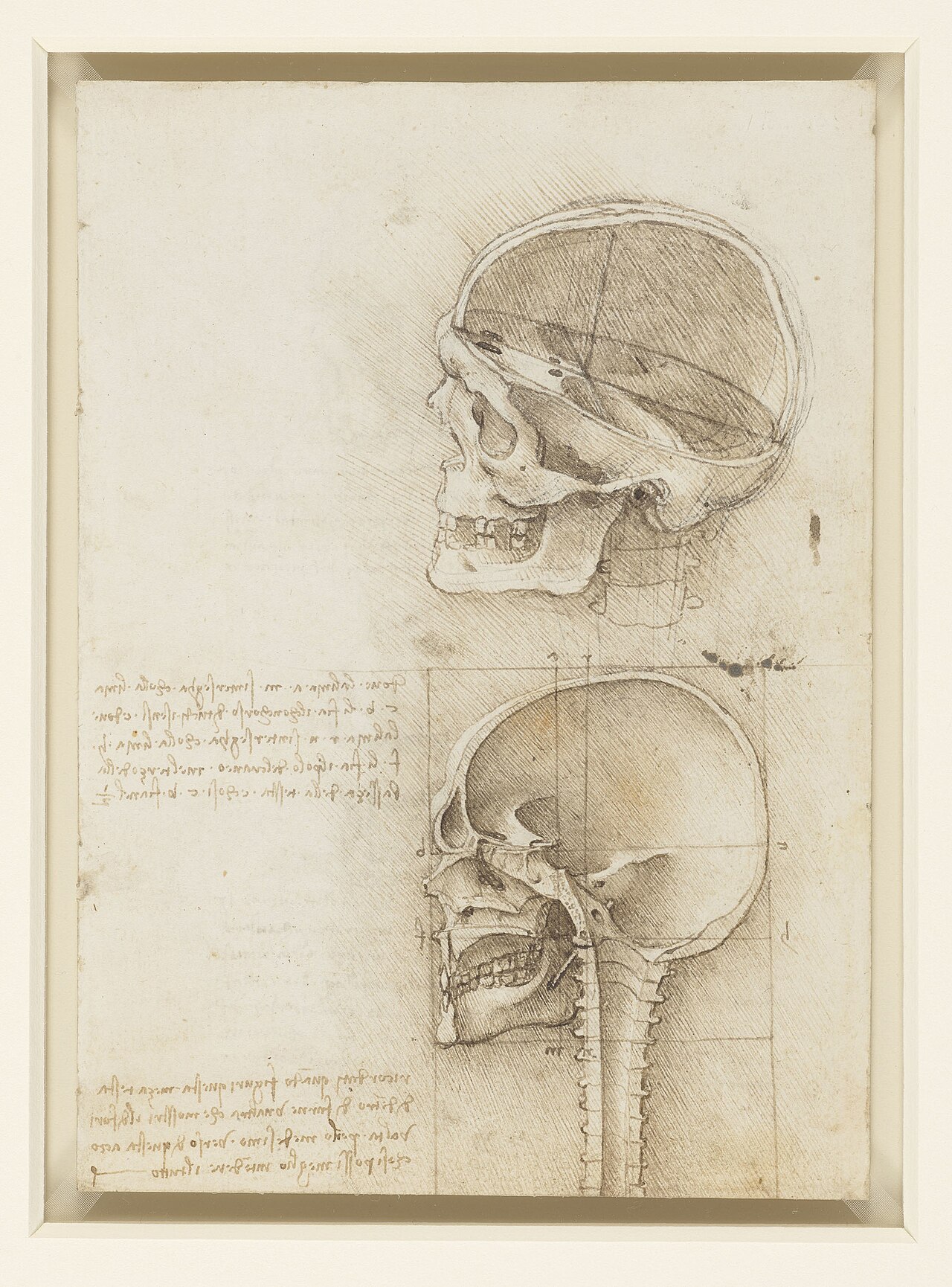
On the upper half of the sheet I drew the whole skull seen from the left side, with the vault sawn round level and the part of it on this side lifted away, so that the hollow of the case shows and the eye can measure its depth against the face. Inside it I drew the lines I shall explain tomorrow. On the lower half I drew the cut half, seen from the side of the cut, with the bones of the neck still hanging under it, and around it I ruled a frame. The cut edges of the bone I left white, so that the eye knows where the saw went.
Proportion
The frame around the lower drawing is the measure of the head, and the head is the measure of the man. On the sheet of the proportions after Vitruvius I give the head, from below the chin to the top, an eighth of the man. With my man of three braccia, and the braccio divided into 32 fingers, the head is
\[ \tfrac18 \times 3 = \tfrac38 \text{ braccio} = \tfrac38 \times 32 = 12 \text{ fingers}. \]
Twelve divides into halves, thirds, quarters and sixths without leaving crumbs. So I ruled the frame twelve fingers high, from the line under the chin to the line on the crown, drew lines across it and up it, and lettered their ends so that I could name the crossings.
- A line from the front of the frame to the back at half the height, which is six fingers below the crown.
- A line straight down from the highest point of the vault to the floor of the case.
- A line across at a third of the height above the chin, four fingers up.
- A line straight up from the place at the back where the skull sits on the top of the neck.
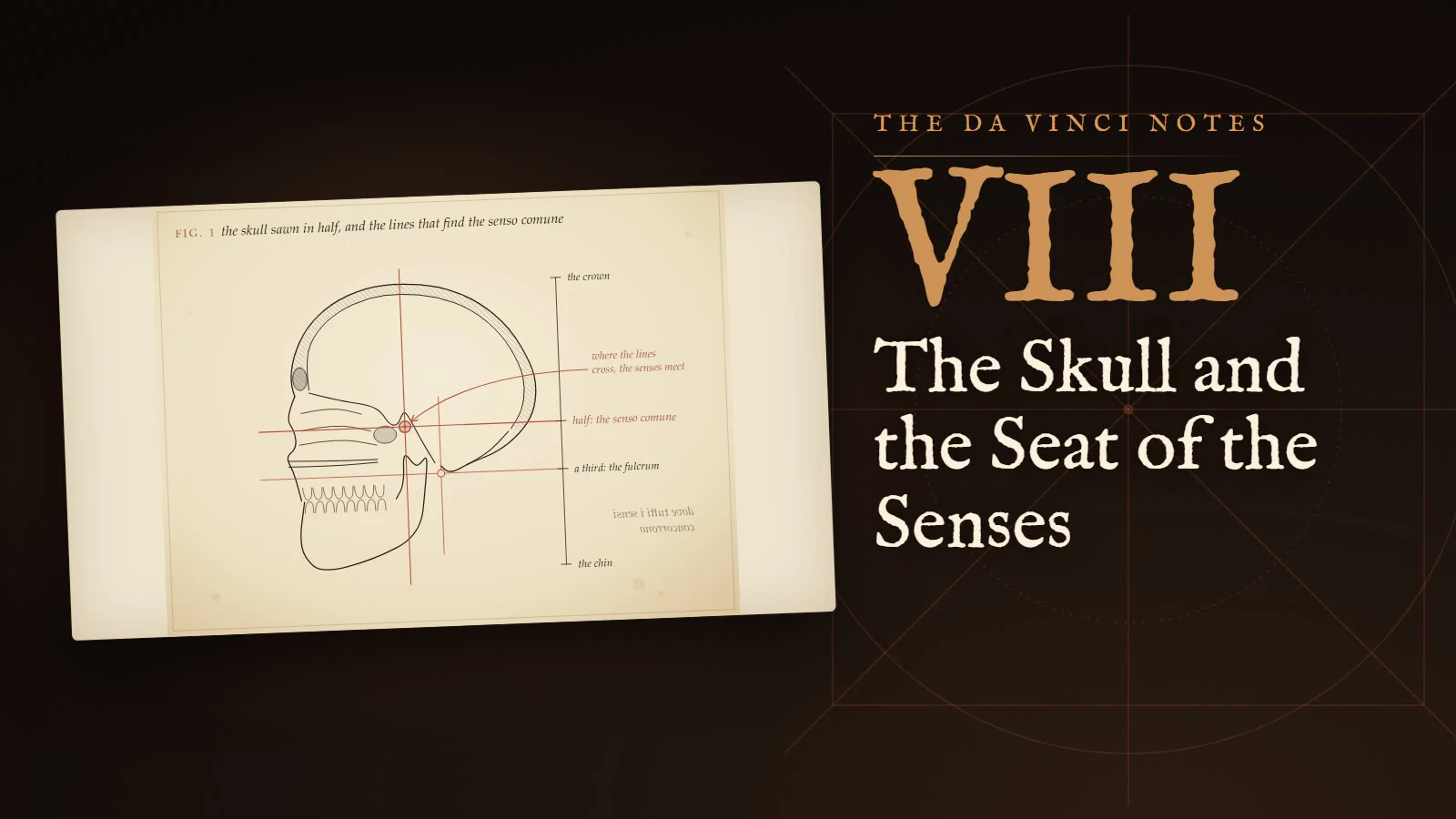
Then I wrote beside it, in my own words, what the crossings mean. Where the line a m is cut by the line c b, there is the meeting of all the senses. Where the line r n is cut by the line h f, there is the fulcrum of the cranium, the point on which the head turns when it nods, and it lies at a third of the height of the head.
Margin
The fulcrum gave me trouble. I wrote a third. When I look at the drawing with the compass, the crossing on the line at the back sits lower, nearer a quarter of the height than a third. Either the drawing is wrong or the sentence is, and since I made the sentence from the rule and the drawing from the bone, I suspect the sentence. A rule that is pleasant to say is the most dangerous kind. I leave both as they are, so that whoever comes after me can see the disagreement and measure a better skull than mine.
Reflection
The meeting of the senses has fallen exactly at the middle of the height of the head, on the vertical of its highest point. I did not put it there; the lines put it there, and the lines came from the bone. It pleases me more than it should. The middle is where an architect puts the thing that matters most, the altar under the dome. Or I have found what I hoped to find, which is the oldest mistake there is. I must test it against the nerves, which do not care what I hope.
Milan, April 1489. Three lines through the head
Two lines on a flat drawing fix a point on the paper; to fix a point inside a head I need three, one for each way a thing can go. So today I worked with the whole skull and the upper drawing, and set my three lines through it as a mason sets the strings of a foundation.
- The first line runs from front to back, level, through the middle of the height.
- The second line stands straight up through the highest point of the vault and comes down through the floor of the case.
- The third line runs across from side to side, along the ridge of bone that rises at the back of the saddle in the middle of the floor.
Where the three meet is a single point, and it lies a little behind the two holes in the floor of the case through which the nerves of the eyes come in from the sockets. I followed the nerves of the eyes with a thin wire as far as the bone would let me. They run backward and inward from the eyes and come together toward the same place. That is the test I wanted, and the nerves have passed it. The eye, the chief of the senses, sends its images to the point where my lines cross.
Proportion
On the next sheet I wrote down where the meeting of the senses stands against the parts of the head that a painter can see and touch, so that he can find it in a living face without a saw. I give it here in the order I wrote it.
- Above it, half a head, is the place where the bones of the top of the skull join, the crown.
- In front of it, on a level line, at a third of a head, is the lachrymal of the eye, the inner corner where the tears come out.
- Straight below it, at two fingers, is the uvula, where one tastes the food.
- Straight below it, at a foot, is the windpipe and the orifice of the heart.
Half a head is six fingers, a third of a head is four, a foot is a seventh of the man, nearly fourteen fingers.
I have drawn the skull again as Plate VIII so that you can saw it yourself, set my lines on it, and lay off any of my measures from the meeting of the senses. The last button puts the three cells inside, first as the physicians drew them in my day, then as the wax showed them to me many years later.
Calculation
In fingers, with the chin at nought and the crown at twelve:
- The meeting of the senses: \( 12 - 6 = 6 \), the middle.
- The uvula: \( 6 - 2 = 4 \), a third of the way up, the same height as the fulcrum at the back.
- The windpipe and the orifice of the heart: \( 6 - \tfrac{96}{7} = 6 - 13\tfrac57 = -7\tfrac57 \), that is, nearly eight fingers below the chin, in the throat at the top of the breast.
- The lachrymal: at the height of the meeting point, four fingers in front of it, so that the eye stands before the judge by a third of a head, as a sentry before a gate.
The uvula and the fulcrum at the same height pleased me: the head balances on the neck at the level of the back of the mouth, where a builder would put the hinge.
Milan, April 1489. The front sawn away
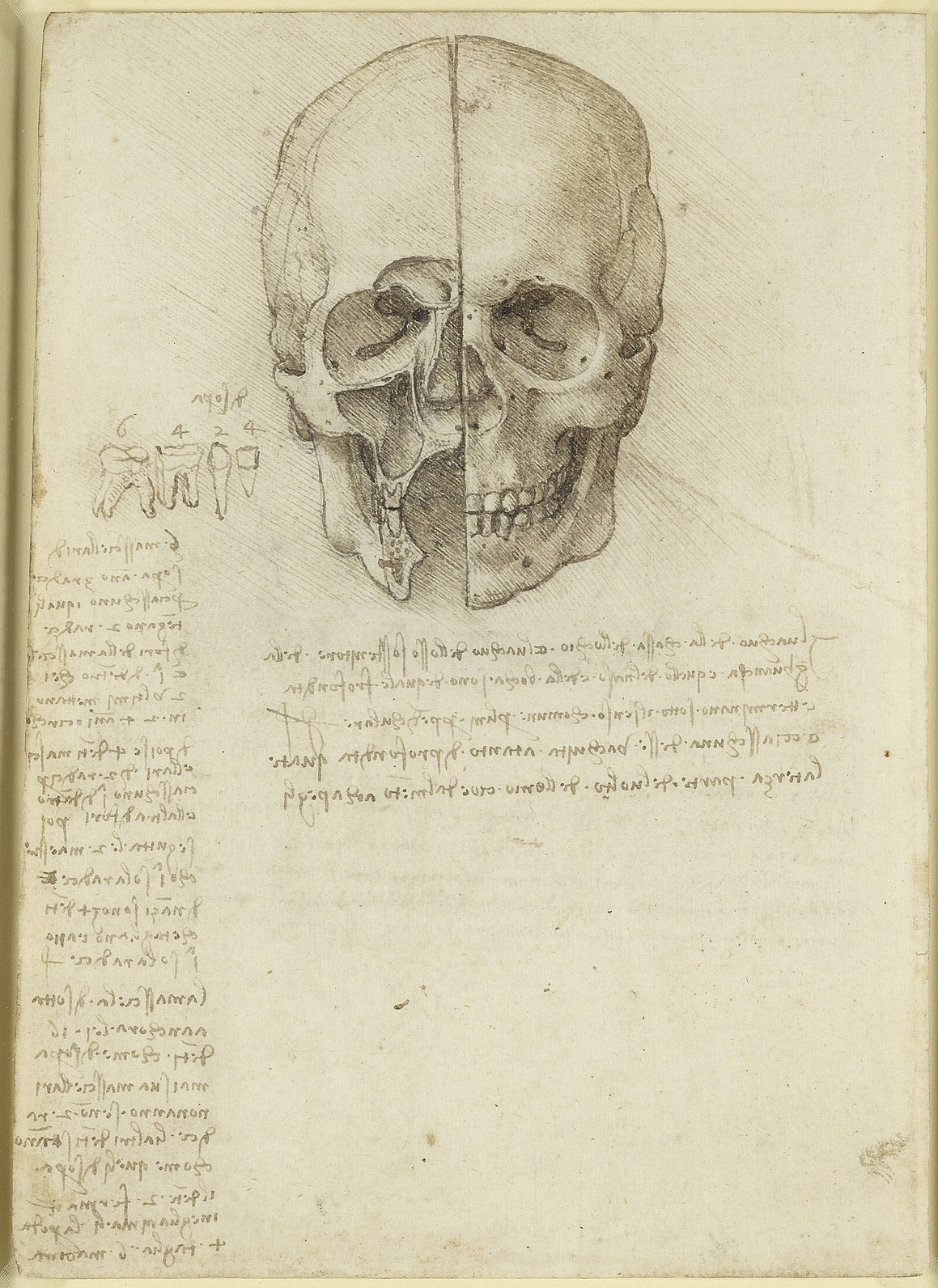
Today I took the other half of the skull and sawed away its front on one side, from the forehead down through the eye and the cheek to the teeth, so that a man looking at the face sees one half whole and the other half opened like a cupboard.
Draftsman's note
I drew the skull from straight in front, at the same size as the side views, and ruled a line down the middle of it from the crown to the chin. On the right hand of the drawing the face is whole. On the left hand everything in front of a certain depth is gone, and what is left shows the cavities as they lie one above another: the socket of the eye, under it the hollow in the bone of the cheek, beside it the passage of the nose, and below them the mouth.
Proportion
Here is what the cut shows, and I wrote it beside the drawing. The cavity of the eye, the cavity of the cheek bone, the passage of the nose and the mouth are of equal depth, and they all end on a perpendicular line that comes down from the meeting of the senses. Each of them is as deep as a third of the face, from the chin to the roots of the hair. The face is a tenth of the man on my Vitruvian sheet, \( \tfrac{96}{10} = 9\tfrac35 \) fingers, and a third of it is \( 3\tfrac15 \) fingers.
Four cavities, all the same depth, all ending under the same point. I would not have believed it from a drawing in a book. I believe it from the saw. It is as if the face were a front built out from a wall, and the wall were the plane that stands under the judge.
Calculation
The teeth, while I had the jaw open. I counted the kinds in one jaw and drew one of each beside the skull with its number over it: the grinding teeth at the back, six; the smaller ones in front of them with two roots or one, four; the eye teeth, two; the cutting teeth at the front, four. Then
\[ 6 + 4 + 2 + 4 = 16 \text{ in one jaw}, \qquad 2 \times 16 = 32 \text{ in the mouth}. \]
On the other sheet I had written that the roots of the upper grinding teeth reach up toward the hollow in the cheek, and that this hollow, being so near them, must serve them by feeding their roots with a moisture. And the spongy bone between the eyes, I wrote, lets the humours of the head down into the nose; I have seen the nose run with them in every winter of my life.
Margin
Where do the tears come from? The philosophers say from the brain, which they make cold and wet like the moon, and they say the brain weeps through the eyes. I wrote on this sheet that the lachrymal stands level with the meeting of the senses and four fingers before it, so the tears are close to the judge. But I wrote in another place, more plainly: "The tears come from the heart and not from the brain." A man weeps for what he loves, and love is of the heart. I have not found the passage from the heart to the eye. I have not found it from the brain either.
Reflection
The dome of the cathedral of Milan is still unbuilt, and the deputies of the works have asked masters from everywhere, and I among them, for designs and models of the tiburio, the lantern over the crossing. I have spent this spring between two vaults, one in stone over the crossing of the church and one in bone over the meeting of the senses. The bone vault is thin at the top and thick at the springing, as a good vault should be. It is held by the sutures as a stone vault is held by its joints. And under the middle of it, in both buildings, is the place where everything comes together.
Milan, about 1490. Three cells in a row
I have drawn the old doctrine as the physicians draw it, to see whether it will lie down inside the skull I measured.
The doctrine is this, and I have written it in my own words in another place. "And they say that this Sense is situated in the centre of the head between Sensation and Memory." The first cell, in front, takes in the images of things from the five senses; I call it the imprensiva, the receiver of impressions. The second, in the middle, compares and judges them; that is the senso comune. The third, behind, keeps them; that is the memoria. The images go from the eye to the first cell, from the first to the second, from the second to the third, and are stamped there more or less deeply according to their force.
Draftsman's note
On a new sheet I drew a head in profile with the layers of it peeled back one over another, the hair, the skin, the flesh, the membrane over the skull, the skull, and then the two membranes over the brain, like the skins of an onion cut through the middle. Inside I drew the three cells in a row from the eyes to the nape, and the nerves of the eyes running back to the first cell. In my book I wrote that the divisions of the head are ten, five outside and five inside, and I lettered them in order from the hair inward.
Proportion
Now I lay my three cells over my measured skull. If the senso comune is the middle cell, and the middle cell is the middle of the head, then it falls on the point where my lines cross, half a head below the crown and on the vertical of it. The three fit inside the case with room to spare. I do not know yet whether the cells are really the shape the physicians draw, three round bubbles. Nobody has seen them. You cannot see a hollow in a soft thing by cutting it, because the knife closes it.
Margin
Why must there be a single meeting place at all? If the judgment were spread through the whole body, the eye would only need to feel on its own surface, and there would be no reason for nature to make the nerves of the eye run back into the head. But she has made them run back, and the nerves of hearing and smell as well, and the cords of touch from every part of the skin, so they must be going somewhere, and they go to one place. Then I set down how the body obeys it: "The nerves with their muscles obey the tendons as soldiers obey the officers, and the tendons obey the Common [central] Sense as the officers obey the general."
Reflection
Here I stop. I can measure where the senses meet, and I think I have found it, but I cannot measure what meets them there. The physicians will tell me it is the soul, and the friars will tell me what the soul is, and I wrote of them once that "the rest of the definition of the soul I leave to the imaginations of friars, those fathers of the people who know all secrets by inspiration." A painter has enough to do with what can be seen. Let me find the shape of the rooms before I argue about the tenant.
Milan, about 1508. Wax in the ventricles of an ox
Nearly twenty years have passed since the skull, and I am back in Milan for the French, with a white beard and a book of anatomy that has grown by many dissections and still has no end. The three cells have stayed in my drawings all this time as round bubbles, because no one could see them. Now I have found how to see them. If a hollow cannot be seen in a soft thing, then fill the hollow with something that sets hard, and take the soft thing away.
Experiment No. 1
To take the shape of the cells of the brain, which the knife destroys.
- I took the brain of an ox from the butcher, whole in its case, as fresh as I could get it, because the brain of a man is not easily had and goes soft within a day.
- With a fine drill I made two small holes into the horns of the great cells at the front, so that the air could get out as the wax came in, and set a little tube in each.
- I made a hole into the cell of the memory at the back, and through it, with a syringe, pushed in melted wax, slowly, until it came out at the two holes at the front. Then I knew the cells were full and the air was out.
- I let it cool until the wax was hard all through.
- Then I took away the brain, which comes off the wax like the flesh of a ripe fruit from its stone, and there in my hand was the shape of the cells, exactly, as nobody has ever seen it.
Draftsman's note
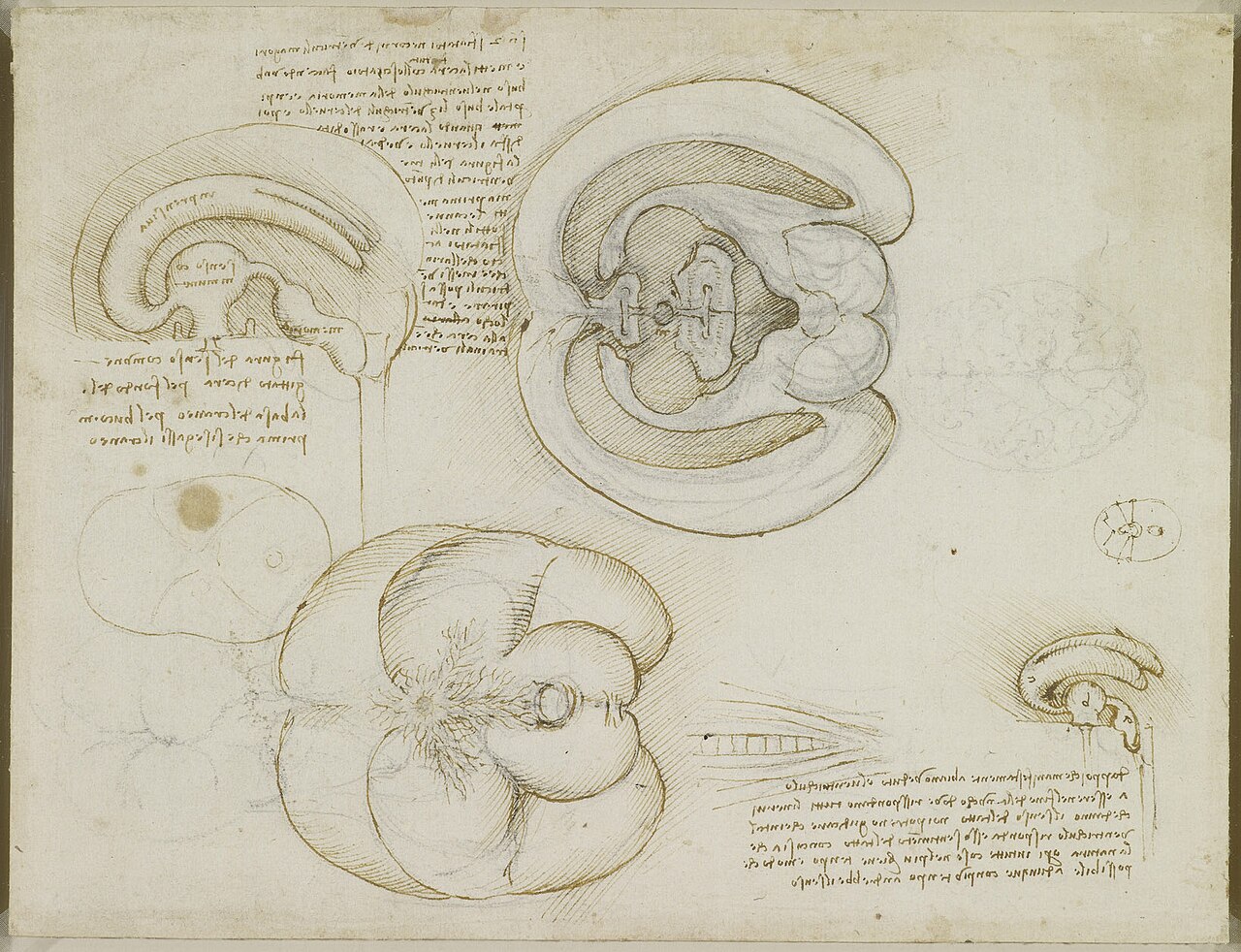
The cast is nothing like three bubbles. The front cells are two, one on each side, long and curved like the horns of a ram, sweeping back from the front and down; between them and behind them is a small narrow cell in the middle; and behind that, a little cell joined to it by a thin passage, where the brain goes down into the cord of the back. I drew it from the side inside the outline of the brain, and from above, and I drew the base of the brain with the fine net of vessels that lies there under it in the ox, which the ancients called the marvellous net and which I have looked for in the heads of men and not found.
Proportion
I kept the old names and gave them to the new shapes, and lettered them on the drawing. The two great horns in front, which come nearest to the nerves of the eyes, I called the imprensiva. The small middle cell I called the senso comune. The cell at the back I called the memoria. Then I laid the middle cell against my old measures, and it is where it ought to be: in the middle of the head, on the vertical of the crown, a little behind the place where the nerves of the eyes come together. The skull of 1489 and the wax of this year agree.
Reflection
Twenty years ago I found the middle of the head with a rule. Today I found the room in the middle with wax. I am as sure as I can be of the place. The wax has told me nothing about what the judge does there, any more than the rule did. I shall go on looking at the walls, because they are what I can see, and I would rather leave a true drawing of a room than a false account of its inhabitant.
Problems I set myself
1. A man of 3 Milanese braccia, the braccio being 32 fingers and 59 and a half of your centimetres. His head, from below the chin to the crown, is an eighth of him. Find in fingers and in centimetres how far the meeting of the senses lies below the crown, how far the uvula lies above the line of the chin, and how far below the chin the windpipe and the orifice of the heart lie, if they are one foot, a seventh of the man, below the meeting of the senses.
Answer. The finger is \( 59.5 \div 32 = 1.86 \) cm and the head \( 12 \) fingers, \( 22.3 \) cm. The meeting of the senses is half a head below the crown, \( 6 \) fingers, \( 11.2 \) cm. The uvula is two fingers below that, so \( 12 - 6 - 2 = 4 \) fingers above the chin, \( 7.4 \) cm, at the height of the fulcrum. The foot is \( \tfrac{96}{7} = 13.7 \) fingers, \( 25.5 \) cm, so the windpipe and the orifice of the heart lie \( 13.7 - 6 = 7.7 \) fingers below the chin, \( 14.3 \) cm, at the top of the breast.
2. The head turns on its fulcrum a third of the way up. Take the crown as straight above the fulcrum, at two thirds of a head. When a man bows his head forward by a third of a right angle, how far does his crown travel along its arc, how far forward does it come, and how far down?
Answer. The crown is \( \tfrac23 \times 12 = 8 \) fingers from the fulcrum. A third of a right angle is a twelfth of a full turn, so the arc is a twelfth of the circle of radius 8: \( \tfrac1{12} \times 2 \times \tfrac{22}{7} \times 8 = 4.19 \) fingers, \( 7.8 \) cm. The angle is 30 degrees, so the crown comes forward by \( 8 \sin 30^\circ = 4 \) fingers exactly, half the radius, and drops by \( 8\,(1 - \cos 30^\circ) = 8 \times 0.134 = 1.07 \) fingers, about two centimetres. The forward motion is nearly four times the fall, which is why the eye reads a nod as a movement forward.
3. The wax cast of the cells weighs 19 parts. Wax is lighter than water by about a twentieth, so that a body of wax weighs \( \tfrac{19}{20} \) of the same body of water. I lay it on a brimful cup and catch the water that runs over. How much runs over while it floats, and how much when I push it under with a needle? Which gives the size of the cells?
Answer. A floating body pushes out its own weight of water, so while it floats the cast spills 19 parts of water by weight. Pushed under, it spills its whole body of water, which weighs \( 19 \div \tfrac{19}{20} = 20 \) parts. Only the second measures the cells: their size is the size of 20 parts of water.
To the student who reads this later
You have saws I did not dream of, X-rays and the magnetic scanner that slices a living head without touching it. Here is what they found where I drew my lines.
The three cells I inherited are older than I knew. The scheme of a front cell for imagination, a middle one for reason and a back one for memory goes back at least to Nemesius of Emesa around the year 400, and passed through Arabic and Latin medicine to the woodcuts of my own lifetime. My wax cast of about 1508, recorded on the sheet at Windsor, is the first recorded injection of a setting material into a cavity of the body, and it gave the true shape: two lateral ventricles shaped like horns, a narrow third ventricle in the middle, and a fourth ventricle behind it, joined by a thin canal. The net of vessels at the base of the brain, the rete mirabile, is real in oxen and sheep and absent in human beings; Galen had described it from animals.
Andreas Vesalius, in 1543, pointed out that animals have ventricles much like ours, and so the ventricles could hardly be the seat of the faculties that make us human. Thomas Willis, in 1664, put the work of the brain into its solid substance. The ventricles are now known to hold the cerebrospinal fluid, a clear water that cushions the brain. An adult has about 150 millilitres of it, of which roughly 20 to 30 are in the ventricles, and the choroid plexus in their walls makes about half a litre a day. In 1918 the surgeon Walter Dandy replaced the fluid with air and photographed the ventricles with X-rays, as I had replaced it with wax; it was one of the first ways to see the shape of the brain inside a living patient.
Two of my cavities have other men's names. The hollow in the cheek bone, which I drew opened on the sheet of 1489, is called the maxillary sinus, or the antrum of Highmore, after Nathaniel Highmore, who described it in 1651. The hollow in the forehead is the frontal sinus. Neither feeds the teeth nor stores humours; they lighten the skull and warm and moisten the air we breathe, and may lend resonance to the voice. Tears are made by the lacrimal gland in the upper outer corner of each orbit, and drain away at the inner corner I called the lachrymal.
And the senso comune? There is no single point where all the senses meet and are judged. But the place where my lines cross is not empty of meaning. The middle cell of my cast is the third ventricle, and its two side walls are the thalami, the pair of grey bodies through which every sense except smell passes on its way to the cortex. So the point I found with a rule lies between the relay stations of the senses. The meeting itself happens in many places: in the superior colliculus of the midbrain, where sight, sound and touch are combined to turn the eyes toward a sudden thing; in the cortex of the parietal lobe and along the superior temporal sulcus, where cells answer to a face seen and a voice heard together. How the brain binds what the eye and the ear report into one experience is still called the binding problem, and it is unsolved. René Descartes, in his Passions of the Soul of 1649, put the meeting place in the pineal gland, near the same middle of the head, because it is single where most parts of the brain are paired: my reasoning, a century and a half later.
The geometry of the head turning on its neck is a rotation about a fixed point. A point at distance \( r \) from the pivot, turned through an angle \( \theta \) in radians, travels an arc
\[ s = r\theta, \]
comes forward by \( r \sin\theta \) and drops by \( r(1 - \cos\theta) \). The real pivot for nodding is the joint between the skull and the first vertebra, the atlas, and it sits behind the mouth at about the height I gave.
What to try today. In front of a mirror, measure your head from under the chin to the top and find the middle; see where the inner corners of your eyes fall against it. Then press a fingertip just in front of each ear, open and close your jaw, and feel its hinge move, a little in front of the place where the skull rests on the neck.
If you want to ask me about the meeting of the senses, come and ask me.
Sources and liberties
The Da Vinci Notes are a modern reconstruction written in Leonardo da Vinci's voice by Eternal Gardens. Dates, places, manuscripts, drawings and quotations come from the sources below; the order of the working, the private reflections, the plates and the sketches are ours.
- J. P. Richter, The Notebooks of Leonardo da Vinci (1883), §1370 (2 April 1489, the title "Of the human figure"), §805 (the list of questions on the same sheet), §812 to §813 (the divisions of the head), §815 (the tears), §836 (the common sense between sensation and memory), §837 (the friars), §838 (the senses as ministers of the soul), §1434 (the saw for bones): Project Gutenberg #5000
- E. MacCurdy, Leonardo da Vinci's Note-Books (1906), for the folios of §838 (Windsor, Anatomical MS B, f. 2r) and §837 (f. 8v).
- Royal Collection Trust, RCIN 919057 and RCIN 919058 (the skull sectioned, 1489), RCIN 919059 (the dated title page and list of topics), RCIN 912603 (the layers of the scalp and the cerebral ventricles, about 1490 to 1492) and RCIN 919127 (the wax cast of the ventricles, about 1508 to 1509), with texts adapted from M. Clayton and R. Philo, Leonardo da Vinci: Anatomist (Royal Collection, 2012): RCIN 919057, RCIN 919058, RCIN 919059, RCIN 912603, RCIN 919127
- K. D. Keele and C. Pedretti, Leonardo da Vinci: Corpus of the Anatomical Studies in the Collection of Her Majesty the Queen at Windsor Castle (1978 to 1980); M. Kemp, Leonardo da Vinci: The Marvellous Works of Nature and Man (Oxford University Press, 1981; revised 2006).
- W. E. Dandy, "Ventriculography following the injection of air into the cerebral ventricles", Annals of Surgery 68 (1918).
Only the passages in quotation marks are Leonardo's words, in Richter's translation. The notes on the skull sheets (the crossing of a m and c b, the fulcrum at a third, the distances from the senso comune to the crown, the lachrymal, the uvula and the windpipe, the four cavities a third of the face deep, the teeth, and the steps of the wax injection) are paraphrased from the Royal Collection's translations and are not quoted. The date "2 April 1489" is written on RCIN 919059 verso, the sheet that opens the anatomical notebook; the two skull sheets, from the same notebook, are dated 1489 by the Royal Collection. The wire along the optic nerves, the barber and the order of the work are our reconstruction. Leonardo submitted a model for the tiburio of Milan cathedral in 1487 to 1490; the comparison with the skull is ours. The cast was probably made from the brain of an ox or a cow, as the rete mirabile shows; Leonardo's own notes do not name the animal on the sheet reproduced here.