 by Marie Curie

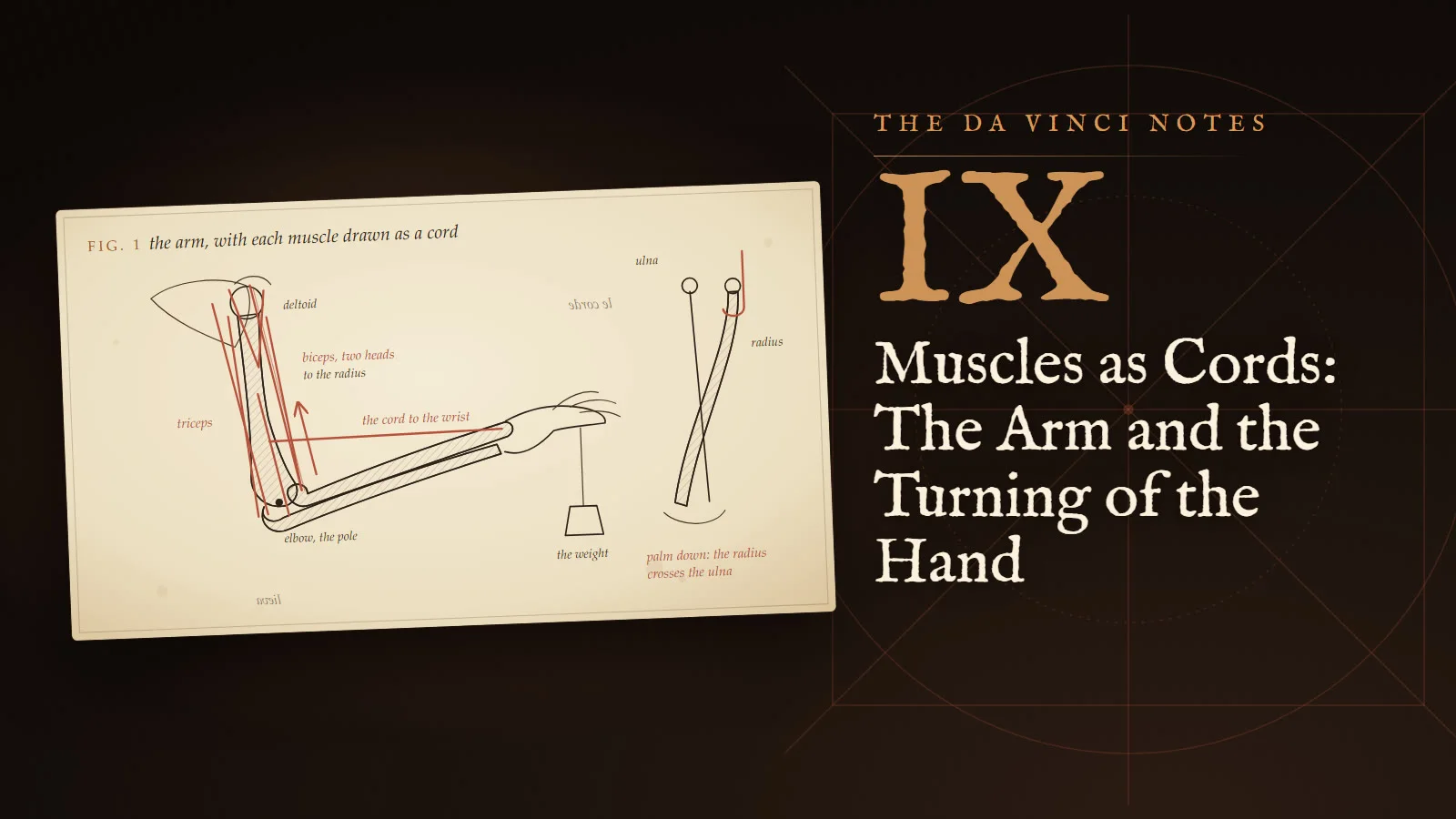

Milan, the autumn of 1510, the French in the castle and the plague talked of in the villages towards Pavia. I am fifty-eight years old and my hand is still steady. All summer I have been drawing bones, and now I must clothe them, which is harder, for the flesh that moves the bones hides the very thing I want to see: the line along which each muscle pulls. A muscle seen as nature leaves it is a lump of red meat, one over another, and the painter who copies it makes a sack of walnuts. I want to see the arm as a machine of ropes and levers, and to know, for a given weight in the hand, how hard each rope must pull. This book is about the arm and the turning of the hand. Its question is simple to write: what does each cord do, and how much does it bear?
You will never get any thing but confusion in demonstrating the muscles and their positions, origin, and termination, unless you first make a demonstration of thin muscles after the manner of linen threads.
Leonardo da Vinci, Windsor, anatomical notes on the muscles of the foot, trans. J. P. Richter (1883), §804
Milan, October 1510. Threads in place of flesh
I set down first my method, because without it all the rest is confusion.
When I took the skin from the arm of the man who died last month at the hospital, I counted beneath it more than twenty fleshy bodies between the shoulder and the wrist, each wrapped in its own thin skin, each ending in a cord of white sinew, all of them pressed together like the fingers of a closed hand. The blood colours everything the same. The fat lies in the creases. When I lift one muscle, the one beneath it moves too, because they are bound to one another by threads of membrane. If I draw this as I see it, the reader sees what I saw on the first day, which is to say nothing.
So I do as I wrote long ago, under the drawing of the foot. I draw each muscle as a single thread, stretched from the place where it begins to the place where it ends, and I lay the threads over the bones as nature has laid the muscles, one over another. A thread has no thickness to hide what is behind it. And a thread shows the one thing a muscle can do, which is to shorten. It cannot push. It can only pull its two ends together, along the straight line between them, like a rope on a ship. That line is the line of its force. When I have the threads right, I will draw beside them the true form and size of each muscle, so that the reader has both: the flesh as the eye sees it, and the cord as the mind understands it.
Draftsman's note
The threads are to be drawn in the centre line of each muscle. I wrote this in the margin of the foot and repeat it here, because it is easy to forget: the thread runs through the middle of the muscle, from the middle of its origin to the middle of its tendon. The edge is easier to see and lies about the direction. A broad muscle such as the one that covers the breast I divide into several threads, one for each band of its fibres, for its parts pull in different directions and do different work. Pen and brown ink over a first drawing in black chalk; a wash of the same ink for the bones, so that they stand back; the threads drawn firmly, with a fine pen, and where two cross, the one behind is broken.
Margin
Here the adversary says: but a muscle is thick, and swells as it works, and the thread lies. I answer that the thread lies about the thickness and tells the truth about the direction, and the direction is what decides the motion. The swelling of the muscle I shall show in the drawings of the living man, where the painter needs it.
Pavia, November 1510. With Messer Marcantonio
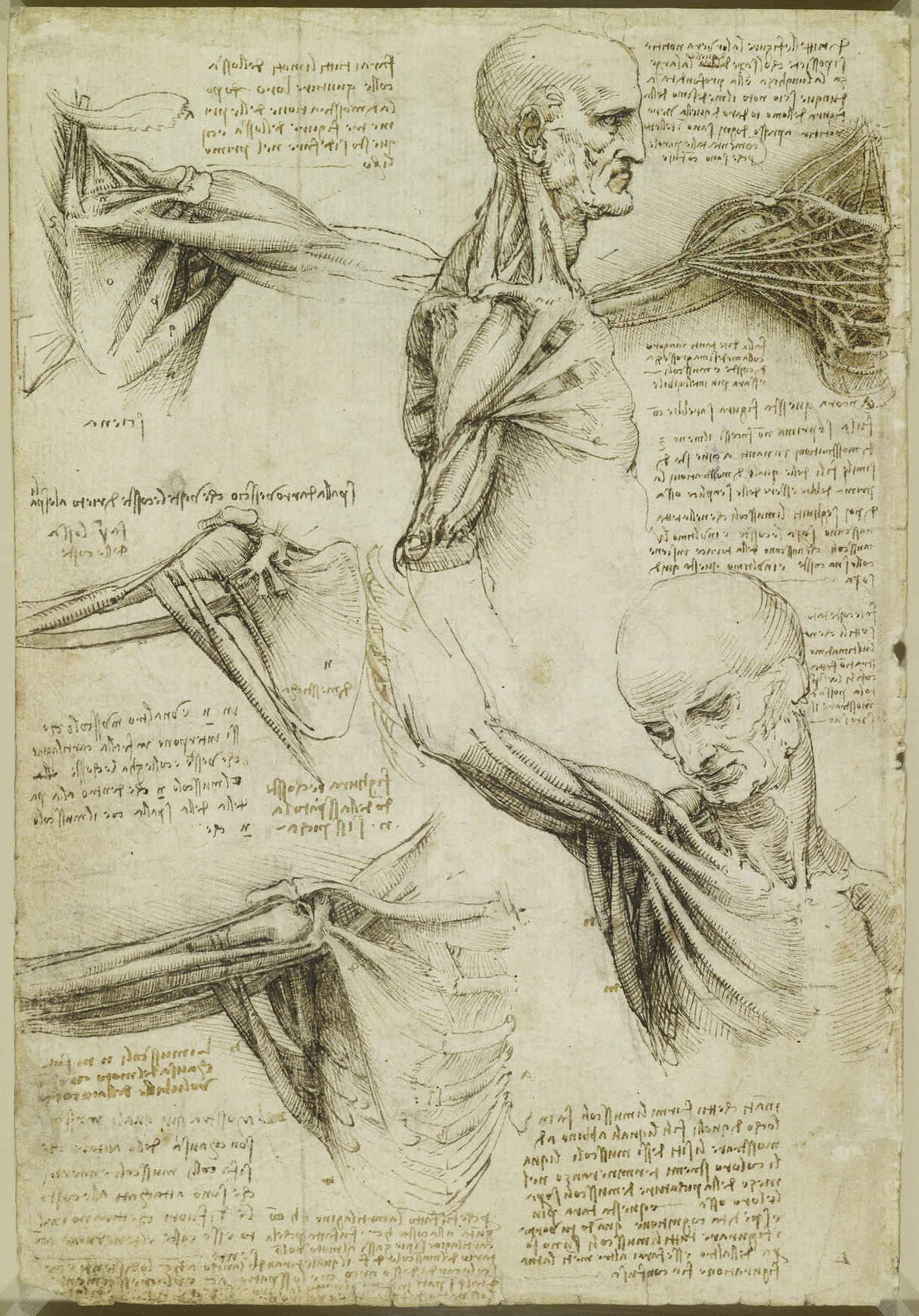
Rode down to Pavia in a day, the roads bad after the rains, and lodged near the Studio, where Messer Marcantonio della Torre reads anatomy to the students from the books of Galen. He is not yet thirty, of a Veronese family of physicians, and quick. He has the authors; I have the drawings. He reads me what Galen says of a muscle, and then we look for it in the body, and sometimes it is there and sometimes it is not, and sometimes it is there and does something else. On those days he laughs before I do.
Vasari, when he writes of my life long after I am gone, will put it this way, and I set it here because it is fair to both of us:
He then applied himself, but with greater care, to the anatomy of man, assisted by and in turn assisting, in this research, Messer Marc' Antonio della Torre, an excellent philosopher, who was then lecturing at Pavia, and who wrote of this matter.
Giorgio Vasari, Life of Leonardo da Vinci (1568), trans. G. du C. de Vere (1912)
The order of the work
A body does not wait. In this cold season it gives me some days, and then the parts I have not yet seen are spoiled. So I work in an order fixed in advance, from the outside inwards and from the shoulder down, and I do not change it because a part is interesting.
- The living arm first, on a strong young man who is paid to stand: raised, lowered, thrust forward, drawn back, the hand turned up and turned down, each drawn from the front, the side and behind. This is the surface the painter sees.
- The skin taken off, and the veins on the surface drawn, for they will be lost at the next step.
- The superficial muscles: the one that covers the shoulder like a cap, the great one of the breast, the two of the back of the arm, the fleshy one in front that the anatomists call the mouse or the fish of the arm, because it runs like a small animal under the skin when the arm bends.
- Each muscle lifted from its end and laid back, and the one beneath drawn.
- The muscles of the forearm, which are many and small: those that bend the fingers on the side of the palm, those that open them on the back, those that move the hand at the wrist.
- The bones bare, with the places where each muscle was fixed marked on them in red chalk.
- The bones of the arm sawn, to see which are hollow and which are full.
For each of these I make at least three drawings, from three sides, and for the shoulder more, for the shoulder turns in every direction and no one view of it is true.
First draw the bones, let us say, of the arm, and put in the motor muscle from the shoulder to the elbow with all its lines.
Leonardo da Vinci, anatomical notes, trans. J. P. Richter (1883), §799
Reflection
How many bodies? I have written elsewhere that to know the veins alone I dissected more than ten human bodies, taking away all the other members and the smallest particles of the flesh around them, because no single body lasts long enough, and then did it all again to learn the differences. For the muscles it is more. I do not keep a count, as a butcher does. Each was a man or a woman who came to the hospital poor and died there, and I have tried to repay them with the truth of the drawing, which is the only payment I can make them.
Margin
Messer Marcantonio says Galen calls the muscle of the front of the arm a bender of the elbow and nothing more, and gives the turning of the hand to the long muscle that runs from the outside of the elbow down to the thumb side of the wrist. I am not certain. I have pulled that long muscle in the dead arm and it bends the elbow well, with the hand half turned, as a man holds a cup. Whether it turns the hand, I must try with the hand turned fully down and see whether it brings it up.
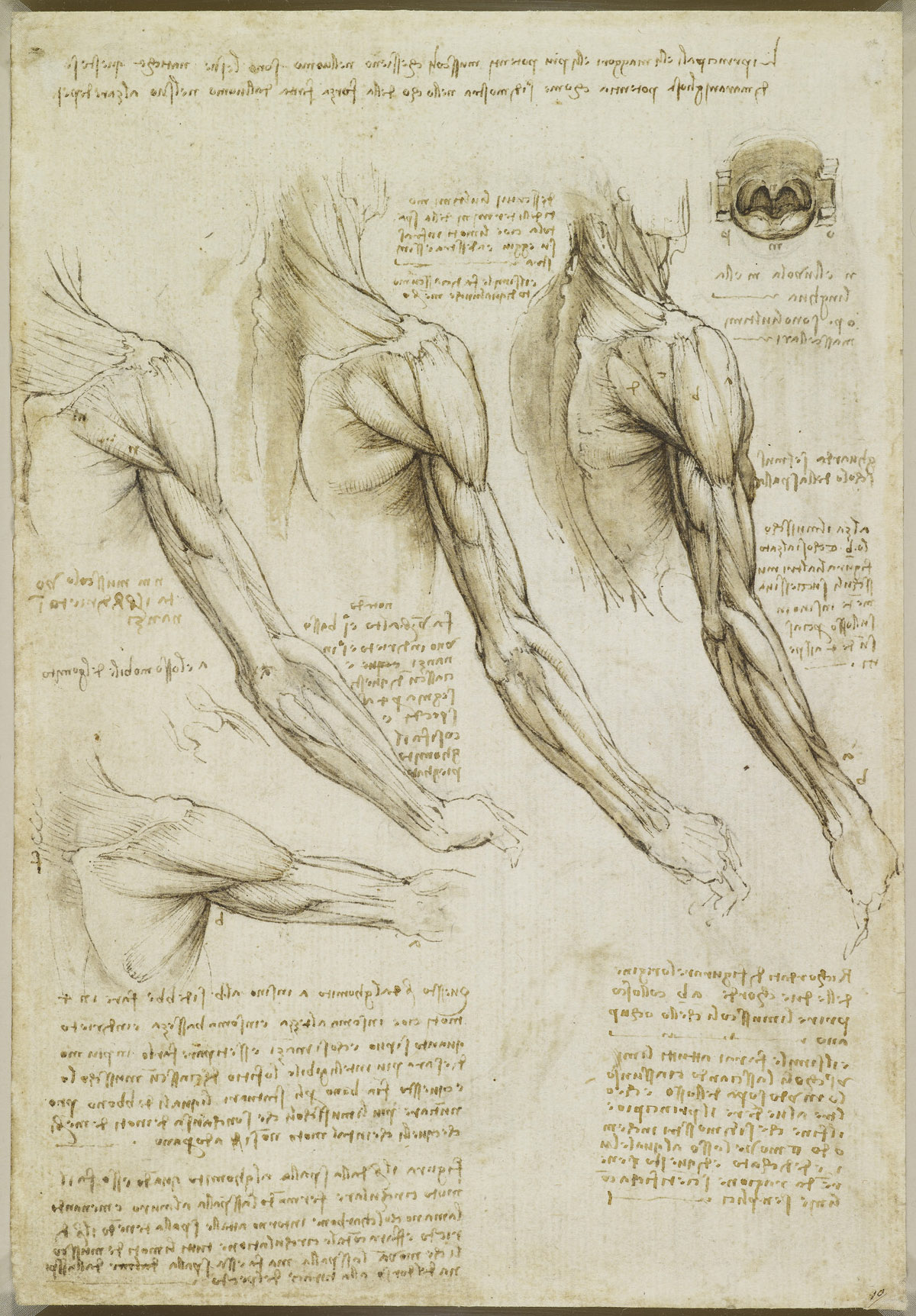
On this sheet I wrote to myself that each muscle should be shown alone, naked on the bone, so that one sees where it begins and ends and in what way it moves the bone it serves, and that the reason of it is to be given, in the Royal Collection's English, "with lines alone". The lines are the threads. Below the drawings I added that this arm must also be drawn in four movements, for the sculptors, who have to make the working muscles stronger than those at rest.
Milan, December 1510. The elbow is the pole of a balance
Back in Milan with a cold in the chest and a box of drawings. Today I want the numbers.
The forearm turns at the elbow as the beam of a balance turns on its pin. The weight in the hand hangs at one end of the beam. The cord of the fish of the arm is tied to the other bone, close to the pin, on the same side as the weight. This is a strange balance, with both forces on one arm of the beam: the cord pulls up near the pole, the weight pulls down far from it. By the rule of the balance, which I learned from the old writers on weights and have proved a hundred times with my own steelyard, the forces must stand in the contrary proportion of their distances from the pole.
Measurement
- On the dead arm, bent to a right angle, I measured from the centre of the turning of the elbow to the place where the tendon of the fish of the arm is fixed on the radius: a little less than one twelfth of a Florentine braccio.
- From the same centre to the middle of the closed fist, where a weight hangs: seven twelfths of a braccio.
- The forearm with its hand, cut at the elbow and weighed on the steelyard: a little under five libbre of Florence. Hung on a thread, it balances at about half the distance to the fist, three and a half twelfths from the elbow.
Calculation
Let the man hold ten libbre in his hand, with the forearm level and the upper arm hanging straight down. The weight is seven parts from the pole and the cord one part. Then
\[ \text{pull of the cord} : \text{weight} = 7 : 1, \]
and for the ten libbre in the hand the cord must pull seventy. But the forearm has its own weight. Its five libbre hang at three and a half parts, so they weigh on the balance as seventeen and a half libbre would weigh at one part. Together:
\[ 10 \times 7 + 5 \times 3\tfrac12 = 70 + 17\tfrac12 = 87\tfrac12 \text{ libbre at one part}. \]
So to hold ten libbre with the arm bent square, the cord must pull with the force of eighty-seven and a half libbre hanging from it, nearly nine times the weight in the hand. And the elbow itself, the pin of the balance, must bear the difference: the cord pulls up with eighty-seven and a half, the weight and the forearm pull down with fifteen, so the end of the humerus is pressed down on the bones of the forearm with seventy-two and a half libbre. A man who carries a pail of water with the arm bent square has six or seven times the pail's weight pressing inside his elbow and does not know it.
Margin
Why does nature tie the cord so near the pole, so that it must pull nine times the weight? Because the hand moves seven times as far as the place where the cord is tied, and seven times as fast. If the cord were tied at the wrist it would lift any weight with ease, and the hand would move no faster than the cord shortens, which is slowly, for a muscle shortens by about a third of its length and no more. Nature has chosen speed and paid for it in force. She does nothing in vain, and she has strength to spare in the fleshy muscle, which can be made as thick as the work needs.
Trial No. 1
A wooden arm, to prove the numbers without a body. Two laths of poplar, one for the upper arm and one for the forearm, joined at an iron pin, the forearm seven twelfths of a braccio long to the place of the fist. A cord tied to the forearm at one twelfth from the pin, running up beside the upper lath to a pulley at the shoulder and down to a scale pan. A weight of one libbra hung at the fist, the forearm held level with a plumb line and a square.
Result. Seven libbre in the pan hold it level, and seven and a half lift it slowly. When the laths themselves were weighed in, the numbers agree with the calculation within half a libbra, which is the friction of the pulley and the pin. Then I lowered the forearm until the angle at the elbow was open, about a hundred and forty degrees, and the pan still held it with almost the same weight. This surprised me.
Calculation
When the forearm hangs lower, the weight in the hand comes nearer to the line that falls plumb from the elbow, and its power to turn the forearm is less. Measure the distance across, from the plumb line of the elbow to the plumb line of the weight: at a right angle it is the whole seven parts; with the forearm let down halfway between level and hanging, it is about five; hanging straight, nothing. But the cord also comes nearer to the pole, for it runs almost along the upper arm, and its distance from the pole, measured square to the cord, shrinks in nearly the same proportion. The two distances diminish together, and the proportion between them changes little. The cord must pull nearly the same at every angle, and a little more when the arm is open, because the cord then pulls more slantwise against the forearm.
I have drawn the whole account as Plate IX. Bend the elbow, hang a weight in the hand, move the place where the cord is tied, and read how hard the cord must pull and how hard the elbow is pressed. The button turns the hand over, and you see in the small figure what the two bones of the forearm do when the palm goes down.
Reflection
The body is made with forces inside it far greater than those it shows outside, as a crossbow at rest holds in its bent wood a force much greater than the weight of the bolt. This is the mechanical part of anatomy that the physicians do not trouble with, and it is the part that interests me most, for here my two sciences, of weights and of the body, become one.
Milan, January 1511. The turning of the hand
Snow on the roofs of Milan, and a body brought on the second day of the cold, a woman of middle age, thin. Thin bodies are the best teachers of the muscles: there is little fat to hide the borders.
The question of the margin of November. When the palm is turned down, which in the dead arm stays wherever I put it, the two bones of the forearm are no longer side by side. The ulna does not move: it is hinged to the humerus at the elbow and can only bend and straighten. The radius, the bone on the side of the thumb, turns. Its head at the elbow spins in place in a ring of ligament like a pivot in its socket, and its lower end, which carries the hand, swings around the end of the ulna. When the palm faces down, the radius lies across the ulna from the outside of the elbow to the inside of the wrist, the two bones crossing like the letter X.
Experiment No. 1
With the forearm stripped and the bones bare at the elbow, the hand turned palm down. I took the tendon of the fish of the arm, where it runs down into the bend of the elbow, and pulled it upward with a hook, gently, as I do to find what a muscle does.
Remember that to be certain of the point of origin of any muscle, you must pull the sinew from which the muscle springs in such a way as to see that muscle move.
Leonardo da Vinci, anatomical notes, trans. J. P. Richter (1883), §804
Result. Before the elbow bent at all, the hand turned over, palm up, and the radius uncrossed itself from the ulna. Then, the palm being up, the elbow began to bend. I did it six times, to be sure. The tendon is fixed on a little knob on the inner side of the radius, below its head, and when the palm is down that knob is turned to the back, so that the tendon is wound halfway around the bone like a cord round the axle of a windlass. Pull the cord and the axle turns. The fish of the arm has two works: it turns the hand palm up, and it bends the elbow. And it turns first.
Experiment No. 2
On my own arm, which costs nothing. I gripped the handle of the vice on my bench with the right hand, palm down, and tried to turn it as a man turns a key to open a lock, bringing the palm up, while my left hand lay on the front of the right arm. The fish of the arm hardened under my fingers at once, without the elbow moving. Turning the other way, palm down, it stayed soft, and other muscles near the elbow hardened instead. Then I held the elbow bent and the palm down and lifted a weight: the fish of the arm was less hard and less strong than with the palm up, and the weight felt heavier. So a man lifts most with the palm turned up. Every porter knows this without anatomy.

Draftsman's note
For this sheet, five figures of the right arm, the bones only with a few muscles, in a row, so that the eye passes from one to the next as through the motion itself: the palm up, the bones parallel; the palm turned halfway, as in holding a cup; the palm down, the bones crossed; the same from behind; and a diagram with the radius drawn as a rod turning about a line from the head of the radius to the end of the ulna, which is the true axis of the turning. In the last figure I put the two muscles that turn the palm down: a short square one that joins the lower ends of the two bones above the wrist, and a longer one that runs slantwise from the inner side of the elbow to the middle of the radius. Their threads are drawn in red chalk over the pen, as in Fig. 1.
Margin
When the bones cross, the forearm becomes a little shorter, for two rods that cross are oblique and reach less far than when they lie side by side. On the living arm the difference is small and hard to measure, because the skin slides; the painter should know it all the same.
Reflection
Galen, whom Messer Marcantonio reads with reverence, gave this muscle the bending of the elbow and nothing more. He dissected apes more often than men. I have seen the hand turn when I pulled the cord. A single experiment, done with care and repeated, outweighs the authority of all the books, and those who cite the authority without trying the experiment use their memory where they should use their understanding. I write this without anger. Galen was a great man, and if he had had the bodies I have had, he would have seen it before me.
Milan, February 1511. The shoulder, which turns in every direction
The shoulder is the most difficult joint in the body, and I have drawn it more than any other part this winter, from above, from in front, from behind, with the arm raised and with it lowered.
The arm, as it turns, thrusts back its shoulder towards the middle of the back.
Leonardo da Vinci, notes on the movement of the arm, trans. J. P. Richter (1883), §352
I wrote that for painters, years ago in Milan, from watching men at work. Now I know why. The arm has no fixed socket on the body as the thigh has in the hip. The humerus hangs from the shoulder blade, and the shoulder blade floats on the back of the ribs, held only by muscles, and the collarbone props it out from the breastbone like the boom of a crane. When the arm turns or rises, the shoulder blade turns and slides with it, and so the whole shoulder moves toward the spine or away from it. The motion of the arm is therefore of two parts: the humerus turning in its shallow cup, and the cup itself carried about on the back.
Observations
- The cap of the shoulder, the deltoid, is to be divided into parts, for its front fibres raise the arm forward, its middle fibres raise it to the side, and its back fibres draw it back. I draw it as three threads, and in one drawing as more, for its fibres are gathered in bundles like the strands of a cable.
- The great muscle of the breast is divided in four, and each part draws the arm in a different direction: the upper part forward and up, the lower part down and in, as a man hauls on a bell rope.
- The fish of the arm has two heads at the shoulder, one long, rising by a slender tendon over the top of the humerus in a groove, the other short, from the hook of the shoulder blade. So it serves the shoulder also, and helps to raise the arm forward.
- Of motions, I distinguish the simple, the mixed and the decomposite. A simple motion is made by one muscle along its thread; a mixed by two pulling together, and the limb goes between their lines, as a boat drawn by two ropes from two banks goes up the middle; the decomposite by many in succession.
Draftsman's note
The thread diagram of the shoulder, at the upper right of the sheet, is too crowded. I have written under it that it must be drawn again larger, keeping the same thickness of ribs and threads. This is the defect of the method: where many muscles meet, the threads make a net, and a net hides as much as flesh does. The remedy is to divide the demonstration, the front muscles in one figure, the back in another, as a cosmographer divides the world into provinces.
Reflection
On a separate leaf, the one with the leg and the tendons of the foot, I wrote in a better hand than usual, because I was pleased with myself, that "this winter of 1510 I believe I shall finish all this anatomy". The winter is nearly over. I have finished the bones and the muscles of the arm and the shoulder and the leg and the foot, and the hand nearly. I have not finished the anatomy. It does not finish. Every muscle I understand shows me two I do not, and behind the muscles are the nerves that command them, and behind the nerves the brain, and behind the brain the soul, which I leave to the friars.
The nerves with their muscles obey the tendons; I wrote it once as a chain of command:
The nerves with their muscles serve the tendons, even as soldiers serve their leaders, and the tendons serve the common sense as the leaders their captain, and this common sense serves the soul as the captain serves his lord.
Leonardo da Vinci, Windsor, Anatomical Manuscript B (Fogli B) 2r, trans. E. MacCurdy (1906)
Margin, later in 1511
Messer Marcantonio is dead, young, of the pestilence, they say, caught while treating the sick at Riva on the lake of Garda. He had the authors and I had the drawings, and we were to make a book. Now there is only my half. I shall finish it alone, and when I name the muscles I shall name them as he taught me.
To do
- Redraw the shoulder threads twice the size.
- The hand: all the motors of the fingers, those that close and those that open, in four demonstrations.
- Find out whether the short muscle at the wrist turns the palm down by itself, or only with the long slanting one.
- Have my books on anatomy bound.
Problems I set myself
1. The cord of the fish of the arm is tied at one twelfth of a braccio from the pole of the elbow, and a man holds fourteen libbre in his hand at seven twelfths, with the forearm level. Leaving aside the weight of the forearm, how hard must the cord pull? And how hard if he holds the same weight with the cord tied at one sixth of a braccio instead?
Answer. By the balance the pull and the weight stand in the contrary proportion of their distances: \( F : 14 = 7 : 1 \), so the cord pulls 98 libbre. Tied at two twelfths, \( F : 14 = 7 : 2 \), so \( F = 49 \) libbre, half as much. In Florentine libbre of about 339.5 grams, 14 libbre is 4.75 kg and 98 libbre is 33.3 kg of pull, about 327 newtons. The price of the easier pull: the hand would move only three and a half times as fast as the place where the cord is tied, in place of seven.
2. The tendon of the muscle that bends the elbow is fixed at one twelfth of a braccio from the pole, and the fist is at seven twelfths. The muscle shortens by two fingers' breadth in a quarter of a second. How far does the fist travel, through what part of the circle does the forearm turn, and how fast does the fist go?
Answer. Points on the same turning beam move in proportion to their distances from the pole, so the fist travels seven times as far as the tendon: fourteen fingers' breadth along its arc. Taking a finger's breadth as 1.8 cm, that is 25 cm along a circle of radius 34 cm, an angle of \( 25 / 34 = 0.74 \) radian, about 42 degrees, nearly half a right angle. The tendon moves 3.6 cm in a quarter of a second, 14 cm per second; the fist moves seven times as fast, about one metre per second. The muscle has bought speed at the price of a sevenfold force.
3. With ten libbre in the hand, the forearm weighing five libbre with its centre at three and a half twelfths, and the arm bent square, how hard is the end of the humerus pressed on the forearm at the elbow?
Answer. As in my December calculation, the cord pulls \( 10 \times 7 + 5 \times 3\tfrac12 = 87\tfrac12 \) libbre upward, supposing it pulls straight up. The weight and the forearm pull 15 libbre downward. For the forearm to be at rest, the elbow must push down on it with the difference, \( 87\tfrac12 - 15 = 72\tfrac12 \) libbre, about 24.6 kg or 241 newtons. The bone of the upper arm presses on the forearm with five times the weight the man thinks he is holding.
To the student who reads this later
First the measures. My Florentine braccio is about 58.4 cm, so one twelfth is just under 5 cm and seven twelfths about 34 cm; the Florentine libbra is about 339.5 g, so the ten libbre in my calculation are 3.4 kg and the forearm's five libbre 1.7 kg. You call my fish of the arm the biceps brachii, and my "pole of a balance" a lever of the third class, with the effort between the fulcrum and the load. The rule I used is the balance of turning forces, which you write about the elbow as
\[ F\,d\,\sin\varphi = g\,(W\,L_W + m\,L_m)\sin\alpha, \]
where \(F\) is the pull of the muscle, \(d\) the distance from the elbow to its insertion, \(\varphi\) the angle between the muscle and the forearm, \(W\) the mass in the hand at distance \(L_W\), \(m\) the mass of forearm and hand with its centre at \(L_m\), and \(\alpha\) the angle of the elbow. With \(d = 4.5\) cm, \(L_W = 33\) cm, \(m = 1.6\) kg at 17 cm and 5 kg in the hand at a right angle, the biceps must pull about 420 newtons, which is what Plate IX shows. My observation that the pull changes little with the angle is true of this simple model, because both \(d\sin\varphi\) and the lever of the weight shrink together as the forearm drops; in the living arm the moment arm of the biceps is greatest near a right angle and smaller at both ends, and the muscle itself pulls hardest at middle lengths, which is why a weight feels heaviest with the arm nearly straight.
The first to work out the forces of muscles systematically by the law of the lever, in print, was Giovanni Alfonso Borelli, in De motu animalium, published in Rome in 1680 and 1681, a hundred and seventy years after my winter. He came to the same conclusion I did: the muscles pull many times the weights they move, and nature trades force for speed. My anatomical sheets had passed from Melzi's heirs to the sculptor Pompeo Leoni and then to England, where they lay bound in an album, and no anatomist read them. As for the turning of the hand, the Royal Collection Trust, which keeps these sheets at Windsor, writes that it would be two centuries before my observation that the biceps both bends the elbow and turns the palm up was made again. Your textbooks now call the biceps the strongest supinator of the forearm, strongest with the elbow bent near a right angle. You also know that the biceps does not work alone: the brachialis, which lies beneath it and is fixed to the ulna, bends the elbow whatever the turning of the hand, and the brachioradialis, my long muscle from the outside of the elbow to the wrist, bends it best with the hand half turned, as I found on the dead arm.
My threads have had a long life. Your computer models of the body still draw each muscle as a line, or a chain of lines, from origin to insertion, and compute its moment arm about each joint from that line, exactly as I did with a ruler.
Where I was wrong or uncertain: I thought the soul commanded the muscles through the nerves as a captain commands soldiers, which is a picture; you know the mechanism: the nerve carries an electrical impulse and the muscle shortens by the sliding of protein filaments, which no eye of my time could see. My count of the bodies changed with the years: in the note on the veins I wrote "more than ten", and to the Cardinal of Aragon's secretary, Antonio de Beatis, who visited me at Cloux in October 1517, I said more than thirty, of men and women of all ages. I never claimed a hundred.
What to try today: sit at a table and hold a bag of sugar in your hand with the elbow on the table and the forearm upright, then slowly lower it to level. Feel the biceps with the other hand. Then hold the bag still and turn the palm down: the bag grows heavier, because the biceps loses part of its power to bend. Turn a stiff screw with a screwdriver, palm turning up, and feel the biceps harden before the elbow moves. Supination is the stronger turn of the two, and that is why a screw is driven clockwise by a right hand.
If you want to argue with me about the threads, the balance at the elbow or the turning of the hand, come and ask me.
Sources and liberties
The Da Vinci Notes are a modern reconstruction written in Leonardo da Vinci's voice by Eternal Gardens. Dates, places, manuscripts, drawings and quotations come from the sources below; the order of the working, the private reflections, the plates and the sketches are ours.
- J. P. Richter, The Notebooks of Leonardo da Vinci (1883; Project Gutenberg ebook 5000): §796 (the dissection of "more than ten human bodies"), §798 (drawing each limb from several sides), §799 (the order of drawing the arm), §804 (muscles as linen threads; pulling the sinew to find a muscle's work), §352 (the arm thrusts back its shoulder), §488 (the sack of walnuts): gutenberg.org/ebooks/5000
- E. MacCurdy, Leonardo da Vinci's Note-Books (Duckworth, 1906), the nerves, muscles and tendons as soldiers, leaders and captain (Windsor, Fogli B 2r).
- Giorgio Vasari, Life of Leonardo da Vinci (1568), trans. G. du C. de Vere (1912), on Marcantonio della Torre at Pavia: Project Gutenberg
- Royal Collection Trust, Anatomical Manuscript A: RCIN 919000 (pronation and supination; biceps as flexor and supinator), rct.uk/collection/919000; RCIN 919003 (the shoulder and its thread diagram; simple, mixed and decomposite motion), rct.uk/collection/919003; RCIN 919005 (each muscle naked on the bone, "with lines alone"; the arm in four movements), rct.uk/collection/919005; RCIN 919016 ("this winter of 1510"), rct.uk/collection/919016
- M. Clayton and R. Philo, Leonardo da Vinci: Anatomist (Royal Collection Publications, 2012).
- K. D. Keele, Leonardo da Vinci's Elements of the Science of Man (Academic Press, 1983).
- M. Kemp, Leonardo da Vinci: The Marvellous Works of Nature and Man (Oxford University Press, revised edition 2006).
- E. MacCurdy, The Notebooks of Leonardo da Vinci (Jonathan Cape, 1938), vol. 1, introduction, quoting Antonio de Beatis' diary of the journey of Cardinal Luis of Aragon, 1517 ("more than thirty bodies").
- G. A. Borelli, De motu animalium (Rome, 1680 to 1681).
The measurements on the dead arm, the wooden arm of Trial No. 1, the experiments on Leonardo's own arm and the to-do lists are our reconstruction, chosen to agree with the anatomy; Leonardo's own sheets record the conclusions, not these trials. Vasari says the anatomical book was "drawn in red chalk"; the sheets of Anatomical Manuscript A are in fact pen and ink with wash over black chalk. The claim, often repeated, that Leonardo dissected a hundred bodies or more has no source: he wrote "more than ten" and told de Beatis "more than thirty".