 by Marie Curie


Florence, the winter of 1507, and I am here against my will, kept from Milan by the lawsuit with my brothers over my uncle Francesco's farm at Vinci, writing letters to the French to excuse my absence and waiting on notaries. The waiting has given me the hospital. Santa Maria Nuova, where my savings are kept in the account of the Spedale, has also given me its dead, and the brothers of the hospital let me work at night in a room off the cloister where they bury the dead. This week a man died there in front of me, sitting on his bed, while we were talking. He said he was a hundred years old. I opened him to find out why a man can die with nothing wrong with him, and found the answer in his vessels. This book is about what old age does to the channels of the blood. Its question: why did the old man die so gently, and why could the child not have died the same way?
Death in old men, when not from fever, is caused by the veins which go from the spleen to the valve of the liver, and which thicken so much in the walls that they become closed up and leave no passage for the blood that nourishes it.
Leonardo da Vinci, anatomical notes, trans. J. P. Richter (1883), §848
Santa Maria Nuova, December 1507. The old man on the bed
I write this the same night, while it is fresh, by the lamp in the room where they let me keep my things.
He was in the men's ward, on the side toward the garden, in the third bed from the door. Thin as a lath, the skin of his hands like old parchment and spotted brown, his eyes clear. He had come in, the brother of the ward said, because he could no longer walk to the market and had no one left to fetch for him. He was not ill. He had no fever, no cough, no pain. He ate a little and slept a great deal. I had stopped by his bed because I had drawn him the day before, his head in profile, for the folds of the neck and the way the skin hangs from the jaw in the very old, and he had asked to see the drawing. He laughed at it and said I had made him look older than he was.
And this old man, a few hours before his death, told me that he had lived a hundred years, and that he did not feel any bodily ailment other than weakness,
Leonardo da Vinci, Windsor, Anatomical Manuscript B (Fogli B) 10v, trans. E. MacCurdy (1906)
He told me he remembered the building of the cupola, when Filippo's machines raised the stones; that he had been a carder of wool in his youth, and then a carter; that he had buried two wives and all his children. Whether he was truly a hundred I cannot say, for no one writes down the birth of a carder's son. The brother who kept the ward thought ninety at least. He was certainly the oldest man I have ever spoken with.
And then, as we talked, he simply stopped. He was sitting upright against the wall with his hands on the blanket. There was no struggle, no cry, no change of colour that I saw; he passed, in MacCurdy's English for my words, "without any movement or sign of anything amiss". I waited, thinking he had fallen asleep, and then I took his wrist and there was no beat in it. I have seen many die in my life, in war and in the hospitals and in my father's house. I have never seen a death like this one.
Reflection
A day well spent brings a happy sleep, and a life well employed brings a happy death. I wrote that years ago as a saying; tonight I saw it done. I do not know whether his life was well employed. He carded wool and drove a cart and buried his children. But his death was the gentlest thing I have ever seen, and I am a man who has spent his life studying how things move. A thing that stops so smoothly must have run down by degrees, the way a clock runs down when its weight reaches the floor, the wheels turning slower and slower until they do not turn at all. Something in him had been running down for years. I want to know what.
Santa Maria Nuova, the same week. To see the cause of so sweet a death
The hospital gave me the body two days later, after the office for the dead. I set it down in the order I used.
The Royal Collection's translation of my note says I dissected him "to see the cause of so sweet a death"; MacCurdy, earlier, has "so peaceful a death". Both are right. My word was sweet. It is the word one uses of sleep.
The order of the work
- The skin of the chest and belly opened from the pit of the throat to the groin, and laid back to each side. Almost no fat beneath it: a thin yellow film where a younger man has a finger's breadth.
- The muscles of the belly, thin as membrane, divided along the white line and laid back.
- The intestines lifted out and laid in a basin in their order, so that the vessels of the mesentery, which carry the nourishment from the bowels to the liver, could be seen spread out like the veins of a leaf held against the light.
- The liver, the spleen and the vessels between them.
- The breast opened by cutting the ribs on each side near the cartilages, and the heart and its great vessels exposed.
- The arm, last, for the veins near the surface.
It went quickly and cleanly, and I noted why, because it matters for anyone who comes after me: with no fat and very little moisture in the body there was nothing to hide the parts. In a fat young man the vessels lie buried in yellow and the knife must find them by touch. Here they lay on the surface like cords on a table.
What I found
Observation 1. The great artery that comes from the heart and goes down along the spine, and its branches to the heart itself and to the lower members, I found dry, shrunk and withered. MacCurdy gives my words as "very parched and shrunk and withered". Their walls were thick and hard. The channel inside them was narrow, much narrower than the thickness of the vessel promised from outside.
Observation 2. The vessels between the spleen and the liver, which bring the blood of the mesentery up to the liver, had coats so thick that the passage within them was nearly closed. In the Royal Collection's translation of my note on the sheet: the artery and vein which in the old extend between the spleen and liver "generate so thick a coat that it closes the passage of blood from the mesenteric veins".
Observation 3. And these vessels, besides thickening their coat, "grow in length and become twisted like a snake". In the child or the young man, a vessel goes from where it starts to where it ends by a short and nearly straight way, as water goes downhill. In the old man the same vessel winds back and forth like a river in a flat plain, so that its length between the same two places is much greater.
Observation 4. The liver small, hard, dried out, and in colour and substance "like congealed bran", so that when it is rubbed a little it falls away in fine particles like sawdust, and only the veins and arteries remain, standing out like the ribs of a leaf from which the soft part has rotted.
Observation 5. In the veins that pass under the fork of the breastbone, some hard stones as big as chestnuts, the colour and shape of truffles, hanging from the vessels in little bags.

Draftsman's note
This page is all writing, with only a small drawing of the veins of the liver as they were in him, and the outline of a body to show where they lie. The drawings of his vessels I made on other leaves, and wrote on each of them del vechio, of the old man, so that I should never confuse them with the vessels of the young. Pen and brown ink. I wrote the account of his death at the head of the page, larger than the rest, because I wanted it to be the first thing read.
Margin
He told me he felt nothing but weakness. I now think the weakness was the whole of his illness: the slow closing of the channels by which his flesh was fed, so slow that he took it for age, which it was. When the artery that feeds the heart could no longer carry enough, the heart fainted, as a lamp gutters when the oil can no longer climb the wick, and he died as the lamp goes out: without noise.
Florence, January 1508. The child of two years
A child of two years died at the hospital of a fever, a boy, and his mother, who had nothing to bury him with, allowed it. I worked on him with more care than on any body I have opened, and less willingly.
The other autopsy was on a child of two years, and here I found everything the contrary to what it was in the case of the old man.
Leonardo da Vinci, Windsor, Fogli B 10v, trans. E. MacCurdy (1906)
Observations, the child against the old man
- The vessels straight, going from their beginning to their end by the shortest way. In the old man, long and winding.
- Their coats thin, soft, smooth inside, and a little transparent, so that the blood showed dark through them. In the old man, thick, hard, opaque, rough within.
- Their channels wide in proportion to their size, the vessel being almost all channel and very little wall. In the old man, the wall had taken the room of the channel, and a vessel of the same outside thickness carried a thread of blood where the child's carried a stream.
- The liver large, soft, dark red and full of blood. In the old man, small, dry and the colour of bran.
- Fat under the skin and around the organs, white and firm, which made the work slow. In the old man none.

Draftsman's note
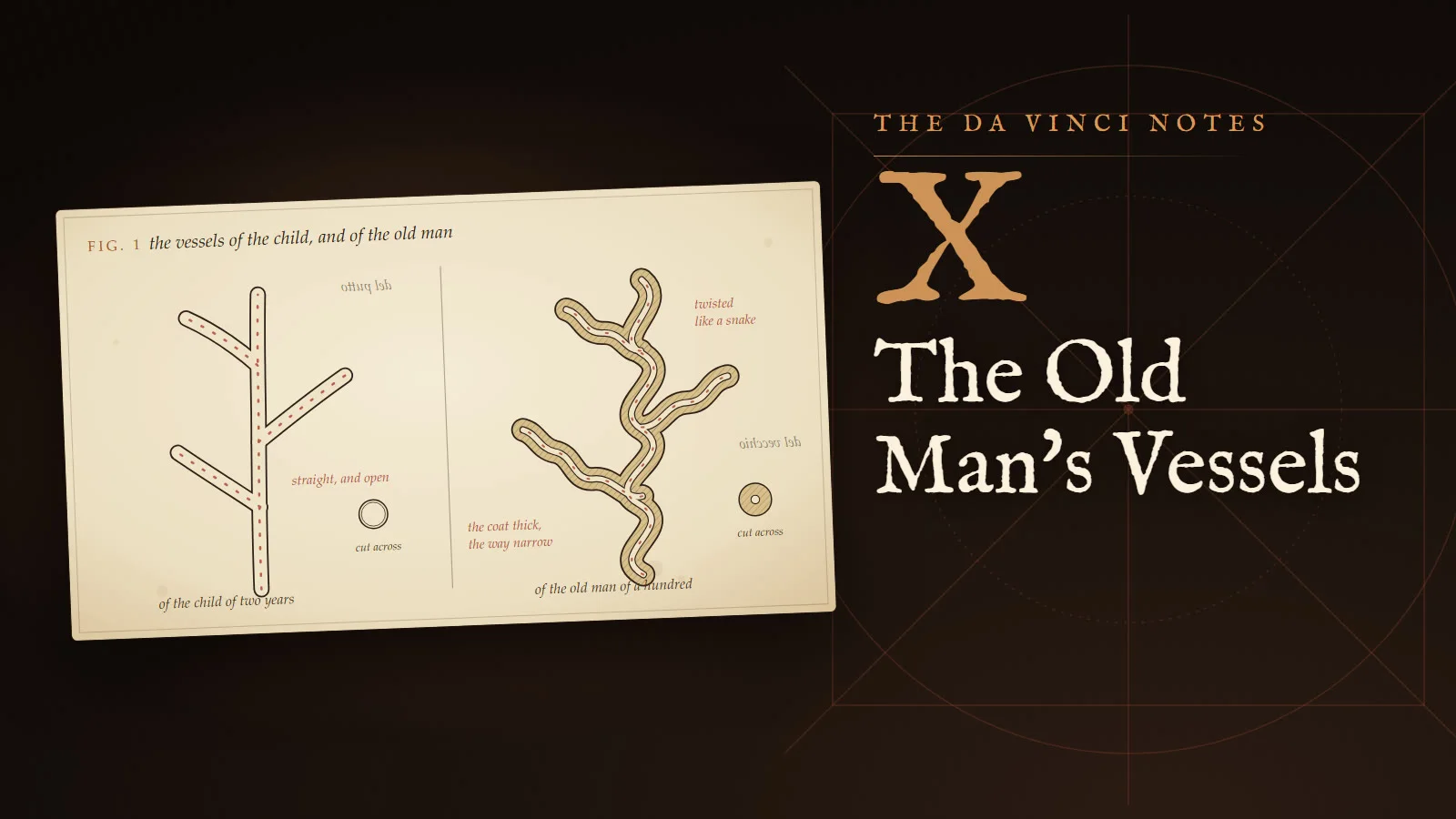
On the other side of the same leaf, the veins of the left arm, which I took from the old man where they show beneath the skin, and beside them the comparison I most wanted to fix: a vessel of the young and the same vessel of the old, side by side, the first straight, the second bent back and forth like a snake. I have drawn the comparison again here larger as Fig. 1, so that the reader sees at once what took me two bodies and a month to see. The wall is drawn thin in the child and thick in the old man, hatched with the pen, and I have cut each one across to show the channel as a round hole: wide in the one, a pinhole in the other.
Reflection
Two bodies on the same table a month apart, the beginning and the end. In the child everything was full, soft, open, wet, growing; in the old man everything was dry, hard, closed, shrinking. I have seen the same thing in the trees on my uncle's farm at Vinci: the young shoot green and full of sap, bending without breaking; the old trunk with its bark thick and cracked, its heart dry, the sap rising only in a thin ring under the bark, so that one hard winter kills it. The tree of the veins is like the trees of the field in this as in its branching. I did not like this work. A child should not be on the table. But I learned from him what I could not have learned from a hundred old men, which is what the old man had lost.
Florence, February 1508. Why the old die without fever
The cause, as I now understand it, written out in order.
- The vessels carry the nourishment of the body, which is the blood, from the heart and the liver to every part, and every part lives only so long as it is fed. The body is continually dying and continually renewed, like the flame of a candle fed by its fat; and if the food fails, the life fails with it.
- The blood runs through the vessels without ceasing, all the years of a man's life. And as water running always in a channel builds up the banks with what it carries, so the blood running always through the vessels builds up their coats.
- So the coats of the vessels thicken with age, and as they thicken outward a little and inward much more, the channel within grows narrow.
- At the same time the vessels grow in length and become winding, so the blood must go a longer way to arrive at the same place.
- The narrowest vessels, the capillary veins at the ends of the branches, close first, being smallest. The skin, which is fed by them, is the first part to starve.
- So the old feel the cold more than the young, and their skin goes the colour of wood or dried chestnut, because it is almost wholly deprived of food.
- Last the great vessels close, the ones that feed the heart and the bowels, and when the heart can no longer be fed it stops, without fever, without pain, as the old man stopped.
The incessant current of the blood through the veins makes these veins thicken and become callous, so that at last they close up and prevent the passage of the blood.
Leonardo da Vinci, anatomical notes, trans. J. P. Richter (1883), §848
Of oranges
I have the comparison for it from the market. Keep an orange through the winter, and it does not rot at once: its peel grows thick and leathery, and inside, when you cut it, the pulp has shrunk and dried away from the peel. The old man's vessels did exactly this.
And this network of veins acts in man as in oranges, in which the peel becomes thicker and the pulp diminishes the more they become old.
Leonardo da Vinci, Windsor, Fogli B 10v, trans. E. MacCurdy (1906)
Margin
Here the adversary says: it is the blood that grows thick in the old, like old wine turning to vinegar and lees, and thick blood cannot run. I answered him on the same page:
And if you say that as the blood becomes thicker it ceases to flow through the veins, this is not true, for the blood in the veins does not thicken because it continually dies and is renewed.
Leonardo da Vinci, Windsor, Fogli B 10v, trans. E. MacCurdy (1906)
The blood of the old man is made new every day from what he eats, as the blood of the child is. The vessel is the part that is old, for it is the vessel that has been worn by the passage of the blood all those years, as a riverbed is shaped by the river and the river is always new water.
Of rivers, and the tree of the veins
The blood moves in the body as water moves in the earth. The waters of the earth rise from the sea to the tops of the mountains and run down again in rivers; the blood rises from the sea of the heart to the top of the head. I wrote of it long ago, and it still seems true to me, though the way the blood returns I do not yet understand.
And the vessels branch as trees branch, one whole divided into as many main branches as there are principal places to nourish, and those subdivided without end.
The vein is one whole, which is divided into as many main branches as there are principal places which it has to nourish, and these branches are subdivided in an infinite number.
Leonardo da Vinci, Windsor, Anatomical Manuscript A (Fogli A) 4r, trans. E. MacCurdy (1906)
Now think of a river that has run a thousand years across a flat plain, as the Arno runs below Empoli. It has filled its bed with sand and mud and raised its banks with silt, and its waters wander in great bends, so that a boat must go three miles to advance one. Such a river carries less water to the sea for the same rain, and floods. The old man's vessels were such rivers: their beds raised, their bends increased, their channels choked.
Trial No. 1
To learn how much a narrowing costs, with water, which does not lie.
Apparatus: a tub of water with a hole low in its side, the water kept always at the same height by a boy with a jug and a mark scratched on the inside. Into the hole, a stopper of wax holding a reed. Two reeds, one with a bore twice the width of the other, each cut to a length of half a braccio. A measure of a quarter of a boccale and the sand glass of the kitchen.
- The wide reed filled the measure while the sand ran through once.
- The narrow reed, of half the bore: by the area of the opening, which goes as the square of the width, it should take four times as long. It took sixteen times as long, near enough, for I counted the glass turned over fifteen times and part of a sixteenth.
- Both reeds cut to a quarter of a braccio and tried again: each ran twice as fast as before. With a long reed the water comes out in half the quantity when the reed is twice as long.
- Each reed cut down to the width of a finger, so that it was nothing more than a short tube in the stopper. Then the narrow one took only about four times as long as the wide one, as the area says.
Calculation
So a long narrow channel loses far more than its opening. By the area alone, half the width should give a quarter of the water; through the long reeds it gave a sixteenth, which is a quarter of a quarter. I think the walls hold the water back by rubbing, for in rivers I have seen that the water runs fastest in the middle, far from the banks, and slowest against them. A narrow channel has more wall for its water, and its water is all near a wall. In proportion:
\[ \text{width } 2 : 1 \;\Rightarrow\; \text{opening } 4 : 1 \;\Rightarrow\; \text{water through a long reed } 16 : 1. \]
And for the length, the water goes as the contrary of the length:
\[ \text{length } 1 : 2 \;\Rightarrow\; \text{water } 2 : 1. \]
Then the old man's vessel, whose channel I measured at half the width of the child's in proportion to the outside of the vessel, and whose length had grown by a third in its windings, carries a sixteenth, and of that sixteenth three quarters: about a twentieth of what the same vessel carried when he was young. No wonder his flesh starved.
I have drawn this as Plate X. The upper vessel is the child's, the lower one the old man's; narrow the old man's channel and lengthen it, and watch how few grains of blood pass, and how slowly.
Florence, 22 March 1508. In the house of Piero di Braccio Martelli
Today I began a new book, here in the house of Piero di Braccio Martelli where I lodge, and I wrote at its head that it is to be a collection without order, taken from many papers, which I hope to put in order later according to the subjects. I shall have to repeat the same things many times. Let no one blame me. I am fifty-five, and the old man's vessels are in my mind every time I climb the stairs.
Begun at Florence, in the house of Piero di Braccio Martelli, on the 22nd day of March 1508. And this is to be a collection without order
Leonardo da Vinci, British Library, Codex Arundel f. 1r, trans. J. P. Richter (1883), §4
Reflection
I have thought much this winter about the old man and his gentle end, and about my own. My father died three years and a half ago, at about eighty, and I wrote the hour of it twice in my notes as though I could not believe it. The old man was older than my father and died more easily. If what I found is true, then a long life is paid for in the vessels, the blood wearing its own channels shut by the very running that keeps the body alive. The same current that feeds the flesh builds up the walls that will starve it. I find this neither cruel nor kind. It is the way a river makes its delta and silts its own mouth. Nature never breaks her own law, and here her law is that whatever moves, wears.
And yet he was content. He told me he felt nothing but weakness. If one must go, I would choose to go as he went, sitting up, in the middle of a conversation, with no one weeping and nothing to fear.
To do
- Ask at Santa Maria Nuova for any very old body, man or woman, and any child; compare the vessels in each.
- Find whether the vessels of the old close more in the legs than in the arms, for the old feel the cold first in the feet.
- Describe the liver of the old man and of the child, side by side, on one sheet.
- Try the reeds again with water mixed with a little honey, to see whether a thicker water obeys the same proportion.
- Draw the heart and its vessels, the ones that feed the heart itself.
- Withdraw four ducats from the Spedale for the notary.
Problems I set myself
1. A vessel has lost a quarter of its width by the thickening of its coat. If the water through a channel went only as its opening, what part would pass? And what part through a long channel, by my trial with the reeds?
Answer. The width falls to three quarters. The opening goes as the square of the width: \( (3/4)^2 = 9/16 \), a little more than half. Through a long channel the water goes as the square of the opening, that is, as the fourth power of the width: \( (3/4)^4 = 81/256 \), about 32 parts in 100. Losing a quarter of the width costs more than two thirds of the flow.
2. A straight vessel of the length of a palm grows winding with age, so that its path between the same two places becomes a palm and a third. With the same push behind the blood and the same width, what part of the blood passes?
Answer. The water goes as the contrary of the length: \( 1 : \tfrac43 = \tfrac34 \). Three quarters pass, a loss of a quarter from the winding alone. Combined with the narrowing of the first problem, \( \tfrac{81}{256} \times \tfrac34 = \tfrac{243}{1024} \), about 24 parts in 100.
3. A vessel keeps the same outside, four parts across. In the child its coat is a third of a part thick; in the old man, a part and a third. How does the old man's channel compare with the child's, by the opening and by the long-channel rule?
Answer. The channel's width is the outside less twice the coat. Child: \( 4 - \tfrac23 = 3\tfrac13 \) parts. Old man: \( 4 - 2\tfrac23 = 1\tfrac13 \) parts. The proportion of the widths is \( 1\tfrac13 : 3\tfrac13 = 2 : 5 \). By the opening, \( (2/5)^2 = 4/25 \), 16 parts in 100. By the long-channel rule, \( (2/5)^4 = 16/625 \), between 2 and 3 parts in 100. A coat four times thicker, which the eye from outside hardly notices, has taken away nearly all the flow.
To the student who reads this later
The law I found with my reeds is yours, measured exactly three centuries and more later. Gotthilf Hagen in Berlin in 1839, and Jean Léonard Marie Poiseuille in Paris from 1840, who was a physician and wanted to understand the flow of blood in the small vessels, measured water flowing through fine glass tubes and found that for slow, steady flow the quantity passing in a given time is
\[ Q = \frac{\pi r^4\,\Delta P}{8\,\mu\,L}, \]
where \(r\) is the radius of the tube, \(\Delta P\) the difference of pressure between its ends, \(\mu\) the viscosity of the liquid and \(L\) the length. The fourth power of the radius is my "quarter of a quarter"; the length in the denominator is my "contrary of the length". The reason is the one I guessed: the liquid clings to the wall and moves fastest in the middle, with a speed that falls as a parabola from the axis to the wall, and in a narrow tube all of it is near the wall. My short reeds behaved differently because there the loss is mostly at the entrance and the flow goes nearly as the area, as I found. Your honey trial is my last to-do item: viscosity is \(\mu\), and doubling it halves the flow.
On what I saw in the old man, you have two names, and the honest thing is to give both. The Royal Collection Trust, which keeps the sheet at Windsor, reads my description of the shrunken, granular liver and the thickened, winding vessels between the spleen and liver as cirrhosis of the liver with portal hypertension, and calls the passage the earliest known description of that condition. René Laennec named cirrhosis in 1819. Other physicians, such as J. M. Boon writing in 2009, read my thickened, narrowed, tortuous arteries, the "artery that nourishes the heart" among them, as the first description of atherosclerosis. Jean Lobstein named arteriosclerosis, the hardening of the arteries, in 1829, and Felix Marchand coined atherosclerosis in 1904. Both readings fit parts of my notes; I saw hardened, narrowed vessels and a ruined liver in one body and explained them with one cause. Your pathologists would separate them.
Where I was wrong: the blood does not build up the walls as a river builds its banks. In atherosclerosis the inner lining of the artery is injured, fatty material and cholesterol carried in the blood collect beneath it, the body's own repair cells gather around it, and over years the deposit grows, scars and calcifies. It forms in patches, mostly at branchings and bends, and narrows the artery in one place, which is why Poiseuille's law, made for a uniform tube, is only a first guide: a short narrowing costs less than a long one, and your physicians reckon that a narrowing must close seven tenths of the width or more before the flow falls enough to cause symptoms. My windings are real: arteries do lengthen and grow tortuous with age. My thick-blood adversary was half right: the viscosity of the blood does matter, and your doctors measure it. And I did not know that the blood goes round. William Harvey showed in 1628 that the heart drives the same blood out by the arteries and back by the veins in a circle; I believed it was made fresh from food and consumed by the flesh.
The old man's long life and gentle death are also familiar to you. Armand Ruffer found hardened arteries in Egyptian mummies in 1911, so the disease is as old as cities, and your physicians still see, in the very old, deaths like his: the heart, short of blood, failing quietly.
What to try today: take two drinking straws, one of half the bore of the other if you can find them, or two hypodermic needles of different gauge on syringes, and time how long each takes to empty the same volume of water under the same push. The narrow one takes about sixteen times as long when the tube is long and the flow slow. Then try a short piece of each. And if you are older, ask your doctor about the pressure of your blood and the fats in it. Your blood is renewed every day; your vessels are as old as you are.
If you want to ask me about the old man, the child, or the oranges, come and ask me.
Sources and liberties
The Da Vinci Notes are a modern reconstruction written in Leonardo da Vinci's voice by Eternal Gardens. Dates, places, manuscripts, drawings and quotations come from the sources below; the order of the working, the private reflections, the plates and the sketches are ours.
- E. MacCurdy, Leonardo da Vinci's Note-Books (Duckworth, 1906): the old man, the child of two years, the oranges, the skin like dried chestnut and the answer on thick blood (Windsor, Fogli B 10v); the vein as one whole (Fogli A 4r).
- Royal Collection Trust, RCIN 919027, "The veins of the arm; and notes on the death of a centenarian", c. 1508, with its translation ("so sweet a death"; "twisted like a snake"; "like congealed bran") and its reading as cirrhosis with portal hypertension: rct.uk/collection/919027
- Royal Collection Trust, RCIN 919028, "The heart compared to a seed; the vessels of liver, spleen and kidneys", c. 1508 (the veins of the aged growing long and flexuous): rct.uk/collection/919028
- J. P. Richter, The Notebooks of Leonardo da Vinci (1883; Project Gutenberg ebook 5000): §848 (death in old men from thickened veins), §849 (the waters and the blood), §4 (Codex Arundel begun 22 March 1508), §1173 (a life well employed), §1372 (Ser Piero's death), footnote to §1530 on Leonardo's account with the Spedale di Santa Maria Nuova: gutenberg.org/ebooks/5000
- M. Clayton and R. Philo, Leonardo da Vinci: Anatomist (Royal Collection Publications, 2012).
- K. D. Keele, Leonardo da Vinci's Elements of the Science of Man (Academic Press, 1983).
- J. M. Boon, "Leonardo da Vinci on atherosclerosis and the function of the sinuses of Valsalva", Netherlands Heart Journal 17 (2009).
- J. L. M. Poiseuille, "Recherches expérimentales sur le mouvement des liquides dans les tubes de très petits diamètres", Comptes rendus de l'Académie des sciences (1840 to 1841); G. Hagen, Annalen der Physik (1839).
- W. Harvey, Exercitatio anatomica de motu cordis et sanguinis in animalibus (Frankfurt, 1628).
The old man's ward, his trade, his memories, the brother of the ward, the drawing of his head, the child's mother, the order of the dissections and the trial with the reeds are our reconstruction; Leonardo's notes record the old man's words, his death, the dissection and its findings, and the comparison with the child, and no more. Whether the man was truly a hundred is unknowable. "Atherosclerosis" and "cirrhosis" are both modern readings of the same notes, and the Royal Collection favours the second.