 by Marie Curie

Vaprio, on the Adda, in the house of Girolamo Melzi, the autumn of 1512. On the table by the window lies the heart of an ox that Francesco brought up from the butcher in the village, as long as my forearm from elbow to wrist, wrapped in a wet cloth so that it does not dry before I have finished. Milan is full of Swiss soldiers and nobody wants pictures, so I have spent my time on the motor of all the others. For five years I have argued with it. I began by believing what Galen and Mondino say of it, and one by one their sentences have fallen away under the knife. Tonight one question is left on the table, and it is small and hard: when the heart has thrown out its blood into the great artery, what shuts the three little doors behind it, and shuts them so quickly that almost nothing runs back?
That the blood which returns when the heart opens again is not the same as that which closes the valves of the heart.
Leonardo da Vinci, Windsor anatomical manuscripts, trans. J. P. Richter (1883), §850
Florence, winter 1508. What the books say of the heart
First what the authorities teach, so that later I may see where I left them.
Galen, in the book that our doctors call On the use of the parts, says the following, and Mondino of Bologna repeats most of it in his little Anothomia, which the printers in Pavia put out in 1478 and every student at the hospital carries. The heart has two ventricles, the right and the left. It is the seat of the natural heat of the body, a furnace, and the lungs are its bellows, which bring in air to cool it and carry away the smoke. The blood is made in the liver from food and goes out through the veins to the members, which use it up as a lamp uses oil. Some of it passes from the right ventricle to the left through little pores in the wall between them, and in the left it meets the air from the lung and becomes the vital spirit, which the arteries carry to the whole body and which makes the pulse. Aristotle gives the heart three cavities, and Mondino, who follows Galen everywhere else, here follows Aristotle and puts a third ventricle in the middle of the wall, which pleases nobody and settles nothing.
The doctors at Santa Maria Nuova repeat all this as if they had seen it. They have read it.
Reflection
This winter I opened the old man who died so quietly in the hospital, and the child of two years, and I wrote down what I found in them with great care. In the old man the vessels were thick and twisted and the passage of the blood almost closed. In the child everything was the contrary. I have looked at the heart of each, and I could not answer the simplest questions. Is the heart a muscle like the others? Why does it beat when no one commands it? Where does its heat come from? The books answer every question with a word: spirit, faculty, virtue. A word is a box with nothing in it. I want to see the thing.
And there is a difficulty that the books do not mention. A human heart comes to me rarely, a day or more after death, full of clots and already soft. The beasts of the slaughterhouse come fresh every morning. The ox has the same members as the man, larger and stronger, and the butcher will sell me the heart with the lung and the great vessels still on it for a few soldi. So I shall learn the heart of man from the heart of the ox, and where they differ I shall say so.
To do
- Have the Galen read to me in good Italian, the books on the use of the parts, in particular what he says of the valves. I wrote it once in a list of books to find, "Galenus on utility" (Richter §1412), and have not yet found it.
- Get an ox heart with the great artery left long, at least a span of it above the root.
- A sharp thin knife, a syringe of brass, a bladder, wax, a saucepan.
Milan, about 1511. The heart is a muscle, and it has four rooms
I have now opened eleven ox hearts and two of pigs. What they showed me, in order.
Observation 1. That the heart is a muscle
The wall of the left ventricle of the ox is a full finger thick and made of fibres like the flesh of the thigh, which run in spirals around the cavity, some across the others, as the twigs of a basket go round. Every muscle has its own artery and its own vein to feed it. And the heart has its own: two arteries that come out of the great artery just above the doors I shall describe, and run round the heart in a crown, and send branches down over its surface, with veins beside them. A heart fed by the blood in its cavities would need no such vessels, as a canal needs no pipe to bring it water. It is fed like a muscle, and it is a muscle, the strongest in the body, which works from birth until death and never rests.
The heart therefore is not the beginning of life, as they say. It is a vessel of dense muscle, kept alive by its artery and its vein like the others, and moved by its own force.

Draftsman's note
The sheet above, as I want it read. The heart is drawn from the front and from behind, at the size of life for the ox, which is a little less than half a braccio from the point to the root of the vessels. Pen in iron-gall ink, hatched from the upper left to the lower right as my hand goes, no wash, which would hide the vessels. Each artery of the crown is drawn with its veins beside it as far as the point, and where a branch dives into the flesh I stop the line and do not guess. The writing beside it says what each figure shows, so that a reader who has never seen a heart can find his way round it as round a city with a map.
Observation 2. That the heart has four ventricles
Above each of the two ventricles there is a chamber which the anatomists call the ear of the heart, because in the ox it hangs down like an ear, and which they treat as a mere end of the great veins, a kind of porch. Yet its wall has fibres of its own, and when the heart of a pig is opened while it still moves, these chambers can be seen to tighten and slacken, out of step with the lower ones. Something that tightens and drives the blood is a ventricle. So I count four: two upper and two lower, the upper ones thinner because they push only a short way, into the lower ones below them, and the lower left the thickest of all, because it pushes the blood into the great artery and so to the whole body.
Observation 3. The cords
Inside the lower ventricles the wall is rough with columns of flesh, and from the tops of these columns run fine white cords, like the strings of a tent, to the edges of the doors between the upper and the lower ventricle, and they stop these doors from being blown back into the upper chamber when the lower one tightens. In the right ventricle of the ox a thick cord also crosses the cavity from the wall to the partition, as a chain is put across a vault; I think it keeps the ventricle from opening too far. No book that I know mentions it.
Experiment No. 1
In Tuscany the country people kill their pigs by passing a long thin iron, a spillo, between the ribs into the heart. The iron stays fixed in the heart while the animal dies, and its outer end moves with every beat: when the heart tightens, the handle swings one way, and when it slackens, the other, and the movements grow weaker and slower until they stop. The heart therefore moves of itself, by a tightening of its flesh, like a hand closing; and the pulse that I feel at the wrist of a man is the echo of that tightening.
Margin
The pores in the wall between the right and the left ventricle. Galen says they are there, and they must be there if the blood is to pass from right to left, for I have found no other road. I have looked for them with the finest bristle of a pig and in the light of the window and I have not seen them. I write them in my drawings because the ancients say so, and this troubles me. Either they are too small for the eye, or the blood goes by a way I have not found.
Vaprio, about 1512. Why the door has three leaves
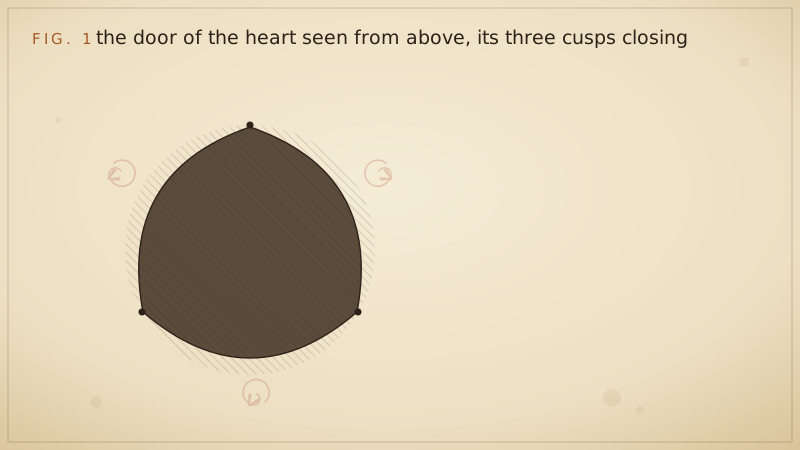
At the mouth of the great artery, where it leaves the left ventricle, there is a door of three leaves. Each leaf is a thin half-moon of white skin, fixed by its curved edge to the wall of the artery and free along its straight edge, and behind each leaf the wall of the artery bulges outward in a little pouch, so that the root of the artery, seen from outside, has three swellings like a clover. When the ventricle tightens, the leaves are pushed open and lie back against the mouths of their pouches, and the blood goes up between them. When the ventricle slackens, the three free edges come together in the middle and meet in a seam of three arms, and the blood above cannot fall back.
Why three? The great artery and the artery of the lung have three, always, in every heart I have opened, of man, ox and pig. Nature does nothing in vain, and nothing more than is needed. So there must be a reason, and I think I have found it with a pair of compasses.
Calculation
- Let the mouth of the artery be a circle, and let the leaves be fixed to it at points equally spaced, which I call their horns.
- When the door is shut, each free edge runs from one horn to the centre and from the centre to the next horn. So each edge is two semidiameters long, whatever the number of leaves.
- When the door is open, the free edges must lie back against the wall of the circle, or the opening will be smaller than the mouth and the blood will be squeezed. So the free edges together must be as long as the circle, or nearly.
- The circle is three times its diameter and one seventh more, which is six semidiameters and two sevenths.
- With two leaves, the edges together are four semidiameters. Laid open they can cover only four parts of the six and two sevenths, and the opening stays a slit between two lips, as the doors in the veins are.
- With three leaves, the edges together are six semidiameters, against six and two sevenths: \( 6 : 6\tfrac{2}{7} = 21 : 22 \). The leaves, laid open, fall short of the whole circle by only one part in twenty-two, and the opening is nearly as large as the mouth.
- With four leaves, the edges are eight semidiameters, longer than the circle by one and five sevenths. When the door is open they have too much skin and must fold and wrinkle against the wall, and when it is shut the four meet at a point where four edges must all touch at once, which is a weaker joint than a seam of three.
- So three is the number at which the shut door has no excess and the open door has no lack. It is the number a good carpenter would choose.
Draftsman's note
Fig. 1, as I drew it with the root of the ox's artery cut off a finger above the leaves and set upright on a plate. The ring is drawn with the compasses, the three pouches freehand around it, each bulging outward between two horns. The leaves are hatched, the opening between them darkened with a little ink and water, because a hole must look deep. At the right, three small rings: the door open, the door half shut with a little three-cornered opening in the middle, and the door shut with its seam. Where the three edges meet I have drawn them overlapping a little, a hair's breadth, because in the shut door of the ox each leaf lies on its neighbours for the width of a straw, and so the seam holds when the artery presses on it from above.
Reflection
Here the adversary says: the door shuts as any door shuts in the wind. When the ventricle slackens, the blood in the artery begins to fall back, and the backward blood catches the leaves and slams them. What more do you want?
I answer him with three things. First, a door shut by the returning blood would let much of that blood back before the leaves met, as a door slammed by the wind lets in the gust that slams it, and the heart would lose at every beat part of what it had thrown out. Second, the open leaves lie back against the mouths of the pouches, and blood coming back along the wall would press them flatter still. Third, why are the pouches there at all? Nature has hollowed the wall behind each leaf, with great care, in every heart. A pouch behind a door that shuts by the wind would be a useless thing, and she makes nothing useless. I wrote it in a short sentence that I keep coming back to: the blood which returns when the heart opens again is not the same as that which closes the valves. Something else shuts them, and before the return. I believe it is the blood in the pouches, turning.
Vaprio, about 1512. The wax, the plaster and the glass
The blood moves too fast and in the dark. In the living heart I cannot see it; in the dead heart it does not move. So I shall make the heart transparent and give it water for blood, with something in it that the eye can follow.
Experiment No. 2. The mould
- Through the ventricle, pour wax, melted and not too hot, into the root of the artery, so that it fills the three pouches and the space above and below the leaves and takes their true shape. Let it cool all night.
- Cut away the flesh and the leaves. What remains is the inside of the root in wax: a short column with three swellings, like a little pear with three lobes.
- Cover the wax with plaster of Paris, a finger thick all round, leaving an opening at each end. When it is hard, set it over the fire and pour out the wax. Now the mould holds the empty shape of the root.
- Have the glassblower blow thin glass inside the mould, so that the glass takes the shape of the hollow, pouches and all. Then break the plaster away.
- Fix the glass at its lower end to a bladder or a bag of ox gut filled with water, which stands for the ventricle, and at its upper end to a tube of glass a braccio long, which stands for the artery. In the throat of the glass, where the leaves were, tie three half-moons of thin parchment wetted with oil, each by its curved edge.
Margin
The first glass cracked in the mould when the plaster was still damp; the second came out whole but so thick that it bent every line seen through it like the bottom of a beaker. The third is good. The glassblower wanted three times his price for it. Two lire and ten soldi.
Experiment No. 3. Seeds in the water
Into the water of the bladder I put seeds of panic, the small round grass seed that the country people feed to birds, soaked overnight so that they neither float nor sink but hang in the water, and some husks of the same, which are lighter. Then I press the bladder smartly with the flat of the hand and slacken it, again and again, with the light of the window behind the glass.
What I saw, set down in the order it happened, over many presses:
- When the hand presses, the parchment leaves fly open and lie back against the mouths of the pouches, and the seeds in the middle go straight up the glass in a column, as water goes up from a fountain.
- The edge of that column, where it passes the mouths of the pouches, drags the water in the pouches with it. The seeds in each pouch begin to turn: up along the back of the leaf, outward at the top of the pouch, down along its wall, and inward again at its bottom, at the root of the leaf.
- When the hand begins to slacken, and the column slows, the eddies do not slow with it. Water that is turning goes on turning, as a wheel goes on after the miller takes his hand from it. And now the eddy is stronger than the column, and the water turning down the wall of the pouch and inward at its bottom strikes the leaf from behind, on the side of the pouch, and pushes it toward the middle.
- So the three leaves begin to close while the water in the middle is still going up. By the time the column has stopped they are almost together, and only a very little water comes back down the glass, enough to finish the joint.
- When I take the pouches away, by doing the same with a straight tube of glass of the same throat and the same leaves, the leaves lie flat against the glass as long as the water rises, and do not stir until it falls back; then they are caught by the falling water and slammed shut, late, and a good deal of water and many seeds go back down into the bladder first.

Calculation
Why the column speeds up in the throat, and why the shut is so quick.
- The same quantity of water must pass every section of the tube in the same time, so where it is narrower the water goes faster, in the proportion that the section is smaller.
- When the leaves have closed three quarters of the way, the opening is a quarter of the mouth. If the same water still had to pass, it would go four times as fast. But the hand is slackening, so less water comes, and the leaves shut on a slowing stream that has less and less to push them open.
- The eddy in the pouch was set turning by the column at its strongest, and keeps that force when the column has lost it. So at the end of the beat the eddy wins, and the door shuts by the motion that the beat itself put into the pouch. The heart closes its own door with the remainder of its own push. I find this beautiful.
I have drawn the whole engine as Plate XI, cut down the middle so that two of the three pouches can be seen. Press Play and watch one beat, slowed six times. Move the strength of the stroke and the eddies turn faster and the door shuts sooner. Take the pouches away with the button and watch the leaves wait against the wall for the water to come back.

Reflection
My glass does not swell as the living artery does, my leaves are parchment, my hand is a poor ventricle. The eddy does not care. It needs only a stream passing the mouth of a hollow, and that I have given it. I have seen it a thousand times in the Adda below this house, where the river passes a bay in its bank and the water in the bay turns round, and every chip that enters goes round there long after the others have gone down to the bridge. The pouch of the artery is such a bay. Nature has built in the heart, very small, what she builds in every river.
Rome, the Belvedere, December 1513. Heat, the ebb and flow, and what I still do not know
On the twenty-fourth of September I left Milan with Giovanni, Francesco, Salaì, Lorenzo and il Fanfoia, and now I have rooms in the Belvedere, through the kindness of the Magnifico Giuliano, with a view of the vines and the city below. I have no ox here yet, and the hospital of Santo Spirito does not know me. So I read back what I wrote at Vaprio and try to see where it holds and where it is weak.
Of the heat of the heart
The heart is warmer than the other members, and the ancients say its heat is innate, a fire lit by nature that burns there until death. I do not like a fire without fuel. My own view is that the heat is made by the motion: the blood, beaten and thrown by the tightening of the ventricles, rubs against the walls of the heart and the leaves of its doors and against itself in the narrow passages, and rubbing makes heat, as two sticks rubbed together grow hot, and as the hands grow warm when we rub them in winter. The harder the heart works, in fever or in running, the hotter the body; this agrees.
Of the ebb and flow
The blood goes out of the heart and comes back to it, in each beat, as the sea goes out and comes back with the tide. I compared them years ago: the waters go up into the mountains as the blood of animated beings, in my old words in the book on water, "always moves from the sea of the heart and flows towards the top of the head" (Richter §849; the passage is in the Codex Leicester). The pulse is the wave of that sea. I wrote in Florence that by means of the beating of the heart "there is produced a wave of blood in all the veins, and these are continually either enlarging or contracting" (Windsor anatomical manuscripts, Fogli B, f. 28r, trans. McCurdy 1906). And at each slackening a part of the blood flows back into the upper ventricle, and from there some goes through the wall to the left, and some goes on to the members to feed them, and food made into blood in the liver replaces what is consumed.
Margin
This is the part I am least sure of. The doors of the heart are made to let the blood go one way only; I have proved it with the glass. If the doors are good, how does the blood ebb back into the ventricle at each beat? A little runs back before the leaves are shut, I have seen it, but it is very little. Either my ebb is wrong or my doors are. I believe the doors, because I have seen them work. Write this question at the top of the next book on the heart.
To do
- Ask at Santo Spirito for the bodies of those who die without kin, and whether the prior permits drawing.
- Measure with water how much the left ventricle of the ox holds, full, and how much remains when it is squeezed as hard as the hand can squeeze it. The difference is what one beat throws out.
- Count the beats of a resting man by the sand-glass, many times, morning and evening.
Reflection
I do not know whether I shall finish the book of the heart; I have begun more books than a man can finish in three lives. But the door with three leaves, and the eddies that shut it before the blood can return, I have seen with my own eyes, and drawn, and that is written, and the water will do it again for anyone who builds the glass.
Problems I set myself
1. A door of five leaves is fixed in a round mouth. How long are the free edges together, in semidiameters, and by how much do they exceed the circle? Compare with the doors of two, three and four leaves, and say why the five-leaved door is worse than the three.
Answer. Each free edge, shut, runs from a horn to the centre and back to the next horn, two semidiameters, so five leaves have ten semidiameters of edge. The circle is six and two sevenths. Ten exceeds it by three and five sevenths, more than half the circle again. Laid open, the five leaves have thirty-five parts of edge for every twenty-two parts of wall, so they must fold deeply; shut, five edges must meet at one point. Two leaves fall short of the circle by more than a third, four exceed it by more than a quarter, and three alone come within a twentieth.
2. Suppose the left ventricle of a man throws out two ounces of blood at each beat, and the pulse beats 72 times in a minute. How much blood does the heart throw out in an hour? A man of middling size weighs about two hundred libbre, and has in his whole body perhaps fifteen libbre of blood. Compare.
Answer. In a minute, \(72 \times 2 = 144\) ounces, which at twelve ounces to the libbra is 12 libbre. In an hour, \(12 \times 60 = 720\) libbre: more than three times the weight of the whole man, and forty-eight times all the blood in his body. No liver can make 720 libbre of blood in an hour from the food of a day, which weighs a few libbre. So the same blood must pass through the heart again and again, many times in an hour, and come back to it by some road. I have set this down because the arithmetic is plain and I do not yet understand what it is telling me.
3. The round mouth of the great artery is one finger across. Five cubic fingers of blood pass through it in a third of a second. Taking the circle as eleven fourteenths of the square on its diameter, find the mean speed of the blood in fingers and in braccia per second. Then find the speed in the opening when the leaves have shut three quarters of the way, if the same quantity were still passing.
Answer. The area of the mouth is \(\tfrac{11}{14}\) of a square finger. In one second fifteen cubic fingers pass. The speed is \(15 \div \tfrac{11}{14} = 15 \times \tfrac{14}{11} = 19\tfrac{1}{11}\) fingers a second, and since a braccio has twenty-four fingers, about four fifths of a braccio a second. With the leaves three quarters shut the opening is a quarter of the mouth, so the speed would have to be four times as great, \(76\tfrac{4}{11}\) fingers, about three braccia and one sixth a second.
To the student who reads this later
You have the word I lacked: circulation. William Harvey, an Englishman trained at Padua, printed it in 1628 in De motu cordis, and he reached it by the arithmetic of my second problem: a modest measure of blood per beat, multiplied by the beats in half an hour, is more than the body holds and far more than food could make, so the blood must go round, out by the arteries and back by the veins, and from the right ventricle to the left through the lungs. Ibn al-Nafis in Cairo, in the thirteenth century, and Realdo Colombo in 1559, had already said that the blood crosses through the lung and not through the wall. My pores in that wall do not exist. Malpighi saw the tiny vessels that join the arteries to the veins in 1661. The answer was written in my own numbers, and I did not hear it. A resting heart throws out about 70 millilitres a beat, some five litres a minute, while the whole body holds about five litres: the blood goes round about once a minute.
The heat of the heart is the heat of the whole body, and it comes from a slow burning of food with the air we breathe, which Lavoisier showed in the 1780s when he measured the breath of a guinea pig against the heat it gave to ice. Friction in the blood is real, but its heat is a few watts against the hundred or so that a resting body makes. The heart does beat of itself, from its own pacemaker in the wall of the right upper chamber. My four ventricles you call the two atria and the two ventricles, and my cord across the right ventricle is the moderator band.
The door of three leaves you call the aortic valve, its leaves the cusps, and the three pouches the sinuses of Valsalva, after Antonio Maria Valsalva of Bologna, who described them some two hundred years after me. Their purpose was argued about for four and a half centuries. In 1968 B. J. and F. H. Bellhouse, at Oxford, published in Nature a short paper on the mechanism of closure of the aortic valve, and the next year Bellhouse and Leon Talbot printed the full study in the Journal of Fluid Mechanics. In a model of the root in a pulsing water tunnel they found a trapped vortex in each sinus and a point where the jet divides at the tips of the cusps, and showed that about three quarters of the closing happens while the blood still flows forward, so that only a small reversed flow is needed to seal. The sinuses also keep the open cusps off the wall and away from the mouths of the coronary arteries, which leave from two of them. Their first paper cited one earlier work only: Kenneth Keele's study of my drawings of the heart.
In 2002 Morteza Gharib and his colleagues at Caltech, with Martin Kemp, rebuilt my glass and put seeds in it, and saw eddies in the sinuses; Kemp doubts that a glass like mine could show all that I drew, and he may be right. In 2014 Margaret Bissell, Erica Dall'Armellina and Robin Choudhury, at Oxford, used four-dimensional magnetic resonance imaging, which can measure the speed of blood at every point of a living heart through the beat, and saw the vortices turning in the sinuses of healthy people, as I said. Francis Wells, a heart surgeon at Papworth Hospital near Cambridge, explained my drawings to surgeons in The Heart of Leonardo (2013).
You write my rule of sections as flow equals area times speed:
\[ Q = A\,v. \]
And your physicians reckon the pressure lost in a narrow valve from the speed through it, with the speed in metres per second and the pressure in millimetres of mercury, by a short form of Bernoulli's law:
\[ \Delta p \approx 4\,v^2. \]
A healthy valve passes blood at about one metre a second and loses about 4 millimetres of mercury. The eddies that close the valve come from the slowing itself: when a column of fluid decelerates, the pressure rises in the direction it is going, \(\partial p/\partial x = -\rho\,\partial u/\partial t\), and that rise pushes the fluid near the wall, where it is slow, backward into the sinuses, where it turns.
What to try today at a table: cut the top off a clear plastic bottle so that you keep the shoulder and the neck, and hold it neck down under water in a basin. Fill a turkey baster or a soft squeeze bottle with water and a pinch of ground pepper or tea dust, push its nozzle into the neck, and squeeze in short, sharp pulses. In each pulse the jet goes up the middle, and as it stops, the pepper in the shoulder curls back and down in a ring. That ring is my eddy in the pouch, and in your own chest it closes a door about seventy times a minute, some three thousand million times in a long life, while you sleep.
If you want to argue with me about the glass, the four rooms, or the arithmetic I did not understand, come and ask me.
Sources and liberties
The Da Vinci Notes are a modern reconstruction written in Leonardo da Vinci's voice by Eternal Gardens. Dates, places, manuscripts, drawings and quotations come from the sources below; the order of the working, the private reflections, the plates and the sketches are ours.
- Leonardo da Vinci, The Notebooks of Leonardo da Vinci, trans. J. P. Richter (1883), §814 (the causes of the motion of the heart), §849 (the sea of the heart), §850 (the epigraph), §1412 ("Galenus on utility"): Project Gutenberg
- Edward McCurdy, Leonardo da Vinci's Note-Books (London: Duckworth, 1906), the wave of blood made by the beating of the heart, from Windsor anatomical manuscripts, Fogli B, f. 28r.
- Royal Collection Trust, RCIN 919082, The aortic valve, about 1512 to 1513 (the wax cast, the plaster mould and the glass model, water with grass seeds): rct.uk
- Royal Collection Trust, RCIN 919083, Blood flow through the aortic valve: rct.uk; RCIN 919073, The heart and coronary vessels: rct.uk
- Google Arts and Culture, The aortic valve (catalogue description of RCIN 919082, pen and ink on blue paper, 28.3 by 20.4 cm): artsandculture.google.com
- B. J. Bellhouse and F. H. Bellhouse, "Mechanism of closure of the aortic valve", Nature 217 (1968), 86 to 87: doi.org/10.1038/217086b0
- B. J. Bellhouse and L. Talbot, "The fluid mechanics of the aortic valve", Journal of Fluid Mechanics 35 (1969), 721 to 735: doi.org/10.1017/S0022112069001406
- M. M. Bissell, E. Dall'Armellina and R. P. Choudhury, "Flow vortices in the aortic root: in vivo 4D-MRI confirms predictions of Leonardo da Vinci", European Heart Journal 35 (2014), 1344.
- M. Gharib, D. Kremers, M. Koochesfahani and M. Kemp, "Leonardo's vision of flow visualization", Experiments in Fluids (2002).
- Francis Wells, The Heart of Leonardo (London: Springer, 2013).
- Martin Clayton and Ron Philo, Leonardo da Vinci: Anatomist (London: Royal Collection Publications, 2012).
- William Harvey, Exercitatio anatomica de motu cordis et sanguinis in animalibus (Frankfurt, 1628).
The number of hearts opened, the glassblower's price, the parchment cusps, the seeds that neither float nor sink, the straight tube without pouches and the pig killed at Fiesole are our reconstruction; the wax cast, the mould for thin glass and the grass seeds in water are on Leonardo's sheet RCIN 919082, and the Tuscan practice of killing pigs with a spillo is recorded in his notes on the heart, though the folio is not given here. Scholars, Martin Kemp among them, doubt whether Leonardo ever built the glass model or drew the vortices from what he expected to see; the plate's closure model is ours, tuned to Bellhouse and Talbot. The ebb and flow of the blood and the heat made by friction are his errors, stated as he held them.