 by Marie Curie


Florence, the end of March 1508, in the house of Piero di Braccio Martelli, where I have begun a new book of loose sheets that will have no order. The Arno is high with the snows of the Casentino, brown and fast, and from the weir below the Ognissanti comes a noise all night like a crowd that never goes home. I have spent the winter with the dead at Santa Maria Nuova and the spring is for water. Of all the things I have tried to write about, water is the one that has never once stood still to be drawn. It falls, it strikes, it turns back on itself, and the turning carries away the banks of rivers and the foundations of bridges. So the question of these pages is the oldest of mine: what does water do when it strikes something, a stone, a post, or other water, and why does it turn?
Universally all things desire to maintain themselves in their natural state. So moving water strives to maintain the course pursuant to the power which occasions it, and if it finds an obstacle in its path, it completes the span of the course it has commenced by a circular and revolving movement.
Leonardo da Vinci, Manuscript A, f. 60r, trans. Edward McCurdy (1906)
Florence, March 1508. My old book A, and what I wrote in it of water
Among the books I carried from Milan is the little one I filled there some sixteen years ago, with perspective and light and the weights of things, and at the end of it, water. I read it again tonight by the lamp, as one reads the letters of a younger brother who was quick and sure of himself.
He wrote the sentence above, that moving water keeps the course its power gives it, and when something stands in its way, it finishes that course by going round. It is well said, and I still hold it. The water does not want to stop; it cannot go forward; so it goes round, and the going round is the eddy. All the motions of the wind, he added, resemble those of water.
He also wrote of water falling into other water, and this I had forgotten:
Water which falls from a height into other water imprisons within itself a certain quantity of air, and this through the force of the blow becomes submerged with it, and then with swift movement rises up again
Manuscript A, f. 59r, trans. McCurdy (1906)
Good, again. But he did not measure anything. He says the eddy goes round and does not say how fast, how large, how many, in what order. He says the air goes down and comes up and does not say how deep. Sixteen years ago I thought that to state the cause was enough. Now I know that a cause which cannot give a number is only half a cause.
Reflection
I once defined water in a single line: "Among the four elements water is the second both in weight and in instability" (Richter §931). The second in weight, after earth; the first, I think, in restlessness, for even fire keeps one shape while it burns. Water has no shape of its own. It takes the shape of the vessel, the bed, the obstacle, and the moment it is free of them it takes another. To draw it I must draw what it is doing, because what it is changes faster than the pen.
To do
- A tub of a braccio and a half, a trough of planks that can be raised and lowered on pegs, a bucket with a hole of one finger.
- Millet and panic seed, soaked; sawdust of fir, which floats; fine sand, which sinks.
- Ask the miller at the weir of the Ognissanti at what hours he opens the race.
- Count my pulse against the sand-glass of the hospital, to know how many beats make a minute, so that I may use the pulse as a clock beside the water.
Florence, April 1508. Water falling into a pool
I have spent three mornings at the weir and two afternoons with the tub in the courtyard, and here is what I saw, set down in the order of the water's own journey.
Observation 1. The jet narrows as it falls
Water leaving the lip of the trough in a sheet two fingers thick is, a braccio and a half lower, hardly half a finger thick, though no water has been lost on the way. The same water must pass every height in the same time, so where the sheet is thinner it must be going faster, in the same proportion. A sheet four times thinner goes four times faster. So the water is going four times as fast when it reaches the pool as it was at the lip, and I have measured the speed of falling without a clock, with a pair of compasses.
Observation 2. The stroke, and the air carried down
Where the jet strikes the pool, it opens a hollow in the surface, a little cup, and the edges of the cup are thrown up in a ring. The falling water goes down into the pool carrying with it a column of air broken into bubbles, white, deeper the higher the fall. With the trough at one braccio above the tub, the white goes down a third of a braccio; at two braccia, more than half. Then the bubbles rise again on either side of the place where they went down, in curling paths, and burst on the surface in a ring of foam a little way from the jet.
Observation 3. The two eddies
Under the surface, with sawdust in the water, the descending jet is seen to drag the water beside it downward, and that water, when it reaches the bottom of its fall, spreads out and comes back up, outward and upward, and is drawn back toward the jet at the top. So on each side of the jet there is a great eddy, turning one way on the left and the other way on the right, like two wheels driven by a belt that runs between them. If the jet falls on a slope, as it does over the weir, one eddy is large and the other small, and the large one turns under the falling sheet and scours the bed below the weir, which is why every weir in Tuscany has a hole at its foot and why the millers pile stones there and the stones disappear.

Draftsman's note
When I drew this again later, on the sheet above, I put the falling water at the top as it enters the pool, the surface drawn as a thin line broken by the cup and the ring, and under it the descending column drawn as threads that separate and curl back on either side, each thread a line of the water's path, as I saw it with the sawdust. The bubbles I draw as small circles, larger as they rise, because the air swells as the weight of water above it grows less. Below, on the same sheet, water flowing past flat boards set across it at different angles, with the eddies behind each board. Pen and brown ink over black chalk, no wash at all: water drawn with wash looks like a cloud.
Experiment No. 1
To see how the depth of the white depends on the fall. The trough set at four heights above the tub: half a braccio, one, one and a half, two. At each height the same opening of the race, and I read the depth of the white against a rod marked in fingers, standing in the tub.
- At half a braccio: the white goes down 4 fingers.
- At one braccio: 7 fingers.
- At one and a half: 10 fingers.
- At two braccia: 13 fingers, and the eddies reach the bottom of the tub and throw up the sand.
So for each half braccio of fall the air goes down about three fingers more. I would not swear to the numbers within a finger, because the white flickers and the eye cannot hold it still; but the order is certain, and it is near enough to a simple proportion that I shall look for its cause.
Margin
The rings on the surface go out from the stroke and leave the water behind them. A chip of wood lying on the pool rises and falls as the ring passes under it and stays where it was, as a field of wheat bends in the wind and the wheat stays in the field. So the wave is one motion and the water is another. Write this in the book of waves.
Milan, about 1510. Water and hair
Back in Milan, with the French, and my rooms near San Babila. I have been drawing heads again, and the hair of heads, and I cannot draw hair now without seeing water in it.
I wrote it beside a drawing of water flowing past an obstacle, and I copy it here because it is the heart of the matter:
Observe the motion of the surface of the water which resembles that of hair, and has two motions, of which one goes on with the flow of the surface, the other forms the lines of the eddies
Windsor, RCIN 912579, trans. J. P. Richter (1883), §389
A lock of hair hanging from the head has two motions. Its weight pulls it straight down, and this is the first; and each lock, being twisted, turns on itself as it falls and makes curls, and this is the second. A long lock in a woman's hair, when it is not combed, shows both at once: the whole falls, and every part of it turns. Water does the same. The stream as a whole goes down its bed, and every part of it, where it strikes or is struck, turns on itself. One part of the eddy is due to the push of the main current, and the other to the motion that the obstacle gives it, the return. When I drew the head of Leda with her hair plaited and coiled in rings over the ears, I was drawing water without knowing it.
Draftsman's note
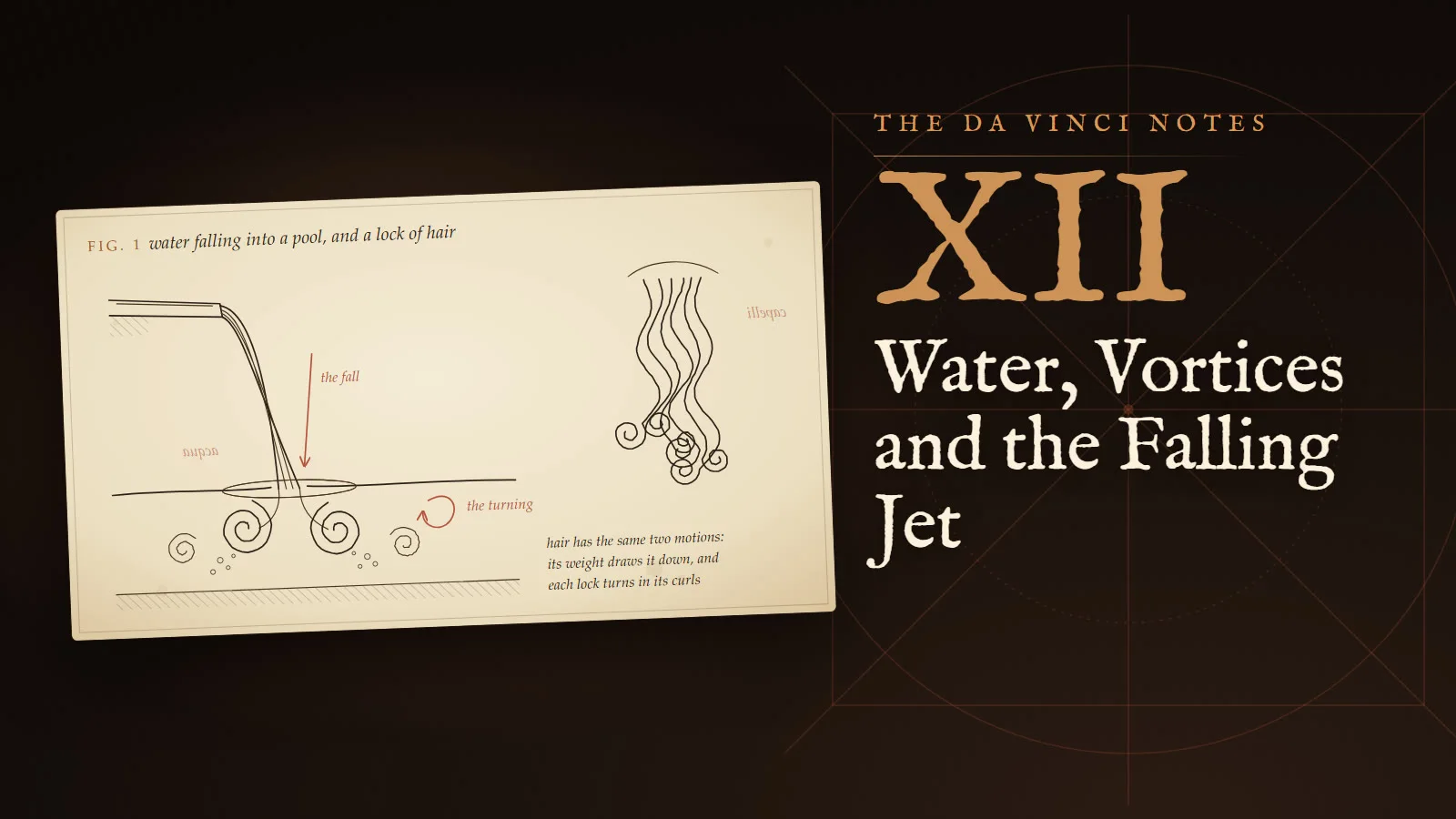
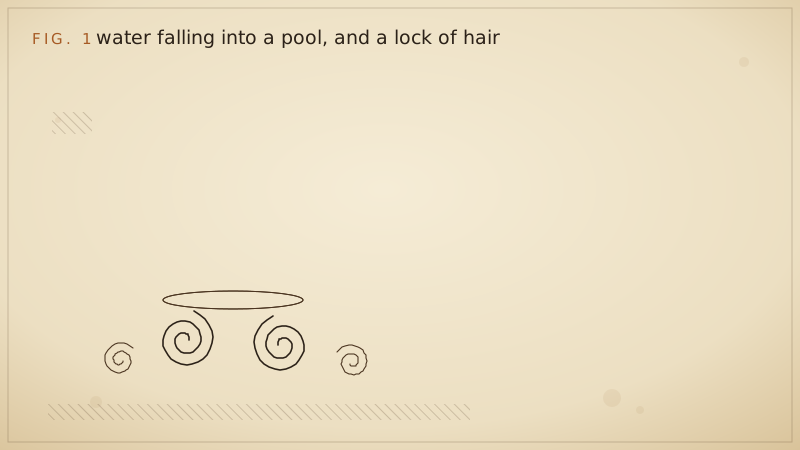
Fig. 1, made to put the two side by side. The jet comes from the lip of a plank trough at the upper left and is drawn with two outer lines and two threads inside, all four converging as it falls, because it narrows. Below the surface, two curls, the left turning against the hands of a clock and the right with them, drawn as spirals from the centre outward, because the eddy grows from its middle. A few bubbles in single circles. At the right, a lock of six strands, each waved and ending in a curl that turns alternately one way and the other. Red chalk only for the two arrows, the fall and the turning.

Reflection
On that sheet I drew an old man sitting on a rock with his chin down, looking at nothing, and beside him the water turning round a stone in plaits like a girl's hair. I did not plan them together; the paper was there and both were in my head. An old man sits still and thinks; the water never sits and never thinks, and it does more work in a day than he in a lifetime. And yet the man who sits and watches is the only one who can write down what the water does. Nature does not explain herself. She does, and does again, and waits for someone to look.
Milan, about 1510. A post in a channel, and the eddies that leave by turns
The eddy behind a single obstacle is the simplest case, and I have been wrong about it for sixteen years. I thought, and wrote, that behind a post in a stream there are two eddies, one on each side, turning in opposite ways, and that they stay there. That is true when the water is very slow. When it runs as a stream runs, they leave by turns, first one side and then the other.
Experiment No. 2
In a mill channel outside the Porta Comasina, where the water runs straight between plank walls two braccia apart, I drove a pole of fir into the bed upright, two fingers thick, and scattered sawdust on the water upstream of it, a handful at a time, so that the sawdust went past the pole on both sides. I timed the water by a chip of wood over ten braccia of channel, counting my pulse, which runs seventy-two to the minute.
- The chip went ten braccia in twelve beats, which is ten braccia in ten seconds of a minute, so the water ran one braccio in each sixtieth of a minute, about as fast as a man walks slowly.
- Behind the pole, the sawdust that passed on the left side curled into an eddy on the left, which grew for a moment against the pole and then broke away and went down the channel, turning. At once an eddy began on the right side, grew, and broke away. Then the left again. So they go, left and right, left and right, like a man walking, and each one, once free, goes down the channel turning, the left ones one way and the right ones the other, in two rows, staggered, the eddies of one row set between those of the other.
- Counting the eddies that left from the left side in twenty beats of the pulse, I counted between seven and eight; from the right, the same.
- The distance between two eddies of the same row, measured against the plank walls marked every half braccio, was a little more than five times the thickness of the pole: ten or eleven fingers.
Calculation
- The water runs one braccio, which is twenty-four fingers, in the time of \( 1\tfrac15 \) beats (twelve beats for ten braccia).
- Each eddy of one row is followed by the next of the same row at ten or eleven fingers, so the time between them is the time the water takes to run ten or eleven fingers: about half a beat. In twenty beats, then, some forty eddies? I counted seven or eight. Here is a contradiction, and I spent an evening on it.
- The fault was mine. The eddies travel slower than the water; they lag, and the water slides past them. And the chip on the surface runs faster than the water near the pole, which is slowed by it. Repeating with a chip let go half a braccio behind the pole, in the wake, I found it took about three beats to go a braccio there. Then ten fingers take about one and a quarter beats, and in twenty beats I should count about sixteen.
- Still twice what I counted. So I counted again, this time watching only one side and saying a word at each eddy, and found fifteen in twenty beats. The first time my eye was taking two eddies as one.
- So: an eddy leaves each side in the time the water runs about five thicknesses of the pole. With a pole of four fingers in the same stream, the eddies were twice as far apart and came half as often. With the channel opened so that the water ran twice as fast, they came twice as often and were the same distance apart. Their spacing follows the post; their number follows the speed divided by the post.
I have drawn the post and its stream as Plate XII, seen from above. The ink is released upstream in threads and at the sides of the post. Change the speed of the stream and the thickness of the post, and the readings give the number of eddies in a second and their spacing. At very slow speeds the two eddies stand behind the post and stay; above a certain speed they leave by turns, and from then on the pattern is always the same, only quicker.

Margin
The piles of a bridge are posts in a stream. The eddies that leave them by turns strike the bed behind each pile, now on one side, now on the other, and dig there; this is why the bed is deepest a little downstream of a pile, and why the piles of the Ponte alla Carraia need stones heaped round their feet after every flood. Make the cutwater sharp upstream and the tail sharp downstream, and the eddies are smaller. Write this in the book of bridges.
Milan, about 1510. That the eddy turns faster near its centre
In the description of a deluge that I have been writing for painters, I put a sentence that I wrote first as a thing seen, and want now to test as a thing measured: "The water in the eddies revolves more swiftly in proportion as it is nearer to their centre" (Richter §609).
Experiment No. 3
A round tub a braccio across, filled to a span, with a hole of one finger in the middle of the bottom stopped with a peg. The water stirred round with a paddle and left to settle for the time of a hundred beats, so that it turns slowly of itself, and then the peg pulled. As the water drains, it turns faster and faster near the hole, and a hollow forms in the middle, a funnel of air that goes down from the surface toward the hole like the inside of a horn.
On the surface I set chips of fir, one at six fingers from the centre, one at four, one at two, and counted the beats each took to go once round.
- At six fingers: nine beats for one turn.
- At four fingers: four beats.
- At two fingers: one beat, and it was hard to see.
- At the edge of the funnel, about one finger: too fast to count; I estimate four turns in a beat.
Calculation
- The path of a chip once round is as its distance from the centre: at six fingers three times as long as at two.
- If, as I wrote, the speed were in proportion to the nearness, then at two fingers the chip goes three times as fast as at six, on a path three times shorter, so it should go round nine times as often. Nine beats at six fingers; one beat at two. So it is.
- At four fingers: the speed is as six to four, the path as four to six, so the time is as \( 4 \times 4 : 6 \times 6 = 16 : 36 \), and nine beats become four. So it is again.
- So the time of one turn is as the square of the distance from the centre. At one finger it should be a quarter of a beat, four turns in a beat, as I estimated.
- But at the centre itself the speed cannot become infinite. There is no water at the centre: there is the funnel of air. The eddy keeps its rule as far as the wall of the hollow, and the hollow is where the rule would break.
Reflection
The same rule, I think, holds in the eddies behind the post, and in the whirlwinds that I saw at Piombino that lifted the water of the sea in a column, and in the wind that goes round a corner of a palace and lifts the dust in a ring. The wind is a river of air. All the movements of the wind resemble those of water, the younger brother wrote, and he was right.
Florence and Milan, 1508 to 1513. The book of water, and its many heads
I have tried a dozen times to set my notes on water in order, and each order breaks under the weight of what does not fit. Here is the latest:
Book 1 of water in itself. Book 2 of the sea. Book 3 of subterranean rivers. Book 4 of rivers. Book 5 of the nature of the abyss. Book 6 of the obstacles.
Richter §920, the first six of fifteen books
Then gravels, the surface of water, things placed in it, the repairing of rivers, conduits, canals, machines turned by water, raising water, and matters worn away by water: fifteen books. And in another list, longer, are the books I most want to write and have least written: "A book of the perpendicular fall of water on various objects" and "A book of the various forms of the obstacles which impede the course of waters" (Richter §928). What I have set down in these pages are the first leaves of those two.
The rule of order I gave myself is good, even if I have not obeyed it: "First write of all water, in each of its motions; then describe all its bottoms and their various materials, always referring to the propositions concerning the said waters; and let the order be good, for otherwise the work will be confused" (Richter §922).
Of what water does in the world
Water is the carter of nature. It carries everything from one place to another: the earth from the mountains to the plains and the sea, the salt from the rocks, the shells of sea creatures up into the hills where I have found them, the seeds of plants, the heat of the sun drawn up as vapour and let down as rain. It wears away the mountains and fills up the valleys. It goes round from the sea to the clouds to the springs to the rivers to the sea, and in the earth it goes through veins as the blood goes through ours. I wrote it years ago and still believe it, that "the cause which moves it through its ramified veins, against the natural course of heavy matters, is the same property which moves the humours in every species of animal body" (Richter §965). And in the beginning of my first treatise on water: "as man has in him a pool of blood in which the lungs rise and fall in breathing, so the body of the earth has its ocean tide which likewise rises and falls every six hours, as if the world breathed" (Richter §929).
Margin
Careful. The comparison of the earth with the body is beautiful and it has led me wrong before. I once thought the water rose to the tops of the mountains by the heat of the earth as the blood rises to the head. The springs on the mountains are fed by the rain and the snow that fall on them, and by nothing else that I can measure. The comparison may guide the eye, but the measure must decide.
Reflection
I am fifty-six years old, and I have promised more books on water than I have written pages. The ancients wrote of water as they wrote of the soul, in general words, and they were never wet. I would rather leave one true sentence with a number in it, the eddy leaves every five widths of the post, the eddy turns in a time as the square of its distance, than a whole book of fine words that no one can test with a tub and a chip of wood.
To do
- Have the planks of the channel walls marked in red at every finger, so that small distances can be read.
- Try a square post, a flat board edgewise, and a board across the stream, and see whether the five widths hold.
- Find a glass vessel with flat sides, so that I can see the eddies from the side as well as from above.
- Ask Messer Giovanni the bombardier how the smoke of a gun turns in rings when it is fired in still air.
Problems I set myself
1. A stream runs a braccio in each second of a minute, and a post three fingers thick stands in it. If an eddy leaves each side in the time the water runs five thicknesses of the post, how many eddies leave each side in a second, and how far apart are those of one row?
Answer. Five thicknesses are fifteen fingers. The stream runs twenty-four fingers in a second, so it runs fifteen fingers in \( \tfrac{15}{24} = \tfrac58 \) of a second. One eddy leaves each side every five eighths of a second, which is one and three fifths eddies in each second, and those of one row are fifteen fingers apart, five eighths of a braccio. If the stream runs twice as fast, they come twice as often and are still fifteen fingers apart.
2. A sheet of water leaves the lip of a weir two fingers thick at a speed of half a braccio in a second. At the foot of the weir it is moving at three braccia in a second. How thick is it there, if no water is lost and the sheet keeps its width?
Answer. The same water passes the lip and the foot in the same time, so thickness and speed go in contrary proportion. The speed has grown from one half to three braccia, six times, so the thickness falls to one sixth: \( 2 \times \tfrac16 = \tfrac13 \) of a finger. A sheet that leaves the weir as thick as two fingers strikes the pool as thin as a knife.
3. In a draining tub a chip at eight fingers from the centre goes round once in sixteen beats. If the speed of the water is in proportion to its nearness to the centre, how long does a chip take at four fingers, and at two? Where must the rule stop?
Answer. The time of a turn goes as the square of the distance. At four fingers, half the distance, the time is a quarter: four beats. At two fingers, a quarter of the distance, the time is a sixteenth: one beat. At one finger it would be a quarter of a beat, and at the centre nothing at all, which is impossible; so the rule must stop at the wall of the hollow, where the water ends and the air begins, or wherever the water near the middle begins to turn all together like a wheel.
To the student who reads this later
You have names for everything I saw. The two staggered rows of eddies behind my post are called a von Kármán vortex street, after Theodore von Kármán, who explained in 1911 why the two rows are stable only when they are staggered and spaced in a certain ratio, after Henri Bénard had studied them in Paris; my rows were indeed staggered. The rule that the eddies leave in the time the stream runs about five widths of the obstacle was found by Čeněk Strouhal in Prague in 1878, from the singing of wires whirled through the air, and you write it with his number:
\[ \mathrm{St} = \frac{f\,D}{U} \approx 0.2, \]
where \(f\) is the number of eddies leaving one side each second, \(D\) the width of the post and \(U\) the speed of the stream. My five widths are the same thing: the spacing of one row is \(U/f = D/\mathrm{St} = 5D\). Whether the eddies stand still or leave depends on a second number, found by Osborne Reynolds in Manchester in 1883 with dye in a glass pipe:
\[ \mathrm{Re} = \frac{U\,D}{\nu}, \]
with \(\nu\) the viscosity of water divided by its density, about one millionth of a square metre per second near room temperature. Below a Reynolds number of about 47 the two eddies stand behind the post; above it they leave by turns; and from a few hundred up to a few hundred thousand the Strouhal number stays close to 0.2. My pole of two fingers, about 5 centimetres, in water running 0.6 metres a second has a Reynolds number of about 30,000, well inside that range, and the formula gives 2.4 eddies a second from each side. I counted fifteen in twenty beats of the pulse, which at seventy-two beats a minute is 0.9 a second. Either my stream was slower than I measured, or I still missed some. You may laugh. The proportions were right.
On the eddy that turns faster near its centre I was right outside its core and wrong in it. Your model of a whirlpool, the Rankine vortex, has a free part outside, where the speed falls as one over the distance, \( v = \Gamma/(2\pi r) \), so the time of a turn goes as the square of the distance, as my chips showed; and a core inside, where the water turns all together like a wheel and the speed falls toward the centre. In a draining tub the core is the hollow of air and a thin wall of water around it. In a whirlwind or in the eddies behind a post, it is a region of water or air turning solidly.
My falling sheet obeys two rules together: the same flow through every section, so thickness times speed is constant, and the speed gained by a fall from height \(h\), which Galileo found a century after me: \( v^2 = v_0^2 + 2gh \). A jet plunging into a pool carries air down by a mechanism your engineers study for weirs, waterfalls and ships' bows, because the bubbles carry oxygen into rivers and also eat the concrete of spillways.
My word for these turning waters was ritrosi, return eddies; yours is turbulence, and Lewis Fry Richardson described it in 1922 as large eddies feeding smaller ones, and these still smaller, until at the smallest the motion is lost as heat in the stickiness of the fluid. Andrei Kolmogorov gave it numbers in 1941. Ivan Marusic and Susan Broomhall have read my water notes again with the eyes of modern fluid mechanics, in the Annual Review of Fluid Mechanics (2021), and the book I could not finish, the Codex Leicester, 72 pages of water, rivers, mountains and the moon, written mostly in Florence between about 1504 and 1508, passed from Thomas Coke, Earl of Leicester, who bought it in Rome in 1717, to Armand Hammer in 1980 and to Bill Gates in 1994.
What to try at a table: put a long baking dish of water on a dark cloth, scatter ground pepper or a little talc on the surface, and draw a pencil through it, upright, at a steady walking pace for a pencil, about a hand's breadth a second. Behind the pencil you will see my two rows of eddies, staggered, about five pencil widths apart. Go slower, very slowly, and you will see the two eddies stay behind it. Then run a tap into a full basin from a height and watch the air go down and come up again on either side; and pull the plug of a bath with a little pepper on it, and time a fleck at two distances from the hole. And for the hair, hang a long thread in a running stream and watch it wave.
If you want to argue about posts, hair, weirs or the fifteen books I never finished, come and ask me.
Sources and liberties
The Da Vinci Notes are a modern reconstruction written in Leonardo da Vinci's voice by Eternal Gardens. Dates, places, manuscripts, drawings and quotations come from the sources below; the order of the working, the private reflections, the plates and the sketches are ours.
- Leonardo da Vinci, The Notebooks of Leonardo da Vinci, trans. J. P. Richter (1883), §389 (water and hair), §609 (eddies turn faster near the centre), §920 and §928 (the books on water), §922 (the order of the work), §929 (the earth breathing), §931 (water the second element), §965 (the veins of the earth): Project Gutenberg
- Edward McCurdy, Leonardo da Vinci's Note-Books (London: Duckworth, 1906): "What causes the eddies of water" (Manuscript A, f. 60r) and "Of the foam of water" (Manuscript A, f. 59r).
- Royal Collection Trust, RCIN 912579, Studies of water, and a seated old man: rct.uk; RCIN 912660, Studies of water: rct.uk; RCIN 912659, Studies of flowing water, with notes: rct.uk
- Museo Galileo, Water as Microscope of Nature: the Codex Leicester (dates, 18 double sheets, provenance): mostre.museogalileo.it
- Edmondo Solmi (ed.), I pensieri di Leonardo da Vinci (1904), "Pensieri sulla natura", for the line on water as the vetturale della natura: Wikisource
- Ivan Marusic and Susan Broomhall, "Leonardo da Vinci and Fluid Mechanics", Annual Review of Fluid Mechanics 53 (2021), 1 to 25: doi.org/10.1146/annurev-fluid-022620-122816
- V. Strouhal, "Über eine besondere Art der Tonerregung", Annalen der Physik und Chemie (1878); Th. von Kármán, Göttinger Nachrichten (1911); O. Reynolds, Philosophical Transactions of the Royal Society 174 (1883).
- Martin Kemp, Leonardo da Vinci: The Marvellous Works of Nature and Man (Oxford University Press, revised edition 2006).
The experiments with the trough, the tub, the pole in the mill channel and the draining tub, and all their numbers, are our reconstruction, made physically consistent; Leonardo's own drawings of falling water and of eddies behind obstacles are on the Windsor sheets shown. "Water is the carter (vetturale) of nature" is a genuine idea of Leonardo's, printed in Solmi's anthology as "L'acqua è 'l vetturale della natura", but its folio is uncertain and it is not in the Richter or McCurdy selections, so we paraphrase it; the popular English line "Water is the driving force of all nature" is a loose modern rendering. The word ritrosi (retrosi) for eddies is taken from the chapter titles of the early compilation of his water notes described by Richter.