 by Marie Curie


Florence, the summer of 1503. I came back from the service of Duke Valentino in the spring with a bag of maps and a head full of fortresses, and the city has given me two tasks that pull my mind two ways: a battle to paint on a wall of the great council hall, and a river to move. The war with Pisa has lasted eight years and a half, since the French king came down in 1494 and the Pisans shut their gates against us. Pisa lives by the Arno: its boats come up from the sea, its mills grind on its water, its ditches fill from it. The Gonfaloniere Piero Soderini and his secretary Niccolò Machiavelli, whom I knew at Imola in the duke's camp, ask whether the river can be persuaded to leave the city and run to the sea by another road. Before I answer them I must answer a simpler question, which I wrote down in Milan twelve years ago and never finished: how does a river carry itself through a narrow place, and what does it do when the place grows wide?
That the river which is to be turned from one place to another must be coaxed and not treated roughly or with violence
Leonardo da Vinci, Codex Leicester, sheet 13r, trans. J. P. Richter (1883), §1008
Florence, spring 1503. What I wrote in Milan of the narrow and the wide
I have the little book from Milan open on the table, the one I began about 1490, and on its fifty-seventh leaf, in a smaller hand than I write now, is the proposition I made about the straits of Spain. I wanted to know why the sea runs harder between the pillars of Hercules than in the open Mediterranean, and I reasoned from rivers, because a strait is a river with salt in it.
A river of equal depth runs with greater speed in a narrow space than in a wide one, in proportion to the difference between the wider and the narrower one.
Leonardo da Vinci, Manuscript A, f. 57r (Institut de France), trans. J. P. Richter (1883), §1083
In my own words on that page: il fiume d'equal profondita avra tanto piv fuga nella minore larghezza, the river will have so much more flight in the lesser breadth. Water in a narrow place does flee, as a crowd flees through a gate.
Proportion
- Imagine a channel one mile wide, and suppose that in a certain time one mile in length of water passes through it: one square mile of surface, with the water's depth beneath it.
- The same water, before it reaches the channel, lies in a river five miles wide. What passes the narrow place must pass the wide place in the same time, or the water would pile up or run short between them, and neither happens: the river stands as high tomorrow as today.
- So each of the five square miles of the wide river need move only a fifth of itself to make up the one square mile of the narrow part.
- The wide water travels a fifth of a mile while the narrow water travels a mile. The speeds stand as \( 1 : 5 \), the breadths as \( 5 : 1 \). Where the river is three miles wide, the speed is a third of the speed in the strait.
All this rests on one condition, written at the head of the proposition: equal depth. I reasoned with square miles of surface as though the water had no thickness worth counting. A river is a body, and a body has three dimensions.
Experiment No. 1
A trough of fir boards, twelve braccia long and one wide, set on trestles in the yard with a fall of two fingers from end to end, fed by a boy with two buckets and a barrel with a bung. Halfway along I fixed two boards inside it, slanting, so that the breadth closes from one braccio to a third of a braccio, holds narrow for one braccio, and opens again. The floor is level throughout. On the water, chips of poplar pith, light and white, that ride the surface; on the side, a charcoal mark every braccio; for time, I count as a musician counts, two beats to each beat of my pulse at rest.
Result. In the wide part a chip in midstream passed one braccio in about nine beats; in the narrows, in about three. The breadths were as three to one and the speeds as one to three. The proposition stands. But the surface rises a little before the narrows and drops in them, by perhaps a finger: the water heaps itself before the gate and then runs down through it. My equal depth is true only before the water moves.
Trial No. 2
The boards out; in their place a box let into the floor, one braccio long, which doubles the depth while the breadth stays the same. The chips slowed over the deep place by half, near enough, and ran on beyond it. So depth does what breadth does, and the rule is this:
In every part of a river, in equal times, there passes an equal quantity of water. Where the section is small the water runs fast, where it is large the water runs slow, and the speed is as much greater as the section is smaller. By the section I mean the face the river would show if you cut it across with a knife, as you cut a loaf: its breadth and its depth together.
Margin
The chips do not all go at one speed. Those in midstream outrun those by the boards, and a drop of ink let fall to the bottom creeps while the surface flies; the banks and the bed hold the water back by rubbing. So the speed of the river is a mean speed, the one that, multiplied by the whole section, gives the whole quantity. Write this in the book on water.
I have drawn the rule as Plate XIII. A river of changing breadth and depth runs from left to right; choose how much water it brings down, mark any section, and watch the leaves hurry through the narrows and loiter where the water spreads.
The camp before Pisa, 23 July 1503. Levelling the Arno
Yesterday I rode with Alessandro degli Albizzi and a few others to the last great bend of the river above Pisa, near Riglione, where our soldiers are lodged, and we went over the drawing with the governor of the army. There were many discussions and many doubts. The conclusion, as Francesco Guiducci will write to the Ten, was that the work is much to the purpose: either the Arno can be turned here, or at worst a canal can be cut that will keep the enemy from harming the hills behind us. A soldier sees a ditch as a wall dug into the ground. I see it as a second river.
Last month, on the twenty-first of June, two days after our men took the fortress of La Verruca on the ridge of Monte Pisano, I went up to look at it. From that rock the plain lies under you like a coloured map: Pisa with its towers, the river winding through it to the sea, the marshes to the south shining between the reeds, the hills of Livorno beyond. If the river could be led across that plain to the marsh they call the Stagno, Pisa would be left with no boats from the sea, no water in its ditches, no flour from its mills.
Draftsman's note
The sheet I am making for the Signoria shows western Tuscany as a bird sees it, flying high over the hills of Pistoia and looking towards the sea. The mountains in relief with the light from the upper left, so that a man who has never walked there can see which valleys open and which close; the rivers in a darker wash, the lakes and marshes paler, with tufts of reeds; the towns as little clusters with their names written the ordinary way, left to right, because this is for other eyes. Pisa, Lucca, Livorno, Pistoia, the lake of Sesto, Vico, Cascina, Pontedera: nearly a hundred names on the one sheet. Distances I take by the paces of the horse, by the hours of the journey and by the compass. Where I have not been I ask the peasants, and believe one in three.

Experiment No. 2
Levelling. Giovanni Piffero, the Signoria's piper, has come with us in a carriage with six horses, at the city's expense, to help me level the Arno in the Pisan country so that it can be taken out of its bed. The instrument: a straight trough of wood four braccia long, filled with water, with a sight at each end, on a stand that turns, and a staff marked in braccia and once (the oncia is the twelfth of a braccio) held upright by Piffero at the far station. Water lies level of its own accord, so the line along the sights is level, and where it cuts the staff shows how much the ground falls. From the water at the bend below Riglione, two hundred braccia at a time, southwest across the fields to the Stagno. I read every staff myself.
Result, after three days: from the surface of the river at the bend, as it is in July, to the water of the Stagno, about five braccia of fall over a distance I reckon at eight miles. One braccio of fall in every five thousand of length. A ball would not roll on such ground. A river will, pushed by all the water behind it, but slowly, and only if nothing stands in its way.
Calculation
- The Arno now runs to the sea through Pisa by its old bed, short, deep and worn smooth by its own work. To make it leave that bed, the new one must be easier: shorter, or steeper, or deeper.
- The road to the Stagno is longer than the old road and has hardly more fall. So it must be deeper and wider than the water wants.
- By the rule of the trough: if I offer the river a ditch with a smaller section than its own, the water in the ditch must run faster than the river runs now, and it will not, for it has no more fall to drive it. So the water heaps up at the mouth, as it heaped before my boards, and goes on by its old road.
- Hence the mouth of the cut must be at least as deep as the bed of the river at the bend, and its section as large as the river's. Then, with a weir across the old bed, the greater part goes into the new.
To do
- Ask the millers of Cascina how high the Arno rose in the floods of the last ten years.
- Find out what the Stagno does in the winter rains, and by which mouth it empties to the sea.
- Redraw the engine for lifting earth at the scale of a ditch sixteen braccia deep.
Florence, the Sala del Papa, winter 1503 to summer 1504. The reckoning of the earth
The Signoria has given me the Pope's Hall at Santa Maria Novella to draw the cartoon of the battle, and on half of my long table is the battle and on the other half the river. Niccolò comes in the evening from the Palace with letters and questions. He is thirty-four, quick and sharp-tongued, and likes to say that Fortune is like a river which a prudent man can embank before the flood. I tell him a river is stronger than any prince he has met.
The plan: a weir across the Arno at the bend to hold up its water, and a great ditch a mile long and sixteen braccia deep leading south, which then divides into two smaller ditches across the plain to the Stagno, and from the Stagno the water finds the sea by the old mouths near Livorno. Before anyone puts a spade in the ground I must know what it costs in earth, in men and in days.
Calculation
- The great ditch: one mile, which is three thousand braccia; about forty braccia wide at the mouth and thirty-two at its end, a mean of thirty-six; sixteen deep.
- Its earth is length times mean breadth times depth: \( 3{,}000 \times 36 \times 16 = 1{,}728{,}000 \) cubic braccia.
- A cubic braccio of the wet clay of the plain, weighed in a box made for it, comes to near a thousand libbre. So the great ditch holds some seventeen hundred million libbre of earth, and the two lesser ditches as much again.
- A man cannot throw earth sixteen braccia up. He throws it a little more than a braccio, to a ledge, where another throws it again: from the bottom to the top a shovelful passes through fourteen pairs of hands.
- The masters of water promise the work with two thousand labourers in thirty or forty thousand days of one man's work. I reckon fifty-four thousand, and that only if engines do the lifting at the deep part.
- Fifty-four thousand man-days among two thousand men is twenty-seven days. It will not be twenty-seven days. Men fall ill, it rains, the soldiers who guard them go plundering, the Pisans come out at night and fill in what we dug by day. Double it, and pray for a dry September.
Draftsman's note
The digging engine as I have drawn it for the ditch: a great beam turning on a post in the middle of the ditch, a bucket at each end, so that while one is filled at the bottom the other is emptied at the bank. The post stands on a carriage that runs along the ditch as the work advances, and the ditch is cut in steps, each with its own engine, so that the earth climbs from step to step. Plan and elevation, with the measures written beside them, so that a carpenter can make it without me.
Margin
The adversary in my head speaks in Niccolò's voice: once the river turns into the ditch, it will cut the ditch deeper and wider of its own accord. True, and that is the whole hope of the work. But the river chooses its road by the depth at the mouth, and if the mouth is shallow it will not choose it at all. Everything rests on the first fifty braccia.
Reflection
On the fourth of May the Signoria made a new agreement with me for the battle painting, and Niccolò's name is on it among the witnesses. So the same man holds my wall and my river in one hand. The wall shows a victory over the Milanese at Anghiari sixty years ago; the river would give them a victory over Pisa next year. On the ninth of July, at the seventh hour, my father died, Ser Piero, notary at the Palace of the Podestà, eighty years old by his own count, leaving ten sons and two daughters. I wrote it in the book with the hour twice, as if writing it again would make it more exact. He drew up contracts all his life; I think he would have liked the reckoning of the earth better than the battle.
Florence, 20 August to the middle of October 1504. The work begun and lost
The work began on the twentieth of August at the tower of the Fagiano near the bend, which has been pulled down to give stone for the weir. The digging is in the hands of a master of water called Colombino, whom the Ten trust more than they trust me, perhaps because he promises less money and fewer days. I am in the Pope's Hall with my cartoon, and they send me word by letter. Two thousand men at work, at a carlino a day each, and a thousand soldiers watching them.
Calculation
Colombino has changed the plan. In place of one great ditch sixteen braccia deep he is digging two lesser ditches side by side, each narrower than the one and less deep, because two shallow ditches cost less than one deep one. I wrote to the Palace what I write here:
- The water of the Arno at the bend must pass through the sections of the ditches or not at all.
- Two ditches each half the breadth of the one have the same breadth together, but if each is shallower, their sections together are smaller.
- Worse, if the floor of the ditches is higher than the floor of the river, then when the river is low the water at the mouth does not reach the ditches at all.
- So they will take the Arno only in flood, when its surface stands high above its bed, and give it back as soon as the flood falls. They will drain the river for a week in November and leave Pisa in peace for the other fifty-one.
Margin, October 1504
It happened as I wrote. The water went into the ditches only when the river rose, and ran back into the Arno when it fell. Then, in the first week of October, a storm came in from the sea. The boats that guarded the mouth of the river were driven ashore and broken, and some eighty men drowned. The sides of the ditches, cut steep to save digging, slid into them in the rain; the water broke out across the plain and drowned the farms of the very peasants we had hired. By the middle of the month the work was given up. Eighty thousand days of men's labour did not bring it halfway, Biagio Buonaccorsi says, who keeps Niccolò's accounts, and seven thousand ducats and more are gone into the clay. Now the Pisans come out with their own shovels and fill in our ditches.
Reflection
I have written elsewhere what a river in flood does to the works of men:
Amid all the causes of the destruction of human property, it seems to me that rivers on account of their excessive and violent inundations hold the foremost place.
Leonardo da Vinci, Codex Atlanticus f. 361v, trans. E. MacCurdy, Leonardo da Vinci's Note-Books (1906)
What beat us was the rule of the trough, and the rain. The river was asked to leave a deep, smooth, ancient bed for a shallow new one with no more fall, and it declined, as I would decline to leave a good house for a worse one. A river must be coaxed. Niccolò di Forsore once told me how the Flemings turned a river: by a row of weirs, the second set a little in front of the first and the third in front of the second, so that the water is turned a little at each and comes into its new channel without noticing that it has been made to. I should have insisted on it, and I did not insist, because I was painting horses.
Three men will be blamed, in this order: Colombino, the Gonfaloniere, Niccolò. My name will be said only quietly, because the drawing was mine. Let it be said. The drawing was right about the depth, the men who did not follow it were wrong about the money, and the river knew both.
Florence, autumn 1504. The canal of Florence, by Prato and Pistoia
The river would not go to Livorno; it can still be brought to Florence. I return to an older thought, which Vasari, when he comes to write of me, will say I had while still a youth: that the Arno could be made into a navigable canal from Pisa to Florence. Between Signa and Montelupo the river squeezes through the gorge of the Gonfolina over rocks; in summer it has too little water to float a loaded boat, in winter too much to hold one. Goods from the sea come up to Pisa by water and then by mule. I found in an old sheet what I wrote of it, when Pisa was still ours and so still among the cities that would profit:
I shall direct it to Prato and Pistoia, and cut through Serravalle and make an issue into the lake; for there will be no need of locks or supports, which are not lasting and so will always be giving trouble in working at them and keeping them up.
Leonardo da Vinci, Codex Atlanticus, trans. J. P. Richter (1883), §1001
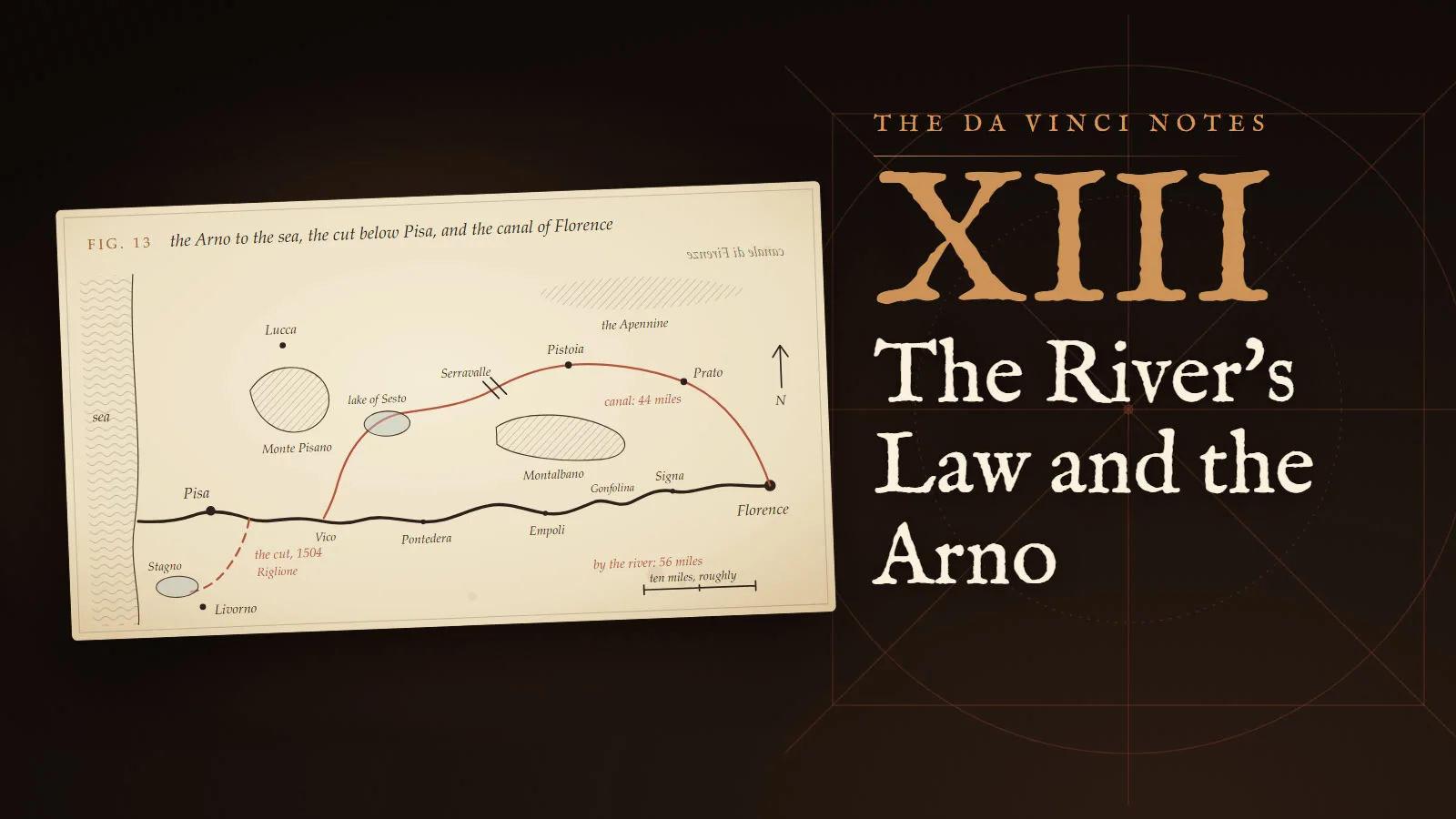
The canal leaves the Arno at Florence and runs northwest to Prato and Pistoia, where the mountain streams can feed it; it passes the hills at Serravalle, where the ridge of Monte Albano meets the Apennine, by a cutting; it falls into the lake of Sesto below Lucca, and through the lake to the Arno again near Vico, above Pisa. On the map it makes a great curve like a bow, and the Arno is the string. Yet the bow is shorter than the string, because the string wanders.
Calculation
- By the river from Florence to Vico, following all its windings, is fifty-six miles; by the Pistoia canal, forty-four. The canal is twelve miles shorter.
- The canal is twenty braccia broad at the bottom and thirty at the top, with two braccia of water or four. With four, its section is the mean breadth times the depth: \( \tfrac{20 + 30}{2} \times 4 = 100 \) square braccia. Two braccia of water go off to the mills and the meadows, and two carry the boats.
- For the summer, when the Arno lacks water, the canal is fed from sluices in the valley of the Chiana near Arezzo, where the waters can be held back and let go.
- Prato, Pistoia and Pisa with Florence would gain two hundred thousand ducats a year from it, and the Lucchese too, for the lake of Sesto becomes navigable; so they would lend hands and money.

Draftsman's note
The great curve I struck with a compass, from Florence round through Prato and Pistoia, and then pricked the line through with a needle so that it can be pounced onto a fair copy. The river in pen, the hills in charcoal rubbed with the finger, the canal a double line. On the left of the sheet the lower Arno again, with the scheme of the siege, because whoever looks at the canal must remember why the lower river is closed to us. At Serravalle the ridge must be cut, or tunnelled, or the boats lifted over by locks.
Margin
Why does the Arno never stay in its channel, so that every few years the banks must be rebuilt and the fields beside it change owners? I wrote the answer beside the map of the valley:
They do not know why the Arno will never remain in a channel. It is because the rivers which flow into it deposit earth where they enter, and wear it away on the opposite side, bending the river in that direction.
Leonardo da Vinci, Windsor map sheet, trans. J. P. Richter (1883), §1006
The rule of the trough again. Where a stream enters, the section of the Arno suddenly grows, the water slows and drops its earth, and a bank of sand rises; the river is pushed against the far side, where the section is now smaller and the water faster, and it eats that bank. So the river walks across its plain one bend at a time. This summer I surveyed it just west of the city, from the gate at Prato down past the mills, with stakes every hundred braccia, a cord of fifty braccia, a compass card and a sounding rod, so that the Signoria's officers can see on one sheet why their walls fail where they fail: always on the outside of a bend, below the mouth of a stream, where the section narrows and the water runs.

Reflection
I have drawn the whole valley once more as a bird would see it, with both schemes on it: the cut below Pisa that failed, and the canal of Florence that has never been begun. The cut was made to take something from someone, in a hurry, by men who argued over the price. The canal is made to give something to everyone, the mills, the meadows, the boats, the Lucchese and even the Pisans when there is peace, and so it needs only patience and money, which the Republic has in the opposite proportions.
To do
- Ride the line of the canal from Prato to Serravalle and take the levels every five hundred braccia, as at Pisa.
- Judge the hill of Serravalle from the abbey of San Giusto and from the Montalbano.
- Measure the Arno at the Ponte alla Carraia in July and in November, its breadth, depth and speed, and so find how many times more water it carries in winter.
Problems I set myself
1. A river of equal depth, three hundred braccia wide, runs one braccio in every two beats. It enters a gorge sixty braccia wide, with the same depth. How fast does it run in the gorge?
Answer. The same quantity passes both places in the same time and the depth is equal, so the speeds are as the breadths inverted: \( 60 : 300 = 1 : 5 \). In the gorge it runs five times as fast, five braccia in every two beats. (If the gorge is also deeper, as gorges usually are, the speed is less, because the section is larger.)
2. My canal is twenty braccia broad at the bottom and thirty at the top, with four braccia of water. It takes the whole of an Arno that, at a place one hundred and twenty braccia wide and three deep, runs one braccio in every three beats. How fast does the canal run?
Answer. The river's section is \( 120 \times 3 = 360 \) square braccia, the canal's \( \tfrac{20 + 30}{2} \times 4 = 100 \). The sections stand as \( 100 : 360 \), so the speeds stand as \( 360 : 100 \): the canal runs 3.6 times as fast, 3.6 braccia in every three beats. Too fast for boats going upstream; so the canal must take only part of the river, or be broader.
3. The great ditch holds 1,728,000 cubic braccia. If one man moves twelve cubic braccia a day near the surface and only a fourteenth of that from the bottom, how many man-days does the ditch need, taking the mean of the two?
Answer. At the surface 12 cubic braccia a day, at the bottom \( 12 \div 14 \), about 0.86; the mean is about 6.4. Then \( 1{,}728{,}000 \div 6.4 = 270{,}000 \) man-days, five times the fifty-four thousand I reckoned with engines; with two thousand men, 135 working days, the whole dry season and part of the wet. This is why the engines were no luxury, and why eighty thousand man-days did not reach halfway.
To the student who reads this later
You call my rule the equation of continuity, and for water, which hardly squeezes, you write the flow \( Q \) through any section as \[ Q = v\,A, \qquad v_1 A_1 = v_2 A_2, \] where \( A \) is the area of the section and \( v \) the mean speed across it. My proposition in Manuscript A, with its condition of equal depth, is the special case for breadths alone. The Benedictine Benedetto Castelli, Galileo's pupil, printed the rule in his Della misura dell'acque correnti in Rome in 1628, and he is usually given the credit, because he published and I did not. That is just; a rule in a notebook in mirror writing helps no one.
What my trough could not teach me is how fast a river runs for a given fall, roughness and depth, so that you can say beforehand which of two roads the water will choose. That needed Antoine de Chézy, who about 1769 made the speed proportional to the square root of the depth times the slope, and Robert Manning in 1889, whose formula engineers still use: \[ v = \frac{1}{n}\,R^{2/3} S^{1/2}, \] with \( R \) the area of the section divided by its wetted perimeter, \( S \) the slope, and \( n \) a number for the roughness of the bed. Put my levelling into it. A slope of one in five thousand is \( S = 0.0002 \); a ditch twenty metres wide and five deep in rough clay has \( R \approx 3.3 \) metres and \( n \approx 0.03 \), and runs at about one metre a second, carrying about a hundred cubic metres a second, the Arno's ordinary water, if its whole section is full. That is the condition. With the floor of the ditch above the floor of the river, the section fills only in flood, and at ordinary water the formula gives the ditch next to nothing to carry. Colombino's ditches had smaller sections and floors set too high, and the river did what the formula says.
The Florentines took Pisa in the end without moving the river: they closed the mouths of the Arno, the Serchio and the Fiume Morto with boats and stakes and starved the city, which surrendered in June 1509. Your engineers dug a channel very like mine in the twentieth century, the Canale Scolmatore, which leaves the Arno near Pontedera and takes its floods to the sea near Livorno, so that Pisa is not drowned: a cut to protect the city, where mine was meant to hurt it. And the line of my canal of Florence, by Prato, Pistoia and Serravalle, now carries the motorway to the sea.
On units: my Florentine braccio was about 58.4 centimetres, so a cubic braccio is about 0.2 cubic metres, and my mile of three thousand braccia about 1.75 kilometres. The great ditch of 1,728,000 cubic braccia is some 344,000 cubic metres of earth, near 580,000 tonnes. The Arno at Pisa brings down on average a little over a hundred cubic metres a second, and in great floods many times that.
What to try: lay a length of roof gutter on a slight slope, run a garden hose into the top, and fix two pieces of wood inside it to make a narrows. Float grains of rice and time them over a marked length, in the wide part and in the narrows, and measure the depth in both with a ruler. Multiply breadth by depth by speed: you will get the same number in both places, within the errors of your watch, and it will match the hose's flow measured with a bucket. Then put a step in the bottom and watch the water heap up before it, as mine did before my boards.
If you want to argue with me about Pisa, Colombino, or why a river refuses a shallow road, come and ask me.
Sources and liberties
The Da Vinci Notes are a modern reconstruction written in Leonardo da Vinci's voice by Eternal Gardens. Dates, places, manuscripts, drawings and quotations come from the sources below; the order of the working, the private reflections, the plates and the sketches are ours.
- J. P. Richter (ed. and trans.), The Notebooks of Leonardo da Vinci (1883), §1083 (Manuscript A, f. 57r), §1001 (the canal of Florence), §1006 (the Arno never remains in a channel; 56 and 44 miles), §1008 (the river must be coaxed; Niccolò di Forsore and Flanders), with Richter's notes quoting Francesco Guiducci's letter of 24 July 1503 and the Signoria's payment of 26 July 1503 for Giovanni Piffero's journey with Leonardo "a livellare Arno": Project Gutenberg
- J. P. Richter, The Literary Works of Leonardo da Vinci, vol. 2 (London, 1883), for the Italian of §1083 and the manuscript concordance: Internet Archive
- E. MacCurdy, Leonardo da Vinci's Note-Books (London: Duckworth, 1906), Codex Atlanticus f. 361v, on the destruction caused by rivers.
- Giorgio Vasari, Life of Leonardo, trans. G. du C. de Vere (1912), on the young Leonardo's plan of a navigable canal from Pisa to Florence.
- Royal Collection Trust: RCIN 912683, RCIN 912279, RCIN 912678.
- Museo Galileo, Leonardo's itineraries: the deviation of the Arno from Riglione to the Stagno (start of work at the tower of the Fagiano on 20 August 1504; Codex Madrid II ff. 52v to 53r).
- Roger D. Masters, Fortune Is a River: Leonardo da Vinci and Niccolò Machiavelli's Magnificent Dream to Change the Course of Florentine History (New York: Free Press, 1998).
- Charles Nicholl, Leonardo da Vinci: The Flights of the Mind (London: Allen Lane, 2004), for La Verruca, the ditch, Colombino, the workforce and wages, and Buonaccorsi's account of the cost and the October storm.
- Leslie A. Geddes, Watermarks: Leonardo da Vinci and the Mastery of Nature (Princeton University Press, 2020).
The trough, the levelling and its five braccia of fall, the weighing of the clay and the survey method are our reconstruction, chosen to agree with the documents and the ground. The ditch's dimensions, the 54,000 man-days and the eighty drowned come from modern accounts of the Florentine archives and vary between historians; Leslie Geddes and Emanuela Ferretti argue that Leonardo's direct part in the work of 1504 has been exaggerated. Machiavelli's image of Fortune as a river is from chapter 25 of The Prince (1513), written after these events. Ser Piero's death note (Richter §1372) says Wednesday and eighty years; 9 July 1504 was a Tuesday and Piero was about seventy-seven.