




 by Marie Curie


Milan, the spring of 1498. In the Castello I am painting the vault of the great room in the tower, the one they call the room of the boards, as a bower of trees whose branches climb the walls, meet overhead and knot themselves into a golden cord, and the duke wants it finished by September. For three weeks I have looked at nothing but trunks and branches, and I have found that I do not know how a tree is made. I can draw a tree that pleases the eye. I cannot yet say why its limbs are as thick as they are and no thicker, why they leave the trunk where they leave it, why the leaves sit round the twig in the order they keep. A painter who draws branches by habit draws a stage set. I want the law.
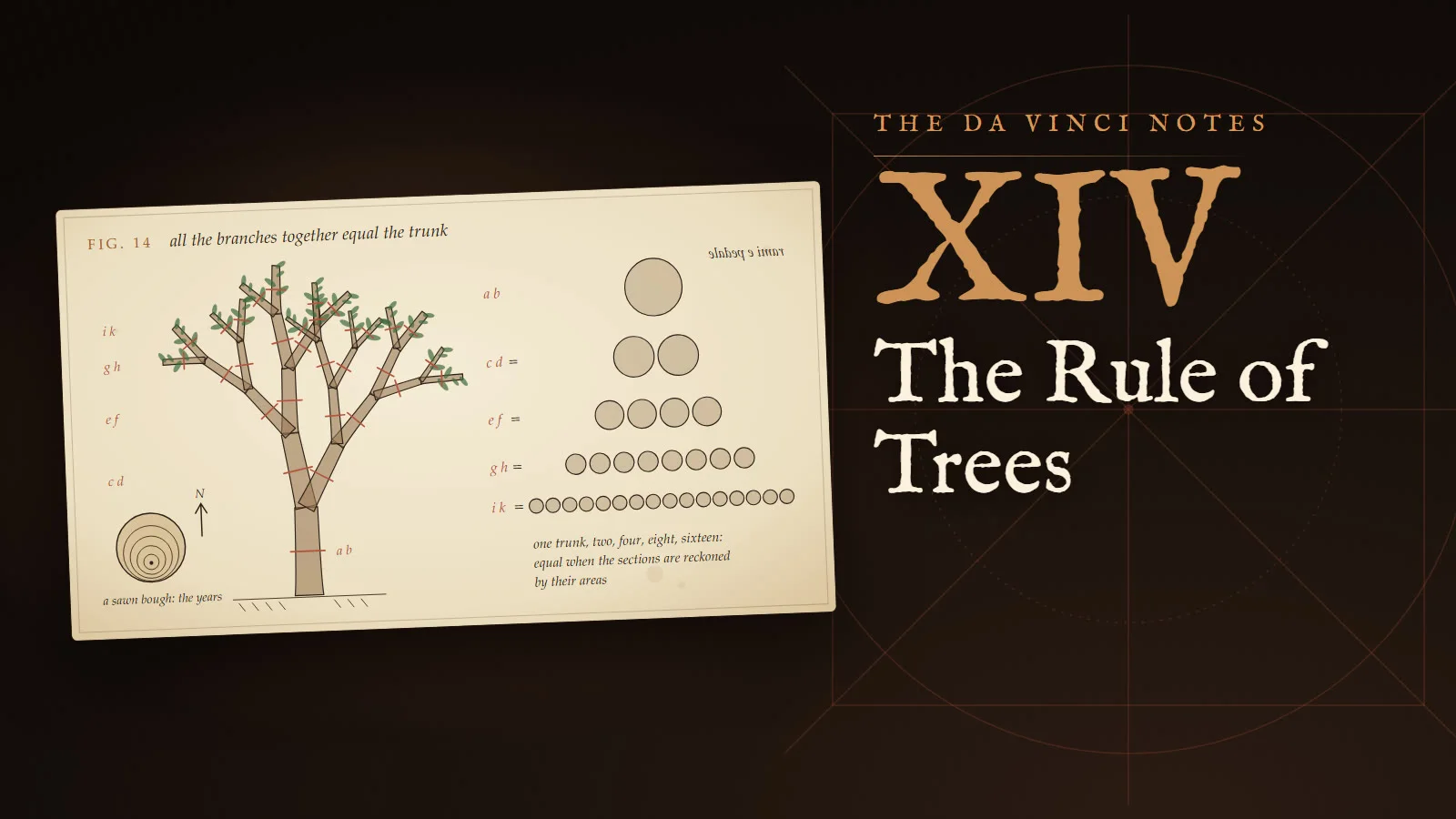
All the branches of a tree at every stage of its height when put together are equal in thickness to the trunk [below them].
Leonardo da Vinci, Manuscript I, f. 12v (Institut de France), trans. J. P. Richter (1883), §394
Milan, spring 1498. The trunk and its stages
The proposition came to me first as a guess, from the look of a winter tree against the sky over the moat: the trunk goes up, divides, and each division divides again, and yet the whole crown seems to hold the same quantity of wood at every height, only cut finer and finer, as a rope is unravelled into its strands. A guess is worth nothing until it has been measured.
Experiment No. 1
The woodmen of the duke's park felled an elm by the Porta Giovia that the wind had cracked, about thirty years old by the look of it, straight, never lopped. Before they could cut it up I measured it where it lay, with a cord and a rule in Milanese braccia and once (the oncia is the twelfth part of the braccio). I take the girth with the cord rather than the breadth with the compasses, because the cord embraces the whole limb and the compasses only one way across it, and a limb is seldom perfectly round.
- The trunk, a hand's breadth below the first fork: girth 30 once.
- The two limbs above that fork, each a hand above the swelling where it leaves the trunk: girths 24 once and 17½ once.
- The four branches above the next forks: 17, 16, 13 and 11 once.
- The eight above those I measured with more trouble, the boy holding the cord: their girths together made a little less again.
Calculation
- If the rule meant that the breadths of the branches added together make the breadth of the trunk, then 24 and 17½ should make 30. They make 41½. The branches are much thicker than that rule allows.
- Then the rule means something else by thickness. I say it means the whole body of the limb, the face you would see if you sawed it across: its area. The areas of circles stand as the squares of their girths, as Euclid shows, so I compare squares.
- The square of the trunk's girth: \( 30 \times 30 = 900 \). The squares of the two limbs: \( 24 \times 24 = 576 \) and \( 17\tfrac12 \times 17\tfrac12 = 306 \), together 882. Within two parts in a hundred of the trunk.
- The four branches: \( 289 + 256 + 169 + 121 = 835 \), seven parts in a hundred short of the trunk.
- So the faces of the branches, put together at each stage, equal the face of the trunk, losing a little at each stage. The loss I put to the bark, which is thicker in proportion on small branches, to twigs that have died and fallen and left their scars, and to my cord, which cannot be pulled as tight round a twig as round a trunk.
Proportion
From this a rule for the painter that needs no arithmetic. A trunk divides into two equal branches: how thick is each? Draw the circle of the trunk, and in it the largest square that fits, with its corners on the circle. The side of that square is the breadth of each branch. For the square on the side is half the square on the diameter, and so the circle on the side is half the circle of the trunk, and two such make the whole. If the trunk is twelve once across, each of two equal branches is a little under eight and a half; each of four equal branches is six; each of eight, a little over four.
Margin
Under the same proposition I wrote at once the comparison that makes it clear to me why the faces must be meant and the breadths cannot be:
All the branches of a water [course] at every stage of its course, if they are of equal rapidity, are equal to the body of the main stream.
Leonardo da Vinci, Manuscript I, f. 12v, trans. J. P. Richter (1883), §394
A river divides into channels round islands; if the water in each channel runs as fast as in the river, the channels together must have the same section as the river, or the water would heap up or run short. The tree is a river of sap running upwards and dividing. What goes into the trunk must come out of the branches, and if it runs equally fast in all of them, their faces together equal the face of the trunk. Body, river and tree keep one account.
Reflection
In the room of the boards I had drawn the main limbs on the vault too thin where they leave the trunks, as every painter does, so that the trees looked like brooms. Tomorrow I correct them: the limbs thicker at the base, the trunks shorter between forks, and each stage of the bower holding the same quantity of wood as the stage below. The duke will not know why it looks better. The trees would.
To do
- Measure a walnut, a fir and a willow the same way; the fir does not fork like the elm.
- Ask the woodmen whether a lopped tree keeps the rule, and how many years it takes to recover it.
- Find a cord that does not stretch when wet: waxed linen.
Milan, about 1499. The tree drawn with its stages
I have drawn the rule in the small book I keep at my belt, two leafless trees one above the other, and lettered their stages from the top down, so that each stage can be named and compared.
Every year when the boughs of a plant [or tree] have made an end of maturing their growth, they will have made, when put together, a thickness equal to that of the main stem
Leonardo da Vinci, Manuscript M, f. 78v (Institut de France), trans. J. P. Richter (1883), §395
On the drawing, i k, g h, e f, c d, a b are the stages, and I wrote that they will always be equal to each other, unless the tree has been pollarded: when the woodman has cut the head off a tree and it has sent up a crown of new shoots from the wound, the rule fails, because those shoots spring from a scar, and no stage of the trunk divided to make them. I wrote also that all the branches have a direction which tends towards the centre of the tree, and I marked that centre m.
Draftsman's note
For drawing trees I use red chalk on a paper with a light ground, sharpened to a point for the twigs and laid on broad and flat for the masses of leaves, and in the shadows I sometimes wet the point on my tongue so that the chalk goes down darker and denser. The trunk and the large limbs I draw with a doubled line, the twigs with a single one, and the foliage as masses of light and dark, with only the edges broken into leaves. A tree is first of all a pattern of light and shade; the leaves come afterwards. On the page of rules, though, I draw in pen, bare, so that the stages can be seen.

Observation 1, of the joints
The branches swell where they leave the trunk. Every limb, at its root, makes a base with a prominence, a collar of wood like the shoulder where an arm joins the body, and the collar is wider than the limb above it. On the next leaf of the same book I wrote why: if the plant grows to a greater thickness, its branches answer to it at the junction, because the wood grows inside as well as outside. The fork is fed from below and from above at once, and the wood heaps up there, as water heaps up where two currents meet.
Observation 2, of the forks
Where a smaller branch leaves a larger one, the larger turns a little away from it, so that the fork lies between two angles, and the larger angle is on the side of the larger branch, in proportion, unless some accident has spoiled it. So the main limb does not go straight on: it bends from the side branch as a man leans away from the weight he carries in one hand. Draw the fork as a balance, never as a letter Y with one arm stuck on.
Observation 3, of the angles
The trees that spread much have the angles between their branches more open the lower they spring, near the old thick wood, and more acute in the youngest parts of the tree. The lowest branches, after they have left the trunk, bend downwards so as not to crowd those that follow above them and to take the air.
I have made the rule into Plate XIV. Grow a tree, change how many branches leave each fork and how wide they spread, and change the exponent of the rule: at two the faces of each stage, put together, equal the trunk, and the bars beside the tree stay level; below two the tree starves upwards, above two it swells. Press Wind to see which parts move most.
Reflection
In September 1499 the French came and the duke fled; his horse of clay became a target for the Gascon archers, and his room of trees stands as I left it. The trees on the vault at least obey the rule. I take this book with me when I go.
Rome, the Belvedere, about 1514. The order of the leaves
Fifteen years later, and the rules of the tree still occupy me, now in a small book of ninety-six leaves, the one marked G, that I fill with nothing else for many pages together. Giuliano de' Medici has given me rooms in the Belvedere above the Vatican gardens, and from my window I see orange trees in pots, a walk of laurels, and beyond the wall the vineyards of Monte Mario. In the gardens there is time to count leaves.
As the branches are set on the trunk, so the leaves are set on the shoot. I have seen four ways in which they grow one above another, and I wrote them on one page with a sketch of each: the first and most common, where the sixth leaf stands over the first; the second, where two leaves stand opposite at each knot and each pair is set crosswise to the pair below, as in the elder, so that the third pair stands over the first; the third, where the leaves stand to right and left alternately, so that the third stands over the first. The fourth I drew and did not describe.
Nature has so placed the leaves of the latest shoots of many plants that the sixth leaf is always above the first, and so on in succession, if the rule is not [accidentally] interfered with
Leonardo da Vinci, Manuscript G (Institut de France), trans. J. P. Richter (1883), §415
Experiment No. 2
A young shoot of this year from a cherry in the garden, with eleven leaves on it. I tied a thread to the stalk of the lowest leaf and carried it up the shoot, round and round, touching each leaf stalk in turn without skipping any, always winding the same way. When the thread reached the sixth leaf it lay exactly above the first, and the thread had gone twice round the shoot. From the sixth to the eleventh, twice round again, and the eleventh stood above the sixth. I did the same on a pear and on a young oak, with the same count. On the elder, the leaves stand two at each knot, crosswise, and the thread is useless.
Calculation
- Five steps from the first leaf to the sixth, and two turns of the circle in those five steps. So each step from one leaf to the next goes round two fifths of the circle.
- The circle is three hundred and sixty degrees, as the astronomers divide it. Two fifths of it is \( 360 \times \tfrac{2}{5} = 144 \) degrees. Each leaf stands 144 degrees round the shoot from the one below it.
- So the first five leaves look out on five different sides, no two the same, and the sixth returns over the first, but higher up the shoot, at a distance.
- In the elder: two leaves at a knot, half a circle apart, and the next pair turned a quarter of a circle; the third pair returns over the first.
- In the elm, whose leaves go right and left, each leaf is half a circle from the last, and the third returns over the first.
Reflection
Why should nature take the trouble? I gave two reasons in the book. First, the bud of next year's shoot sits in the angle above each leaf, and the rain that falls on the shoot runs down and is caught in the hollow where the leaf joins the stem, and nourishes the bud. Second, when those buds become shoots next year, the five come forth on five different sides and none covers the one below, and the sixth, which is above the first, is far enough away not to shade it. And the leaves themselves are so set that each covers the others as little as possible, leaving gaps for the air and the sun, and the drops that fall from the first leaf fall onto the fourth, or in other trees onto the sixth. Nothing in a plant is placed by chance; it is placed for the light and the water.
Margin
I made the trial once of leaving only one small root on a gourd and keeping it watered, and the gourd brought to perfection all the fruits it could produce, about sixty gourds of the long kind. From one small root. I am persuaded the leaves drink the dew of the night, and that is why their upper side is always turned to the sky. Write it in the book with the drawing of the gourd.
To do
- Count the leaves of the laurel in the walk, and of the orange, with the thread.
- Find a plant whose eighth or ninth leaf stands over the first, and see whether such a plant exists.
- Ask the gardener of the Belvedere which trees he prunes every year and which he leaves.
Rome, about 1515. The south side, the wind, and the rings
A tree that stands alone in the open shows on its body the history of where it stood. In my notes on the shape of trees I wrote:
In general almost all the upright portions of trees curve somewhat turning the convexity towards the South; and their branches are longer and thicker and more abundant towards the South than towards the North.
Leonardo da Vinci, Manuscript G, f. 93r (Institut de France), trans. J. P. Richter (1883), §409
And this happens because the sun draws the sap towards the side of the tree nearest to it, and it may be seen wherever the sun is not screened off by other plants. The painter who sets a lone tree in a landscape should give it more and longer boughs on the side of the sun.
Observation 4, of the wind
A tree struck by the wind bends to the side the wind blows towards, and when the gust has passed it swings back past upright, the other way, and returns. The leaves that hung downwards are turned upside down by the gusts, and their pale undersides show, so that a tree seen from the side the wind comes from looks lighter than from any other side. And the tree has foreseen the wind in its wood:
That portion of a tree which is farthest from the force which strikes it is the most injured by the blow because it bears most strain; thus nature has foreseen this case by thickening them in that part where they can be most hurt
Leonardo da Vinci, trans. J. P. Richter (1883), §473
Most of all in trees that grow to great heights, like the pines. A tree is built against the wind as a wall is built against the earth it holds back: thickest where the strain is greatest.
Observation 5, of the rings
When a bough is sawn across, its face shows rings round the pith, one within another. I have counted them on sawn trunks in the timber yards and on the stumps the woodmen leave, and I say that the rings show the number of the tree's years, one ring for each year. And they show more: the greater or smaller breadth of each ring shows which years were wetter and which drier, for in a wet year the tree grows much and lays a broad ring, and in a dry year little. And they show which way the tree faced, because the rings are thicker on the side that looked north than on the side that looked south, so that the pith stands nearer the south side of the face than the north. A sawn trunk is a chronicle and a compass at once.
Margin
Here my two notes quarrel, and I must settle them. On a lone tree the branches are thicker and more abundant towards the south, where the sun draws the sap; and yet the rings of the trunk are thicker towards the north. Is the trunk thickened on the north to bear the weight of the greater crown on the south, as a man leans back against a load he carries in front? If so, the north side is the side that bears the most strain, and my note on the wind answers my note on the rings. Or I have seen too few trunks, in too few places, and must saw more before I believe either. Note: the stumps I saw in the yards had been brought in from the hills, and no one marked which side of them faced the north. Ask the woodmen of the Campagna to mark the north on a stump before they cut, with a nail.
Rome, about 1515. Light through leaves, for the painter
All of this serves the eye. The botany of the painter is the study of how a tree shows itself in the light, at every distance and from every side.
Of the accidents of colour in trees
The accidents of colour in the foliage of trees are four: shadow, light, lustre and transparency. The shadow is where the leaf turns from the light; the light is where the sun strikes it full; the lustre is the gleam where the leaf, being smooth, reflects the sky, and so takes something of its blue; the transparency is the light that passes through the leaf to the eye on the far side, a beautiful green verging on yellow. At a great distance these accidents mix together, and the one with the greatest breadth wins.
The shadows of plants are never black, for where the atmosphere penetrates there can never be utter darkness.
Leonardo da Vinci, Manuscript G, f. 8r (Institut de France), trans. J. P. Richter (1883), §430
Rules for the painter
- Young plants have more transparent leaves and a more lustrous bark than old ones; the walnut is lighter coloured in May than in September.
- When one green has another green behind it, the lustre and the transparent lights of the leaves show more strongly than against the bright sky.
- Never paint leaves transparent to the sun, because they are confused: on the transparency of one leaf the sharp shadow of another above it falls, half or a third of the leaf, and the eye cannot read it.
- That part of the foliage is darkest which is nearest the eye or farthest from the luminous air.
- Show some branches low down and dark, to set off the lit greens farther away.
- Under a tree, looking up, you see some leaves from above and some from below, and the same leaf sometimes shows part of each side, so it must be made of two colours.

Draftsman's note
The willow, and the trees that are lopped every three or four years, send up very straight shoots, and their shadow is at the middle, where the shoots spring from the cut head; towards the tips they cast little shade, having small leaves and few slender twigs. These are exactly the trees where my rule of the stages fails, because their shoots are a new crop from a wound, with no stage of the trunk divided to feed them. Draw them so: a dark knob at the head, and the shoots fading upwards into light.
Reflection
The painter who does not know these laws should at least escape the blame of those who do, and he can: by drawing everything from nature, and by not despising this study as those do who work only for money. I have spent more days counting leaves than some painters spend on an altarpiece. I do not regret one of them. The tree will be in every landscape I paint for the rest of my life, behind every Madonna, and I would rather it stood there by its own law than by mine.
Problems I set myself
1. A trunk twelve once thick divides into two equal limbs. How thick is each limb by the rule? And by the false rule, that the breadths add up?
Answer. By the rule the faces add, so each limb has half the face of the trunk. Faces stand as the squares of breadths, so each limb's breadth squared is half of \( 12 \times 12 = 144 \), that is 72, and the breadth is the number whose square is 72: a little under 8½ once (8.49). The side of the square inscribed in the trunk's circle gives it with compasses alone. By the false rule each limb would be 6 once, half the trunk, and the tree would look like a broom.
2. A trunk one braccio thick divides eight times over, each time into two equal branches. How thick is each of the last twigs, by the rule and by the false rule?
Answer. After eight divisions there are \( 2 \times 2 \times 2 \times 2 \times 2 \times 2 \times 2 \times 2 = 256 \) twigs, each with a 256th part of the trunk's face. The breadth of each is the trunk's breadth divided by the number whose square is 256, which is 16: one sixteenth of a braccio, three quarters of an oncia, about 3.7 centimetres in Milanese measure. By the false rule each would be a 256th of a braccio, the thickness of a straw, and could not hold a single leaf.
3. On a shoot whose leaves go round two fifths of the circle from one to the next, which leaf stands over the first, and after how many turns? And on a shoot whose leaves go round three eighths?
Answer. At two fifths, after five steps the thread has gone \( 5 \times \tfrac25 = 2 \) whole turns, so the sixth leaf stands over the first after two turns. At three eighths, after eight steps it has gone \( 8 \times \tfrac38 = 3 \) turns, so the ninth stands over the first after three turns, and the leaves look out on eight sides in place of five. The finer the fraction, the less each leaf shades the one directly below it.
To the student who reads this later
You write my rule with an exponent, for a parent branch of diameter \( D \) dividing into daughters of diameters \( d_i \): \[ \sum_i d_i^{\,\Delta} = D^{\Delta}, \] and my rule is \( \Delta = 2 \), the conservation of cross-sectional area; if the breadths added, \( \Delta \) would be 1. For \( n \) equal daughters each is \( d = D\,n^{-1/\Delta} \), which for two daughters at \( \Delta = 2 \) is my \( D/\sqrt{2} \). Measurements over many species give \( \Delta \) between about 1.8 and 2.3, close to two. In 1964 the Japanese ecologists Shinozaki, Yoda, Hozumi and Kira explained it as a bundle of pipes: each leaf is fed by its own unit pipe of wood running down to the roots, so the wood at any height is proportional to the leaves above. This is my river of sap. In 2011 Christophe Eloy, in Physical Review Letters, showed that a self-similar tree whose branches are each just thick enough to resist the wind with the same risk of breaking comes out with \( \Delta \) close to two: the area rule follows from the wind, as my note on the pines suggests. In 2014 Ryoko Minamino and Masaki Tateno measured Japanese beeches and firs and found that my rule did not seriously contradict the models built on mechanical strength, of which the one with a uniform stress along each branch fitted their trees best. For blood vessels Cecil Murray found in 1926 that the cubes add, \( \Delta = 3 \), because blood must be pumped and the walls kept alive; the wood of a tree, which is mostly dead and carries water pulled up from above, keeps the squares.
The order of the leaves you call phyllotaxis. My two fifths is one of a series that Karl Schimper and Alexander Braun found about 1830: one half, one third, two fifths, three eighths, five thirteenths, each made from the two before it. The fractions approach a limit, and the brothers Louis and Auguste Bravais showed in 1837 that the angle between successive leaves or seeds in many plants is near the golden angle, \[ 360^\circ\,(2 - \varphi) \approx 137.5^\circ, \qquad \varphi = \tfrac{1 + \sqrt5}{2}, \] at which no leaf ever stands exactly over another. Stéphane Douady and Yves Couder reproduced it in 1992 with drops of magnetic fluid falling on a dish of oil, each new drop going where the old ones crowded it least: the plant puts each new leaf where there is the most room.
On the rings I was right that each ring is a year, and right that a broad ring means a good year and a narrow one a dry or hard one; the American astronomer Andrew Ellicott Douglass built a science on it in the first years of your twentieth century, reading the climate of past centuries in the beams of old houses, and George Sarton in 1954 gave me credit for noticing first. On the north side I was wrong as a general rule. A trunk grows eccentric where it must bear strain: conifers lay extra wood, called compression wood, on the underside of a lean, and broadleaved trees lay tension wood on the upper side, and the lean comes from wind, slope and the search for light, which point every way. My trees in the Campagna may have leaned from the south wind; those of the next valley may lean the other way. My sap drawn by the sun, my leaves drinking the dew, and my one-rooted gourd are also mostly wrong: branches grow towards the light because the shoot bends to it, the water rises in the wood because the leaves pull it up as they breathe it out, and the gourd built most of its body from the air, using the light, as Jan Ingenhousz began to show in 1779 and Nicolas-Théodore de Saussure proved in 1804.
On units: my Milanese braccio was about 59.5 centimetres, and the oncia about 5 centimetres, so my elm's trunk of 30 once girth was about 1.5 metres round and 47 centimetres thick.
What to try: take a fallen branch with a fork, measure the diameter of the parent just below the fork and of each daughter just above the swelling, with a ruler or calipers, two ways across, and average. Square them: the squares of the daughters should add to within a few parts in a hundred of the square of the parent. Then take a shoot of oak, cherry, apple or willow, tie a thread to the lowest leaf stalk, and wind it upwards from leaf to leaf, counting leaves and turns until a leaf stands over the first. And find a fresh stump in a park, count its rings, and see on which side they are widest, and which way the tree leaned.
If you want to ask me how a tree knows its own thickness, or why the sixth leaf, come and ask me.
Sources and liberties
The Da Vinci Notes are a modern reconstruction written in Leonardo da Vinci's voice by Eternal Gardens. Dates, places, manuscripts, drawings and quotations come from the sources below; the order of the working, the private reflections, the plates and the sketches are ours.
- J. P. Richter (ed. and trans.), The Notebooks of Leonardo da Vinci (1883), part VIII, Botany for Painters: §394 (Manuscript I, f. 12v), §395 and §396 (Manuscript M, ff. 78v and 79r), §401, §403, §404, §407, §409 (Manuscript G, f. 93r), §412, §415, §417, §418, §421, §422, §428 to §430 (§430 Manuscript G, f. 8r), §432, §433, §471 to §473, and §402 for the address to the painter: Project Gutenberg
- J. P. Richter, The Literary Works of Leonardo da Vinci (London, 1883), vols. 1 and 2, for the manuscript concordance: Internet Archive
- E. MacCurdy, Leonardo da Vinci's Note-Books (London: Duckworth, 1906), Codex Arundel f. 113v on leaves turned pale side up by the wind.
- Royal Collection Trust: RCIN 912431, a stand of trees; RCIN 912402, two willow trees.
- C. Eloy, "Leonardo's rule, self-similarity, and wind-induced stresses in trees", Physical Review Letters 107, 258101 (2011): arXiv
- R. Minamino and M. Tateno, "Tree branching: Leonardo da Vinci's rule versus biomechanical models", PLoS ONE 9(4): e93535 (2014): PLoS ONE
- K. Shinozaki, K. Yoda, K. Hozumi and T. Kira, "A quantitative analysis of plant form: the pipe model theory", Japanese Journal of Ecology 14 (1964).
- S. Douady and Y. Couder, "Phyllotaxis as a physical self-organized growth process", Physical Review Letters 68, 2098 (1992).
- G. Sarton, "When was tree-ring analysis discovered?", Isis 45 (1954).
The felled elm and its measurements, the thread on the cherry and the plan to nail the north on a stump are our reconstruction. The note on tree rings, their years, wet and dry seasons and the thicker north side, survives in the Treatise on Painting compiled by Francesco Melzi (Codex Urbinas, Vatican), from a lost notebook; it is paraphrased here, and Leonardo is sometimes called the founder of dendrochronology, which overstates a single observation. Richter translates Leonardo's "grossezza" as thickness; reading it as cross-sectional area, as here, follows his own comparison with branching water in the same note. The room of the boards (Sala delle Asse) in the Castello Sforzesco was documented in April 1498, and how much of its present painting is Leonardo's is debated.