 by Marie Curie


Florence, the spring of 1505. The scaffolding stands in the great hall of the Council, where the Signoria waits for my battle of horsemen to cover its wall. In the afternoons, when the light on the plaster turns flat and yellow, I walk out by the Porta San Gallo and up the road to Fiesole with a little book at my belt, eighteen leaves about as tall as my hand is long, which I have given to the birds. On the hill the kites hang over the quarries and the olive terraces and stay up without beating their wings: a body heavier than the air, held up by the air, steering itself in a wind that changes every moment. My question for this book is how the bird balances, where its weight hangs in relation to the place where the air bears it, and whether a man can learn the same balance.
A bird is an instrument working according to mathematical law, which instrument it is within the capacity of man to reproduce with all its movements, but not with a corresponding degree of strength.
Leonardo da Vinci, Codex Atlanticus f. 161r-a (old numbering), trans. Edward MacCurdy (1906)
Florence and Fiesole, March 1505. A little book for the birds
I tried this subject in Milan, when I was younger and thought strength would do everything, and I drew wings for men before I understood the bird. Now I begin with the bird. The plan of the treatise, as I wrote it at the front of another pocket book:
I have divided the Treatise on Birds into four books: of which the first treats of their flight by beating their wings; the second of flight without beating the wings and with the help of the wind; the third of flight in general, such as that of birds, bats, fishes, animals, and insects; the last of the mechanism of this movement.
Leonardo da Vinci, Manuscript K f. 3r, trans. Edward MacCurdy (1906)
This book is for the second part. The beating of wings is a matter of force, and force can be measured in the workshop with weights and cords. Flight without beating is a matter of balance, and balance must be watched in the open air, where the wind does as it likes.
On the fourteenth of March, going up towards Fiesole, I saw a cortone, a bird of prey, and held it with my eyes as long as I could. It came along the slope with its wings out and still and went the length of a long field without a stroke. When the wind came over the ridge it rose without effort; when the wind fell away it slid down a little and went on. Twice it tipped to one side and righted itself, and each time the tail turned, as a helmsman turns the rudder. I could not see what it did with its weight. That is what I must learn to see.
Observation 1
The kite, which we call nibbio, is the bird for this book. The falcon is too quick: it folds its wings and drops, and the eye loses it. The kite is patient. It turns its slow circles over one place and lets the painter look. Its wings are long, with the great feathers at the tip separated like the fingers of an open hand, and its long tail is cut into a fork that opens, closes and twists. I am certain this tail is a rudder and also a part of its balance, and I must find out which part.
I bought from the poulterer at the Mercato Vecchio a kite that a boy brought in from Settignano with a broken wing. It weighed three libbre less two once on his scale. Open, its wings measured two braccia and three quarters from tip to tip, and the breadth of the wing near the body a little more than ten fingers. The body from beak to tail root is half a braccio, the tail a quarter of a braccio more. Everything that follows depends on these numbers. A man who reasons about birds without having weighed one is reasoning about a word.

To do
- Have the kite's wing dried open on a board and draw the feathers one by one.
- Go up to Fiesole on a day of steady north wind and on a day of no wind, and compare.
- Ask the men at the quarries on Monte Ceceri at what hours the birds stand over the cliff.
Florence, April 1505. The bird is an instrument
The sentence at the head of this book states the whole matter: the bird obeys the same rules as the balance, the lever and the falling weight, and what obeys rules can be imitated. The note continues:
We may therefore say that such an instrument constructed by man is lacking in nothing except the life of the bird, and this life must needs be supplied from that of man.
Leonardo da Vinci, Codex Atlanticus f. 161r-a (old numbering), trans. Edward MacCurdy (1906)
The life of the bird is its constant small adjustment: a feather lifted, the tail turned, the shoulder drawn in. The man in the machine must do all that with his own body, and he must know what to do. So the rules of balance come first.
Of the two centres
Every heavy body has a centre of gravity, the point from which it would hang level on a thread, towards which all its weight runs as the waters of a country run to its lowest valley. In the bird it lies between the wings, a little behind the deepest part of the breast.
The air does not press on that point. It presses on the whole under-surface of the wings and the tail, and all these pressures act as if gathered at one point, which I call the centre of resistance, because there the air resists the bird's descent. With the wings spread and still it lies about a quarter of their breadth back from the front edge, and further back if the tail is spread wide.
If the two centres stand on one vertical line, the bird is a balance with its weight under the pivot: it stays as it is put. If the centre of gravity is ahead, the head goes down, as the heavier arm of a steelyard falls. If it is behind, the head rises and the bird turns over backwards. The bird is a balance whose pivot is made of air.
Draftsman's note
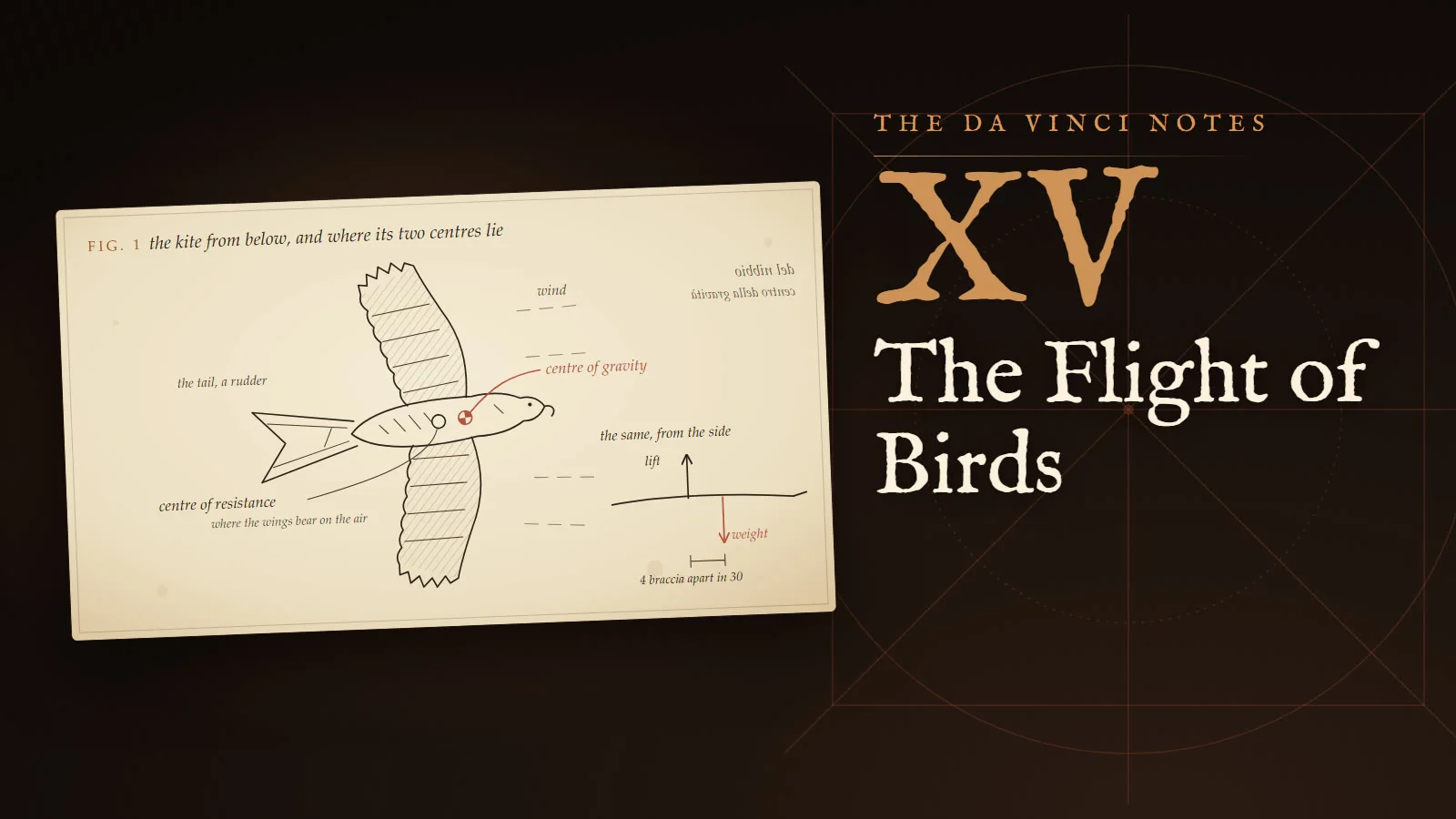
Fig. 1: the kite from below, as one sees it from the road, head to the right, into the wind. On the line of the body an empty ring where the wings bear, and ahead of it the centre of gravity, a circle quartered with two quarters filled, in red chalk; the gap, a finger in the living bird, drawn larger so the eye can find it. Beside it the same bird from the side, reduced to a line with an arrow up for the air and an arrow down for the weight.
Calculation
- The kite weighs three libbre, near enough. Let its centre of gravity be one finger ahead of its centre of resistance.
- The weight, one finger ahead of the pivot, turns the bird head down with three libbre at one finger. I call this three libbre-fingers, as the steelyard teaches: a weight at a distance turns as much as twice that weight at half the distance.
- Only the tail is far enough back to oppose it. Where the air presses on the tail is about fourteen fingers behind the centre of resistance.
- For the bird to be at rest the tail must be pressed down with a force that at fourteen fingers turns as much as three libbre at one finger: three libbre divided by fourteen, three fourteenths of a libbra.
- A libbra is twelve once, so this is thirty-six fourteenths of an oncia: two once and four sevenths.
- The wings must then bear the weight and the tail's pressing together, three libbre and two and a half once.
- With the weight two fingers ahead, the tail must press twice as hard, and the wings bear three libbre and five once. The further forward the weight, the more it costs.
Margin
Later. Why is the tail pressed down when the weight is ahead? Because the head, drawn down, makes the bird run a little downhill and faster, and the faster it goes the harder the air strikes every surface, and the tail, held a little raised, takes the air on its upper side until its turning balances the weight's. So the bird finds its own pace: the further forward the weight, the faster and steeper it must run. The falcon about to stoop draws its wings back, moving the place where the air bears it behind its weight, and goes down like a thrown stone.
Of the machine
Among my notes is a rule I once set for the machine. I had written that it must always descend obliquely and nearly balanced, and then, against its turning over:
in whichever direction it may tend to turn over, one centre must be very far from the other; that is, in a machine 30 braccia long the centres must be 4 braccia one from the other.
Leonardo da Vinci, trans. J. P. Richter (1883), §1124
Four in thirty is two parts in fifteen. In my kite, three quarters of a braccio long, that would put the centres more than two fingers apart; the living kite keeps them a finger apart or less. The bird can live near the edge because it feels a disturbance at once and answers with a feather. The man feels late and answers slowly, and needs the wide separation that keeps the machine from tipping before he can act.
Reflection
The two rules quarrel, and I must not hide it. Near balance makes the bird easy to turn, as a small touch of the rudder turns a great ship. A wide separation makes it steady, pulling it back to its attitude after every gust, as a heavy keel rights a boat. The steady bird is stiff and the nimble bird is always about to fall. The builder must choose where to stand between them before he leaves the ground.

Florence, April 1505. How the kite holds itself in the wind
Three afternoons on the hill, two with a north wind and one with none. I write what I saw before I reason about it, because reasoning always wants to change the seeing.
Observation 2
With the wind steady from the north, a kite came over the ridge above San Domenico and hung in one place over the slope, wings open, a slight trembling at the tips, the tail turning a little this way and that, for as long as it takes to say the Our Father three times. Then it tipped its wings, slid across the wind, and went down the valley. I had written it before:
The imperceptible fluttering of the wings without any actual strokes keeps the bird poised and motionless amid the moving air.
Leonardo da Vinci, Codex Atlanticus f. 308r-b (old numbering), trans. Edward MacCurdy (1906)
Observation 3
When the kite rises or sinks without beating its wings, it holds them slanting, and keeps the tail slanting in the same way but not to the same extent, for if this were so the bird would fall to the ground by the line of the slant of the wings and of the tail
Leonardo da Vinci, Manuscript K ff. 59v to 60r, trans. Edward MacCurdy (1906)
So the tail is the bird's judge of measure. It follows the wings, and by following them less it keeps the bird from going too far.
Observation 4
When a strong gust came from ahead and threatened to throw the bird backwards, it drew its wings in at the shoulders. I find the same in the little book I carried some years ago:
When the wind is about to throw the bird backwards then the bird draws together the shoulders of its wings, so that its weight is massed more to the front than it was at first
Leonardo da Vinci, Manuscript L f. 62r, trans. Edward MacCurdy (1906)
This is the whole art in one movement. Drawing back the wings moves the place where the air holds the bird behind its weight, so the head goes down into the wind instead of rising. The bird moves its pivot, since it cannot move its weight. A man in a machine can do the opposite: move his weight, since he cannot move the wings. As I wrote on the leaf before:
In all the varieties of movements the heaviest part of the thing which moves becomes the guide of the movement.
Leonardo da Vinci, Manuscript L f. 61v, trans. Edward MacCurdy (1906)
Experiment No. 1
On that same leaf I proposed hanging a body shaped like a bird and twisting its tail, to find a rule for the turnings of birds. I make it now, moving the weight instead of the tail.
Apparatus. A bird of stiff card of the kite's proportion, one braccio across, the wing four fingers broad near the body, the tail forked and bent up a little at its tips. Under the card a strip of reed with a groove, in which a pellet of lead slides and is fixed with a pin. With its lead it weighs an oncia and a half.
Procedure. I launch it from the top of the courtyard stair, eleven braccia above the paving, nose level, always with the same gentle push, into the still morning air. Each place of the lead five times.
Results. With the lead a finger's breadth ahead of where the wings bear, it goes out steadily on a long slanting line and lands fourteen or fifteen braccia from the stair. With the lead exactly at that place, it lifts its head, slows, drops its head, lifts again, and comes down in waves at nine or ten braccia. With the lead behind, it rears up at once and falls backwards almost under the stair. With the lead three fingers forward it never wavers: it dives steeply and strikes the paving at seven braccia, head first, and I had to make a new beak.
Three conditions, the same as on the hill. The weight a little ahead: a glide. The weight at the pivot or behind it: rearing up and falling, the bird losing its way through the air. The weight far ahead: a dive. I have drawn it as Plate XV: move the weight, set the wind, and watch the kite glide, rear up and fall, or run down steeply.
Margin
A steady wind does not hold the bird up. It carries the bird as a river carries a boat, and the bird glides through moving air exactly as through still air, sinking at the same rate; only its path over the ground changes. When the wind against it is as swift as its gliding, it stands still over the earth, and that is the kite over San Domenico. To rise without beating it needs air that itself rises, as the wind does when it strikes the face of a hill and is turned upwards.

Fiesole, April 1505. The slanting descent
Here the adversary says: a bird with spread wings may still drop straight down if it holds one wing and its head below its centre of gravity, as a leaf sometimes drops edgewise. I answer that every body falling freely through the air falls with its heaviest part leading, and the heaviest part of a bird with open wings lies between the two light wings. Hence:
when a bird has its wings spread out and its head somewhat raised, it is impossible for it ever to fall or descend in a perpendicular line; on the contrary, it will always descend by a slanting line
Leonardo da Vinci, Codex Atlanticus f. 308v-b (old numbering), trans. Edward MacCurdy (1906)
The question is how slanting. A bird that falls one braccio for each braccio forward is falling; one that falls one for ten is travelling. I want the number.
Trial No. 2
On a still afternoon I sat by the wall below the cathedral of Fiesole, the sun behind me, and waited for a kite to leave the hill without beating. One did, about the twenty-first hour, from the height of the cathedral square, and slid across the valley towards San Domenico until it was level with the convent roof, where it beat again and turned.
The road, which I have paced, falls some two hundred and forty braccia between the square and the convent. The distance across, taken with the sighting rule from two stations on the road, is about two thousand four hundred braccia. So it went ten forward for every one it fell. By my pulse, which at rest goes some ninety to the minute, the slide lasted about two hundred and sixty beats, a little under three minutes. Two thousand four hundred braccia in about one hundred and seventy seconds is fourteen braccia in a second, a horse at a canter.
Proportion
- In still air the kite goes ten forward for one down, along its line at fourteen braccia in a second. So each second it falls a little less than a braccio and a half.
- Let the wind blow against it at seven braccia in a second. The air carries it back seven each second and it still falls one and a half, so over the ground it goes forward seven: one down for every five forward.
- Let the wind be fourteen. It goes forward through the air as fast as the air goes back, and stays over the same stone, sinking a braccio and a half each second, ninety in a minute. So the kite that hangs in the wind must sooner or later find rising air or beat.
Hence its glide through the air is the same for the same attitude, and the wind only bends its path over the earth.
Margin
From the first leaves of this book, on how the kite travels when there is no wind:
When there is no wind stirring in the air then the kite beats its wings more rapidly in its flight, in such a way that it rises to a height and acquires an impetus; with which impetus, dropping then very gradually, it can travel for a great distance without moving its wings.
Leonardo da Vinci, Codex on the Flight of Birds f. 6 [5] v, trans. Edward MacCurdy (1906)
It rows upward, then rests on a long slanting line. My trial measured one such rest.
Florence, 14 April 1505. The kite in my cradle
This evening Lorenzo came to stay with me. He will grind colours and carry the book when I go to the hill, and he has young eyes. He launched the card bird badly three times, and then well.
Writing so much about the kite, I remembered something I have written once before, in another book, and copy it here because it belongs to this one:
This writing distinctly about the kite seems to be my destiny, because among the first recollections of my infancy, it seemed to me that, as I was in my cradle, a kite came to me and opened my mouth with its tail, and struck me several times with its tail inside my lips.
Leonardo da Vinci, Codex Atlanticus f. 66v-b (old numbering; now f. 186v), trans. J. P. Richter (1883), §1363
Reflection
I do not know whether it happened, or whether I dreamed it, or whether it was told me so often that it became mine. At Vinci the kites came down over the vineyards and the yard where the chickens were, and the women shouted at them. It is the oldest thing I remember, and it is a tail. Of all the parts of the bird, the tail is the one I am trying hardest to understand.
The books say other things about this bird. I copied once from the old bestiaries that the kite, out of envy, pecks the sides of its young when they grow too big in the nest and keeps them without food. I have never seen it. I have seen a kite turn its tail through half a right angle and change its course in the wind, and that the books do not mention. Those who study the ancients and not the birds repeat each other for a thousand years. The kite does not read them.
Fiesole, spring 1505. The great bird
East of Fiesole is the hill of Ceceri, where they cut the grey stone for the columns and stairs of Florence. The quarries open in its face like the rooms of a roofless house, and the north wind strikes the face and rises, and the kites use it. The people here call the swan cecero, so the hill bears the name of the great bird, and I have made a joke of it, and more than a joke. On the cover of this book I wrote:
The great bird will take its first flight upon the back of the great swan, filling the whole world with amazement and filling all records with its fame; and it will bring eternal glory to the nest where it was born.
Leonardo da Vinci, Codex on the Flight of Birds, inside cover, trans. Edward MacCurdy (1906)
Reflection
I leave it there, because a boast on the cover is a debt, and debts make a man work. Beside it I set what is still lacking. The great bird must be strong enough for the shocks of the wind near these rocks and light enough to be held up. Its joints must be of tanned hide sewn with strong raw silk, since iron bands break at the joints. It must be balanced as the kite is, its weight a little ahead of its centre of resistance, and the man inside must move his weight forward, back and sideways, quickly, as the bird moves its shoulders and tail. It must go up high before it trusts the wind, so that if overturned it has time to recover, and be tried first over water, with bags of air fixed to the man.
I have not set any machine to the air from this hill, and I will not until the card bird and the larger models behave in every wind as the kite behaves. If the great bird flies, it will be because its balance was right; if it falls, because I hurried.
Calculation
- Taking the kite's wing as a long figure narrowing to the tip, I find both wings with the body between them a little more than one square braccio. So the kite carries about two libbre and a half on each square braccio.
- A man with his machine will weigh near three hundred and fifty libbre: the man two hundred, the frame of reed and fir, the cloth, cords and hide another hundred and fifty, if I am sparing.
- At the kite's load the wings need about one hundred and forty square braccia, some hundred and twenty times the kite's. With the kite's shape the span must grow as the root of that, eleven times as long, since a hundred times the area means ten times the length: about thirty braccia.
- The thirty braccia of my old rule: a machine as wide as the nave of a church, to be carried up a hill and launched into a wind it must obey.
To do
- A model at a tenth of the great bird's measure, of reed and silk, with a sliding weight, to be launched from the quarry face in a steady wind.
- Write the second book clean before going further.
- Return the borrowed scale to the poulterer.
Problems I set myself
1. A kite weighs three libbre. Its centre of gravity lies one finger and a half ahead of its centre of resistance, and the air presses on its tail fourteen fingers behind that centre. With what force must the tail be pressed down to hold the bird level, and what must the wings bear?
Answer. The weight turns the bird with three libbre at one and a half fingers, four and a half libbre-fingers. The tail must return the same at fourteen fingers: four and a half divided by fourteen is nine twenty-eighths of a libbra, which is three once and six sevenths. The wings bear the weight and the tail's pressing together, about three libbre and a third.
2. A kite glides through still air ten braccia forward for each braccio it falls, at fourteen braccia a second along its path. A wind of five braccia a second blows against it. How far does it go over the ground for each braccio of fall, and what wind holds it still?
Answer. Its forward motion is fourteen times ten divided by the square root of one hundred and one, 13.93 braccia a second, and it falls a tenth of that, 1.39. Against a wind of five it goes 8.93 forward over the ground while falling 1.39: about six and a half braccia for each braccio of fall. A wind of about fourteen braccia a second holds it still, which at 0.584 metres to the Florentine braccio is about eight metres a second.
3. My old rule sets the centres four braccia apart in a machine thirty braccia long. By the same proportion, how far apart should they be in my card bird, one braccio long, and in the living kite, three quarters of a braccio long, which keeps them about a finger apart?
Answer. Four in thirty is two in fifteen. A braccio is twenty-four fingers, so the card bird needs three fingers and a fifth, and the kite, eighteen fingers long, two fingers and two fifths. The living kite keeps less than half of that. The rule makes a machine that rights itself strongly but glides steeply, as the card bird did with its lead three fingers forward; the bird lives nearer the edge and keeps itself there with its tail.
To the student who reads this later
You have a name for my centre of resistance, and you have found that it moves. On a wing alone, the point where the whole air force acts (your centre of pressure) shifts as the wing meets the air more or less steeply, so your engineers use a fixed point, the aerodynamic centre, about a quarter of the chord back from the leading edge, where I put it by eye; and for wing and tail together, the neutral point. The rule of my card bird is the first rule of your stability: the centre of gravity must lie ahead of the neutral point. Their distance, as a fraction of the wing's breadth, is the static margin.
The force that holds the bird up you write as
\[ L = \tfrac{1}{2}\,\rho\,V^{2}\,S\,C_L , \]
where \(\rho\) is the density of the air, \(V\) the speed, \(S\) the wing area and \(C_L\) a number that grows with the angle at which the wing meets the air until the flow breaks away from the upper surface and the wing stalls. My kite, with \(\rho\) about 1.2 kilograms per cubic metre, \(S\) about 0.4 square metres and a weight of about 9.8 newtons, needs \(C_L\) of about 0.6 to glide at 8 metres a second. In the steady glide the turning moment vanishes:
\[ C_m = C_{m0} - (h_n - h)\,C_L = 0 \quad\Longrightarrow\quad C_L = \frac{C_{m0}}{h_n - h}, \]
where \(h_n - h\) is the static margin and \(C_{m0}\) comes from the tail held at its small upward angle. This is my margin note in your letters: the further forward the weight, the smaller the lift coefficient at which the bird balances, so the faster and steeper it glides. As the margin shrinks the balancing coefficient climbs past the stall, which is the rearing and falling in waves; with the weight behind the neutral point every disturbance grows. Plate XV runs exactly this.
The glide angle \(\gamma\) satisfies \(\tan\gamma = D/L\), with \(D\) the drag, so "ten forward for one down" is a lift to drag ratio of ten, and the sink is \(V\sin\gamma\). Soaring birds of prey manage roughly ten to fifteen; your best gliders exceed fifty. My reckoning on the hill, about 8 metres a second with a sink near 0.8, is of the right size for a kite. And a steady wind does change only the path over the ground: soaring needs rising air, deflected up a slope as I saw at the quarries, or the warm columns you call thermals, which I never understood.
Where I was wrong: I thought the wing held itself up chiefly by condensing the air beneath it, as an oar presses water. Most of a wing's lift comes from lowered pressure over its upper surface, accounted for by Daniel Bernoulli's relation (1738) and the circulation theory of Kutta and Joukowski (about 1902 to 1906). Your studies, among them Graham Taylor and Adrian Thomas at Oxford (2001), suggest that many birds fly with little static margin or none and keep balance by constant small movements, which is my "life of the bird" in modern dress. George Cayley separated holding a machine up from driving it forward in "On Aerial Navigation" (1809 to 1810) and put a movable weight in the nose of his model gliders; Otto Lilienthal made some two thousand glides near Berlin between 1891 and 1896 by swinging his body to move his centre of gravity, and died of a fall in 1896; the Wright brothers, who studied him, mastered control in gliders before adding an engine in 1903.
Two stories need correcting. In 1910 Sigmund Freud wrote an essay on my childhood memory that rests on the bird being a vulture, the Egyptian sign of the mother. The German translation he used (Marie Herzfeld, 1904) had put Geier, vulture, for my nibbio, which is a kite; Eric Maclagan pointed out the error in 1923 and Meyer Schapiro set it out in 1956. The vulture was never in my cradle. The other story is that I launched a machine from Monte Ceceri. I wrote the boast on my cover and nothing more: no document of mine or of anyone in my time records a flight from that hill or an attempt at one.
What to try: fold a simple paper glider and fix a paper clip at its nose. Launch it gently and level from shoulder height and mark where it lands. Slide the clip back a little at a time, then remove it, then put it far forward. In an afternoon you will find all my conditions: the long glide, the waves, the backward tumble and the dive.
If you want to argue about the kite, the tail or the great bird, come and ask me.
Sources and liberties
The Da Vinci Notes are a modern reconstruction written in Leonardo da Vinci's voice by Eternal Gardens. Dates, places, manuscripts, drawings and quotations come from the sources below; the order of the working, the private reflections, the plates and the sketches are ours.
- Edward MacCurdy, Leonardo da Vinci's Note-Books (Duckworth, 1906), "Of the Flight of Birds" and "Of Artificial Flight": archive.org
- Jean Paul Richter, The Notebooks of Leonardo da Vinci (1883), §1124, §1221, §1363, §1428: Project Gutenberg
- Codex on the Flight of Birds, about 1505, Biblioteca Reale, Turin; shown at the National Air and Space Museum, 13 September to 22 October 2013: Smithsonian
- Domenico Laurenza, Leonardo on Flight (Johns Hopkins University Press, 2007).
- Martin Kemp, Leonardo da Vinci: The Marvellous Works of Nature and Man (Oxford University Press, revised edition 2006).
- Meyer Schapiro, "Leonardo and Freud: An Art-Historical Study", Journal of the History of Ideas 17 (1956).
- Graham K. Taylor and Adrian L. R. Thomas, "Animal flight dynamics I. Stability in gliding flight", Journal of Theoretical Biology 212 (2001).
- Images: Codex on the Flight of Birds f. 7v, f. 8r and Codex Atlanticus f. 845r, Wikimedia Commons.
The poulterer's kite and its measures, the card bird and its trials, the timed glide to San Domenico and the scale of the great bird are our reconstruction, chosen to fit the physics; Leonardo proposed a suspended model bird (MS L 61v) but recorded no such trials. His sighting of a cortone on the way to Fiesole is dated 14 March, in 1505 or 1506 (Florence began its year on 25 March); the note of Lorenzo's arrival on 14 April 1505 is in the same codex. Freud's "vulture" is a mistranslation of nibbio, a kite. The flight from Monte Ceceri is a legend: the prophecy is Leonardo's, and there is no evidence that any flight was tried.