 by Marie Curie

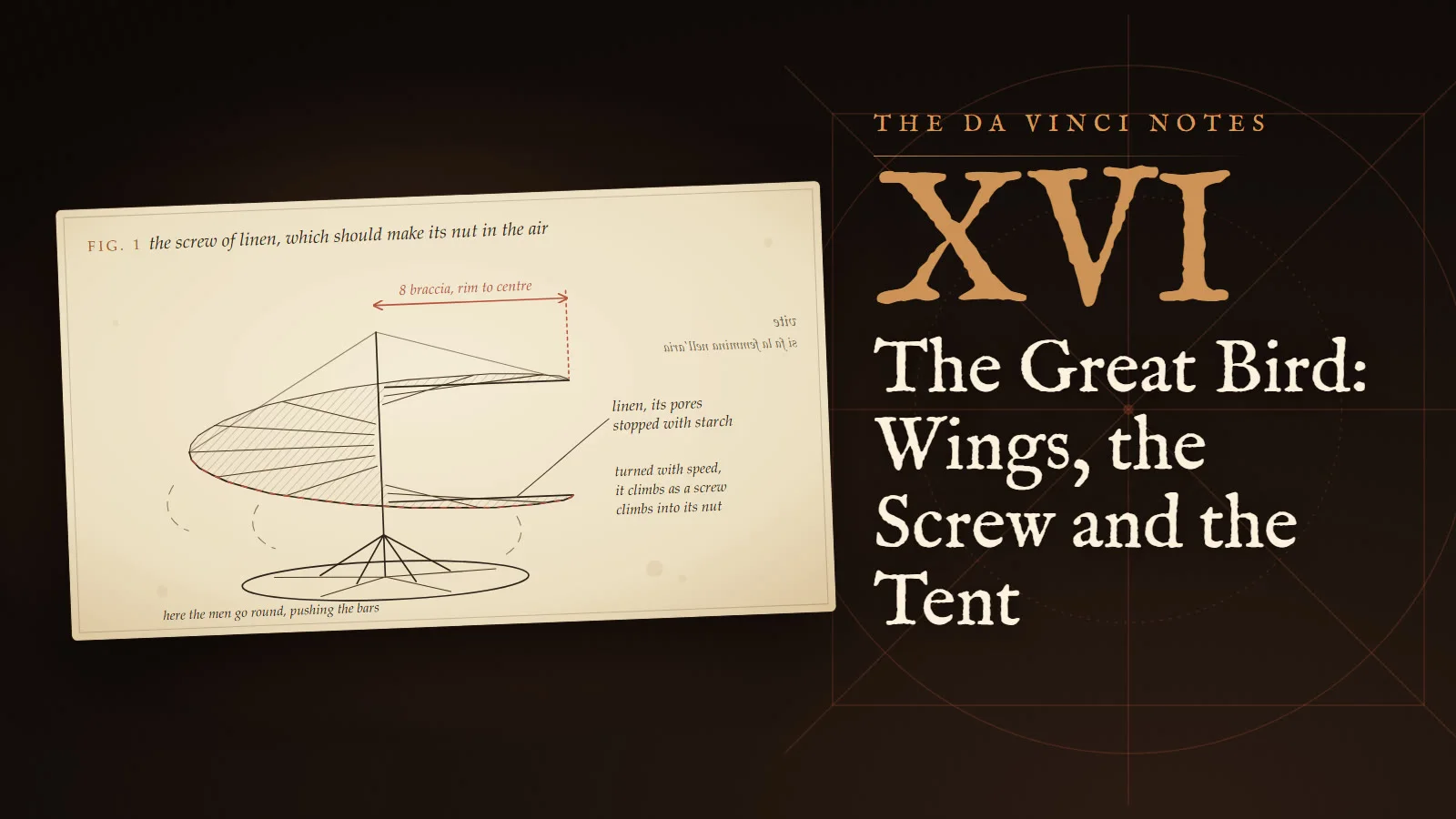
Milan, in the years when I was drawing and measuring horses for the Duke's great monument in bronze. Between the horse and the festivals, the canals and the stage machinery, I kept a book in which I drew machines for a man to fly. I drew wings that a man would beat lying on his belly, wings he would beat standing upright, a screw of linen that should climb into the air as a screw climbs into wood, and a tent of linen under which a man might drop from any height. I was young enough to think that what the hand could draw, the arm could drive. These are the notes of that book, with what I came to understand afterwards in Florence, when I watched the kites and began to doubt my own arms.
a man with wings large enough and duly connected might learn to overcome the resistance of the air, and by conquering it, succeed in subjugating it and rising above it.
Leonardo da Vinci, Codex Atlanticus f. 381v-a (old numbering; now f. 1058v), trans. J. P. Richter (1883), §1126
Milan, about 1487. Wings for a man lying down
The argument comes first, and I wrote it on the same sheet as the tent of linen, beside a man straining at a wing:
There is as much pressure exerted by a substance against the air as by the air against the substance.
Leonardo da Vinci, Codex Atlanticus f. 381v-a (old numbering; now f. 1058v), trans. Edward MacCurdy (1906)
The eagle beats the thin air and is held up; the wind fills the sail and drives the laden ship. If the wing presses the air, the air presses the wing, so a man who can strike the air hard enough with a wide enough surface will be pushed up by it. The whole question, then, is how to make him strike.
The arms of a man are weak for this, and the legs are strong; a man carries his whole weight on one leg all day and climbs a stair with it. So the legs must give the downstroke, which carries the weight, and the arms the upstroke, which carries nothing but the wing.
The machine
The man lies face down on a board the length of his body, padded at the chest, with a hoop about his shoulders to hold him. His feet go into two stirrups. Each stirrup pulls a cord, the cord runs over a pulley at the front of the frame and down to the wing at a point near its root, so that when he kicks back with both legs the two wings are drawn down together. His hands hold a bar which, by a second cord and pulley, raises the wings again. Behind him a tail of cloth on a light frame, which he turns by a cord to steer.
The wings are made after the bat, a frame of cane and fir like the bones of a hand, with the fingers joined by a skin. I use fustian, starched, or a light taffeta, and where the fingers meet the palm I make joints of leather so the wing can bend on the upstroke and spread on the down. Each wing is ten braccia long and three wide at the root, narrowing to the tip.
Calculation
- The man weighs about one hundred and fifty libbre. The frame, the wings, the cords and the pulleys, made as lightly as I dare, another hundred and fifty. Three hundred libbre must be held up.
- Each wing, ten braccia long and three wide at the root, narrowing to the tip, has the area of a triangle, half the length times the breadth: fifteen square braccia, with something added for the round tip. Two wings, some thirty-five square braccia.
- Thirty-five square braccia must hold up three hundred libbre: eight libbre and a half on each square braccio.
- If a man can press down with twice his weight, as I believe, his legs give three hundred libbre at the stirrups, the very weight to be held up. The cord, led once over its pulley, turns the direction of that force and does not change its size.
- At the root the force is large and the motion small. At the tip the motion is large and the force small, as in a lever. Most of the work is done in the outer half of the wing, which moves through the most air.
Draftsman's note
Draw the man from above and from the side, the board, the stirrups, the cords over their pulleys, the wing in three positions, raised, level and struck down, the three overlapping in faint lines so the eye reads the stroke. The cords in red chalk, so they are not confused with the frame.
Milan, about 1487. Trial of the wing
Before anyone lies on the board, I must know whether a man's stroke can lift the weight at all. So I set a wing to lift a plank.
Trial No. 1
Apparatus. One wing of the machine, ten braccia long, of cane and starched fustian, fixed by its root to a pivot on a heavy beam laid across two trestles in the courtyard, so the wing can swing down and up. Beneath the beam a plank loaded with stones to two hundred libbre, joined to the beam so that if the wing's stroke pushes the beam up, the plank rises with it. A lever of fir two braccia long fixed to the wing at its root, for a man to throw his weight on.
Procedure. Tommaso, who is strong, stands on a stool, takes the lever, and throws his whole weight down on it as fast as he can, once. Then ten times as fast as he can, with a mark on the post to show how high the plank goes each time.
Results. On the first stroke, given with all his strength and his weight, the plank leaves the trestles by the breadth of three fingers and drops back. On the second, two fingers. By the sixth, one. By the tenth, the wing goes down and the plank does not move, and Tommaso sits on the stool and says he would sooner carry the plank on his back up the bell tower.
Reflection
One stroke lifts it, which proves the air pushes the wing as hard as the wing pushes the air. I wrote that the trial succeeded. But to fly the man must lift the whole weight with every stroke, and keep striking for as long as he means to stay up, and Tommaso's strength was gone in ten strokes. The force was there. Something else was missing, which I did not know how to name.

Milan, about 1488. The man who stands
The man lying down has his arms and legs at work and nothing left to steer with, and he can see only the ground. So I drew a second machine in which he stands upright in a bowl like a boat, as he stands in a boat, with his body free to lean. Above him four wings on a mast, beating two and two, crosswise, as a horse moves its legs, so that while one pair rises the other strikes and the machine is never left without support. His feet drive the wings by treadles, his arms by bars, and his head works a fifth cord, since every part of him that can push must push.
To climb in, a ladder; and since a ladder hanging below would catch the air, the ladders are drawn up after the machine leaves the ground, and let down again to land on, so that it settles on their feet as on legs.
Margin
The standing man can see where he goes and move his weight, which the lying man cannot. But the standing machine is heavier by its bowl, mast and four wings, and every pulley and every joint takes some of the strength and gives it back as heat and noise. More weight and the same man.
To do
- Weigh every part of the standing machine as it is made, and write the total in large letters.
- Make the treadles of the standing machine and let Tommaso tread them for the space of a Miserere, counting the strokes.
- Ask the cordmaker at the Porta Vercellina for a cord of raw silk, and test it against hemp with the same weight.
Milan, about 1489. The screw of linen
The wings, beaten up and down, waste half their labour on the upstroke. A thing that turns always in one direction wastes nothing in returning. The screw that a carpenter turns into wood goes in without going back. I have seen a flat card, cut into a spiral and spun on a pin over a candle, turn by itself in the hot air rising; and the boys' toy, the little mill of four feathers on a stick, spun between the palms, goes up out of the hand.
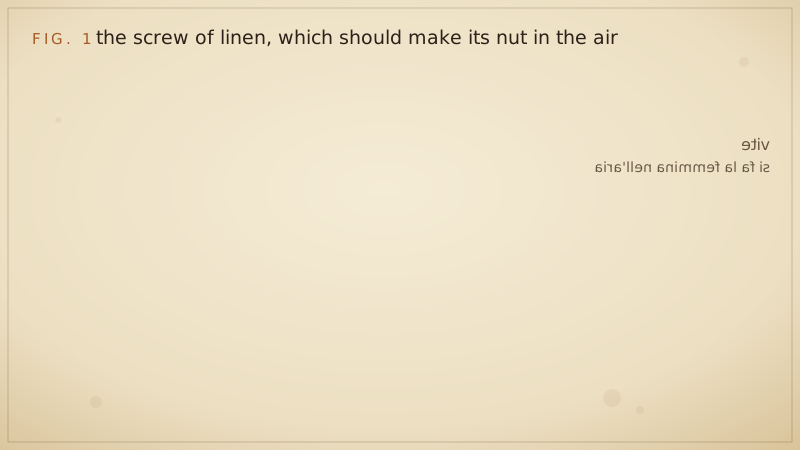
So I drew a screw of linen, one turn of a helix about a mast, its rim stiffened with a ring of cane and held to the mast by cords. Beneath I wrote the note, which I give here in my own words: I find that if this instrument made like a screw is well made, that is, of linen with its pores stopped with starch, and turned swiftly, the screw will make its nut in the air and will climb high. The air is thick enough, I believe, to serve the linen as the wood serves the iron screw.
Draftsman's note
Fig. 1: the screw from a little above, so both halves of the turn show, the far half hatched behind the mast. The radius marked in red chalk: eight braccia from the rim to the centre. Below, the platform with its bars, and the men. A few curls of air going down beneath the rim, which is what the screw must do: send air down so the air sends it up.
Experiment No. 1
Apparatus. A small screw of card, a palm across, glued about a straw. Through the straw a thin strip of iron, twisted many times so that, let go, it untwists and turns the card. A second screw the same, its straw held by a thread from the beam.
Procedure. Twist the strip fifty times, hold the screw upright on the table, and let go. Then let go the hanging one.
Results. The screw on the table hops a palm up and falls over, spinning. The hanging screw turns its card one way, and the straw with its strip of iron turns the other way, as fast, and the thread twists. I tried it five times and it never failed: whatever turns the screw is turned back by it.
Reflection
This is my own rule, as much pressure by the air on the substance as by the substance on the air, come back to trouble me. The men on the platform push the bars to turn the screw. The screw pushes back on the men, and the platform, if it stands free in the air, will turn the other way under them. On the ground the earth holds the platform. In the air nothing holds it. I must find something that pushes against the air to hold the platform still, or set two screws turning against each other.

Calculation
- The rim is eight braccia from the centre. Its circuit is the diameter, sixteen braccia, times three and a seventh: a little more than fifty braccia.
- For the screw to bite, the rim must move quickly through the air, as fast as a horse at a gallop, say twenty-five braccia in a second. Then it turns once every two seconds, thirty turns in a minute.
- The men push bars two braccia from the centre. Their circuit is a little more than twelve and a half braccia, and they must go round once every two seconds: more than six braccia in a second, which is running.
- Four men running in a circle, pushing hard, for as long as they mean to stay up, and the platform turning against them.
Milan, about 1485 to 1490. The tent of linen
If the machine breaks or overturns, the man falls. So, on the same sheet as the men and the wing, I drew a tent of linen in the shape of a pyramid with the man hanging beneath it by cords from its four corners, and wrote, again in my own words: if a man has a tent of linen with all its pores stopped, twelve braccia on each side and twelve high, he can throw himself down from any great height without harm to himself.
Here there is no beating and no strength wanted. The man only falls, and the tent makes the air hold him back. The air under the tent cannot get out quickly enough; it is pressed together, and pressed air resists, as the air in a bladder resists the hand. The heavier the man, the faster he must fall before the air holds him; the wider the tent, the slower.
I wrote also, for a smaller danger, a remedy that asks no frame at all:
Bags by which a man falling from a height of 6 braccia may avoid hurting himself, by a fall whether into water or on the ground; and these bags, strung together like a rosary, are to be fixed on one's back.
Leonardo da Vinci, trans. J. P. Richter (1883), §1125
Proportion
- The tent holds the man back by its breadth; the air presses on the whole square of its mouth. A tent of twelve braccia a side has a mouth of one hundred and forty-four square braccia.
- A tent of six braccia a side has a mouth of thirty-six, a quarter as large. To fall as slowly, it can carry a quarter of the weight.
- So the weight a tent can carry at the same slow fall grows as the square of its side. Double the weight wants a side larger by the root of two, about seventeen braccia.
Experiment No. 2
Apparatus. A small tent of linen one braccio a side and one high, its pores stopped with starch, on a frame of four reeds, with a weight of lead hung from its corners by threads. A second weight the same, without a tent.
Procedure. Both let go together from the loggia, thirty braccia above the court.
Results. The bare lead strikes the court in less than two beats of the pulse. The tent swings at first, then comes down steadily, the lead hanging beneath, in some six beats of the pulse. With twice the lead it comes down faster, but steadily still; with four times, it falls almost as the bare lead after the first few braccia.
Margin
A man with the tent comes down no slower than this lead, if I have kept the proportion: the tent a hundred and forty-four times as wide in its mouth, the man a hundred and forty-four times as heavy as the lead. The weight I hung was a libbra and a third, which times a hundred and forty-four is the man and his tent together, near enough. So by my reckoning the man comes to the ground no harder than the little tent came to the court, and that I could have caught in my hands.
Florence, 1505. Of strength
Fifteen years later, with the kites over Fiesole and the little book for the birds at my belt, I took up the old question again. Men tell me the bird has a strength no man has. I answered them in the book:
You will perhaps say that the sinews and muscles of a bird are incomparably more powerful than those of man
Leonardo da Vinci, Codex on the Flight of Birds f. 17 [16] r, trans. Edward MacCurdy (1906)
My answer was that the bird keeps a great reserve: it must double or treble its speed to flee or to catch, and carry a weight in its talons as heavy as itself, as the falcon carries the duck and the eagle the hare. To sustain itself on the wind it needs little force. And a man too is stronger than his need. Let him stand on the sand of the shore and mark how deep his feet sink; set another man on his back and mark again; then let him jump straight up as high as he can, and his feet sink deeper where he jumps than where he carried the other man:
This affords us a double proof that man is possessed of more than twice the amount of strength that is required to enable him to support himself.
Leonardo da Vinci, Codex on the Flight of Birds f. 17 [16] r, trans. Edward MacCurdy (1906)
Reflection
I set down the proof and I still believe the measure in the sand. A man pressing with all his strength, for the space of one jump, presses with more than twice his weight. The sand records a moment. It says nothing of how many times he can do it. Tommaso lifted the plank once and then less and less. The kite over Fiesole hangs in the wind all afternoon, and the cortone I followed went the length of a field without a stroke. The bird beats its wings to rise or to flee, and for the rest of its flying it does not beat them at all. It rides.
So my machine, if it is ever to stay up, must ride as the kite rides. Let the man give only the small strength the bird gives: the steering, the balance, the shift of the weight. Let the wind do the holding up. I have written it plainly before, and now I understand why it matters:
Man when flying must stand free from the waist upwards so as to be able to balance himself as he does in a boat so that the centre of gravity in himself and in the machine may counterbalance each other, and be shifted as necessity demands for the changes of its centre of resistance.
Leonardo da Vinci, trans. J. P. Richter (1883), §1122
The machine must be built to stand the shocks of the wind, which near the hills are violent:
its joints should be made of strong tanned hide, and sewn with cords of very strong raw silk. And let no one encumber himself with iron bands, for these are very soon broken at the joints or else they become worn out
Leonardo da Vinci, Codex on the Flight of Birds f. 8 [7] r, trans. Edward MacCurdy (1906)

Of the bat
For the wing I hold to the bat, as I have written in this book:
Remember that your flying machine must imitate no other than the bat, because the web is what by its union gives the armour, or strength to the wings.
Leonardo da Vinci, trans. J. P. Richter (1883), §1123
Feathers let the air through on the upstroke and close on the down, which a man cannot make; a web holds the air on both strokes and can be made of cloth. For a wing that rides the wind and does not beat, the web is enough.
To do
- Find what a man can do for an hour, and what for a moment: let Lorenzo carry a weight up the stair of the Palazzo, once running and once walking, and count the steps and the beats.
- Build the great bird to glide first. Beating can be added when the gliding is mastered.
- Try every new machine over the lake or the river, with the bags on the man's back.
I have drawn the question of the strength as Plate XVI, with the help of a reckoning I could not have made: how much work each second the wings ask in order to hold a weight up, against what a man can give. Choose my ornithopter, a sparrow, or the machines that men of a later age made, and see where the man's line falls.
Problems I set myself
1. A tent of linen twelve braccia a side lets a man and his tent, together two hundred libbre, come down slowly. If he carries a load that makes him half as heavy again, what side must the tent have for him to come down as slowly?
Answer. The weight the tent can carry at the same slow fall grows as the square of its side. Half as heavy again is three hundred libbre, so the square of the side must be half as large again: one hundred and forty-four and seventy-two, two hundred and sixteen square braccia. The side is the root of that, a little less than fourteen braccia and three quarters.
2. A bird of card one braccio across weighs one oncia and a half. A machine of the same shape and the same make is twenty times as long in every measure. How heavy is it, how large are its wings compared with the card's, and how much faster must it go to be held up?
Answer. Its weight grows as the cube of its length: twenty times twenty times twenty, eight thousand times, which is twelve thousand once, or one thousand libbre. Its wings grow as the square, four hundred times. So each part of its wing must carry twenty times what the card's carries. The air presses on a wing as the square of its speed, so the speed must grow as the root of twenty: about four times and a half. A larger bird of the same make must go faster and is heavier for its wings; to stay light, the machine must be made of thinner stuff than the card, in proportion.
3. The rim of the screw of linen is eight braccia from its centre, and must travel twenty-five braccia in a second. The men push bars two braccia from the centre. How many turns in a minute, and how fast must the men go round?
Answer. The rim's circuit is sixteen times three and a seventh, fifty braccia and two sevenths. At twenty-five braccia a second it turns once in a little over two seconds, about thirty times a minute. The men's circuit is a quarter of the rim's, twelve braccia and four sevenths, so they go a quarter as fast as the rim, a little over six braccia a second, which is a steady run, and they must keep it up for as long as the machine is in the air.
To the student who reads this later
You have the word I lacked. What Tommaso had for one stroke and lost in ten is power, work done each second, which you measure in watts. Force can be stored in a bent bow or a man's braced legs; power must be delivered continuously. A fit man gives some 75 to 100 watts for an hour, perhaps 300 to 400 if he is a trained athlete on the pedals, and near 1,000 for a few seconds. In 1960 the physiologist Douglas Wilkie set this out in "Man as an aero-engine", and showed that human flight, if possible at all, needed a very light machine with very long wings, flown slowly, and powered by the legs.
The power for level flight has two parts. One holds the weight up, by sending air downward, and falls as the speed rises. The other pushes the air aside, and grows as the cube of the speed:
\[ P = \frac{1}{\eta}\left(\tfrac{1}{2}\,\rho\,V^{3}S\,C_{D0} + \frac{2kW^{2}}{\rho\,V S}\right), \qquad k = \frac{1}{\pi e A}, \]
where \(\rho\) is the air's density, \(V\) the speed, \(S\) the wing area, \(W\) the weight, \(C_{D0}\) the drag of the surfaces, \(A\) the span squared over the area, \(e\) a number a little below one, and \(\eta\) how much of the pilot's work reaches the air. Plate XVI draws exactly this. With my lying-down ornithopter taken at 100 kilograms (my three hundred libbre), 12.5 square metres of wing and 12 metres of span, the least power is about 720 watts at about 9.7 metres a second, close to its stall: some seven times what a man can give for an hour, and near what he can give for a few seconds, which is Tommaso and the plank. Beating the wings, with all the losses of the joints and the effort of reversing them, would cost more than this, never less.
The men who did it obeyed Wilkie. Paul MacCready's Gossamer Condor, pedalled by Bryan Allen, flew a figure-of-eight course around two pylons half a mile apart at Shafter, California, on 23 August 1977: a span of 29.25 metres and an empty weight of about 32 kilograms, flying slowly, a little faster than a man runs, on a few hundred watts. The Gossamer Albatross carried Allen across the English Channel on 12 June 1979. In 1988 the Daedalus flew from Crete to Santorini, 115 kilometres. All three used propellers. The beating wing was achieved on 2 August 2010, when Todd Reichert flew the Snowbird, an ornithopter of 32 metres span and 43 kilograms empty, for 19.3 seconds over 145 metres at Tottenham, Ontario, after a tow by car to launch it; the claim has been questioned. On 13 June 2013 Reichert's AeroVelo Atlas, four great rotors turned by pedals, hovered for 64 seconds and reached a little over 3 metres.
That last machine is the honest answer to my screw. For a rotor holding up a thrust \(T\) over a swept disc of area \(A\), your momentum theory gives the least possible power:
\[ P_{\text{ideal}} = \frac{T^{3/2}}{\sqrt{2\rho A}} . \]
My screw of eight Milanese braccia, 4.76 metres, sweeps about 71 square metres. To hold up 200 kilograms, a thrust of 1,962 newtons, it would need at least 6.7 kilowatts even if perfect, and a starched linen helix is far from perfect; four men give perhaps 400 watts. And the platform would turn against the screw, as my card showed, the torque your helicopters cancel with a tail rotor or with two rotors turning opposite ways. The screw was never built in my lifetime and could not have flown as drawn. In 2022 a student team at the University of Maryland flew a small drone with screw-shaped rotors after my drawing, driven by electric motors.
The tent is the one machine of mine that a man has trusted his life to. On 26 June 2000 the British skydiver Adrian Nicholas dropped from a balloon at 3,000 metres over Mpumalanga, South Africa, under a pyramid built to my proportions, about 7 metres a side, of canvas, wood and cord; at 600 metres he cut himself free and opened a modern parachute, because the heavy frame might have crushed him on landing. He said the ride was smooth. For a steady fall the drag balances the weight:
\[ v = \sqrt{\frac{2W}{\rho\,C_D\,A}} , \]
and with about 100 kilograms under a mouth of 51 square metres and \(C_D\) near 1, \(v\) is about 5.7 metres a second, the speed of a jump from a wall about 1.6 metres high: hard on the knees, and survivable. I was not the first to draw one: a conical parachute appears in a manuscript of the 1470s by an anonymous Sienese engineer, now British Library Add MS 34113, and Fausto Veranzio published his square "Homo Volans" about 1615 to 1616.
The road that led to flight was the one I turned to at the end. George Cayley separated the holding up from the driving forward in 1809 to 1810 and built gliders; Otto Lilienthal glided by shifting his body, as §1122 asks; the Wrights mastered balance and control in gliders and then added an engine of about 9 kilowatts in 1903. The power that a man's body could never give came from burning fuel.
If you want to ask why the arms failed and the wind did not, come and ask me.
Sources and liberties
The Da Vinci Notes are a modern reconstruction written in Leonardo da Vinci's voice by Eternal Gardens. Dates, places, manuscripts, drawings and quotations come from the sources below; the order of the working, the private reflections, the plates and the sketches are ours.
- Edward MacCurdy, Leonardo da Vinci's Note-Books (Duckworth, 1906), "Of Artificial Flight": archive.org
- Jean Paul Richter, The Notebooks of Leonardo da Vinci (1883), §1122 to §1126: Project Gutenberg
- Domenico Laurenza, Leonardo on Flight (Johns Hopkins University Press, 2007).
- D. R. Wilkie, "Man as an aero-engine", Journal of the Royal Aeronautical Society 64 (1960).
- Images: Codex Atlanticus f. 1058v, Manuscript B f. 83v and Codex on the Flight of Birds f. 16v, Wikimedia Commons.
The notes on the screw (Manuscript B f. 83v) and the tent (Codex Atlanticus f. 1058v) are given in our own translation of Leonardo's Italian, without quotation marks. The descriptions of the prone and standing machines follow the type of his drawings in Manuscript B; their dimensions, the wing trial (Tommaso Masini, called Zoroastro, did work with Leonardo, but his part here is invented), the card screw and the model tent are our reconstruction, chosen to fit the physics. Leonardo never flew, and none of his flying machines was built in his lifetime or would have flown as drawn. The story that he or his assistant flew from Monte Ceceri is a legend with no evidence behind it. "Once you have tasted flight, you will forever walk the earth with your eyes turned skyward" is not his: it comes from a television script of 1965.