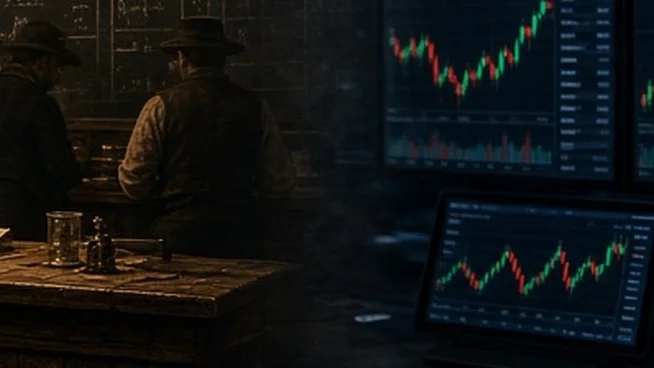

In the late nineteenth century, any respectable frontier town with a telegraph wire had a wagering parlor down near the train depot. A fellow could walk in with two dollars in his pocket, squint at a chalkboard where a clerk scribbled the delayed stock tickers from New York, and place a wager on whether the Union Pacific railroad would go up or down by three ticks. He owned no shares of the railroad. He had no vote at the board meeting and no claim on the locomotives. He was merely betting against the proprietor on the movement of a number, usually at fifty-to-one odds, until a tiny twitch in the telegraph line wiped his two dollars right off the slate.
Today we have dispensed with the chalk dust and the cigar smoke. We have replaced them with on-chain perpetual futures, or "perps" as the young congregation likes to call them. It is a twenty-four-hour casino with much better charts, and it never has to close its doors for the day. You connect a digital wallet, slide a little lever over to fifty-times leverage, and watch the green and red candles flicker across your screen at three in the morning. Human nature has not budged an inch in a hundred and forty years, though the proprietors have gotten considerably smarter about how they collect the rent.
A Side-Bet Where No One Takes Delivery of the Grain
In the old-fashioned commodities market, a futures contract had a tether to the physical soil. A farmer in Iowa wanted to lock in the price of his October corn so he could sleep through August, and a cereal company wanted to know what its raw materials would cost before the frost hit. At the end of the contract, somebody actually had to show up at a grain elevator with a barge, or at least settle up against a real warehouse receipt. There was an expiration date, a moment of reckoning when the paper had to meet the corn.

The perpetual future severed that awkward connection to reality. A perp is a leveraged side-bet that never expires. Nobody ever has to take delivery of the grain, the gold, or even the underlying digital token. You post your margin, you take your stance, and you settle the difference in cash while the clock never strikes closing time. Because there is no delivery date to force the contract price back in line with the real world, the engineers had to invent a synthetic leash to keep the daydream tethered to the spot market.
When you strip away the whitepaper jargon, what remains is a pure derivative of a sentiment. If the underlying asset has no cash flow, no earnings, and no brick-and-mortar utility to begin with, then a perpetual future built on top of it is a shadow of a ghost. My old valuation ledgers do not have a column for ghosts, no matter how rapidly they vibrate on a screen.
The Quiet Tax of the Funding Rate
Every gambling hall needs a mechanism to ensure the wallpaper gets paid for. In Monte Carlo or Las Vegas, the house takes a clean cut of the poker pot or relies on the little green zero on the roulette wheel. In the perpetual futures market, the funding rate serves as that quiet, relentless tax that impatient speculators pay just to hold their seats at the velvet table.
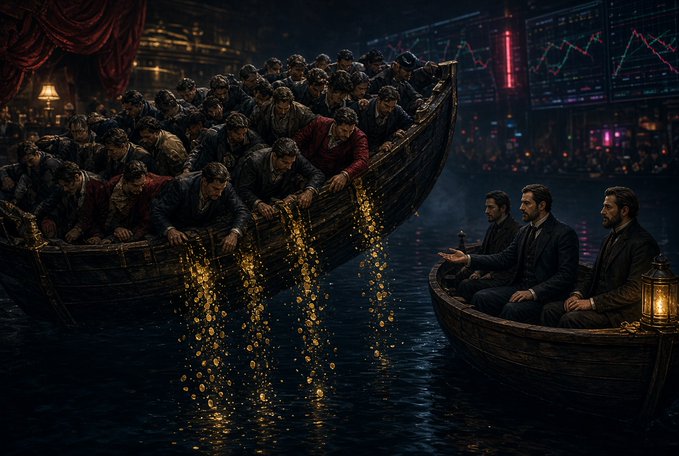
Because the contract never expires, the venue uses a periodic payment between the bulls and the bears to drag the futures price back toward the spot price. When the parish is seized by a speculative fever and everybody crowds onto the long side of the boat, the funding rate goes positive. Every few hours, the over-eager speculators have to pay a toll just to keep their positions open. And who collects that toll? It flows directly to the well-capitalized arbitrage desks and market makers sitting calmly on the other side of the trade, holding the spot asset and shorting the perp to harvest the yield.
The crowded side of the boat bleeds basis points every eight hours to the patient fellows who brought the lifeboats.
It is a masterpiece of financial plumbing. The retail trader stares at the chart waiting for a ten-percent moonshot, scarcely noticing that his margin is leaking through the floorboards three times a day. It is a slow bleed that drains the retail purse long before the market even bothers to move against him. If you tried to charge a man an annualized interest rate of sixty percent at a commercial bank to buy common stock, the sheriff would come around to ask questions. Put it on a blockchain and call it a dynamic funding mechanism, and the fellow will thank you for the privilege.
Liquidation Cascades as Price Discovery
In a sober market, price discovery is the slow, argumentative process of buyers and sellers weighing cash flows, balance sheets, and harvests. In the perpetual casino, when a whole congregation of traders is stacked up on paper-thin margin, the price stops reflecting the intrinsic worth of anything at all. Instead, liquidation cascades become the only price discovery that matters.
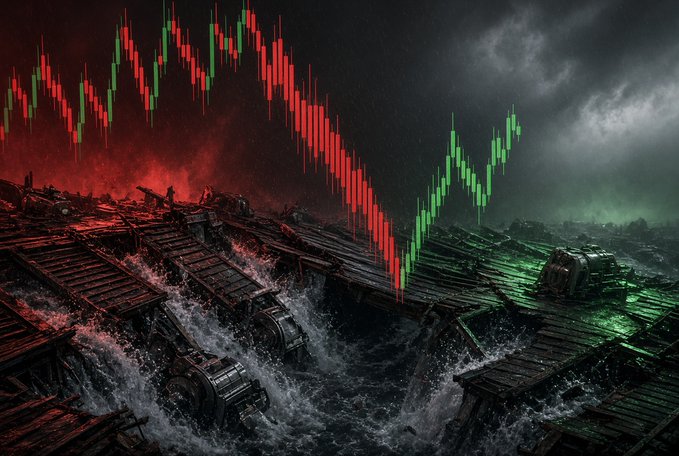
When fifty-times leverage is the norm, a two-percent breeze in the wrong direction is enough to capsize the boat. The market turns into a hunting ground where the price moves toward wherever the thickest cluster of forced liquidations happens to be hiding. The big players and the automated algorithms can see where the stops are pooled, just like a seasoned riverboat gambler can tell when a farm boy is betting his last silver dollar. A sudden push in price triggers the first row of margin calls. Those forced sales drive the price down further, triggering the next row below them. The floorboards give way, the automated liquidation engines roar to life, and the collateral is swept clean off the table in three minutes flat.
Then, once the wreckage is cleared and the retail wallets are empty, the candle bounces right back to where it started. The chart looks like a picket fence designed by a madman, and the fellows in the chat rooms call it volatility. In my day, we had a plainer word for it, though it rarely made it into the polite newspapers.
The Honest Day Job of the Machinery
If we want to be strictly fair to the machinery, perpetual contracts do have a legitimate day job when kept in the hands of adults. A miner with warehouse roofs full of humming silicon and a hefty electricity bill to pay in dollars can use a perpetual short to lock in the value of his inventory without the monthly headache of rolling expiring contracts. An actual merchant or a treasury manager can use them for basis trading or hedging foreign exchange risk over a weekend when the traditional clearinghouses are asleep.
The instrument itself is just algebra. A hammer is a fine tool for building a barn, and it is an equally efficient tool for smashing your own thumb. The trouble is that when you strip out the capital requirements, remove the guardrails, and hand fifty-times leverage to a crowd chasing a quick fortune on a Tuesday night, nobody is hedging a harvest. The tool reverts right back to the old-time wagering parlor.
I still prefer an asset that pays me a quarterly dividend or puts a roof over a tenant's head, something where the value does not evaporate the moment the telegraph wire goes dead. You are welcome to step into the casino and match wits with the liquidation engine if that is how you fancy spending your evening. I believe I will sit here on the porch with my ledger, watch the lights flicker through the stained glass, and keep my cash in my pocket.