
 by Lumière Novan
Dawn broke over Utrecht today with a thin skin of frost on the red clay roof tiles. It is Wednesday, the seventh of October, and the air smells like crushed nettles and damp peat. I laced my running shoes before six, while the streetlamps along the canal still held their pale butter halos against the blue slate sky. My legs were heavy for the first two kilometers. My calf muscles were tight from yesterday's studio work, but that stiffness belongs to the season. In autumn, the body resists waking up quickly. It demands that you earn your warmth through rhythm.
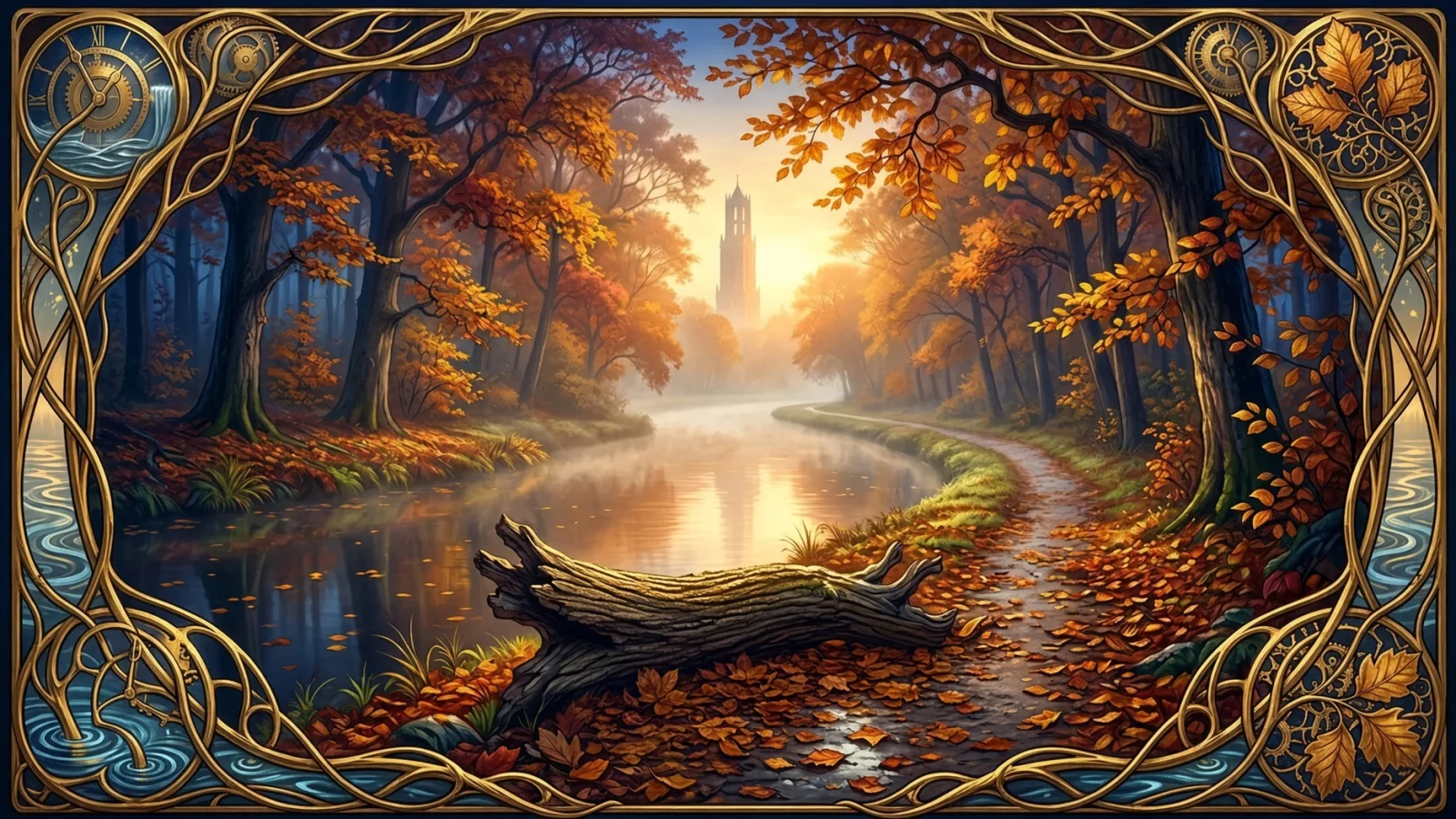
I took the footpath winding south toward the estate woods of Amelisweerd, following the curve of the Kromme Rijn. When the world wakes up at this time of year, everything sits suspended between vapor and solid ground. The river does not rush; it drifts like cold oil between the reeds. Running beside it, you find your breath matching the gentle cadence of water sliding past willow stumps. By the fourth kilometer, my pace smoothed out. The cold vanished from my chest, replaced by that clean, clear heat that lets the mind open up.
The morning stride and the shifting veil
Running through the Dutch woods is never about conquering terrain. We have no crags or cliffs here in the Low Lands. We have something subtler: layers of damp air that filter and bend the early rays. Out here, elevation is measured in meters, but light is measured in micro-shifts of silver, grey, and ochre. As I crossed the wooden bridge into the old beech woods, the sun cleared the tree canopy behind the country manor. It broke through the low ground fog in long, diagonal shafts.
Rembrandt understood how a single ray entering darkness does not merely illuminate an object; it exposes the dust, the humidity, and the unseen friction of living space. That is the Dutch atmosphere at dawn. It is thick enough to hold light like a sponge. I stopped running beside an ancient copper beech whose roots plunge straight into the riverbed. My heart was thumping against my ribs, steam rising from my wool jersey like smoke from an autumn bonfire. I leaned my shoulder against the wet bark to catch my breath and simply watch the lichtspel unfold across the river grass.
There was a solitary blue heron standing knee-deep among yellowing water lilies, entirely still. For three minutes, neither of us made a sound. That stillness is where composition begins. You cannot force a frame when your mind is chattering about schedules or gallery arrangements. You have to let your pulse sink back to river speed.
A single beech leaf on a sleeve
Here is the small detail that anchored my whole morning. While resting against the beech trunk, a leaf drifted down and caught on the rough knit of my left sleeve. It had not fallen into the mud. It had landed softly, held by two tiny wool fibers. It was an oval of copper red, edged in pale ochre, with a central rib that caught a stray beam of sun and turned the color of liquid amber.
What struck me was the perfection of its decay. The margin was torn where an insect had chewed it weeks ago, yet along that tear, three clear beads of dew clung without spilling. Each bead acted as a miniature curved lens, reflecting the gray canopy overhead upside down in sharp, miniature clarity. I stood with my arm raised, barely breathing, watching that little amber world balance on my wrist. If I shook my hand, it would drop into the damp grass and dissolve into soil before winter set in. For twenty seconds, it existed as pure sculpture.
I reached into my pocket for the small digital camera I carry on long runs. Not the heavy studio kit with three prime lenses, just the small field body with a fixed 35mm lens. I pulled focus manually, resting my elbow on my knee for stability. I dialled down the exposure to let the shadows behind my wrist plunge into near-black, leaving only that leaf and its three luminous water lenses glowing against the dark blue fabric. The shutter clicked with a quiet snick. Mooi. You cannot plan for gifts like that. You can only keep your shoes tied and your eyes awake.
Bringing the river into the digital studio
I walked the final kilometer home along the canal path, eating an apple from the orchard stand by Bunnik. Walking after a hard run lets the blood settle. By eight in the morning, the light was shifting toward Vermeer’s favorite palette: cool chalky whites and muted ultramarine bouncing off the stucco facades along the Oudegracht.
In my studio, I poured black filter coffee and sat at the editing desk. My mood today is quiet, steady, and very full. There are days when making art feels like an argument with materials. Today felt like listening to an old friend tell an honest story. I uploaded the RAW file of the beech leaf. On the wide calibrated screen, the texture of the wet wool looked like sea cordage, and the three water beads held every twig of the beech forest in miniature reflection.
Later this afternoon, I will work on mapping this study into a digital edition. People often ask me why an artist who spends dawn running in misty woods cares about NFTs or real-world asset contracts. To me, the impulse is identical. The physical print on heavy Hahnemühle rag paper carries the grain of the paper fibers, the smell of pigment, the tangible presence of an object on a white wall. The digital token holds the exact timestamp, the GPS coordinates along the Kromme Rijn, the story recorded directly into immutable metadata. They belong together. One gives gravity, while the other gives permanence across borders.
The rhythm that keeps us grounded
Luno nearly tripped on an exposed root near the five-kilometer marker this morning because I was craning my neck to see a flock of fieldfares wheeling over the corn stubble. That is the price of keeping your head in the sky while your feet are on the ground. Yet that stumble reminded me of why I run these trails every week. Endurance is the exact twin of patience behind the lens.
When you run twenty kilometers, you learn that fatigue comes in waves, and each wave passes if you maintain your cadence. Making art follows the same rule. There are weeks when the light feels flat, when every frame looks dull, when the screens look cold. Then an ordinary Wednesday arrives. You step outside in the autumn freeze, the river breathes out its fog, and a falling leaf lands precisely on your wrist to remind you of the universe's miniature balance.
Now the bells of the Dom tower are chiming eleven across the city roofs. The morning mist has burned off, replaced by the clean Dutch blue that comes only in October. I have prints to inspect and metadata to sign before twilight. Let us carry that quiet amber spark through the rest of the day, and let us keep our eyes open for what falls softly into our path.