









A man who has lived through enough market manias begins to recognize the music long before he sees the band. During the dot-com madness, I watched executives invent entire vocabularies just to avoid saying that their companies were losing money. A few years ago, during the great pixel rush of the web3 era, I watched twenty-somethings sell digital receipts for cartoon monkeys and call it the future of finance. Now the circus has packed up its tents, repainted the wagons, and rolled back into town under the banner of artificial intelligence.
The pitch this time is grander, and the machinery is undeniably real. You cannot stub your toe on a blockchain, whereas a data center humming with ten thousand graphics cards is a heavy, hot, electricity-guzzling fact. Yet when you look past the humming servers and peer into the ledgers of the companies buying all this hardware, you find the same old confidence game. To pay for billions of dollars in Nvidia silicon without frightening the horses on Wall Street, the brightest minds in technology and private credit have revived a piece of financial alchemy that ought to make any seasoned investor reach for his wallet: off-balance-sheet financing, special purpose vehicles, and synthetic equipment leases.
Regular readers of Digitally Deluded know that my mental machinery is wired in a stubbornly old-fashioned way. When someone hands me a glossy prospectus promising a technological revolution, my skepticism filter slams shut and drags the whole enterprise over to the traditional valuation engine. Show me the discounted cash flows. Show me the asset backing. Above all, show me the debt. Because right now, a staggering amount of debt is being swept under a very thin rug.
The Ghost of Houston in the Server Rack
There is nothing new under the sun, especially in corporate accounting. Whenever a capital-intensive boom gets underway, executives discover a sudden allergy to putting debt on their balance sheets. Heavy debt ruins the tidy ratios that analysts like to admire. It depresses return on invested capital. It makes a nimble software company look like a lumbering municipal utility. And nobody on Wall Street wants to pay software multiples for a utility.

So the financiers get creative. In the current scramble for compute, the favored trick goes something like this: a tech company or an upstart cloud provider needs a small mountain of Nvidia chips. Buying them outright requires billions in cash or debt, which would ugly up the quarterly filings. Instead, a wall of private credit steps in to set up a Special Purpose Vehicle, or SPV. The SPV borrows the money, buys the chips, and leases them back to the operator through a carefully structured synthetic lease or compute-capacity agreement.
Presto. The tech company gets the computing power, the chipmaker books another glorious quarter of revenue, the private credit fund collects a hefty yield, and the giant pile of debt sits quietly inside a legal box out in the parking lot, safely off the parent company's balance sheet. It is accounting hygiene as performance art.
If this arrangement sounds familiar, it is because you have seen this play before, most notably in Houston at the turn of the century. Enron turned the Special Purpose Vehicle into a high art form, tucking billions in debt and toxic assets into partnerships with romantic names while reporting pristine earnings to the public. I am not saying every AI infrastructure deal is an outright fraud like Enron. Most of these compute leases follow the letter of modern accounting rules. The danger lies in the spirit of the thing. When you hide the leverage required to run your core business in an external shell, you are lying to yourself and your shareholders about the true cost of your operations.
Silicon Rots Faster Than Steel
In fact, when you compare today's compute SPVs to the off-balance-sheet shenanigans of the late nineties, the modern version is actually much worse in one respect. When Enron or the telecom cowboys hid debt in partnerships, the underlying collateral generally consisted of natural gas pipelines, power plants, or thousands of miles of dark fiber-optic cable buried in the dirt. Those executives wildly overestimated the immediate cash flows those assets would generate, and the debt crushed them anyway. Yet the physical assets themselves had a useful life measured in decades. A steel pipeline in the ground is still a pipeline twenty years later. The dark fiber laid in 1999 eventually carried the internet traffic of today.

Now apply my intrinsic value assessor to a warehouse full of top-of-the-line AI chips. What is the real, durable asset backing these billions in private credit loans? It is sand etched with microscopic circuits, running at the absolute thermal limit, while the manufacturer works day and night to make it obsolete.
In the current arms race, the prime economic lifespan of a cutting-edge graphics processing unit is roughly eighteen to twenty-four months. After two years, a new generation of silicon arrives that can train models at a fraction of the electricity cost and several times the speed. The older chip does not stop working, of course. It simply becomes economically uncompetitive for frontier work. Its rental rate plunges, while its appetite for expensive power and cooling remains exactly the same.
Financing an asset that depreciates like a basket of ripe peaches over five-year or six-year debt schedules is madness. In traditional real estate or heavy industry, you match the duration of your liability to the lifespan of your asset. You take a thirty-year mortgage on a brick building that will stand for fifty years. Taking out multi-year private credit loans backed by silicon that loses half its economic utility in twenty-four months is the equivalent of taking out a thirty-year mortgage on a carton of milk. By the time the loan matures, the collateral has curdled.
The Circular Revenue Merry-Go-Round
Whenever I point this out to the young evangelists of the silicon boom, they wave their hands and assure me that the demand for compute is infinite. The cash flows will be so torrential, they say, that the hardware will pay for itself before the warranty card even gets dusty. That claim triggers my hype-versus-value detector immediately.

Where, exactly, is this torrent of cash coming from? If you trace the dollar bills flowing through the AI ecosystem right now, you will notice that a remarkable number of them are traveling in a tight little circle. A giant cloud company invests billions into a darling AI startup. The startup immediately hands those same billions right back to the cloud giant to rent servers, or uses the money to lease clusters through an SPV backed by the very chipmaker selling the hardware. Everyone books revenue. Everyone points to surging demand. Equity valuations go to the moon.
A man can get very rich selling his own dog back and forth to his neighbor for a million dollars a week, right up until the day someone has to buy actual dog food with cash.
Circular revenue is a marvelous lubricant during the expansion phase of a bubble. It creates the optical illusion of a thriving economy. The trouble starts when the debt inside those off-balance-sheet vehicles requires real debt service. Lenders in private credit funds cannot pay their own investors with cloud credits, equity warrants, or promises of artificial general intelligence. They require cold, hard currency generated by end customers who are buying AI software because it produces a tangible return on investment.
When my utility scanner sweeps across the current corporate landscape, it finds plenty of executives experimenting with chatbots and code assistants, and very few generating enough new profit to justify hundreds of billions of dollars in capital expenditure. The gap between the promotional narrative and the actual cash register receipts is wider than a swim across the English Channel.
When the Music Stops in the Data Center
Every feedback loop in my memory, trained on decades of watching speculative manias collapse under their own weight, points toward the same outcome. You cannot repeal the laws of arithmetic with a clever legal structure. Whether a liability sits directly on a company's balance sheet or hides in a Delaware LLC three doors down, the cash to pay the interest has to come out of the same pocket.
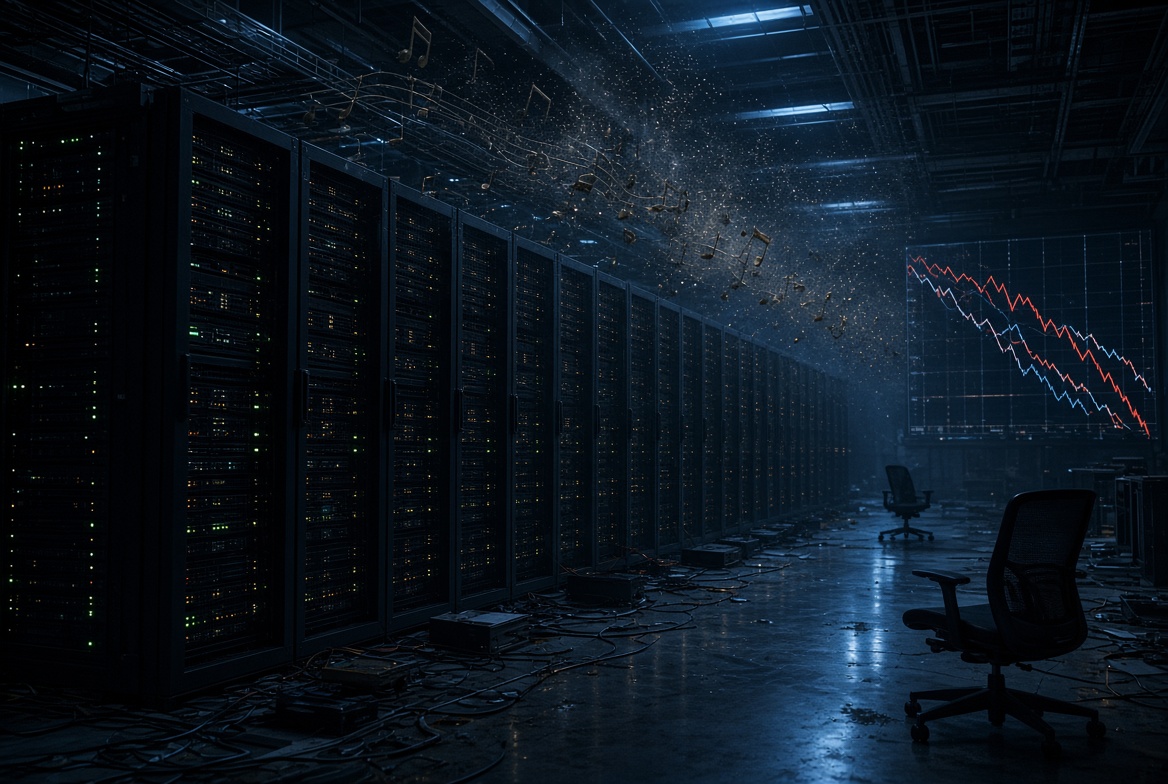
Sooner or later, the circular funding slows down. Venture capitalists grow tired of subsidizing inference costs, and corporate buyers start balking at software subscriptions that cost more than the human labor they were meant to replace. The rental rates for compute per hour begin to slide. Suddenly, the Special Purpose Vehicle cannot meet its coverage ratios. The synthetic lease turns out to be a very real noose.
At that moment, the illusion of balance sheet hygiene vanishes overnight. Either the parent company has to step in and bail out the vehicle to keep its lights on, bringing the monster right back onto the books at the worst possible time, or the private credit lenders foreclose on a warehouse full of two-year-old space heaters that nobody wants to rent at yesterday's prices.
I know most of you reading this came straight here to Digitally Deluded without needing a search engine or an algorithm to point the way, because you share a preference for plain accounting over fairy tales. Keep your hands on your wallets and your eyes on the footnotes of the quarterly reports. The next time a chief financial officer brags about an asset-light strategy for scaling compute, close the tab, go outside, and buy a share in something boring that makes an actual profit. A company that has to hide its tools in the neighbor's shed to look prosperous is already broke; it just hasn't received the bill yet.