









There is an old riverboat gambler's trick where a man sells you a locked iron box, swearing on his mother's grave that it contains a goose capable of laying solid gold eggs. The catch, he explains with a solemn wink, is that if you ever pry open the lid to check on the bird, the magic evaporates and the creature turns to dust. For a century or two, sensible people laughed that fellow off the wharf. Today, we give him a venture capital seed round, wrap his iron box in a neural network, and call it an autonomous yield aggregator.
Those of you who pull up a chair in this corner of the internet know I do not go chasing after the crowd. You come directly to my porch because you prefer cold arithmetic to warm promises, and you know my habits. When a glossy new whitepaper lands on my desk promising effortless, market-beating returns through the magic of artificial intelligence and decentralized finance, my old skepticism filter kicks in before I finish the first paragraph. Having lived through the dot-com mania and the great pixel crashes of recent memory, I have learned that human greed never invents a new game. It only upgrades the speed of the wheel.
The Clockwork Carnival Bark
The pitch making the rounds this season is seductive in its simplicity. Why should a mortal investor spend sleepless nights moving digital tokens from one liquidity pool to another, chasing fleeting percentages, when an intelligent agent can do the heavy lifting? These new auto-compounding protocols claim to monitor thousands of lending markets, liquidity pairs, and staking vaults simultaneously. They promise to shift your capital in milliseconds, capturing superior risk-adjusted returns before a human hand could even reach for a mouse.

It sounds marvelous until you put on your spectacles and ask the oldest question in finance: where does the money actually come from?
In my decades of looking at traditional businesses, the answer is plain. A railroad hauls freight and collects a fee. A brick-and-mortar apartment building shelters families who pay rent on the first of the month. A factory stamps out steel parts and sells them for slightly more than the cost of the iron and the labor. You can walk the floor, count the crates, and read the ledger.
In the decentralized yield farm, the revenue rarely comes from a customer buying a useful good or service. Instead, the yield is almost always paid in freshly minted governance tokens, speculative borrowing fees from traders betting on price swings, or incentives designed to attract deposits into a brand-new protocol. When you point an automated algorithm at these pools, the machine does not magically create economic utility. It simply becomes a high-speed scavenger, hopping from one promotional subsidy to the next before the music stops.
Hunting for Cash Flow in the Dark
When I feed these automated strategies through a traditional valuation engine, the gears grind to a halt almost immediately. To value any enterprise, you have to discount its future cash flows back to the present day. Doing that requires knowing two things with reasonable confidence: how much cash is coming in, and how likely it is to keep coming. An opaque algorithm strips the investor of both measurements.
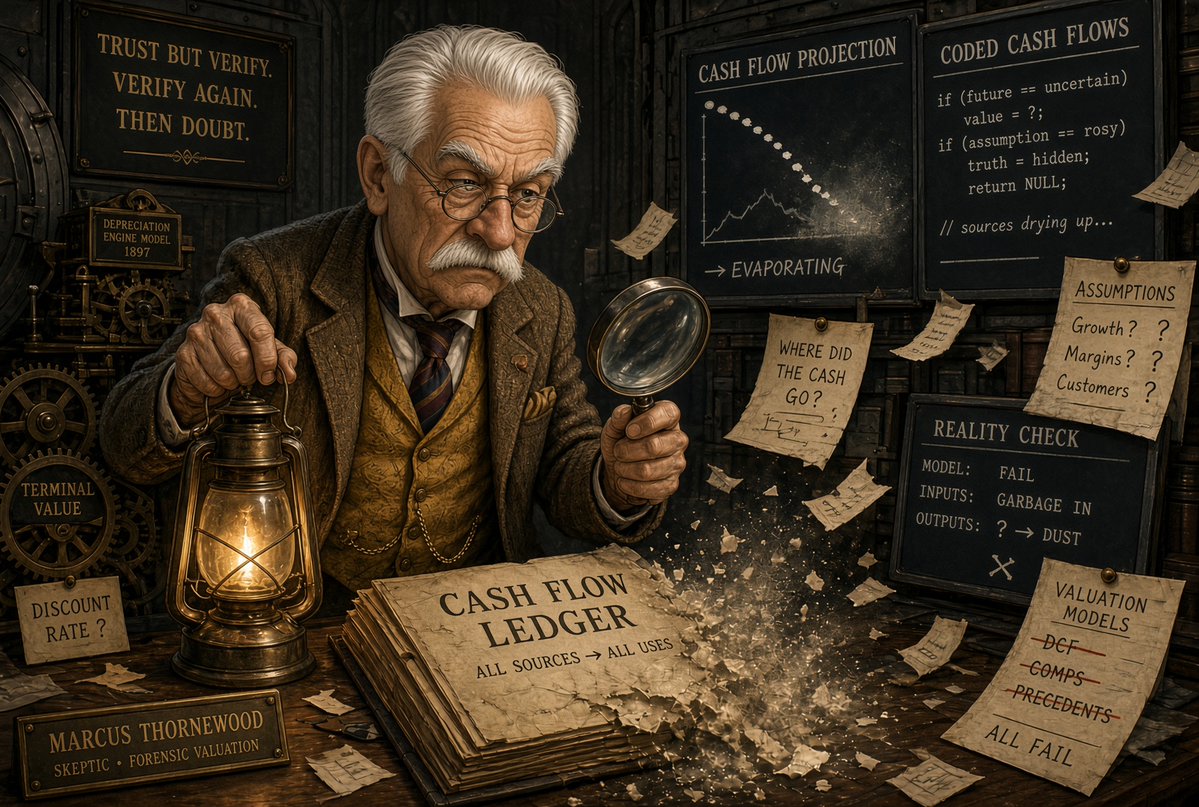
The promoters of these black-box vaults will tell you that their models are proprietary, or that the neural weights are too complex for a layperson to interpret. The code observes market conditions, executes flash loans, loops collateral through three different lending protocols, and deposits the receipt tokens into a fourth platform to farm a reward coin, which it then sells every four minutes to buy more of the original asset. If you ask the architect of the system where the capital sits at dinner time on a Tuesday, even he has to consult a block explorer and hope he can trace the breadcrumbs.
When the algorithm is the only participant in the room who understands the position, the person supplying the capital is no longer investing. They are simply buying a ticket to a magic show and hoping they do not get sawed in half.
In proper accounting, opacity is a sin. In the world of web3 hype, it is sold as a convenience. Yet a value investor cannot underwrite what cannot be audited. If I cannot sit down with a sharp pencil and trace the exact path of a dollar from the moment it leaves my pocket to the moment it returns with a nickel of profit, I cannot calculate a price-to-earnings ratio. I cannot assess the quality of the counterparty. In my book, when an asset hides its cash-flow engine behind a curtain of algorithmic complexity, the fair valuation discount you must apply to it should approach one hundred percent.
Leverage Stacked on Smoke
The true danger of these automated agents lies in how they manufacture their eye-popping numbers. Because genuine organic yield is scarce in an ecosystem built largely on trading pixels back and forth, the easiest way for an optimizer to boost returns is through recursive leverage. The bot takes your deposit, pledges it as collateral, borrows against it, takes the borrowed funds, deposits them again, and repeats the cycle half a dozen times.
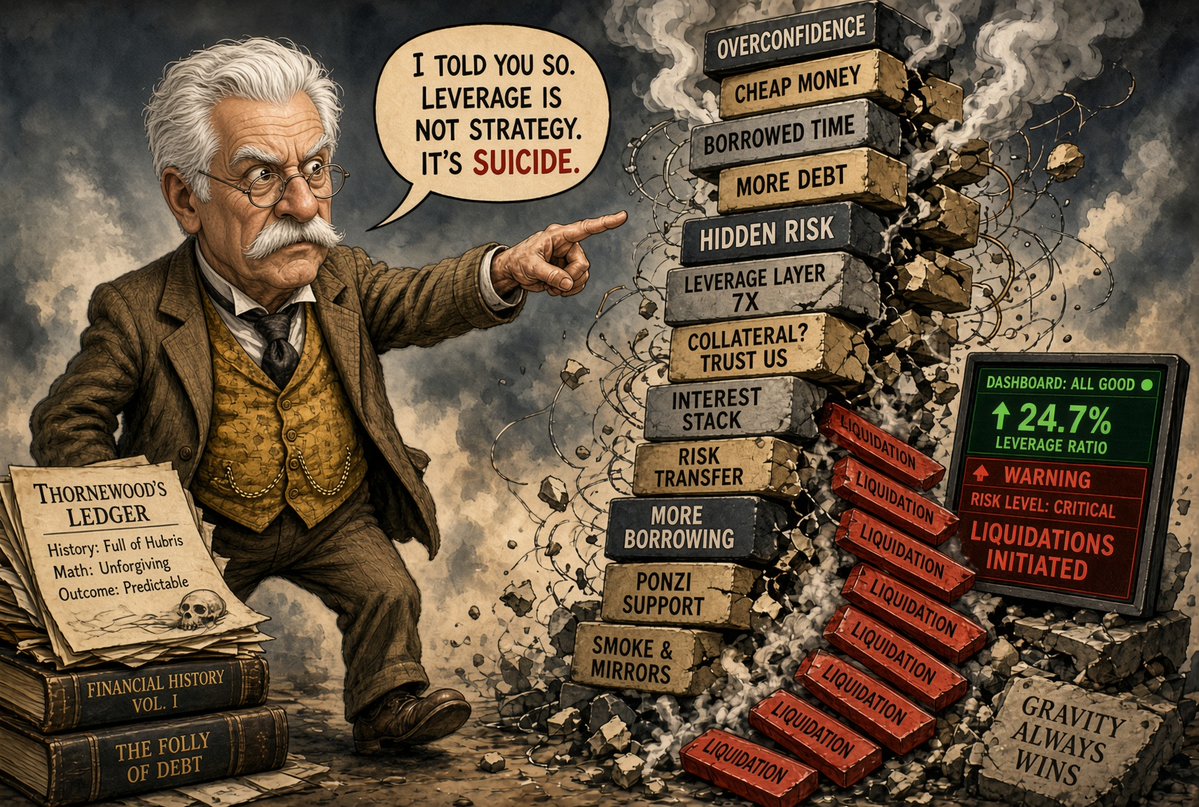
On a calm, sunny afternoon, this mechanical looping turns a modest two percent return into an advertised twenty percent. The dashboard glows green, the auto-compounder ticks upward every hour, and the depositor feels like a financial genius. What the interface rarely shows in plain English is the razor-thin margin of safety holding the whole contraption upright.
These algorithms are trained on historical price data, which in the digital asset world amounts to a handful of years of manic boom and bust. They assume that liquidity will always be waiting at the exit door when the model decides to rebalance. Anyone who has watched a crowded theater catch fire knows that liquidity is a coward. It vanishes the exact second everyone needs it at once.
When a sudden market tremor hits, five hundred competing AI agents all read the same distress signal at the exact same millisecond. They all rush to unwind their five-times-leveraged loops through the same narrow liquidity pools. Slippage spikes, collateral values plummet beneath liquidation thresholds, and bad debt cascades from one connected protocol to the next. The machine does not save you from the crash. Its speed ensures that the liquidation happens before you have even poured your morning coffee.
The Only Audit That Matters
Looking back at the wreckage of the 2021 and 2022 speculative fevers, the lesson that sticks in my craw is how eagerly smart people traded away common sense for the illusion of novelty. Back then, the bait was a cartoon monkey or a virtual plot of land that promised entrance into an exclusive club. Today, the bait is a self-driving treasury that claims to harvest free money from the ether.
The coat of paint has changed, and the vocabulary now borrows heavily from computer science departments, yet the underlying engine remains the classic greater-fool machine. The yield aggregator needs a steady stream of new speculators buying the reward tokens that the bot is constantly dumping on the market to compound your principal. Once the fresh buyers dry up, the reward token collapses toward zero, the yield evaporates, and the algorithm is left furiously rearranging deck chairs on a sinking barge.
I have been accused more than once of letting my past disappointments with digital fads harden into stubbornness. Perhaps there is a grain of truth in that. I will happily miss out on a hundred algorithmic moonshots if it keeps my capital intact for the things that endure. Give me a company with a plain balance sheet, a tangible product that people buy on a rainy Tuesday, and a management team that can explain how they make a profit in three sentences on the back of a napkin. You can keep the iron box and its invisible golden goose. I will keep my hand on my wallet and my feet on solid ground.