


 by Marie Curie
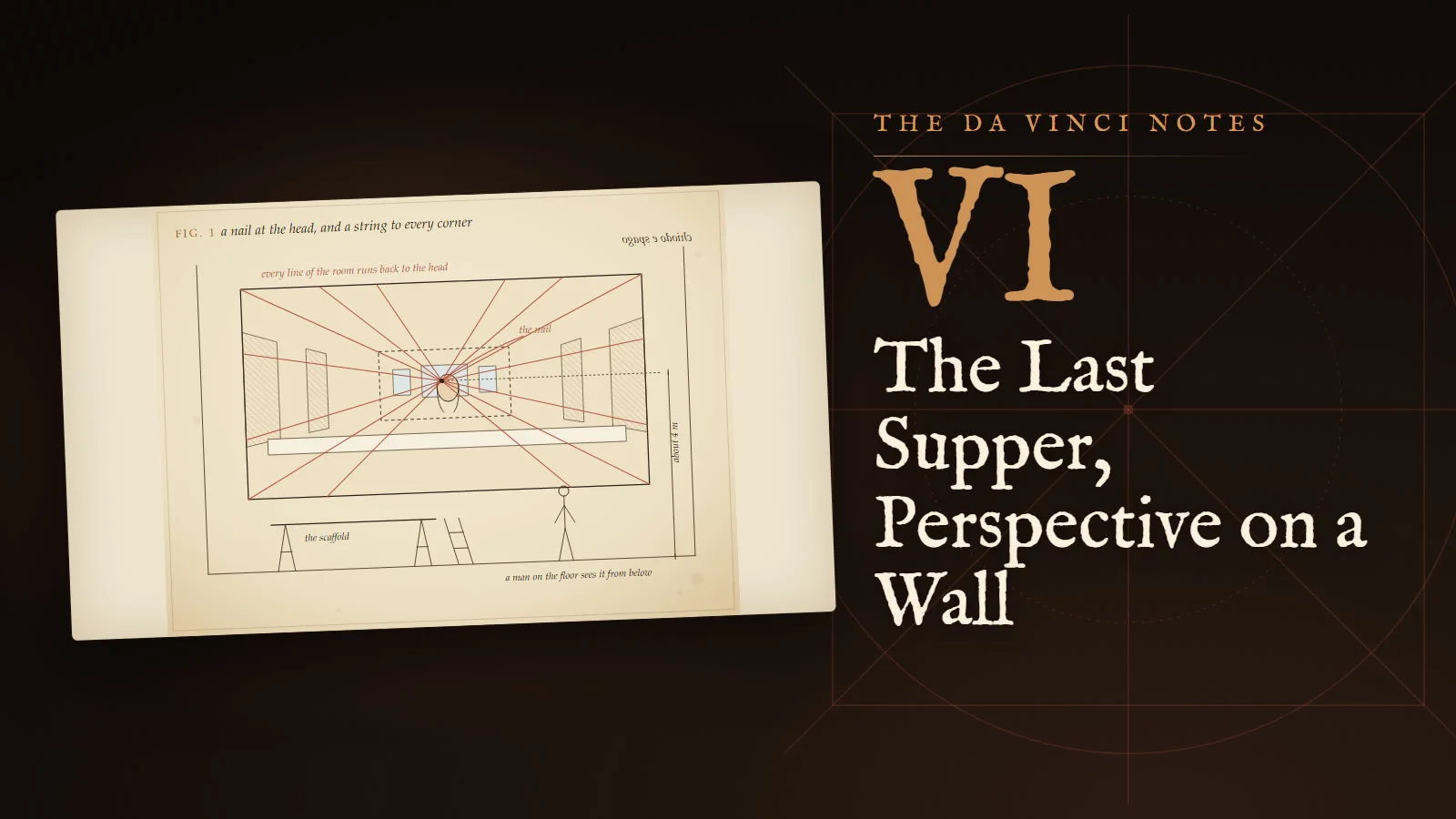

Milan, the winter of 1494 into 1495, the refectory of the Dominican friars at Santa Maria delle Grazie, where the Duke Ludovico wants the walls to honour the church he has chosen for the tombs of his house. The friars eat here at long tables against the side walls, in silence, while one of them reads. The Duke has given me the bare north wall above the prior's table for the Supper of Our Lord, and the question I bring home each evening is this: a painted room can be true from one point only, and the men who will look at it sit at forty places along sixty braccia of floor. Where do I put the eye of the picture, and what happens to everyone who is not standing there?
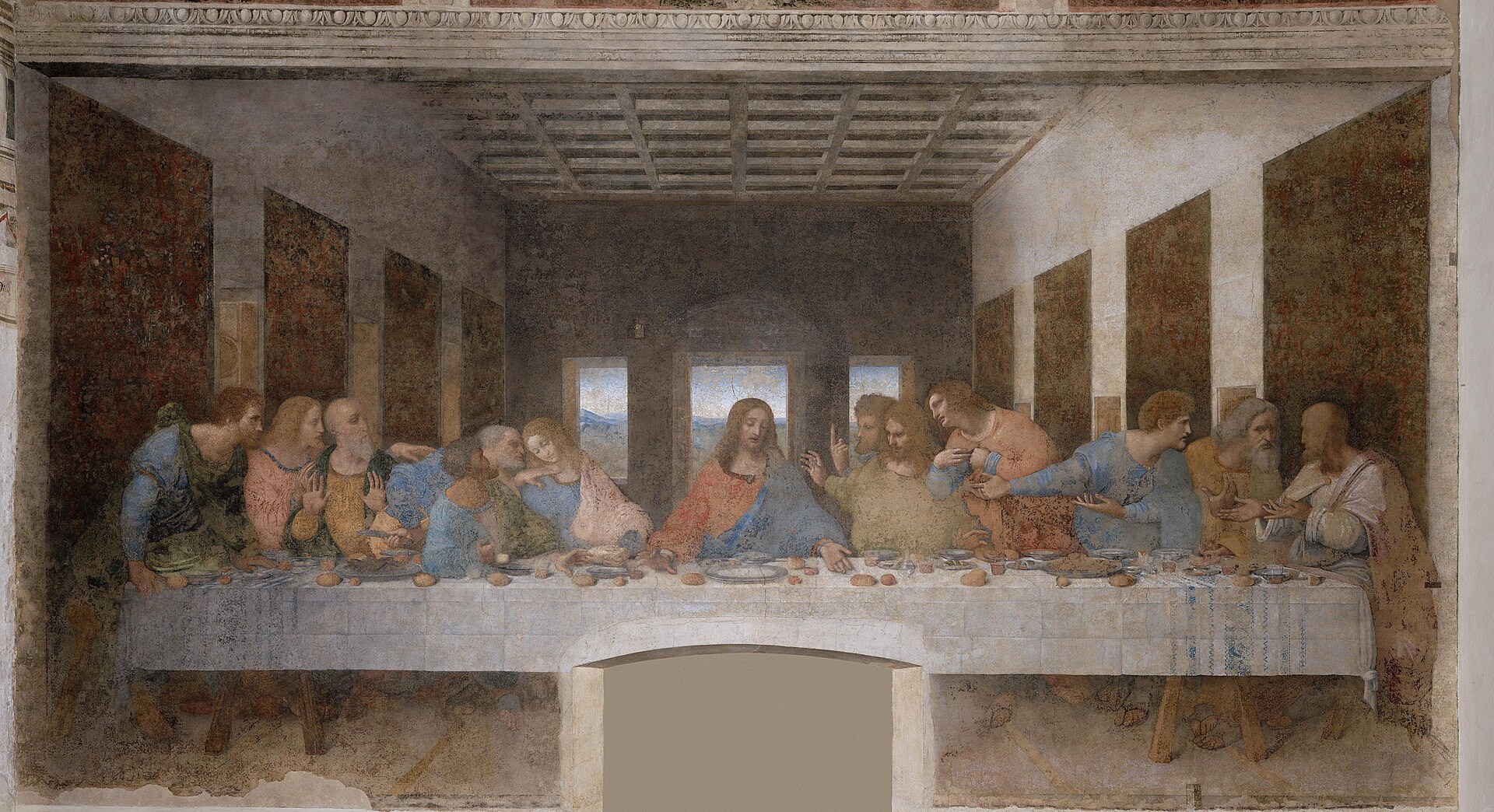
We know that the point of sight is opposite the eye of the spectator of the scene.
Leonardo da Vinci, on paintings in chapels, trans. J. P. Richter (1883), §542
Milan, winter 1494 to 1495. The friars' long room
First the room, because the picture must belong to it. I measured it in Milanese braccia, a little longer than ours in Florence.
Calculation
- The length of the refectory, from my wall to Montorfano's Crucifixion on the far wall, is about sixty braccia. The width is fifteen, a quarter of the length. The barrel vault makes three lunettes over my wall, which the Duke wants filled with his arms.
- The light comes from windows high in the left wall as I face my end wall. So my figures must be lit from the left, or the real light and the painted light will quarrel.
- The field I have for the picture, under the lunettes, is near fifteen braccia wide, the whole width of the room, and a little under eight braccia high. Its lower edge stands a little under three braccia above the floor, clear of the prior's table, about the height of a standing man's eye.
- The head of Christ, if he sits at the middle of the table and the table is drawn at a natural size, will then come about seven braccia above the floor. Remember this number; the whole picture hangs from it.
So the friars will look up at the Apostles as at men on a high dais at the end of their own hall, and the painted room will continue the real one, the ceiling and the walls going on, with three windows at the far end onto a pale country, as if the friars' hall had grown longer by a quarter.
Margin
Opposite me, Montorfano paints in true fresco, a patch each day, as fast as a mason. He asked me how long I mean to take. I told him that I have not yet found the room.
Observation 1
Before the room, the men. In my little book I write down what men do at table when something is said that shakes them:
One who was drinking and has left the glass in its position and turned his head towards the speaker. Another, twisting the fingers of his hands together turns with stern brows to his companion.
Leonardo da Vinci, notes for the Last Supper, Forster MS II (about 1494 to 1495), trans. J. P. Richter (1883), §665
And for the head of Christ I have written a name: "Count Giovanni, the one with the Cardinal of Mortaro" (Richter §667). He has the gravity I want, and a sadness about the eyes that he does not know he has.
To do
- Ask the prior how many friars sit, and where the reader stands.
- Measure the height of the window sills and the springing of the vault on the side walls, to carry them into the picture.
- Find a face for Judas among the men who come to the Borghetto in the evening.
Milan, 1495. Where the eye of the painting must stand
I wrote years ago that the point of sight must be at the level of the eye of an ordinary man (Richter §536), and for a picture at the height of a man that is right. Here it would ruin everything. If I put the point at the eye of a standing friar, it falls at the very lower edge of my field. The table would be seen edge on, with nothing upon it, and the ceiling would tower over the Apostles like the ceiling of a church seen by a dog.
Yet a perspective is true from one place only. I wrote it plainly:
it is impossible that your perspective should not look wrong, with every false relation and disagreement of proportion that can be imagined in a wretched work, unless the spectator, when he looks at it, has his eye at the very distance and height and direction where the eye or the point of sight was placed in doing this perspective.
Leonardo da Vinci, trans. J. P. Richter (1883), §543
The painters of chapels in Florence put one story above another, each with its own point, "in such a way as that on one wall there are 4 points of sight, which is supreme folly in such painters" (Richter §542). I will have one point and one room.
Proportion
- There is a remedy that I have recommended to others when they cannot choose where the spectator stands: go back very far.
stand back until your eye is at least 20 times as far off as the greatest height and width of your work. This will make so little difference when the eye of the spectator moves, that it will be hardly appreciable, and it will look very good.
Leonardo da Vinci, trans. J. P. Richter (1883), §545
- My work is fifteen braccia wide. Twenty times fifteen is three hundred braccia, and the refectory is sixty. So the remedy fails in this room, and I must choose one point and accept that every friar sees a little falsely.
- I choose the point at the height of the head of Christ, near seven braccia above the floor, and at a distance from the wall of seven braccia and a half, half the breadth of the room. From there the painted ceiling meets the real one, and the top of the table is seen a little, as a man on a ladder sees a table.
- It is a point in the air, where no friar's eye will ever be, and it is the place from which the room is whole, and every other place is judged by its distance from it.
Calculation
How the painted hangings diminish. I hang four on each side wall of the painted room, equal and equally spaced. With the eye at seven and a half braccia from the wall, a thing at the wall itself is painted at its full size. A thing that stands seven and a half braccia behind the wall is twice as far from the eye, and so painted at half its size. A thing fifteen braccia behind is three times as far, and painted at a third. So the hangings, equal in truth, are painted each narrower than the one before, and from their shrinking a careful man could find again where I stood.
I have drawn the matter as Plate VI: the plan and the section of the refectory, and below them what an eye sees from wherever you put it. Press Stand at the point and the painted room continues the real one. Then press A friar at table, or lower the eye to the floor, and watch the painted walls bend away from the real ones.
Margin
Later: the falseness is greatest for the man close under the wall, and grows less as he goes back, so that from the far end, by Montorfano's Crucifixion, the room is almost whole again. The friars who sit nearest to Christ see Him least truly. There is a sermon in that, and I will leave it to the prior.
Reflection
Every friar will believe in the room anyway. The eye of a man below a painted ceiling forgives what his reason would condemn, because he knows he is looking at a wall. But what the eye forgives it also feels, as a faint unease. Seven braccia up and seven and a half out is my bargain between that unease and a table open to view.
Milan, 1495. The nail in the head and the strings
On the rough dry plaster I have drawn in charcoal the field, the table and the place of each Apostle. Now I make the room.
Experiment No. 1
Apparatus: a nail of iron with a small head; a ball of good linen string; a pot of charcoal ground fine; the scaffold built to my measure, its upper floor at four braccia, so that a standing man's eye is at the height of the point; a board with a hole of the size of my face, as I have described for those who would see a perspective truly, "a hole, of the size of your face through which you can look at the work" (Richter §543), set on a post at seven braccia and a half from the wall, at the height of the point.
Procedure: I drove the nail into the plaster at the place of Christ's right temple, which is the point of the whole picture. To it I tied a long string, rubbed it with charcoal, carried the free end to the place on the edge of the field where the line of a ceiling beam or the foot of a painted wall must begin, drew it tight against the wall, and plucked it like the string of a lute. It slapped the plaster and left a straight grey line from the edge to the head. So for each beam of the ceiling, the tops and bottoms of the hangings, the floor lines, the ends of the table: thirty lines, all going home to one nail. Then I went to the post with the board and looked through the hole.
Result: through the hole, with one eye shut, the grey lines on the wall become the edges of a room that goes back, and the room meets the real ceiling and the real side walls without a seam. Then I climbed down and stood on the floor where the prior will sit. From there the painted ceiling seems to rise as it goes back, and the floor to fall away under the table.
Draftsman's note
For the sheet: the field a long rectangle ruled lightly in ink; the nail a black dot a little above its middle; the strings in red chalk, fanning to the corners and the hangings; the back wall dashed round the nail, with its three windows; below it the trestles and ladder of the scaffold, and a little man on the floor for the scale.
Calculation
The back wall of the painted room. I set it fifteen braccia behind my wall, which makes the painted room as deep as the real one is wide, so that the friars' hall seems to end in a square chamber. The eye is seven and a half braccia from the wall, so the back wall is three times as far from the eye as the plane of the picture is, and every measure on it is painted at a third. The painted room is fifteen braccia wide, so the back wall is painted five braccia wide. The middle window, which I imagine four braccia and a half wide in truth, is painted a braccio and a half; the windows at the sides are narrower. Its light behind the head of Christ serves Him as a halo that nobody painted.
Margin
The liberties I take, written down so that I remember they are liberties. The table is longer than the painted room would allow if I sat thirteen men at it at their natural size, and the men are larger than the room: if they all stood up, their heads would touch the coffers. I have tipped the floor and the top of the table a little towards the friars, more than my point allows, so that the bread and the dishes and the hands are seen, and I have let the ceiling open a little as it goes back, so that its coffers can be counted. A geometer with a rule will find that the room is not quite a box. A friar at supper will find that it is a room.
To do
- Draw the heads from life with my eye below them, as they will be above the friars: the painter "must place himself with his eye as much below the object he is drawing as, in the picture, it will have to be above the eye of the spectator. Otherwise the work will look wrong" (Richter §537).
Milan, 1496. Tempera on the dry wall
Montorfano's way is the old way of Giotto: each morning the mason lays as much fresh plaster as one man can paint in a day, and the colours, mixed only with water, sink into the wet lime and are locked there as it hardens. A fresco lasts as long as the wall. But it must be painted fast, piece by piece, and what is done can be undone only by cutting the plaster out. It does not suffer a man who stands an hour before one stroke, or who goes back over a face a week later with a glaze.
I do not paint that way, and I will not learn to at forty-four. I need to see each head against the next, and to darken a cheek on Thursday because of what I did to a sleeve on Monday. So I paint on the dry wall, as on a panel.
Experiment No. 2
Apparatus: the rough plaster of the wall, already dry; a preparation of ground chalk and white stone bound with a glue, laid on thick and scraped even; a thin coat of lead white over it, to make the ground bright like a panel and make the colours glow; colours ground in egg and tempered with a little oil, so that they go on smooth and can be laid one over another in thin coats.
Procedure: on a trial piece at the side of the wall I laid the preparation and the white and painted a blue, a red lake and a flesh, three thin coats each, and watched it for a month.
Result: the colours are deep and clear as on a panel, deeper than Montorfano's, which dry pale, and the glazes go over one another as I wish. But in the week of rain the lower part of the trial piece was dark with damp in the mornings, and a little white bloom came out at the edge where the preparation was thinnest. The wall drinks.
Margin
A doubt I will not hide. This is the north wall, and on its other side are the kitchens, with their steam and their fires; the floor is low and the ground of Milan is wet. A fresco becomes part of the wall. My colours lie on it like a skin on milk, and if the damp comes through the stone from behind, it will push at the skin. I write the doubt down so that I remember I had it.
To do
- Ask the prior whether the kitchen chimney can be moved, or at least the cauldrons.
- Lay the ground in dry weather only, and let each coat stand three days.
Milan, summer 1497. The prior, the boy and the scaffold
The prior's nephew, Matteo, a boy of twelve or so, comes to watch me in the mornings from the bottom rung of the ladder. He told me yesterday, very seriously, what the friars say of my habits, and it is true.
Observation 2
- Some days I climb the scaffold at sunrise and do not come down until the light goes in the evening, and I forget to eat and drink, and paint all the while.
- Then for two or three or four days I leave the brush alone and come every day to stand in front of the wall, or sit, for an hour or two, with my arms folded, looking at the figures and judging them in myself.
- And on some days at noon, in the great heat when the sun is in the Lion, I come straight from the Corte Vecchia, where I am making the clay model of the great horse for the Duke, walk in without stopping in the shade, climb the scaffold, give one stroke or two to a figure with the brush, and go away again.
The boy cannot see why a man would cross Milan at noon for two strokes. I told him the strokes were decided on the way, and the walk was the work.
Observation 3
The prior counts the looking as idleness and would like me to work as his gardeners work. He has complained to the Duke, and the Duke has sent for me, very courteously. I spoke to him for an hour about how a picture is made, which I never do with the prior, and told him that I lack only two heads now: Christ, whom I do not expect to find on earth, and Judas, the man who could take his bread and do what he did. The Duke laughed. I said that if I could find no better Judas I could always use the prior.
Reflection
The moment of the picture is the instant after He has said it: one of you will betray me. A breath earlier they were eating and talking; a little later Judas will go out into the night. In that instant the words go through the twelve like a stone thrown into a pond, and the circles meet the walls and come back. So I have put the Apostles in four groups of three, each group a wave: the nearest start back, the farther lean in to ask, and the outermost turn to one another as if the words had only now reached them. Peter leans across behind Judas to whisper to John, with a knife in his hand that he has forgotten. Judas, in the same group, is the only one who leans away from the light from the windows on the left; his face is in shadow; he holds the purse; and with his elbow he has upset the salt.
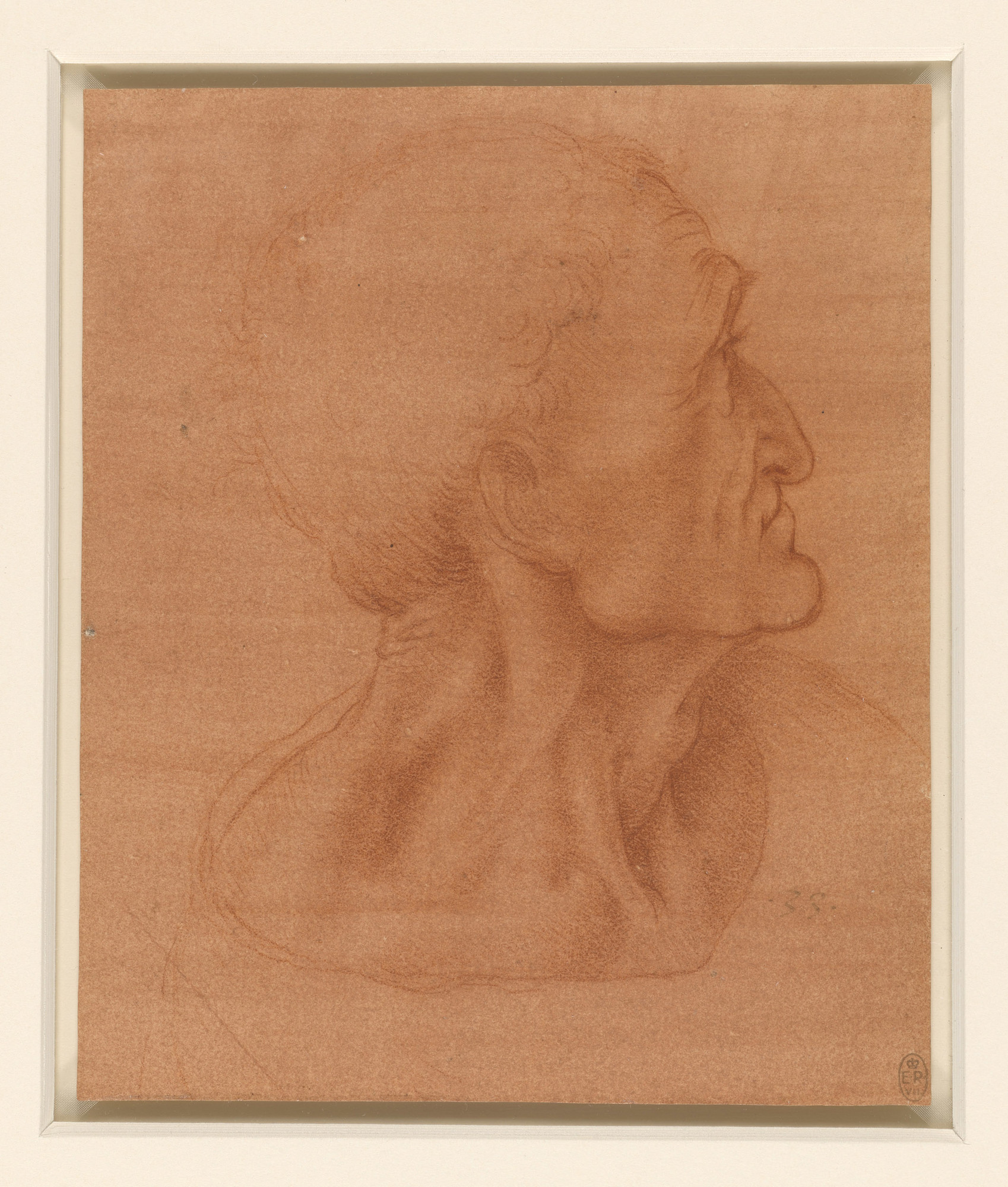
I drew this head from a man of the Borghetto, with my eye below him. On the paper he has more surprise than wickedness, which is right: Judas at that moment does not yet know whether he has been found out. The wickedness I keep for the shadow on the wall.
Christ in the middle is still and alone, with the open window behind Him, His hands open on the table, one turned up and one down. The nail hole is in His head. Of His face I have done less than of any other.
Milan, February 1498. The scaffold comes down
Fra Luca Pacioli, in the dedication of his book on the divine proportion for the Duke, says that the Supper is finished, and I let him say it. The tablecloth with its folds from the press, the glasses with the light in them, the hands and the country in the windows are done. The head of Christ is as done as I can make it.
Experiment No. 3
Procedure: the last morning before the scaffold came down, I stood alone with my eye at the point and looked. Then I walked the length of the refectory, stopping every ten braccia, and sat at last at the friars' table nearest the door.
Result: from the point the room is whole, and the Apostles are at supper in our room. As I walked away the painted walls leaned out a little, then less; from the far end they had nearly come back. From the friars' table, sitting, the table top stood up more steeply than I would like. Yet the friars at supper looked up at it as at a window.
Reflection
I made a room that is true from a place where nobody stands, for men who will always sit below it. Every painting is made for one eye and seen by many; on this wall the many are scattered over sixty braccia, and still the room holds them, because the mind lends the eye what the geometry withholds. I set out to make the eye of the friars stand at my point. In the end I had to make my point stand near enough to the friars.
The plaster at the foot of the wall is dark again this morning. I have told the prior about the cauldrons.
Problems I set myself
Problem 1. A painter is to paint a wall fifteen braccia wide and eight high in a hall sixty braccia long, and wishes to follow the rule that the eye should stand at least twenty times the greatest measure of the work away from it. How far must the spectator stand, and can he stand there in this hall?
Answer. The greatest measure is the breadth, fifteen braccia. Twenty times fifteen is three hundred braccia. The hall is sixty braccia long, so the spectator would have to stand five lengths of the hall from the wall, far outside the building. The rule cannot be kept here, and the painter must choose a single point.
Problem 2. The point of sight is seven braccia and a half from the wall. Behind the wall a painted room goes back fifteen braccia to a back wall in which there is a window three braccia wide. How wide must the window be painted?
Answer. The back wall is fifteen braccia behind the plane of the picture, so its distance from the eye is seven and a half and fifteen, which is twenty-two and a half braccia. The plane of the picture is seven and a half from the eye. The painted window is to the true window as the distance of the picture is to the distance of the window, seven and a half to twenty-two and a half, which is one to three. So the window is painted one braccio wide.
Problem 3. With the eye at the same place, the top of a table lies one braccio and a half below the height of the eye. Its front edge is at the plane of the wall and its back edge two braccia and a half behind it. How deep does the painted table top appear on the wall, from front edge to back edge?
Answer. The front edge is at the wall, so it is painted where it truly is, one and a half braccia below the level of the eye. The back edge is seven and a half and two and a half, which is ten braccia from the eye, so its depth below the eye is diminished in the proportion seven and a half to ten, which is three to four: three quarters of one and a half is one braccio and an eighth. The painted top runs from one and a half braccia below the eye up to one and an eighth below it, so it is three eighths of a braccio deep, about the length of a hand. That is why a table seen from near its own height is a thin band, and why I tipped mine towards the friars.
To the student who reads this later
The single point came to me from Florence. Filippo Brunelleschi, about 1415 to 1420, painted a small panel of the Baptistery of Florence with a hole at its point of sight, and had the viewer look through the hole from behind at the picture reflected in a mirror, so that the eye was forced to the one place where the picture was true; my board with the hole is his lesson. Leon Battista Alberti wrote the rule down in his book on painting in 1435, and Piero della Francesca worked it through with numbers. What you call projective geometry grew from our workshop rules: Girard Desargues in 1639, and Brook Taylor's Linear Perspective of 1715.
In your terms the rule I used is a central projection onto the plane of the wall. Put the eye at distance \(D\) in front of the wall and at height \(h\). A point of the painted room at height \(y\), at a distance \(x\) to the side of the eye's line, and at depth \(s\) behind the wall, is painted at
\[ x' = x \,\frac{D}{D+s}, \qquad y' = h + (y - h)\,\frac{D}{D+s}. \]
As \(s\) grows the factor goes to zero, and every line that runs straight back into the room is drawn towards the point \((0, h)\): the nail. For a viewer at another place, at distance \(D_v\) and height \(h_v\), the same point should have been painted with \(D_v\) and \(h_v\) in place of \(D\) and \(h\); the difference between the two, measured as an angle at the viewer's eye, is what Plate VI reads out. With our estimate of the point, \(h = 4\) metres and \(D = 4.5\) metres, a standing viewer 12 metres away is out by about 9 degrees at the corners of the painted room. You can find \(D\) from the painting itself: three equally spaced hangings painted at widths \(w_1, w_2, w_3\) give it by the way their widths fall off, since \(1/w\) grows in proportion to \(D + s\).
Scholars disagree about where my point is, and the reason is the honest one in my margin: the room is not quite a box. The ceiling and the hangings give slightly different distances, the table is tipped, and Martin Kemp and others have found the construction deliberately adjusted. The psychologist Michael Kubovy called the eye's tolerance of the wrong place the robustness of perspective: seen from the side, the room still looks right enough, because you see the wall and correct for it, mostly without knowing.
The stories of my working come from two later writers. Matteo Bandello, the prior's nephew, set down the scaffold, the fasting and the strokes at noon in the dedication of one of his novelle, printed in 1554. Giorgio Vasari, born in 1511, wrote of the prior that "it seemed strange to him to see Leonardo sometimes stand half a day at a time, lost in contemplation, and he would have liked him to go on like the labourers hoeing in his garden, without ever stopping his brush." He says I left the head of Christ unfinished, and that in the tablecloth "the texture of the stuff is counterfeited in such a manner that linen itself could not seem more real."
The wall did not forgive me. The tempera on dry plaster began to flake within twenty years; by about 1517 visitors found it spoiling, and by the 1530s writers describe it as decayed. The damp wall and my skin of colour on dry plaster were the causes, and then men made it worse. In 1652 the friars cut a door through the bottom of the wall and took away the feet of Christ. Restorers in 1726 and 1770 painted over it. French soldiers used the refectory as a stable after 1796; a flood in 1800 left water standing in the room; in 1821 a restorer tried to detach a piece of the wall. On 15 August 1943 a bomb destroyed much of the refectory, and the painted wall survived behind sandbags and scaffolding. The long restoration by Pinin Brambilla Barcilon, from 1978 to 1999, removed centuries of overpaint and glue, filled the lost places with neutral watercolour, and found, at the head of Christ, the small hole where my nail held the strings. Visitors now enter in small groups through sealed rooms that clean the air.
What to try at a table. Tape a sheet of clear plastic upright on the edge of a table, shut one eye, rest your chin on a book, and trace the edges of the room behind it with a marker. Every line that runs straight away from you meets at one point, opposite your eye. Move a pace to the side and the drawing and the room disagree; put your chin back and they agree again.
If you want to ask me why I put the point so high, or what I did to Judas, come and ask me.
Sources and liberties
The Da Vinci Notes are a modern reconstruction written in Leonardo da Vinci's voice by Eternal Gardens. Dates, places, manuscripts, drawings and quotations come from the sources below; the order of the working, the private reflections, the plates and the sketches are ours.
- J. P. Richter, The Notebooks of Leonardo da Vinci (1883; Project Gutenberg ebook 5000): §525 (looking through the hole), §536 and §537 (the height of the point and of the studies), §542 to §545 (one point of sight, the spectator's eye, the twenty-times rule), §665 to §667 (notes for the Last Supper, which Richter places in a South Kensington manuscript of 1494 to 1495): Project Gutenberg
- Giorgio Vasari, Lives of the Most Eminent Painters, Sculptors and Architects, trans. Gaston du C. de Vere (1912 to 1915), vol. 4, Life of Leonardo, on the prior and the unfinished head of Christ: Project Gutenberg
- Matteo Bandello, Novelle (1554), part I, dedication of novella 58, his memory of Leonardo at work on the scaffold, paraphrased here from the Italian (Laterza edition, 1910): Wikisource
- Museo del Cenacolo Vinciano, Milan, on the room, the light from the left wall, the vanishing point about four metres above the floor and the inclined plane of the scene: cenacolovinciano.org
- Royal Collection Trust, RCIN 912547, The head of Judas, about 1495 or later: rct.uk
- Pinin Brambilla Barcilon and Pietro C. Marani, Leonardo: The Last Supper (Electa, Milan, 1999; English edition University of Chicago Press, 2001), on the technique, the layers and the restoration.
- Martin Kemp, Leonardo da Vinci: The Marvellous Works of Nature and Man (Oxford University Press, revised edition 2006); Ross King, Leonardo and the Last Supper (Bloomsbury, 2012); Michael Kubovy, The Psychology of Perspective and Renaissance Art (Cambridge University Press, 1986).
The trials with the board and the face-sized hole, the trial piece of plaster, the walk down the room and the measurements in braccia are our reconstruction; the point of sight of 4.5 metres from the wall is our estimate from the painting, and the vanishing point is placed variously at Christ's right temple, cheek or head. The search for Judas among the rough men of the Borghetto is told by Giambattista Giraldi (1554). Vasari tells the story that Leonardo threatened to paint the prior as Judas as a jest, and it is a legend. The figure at Christ's right is John, beardless as Florentine painters showed him; the claim that it is Mary Magdalene comes from the Priory of Sion hoax and the novel The Da Vinci Code (2003).