 by Marie Curie

Milan, the spring of 1490, in my rooms in the Corte Vecchia, with the little clay models of the great horse under wet cloths in the next room and a book of Vitruvius open on the table under a stone so that it will not shut. I cannot make a large thing true unless I know how its parts answer to the whole, so I have gone back to the oldest measure there is, the body of a man. The Roman architect says that nature made a man so that he fits both the circle and the square, and that the navel is his centre. I have read it ten times and I believe the first half. This book is about the second half: whether one centre can serve two figures, and if not, where the other centre is, and what the body measures when you lay a rule on it instead of a quotation.
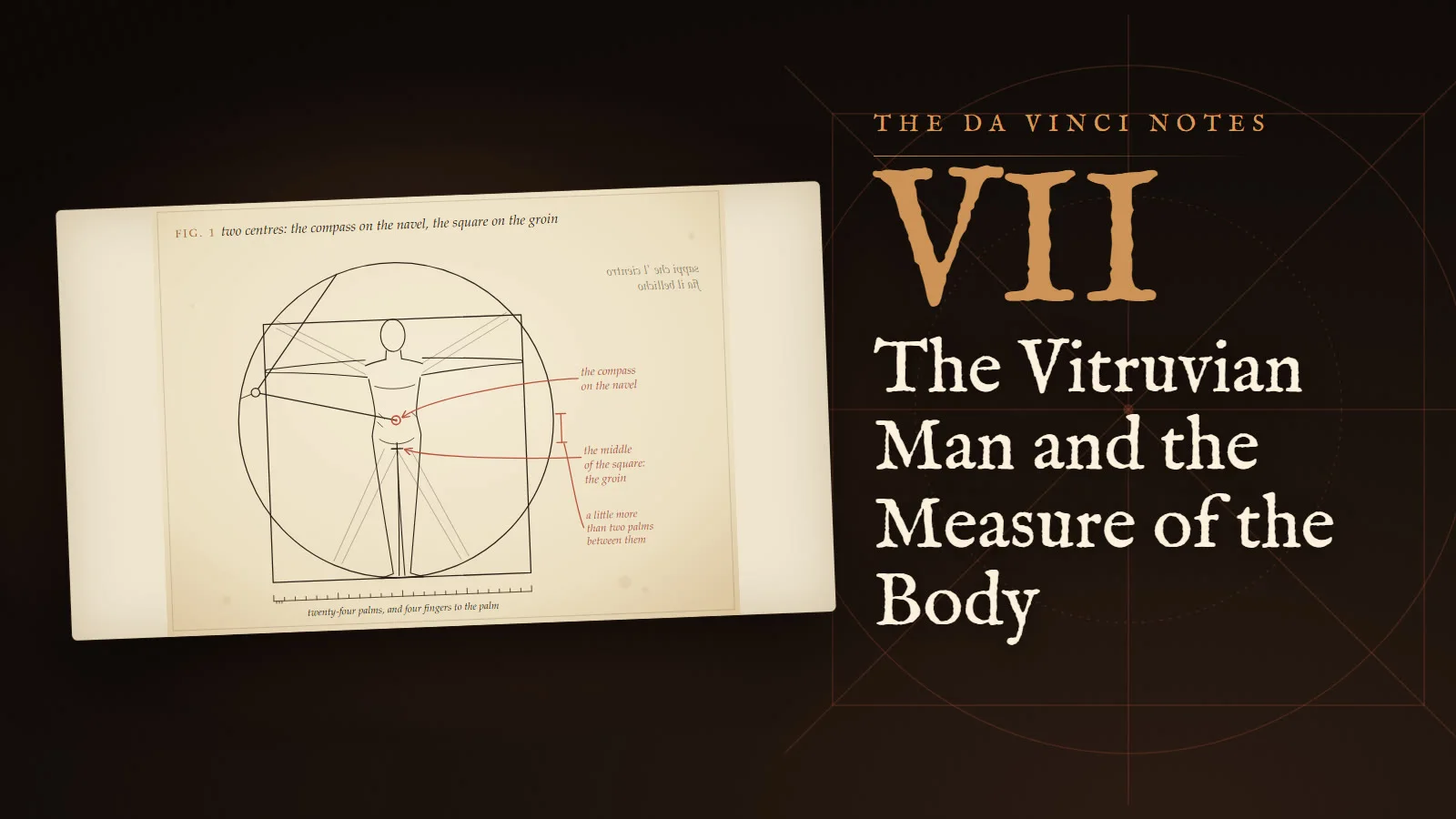
If you open your legs so much as to decrease your height 1/14 and spread and raise your arms till your middle fingers touch the level of the top of your head you must know that the centre of the outspread limbs will be in the navel and the space between the legs will be an equilateral triangle.
Leonardo da Vinci, the sheet of the Vitruvian figure, Gallerie dell'Accademia, Venice, inv. 228, trans. J. P. Richter (1883), §343
Milan, 23 April 1490. A book begun, and Vitruvius on the table
Today I wrote on the first leaf of a new book of paper: "On the 23rd of April 1490 I began this book, and recommenced the horse." The horse has been begun before. Each time I come back to the same difficulty: a thing known only by how it looks cannot be made eight times larger without becoming a monster.
For the horse I have my own measures, taken with a string and a rod in the Sforza stables and among the horses of Messer Galeazzo da Sanseverino. For the rider I need the same for a man. Vitruvius wrote it down in the third of his ten books on building, where he speaks of temples. A temple, he says, must have its parts answering to one another and to the whole as the members of a well-made man answer to his body. Then he gives the members.
My Latin is a thing I am building one brick at a time, out of word lists copied in the margins. Where I cannot follow the sentence I follow the numbers, which are the same in every language.
What Vitruvius says, set down plainly
- The face, from the chin to the roots of the hair, is a tenth of the height, and so is the open hand from the wrist to the tip of the middle finger.
- The head, from the chin to the crown, is an eighth.
- From the top of the breast, with the neck, to the roots of the hair is a sixth; from the middle of the breast to the crown, a fourth.
- The foot is a sixth of the height; the cubit, from the elbow to the end of the fingers, a fourth; the breadth of the breast a fourth.
- A man lying on his back with hands and feet spread touches with fingers and toes a circle drawn from his navel; and his height and the width of his outstretched arms are equal, so that he makes a square.
Proportion
Before I believe a list I make the parts add up. The ancients' little measures go like this: 4 fingers make a palm, 4 palms make a foot, 6 palms make a cubit, 4 cubits make a man. Then a man is
\[ 4 \times 6 = 24 \text{ palms} = 24 \times 4 = 96 \text{ fingers}. \]
- The foot is 4 palms out of 24, so the foot is \( \tfrac{4}{24} = \tfrac16 \) of the man. This agrees with what he wrote of the foot.
- The cubit is 6 palms out of 24, so \( \tfrac{6}{24} = \tfrac14 \). This agrees with the forearm.
- The palm is \( \tfrac1{24} \) of the man and the finger \( \tfrac1{96} \).
- Four cubits also make a pace, he says, so a man's pace is his own height. My step across the courtyard is much less. He must mean the double step.
Margin
He gives reasons for these numbers that have nothing to do with bodies: ten is perfect because of the fingers, and six because the mathematicians say so. A number does not become true of a foot because it is perfect. I will have the numbers of the body from bodies.
To do
- Get Messer Giacomo Andrea to read me the Latin of the chapter again, slowly, the part about the compass.
- Find a young man well made, of the middle size, who will stand still for an hour for a few soldi.
- Measure the step on the gravel of the Corte Vecchia: slow, ordinary, striding.
Pavia, June 1490. Francesco di Giorgio, and a man of one centre
Signor Ludovico sent me to Pavia with Maestro Francesco di Giorgio of Siena, who has been called to give his opinion on the new cathedral there, begun two years ago and still argued over plan by plan. Francesco is a builder of fortresses, a man of fifty who has drawn more machines than I have, and in his treatise he lays the body of a man over the plan of a church, the head in the apse and the arms in the transepts.
On the road, and in the inn at evening, we talked about the circle and the square, because he has drawn them too. His man stands inside the square with his arms out, and the circle is drawn round the square from the same centre, so that one compass serves for both, and the height of the man is at once the side of the square and the width of the circle.
Calculation
- If the side of the square is the man's height, its middle is at half his height.
- If the circle has the same centre, the navel must be at half the height.
- But on every man I have measured the navel stands above the middle by the breadth of a hand or more.
- So either the square moves up to the navel and the feet hang inside it, or the circle moves down to the groin and the spread fingers and toes no longer touch it.
Francesco has chosen a third way: one centre for both figures, at the middle of the square, and the navel left to sit a little above it, so that the circle is no longer centred where Vitruvius put it. A man is being made to fit the geometry. I would rather make the geometry fit the man.
Reflection
In the square before the old cathedral stands the bronze horseman they call the Regisole, and I spent an hour with it. Its trot is the most natural thing in the city, and I wrote in my little book: "In that at Pavia the movement is more to be admired than any thing else." A thing that moves well has its measure right. You cannot see the numbers, but the eye knows when they are wrong.
Milan, 23 July 1490. Supper with Giacomo Andrea
Yesterday, the feast of Saint Mary Magdalen, the boy Giacomo came to live with me, ten years old, with a face like an angel's and hands like a cutpurse's. Today I took him to supper with Messer Giacomo Andrea of Ferrara, an architect who reads Latin as I read a horse. I wrote it all down tonight, as I write down what the boy costs me: "the said Giacomo supped for two and did mischief for four; for he brake 3 cruets, spilled the wine." I paid for the cruets.
Between the cruets we did what I came for. Giacomo Andrea has his own Vitruvius and has been drawing the man in the circle and the square, as Francesco did. He read me the Latin word by word. Nothing in the Latin says the two figures have one centre. Vitruvius says the body yields a circle and also yields a square. He does not say where the square is.
Proportion
This frees me. If the text does not demand one centre, I may give each figure its own, and ask the body where they are.
- The square belongs to the man standing with feet together and arms level. Its side is his height, so its centre is at half his height, where the genitals begin.
- The circle belongs to the man with legs spread and arms raised. Its centre is the navel, and since he stands on the same ground, its radius is the height of the navel above the soles.
- Then the circle is larger than the square is wide, and rises above the square's top by as much as twice the navel's height exceeds the whole height.
- The two centres stand apart by the distance from the navel to the groin.
Giacomo Andrea objected that two centres spoil the unity that Vitruvius wanted. I answered him that the unity is in the man, who is the same man in both figures; the geometry has only to be honest about where he bends. The boy, meanwhile, had found the wine.
To do
- Pay Giacomo Andrea's servant for the cruets, 3 of them.
- Draw the man in both attitudes on one sheet, the circle on the navel, the square on the groin, with compass and ruler and metalpoint before any ink.
- Vitruvius' text at the top of the sheet and my own measures at the bottom.
Milan, about 1490. One sheet, two attitudes, two centres
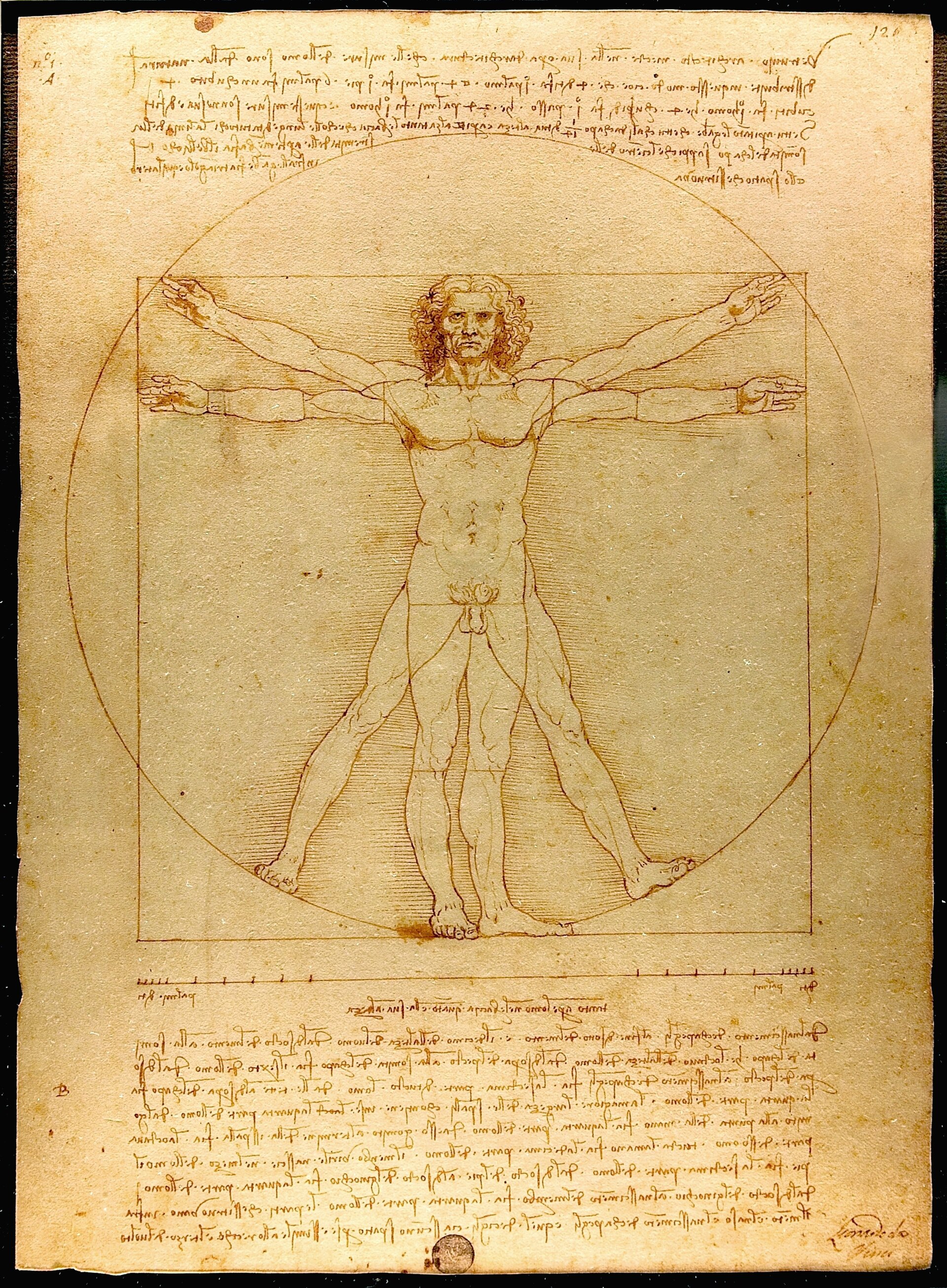
The sheet is done. I set down how I made it, so that if it is copied the copyist will know what is measured and what is drawn.
Draftsman's note
A good sheet of white paper, a little more than half a Milanese braccio high. First I ruled the square with the stylus and metalpoint, the side of it the man's height, and pricked its corners with the compass. Then I set the compass on the place of the navel and swung the circle until it touched the ground line under the feet. Then the figure: first the standing man with his arms level, his fingertips touching the two sides of the square, his feet together on its base, turned outward so that each foot is seen whole in profile; then over him the second man, the same man, his legs opened and his arms raised to the line of the crown, his fingers and his toes upon the circle. All of it in pen over the metalpoint, the shadows in straight hatching sloping down to the right as my left hand goes, a little wash in the hollows.
Across the figure I made small strokes at the divisions of the height, and below the square a line divided into palms, the end palms into fingers. Above and below I wrote the text in my own hand, right to left.
What I wrote above the figure, in plain words
Vitruvius the architect puts in his work on architecture that the measures of a man are arranged by nature in this way: 4 fingers make a palm, and 4 palms make a foot, 6 palms make a cubit, 4 cubits make a man, and 4 cubits make a pace, and 24 palms make a man, and these measures are in his buildings. If you open your legs so far that your height is lowered by a fourteenth, and open and raise your arms until with the long fingers you touch the line of the top of your head, know that the centre of the ends of the spread limbs will be the navel, and the space between the legs will be an equilateral triangle.
What I wrote below the figure, in plain words
- A man opens as much in his arms as is his height.
- From the roots of the hair to the bottom of the chin is a tenth of the height of the man.
- From below the chin to the top of the head is an eighth.
- From the top of the breast to the top of the head is a sixth.
- From the top of the breast to the roots of the hair is a seventh part of the whole man.
- From the nipples to the top of the head is a fourth part of the man.
- The greatest width of the shoulders contains in itself a fourth part of the man.
- From the elbow to the tip of the hand is a fourth part of the man; from the elbow to the end of the shoulder, an eighth part.
- The whole hand is a tenth part of the man.
- The virile member begins at the middle of the man.
- The foot is a seventh part of the man.
- From below the foot to below the knee is a fourth part of the man; from below the knee to the beginning of the member, a fourth part.
- The spaces between the chin and the nose, and between the roots of the hair and the brows, are each the same, and like the ear, a third of the face.
Calculation
The arms, first, because the whole square depends on them. The span must be the height. Is it, by my own fractions?
- Half the width of the shoulders: half of \( \tfrac14 \) is \( \tfrac18 \).
- From the end of the shoulder to the elbow: \( \tfrac18 \).
- From the elbow to the tip of the hand: \( \tfrac14 \).
- From the middle of the breast to one fingertip: \( \tfrac18 + \tfrac18 + \tfrac14 = \tfrac12 \).
- Both sides: \( 2 \times \tfrac12 = 1 \). The span is the height. My fractions close upon themselves, and the man fits the square from fingertip to fingertip exactly as he fits it from sole to crown.
Now the head, from the other side. From the top of the breast to the crown is \( \tfrac16 \); from the top of the breast to the roots of the hair, \( \tfrac17 \). Then from the roots of the hair to the crown is
\[ \tfrac16 - \tfrac17 = \tfrac{7 - 6}{42} = \tfrac1{42}, \]
a little more than two fingers of the 96. By the other road, chin to crown less chin to hair, it is \( \tfrac18 - \tfrac1{10} = \tfrac1{40} \). Two roads, \( \tfrac1{42} \) and \( \tfrac1{40} \), differing by less than a pen line: a warning that the fractions are rounded, by the ancients or by me.
Margin
Here the foot. Above, in Vitruvius' words, 4 palms make a foot and 24 palms make a man, so the foot is a sixth. Below, in mine, the foot is a seventh. A careful reader will think I did not notice. I noticed. The sixth is his. The seventh is the model's. I measured the feet of the young men I could get to stand for me, from the heel to the end of the great toe, and laid the length up their bodies, and it went seven times, a little more or a little less, never six. Vitruvius' foot belongs to a man who was never measured.
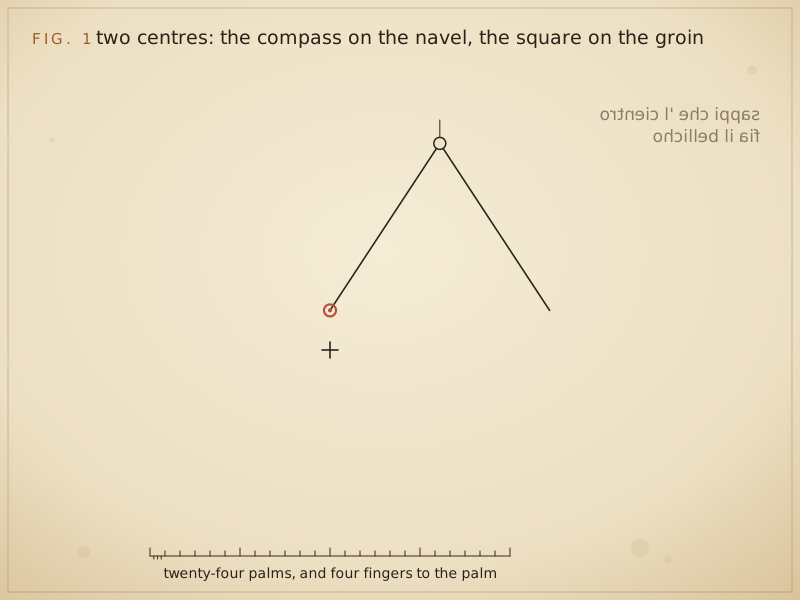
I have drawn the whole thing again as Plate VII so that you can move the man yourself. Raise his arms and open his legs and watch his fingertips and his soles come to the circle, whose centre never leaves the navel, while the square keeps its centre at the groin. The red chalk shows any one of my measures in fractions of the man, in palms and fingers, and in Milanese braccia.
Trial No. 1
Whether the spread man really touches the circle, and whether Vitruvius' fourteenth is right.
I had the young man stand against the whitewashed wall of the courtyard and drew round him with charcoal in both attitudes, marked his navel on the wall, and swung a cord from the mark as a compass.
- With his arms raised so that the long fingers touch the level of the crown, the fingertips lie just inside the circle swung from the navel to his soles: by about the breadth of a finger.
- With his legs opened until the space between them makes an equilateral triangle, each leg leaning out by a third of a right angle, his soles lie on the circle as nearly as the charcoal can show.
- His head is then lower than before. I measured the drop on the wall: a little more than three fingers of a man of 96 fingers. A fourteenth of 96 is nearly seven fingers. A fifteenth is six and two fifths.
I did not like this result, so I reckoned it by geometry instead of charcoal, which is more patient.
Calculation
- Let the legs turn about the groin, which is at half the height, so each leg from the groin to the sole is \( \tfrac12 \) of the man.
- For an equilateral triangle the angle at the groin is a sixth of a turn, so each leg leans out from the upright by a third of a right angle.
- A leg of length \( L \) leaning so reaches down less far than an upright one by \( L \) less its upright height. In an equilateral triangle the height is to the side as 13 to 15 very nearly (6 to 7 is too little, 7 to 8 too much). So the foot rises by about \( \tfrac2{15} \) of the leg.
- Then the man is lowered by \( \tfrac2{15} \times \tfrac12 = \tfrac1{15} \) of his height.
- Vitruvius says \( \tfrac1{14} \). The difference is \( \tfrac1{14} - \tfrac1{15} = \tfrac1{210} \) of the man, less than half a finger.
So the triangle and the fourteenth very nearly agree, if the legs turn at the middle of the man. On the wall my young man turned them at the hips, which are higher, and bent his knees because he was bored, and lost only three fingers. Bodies are more cunning than geometry. On the sheet I drew the geometry, and wrote the fourteenth because it is nearly right.
Margin, later
A third thing hides here, and it took me a week to see it. The soles of the spread man are so close to the ground that any circle touching the ground under him passes close to them, whatever the height of its centre. The feet prove nothing. It is the hands that decide where the navel must be. I set the fingertip at the line of the crown and tried the compass from points on the middle line until the circle that touched the ground also passed through the fingertip. The point was at three fifths of the man. That is where the navel of my young man was, within a finger.
Reflection
People will say this is a drawing of a man as the world in small, the circle being heaven and the square the earth, and the man between them with his navel at the centre of one and his loins at the centre of the other. I do not object. I have written myself that man is the image of the world, and I find more pleasure in that likeness the more exactly I measure it. But I made the drawing first for painters and sculptors and builders of horses, who need to know where a hand will reach and where a knee will fall. If the heavens come into it, they come in at the measuring end.
Milan, about 1490. The kneeling man, the sitting man, and the leg of Caravaggio
The Vitruvian sheet is the rule. The rule is the beginning. Since the summer I have been filling small sheets with the measures of men in every attitude, copied fair from rough notes for the book on the human figure.
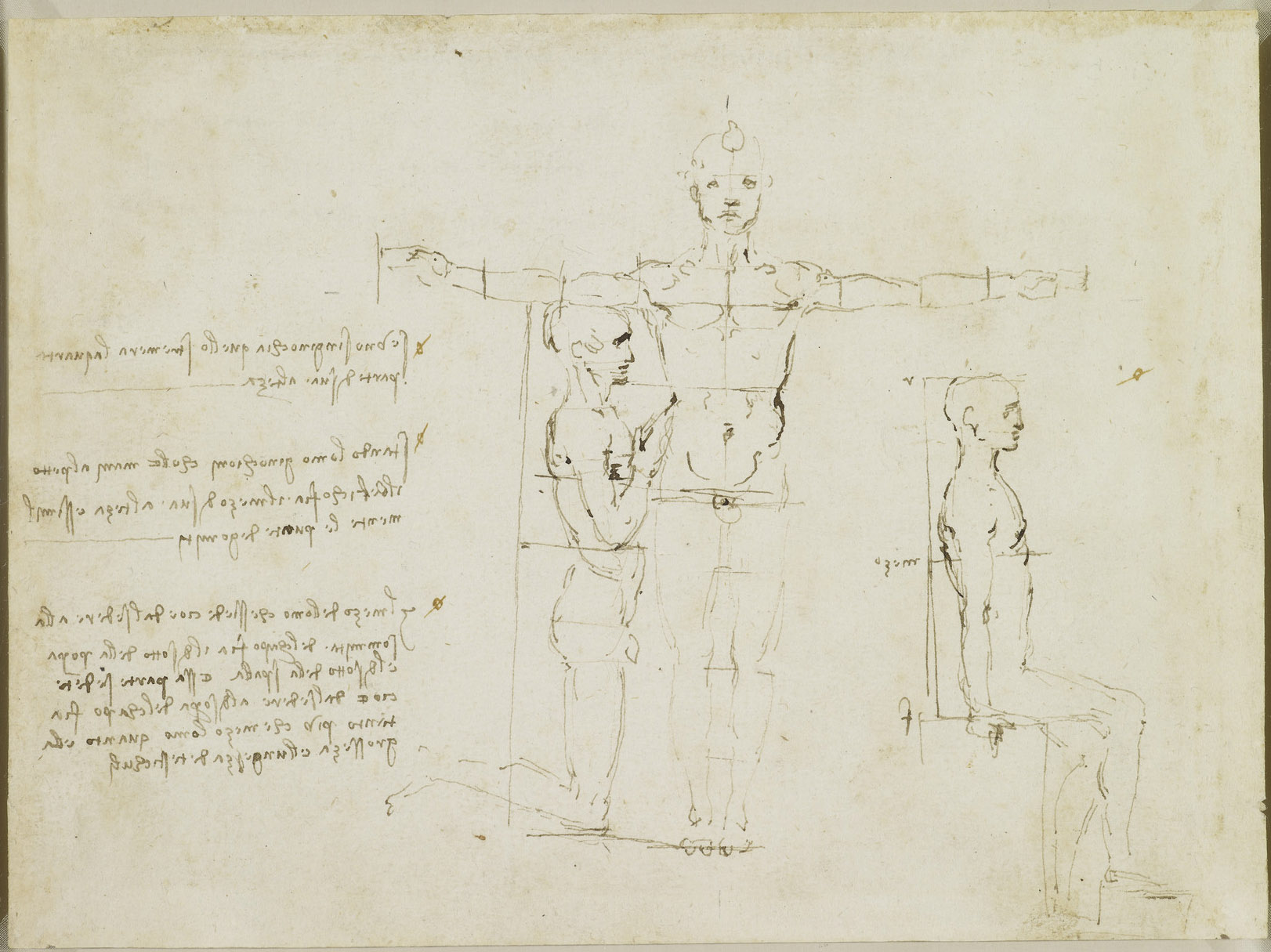
Draftsman's note
Three men on a small sheet. In the middle the standing man with his arms out, the cubits ruled across him at the knee, the groin and between the armpits. Beside him the same man kneeling, his head just under the standing man's arm. To the left a third man seated.
Proportion
The notes, as I wrote them: "In kneeling down a man will lose the fourth part of his height." And: "When a man kneels down with his hands folded on his breast the navel will mark half his height and likewise the points of the elbows." The kneeling man folds away the leg below the knee, and the leg below the knee is a quarter of the man, as I wrote on the Vitruvian sheet: from below the foot to below the knee is a fourth part. So the two sheets agree. If the kneeling man is \( \tfrac34 \) of his height, and the navel marks half of that, then the navel of the standing man must be at
\[ \tfrac12 \times \tfrac34 + \tfrac14 = \tfrac38 + \tfrac28 = \tfrac58 \]
of his height above the soles. Five eighths is three fifths and a little more: the same navel that the compass found on the big sheet. Three roads have come to the same place. I believe the place.
Trial No. 2
Then I measured a real man for a whole afternoon, and the rule began to come apart in my hands. His name I wrote on the sheet as Caravaggio, after the town he comes from on the road to Bergamo. He stood with one foot on a stool while I went round his leg with the calipers, writing each thickness in parts of a head, because the head is a measure the eye can carry from one figure to another. The leg would not divide into the old fractions. Six seventeenths of a head! No ancient ever wrote such a number.
- a c is half a head, and the same as d b, and the same to the attachment of the five toes.
- d k diminishes by a sixth in the leg at g h, and g h is a third of a head.
- m n is larger by a sixth than a c, and is seven twelfths of a head.
- o p is a tenth less than d k, and is six seventeenths of a head.
- The hollow on the outside of the knee is higher than the hollow on the inside by half the thickness of the leg at the foot.
Margin
Two rules for the hand that disagree, and both mine. On the Vitruvian sheet the whole hand is a tenth of the man. In another place I wrote that a painter should take a man of three braccia, because two is too small and four too tall, and that the hand is a third of a braccio and goes nine times in such a man. A ninth and a tenth, and both are true of somebody. In the same place I wrote the remedy: look at many men of three braccia, and out of the larger number who are alike in their limbs choose the most graceful, and measure him.
To do
- Measure Caravaggio again, seated, kneeling, lying on the bench, and with the arm raised.
- Go to the baths: in another list I wrote, "go every Saturday to the hot bath where you will see naked men", and I must keep my own advice.
- Return Giacomo Andrea's Vitruvius before he asks.
Reflection
The ancients had a single man in their heads and wrote him down well. I have a hundred men in the streets of Milan, and none of them is that man. A painter who gives every figure the same proportions makes a crowd of brothers; one who has none makes monsters. The art is to know the rule so well that you can see exactly how each man departs from it, and draw the departure.
Problems I set myself
1. A man of 3 Milanese braccia, the braccio being 59 and a half of your centimetres. Find, by my sheet, his palm, his finger, his face, his head and his foot, in fractions of a braccio and in centimetres. Then find his foot by Vitruvius' rule, and say how much longer it is.
Answer. The man is \( 3 \times 59.5 = 178.5 \) cm. The palm is \( \tfrac1{24} \) of that, 7.44 cm, an eighth of a braccio; the finger \( \tfrac1{96} \), 1.86 cm. The face, \( \tfrac1{10} \), is 17.85 cm; the head, \( \tfrac18 \), is 22.3 cm, three palms. My foot, \( \tfrac17 \), is 25.5 cm, \( \tfrac37 \) of a braccio; Vitruvius' foot, \( \tfrac16 \), is 29.75 cm, half a braccio. His is longer by \( \tfrac16 - \tfrac17 = \tfrac1{42} \) of the man, 4.25 cm, a little more than two fingers.
2. The legs turn about the groin, at half the man, and each is half the man long. Open them until the space between them is an equilateral triangle. By what part of his height is the man lowered? And how far apart are the soles?
Answer. Each leg leans from the upright by 30 degrees. The upright height of a leaning leg of length \( L \) is \( L \cos 30^\circ = 0.866\,L \), so the foot rises by \( 0.134\,L \). With \( L = \tfrac12 \), the man is lowered by \( 0.067 \), which is \( \tfrac1{15} \) of his height (Vitruvius says \( \tfrac1{14} = 0.071 \)). Each sole is \( L \sin 30^\circ = \tfrac14 \) of the man out from the middle, so the soles are half the man apart, which is the side of the triangle, equal to the legs: the triangle closes as it should.
3. The circle is centred on the navel at \( \tfrac58 \) of the man and touches the ground. The shoulder joint is \( \tfrac{1}{8} \) of the man out from the middle and its height is \( \tfrac{13}{16} \) of the man; the arm from there to the fingertip is \( \tfrac38 \). Raise the arm until the fingertip is at the level of the crown. Does it reach the circle?
Answer. The fingertip must rise \( 1 - \tfrac{13}{16} = \tfrac3{16} \) above the shoulder, with an arm of \( \tfrac38 = \tfrac6{16} \), so the arm is raised until its rise is half its length: 30 degrees. Its reach outward is \( \tfrac38 \cos 30^\circ = 0.325 \), so the fingertip is at \( 0.125 + 0.325 = 0.450 \) from the middle and at height 1. From the navel at 0.625 it is \( \sqrt{0.450^2 + 0.375^2} = \sqrt{0.2025 + 0.1406} = 0.586 \) away, while the radius is 0.625. It falls short by 0.039 of the man, nearly four fingers. With the navel at 0.61, as on the sheet, the shortfall is about a finger and a half. The navel that brings the fingertip exactly onto the circle satisfies \( 0.45^2 + (1 - n)^2 = n^2 \), which gives \( n = (0.2025 + 1)/2 = 0.60 \). The higher the navel, the farther the circle runs from the hands, which is why the navel on the sheet sits below five eighths.
To the student who reads this later
You know the drawing better than I did: it is on your coins and your hospitals' signs, and you call it the Vitruvian Man. Here is what has been learned since.
The passage I struggled with is De architectura, Book III, chapter 1. In Morris Hicky Morgan's English of 1914 it reads, "in the human body the central point is naturally the navel. For if a man be placed flat on his back, with his hands and feet extended, and a pair of compasses centred at his navel, the fingers and toes of his two hands and feet will touch the circumference of a circle described therefrom." Morgan's version also gives the foot as "one sixth of the height of the body", the number I would not accept.
I was not the first to draw it, or the only one in 1490. Mariano di Jacopo of Siena, called Taccola, drew a man touching a circle with a square inside it in his book of engines, De ingeneis, in the 1430s (Munich, Bayerische Staatsbibliothek, Clm 197, f. 36v). Francesco di Giorgio drew several, one in his treatise now in the Biblioteca Medicea Laurenziana, Florence (Ashburnham 361, f. 5r). In 1986 the architectural historian Claudio Sgarbi found, in an anonymous Italian translation of Vitruvius in the Biblioteca Comunale Ariostea at Ferrara, a man in a circle and a square very like mine, and he has argued that it is Giacomo Andrea's, drawn in the months when we were eating together. Who drew first, no one can now say. Giacomo Andrea was executed by the French in Milan in 1500. My own sheet passed to Francesco Melzi, was engraved by Carlo Giuseppe Gerli in 1784, and has been in the Gallerie dell'Accademia in Venice since 1822, shown rarely because light fades it.
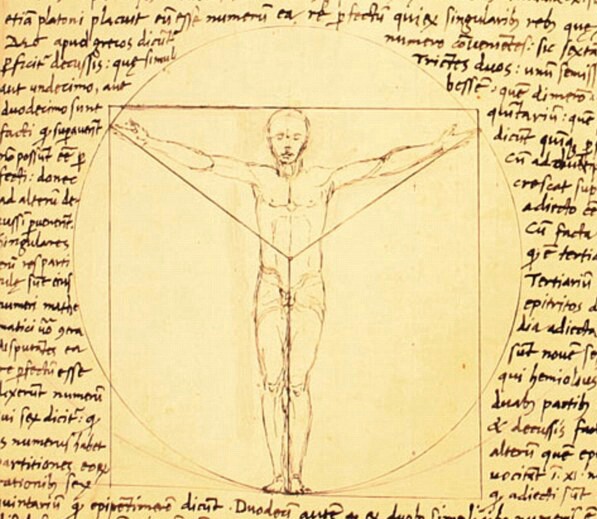
The geometry is simple to state in your notation. Put the soles at height 0 and let the man's height be \( h \). The square has side \( h \) and centre at \( (0, h/2) \). The circle has centre at the navel \( (0, n) \) and radius \( n \), so it touches the ground. A point of the body at \( (x, y) \) lies on the circle when
\[ x^2 + (y - n)^2 = n^2. \]
The navel on my sheet stands at about \( n \approx 0.61\,h \), which some of your writers have tried to make into the golden ratio, \( 1/\varphi \approx 0.618 \). I never wrote that number on this sheet, the measurement cannot tell 0.61 from 0.62, and I met the divine proportion only later, through Luca Pacioli. The lowering of the man by the equilateral triangle is \( \Delta = L(1 - \cos 30^\circ) \approx 0.134\,L \), with \( L \) the length of the leg from where it turns.
Your anthropometrists, who measure living people, have confirmed some of my fractions and corrected others. The span is close to the height in most adults, within a few per cent. The foot of a modern adult is about 15 per cent of the height, a little less than a sixth and a little more than my seventh, so Vitruvius and I were both near the edge of the truth on opposite sides. The navel sits close to 0.6 of the height. Above all, people vary, by age, sex, family and nation, and the most useful thing I wrote on the subject is the margin about choosing the middle of many men. After me, Albrecht Dürer measured more bodies than I did and published men and women of many types in his Four Books on Human Proportion (1528).
What to try today. With a string and a friend, measure your height, your span, your foot and the height of your navel, and divide each by your height. Then lie on a large sheet of paper with arms raised and legs apart, have your friend hold the string at your navel and swing it with a pencil, and see which fingers and toes it touches. You will find, as I did, that the rule is nearly true and that you are not quite the rule.
If you want to argue with me about the circle and the square, come and ask me.
Sources and liberties
The Da Vinci Notes are a modern reconstruction written in Leonardo da Vinci's voice by Eternal Gardens. Dates, places, manuscripts, drawings and quotations come from the sources below; the order of the working, the private reflections, the plates and the sketches are ours.
- J. P. Richter, The Notebooks of Leonardo da Vinci (1883), §343 (the Vitruvian sheet), §332 (the kneeling and seated man), §338, §309 (the man of 3 braccia), §720 (23 April 1490), §1458 (Giacomo's arrival and the supper with Giacomo Andrea), §1501 (Giacomo Andrea's Vitruvius), §1421 (the hot bath), §1445 (the horse at Pavia), §44 (his notes in Francesco di Giorgio's treatise), and his note on the Pavia consultation of 21 June 1490: Project Gutenberg #5000
- Vitruvius, The Ten Books on Architecture, trans. M. H. Morgan (Harvard University Press, 1914), Book III, chapter 1: Project Gutenberg #20239
- Italian transcription of the text on the sheet, after S. Magazù, N. Coletta and F. Migliardo, "The Vitruvian Man of Leonardo da Vinci as a representation of an operational approach to knowledge", Foundations of Science 24 (2019), as reproduced in the Italian Wikipedia article: Uomo vitruviano
- Gallerie dell'Accademia, Venice, the drawing inv. 228: gallerieaccademia.it
- Royal Collection Trust, RCIN 919132 (the standing, kneeling and sitting man) and RCIN 919136 (the measurements of Caravaggio's leg), texts adapted from M. Clayton and R. Philo, Leonardo da Vinci: Anatomist (Royal Collection, 2012): RCIN 919132, RCIN 919136
- Finestre sull'Arte, "Leonardo da Vinci's Vitruvian Man: history and meaning of a modern design" (Taccola, Clm 197 f. 36v; Francesco di Giorgio, Ashburnham 361 f. 5r; the sheet's medium and size): finestresullarte.info
- T. Lester, "The Other Vitruvian Man", Smithsonian Magazine, 2012 (Claudio Sgarbi and the Ferrara drawing): smithsonianmag.com
- M. Kemp, Leonardo da Vinci: The Marvellous Works of Nature and Man (Oxford University Press, 1981; revised 2006); C. C. Bambach (ed.), Leonardo da Vinci: Master Draftsman (Metropolitan Museum of Art, 2003).
The translations of the text above and below the figure are ours, made from the Italian transcription and compared with Richter §343; where Richter prints "the fifth part of a man" for the elbow to the tip of the hand, the transcription we follow reads "la quarta parte", a quarter, which is also what makes the span equal the height. Whether Leonardo went to Pavia with Francesco di Giorgio in June 1490 is Richter's view, doubted by some later scholars because the cathedral's expense record names only Francesco. The trials against the courtyard wall, the conversation at Giacomo Andrea's table beyond what Leonardo recorded, and the order of the sheets are our reconstruction; the navel height of 0.61 is measured from the drawing, and golden-ratio readings of it are a modern interpretation.