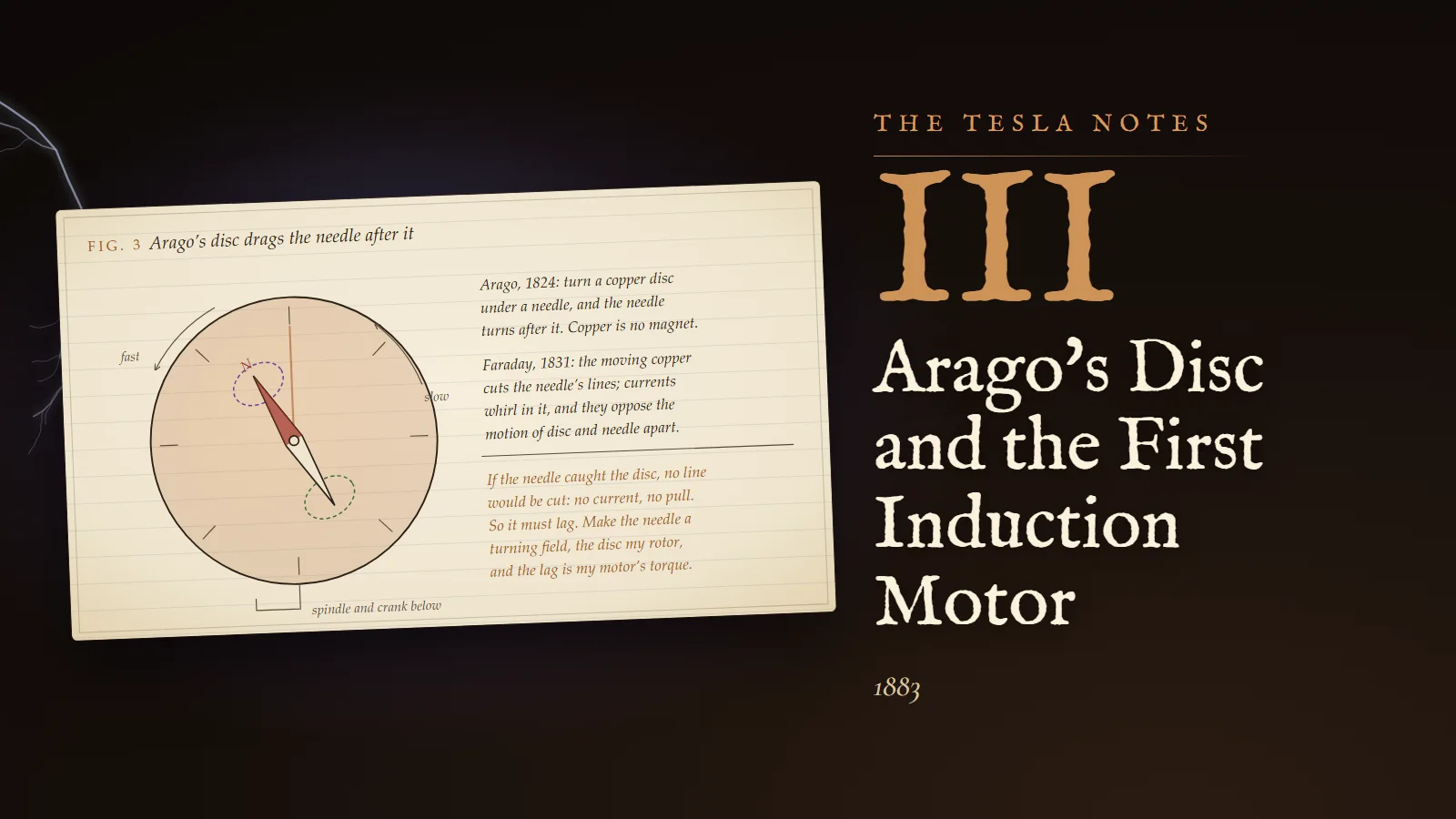

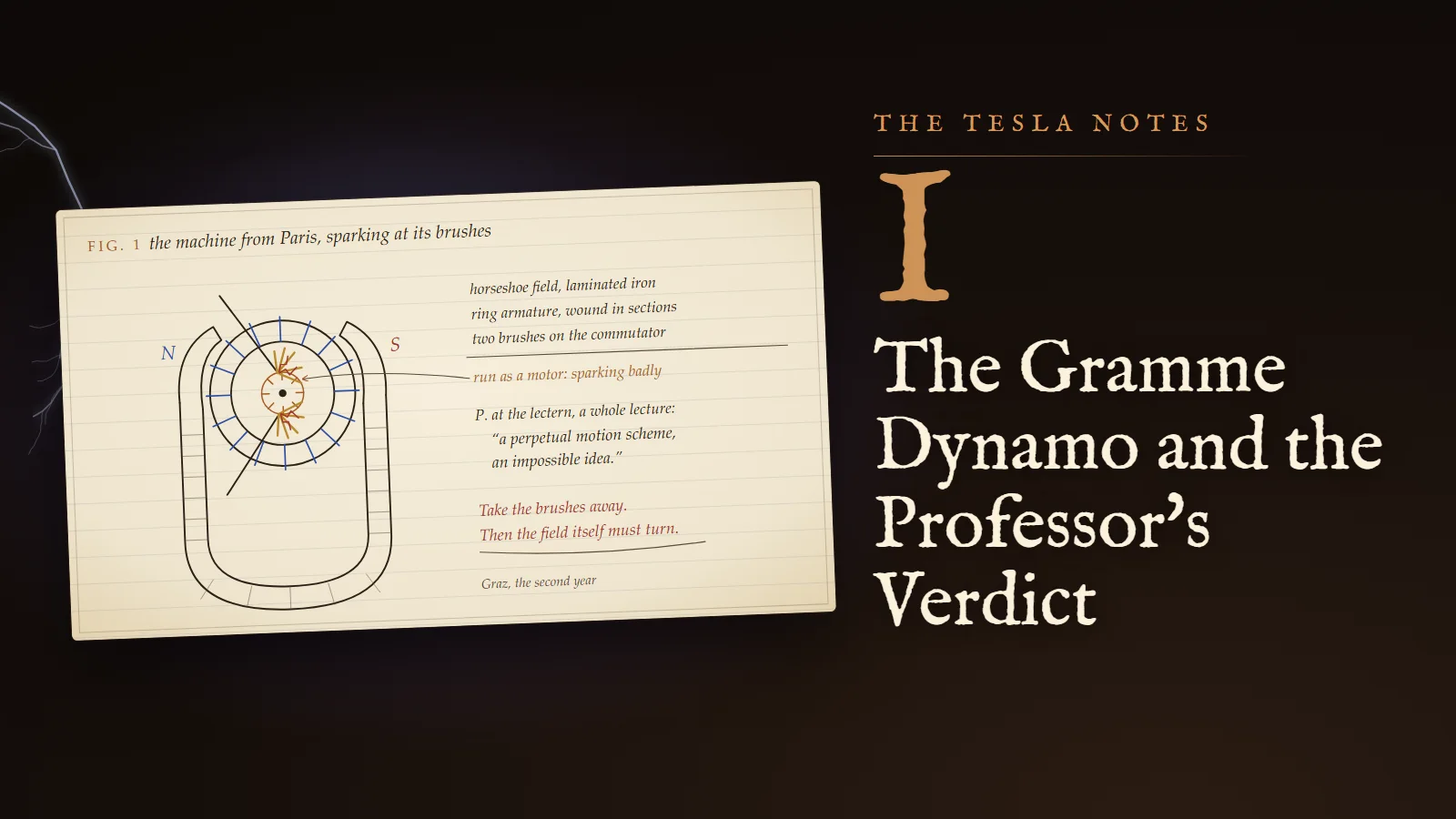
Graz, in the winter of my second year at the Polytechnic, by a lamp that smokes because I trim it badly at three in the morning. I begin this book because the loose sheets have become a danger: calculations for the professors, calculations for myself, a flying machine I am ashamed of, and on top of them all a sheet with a single question written so hard that the pen went through the paper. Can a motor be made to run without a commutator? The professor of physics says it cannot. He says it so well, and with such authority, that for one evening I believed him. These pages are where I intend to find out whether he is right, and if he is right, exactly why.
But instinct is something which transcends knowledge. We have, undoubtedly, certain finer fibers that enable us to perceive truths when logical deduction, or any other willful effort of the brain, is futile.
Nikola Tesla, "My Inventions", Part III, Electrical Experimenter, April 1919
Gospić, September 1875. What I carry to Graz
Tomorrow I leave for Graz. I set down first what I have, so that I can measure later what I gained.
I have mathematics, which has never been a labour to me, because I see the figures and perform the operations on them as if they were objects on a table. I have German, which I shall need, and French and some English. I have a body that was nearly given up twice: the illness after the Real Gymnasium, and then the cholera, which kept me in bed for nine months. In one of those sinking spells my father came into the room and I told him I might get well if he would let me study engineering. He promised me the best technical institution in the world. I believe the promise did more than the physicians. Then he made me spend a year in the mountains with a hunter's outfit and a bundle of books, and I came down stronger and full of schemes, most of them delusive.
From Carlstadt I carry one picture that has never left me: the professor of physics there, who made his own apparatus, connecting a glass bulb with tinfoil coatings, free to turn on a pivot, to a static machine, and the bulb spinning as if alive. Every impression of that kind produces a thousand echoes in me. I wanted to know what force did that, and I still want to know.
Calculation
What I understand of induction, written out so that the professors in Graz can correct it. Faraday found in 1831 that a current appears in a closed wire when the number of lines of magnetic force passing through it changes. The electromotive force is the rate at which the lines are gained or lost. Following Neumann I write it for a coil of N turns, each enclosing Φ lines:
e = −N dΦ/dt
The minus sign is Lenz's rule of 1834: the current induced always flows so as to oppose the change that produces it. If it flowed the other way it would assist the change, the change would grow, and we should have motion for nothing. I like this sign. It is the law of the universe refusing to be cheated.
The practical unit: one volt is 10⁸ absolute units of electromotive force, that is, the cutting of a hundred million lines in one second. I shall keep my fields in lines per square centimetre and my areas in square centimetres, and multiply by 10⁻⁸ at the end to have volts.
Reflection
My father made light, I think, of engineering as a calling for his son. He wanted the Church for me. I have his promise, and I intend to repay it with work of such quantity that the professors will write to him about it. I have not told him that this is my plan. A surprise should be complete.
Graz, March 1876. Three in the morning until eleven at night
The regime is fixed and I keep it without exception: I begin at three in the morning and stop at eleven at night, Sundays and holidays included. My fellow students take things easily and I do not blame them; but I came here to eclipse records and I am eclipsing them. Nine examinations this year. I passed them all with the highest marks except one, the examination with Professor Rogner on the congruity of numbers, where I am told I am merely good.
Three men matter to me. Professor Rogner, who teaches arithmetic and geometry and has turns of phrase that throw the lecture room into a riot, after which there is a long, embarrassing silence. Dr. Allé, who teaches the integral calculus and differential equations, and who is the most brilliant lecturer I have ever heard; he keeps me back for an hour or two after the lecture and gives me problems, and those hours are the best of my week. And Professor Poeschl, who holds the chair of theoretical and experimental physics: a methodical German with enormous feet and hands like the paws of a bear, whose experiments never once fail. I have watched him for a year and I have not seen him miss.
Calculation
Dr. Allé asked me to write out the electromotive force of a coil turning in a uniform field, with every step, as if for a slow student. I record it here because I made an error in it, and an error well understood is worth more than a page of correct work.
- A flat coil of N turns, each of area A square centimetres, turns about an axis perpendicular to a uniform field of B lines per square centimetre, at a steady angular velocity ω radians per second.
- Let θ = ωt be the angle between the field and the normal to the coil. The lines through one turn are Φ = BA cos θ = BA cos ωt.
- Differentiating, dΦ/dt = −BAω sin ωt.
- Therefore e = −N dΦ/dt = NBAω sin ωt absolute units, or NBAω sin ωt × 10⁻⁸ volts.
- The greatest value is E = NBAω, reached when sin ωt = ±1, that is, when θ = 90° and the plane of the coil lies along the lines.
Margin
I first wrote, at step 5, that the force is greatest when the coil faces the poles squarely, because that is where the most lines pass through it. It is the reverse. There the number of lines is greatest but for an instant it does not change, and it is the change that drives the current. The force is greatest a quarter turn later, when the coil holds no lines at all but is gaining and losing them fastest. A full purse is not the same as a full hand of coins changing owners. Dr. Allé laughed and said I had made the commonest mistake in the subject and corrected it faster than most.
Calculation
Numbers, for a coil I could wind myself. N = 100 turns, A = 10 cm × 10 cm = 100 cm², B = 5,000 lines per cm², turning at 900 revolutions a minute.
- ω = 2π × 900/60 = 2π × 15 = 94.25 radians per second.
- NBAω = 100 × 5,000 × 100 × 94.25 = 4.71 × 10⁹ absolute units.
- Multiplying by 10⁻⁸: E = 47.1 volts at the greatest.
And this force is alternating. Fifteen times a second it rises to 47 volts one way, falls through nothing, rises to 47 volts the other way. The coil makes alternating current by its nature. Every machine of this kind does. Whatever comes out of the terminals of a dynamo as a steady current has been made steady afterwards, by a mechanism.
Experiment No. 1
Apparatus: a bobbin of cardboard wound with about two hundred turns of thin covered copper wire, a borrowed horseshoe magnet, the cheap astatic galvanometer I bought from a student who was leaving. Procedure: turn the bobbin slowly by hand between the poles, the ends of the wire going to the galvanometer through two long flexible leads that twist as I turn. Result: the needle swings to one side, returns, swings to the other side, once each half turn, exactly as the sine says. When I turn faster the swings are greater, and when I turn very fast the needle cannot follow and only trembles about zero, as the average of a sine must. The leads twisted into a rope after twenty turns. That rope is the whole problem of the commutator in miniature: a turning coil and a fixed world must be joined somehow.
Graz, winter 1876 to 1877. The machine from Paris
It has come. A Gramme machine, ordered from Paris for the physics cabinet, and today Professor Poeschl had it connected and showed us its effects. I have looked at nothing else all week.
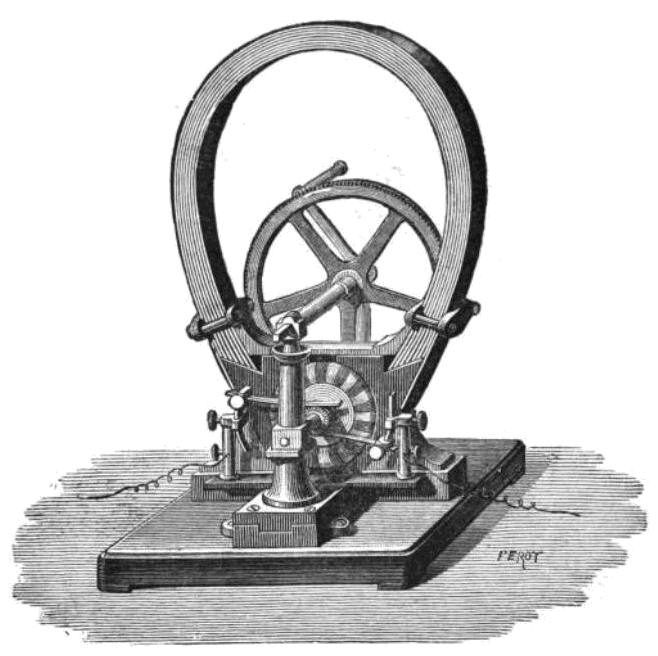
Draftsman's note
The field magnet is in the horseshoe form, built up of thin plates of iron laid together, which Gramme does, I suppose, for the same reason one splits firewood: so that stray currents in the iron cannot circulate in large paths and heat it. The two limbs end in curved pole shoes that embrace the armature closely on left and right. The armature is a ring of iron, itself made of wire or plates, and the copper wire is wound round the ring in many short sections, like beads on a bracelet, each section joined to the next so that the whole winding is one endless loop. From each joint a lead runs to one bar of the commutator, a cylinder of copper bars insulated from one another, on the shaft. Two brushes of copper press on the commutator at opposite ends of a diameter, at the places where the ring is halfway between the poles. I have drawn it as Fig. 1, and I have drawn the sparks too, because the sparks are the point.
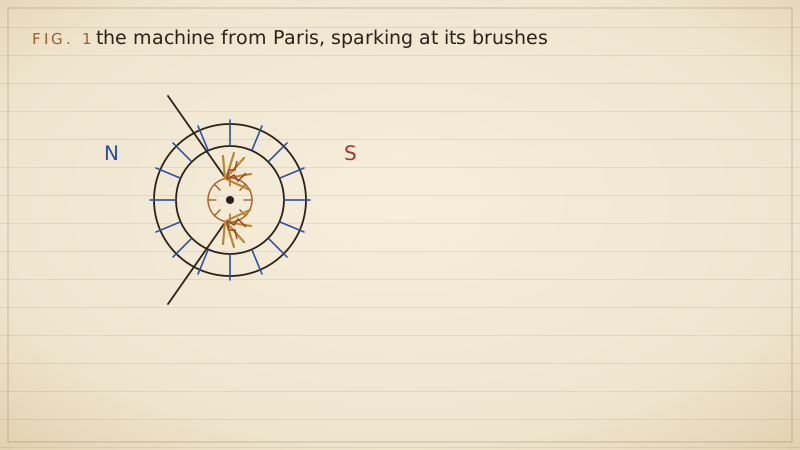
Calculation
How the ring makes its force. The lines leave the north pole shoe, enter the ring, and divide: half go round through the upper half of the ring, half through the lower, and both halves leave by the south shoe. A turn of wire wrapped round the ring encloses whatever lines are flowing along the iron at its place. At the top, halfway between the poles, it encloses the whole half, Φ/2. Carried round under the north pole, it encloses fewer and fewer, none at all under the middle of the pole, and then Φ/2 again at the bottom, but now flowing the other way through it. So in half a revolution each turn passes from +Φ/2 to −Φ/2, a change of Φ.
- Let the machine have two poles and Φ lines from each pole, and let it turn n revolutions a minute. Half a revolution takes 30/n seconds.
- The average force of one turn over that half revolution is Φ ÷ (30/n) = Φn/30 absolute units.
- The brushes divide the winding into two halves, each in parallel with the other, so a path between the brushes holds half of the T turns. Every turn on one side has its force in the same sense, so they add.
- Mean force at the brushes: (T/2)(Φn/30) = ΦTn/60 absolute units.
- For the Graz machine I estimate Φ = 10⁶ lines, T = 384 turns in 24 sections of 16, n = 900. Then ΦTn/60 = 10⁶ × 384 × 15 = 5.76 × 10⁹, or 57.6 volts.
I cannot measure Φ. It is my guess from the size of the pole faces and what such iron will carry. The rest is certain.
Calculation
Now the commutator, which turns the alternating forces of the sections into a force that does not reverse. Take first the simplest machine: one coil, a commutator of two half rings, two brushes. Each half turn the coil's force reverses, and at that same instant the half rings change brushes, so that what reaches the outer circuit is the force with its negative halves turned over: |sin ωt| in place of sin ωt.
- Its mean value over a half period is (1/π) ∫₀^π E sin x dx.
- The integral of sin x from 0 to π is [−cos x]₀^π = 1 − (−1) = 2.
- Therefore the mean is 2E/π ≈ 0.637 E.
- For the coil of my first calculation, 0.637 × 47.1 = 30.0 volts mean, rising and falling between 0 and 47.1 volts thirty times a second.
A current that drops to nothing thirty times a second is a poor thing to light a lamp with. Gramme's ring is the cure. Let it have k sections, equally spaced, and let each section, concentrated at its place, have force E sin ψ, where ψ is its angle measured from the brush. Between the brushes at a given instant lie k/2 sections at angles δ, δ + 2π/k, δ + 4π/k, and so on, where δ, the angle of the first one past the brush, runs from 0 to 2π/k and then begins again. Their sum is:
- S = E Σ sin(δ + 2πm/k), for m = 0, 1, ..., k/2 − 1.
- By the rule for a sum of sines in arithmetic progression, Σ sin(a + md) = sin(nd/2) sin(a + (n − 1)d/2) ÷ sin(d/2), with n = k/2 terms and d = 2π/k.
- Here nd/2 = π/2, so sin(nd/2) = 1, and (n − 1)d/2 = π/2 − π/k.
- Therefore S = E cos(δ − π/k) ÷ sin(π/k).
- As δ runs from 0 to 2π/k, the angle δ − π/k runs from −π/k to +π/k. The sum is greatest, E/sin(π/k), in the middle, and least, E cos(π/k)/sin(π/k), at the ends.
- The ripple, the fall from greatest to least as a fraction of the greatest, is 1 − cos(π/k).
Check with k = 2, the single coil: 1 − cos 90° = 1. The force falls all the way to nothing. Correct. With k = 24: 1 − cos 7.5° = 0.0086, less than one per cent. The ring with many sections gives a force so nearly steady that no galvanometer in the cabinet could see the ripple.
And the mean of S, averaging cos over an interval of width 2π/k about zero, is E sin(π/k)/(π/k) ÷ sin(π/k) = kE/π. Each section contributes 2E/π, its own rectified mean, and k/2 of them stand in series: (k/2)(2E/π) = kE/π. The two calculations agree, which is the only proof of arithmetic I fully trust.
Graz, 1877. Professor Poeschl runs it as a motor
Today he showed that the machine is reversible: send current into it from a battery and it turns, a motor. This was found at Vienna in 1873, they say, when a Gramme machine was by accident connected to another that was running, and began to turn. It is a beautiful fact. A machine that makes current from motion makes motion from current, by the same law read backwards.
But while it ran as a motor the brushes gave trouble, sparking badly, a little crown of fire at each brush, and the smell of burnt copper. I said, aloud, that it might be possible to work a motor without these appliances at all. Professor Poeschl did me the honour of devoting the rest of the lecture to my remark. He was thorough and he was kind and he was utterly certain. At the end he said, and I set it down as nearly as I can remember it:
"Mr. Tesla may accomplish great things, but he certainly never will do this. It would be equivalent to converting a steadily pulling force, like that of gravity, into a rotary effort. It is a perpetual motion scheme, an impossible idea."
Professor Poeschl's verdict, as Tesla recorded it in "My Inventions", Part III, April 1919
Reflection
I lay awake on it. He is a better experimenter than I shall be for years, and his argument has the form of truth. A magnet pulls steadily. A coil carrying a steady current pulls steadily. Steady pulls between fixed things produce a position of rest, as a stone comes to rest on the ground, and to get continual turning from them you must keep changing which coil pulls, and that is exactly what the commutator does. Remove it, and you ask a steady pull to become rotation by itself. That is perpetual motion.
But where is it written that the pull must be steady? Inside the armature nothing is steady. I showed it with the galvanometer and my twisted leads: the current in every section reverses twice in every turn. What the commutator does is take something alternating and chop it into something steady, at the price of a spark at every bar. Suppose one did not chop it. Suppose the alternating currents were left alternating and made to do the shifting of the pull themselves. Then the pull would be like gravity that walks.
For a time I wavered, because of his authority. I do not waver now. I cannot yet see how, but I know that he has proved only that a steady pull cannot turn a wheel, and nobody asked for that.
Calculation
Why the brushes spark, worked out properly, because I must understand the disease before I can claim that I have a cure.
- A brush is wider than the gap between two bars. For a moment it touches both bars at once, and the section of winding between those bars is short-circuited through the brush. At 900 revolutions a minute, a brush covering 15 degrees of the commutator shorts a section for t = (1/15 s) × (15/360) = 1/360 s = 2.8 thousandths of a second.
- During that moment the current in the section must reverse completely. Before the brush it carried half the armature current one way, I/2; after the brush it must carry I/2 the other way. The change is I.
- The section has self-induction. Maxwell calls its measure the coefficient of self-induction, L. A coil resists a change of its own current with a force L × (change of current) ÷ (time). This force tries to keep the old current flowing. Call it the reactance force, e_r = L I/t.
- I estimate L for one section of 16 turns on iron at about 3 × 10⁵ centimetres, the absolute unit of self-induction being the centimetre. In volts per ampere-per-second that is 3 × 10⁵ × 10⁻⁹ = 0.0003. With I = 8 amperes: e_r = 0.0003 × 8 ÷ 0.00278 = 0.86 volt.
- If the reversal is not finished when the bar leaves the brush, the current still flowing in the section must jump the widening gap. That jump is the spark.
- There is a second cause. If the brushes are not exactly at the neutral place, the shorted section is still cutting lines, and has a force of its own, E_s sin β, where E_s is the greatest force of one section and β the angle of the brush from neutral. For my machine E_s = 16 × (10⁶/2) × 94.25 × 10⁻⁸ = 7.54 volts. At β = 10°, 7.54 × 0.174 = 1.31 volts, driving a current round a loop of a few hundredths of an ohm: at 0.05 ohm, twenty-six amperes circulating uselessly through the brush.
- The two causes can be set against each other. If the brush is moved a little forward in the direction of rotation (for a dynamo), the shorted section enters the field of the next pole, and its own force is in the direction the new current must take. It helps the reversal. The sparking ceases when E_s sin β = L I/t, that is, sin β = 0.86/7.54 = 0.114, β ≈ 6.6°.
- But the armature current also distorts the field and pushes the neutral place forward. I guess half a degree for each ampere, so four degrees at eight amperes. The quiet position is then about 6.6° + 4° ≈ 11° forward.
- For a motor everything is mirrored: the current flows against the machine's own force, and the brush must be moved backward, against the rotation.
So the correct brush position changes with every change of load. In the lecture the professor had set his brushes at the neutral place, as for a dynamo with no current, and then drove it as a motor with a large current. Of course it sparked. Every attendant of every Gramme machine in Europe stands beside it with his hand on the rocker, moving the brushes as the load changes, and burning his fingers on the commutator when he is late.
I have drawn all of this as Plate I. Choose the number of bars, move the brushes, change the current, and watch the force at the brushes and the sparks.
Experiment No. 2
Performed in the mind, which is where I do my best experiments, because the apparatus never breaks and I can stop time to look. I run the Gramme machine as a motor and follow one section of winding round. It enters under the north pole carrying current one way, and is pushed. It reaches the neutral place, the brush grips it, its current is torn round to the other direction with a small explosion, and it passes under the south pole carrying current the other way, and is pushed again in the same sense of rotation. The motor turns because every section's current is reversed at exactly the moment its place in the field reverses. The commutator is a clerk at a gate, turning every traveller round as he passes. Now I dismiss the clerk. The currents in the sections go on alternating, if I feed them alternating currents from outside. But the field stays fixed, and so the sections are pushed one way, then the other, and the armature trembles in place. Unless the field itself changes, alternately, in step. I see it as clearly as I see the inkwell. I cannot yet see what makes it go.
Graz, spring 1878. The fee unpaid
I write this badly and briefly. I did not pay the teaching fee for the first semester of this year, and the Rectorate has struck me from the list. The Military Frontier's stipend, which was given on condition of steady progress, has been asked about by the General Command at Agram; I hear the Rectorate replied that I drew the money until January and had not been in hospital. I expect the stipend to be stopped. I know what is said about me in the coffee houses and I will not answer it here.
Reflection
The truth I can write is this. After the first year, when I came home with the professors' certificates and expected a triumph, my father made light of them. That almost killed my ambition. In the second year I gave myself to physics, mechanics and mathematics, and to the library. In this third year I have given myself to one problem that is on no examination. The professors were right to think I was working myself to death in the first year. They would be right to think I am not working now. Both are false and both are true.
Calculation
My programme. First I picture a direct current machine, run it, and follow the changing flow of the currents in the armature. Then I picture an alternator and do the same. Then systems of generators and motors joined in various ways. I write here what the pictures yield.
- In a two pole machine turning n revolutions a minute, the current in each armature section completes one period each revolution: n/60 periods per second. At 900 revolutions, fifteen periods a second.
- With p pairs of poles the current passes p periods each revolution: f = pn/60 periods per second.
- If these currents are sent out by slip rings in place of the commutator, the external circuit receives alternating current of f periods a second, and an ordinary Gramme machine becomes an alternator. Nothing about the iron or copper need change.
- Send that alternating current into the coils of a second machine, a motor with a fixed field. The force on each section alternates f times a second. The average pull over a period is nothing, unless the armature is already turning exactly in step with the alternations, and even then, if stopped, it will not start.
So the alternator and the alternating current motor, as I picture them, can run together in step but cannot start, and fall out of step at the first jolt. That is a motor for a demonstration, useless for work.
Margin
Line 4 is where the whole difficulty lives. One alternating current gives a pull that goes back and forth along one line. I have been trying to make a single back-and-forth pull turn a wheel, which is Poeschl's perpetual motion in another coat. I need a pull that goes round. A line cannot go round. Two lines, perhaps. I have no more tonight. All my remaining time in Graz has been spent in efforts of this kind, intense and fruitless, and I have nearly concluded that the problem cannot be solved. I write "nearly" and underline it.
Experiment No. 3
A compass needle placed on the axis of a coil fed with the reversing current of the machine, run slowly by hand, through a two-bar reverser of my own making. The needle quivers about its rest position and never turns, however I set it. Then two coils, at right angles, on the same small board. I fed one from the machine and the other from the battery through a switch I worked by hand, trying to give the second coil its push when the first was weak. With practice I could make the needle stagger round, a quarter turn at a time, like a drunk man finding the walls of a room. That is no motor. But it is the first time a needle has gone round on my table without a commutator turning with it, and my hand was the commutator. I must find a way to let the currents do what my hand was doing, smoothly and without a hand.
Prague, 1880. Detaching the commutator
Two years in a sentence. I left Graz. I worked as a draftsman in Maribor and was sent home to Gospić in March of last year for want of a residence permit. On the seventeenth of April my father died. Now, to carry out his wish, I am in Prague, following lectures at the University.
Reflection
When my father died I found among his papers a packet of letters from my professors in Graz, written after my first year, warning him that unless he took me away from the Institution I would kill myself with overwork. He never told me. He let me think he did not care for my certificates. I do not know whether that was cruelty or a wiser kind of love than I yet understand. I know that I owe him the engineering school, the habit of mental calculation he drilled into me as a child, and the memory that does not let go. I owe him also this obstinacy.
Calculation
The advance of this year is small to write and large to me: I have detached the commutator from the machine, in my mind, and I study the phenomena in this new aspect. A Gramme ring with slip rings at two opposite points gives one alternating current. With slip rings at four points, at quarter intervals round the winding, it gives two alternating currents, and they are not in step: the second reaches its greatest value a quarter period after the first, because its tapping points stand a quarter turn further round. One machine gives two currents shifted in time. I write it down because I have the feeling that something important is sitting in it, and I cannot yet see what. Still without result.
Margin
Added later, in another ink: it was sitting there all along. Two currents a quarter period apart, in two coils a quarter turn apart. I would see it in Budapest.
Problems I set myself
1. A coil of 50 turns, each enclosing 200 cm², turns at 1,200 revolutions a minute in a uniform field of 4,000 lines per cm². Find the greatest electromotive force, and the mean force after a two-bar commutator.
Answer. ω = 2π × 20 = 125.66 radians per second. E = NBAω × 10⁻⁸ = 50 × 4,000 × 200 × 125.66 × 10⁻⁸ = 50.3 volts. The mean after commutation is 2E/π = 0.637 × 50.3 = 32.0 volts.
2. A Gramme ring has 12 sections. Find the ripple with the brushes at the neutral place, and again with the brushes shifted 10° from it. By what fraction does the mean force fall in the second case?
Answer. At neutral the ripple is 1 − cos(π/12) = 1 − cos 15° = 0.034, or 3.4 per cent. With a shift β, the sum is E cos(β + δ − π/k)/sin(π/k), so the angle runs over the interval from β − 15° to β + 15°, that is from −5° to +25°. The greatest value is at 0° (cos = 1) and the least at 25° (cos 25° = 0.906): the ripple grows to 9.4 per cent. The mean falls by the factor cos β = cos 10° = 0.985, a loss of 1.5 per cent. The shift costs little in voltage and much in steadiness.
3. A section of armature winding has a coefficient of self-induction of 5 × 10⁵ cm. The armature carries 12 amperes, divided equally between the two paths, and each section is short-circuited by a brush for 1/400 of a second. The greatest force of a section is 8 volts. Neglecting the distortion of the field, how far must the brushes be shifted to commutate without sparking, and in which direction for a dynamo?
Answer. L = 5 × 10⁵ × 10⁻⁹ = 0.0005 in practical units. The current in the section changes from +6 to −6 amperes, a change of 12, so e_r = 0.0005 × 12 × 400 = 2.4 volts. Setting 8 sin β = 2.4 gives sin β = 0.3 and β = 17.5°, forward in the direction of rotation for a dynamo, backward for a motor.
To the student who reads this later
You will have learned my first calculation in a form I could not write in Graz. The law of induction is ∮ E · dl = −dΦ/dt, or at a point, ∇ × E = −∂B/∂t, a compact statement that Heaviside and Hertz gave to Maxwell's theory in the years after I left Graz. Your coil's force is NBAω sin ωt with B in teslas and A in square metres, and then you need no 10⁻⁸. The self-induction I estimated in centimetres you will call 0.3 millihenry. The sum of sines in arithmetic progression you may do more elegantly as the real part of a geometric series of complex exponentials: the terms exp(j(δ + 2πm/k)) form a geometric series whose ratio is exp(j2π/k).
Professor Poeschl was right within his premise. No arrangement of steady pulls between fixed bodies will make continuous rotation: that would indeed be a perpetual motion. He was wrong in assuming that a motor without a commutator must be fed by steady currents. Feed it with several alternating currents in the right relation of time and the pull itself goes round. That is the rotating magnetic field, and my next notebook is about it.
Commutation remained the hardest problem in direct current machines for decades. Engineers later moved the brushes less and cured the sparking more: with small commutating poles between the main poles to supply exactly the force I estimated in my seventh step, with brushes of carbon whose resistance helps the reversal, and with compensating windings. In your century many motors that look like direct current motors are commutated by transistors in place of copper bars and brushes, switched by a sensor of the rotor's angle: the clerk at the gate has become electronic, and he no longer sparks.
What to try: wind a single coil on a cork, make a two-bar commutator from a split tube, and run it as a motor from a battery with an oscilloscope across a small resistor in series. You will see the current fall and the spikes of the self-induced force at each reversal. Shift the brushes and watch the spikes change. Then replace the commutator with two slip rings and drive the coil by hand: you will have my twisted rope, and the oscilloscope will show you a sine.
If you would like to argue with me about Poeschl, or about how I came to see the field go round, come and ask me.
Sources and liberties
The Tesla Notes are a modern reconstruction written in Nikola Tesla's voice by Eternal Gardens. Dates, patents, lectures, apparatus and quotations come from the sources below; the private reflections, the order of the working and the sketches are ours.
- Nikola Tesla, "My Inventions", Electrical Experimenter, February to October 1919, Part III (Graz, the Gramme dynamo, Professor Poeschl's verdict, Prague): https://en.wikisource.org/wiki/My_Inventions
- TU Graz, "Nikola Tesla's time at TU Graz" (dates of study, examination results, the unpaid fee, the conflict over the Gramme dynamo dated 1877): https://www.tugraz.at/en/news/tu-graz-blog/detail/article/nikola-tesla-s-time-at-tu-graz0
- U. Schichler and J. W. Wohinz, Nikola Tesla and the Graz Tech (TU Graz, 2020), pp. 22 and 26 (professors, course lists, the stipend and its withdrawal in 1878): https://austria-forum.org/web-books/en/teslagraz00en2020isds/000026
- Hippolyte Fontaine, Electric Lighting: A Practical Treatise (E. and F. N. Spon, London, 1878), the Gramme machine engraving, via Wikimedia Commons: https://commons.wikimedia.org/wiki/File:Gramme_dynamo.png
- The Gramme machine, its presentation to the Académie des Sciences in 1871 and its reversibility shown at Vienna in 1873: https://en.wikipedia.org/wiki/Gramme_machine and https://bie-paris.org/site/en/latest/blog/entry/zenobe-gramme-s-electrifying-discovery-at-expo-1873-vienna
- Maribor and the death of Milutin Tesla, 1879: https://www.visitmaribor.si/en/what-to-do/sights/17010-maribor-stories-deported-tesla
Poeschl's verdict is Tesla's recollection, written forty-two years after the lecture. The archival record shows that Tesla lost his place at Graz for an unpaid fee and that his stipend was withdrawn in May 1878; stories of gambling or a disciplinary expulsion are contested and are left out here. The machine's flux, the section inductance, the armature-reaction allowance of half a degree per ampere and the student experiments are our estimates and reconstructions, worked with correct physics.