
New York, 1898. In a tank of water on my laboratory floor a boat about four feet long, painted dark, with a little mast and two small lamps, is turning slow circles at a word from my hand. No wire runs to it. Inside its hull a cylinder of metal grains listens for the impulses from my transmitter across the room, and a clockwork the size of a fist turns each impulse into a decision: port, stop, starboard, stop. Visitors who see it either laugh or go pale. I have spent five years and most of my money to make a machine that obeys, and I believe it is the most important thing I have yet built, though not one man in a hundred who sees it understands why.
"So this invention was evolved, and so a new art came into existence, for which the name "telautomatics" has been suggested, which means the art of controlling the movements and operations of distant automatons."
Nikola Tesla, "The Problem of Increasing Human Energy", Century Magazine, June 1900
Houston Street, January 1897. The automaton
The idea is older than any of my inventions. As a boy I made a habit of tracing every thought back to the impression that caused it, and I came to the conclusion, which has never left me, that I am an automaton endowed with power of movement, responding to the stimuli of the sense organs and thinking and acting accordingly. If that is true of me, then a machine of wood and steel can be made to do what I do, provided it has organs corresponding to mine: something to move it, something to steer it, something to sense, and something to decide. The last it can borrow from me at a distance.
I began the active work in 1893, when I started my wireless investigations, and in the two or three years that followed I made a number of small mechanisms worked from a distance and showed them to visitors in the laboratory. Last year I designed a complete machine. This winter I am building it.
Calculation
The organs, and what each must do.
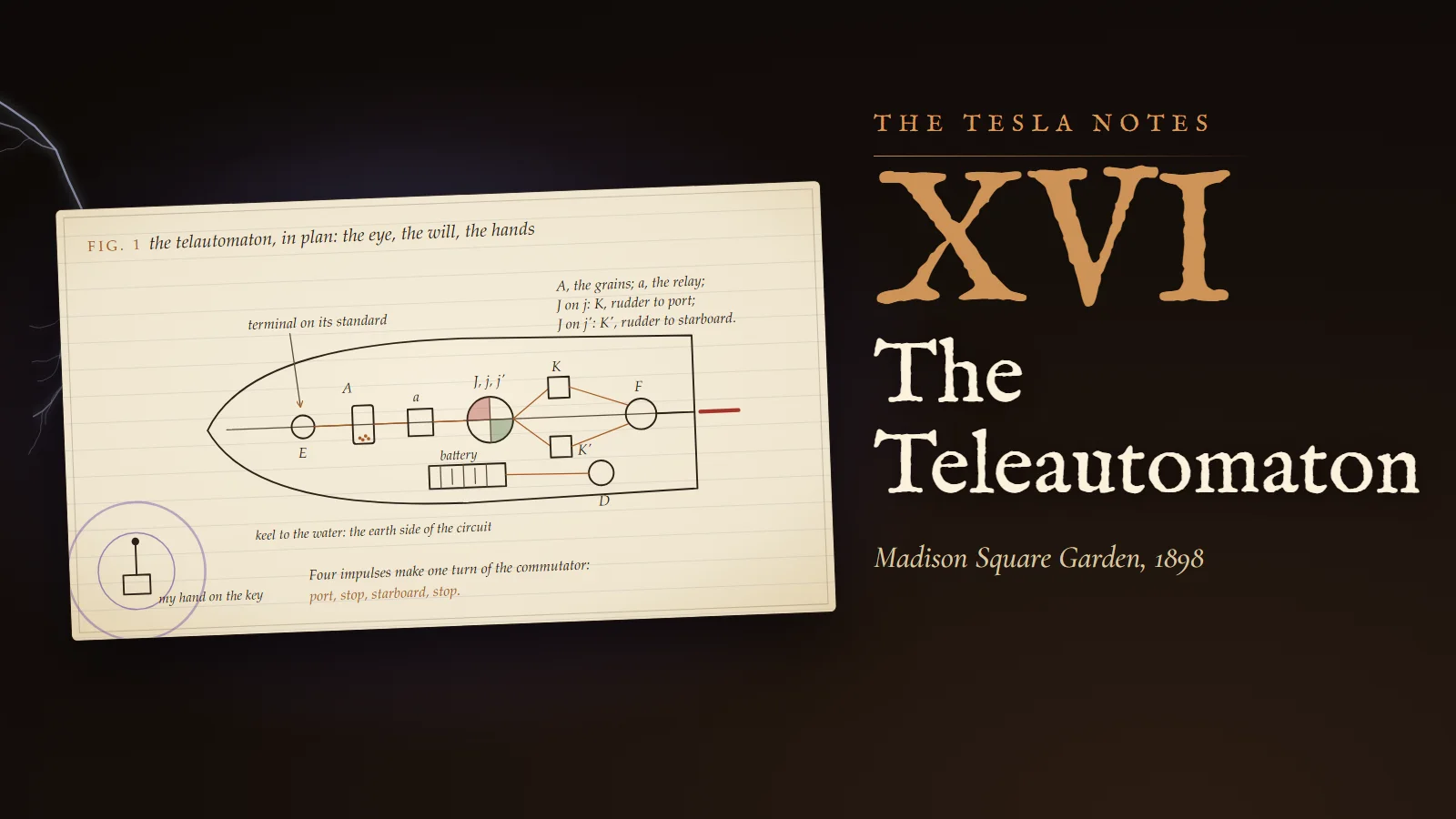
- Locomotion: a propeller turned by an electric motor D.
- Direction: a rudder turned by a second motor F, which can run either way.
- Power for both: a storage battery in the hull. Eight cells of two volts give sixteen volts; the propeller motor takes perhaps four amperes, 64 watts, and the battery of about forty ampere-hours runs it for ten hours.
- Sense: a receiving circuit, tuned to my transmitter, with a sensitive device A that changes its resistance when the impulses arrive.
- Decision: a relay a, worked by the sensitive device, which works an escapement and clockwork; the clockwork turns a commutator that sends the battery current to the steering motor one way, or the other, or not at all.
Margin
Why not light, as everyone suggests? A selenium cell for an eye was my first thought. But any obstacle between me and the machine would blind it, the eye would have to face me, and a ray gives the machine no individuality: any lamp would command it. I want it to answer to my call alone, as a person answers to his name. So it must have an ear, with a circuit tuned to one note. Electrical disturbances that spread in all directions, or follow the earth and the water round every obstacle, will reach it wherever it goes.
Houston Street, March 1897. The sensitive device
The ear. Since Mr. Branly showed that loose metal filings in a tube conduct suddenly when an electric wave passes near, and Dr. Lodge made a detector of it and named it the coherer, half the experimenters in Europe have one on the bench. They are capricious beyond words. The grains stick together after each impulse and must be shaken loose before the next, and a tube that worked yesterday is dead today because the air was damp.
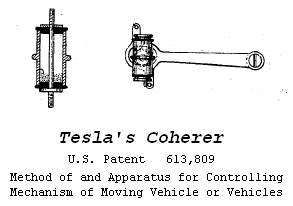
My device: a small cylinder of insulating material with metal plugs at its ends, partly filled with metal grains, set upright between two springs in the receiving circuit. When an impulse passes, the grains cohere and the cylinder conducts, and the relay a closes. Then, instead of tapping it, the clockwork turns the cylinder end for end, and the grains fall from one end to the other through the same space, are shaken in the same way, and the cylinder is ready again. It cannot help but be reset, and it is reset the same way every time.
Experiment No. 1
Six weeks on the grains alone. Filings cut by hand differ in size and shape, and the cylinder behaves differently each time it is turned. So I have a special tool made to cut grains of the same size, weight and shape, and then oxidize them all alike by keeping them a fixed time in an acid solution of fixed strength. Each grain carries a skin of oxide which insulates it until the impulse breaks the skin down at the points of contact. Uniform skins, uniform response.
Results, written in the order found. Bright iron grains: the cylinder conducts on the faintest disturbance, the slamming of a door included, and never reliably lets go. Grains oxidized ten minutes: good for a day, then dead in the evening damp. Grains oxidized, dried warm, and sealed in a cylinder with a drop of shellac on each plug: two hundred consecutive impulses without a failure. The rule I have written above the bench: moisture is fatal.
Calculation
Why the receiving circuit must be tuned, and what tuning buys.
The receiving circuit is a terminal E of large capacity on a mast, a conductor to the sensitive device, and the keel to the water. With its self-induction L and its capacity C it has a natural period, and I adjust it so that its frequency is the same as my transmitter's, or a harmonic of it.
f₀ = 1 / (2π √(LC))
- Take, for illustration, L = 0.1 henry and a transmitter at 20,000 periods. The capacity required is C = 1 / ((2πf₀)² L) = 1 / ((1.257 × 10⁵)² × 0.1) ≈ 6.3 × 10⁻¹⁰ farad, about 630 picofarads.
- Let the circuit's resistance be 50 ohms. Its sharpness of tuning is Q = ωL / R = 1.257 × 10⁵ × 0.1 ÷ 50 ≈ 250.
- The width of its response, between the frequencies where the current falls to 0.71 of its peak, is f₀ / Q = 20,000 ÷ 250 = 80 periods.
- A second transmitter at 21,000 periods, five per cent away, drives the circuit with a current reduced in the ratio 1 ÷ √(1 + (2Q × Δf/f₀)²) = 1 ÷ √(1 + (2 × 250 × 0.05)²) = 1 ÷ √626 ≈ 1/25.
Hence the rule, which is the whole art of individualisation: make the self-induction as high as possible and the resistance as low as possible, for Q = ωL/R. A circuit so made hears its own note and is nearly deaf to every other. In principle I could set fifty or a hundred receiving circuits, or more, each called by its own frequency, and command fifty boats on one pond.
Houston Street, November 1897. Four impulses make one turn
The machine is complete. I record the logic, which is the part that will outlast the boat.
Each impulse coheres the grains; the relay a closes; a magnet f draws its armature, which rocks an anchor escapement g. The escapement lets a clockwork turn a spindle carrying a disc with four pins, so that each impulse turns the spindle through exactly one quarter of a revolution. On the same spindle is the commutator: a disc in four quarters with a brush J pressing on it. Two quarters are blank. One quarter, j, sends current to relay K, which runs the steering motor F so as to put the rudder to port. The opposite quarter, j′, sends current to relay K′, which runs F the other way, to starboard. A second spindle, geared to make half a turn for each quarter turn of the first, carries the sensitive cylinder and turns it end for end.
So with each impulse the boat passes through the states in order: centre, port, centre, starboard, centre again. The rudder moves only while K or K′ is closed, up to forty-five degrees, where a contact plate stops the motor; in the blank quarters it stays where it was put. I steer by counting.
I have made the whole mechanism into Plate XVI. Send impulses from the transmitter and watch each organ answer in turn.
Margin
An ambiguity I cannot avoid. In the neutral states the rudder holds wherever it stopped. If I send two impulses in quick succession, port and then centre, the rudder goes over a little to port and is held there, and the boat circles gently forever. That is a feature: I can set any angle of turn I like by timing the impulses. But it means the operator must remember the state of the machine, because the boat will not tell him. So I have added a little motor m in series with the steering motor, working against a spring. Single impulses leave it where it is. A rapid run of impulses, too quick to move the rudder, winds it round until its lever touches a plate and lights two small lamps on standards, which show where the rudder stands. A longer run carries the lever on to a post and fires whatever device the vessel carries.
Calculation
Counting, written as a table of states. Call the commutator position s, numbered 0 to 3, and let s go to (s + 1) mod 4 at each impulse.
- s = 0: brush on blank. Rudder held.
- s = 1: brush on j. Relay K. Rudder moves to port, up to 45°.
- s = 2: blank. Rudder held.
- s = 3: brush on j′. Relay K′. Rudder moves to starboard, up to 45°.
From any state the number of impulses needed to reach a chosen state is (target − s) mod 4, so at most three. With the rudder turning at about thirty degrees a second, a full swing from 45° port to 45° starboard takes three seconds, and two impulses, through the blank state, are enough to begin it. The machine has four states and one input, and every behaviour I can show follows from those two facts and a little timing. I find it beautiful that so much obedience is made from so little.
Experiment No. 3
The danger of counting is a miscount. If the machine misses one impulse, or takes one impulse for two, it falls out of step with me, and every later command means the opposite of what I intend. So the escapement is adjusted with care: the pin is released only when the armature of magnet f has nearly reached its extreme position toward the magnet, so that a weak or broken impulse that does not pull the armature fully home moves nothing, and a long one moves the spindle once. The clockwork then needs about a third of a second to complete the quarter turn and flip the cylinder, and an impulse that arrives sooner is lost.
I ran the boat in the tank for an evening and counted. Of 600 impulses sent at a steady pace, the commutator missed three, all when I sent them faster than two a second.
Calculation
- Rate of failure at my working pace: 3 ÷ 600 = 0.005, one in two hundred.
- Chance that a single impulse is obeyed: 1 − 0.005 = 0.995.
- Chance that a course of twenty impulses is obeyed throughout: 0.995²⁰ ≈ 0.905.
- For a hundred impulses: 0.995¹⁰⁰ ≈ 0.61.
Hence, over a long voyage the boat will almost certainly fall out of step at least once, and I must be able to see it and correct it. That is a second reason for the lamps. A machine that obeys must also report, or obedience decays with every order. I suspect this rule is more general than my boat.
Madison Square Garden, 1898. The pond
The Electrical Exhibition, and a large tank built in the hall for the boat. I stood at the transmitter at one end with my hand on the key, and the boat ran, turned, stopped, came back, and lit its lamps at my command. For the newspapermen I made it seem to answer questions: asked a sum, it flashed its lamps the right number of times. They thought it read their minds. Its only guide was my hand on the key, which they could not see move.
When it was first shown at the beginning of this year it created a sensation such as no other invention of mine has ever produced, and I have learned how little a sensation is worth. Of the hundreds of men who wrote about it, most considered the results entirely impossible, and the few who admitted that they were possible saw in it merely an automobile torpedo, to be used for blowing up battleships, with doubtful success.
Experiment No. 2
A problem I did not foresee. The discharges of my high-tension transmitter ionize the air of the hall so thoroughly that even a very small aerial draws electricity out of the surrounding atmosphere for hours afterward. In the laboratory I tested it with a highly exhausted bulb twelve inches across, with a single terminal and a short wire attached: it gave nearly a thousand flashes in succession before the charge in the air was spent. An aerial on a mast in such air hears my transmitter, and also hears the air.
The remedy: receiving circuits in the form of closed loops, including condensers. A loop has no free end for the charged air to feed, and it answers to the changing magnetic field of the transmitter, through its self-induction, more than to the electric charge of the air. In the boats as I actually run them several circuits act together, so that interference of every kind is excluded. The patent, on the advice of my attorneys, shows only a single circuit and a well-known form of detector, because I have not yet secured protection on my methods of individualisation.
Reflection
A visitor at the Garden, a naval officer, asked me afterward how many pounds of dynamite it could carry. I told him it could carry anything, and that this was the least interesting thing about it. He looked at me as if I were mad. I wanted to tell him that the boat has a borrowed mind, my mind, conveyed to it across the water; that it behaves just like a blindfolded person obeying directions received through the ear; and that one day such a machine will have a mind of its own, able to follow a course laid out far in advance, to learn from experience and to choose. That is the art I have founded, and he wanted to know about dynamite.
Washington and New York, July to November 1898. The patent
Filed the 1st of July, Serial No. 684,934, "Method of and Apparatus for Controlling Mechanism of Moving Vessels or Vehicles". I described the vessel as any type that can be propelled and directed, such as a boat, a balloon, or a carriage. The Patent Office would not believe it. My claims seemed impossible to them, and the Examiner-in-Chief himself came to New York to see the boat perform before they would allow it. He saw it, and they did. Granted the 8th of November, 1898: No. 613,809.
Calculation
What the Examiner saw, in terms of energy, because he asked how a feeble impulse across a room could turn a rudder against the water.
- The impulse itself need do one thing only: break down the oxide skins between the grains. That takes a few volts across the cylinder and the energy of a small fraction of a joule.
- The cohered cylinder closes the local circuit of the relay a: a cell of a volt or two, a few milliamperes.
- The relay closes the circuit of the escapement magnet f and the commutator relays K and K′, at battery voltage, perhaps an ampere: some sixteen watts.
- K or K′ closes the steering motor's circuit, several amperes: fifty watts or more, applied for as long as the commutator stands on j or j′.
Each stage releases a larger stage, and none supplies the energy of the next. The impulse is the trigger and the battery is the charge, exactly as the lightning releases the rain, which I wrote of in the mountains six years ago. Every control is a chain of releases.
New York, December 1898. The government
I offered the invention to the Government. When I called on an official in Washington and told him what I had accomplished, he burst out laughing. Nobody thinks there is the faintest prospect of perfecting such a device, and I have the device, in a tank on Houston Street, steering itself in circles while we speak.
Reflection
I believe this will end war, and I set down why, so that I can hold myself to it later. Wars are kept alive by bloodshed, and bloodshed by the presence of men in battle. Its advent introduces into warfare an element which never existed before, a fighting-machine without men. As machines replace soldiers, battles will become contests of machines, the nations interested spectators, and in the end no nation will see the point of buying them. Its destructiveness will be so unlimited, and the personal element of combat so excluded, that it must lead to peace.
Margin
Added in a later hand. My views have changed since. War cannot be avoided until its physical cause is removed, which is the vast extent of the planet on which we live and the distance between its peoples; only by annihilating that distance, in the carrying of intelligence, of passengers and supplies, and of energy, will friendly relations be made permanent. I go to Colorado in the spring to work on the last of these, and the first.
Draftsman's note
Fig. 1 is drawn in plan with the deck removed and the parts set out along the keel line in the order the signal passes through them, which is not their true arrangement in the hull. The commutator quarters are coloured red for port and green for starboard, as a ship's lights are, so that the eye can follow which relay is fed.
Problems I set myself
1. A receiving circuit has a self-induction of 0.25 henry. What capacity tunes it to a transmitter of 10,000 periods? If I wish to tune it instead to the second harmonic of a transmitter at 5,000 periods, what capacity is needed?
Answer. C = 1 / ((2πf)² L). At 10,000: (2π × 10⁴)² = 3.948 × 10⁹, so C = 1 ÷ (3.948 × 10⁹ × 0.25) ≈ 1.01 × 10⁻⁹ farad, about 1,000 picofarads. The second harmonic of 5,000 periods is 10,000 periods, so the same capacity serves: a circuit tuned to a harmonic of the source responds to it, as the patent says.
2. The circuit of Problem 1 has 40 ohms of resistance. Find its Q and the width of its response. By what ratio is the current reduced for a transmitter at 10,500 periods?
Answer. Q = ωL / R = (6.283 × 10⁴ × 0.25) ÷ 40 ≈ 393. Width = f₀ / Q = 10,000 ÷ 393 ≈ 25 periods. For 10,500, Δf/f₀ = 0.05, so 2Q × 0.05 ≈ 39.3 and the ratio is 1 ÷ √(1 + 39.3²) ≈ 1/39. Doubling the resistance would halve Q and roughly double the ratio, to about 1/20.
3. The boat is steering to port, its commutator at s = 1. I wish to steer to starboard. How many impulses must I send, and what does the rudder do in between? If the rudder turns at 30 degrees a second and I send the impulses 1.1 seconds apart, how far is it from the 45° limit when the commutator reaches j′, assuming it started hard over to port?
Answer. (3 − 1) mod 4 = 2 impulses: the first moves the brush to blank, where the rudder is held hard to port; the second moves it to j′ and relay K′ drives the rudder toward starboard. It must travel 90° from 45° port to 45° starboard, which takes 3 seconds. The interval of 1.1 seconds spent at blank does not move it, so at the instant the second impulse arrives the rudder is still at 45° port, the full 90° from the starboard limit; it reaches the limit 3 seconds later if I send nothing more.
To the student who reads this later
You will recognise my boat at once: a radio receiver, a one-bit detector, and a two-bit counter driving an actuator. My commutator is a finite-state machine with four states and a single input, and my chain of releases is what you call amplification and switching, done here by relays. The coherer was soon replaced by crystal detectors and then by the vacuum tube, which can amplify a weak signal smoothly instead of merely triggering; with it radio control became practical for aircraft and ships within thirty years. Drones, the rovers on Mars, the robotic arms in your factories and the little machine that cleans your floor are all telautomata, many of them with something like a mind of their own, which is the part I promised and did not live to see.
My tuned circuit is exactly your resonant LC filter, and Q = ωL/R is exactly your quality factor. Selectivity by tuning was being developed at the same time by others; Oliver Lodge patented syntonic tuning in 1897 and Marconi his four-sevens patent in 1900, and the courts later spent decades on who owned what. On my loops I was right: a small loop antenna responds chiefly to the magnetic field and is far less troubled by electrostatic noise than a short wire, and it is still used where noise is bad.
On the end of war I was wrong, and I said so myself in 1919. Machines without men have made war cheaper to begin, and have not made it rarer. If you build a telautomaton, I would ask you to think about what it will be asked to do before you think about how well it obeys.
If you would like to argue about any of this, or hear how the boat behaved on the day the Examiner came, come and ask me.
Sources and liberties
The Tesla Notes are a modern reconstruction written in Nikola Tesla's voice by Eternal Gardens. Dates, patents, lectures, apparatus and quotations come from the sources below; the private reflections, the order of the working and the sketches are ours.
- N. Tesla, US Patent 613,809, "Method of and Apparatus for Controlling Mechanism of Moving Vessels or Vehicles", filed 1 July 1898, granted 8 November 1898: Google Patents
- N. Tesla, "The Problem of Increasing Human Energy", Century Magazine, June 1900 (telautomatics; the selenium cell; the ear; borrowed minds; the automobile torpedo; the fighting-machine without men): Wikisource
- N. Tesla, "My Inventions", Electrical Experimenter, 1919, chapters II and VI (the automaton; 1893, 1896 and 1897; the Examiner-in-Chief; the official who laughed; the attorneys; the loops and the twelve-inch bulb; "my views have changed since"): Wikisource
- Commons image of the rotating coherer from the patent: Wikimedia Commons
- On Branly and Lodge and the coherer: Wikipedia, "Coherer"
The boat's length, the battery figures, the grain experiments after the first sentence, the count of 600 impulses, the illustrative tuning values and the energy chain are ours, as are the naval officer and the dates of the Houston Street and December entries; Tesla does not date his visit to the official in Washington. Tesla wrote only that the machine was "first shown in the beginning of 1898"; the public demonstration at the Electrical Exhibition in Madison Square Garden is dated here simply 1898, and the boat answering arithmetic questions from the crowd comes from later popular accounts. That Tesla offered the invention to the Government in 1898 and 1900 rests on his own statement in 1919, and whether "it" in that passage means telautomatics or the magnifying transmitter is read differently by different writers.