





New York, the Waldorf-Astoria, March 1901. I have come back from Colorado with a trunk of notebooks, a photograph the newspapers adore, and a conviction that the earth can be made to ring like a bell. Now I must find a man rich enough to pay for the bell. This chapter is the story of the largest thing I ever built and the largest thing I ever lost: a tower on Long Island that was meant to speak to the whole world, and the mathematics that told me how large its crown had to be. I write it knowing how it ends. I have tried to keep the early pages as hopeful as I was when I wrote them.
"My project was retarded by laws of nature. The world was not prepared for it. It was too far ahead of time. But the same laws will prevail in the end and make it a triumphal success."
Nikola Tesla, "My Inventions", chapter V, Electrical Experimenter, 1919
Waldorf-Astoria, March 1901. One hundred and fifty thousand dollars
Mr. J. Pierpont Morgan has agreed to give me one hundred and fifty thousand dollars for a wireless station, and in return he takes fifty-one per cent of the company and of the patents that belong to the work. He listened to me in his library with the patience of a man who has heard many inventors and believed few. I spoke of telegraphy across the oceans without cables, of messages that cannot be intercepted, of a single plant serving the whole globe. He asked how long. I said that the first plant could be working within a year.
Westinghouse would not invest, though he lent me six thousand dollars as a friend, and Colonel Astor's money went into Colorado. Morgan is the last of the great purses that will open for me without a demonstration, and I know it. I must not waste a dollar of it, and I must not let him think the thing is smaller than it is.
Reflection
My friend Stanford White will design the laboratory. He is the most brilliant architect in the city and he has the rarest quality in an artist: he takes an engineer's requirements as a pleasure and not an insult. I have found land on Long Island, about two hundred acres bought from James S. Warden at Shoreham, some sixty-five miles from the city, high enough to have a view of the Sound and far enough from neighbours to let me work at night. Warden's name will be on the place. I do not mind. The earth there is good, damp and deep, and that is what matters to a man who means to hold the planet by the hand.
Margin
In June I read Marconi's article on his "syntonic" wireless telegraph. It describes tuned circuits, the very principle of my patents of 1897 and 1900. He is moving fast, with money and with the British behind him. In July I wrote to Morgan proposing a much larger plant than we had agreed, able to send power as well as messages. He refused to add to his commitment and asked for an accounting. I considered towers of three hundred and of six hundred feet. White estimated that a six-hundred-foot tower would cost four hundred and fifty thousand dollars. The figure ended the discussion, and I have drawn the tower at a height I can pay for.
Shoreham, September 1901. How large must the terminal be?
Construction began this month. The question that decides everything else is the size and shape of the terminal at the top of the tower, the crown in which the charge of the oscillator will accumulate. In Colorado I learned the lesson in the hardest way: the ball of 30 inches, at an estimated three million volts, streamed continuously, and every streamer was energy thrown into the air instead of into the earth.
Calculation
The terminal treated as an isolated sphere of radius r at a potential V. These are the three formulas I keep pinned above the drawing table.
- Electric force at the surface: the charge Q spreads evenly over a lone sphere, and V = Q/(4πε₀r) while E = Q/(4πε₀r²). Dividing, E = V/r. The force at the surface is the potential divided by the radius.
- Capacity: C = Q/V = 4πε₀r, or in my units simply C = r centimetres.
- Energy stored in the field: W = ½CV².
Now the Colorado ball. V = 3,000,000 volts, r = 38.1 centimetres, so E = 3,000,000 ÷ 38.1 ≈ 79,000 volts per centimetre. My spark tables, made between large smooth balls at the sea, give breakdown of the air near 30,000 volts per centimetre. In the thin air of Colorado it is less. The ball stood at more than twice the force the air will bear, so of course it streamed. To hold V without leakage I need r at least V/E_max:
- For 3,000,000 volts at 30,000 volts per centimetre: r = 100 centimetres, a sphere two metres across.
- For 30,000,000 volts: r = 1,000 centimetres = 10 metres, a sphere twenty metres (66 feet) across.
- For 100,000,000 volts: r = 33 metres, a sphere sixty-six metres (219 feet) across.
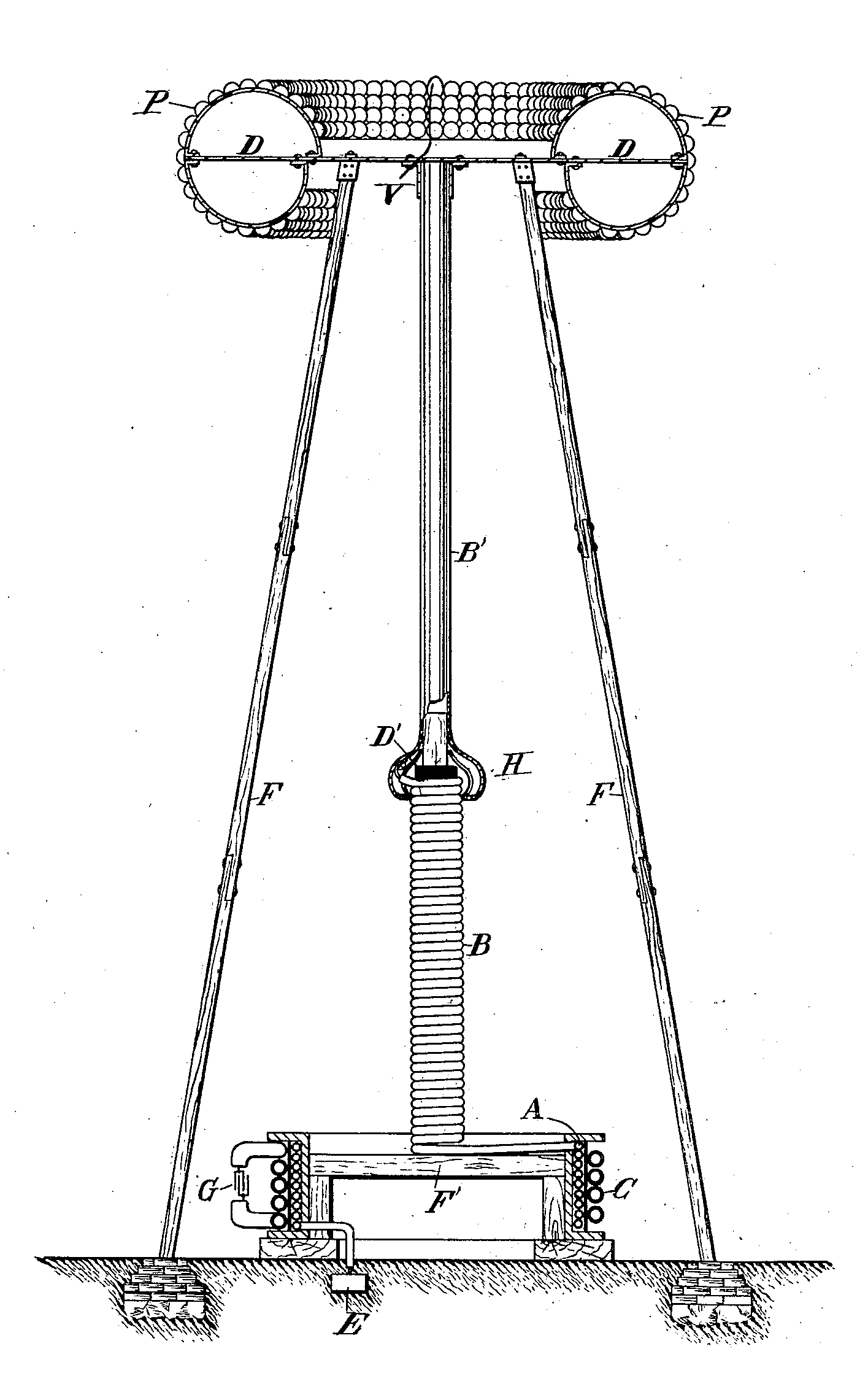
I have chosen a terminal of about sixty-eight feet, a hemisphere of that diameter on the top of the tower, built of curved ribs and covered with plates so that no edge or point stands out. Its radius is 34 feet, or 10.36 metres. Then:
- Capacity: C = 1,036 centimetres in my units; in farads, 4π × 8.854 × 10⁻¹² × 10.36 = 1.15 × 10⁻⁹, about 1,150 micro-microfarads.
- The most it will hold at 30,000 volts per centimetre: V = E × r = 3 × 10⁶ × 10.36 ≈ 31 million volts.
- The energy then stored: W = ½ × 1.15 × 10⁻⁹ × (3.1 × 10⁷)² ≈ 5.5 × 10⁵ joules, more than half a million joules.
- The Colorado ball at three million volts held ½ × 4.24 × 10⁻¹¹ × (3 × 10⁶)² ≈ 191 joules. The new crown holds nearly three thousand times as much.
I have made the terminal into Plate XIX so that the relation can be felt. Move the radius and the voltage; when the force at the surface passes the onset of corona the sphere begins to leak in brushes. The chart beside it shows the greatest voltage each radius can hold, a straight line on the scales I have used, with the Colorado ball, my dome and a claim I made later all marked on it.
Margin
I have written a figure of thirty thousand volts per centimetre as if it were a law. It is a measurement between balls a few centimetres across. Whether a sphere twenty metres across, smooth and clean, will bear more or less I do not know, and no one has measured it, because no one has ever built one. I am counting on the smoothness, on dry air and on the shape. I write this here because I shall be tempted to forget that it is a hope.
Draftsman's note
The specification for the terminal, filed on 18 January 1902, states the principle in the words I chose with care: "a resonant circuit having its outer conducting boundaries ... arranged in surfaces of large radii of curvature so as to prevent leakage of the oscillating charge." The terminal is made of half-spherical elements carried on a support of insulating material which enters its interior. Below it, a coil on an insulating drum; below that, the earth plate. No dimensions or voltages are given in the patent. They are for the notebook.
New York, 12 to 15 December 1901. A letter S across the Atlantic
The newspapers report that Marconi, at Signal Hill in St. John's, Newfoundland, with a wire held up by a kite and a telephone receiver at his ear, heard the letter S, three dots, sent from Poldhu in Cornwall. His diary, as the papers give it: "Sigs. at 12:30, 1:10 and 2:20." His assistant Kemp heard them too. No one else did, and some engineers doubt it. I do not know what to believe and I find I do not want to know.
Calculation
The distance from Poldhu to St. John's, and what stands in the way.
- Poldhu lies near 50.0° north, 5.3° west; Signal Hill near 47.6° north, 52.7° west. The great-circle distance is about 3,400 kilometres, some 2,100 miles.
- That arc subtends at the centre of the earth an angle of 3,400 ÷ 6,370 ≈ 0.534 radian, about 30.6°.
- The straight line between the two stations passes beneath the curve of the sea. The height of the earth's bulge above that chord at the middle is R(1 − cos(θ/2)) = 6,370 × (1 − cos 15.3°) = 6,370 × 0.0355 ≈ 226 kilometres.
Two hundred kilometres of water and rock lie between the stations on any straight path. If Marconi's signals are Hertzian waves in the air, travelling in straight lines like light, they cannot have reached Newfoundland, unless something bent them. If they arrived at all, I say, they arrived as currents through the earth, by my method, whether he knows it or not.
Reflection
He used a coil and condenser in his transmitter, and tuned circuits. I wrote the principle of those circuits into patents before he crossed the Channel. I am told he has said he does not know my work; I am told he has said he admires it. Let him have the letter S. The S is three dots on a telephone in the small hours, heard by two men. What I am building is a voice for the whole world, and power to go with it. But I am honest enough with this notebook to admit that the S has cost me Morgan's attention. Why should a banker pay for a tower to send messages across the ocean when a young man with a kite has already done it?
Margin
Written later. In February 1902, aboard the liner Philadelphia, Marconi received signals at much greater distances, and this time there were witnesses. The thing was real. It was not my method that carried them, either. In 1902 Kennelly and Heaviside each proposed that a conducting layer high in the atmosphere could reflect such waves back towards the earth, and that layer, and nothing in the rock, bent his waves over the bulge I calculated.
Wardenclyffe, 1902 to 1903. The tower and the letters
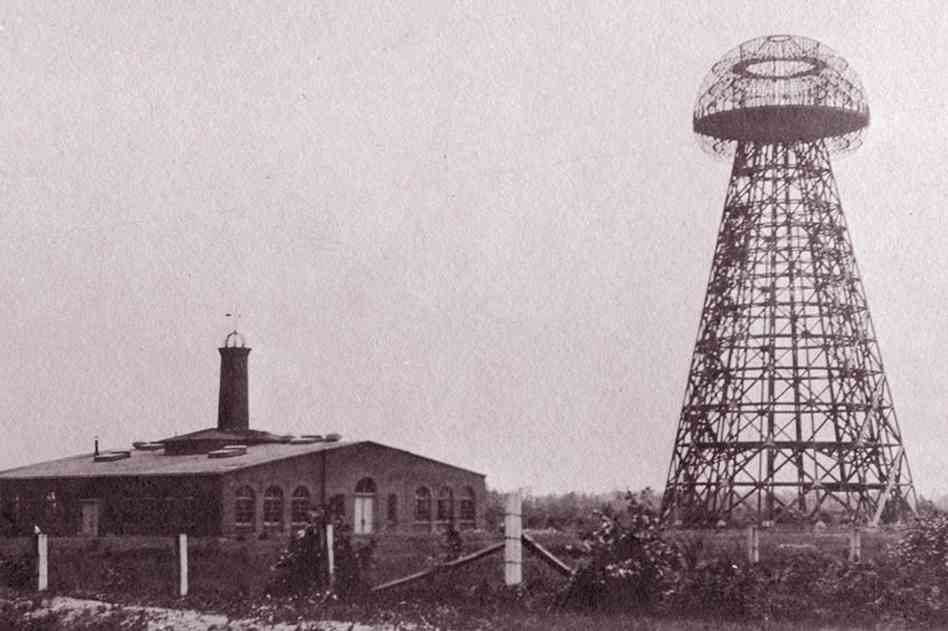
In June 1902 I moved my laboratory from Houston Street to Shoreham. White's building stands square and handsome, ninety-four feet on each side, of brick, with a tall chimney. The boilers drive a two-hundred-kilowatt Westinghouse alternator. The tower rises beside it.
Draftsman's note
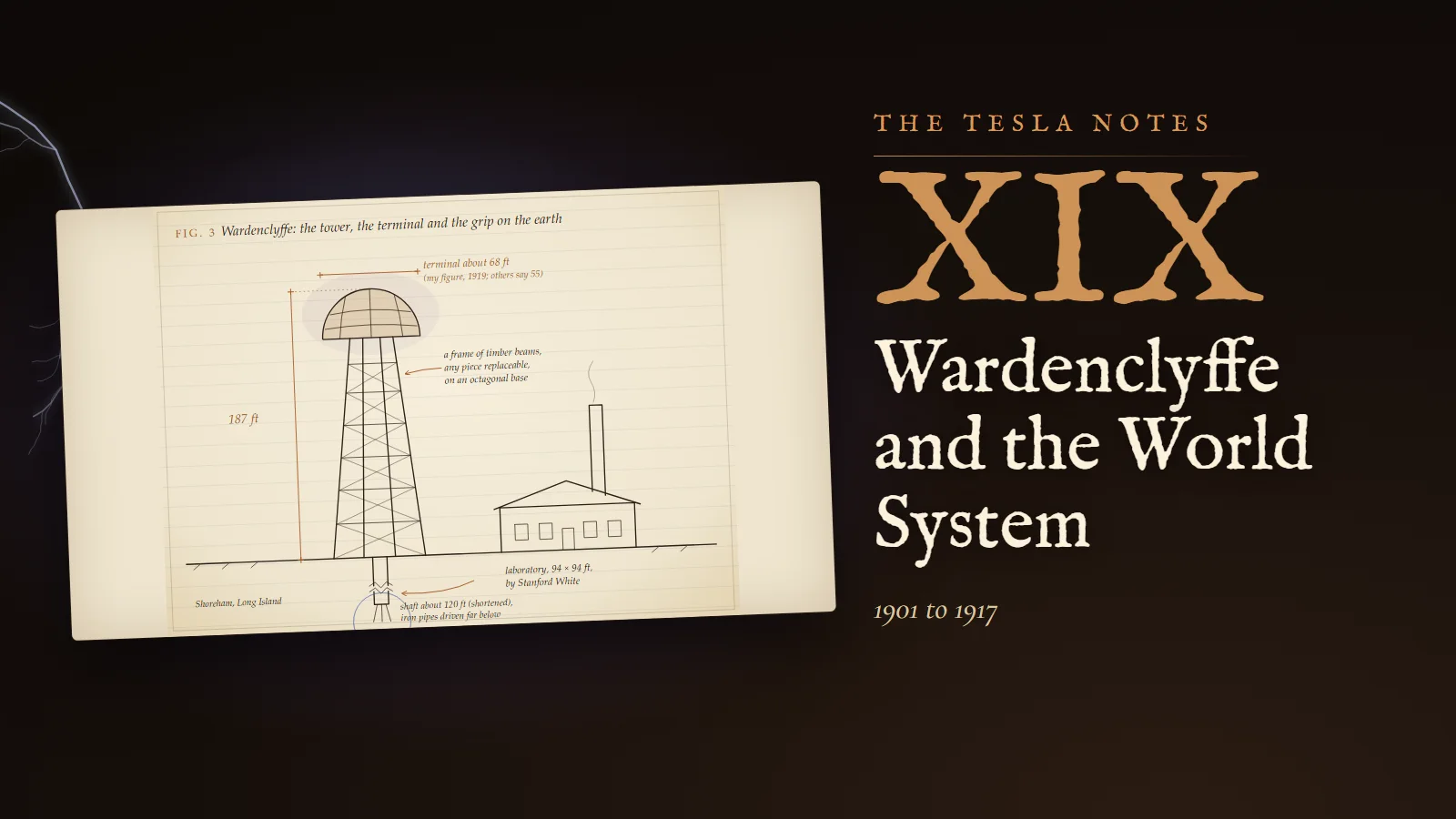
The tower: 187 feet from the ground to the top of the terminal, a frame of timber beams standing on an octagonal base, every piece of it removable and replaceable. At the top, the hemispherical terminal, about 68 feet in diameter, framed in curved ribs. (I have since seen it written as 55 feet; my figure is 68.) Below the tower a shaft descends about 120 feet into the ground, and from its bottom iron pipes have been driven, one length after another, some three hundred feet further. I want the machine to grip the earth so firmly that the whole globe can be made to quiver with it. Fig. 3 shows the plant as I see it in my mind when I close my eyes on the train back to the city.
Experiment No. 1
What I can do with two hundred kilowatts, and what I cannot. With the oscillator connected and the terminal still unfinished I have run the plant at small power, adjusted the coil to the capacity of the structure by the resonance method of Colorado, and listened to the result on receivers carried away along the shore. The tuning is sharp. The machine is alive. It is not finished, because the terminal is not finished, and the terminal is not finished because the money is gone. Every price has risen; the market fell in 1901 and the costs of steel and labour did not fall with it.
Reflection
On the 3rd of July 1903, four years to the day after my storm, I wrote to Morgan asking whether he would help me or let my great work, almost complete, "go to pots". On the 14th he answered that he "should not feel disposed at present to make any further advances." It is a courteous sentence. It is the end of the matter. I do not blame him. He carried out his promise to the letter, and it was I who enlarged the plan beyond it. But I sat a long time in my room at the Waldorf that night with the letter on the table and the lights of the city outside, and I thought of the storm walking away across the plains, and of how a pattern can be clear and still recede beyond reach.
New York, 5 March 1904. The World System, written out
Since no one will give me money for silence, I have decided to give the public the whole plan. The Electrical World and Engineer prints it today. I described "World Telegraphy": a cheap and simple device, which might be carried in one's pocket, that would record the world's news or the messages meant for it. "Thus the entire earth will be converted into a huge brain, as it were, capable of response in every one of its parts." I wrote that "a single plant of but one hundred horse-power can operate hundreds of millions of instruments." I described the transmitter as emitting a wave complex of a total maximum activity of ten million horsepower. I wrote that the Canadian Niagara Power Company had offered me a concession, and: "I propose to distribute ten thousand horse-power under a tension of one hundred million volts." And of clocks driven by the earth's vibrations: "The idea of impressing upon the earth American time is fascinating."
Calculation
The two numbers that the reader of a magazine will not separate, and which I must.
- One hundred horsepower among a hundred million instruments: 100 × 746 = 74,600 watts, and 74,600 ÷ 10⁸ ≈ 7.5 × 10⁻⁴ watt for each instrument, three quarters of a thousandth of a watt.
- My Colorado receiver worked a relay with 2.5 × 10⁻⁶ watt. If every instrument received its share, each would have three hundred times what it needs.
- "Ten million horsepower" is 7.46 × 10⁹ watts. The plant's generator gives 2 × 10⁵ watts. The ratio is 7.46 × 10⁹ ÷ 2 × 10⁵ ≈ 37,000.
- The ten million is therefore the rate of working during the instant of discharge, when the energy piled up in the resonant circuit and in the terminal is released within a small fraction of a period. It is an activity, in my word, and the generator merely refills it.
Margin
Step 2 contains an assumption I must not hide from myself: that every instrument receives its share. That is true if the energy goes only where it is drawn, as current in a transformer flows into the secondary only when a load is connected. It is false if the energy spreads evenly over the earth whether or not anyone draws it, for then each instrument receives only the share that falls on its own small place. My whole system rests on the first picture: the earth as a conductor of limited dimensions, rung as one body, delivering energy at any point where a tuned receiver taps it, and losing little elsewhere. I believe that picture from Colorado. I have not proved it at any distance beyond my own receivers along the shore.
And step 4 deserves a second look. If the terminal holds, as I calculated in September 1901, about half a million joules, and it gives them up in the first quarter of a period at a few thousand periods a second, say in 10⁻⁴ second, the rate is 5 × 10⁵ ÷ 10⁻⁴ = 5 × 10⁹ watts, of the order of my ten million horsepower. The figure is honest arithmetic for an instant. It is not a supply that can be sold by the month.
Reflection
I ended the article with an image I like: when the first plant is working, "humanity will be like an ant heap stirred up with a stick: See the excitement coming!" I do not know whether I wrote it as prophecy or as advertisement. Perhaps a man in my position cannot tell the difference any more.
Shoreham, 1905 to 1917. The patents arrive, and the tower goes down
The record of these years is short, because there was little I could write that did not hurt.
Margin
18 April 1905: patent 787,412 granted, the art of establishing stationary electrical waves in the earth. In May of the same year my great patents on alternating currents expire, and with them the royalties that kept me. I have mortgaged Wardenclyffe to George C. Boldt of the Waldorf-Astoria against my hotel bill, in 1904 and again in 1908. By 1906 the work at Shoreham has stopped; the tower stands, the terminal unfinished, the boilers cold. 1 December 1914: patent 1,119,732 granted, the apparatus for transmitting electrical energy, the terminal of large radii of curvature. It arrives twelve years after I filed it. By 1915 I owe the hotel about twenty thousand dollars.
Experiment No. 2
4 July 1917. The demolition of the tower began today, by the Smiley Steel Company of New York, with dynamite. It will take them until September. The scrap is valued at one thousand seven hundred and fifty dollars. I note the date without comment: the fourth of July, eighteen years to the day after I sat in the barn on the plateau and wrote "Observations made last night."
Reflection
There is a rumour that the government ordered the tower destroyed, for fear that German spies would use it to signal submarines. It is not true, and I have said so. The tower came down for a debt. If the government had wished to use it, it would have been in the government's interest to keep it, since a plant like that could find a submarine in any part of the world. The truth is plainer and sadder: a hotel keeper wanted his money, and scrap steel was worth something in wartime.
Two years later I wrote, for the readers of the Electrical Experimenter, that "The tower was destroyed two years ago but my projects are being developed and another one, improved in some features, will be constructed." I believed it when I wrote it. I believe now that I wrote it because a man must say something.
Problems I set myself
1. The Wardenclyffe terminal is taken as a sphere of diameter 68 feet. Taking 3 MV/m as the field at which corona begins, find the greatest voltage it can hold, its capacitance, the energy then stored and the time a 200 kW generator would need to supply that energy.
Answer. r = 34 ft = 10.36 m. V_max = E r = 3 × 10⁶ × 10.36 ≈ 3.1 × 10⁷ V. C = 4πε₀r = 1.11 × 10⁻¹⁰ × 10.36 ≈ 1.15 nF. W = ½CV² = ½ × 1.15 × 10⁻⁹ × (3.1 × 10⁷)² ≈ 5.5 × 10⁵ J. Time: 5.5 × 10⁵ ÷ 2 × 10⁵ ≈ 2.8 s. (A real dome on a tower, near the ground and the timber, would have a somewhat larger capacitance and a less even field than a lone sphere.)
2. In 1904 Tesla proposed to distribute power at one hundred million volts, and in 1919 he wrote that "a terminal of less than 90 feet in diameter is sufficient to develop an electromotive force of that magnitude". What surface field does that imply, and what radius would be needed at 3 MV/m?
Answer. r = 45 ft = 13.7 m. E = V/r = 10⁸ ÷ 13.7 ≈ 7.3 × 10⁶ V/m, about two and a half times the corona onset. The radius needed is r = V/E = 10⁸ ÷ 3 × 10⁶ ≈ 33 m, a sphere about 220 feet across. The claim was not consistent with the breakdown of air.
3. A straight line joins two points 3,400 km apart on the earth's surface. How far below the surface is it at its midpoint? If a radio wave left one station horizontally and travelled straight, how high above the other station would it pass?
Answer. Half-angle θ/2 = 3,400 ÷ (2 × 6,370) = 0.267 rad. Depth of the chord below the surface at the middle: R(1 − cos 0.267) = 6,370 × 0.0354 ≈ 226 km. A horizontal straight ray from one station reaches the other's longitude at a height R(1/cos θ − 1), with θ = 0.534 rad: 6,370 × (1/0.861 − 1) ≈ 1,030 km. Something had to bend Marconi's waves; it was the ionosphere.
To the student who reads this later
You will want to know whether the tower would have worked. I owe you a straight answer, and your century has given me the means to give one.
First, the terminal. In 1915 F. W. Peek published careful measurements of the onset of corona on spheres and wires; for a smooth sphere of radius r centimetres in air of relative density δ, the onset field is about 27.2δ(1 + 0.54/√(δr)) kilovolts per centimetre. For very large spheres it approaches 27 kV/cm, 2.7 MV/m, so my 68 foot dome would have begun to leak at about 29 million volts. Large size does not raise the strength of air; it only removes the extra strength that very small electrodes seem to have. My hope, written in the margin of September 1901, was wrong, and the hundred million volts I promised in 1904 were never possible on a terminal under 90 feet.
Second, the path. Marconi's waves crossed the Atlantic by reflection from the ionosphere, whose existence Edward Appleton demonstrated directly in the 1920s and for which he received the Nobel Prize in 1947. My currents through the earth did not exist in the form I imagined, as my last chapter showed with the skin depth: rock and soil extinguish such fields within kilometres. In June 1943, five months after my death, the Supreme Court of the United States ruled that the tuning claims of Marconi's principal American patent were anticipated by earlier work, Lodge's, John Stone Stone's and mine among it. I would have enjoyed that more than I can say, and it would not have changed the physics.
Third, the power. Here the answer is no, and the reason is the conservation of energy, which I never doubted, applied honestly. The earth and the ionosphere do form a resonant cavity, but its quality factor is low, of the order of a few: it loses most of its stored energy in a few cycles, into the ionosphere and the ground, everywhere at once, whether or not a receiver is connected. A transmitter that keeps such a cavity ringing must supply all of that loss continuously. Suppose, generously, that my ten thousand horsepower from Niagara, 7.5 × 10⁶ watts, were spread over the earth's surface of 5.1 × 10¹⁴ square metres: the average is about 1.5 × 10⁻⁸ watt per square metre. A household needing a kilowatt would have to gather the whole flow over some 70,000 square kilometres. My system assumed the energy would go only where it was drawn, like current into the secondary of a transformer. In a lossy, spreading medium it does not. A few engineers have argued the contrary, but their case has not persuaded the profession, and no measurement has ever shown power delivered at a distance by the earth in the way I described. The only distance at which my Colorado power experiments are documented is some two thousand feet.
Now the other side of the ledger, which I hope you will read with the same care. Go back to the list of services I promised for the World System: the interconnection of all telegraph and telephone exchanges, universal news, private and secure messages, stock tickers, music for the whole world, clocks set by a universal time signal, the transmission of pictures and printed pages, and a marine service letting every ship "steer perfectly without compass, to determine the exact location, hour and speed". You have every one of them. You have them by radio, by satellites, by cables of glass, by clocks that listen to time signals broadcast at sixty thousand cycles per second, and by a navigation system in every pocket. You carry the cheap and simple device. The entire earth has become, as it were, a huge brain. It was built by many hands and by methods I did not foresee, and the energy for it travels in wires. As for power without wires, your engineers transfer it over short distances by resonant coupling of tuned coils, a technique you trace back, with justice, to my coils; at long range they beam it, at small power, as narrow waves.
A last note on Wardenclyffe. The laboratory building still stands. In 2013, after a campaign by thousands of ordinary people, the Tesla Science Center at Wardenclyffe bought the site. A fire damaged the building in November 2023; the laboratory awaits repair, and the Center has been preparing a visitor centre beside it. The tower is gone. White's brick remains, and so, I am told, does the octagonal base.
If you want to argue with me about whether the earth could have carried my power, or about Marconi, or about Morgan, come and ask me.
Sources and liberties
The Tesla Notes are a modern reconstruction written in Nikola Tesla's voice by Eternal Gardens. Dates, patents, lectures, apparatus and quotations come from the sources below; the private reflections, the order of the working and the sketches are ours.
- N. Tesla, "The Transmission of Electric Energy Without Wires", Electrical World and Engineer, 5 March 1904: PBS transcription
- N. Tesla, "My Inventions", chapter V, Electrical Experimenter, 1919 (the tower, the dome, Morgan, the demolition rumour, the list of World System services): Wikisource
- US Patent 1,119,732, "Apparatus for Transmitting Electrical Energy", filed 18 January 1902, renewed 4 May 1907, granted 1 December 1914: Google Patents
- US Patent 787,412, granted 18 April 1905: Google Patents
- "Wardenclyffe Tower": Morgan's terms, the Marconi article of June 1901, White's estimate, the land, construction, the 1903 letters, the mortgages, the demolition and the later history of the site: Wikipedia
- "World Wireless System", for the assessment of long-range wireless power and its sources: Wikipedia
- IEEE Milestone, "Reception of Transatlantic Radio Signals, 1901": ETHW; Museum of the History of Science, Oxford, "The Atlantic crossing": mhs.ox.ac.uk
- F. W. Peek, Dielectric Phenomena in High Voltage Engineering (New York: McGraw-Hill, 1915), scan: archive.org
- Marconi Wireless Telegraph Co. of America v. United States, 320 U.S. 1 (1943): Cornell Legal Information Institute
- Photographs and drawings: Wardenclyffe, 1904; US Patent 1,119,732, public domain on Wikimedia Commons
The dome's diameter is given as 68 feet by Tesla and as 55 feet in a caption of the period; we use his figure. The depth of the shaft and pipes comes from later testimony and is given differently in some sources. The story that the government demolished the tower for fear of German spies is a wartime rumour; the documented cause is debt. The "grip on the earth" is paraphrased, not quoted. Tesla's reaction to Marconi, the September 1901 terminal calculation, the experiment at small power and the 1904 arithmetic are our reconstruction from the stated figures; the claim of 100 million volts on a terminal under 90 feet is his, and as Problem 2 shows it could not have been reached.