
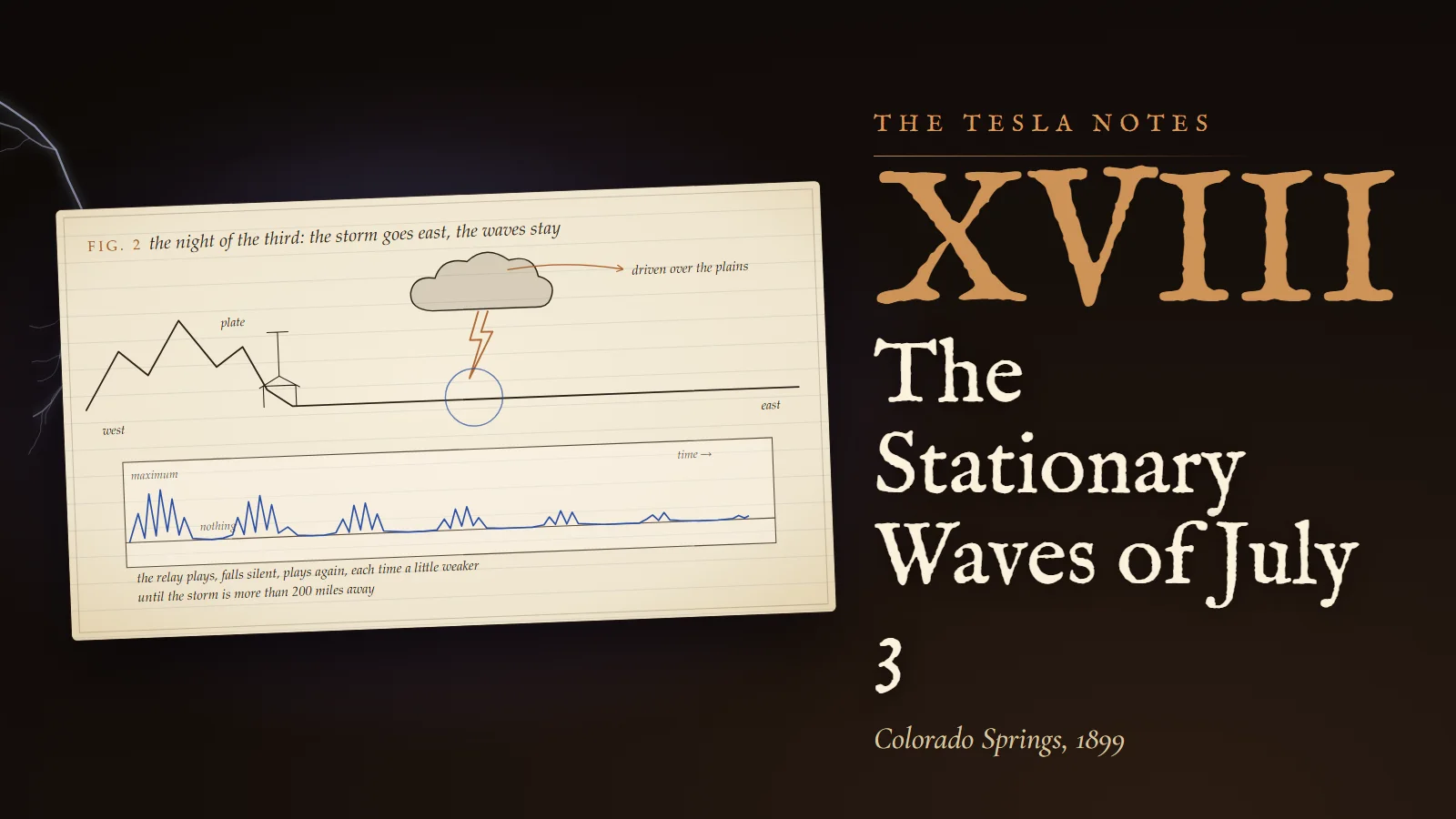
Colorado Springs, the 4th of July 1899, in the early morning. The town is preparing its fireworks, and I have had mine already. Last night a storm came off the mountains and went away east across the plains, and for hours my receiving instrument rang, fell silent and rang again, long after the thunder had gone out of hearing. I have not slept. Before the meaning hardens into a conviction I want to write down exactly what I saw and exactly what I thought, because I suspect that in a few years I shall remember it differently. The question of this page is simple to state: are these electrical waves stationary, and if so, what is holding them still?
"Impossible as it seemed, this planet, despite its vast extent, behaved like a conductor of limited dimensions."
Nikola Tesla, "The Transmission of Electric Energy Without Wires", Electrical World and Engineer, 5 March 1904
Colorado Springs, 1 to 30 June 1899. Listening to the ground
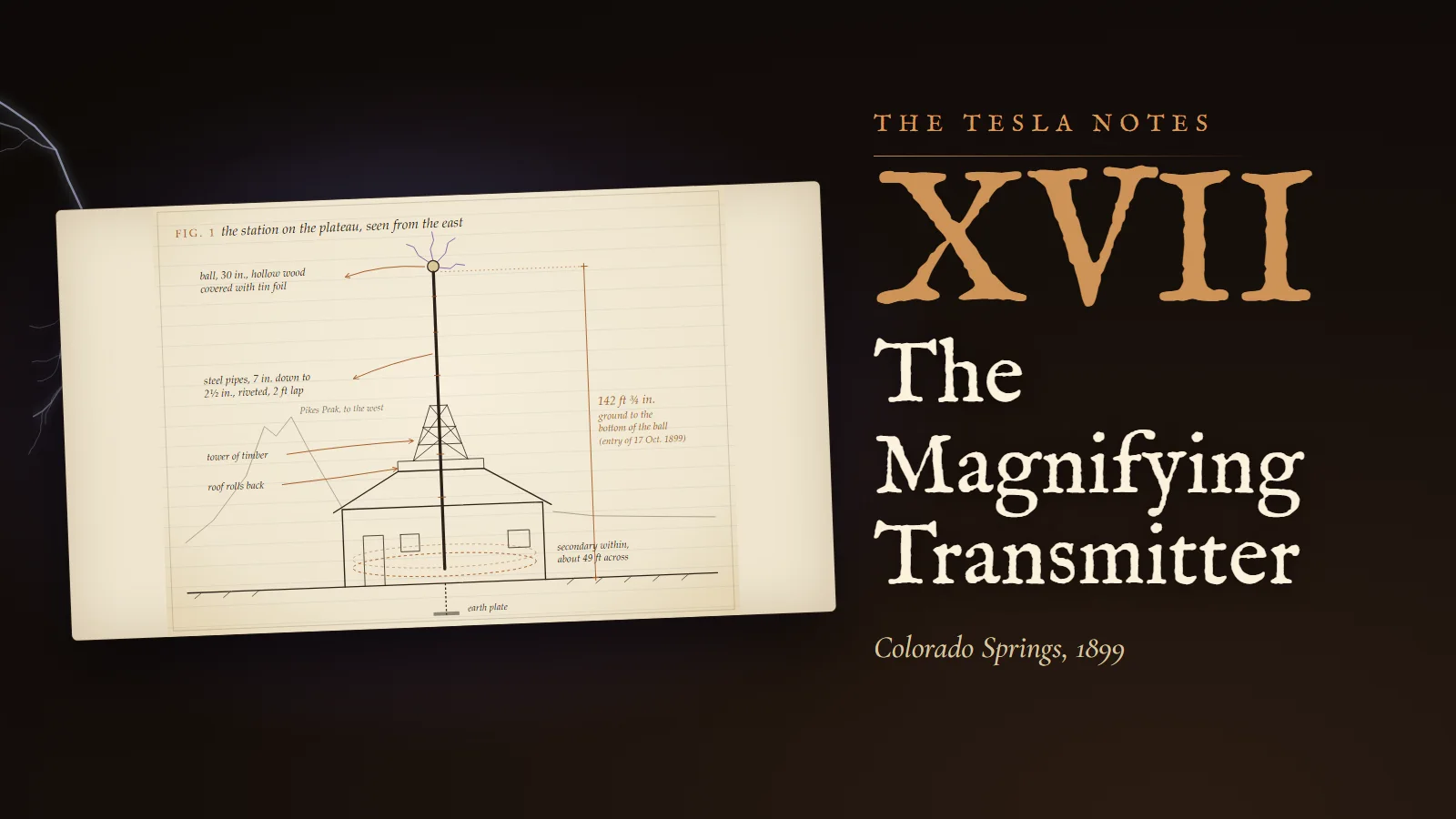
Before the transmitter was finished I built the ear. A receiving transformer, one end of it to the earth plate and the other to a plate raised above the ground, with a sensitive device in its secondary and a relay that works a recorder. The device is a tube of metal particles which cohere when an electrical disturbance passes through them and must be shaken loose again; I keep them shaken by turning the tube. The relay closes, the recorder marks, and I have a written line where before there was only a crackle in the telephone.
Calculation
How little the receiver needs. On 1 June I found that it works with about one twenty-thousandth of an ampere through a relay of 1,000 ohms.
- Current: I = 1/20,000 = 5 × 10⁻⁵ ampere.
- Pressure across the relay: V = IR = 5 × 10⁻⁵ × 1,000 = 0.05 volt.
- Power: P = I²R = (5 × 10⁻⁵)² × 1,000 = 2.5 × 10⁻⁶ watt, two and a half millionths of a watt.
A candle radiates some tens of watts. My receiver answers to a ten-millionth of that. With such an ear the whole country is audible.
Experiment No. 1
From the middle of June I left the recorder running through the storms. The earth is never quiet. Every flash within a hundred miles makes its mark, and on some afternoons the marks come so thick that the line becomes a smudge. At the end of June I noticed something that offends common sense. The instrument was affected more strongly by discharges far away than by discharges near by. A flash on the mountains five miles off might leave a faint mark, and a storm I could barely see on the eastern horizon would make the relay chatter.
Margin
Possible explanations, each to be tested. The near flashes may be so violent that the particles cohere and stay cohered, so that the relay misses most of them. The distant ones may arrive in some more regular form. Or the effect at a given place may depend upon distance in a way that rises and falls, as the sound in a room rises and falls when one walks through a standing note of an organ pipe. I write this third possibility with hesitation, as a man writes down a thought he would rather not have yet.
Colorado Springs, 4 July 1899. Observations made last night
I copy the opening of the entry as I wrote it this morning, without improving it: "Observations made last night. They were such as not to be easily forgotten, for more than one reason. First of all a magnificent sight was afforded by the extraordinary display of lightning, no less than 10-12 thousand discharges being witnessed inside of two hours."
Calculation
- Ten to twelve thousand discharges in two hours, which is 7,200 seconds.
- Rate: 10,000 ÷ 7,200 ≈ 1.4 and 12,000 ÷ 7,200 ≈ 1.7 per second.
- So for two hours the sky flashed more often than my heart beat. Some of the discharges showed ten branches or twice as many.
Experiment No. 2
The instrument as it stood: the rotating coherer, connected to the ground and to a plate above the ground, as in my plan of telegraphy, with a condenser to magnify the effects coming through the earth. An ordinary bell, wired between the earth and the elevated terminal, often rang by itself as well, and a small spark gap in the same circuit was bridged by sparks whenever the lightning came near.
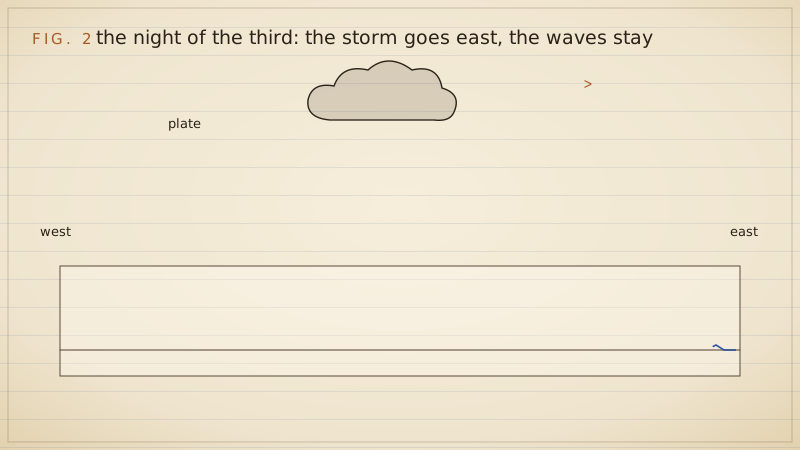
As the storm went east the relay kept playing with it at a distance I judged to be 80 to 100 miles, and later at a distance greater than 200 miles at least. That alone is remarkable. What is more remarkable is the manner of the playing. The instrument did not fade steadily as the storm withdrew. It fell silent, then began again, grew stronger, passed through a greatest effect, weakened and ceased; and then the whole cycle repeated, again and again, at intervals that seemed to me regular, until the storm was beyond reach. I have drawn the strip as Fig. 2.
Reflection
Then I wrote, still in the same entry: "It showed clearly the existence of stationary waves, for how could the observations be otherwise explained?" And at once the next question, which is the one that has kept me awake: "How can these waves be stationary unless reflected and where can they be reflected from unless from the point where they started?"
A travelling wave passes a receiver and is gone; it may be strong or weak, but it does not rise and fall in a regular pattern as its source moves away. A stationary wave is a travelling wave and its reflection lying on top of each other, adding at the loops and cancelling at the nodes. If the storm carried such a pattern with it, then as it moved my receiver would find itself now at a loop, now at a node, and the relay would play and fall silent just as it did. But a reflection requires a reflector. I considered the opposite side of the earth and did not like it. In the words of the entry: "It would be difficult to believe that they were reflected from the opposite point of the Earth's surface ... But I rather think they are reflected from the point of the cloud where the conducting path began; in this case the point where the lightning struck the ground would be a nodal point."
That is my answer of this morning: a local reflection, between the cloud and the ground, along the channel of the lightning itself. It is a modest answer. I set it down because it is what I believe today, and because I know my habit of falling in love with the grander explanation.
Margin
A note on the distances. Thunder carries a few miles at most, so I can only have judged the nearer positions of the storm by the delay of its thunder, and the farther ones by its direction and the visible drift of the cloud. If the thunder of a flash at 100 miles could be heard, it would arrive 528,000 ÷ 1,100 ≈ 480 seconds, eight minutes, after the light. I heard no such thunder last night. When I write publicly about these storms I must remember which distances were measured and which were judged.
Colorado Springs, 23 July to 11 September 1899. Maxima and minima
Since the night of the third I have done little else in the evenings but improve the ear and watch for retreating storms. Each instrument is an argument with the last one.
Draftsman's note
23 July: a rotating sensitive device. A glass tube of three eighths of an inch bore, about one third full of metal chips, turning at 16 revolutions a minute so that the chips are always falling and can never cohere for long. With short wires it recorded lightning to about 30 miles; with the rotating device, to about 50.
28 July: a detector with a secondary of 5,120 turns, 32 layers of 160 turns each, working a relay of 998 ohms through a break wheel of 180 teeth bearing on a platinum brush, making 72 breaks a second. The wheel therefore turns 72 ÷ 180 = 0.4 times a second, 24 revolutions a minute. With this arrangement I recorded lightning at a distance I estimate at about 500 miles.
Calculation
How a length of wave may be read from the maxima. Suppose the pattern of loops and nodes is carried with the storm, and the storm recedes at a steady speed v. Between one greatest indication and the next, the distance from storm to receiver changes by half a wave length, since loops stand half a wave apart.
- Let Δt be the interval between maxima. Then λ/2 = vΔt, and λ = 2vΔt.
- For illustration (I did not measure the storm's speed): v = 50 kilometres an hour and Δt = 30 minutes give λ = 2 × 50 × 0.5 = 50 kilometres.
- A wave of 50 kilometres travelling with the velocity of light has a frequency n = 300,000 ÷ 50 = 6,000 per second.
- Over many storms the lengths I obtain lie roughly between twenty-five and seventy kilometres, that is, between 300,000 ÷ 70 ≈ 4,300 and 300,000 ÷ 25 = 12,000 per second.
These are waves of a few thousand periods a second, of the order of the slower vibrations I produce myself. The thought that follows is dangerous and I cannot stop it: if lightning sets up such waves, so can I.
Experiment No. 3
11 September. With the transmitter working, I recorded its disturbances about one mile away, the waves about 4,000 feet long. Entry: "only the ground connection was essential as the waves were still fairly long." A wave of 4,000 feet corresponds to 982,080,000 ÷ 4,000 ≈ 245,500 periods a second, the very rate of the drum coil I wound in September. The receiver did not need its elevated plate. The earth alone carried the message across the mile.
Margin
Written in 1901. In Collier's Weekly for 9 February 1901 I described changes in my Colorado instruments that seemed to me to show number and order, and I spoke of them as possibly signals from another world. The newspapers decided at once that the world was Mars. My dated notes from the station, so far as I have kept them, record the observations and none of that interpretation. Later students have proposed other causes, from distant experimenters to natural radio emissions, and none has been proved. I leave the question where my notebook leaves it: an observation I could not explain.
New York, 5 March 1904. A conductor of limited dimensions
Today the Electrical World and Engineer printed my account of Colorado. I wrote of the receiver of June that "The earth was found to be, literally, alive with electrical vibrations." I called the third of July "the date I shall never forget", and I described the storm that gathered in the west, spent much of its fury on the mountains, and was driven away with great velocity over the plains. And then the sentence I have most wanted to write since that night: "No doubt, whatever remained: I was observing stationary waves. As the source of disturbances moved away the receiving circuit came successively upon their nodes and loops."
Reflection
I must be honest with this notebook, because no one else will hold me to account. On the morning of the 4th of July, 1899, I wrote that the waves were most likely reflected locally, from the cloud end of the lightning channel, and that reflection from the opposite side of the earth was difficult to believe. In 1904 I have printed that the planet, in all its vastness, behaved like a conductor of limited dimensions, and that it is to electric currents virtually no more than a small metal ball. Between those two sentences lie four and a half years.
What changed my mind? Partly the persistence of the pattern: the maxima recurred, with something like regularity, until the storm was some three hundred kilometres away. (My notebook said greater than 200 miles, which is about 320 kilometres; the two figures agree within the uncertainty of a judged distance.) A reflection from the end of a lightning channel a few miles long would make its pattern within a few miles of the storm. A pattern that follows a storm for hundreds of kilometres seemed to me to require a reflector on the scale of the earth. Partly, I admit, it was the mathematics of my own transmitter, which works best when the whole system rings, and I wished the earth to ring with it. I believe the evidence pointed where I went. I also know that a man who wants a conclusion finds the evidence obliging.
Calculation
The earth as a metal ball. If it is a conductor of limited dimensions it has a capacity, and the capacity of a sphere in centimetres is its radius in centimetres.
- Radius of the earth: about 6,370 kilometres = 6.37 × 10⁸ centimetres.
- Capacity: C = 6.37 × 10⁸ centimetres. Since 900,000 centimetres make one microfarad, C ≈ 708 microfarads.
- One of my Leyden jars holds 0.003 microfarad. The earth is therefore worth 708 ÷ 0.003 ≈ 236,000 jars.
It is a large condenser, but it is not an infinite one. Two hundred thousand jars is a quantity a man can picture: a warehouse of glass. That picture, more than any argument, persuaded me that the earth could be charged and discharged in rhythm by a machine.
New York, 1900 to 1905. The numbers of patent 787,412
I filed the application on 16 May 1900, renewed it on 17 June 1902, and on 18 April 1905 the patent was granted: "Art of Transmitting Electrical Energy Through the Natural Mediums." Its first claim ends with the words "establishing stationary electrical waves in the earth". In it I gave the numbers that follow from Colorado, and since they are compressed there, I work them out here as I did on Waldorf notepaper.
From the observations: "From data obtained in a large number of observations of the maxima and minima of these waves I found their length to vary approximately from twenty-five to seventy kilometers." The rule for the transmitter: "The earth's diameter passing through the pole should be an odd multiple of the quarter wave length." And the most daring statement: "The lowest frequency would appear to be six per second, in which case there will be but one node", at or near the ground plate of the transmitter, the effect increasing with the distance and greatest in the region diametrically opposite.
Calculation
My model: the disturbance spreads from the transmitter through the body of the earth with the velocity of light. I picture its front as a plane, perpendicular to the diameter through the transmitter, travelling down that diameter.
- The patent speaks of the time "taken in passing to and returning from the region diametrically opposite": not less than one twelfth, or probably 0.08484, of a second. Going and returning through the diameter D at c = 300,000 kilometres per second, 2D/c = 0.08484, so D = 0.08484 × 300,000 ÷ 2 = 12,726 kilometres. The polar diameter is about 12,714; I am content.
- When the plane front has gone a distance s down the diameter, it meets the surface on a circle at the angle θ from the transmitter, where s = R(1 − cos θ), R = D/2.
- Differentiating, ds = R sin θ dθ. The front moves at ds/dt = c, so the circle on the surface runs along the meridian at R dθ/dt = c/sin θ.
- At the transmitter and at the opposite point, sin θ = 0 and that speed grows without limit; at the equator of the transmitter (θ = 90°) it equals c.
- Mean speed over the surface: half the circumference, πR, covered in the time D/c = 2R/c, which is πR ÷ (2R/c) = (π/2)c = 1.5708 × 300,000 = 471,240 kilometres per second, the figure of the patent.
- Resonance: the diameter must be an odd multiple of a quarter wave. For a single quarter wave, λ = 4D = 50,904 kilometres and n = 300,000 ÷ 50,904 ≈ 5.9 per second, which I rounded to six.
- Three quarters and five quarters give n ≈ 17.7 and 29.5 per second, the next tones of the earth in this picture: about 6, 18 and 30.
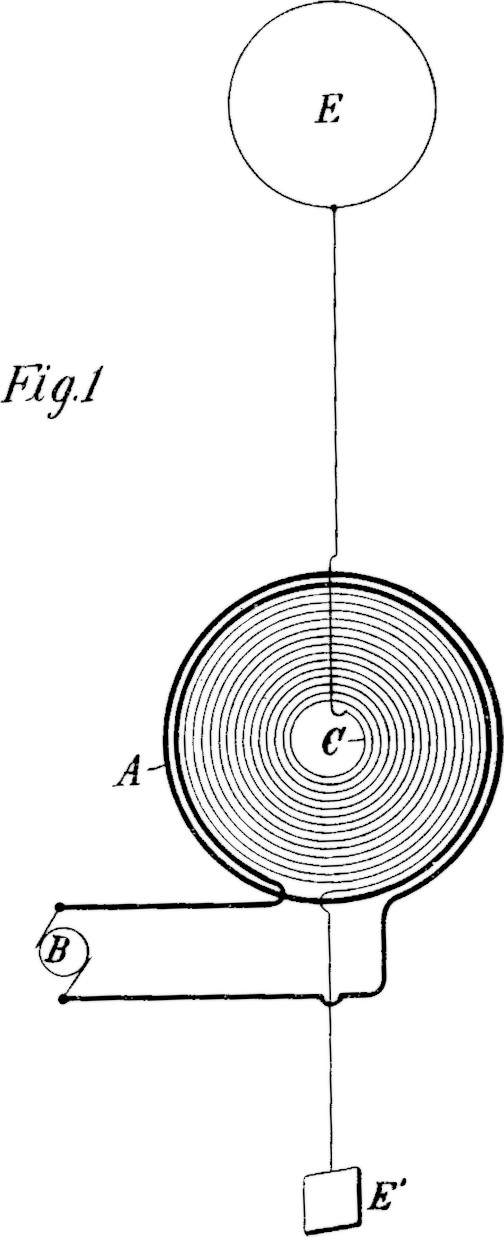
I have drawn the picture as Plate XVIII, together with what later men found. Choose "Tesla, 1905" and slide the frequency to 5.9: the surface swings with a node at the transmitter and its greatest motion at the opposite point; at 17.7 a node appears beyond the equator. Press "Send one pulse" and watch the two points where my plane front meets the surface race away from the transmitter, slow near the equator and race again into the antipode. Then choose "Earth and sky, 1952", which is the subject of my letter to the student below.
Margin
A doubt I keep in this notebook and nowhere else. The waves I measured in Colorado were twenty-five to seventy kilometres long, thousands of periods a second. The tone of six per second, with a wave of fifty thousand kilometres, I never measured at all: I computed it from the size of the earth and the picture of a wave through its diameter. The patent joins the two as if one were the overtone of the other. They are separated by a factor of about a thousand in frequency. If the waves of the third of July were a vibration of the whole planet, they were a very high harmonic of it, and I should be able to say which one. I cannot.
Problems I set myself
1. Using the earth's mean diameter of 12,742 kilometres and c = 300,000 kilometres per second, compute the first three frequencies for which the diameter is an odd number of quarter waves.
Answer. n = (2k + 1)c/(4D). For k = 0: 300,000 ÷ (4 × 12,742) = 300,000 ÷ 50,968 ≈ 5.89 Hz. For k = 1: 3 × 5.89 ≈ 17.7 Hz. For k = 2: 5 × 5.89 ≈ 29.4 Hz. The series is 1 : 3 : 5.
2. In the plane-front picture, how fast does the circle where the front meets the surface move along the meridian at 30° from the transmitter, and how long after emission does it reach 90°?
Answer. The surface speed is c/sin θ. At θ = 30°, sin θ = ½, so the speed is 2c, twice the velocity of light. (Nothing material travels faster than light: the point of intersection of a front with a curved surface is a geometrical point, like the spot where a slanting wave meets a beach.) The circle reaches θ = 90° when s = R(1 − cos 90°) = R, after R/c = 6,371 ÷ 300,000 ≈ 0.0212 second.
3. For an ideal, lossless cavity between a conducting earth of radius a = 6,371 kilometres and a conducting sky close above it, the resonant frequencies are fₙ = (c/2πa)√(n(n + 1)). Compute the first three and compare them with the measured 7.83, 14.1 and 20.3 Hz.
Answer. c/2πa = 3 × 10⁸ ÷ (2π × 6.371 × 10⁶) = 7.49 Hz. Then f₁ = 7.49 × √2 ≈ 10.6 Hz, f₂ = 7.49 × √6 ≈ 18.3 Hz, f₃ = 7.49 × √12 ≈ 25.9 Hz. The measured values are about 0.74 to 0.78 of these: the losses of the real ionosphere, which is a poor and gradual conductor, lower the frequencies and broaden the peaks. The ratios 1 : 1.73 : 2.45 are not the 1 : 3 : 5 of problem 1.
To the student who reads this later
The night of the third of July was real, and so were my maxima and minima. What your century has done is tell me where my explanation went wrong and where, by a kind of accident, it came close.
The earth does ring. In 1952 Winfried Otto Schumann calculated that the space between the conducting ground and the conducting lower ionosphere (a layer proposed by Kennelly and by Heaviside in 1902, the year I was building Wardenclyffe) forms a cavity that should resonate at frequencies of a few cycles per second, excited by lightning. In 1960 Balser and Wagner extracted those resonances clearly from the noise. The fundamental lies near 7.83 Hz, with further peaks near 14.1, 20.3, 26.3 and 32.5 Hz. The world's thunderstorms, some fifty flashes every second, keep the cavity ringing all the time. Your problem 3 shows how they follow the formula fₙ = (c/2πa)√(n(n + 1)), lowered by the losses.
My six, eighteen and thirty per second resemble those numbers, and you will see the resemblance quoted as though I had anticipated Schumann. Please do not repeat it. My series runs 1 : 3 : 5 and theirs runs as √(n(n + 1)); my wave goes through the solid earth and theirs is guided around it, between the ground and a sky I did not know was there. The closeness of my fundamental to theirs is a near-miss of geometry: both are set by the size of the earth and the speed of light, so both must come out at a few cycles per second.
Worse, my wave through the earth could not exist. Rock and soil conduct poorly, with a conductivity σ of perhaps 10⁻³ siemens per metre. An alternating field penetrates such a conductor only to the skin depth δ = √(2/(ωµ₀σ)). At 10 kHz, the frequency of my measured waves, δ = √(2/(2π × 10⁴ × 4π × 10⁻⁷ × 10⁻³)) ≈ 160 metres. Even at 6 Hz, δ ≈ 6.5 kilometres. A disturbance cannot cross twelve thousand kilometres of rock when it is extinguished within a few kilometres. The earth is not, to these currents, a small metal ball. The cavity is real, and its quality factor is low: it loses most of its energy within a few cycles. That fact will matter in my next chapter.
What did I measure on the night of the third? Waves of a few thousand cycles per second, which your engineers call very low frequency, are exactly the band in which the radio crackle of lightning, the sferics, travels thousands of kilometres in the waveguide between earth and ionosphere. A pattern of maxima and minima as a storm recedes can arise from interference between a wave along the ground and a wave reflected from the sky, whose difference of path changes with distance; it can also arise simply from changes in the storm's own activity. No one, so far as I know, has analysed my data of that night with modern methods, so I hold this as a likely reading, not a proved one. Notice the irony: there was a reflector after all, as I wrote on the morning of the 4th. It was above the cloud, not below it.
What you can do today: a simple VLF receiver, a long wire and a sound card will let you hear sferics, and on quiet nights the falling whistles called tweeks and whistlers. Measuring the Schumann resonances themselves needs a sensitive induction-coil magnetometer at a site far from power lines, but the data from such stations are published, and you can compute the spectrum and find 7.83 Hz with your own hands.
If you want to ask me how it felt to watch a storm walk away while my relay counted the nodes, or to argue with me about my change of mind, come and ask me.
Sources and liberties
The Tesla Notes are a modern reconstruction written in Nikola Tesla's voice by Eternal Gardens. Dates, patents, lectures, apparatus and quotations come from the sources below; the private reflections, the order of the working and the sketches are ours.
- N. Tesla, Colorado Springs Notes, 1899 to 1900, ed. A. Marinčić and V. Popović (Belgrade: Nolit, 1978), July pages from p. 53: Tesla Universe; transcription of the June and July entries, including 4 July 1899: bibliotecapleyades.net
- A. Marinčić, introduction to the Colorado Springs Notes, on the 6, 18 and 30 Hz reading: bibliotecapleyades.net
- N. Tesla, "The Transmission of Electric Energy Without Wires", Electrical World and Engineer, 5 March 1904: PBS transcription
- US Patent 787,412, "Art of Transmitting Electrical Energy Through the Natural Mediums", filed 16 May 1900, granted 18 April 1905: Google Patents; Wikisource
- N. Tesla, "Talking with the Planets", Collier's Weekly, 9 February 1901: Wikisource
- W. O. Schumann, "Über die strahlungslosen Eigenschwingungen einer leitenden Kugel, die von einer Luftschicht und einer Ionosphärenhülle umgeben ist", Zeitschrift für Naturforschung A 7 (1952): doi:10.1515/zna-1952-0202
- M. Balser and C. A. Wagner, "Observations of Earth–Ionosphere Cavity Resonances", Nature 188 (1960): doi:10.1038/188638a0
- "Schumann resonances", for the measured peaks and the ideal-cavity formula: Wikipedia
The notebook entry describing the night of 3 July is dated 4 July 1899; on that morning Tesla preferred a local reflection from the cloud, and by 1904 and 1905 he described the whole earth resonating, a change of mind shown here as it stands in the two texts. The decoding of 471,240 km/s as (π/2)c, of 0.08484 s as a round trip through the diameter and of "six per second" as a quarter-wave diameter is our arithmetic; the patent does not use the words "infinite" or "antipode". The illustrative storm speed, the earth-capacity calculation and the skin-depth figures are ours. The 1899 "signals" and their attribution to Mars are a newspaper legend built on Tesla's 1901 article; the dated notes record no such interpretation. The Schumann resonances are a near-miss of Tesla's figures, never an anticipation of them.