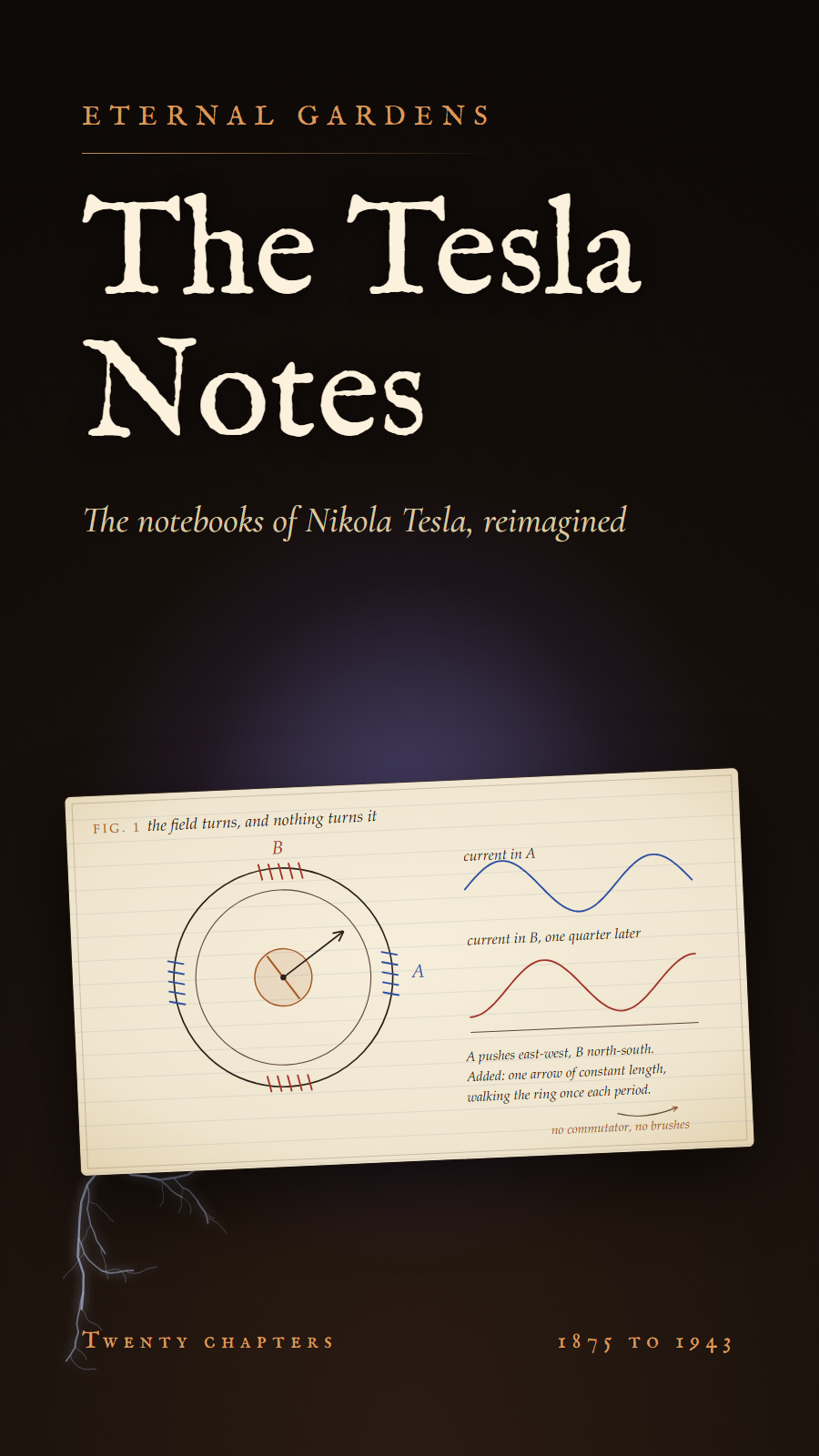
Nikola Tesla's notebooks, reimagined in his own voice. Twenty chapters follow electromagnetism while it was still being built: the Gramme dynamo at Graz, the rotating magnetic field, the induction motor, the transformer, sixty cycles, the oscillating spark, Hertz and Maxwell, the Tesla coil, light without wires, Niagara, Colorado Springs, Wardenclyffe and the bladeless turbine. Every chapter works the physics and mathematics step by step, with draftsman's sketches, interactive plates you can play with, and sources for every date, patent and quotation. When you finish a chapter, talk it over with Nikola Tesla on Eternal Gardens.
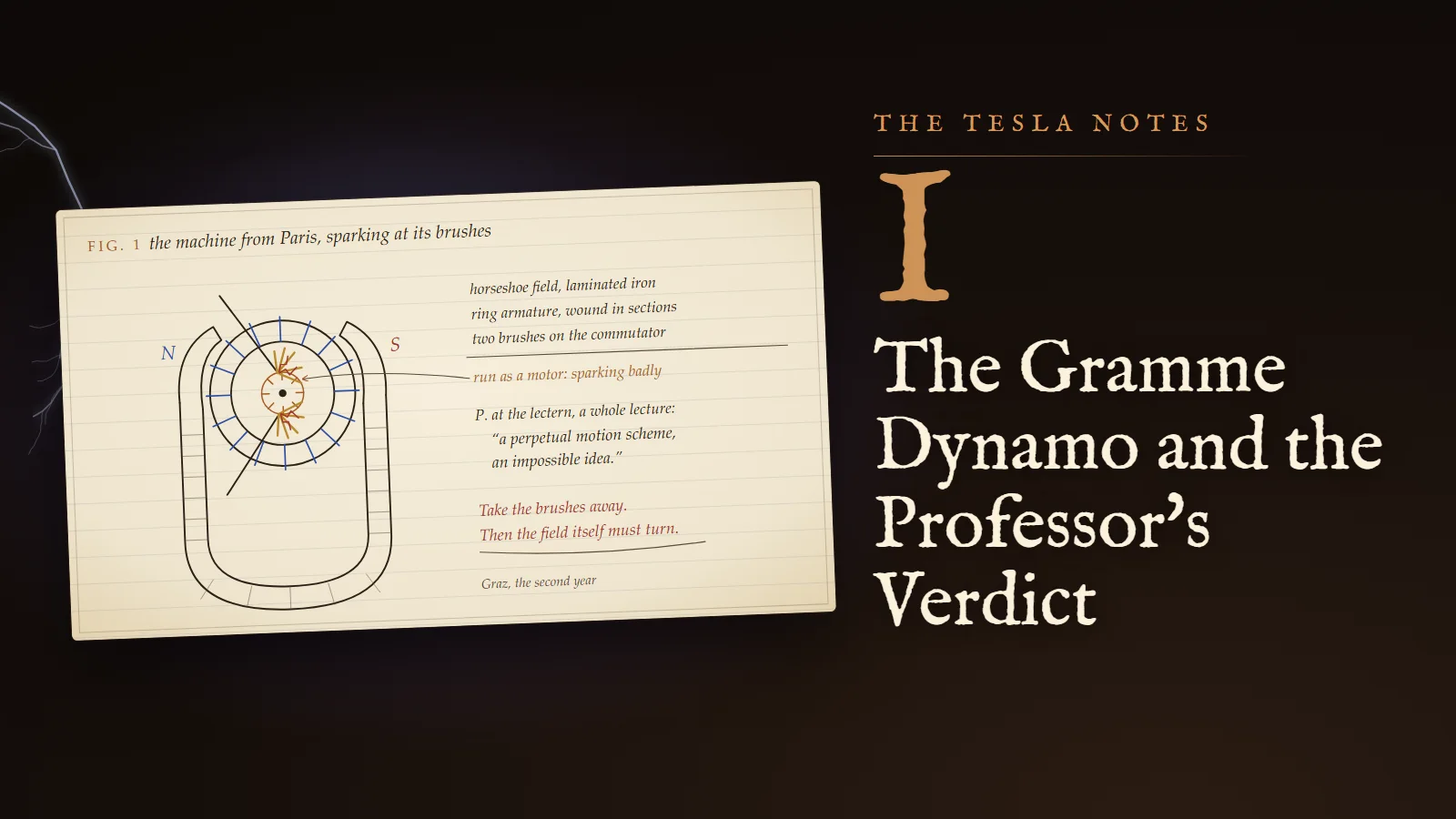 Tesla Notes 01: The Gramme Dynamo and the Professor's Verdict
Tesla's Graz notebook: the emf of a turning coil, why a commutator gives 2/π of the peak, why brushes spark, and Poeschl's verdict.
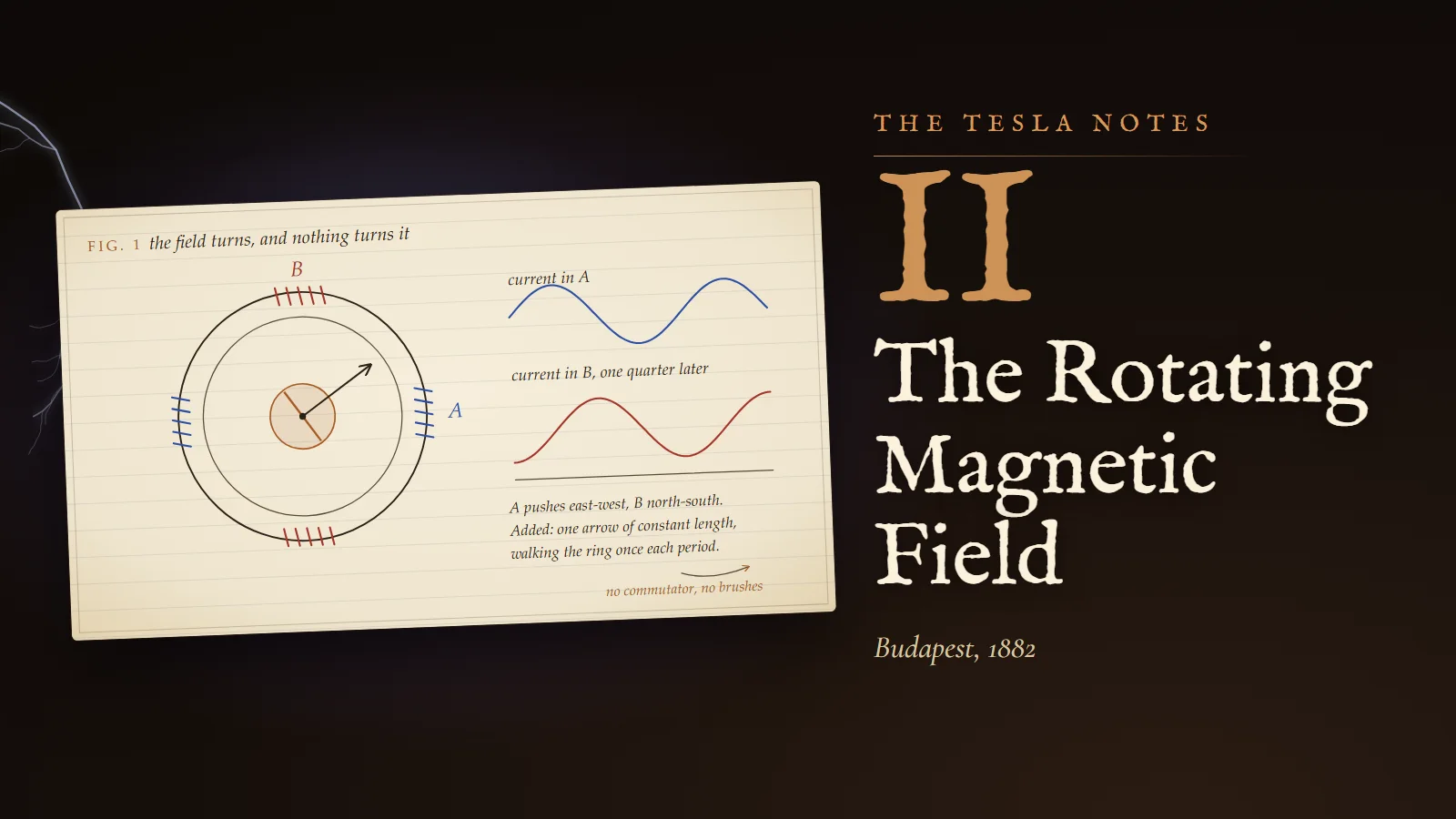 Tesla Notes 02: The Rotating Magnetic Field (Budapest, 1882)
Tesla's Budapest notebook: how two or three phase-shifted currents make a field that turns, the (3/2)B cos(θ − ωt) proof, and why one phase cannot.
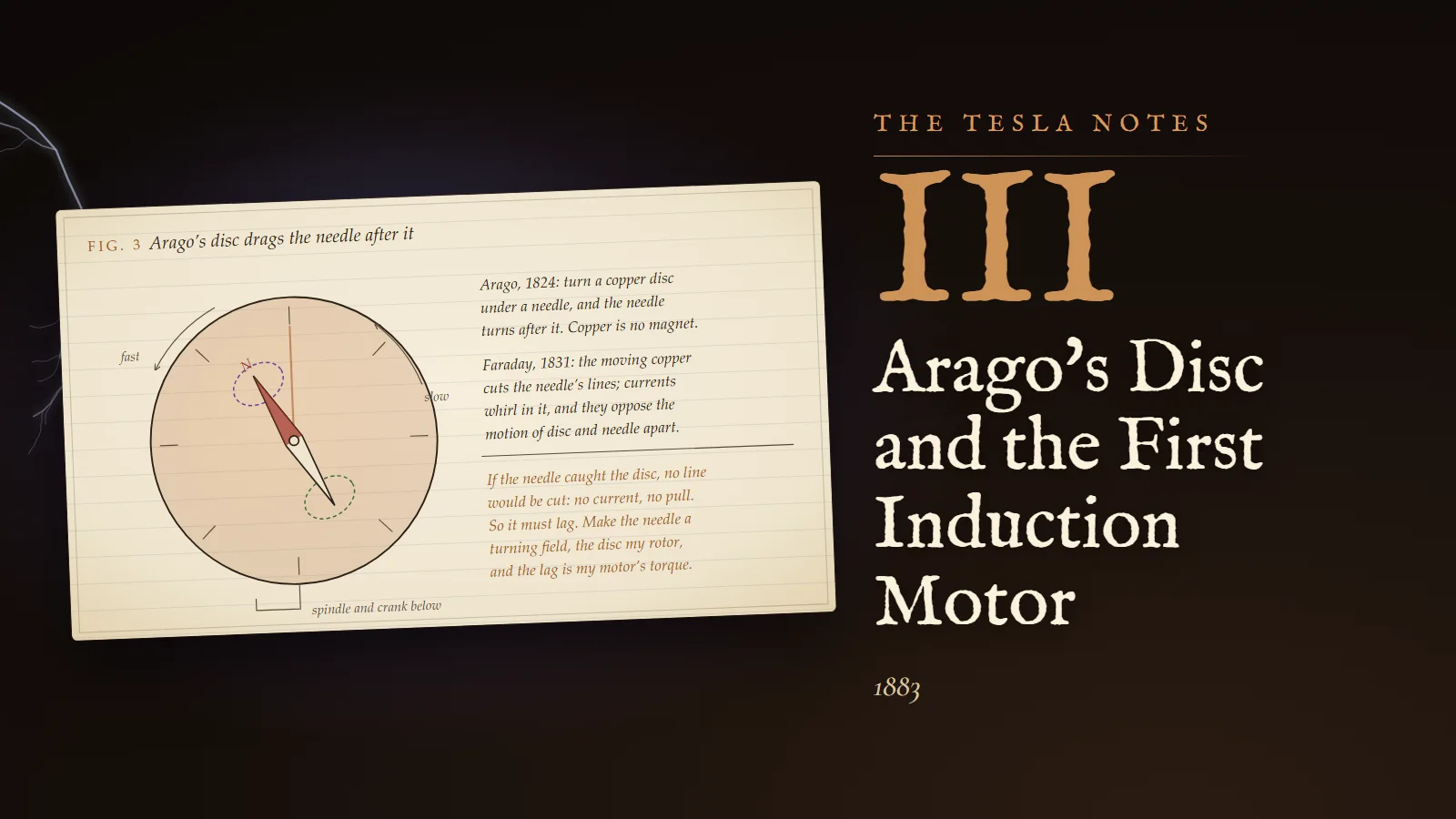 Tesla Notes 03: Arago's Disc and the First Induction Motor (1883)
Tesla's Strasbourg notebook: Arago's disc, eddy currents and Lenz's law, the torque-slip law T = 2xm/(x² + m²), and his first induction motor.
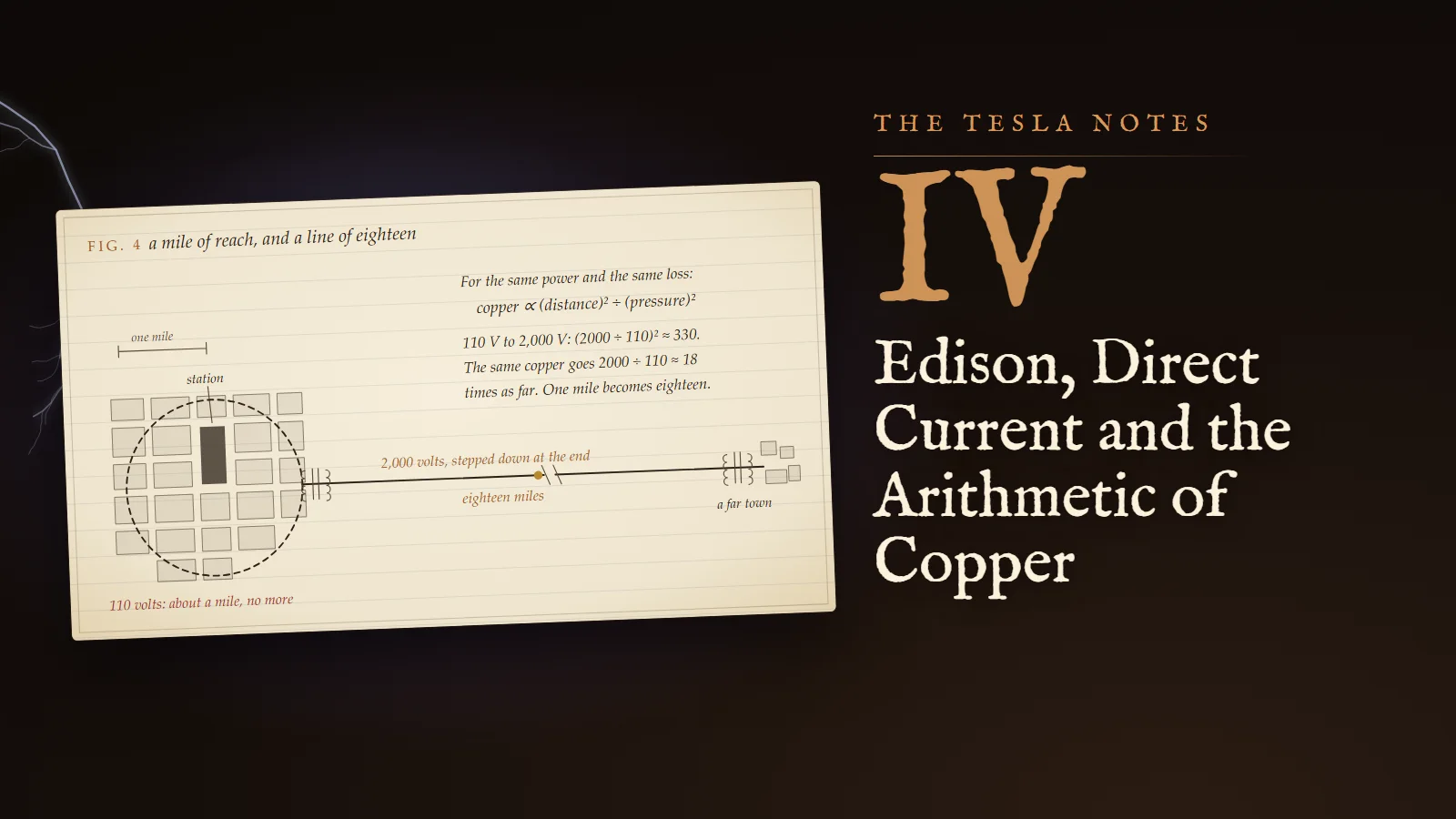 Tesla Notes 04: Edison, Direct Current and the Arithmetic of Copper
Tesla's New York notebook: why 110 V direct current reached about a mile, the I²R arithmetic of copper, Edison's three-wire saving, and the $50,000 story.
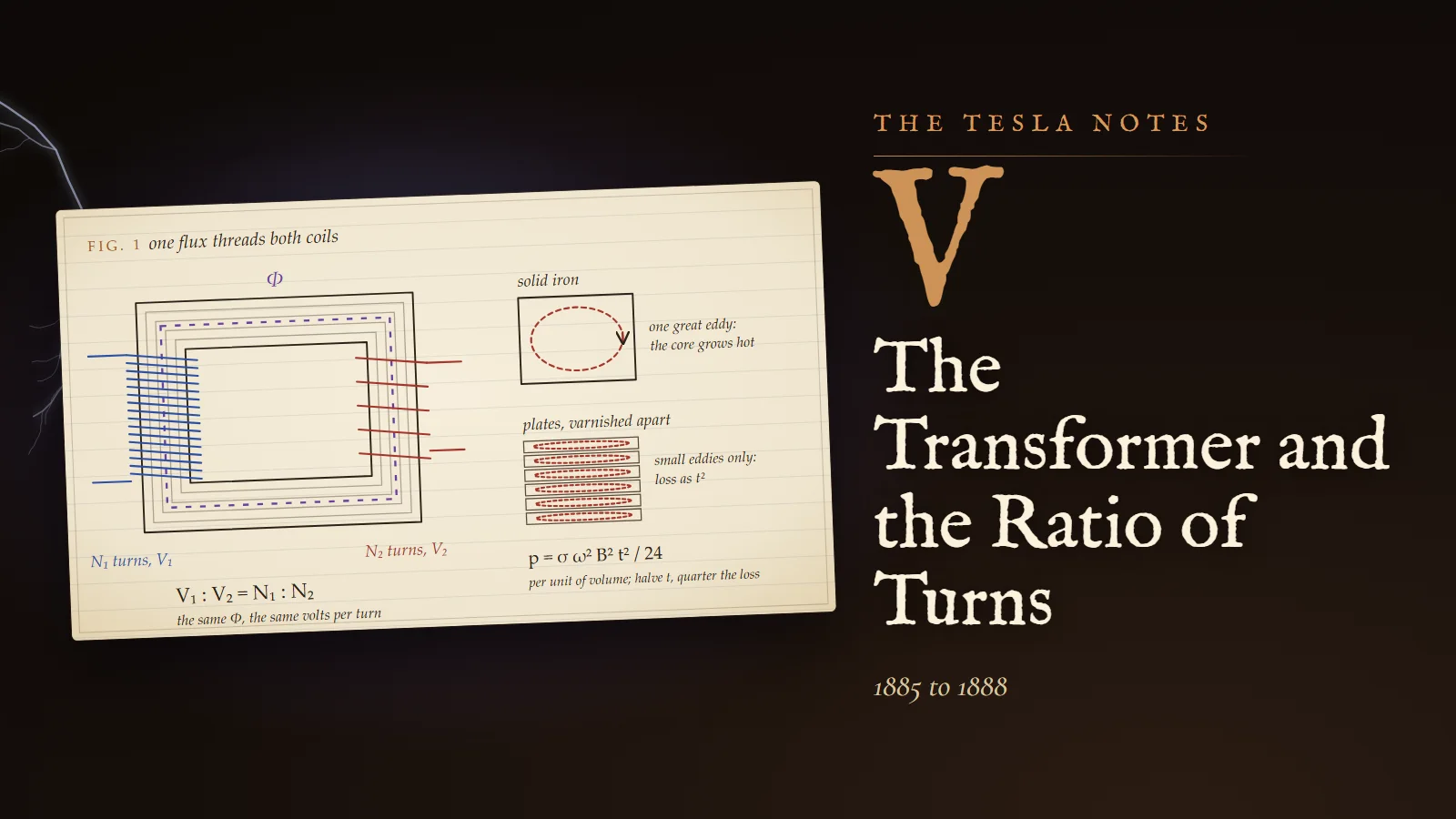 Tesla Notes 05: The Transformer and the Ratio of Turns (1885 to 1888)
Why a transformer needs alternating current: the ratio of turns, V = 4.44 f N Φ, magnetising current, eddy losses and laminations, worked in Tesla's voice.
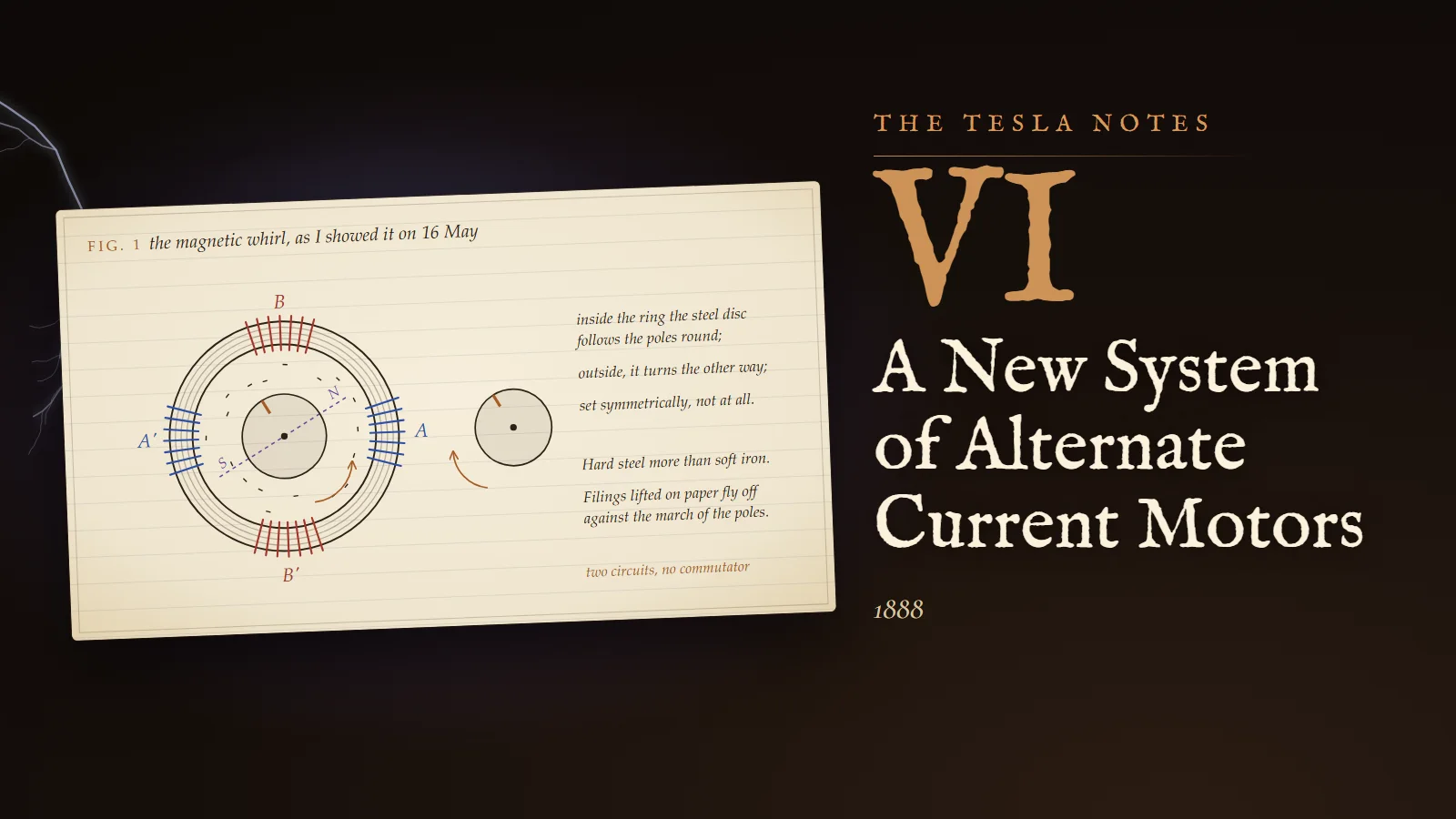 Tesla Notes 06: A New System of Alternate Current Motors (1888)
Tesla's 1887 to 1888 polyphase patents and AIEE lecture: the rotating field's circle proof, synchronous versus induction motors, and why three-phase saves copper.
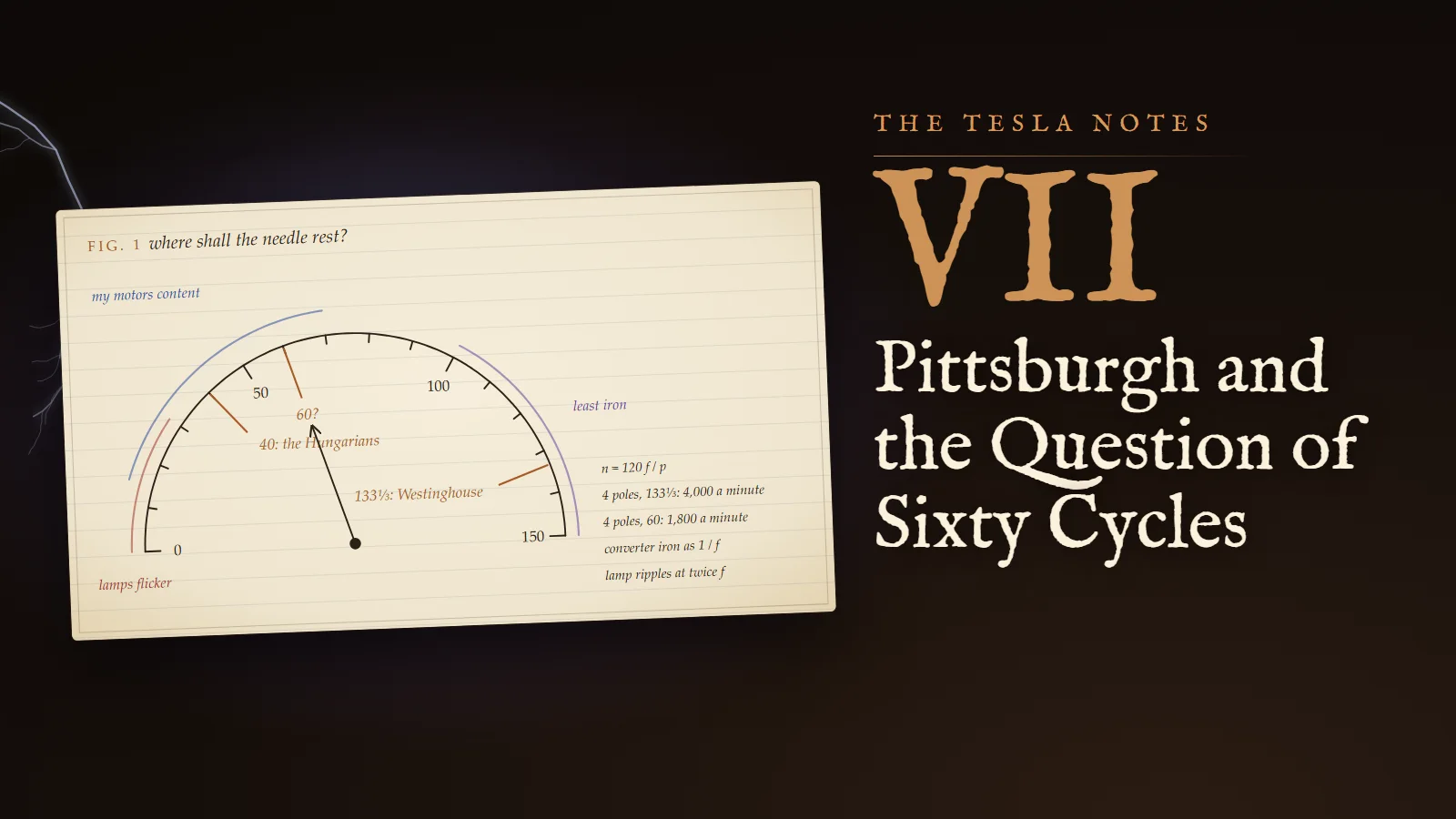 Tesla Notes 07: Pittsburgh and the Question of Sixty Cycles
Why 60 Hz? Tesla's Pittsburgh year worked out: motor speed n = 120f/p, split-phase motors, lamp flicker and filament heat, and transformer iron versus frequency.
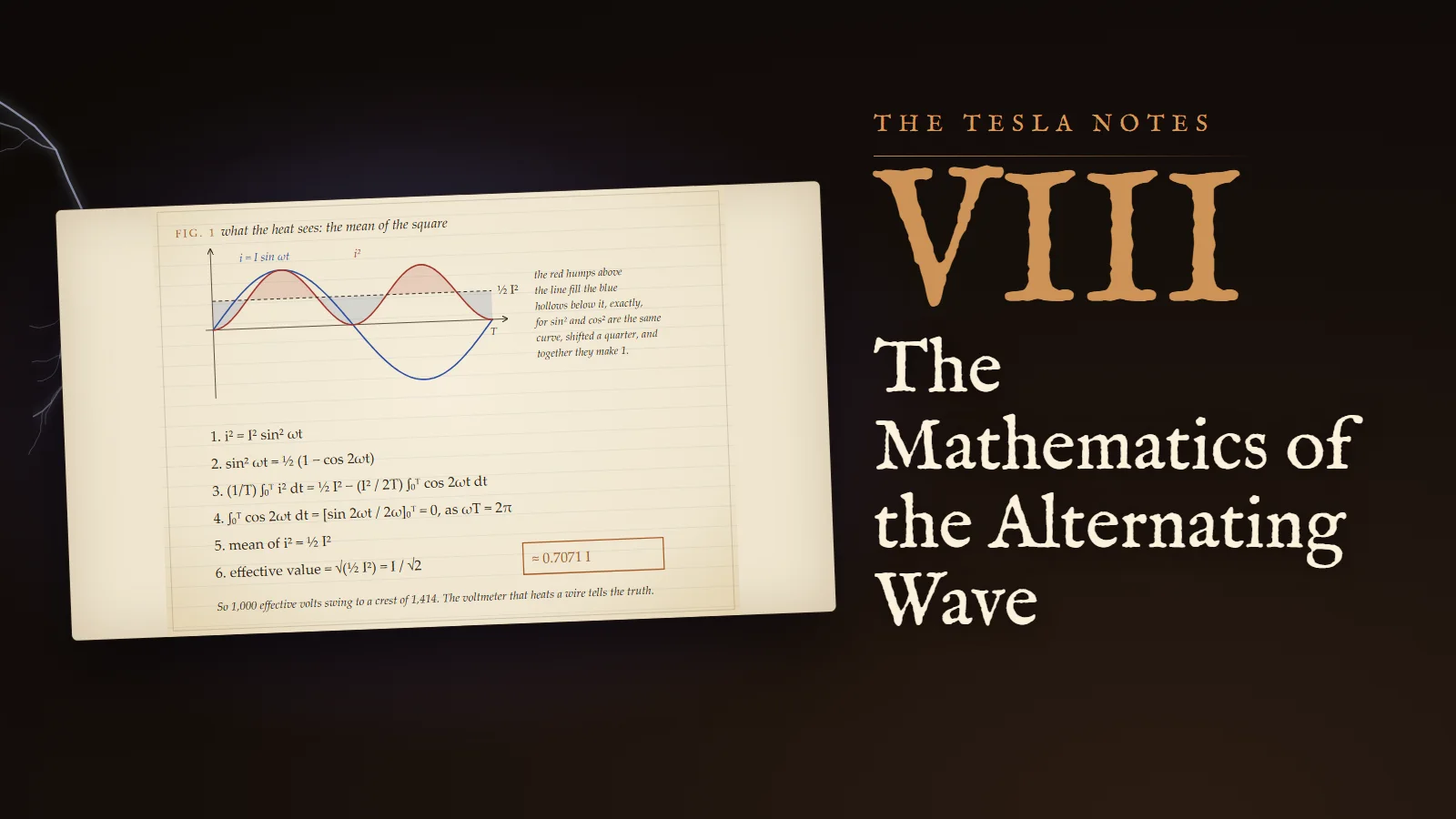 Tesla Notes 08: The Mathematics of the Alternating Wave
RMS by integration, impedance, phase lag, power factor and series resonance, derived step by step from Tesla's geometric method of turning radii (proto-phasors).
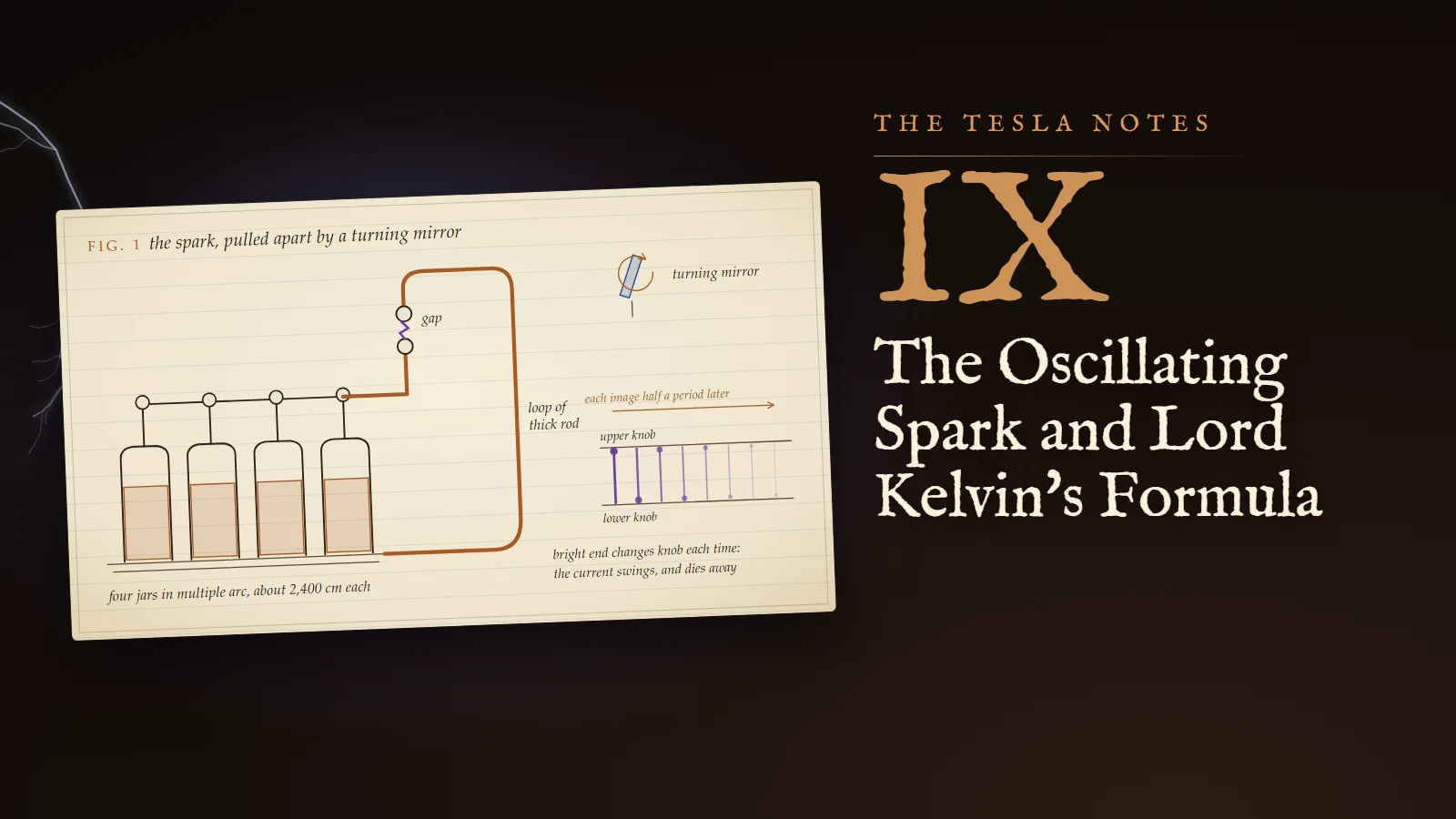 Tesla Notes 09: The Oscillating Spark and Lord Kelvin's Formula
Tesla derives f = 1/(2π√(LC)) and the damping of a Leyden-jar discharge, counts the swings in a turning mirror, and finds the spark's loss.
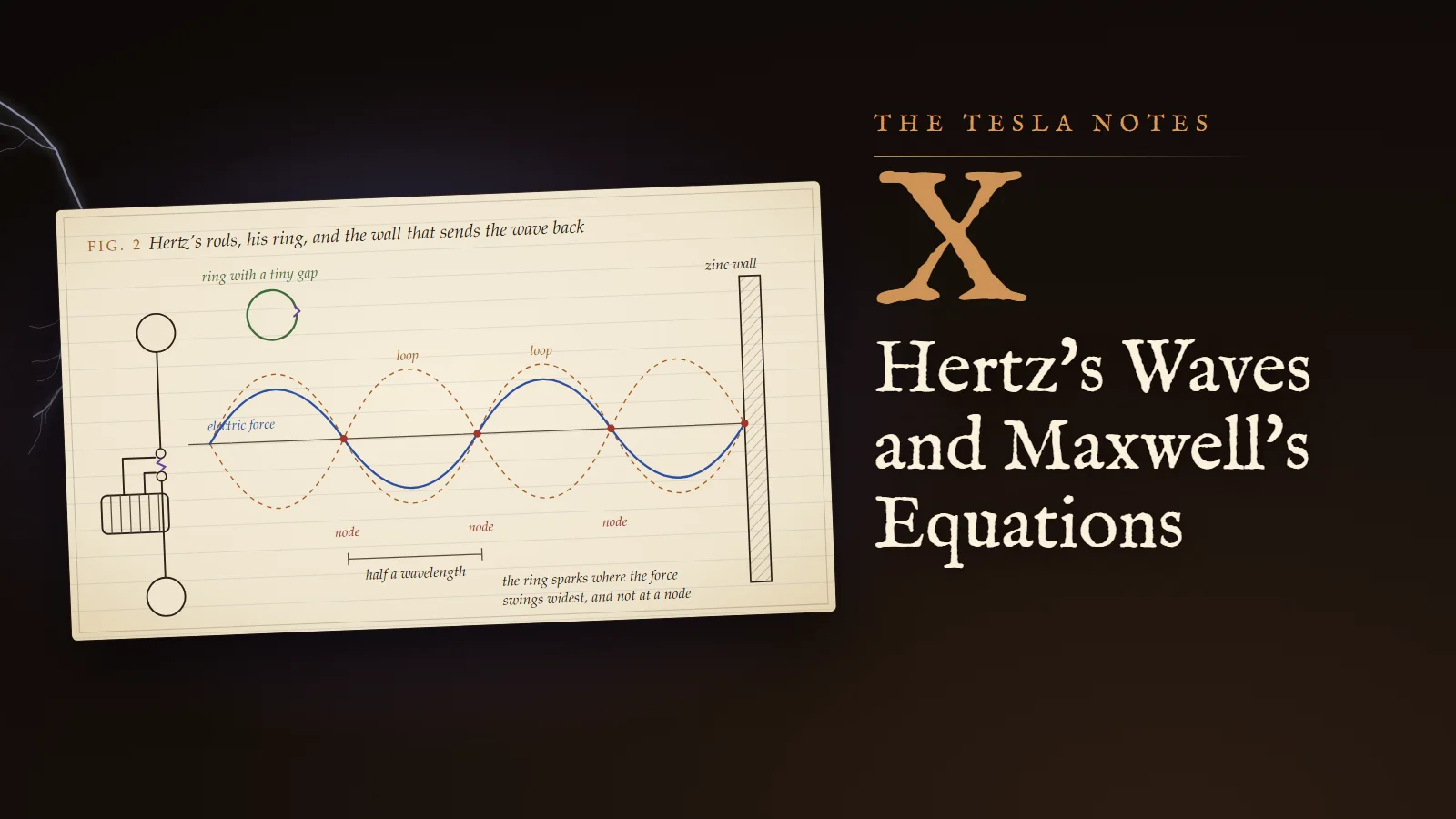 Tesla Notes 10: Hertz's Waves and Maxwell's Equations
Tesla derives the speed of Maxwell's waves from the ratio of the units, estimates Hertz's wavelength, and takes his objections to Bonn.
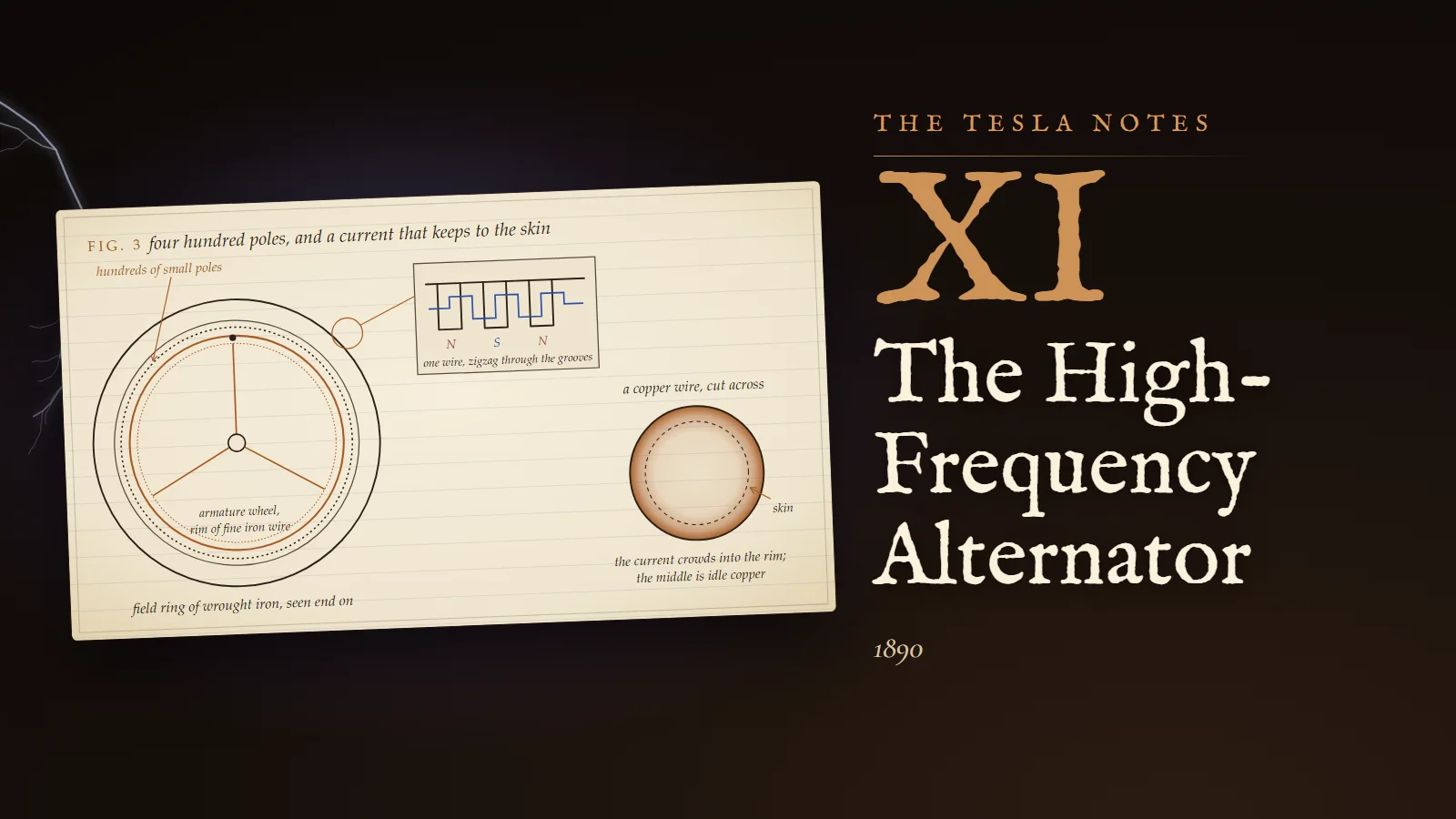 Tesla Notes 11: The High-Frequency Alternator (1890)
Tesla works out how many poles make 10,000 alternations a second, why the iron must be wire, and why copper carries current only in its skin.
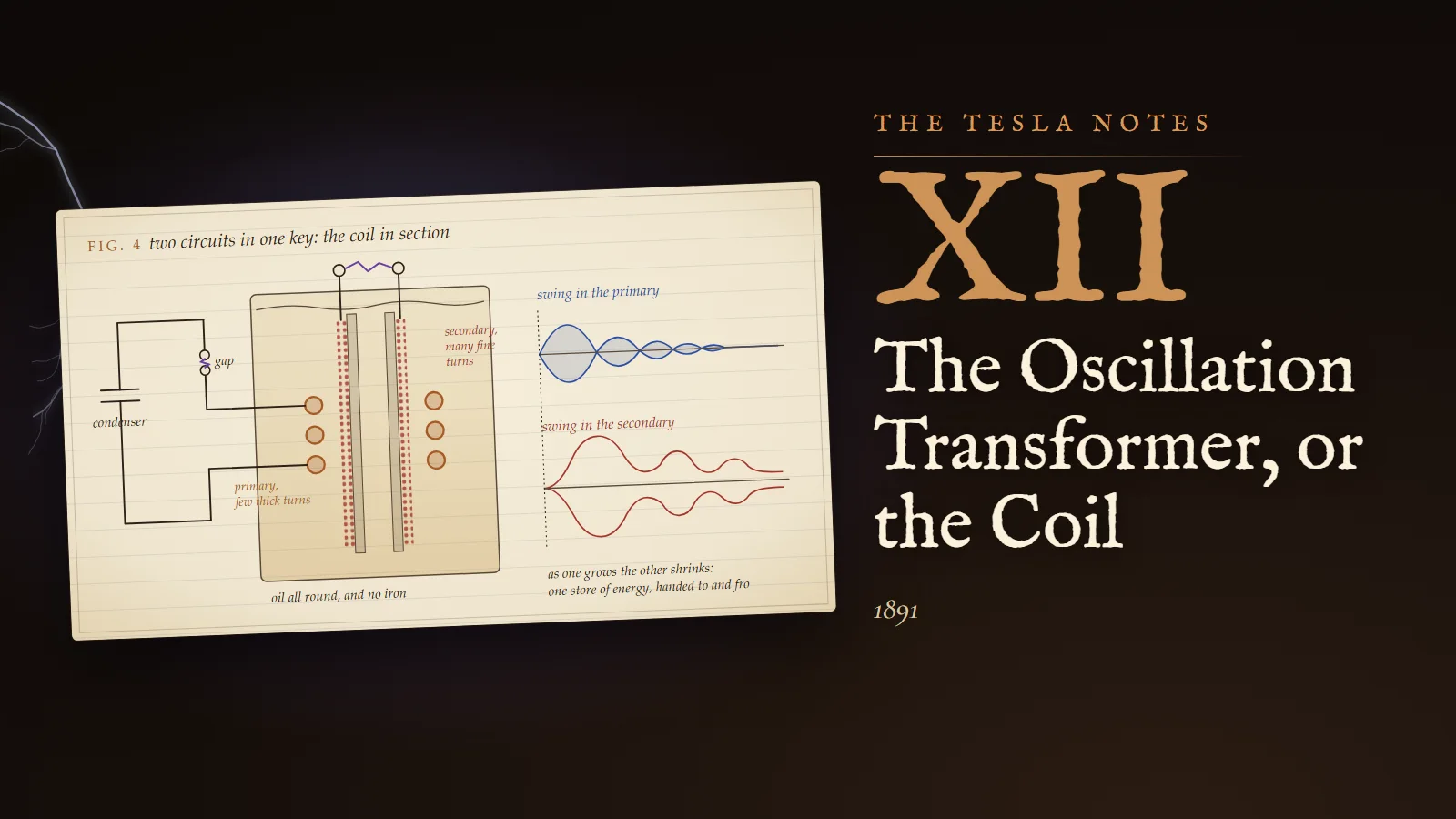 Tesla Notes 12: The Oscillation Transformer, or the Coil (1891)
Tesla tunes two coils without iron, derives their two frequencies and the voltage gain √(L₂/L₁), and files patent 454,622 for the coil.
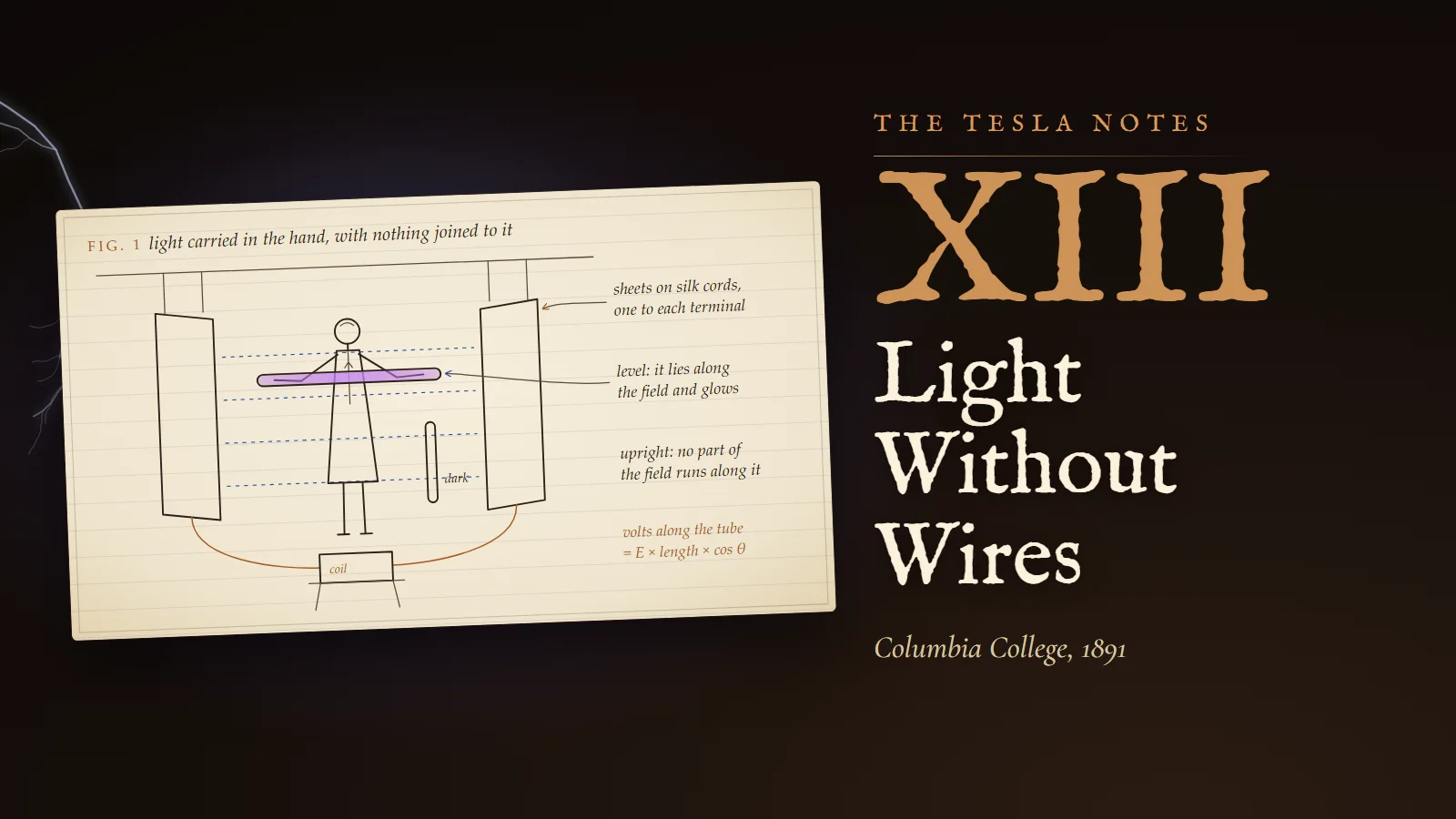 Tesla Notes 13: Light Without Wires (Columbia College, 1891)
Tesla's 1891 Columbia lecture: how an alternating electric field lights an exhausted tube, why only the field along it counts, and why frequency matters.
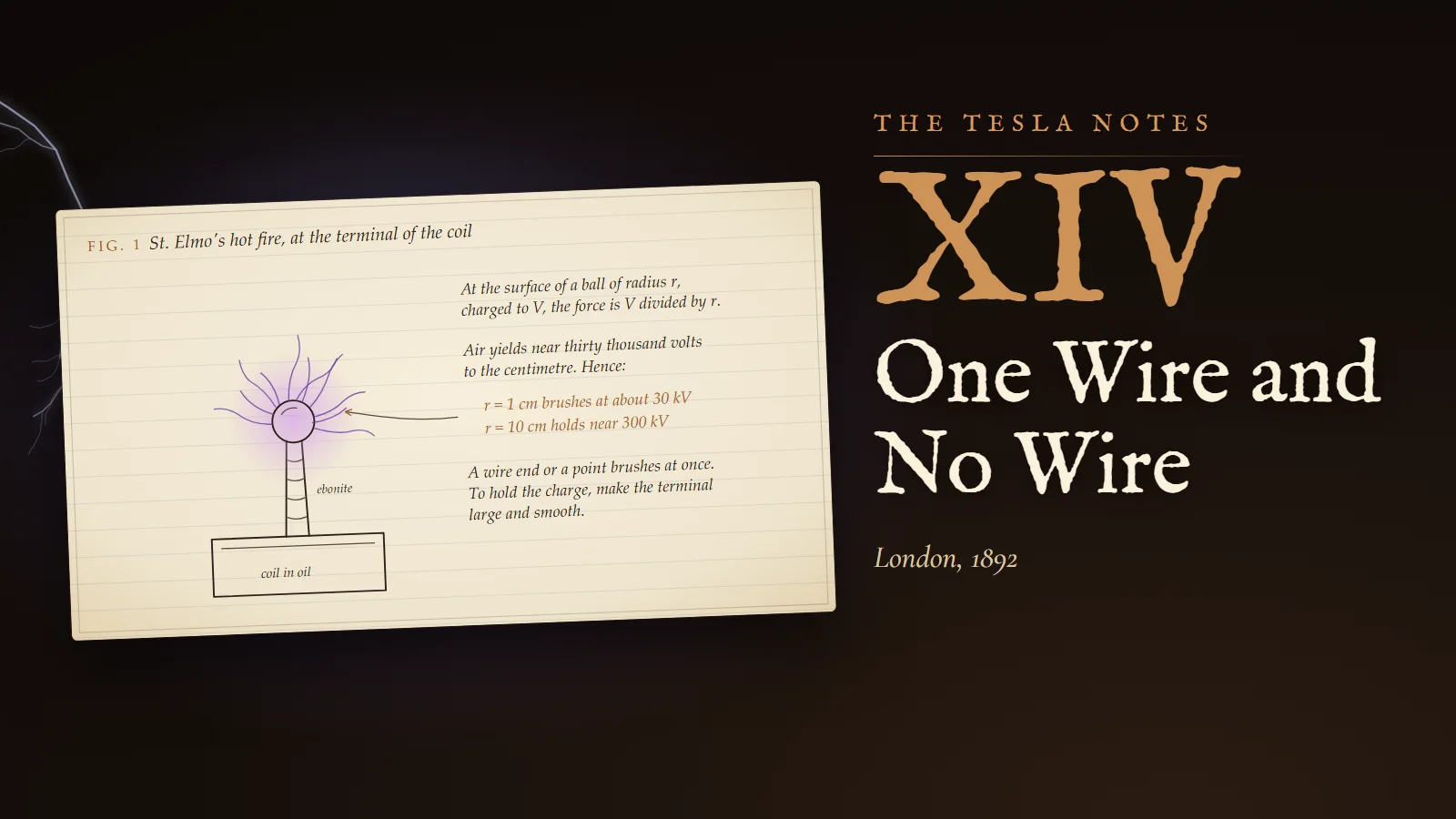 Tesla Notes 14: One Wire and No Wire (London, 1892)
Tesla's 1892 notebook: why a plate in the air can close a circuit, how to keep a terminal from brushing, and the storm that set his course for life.
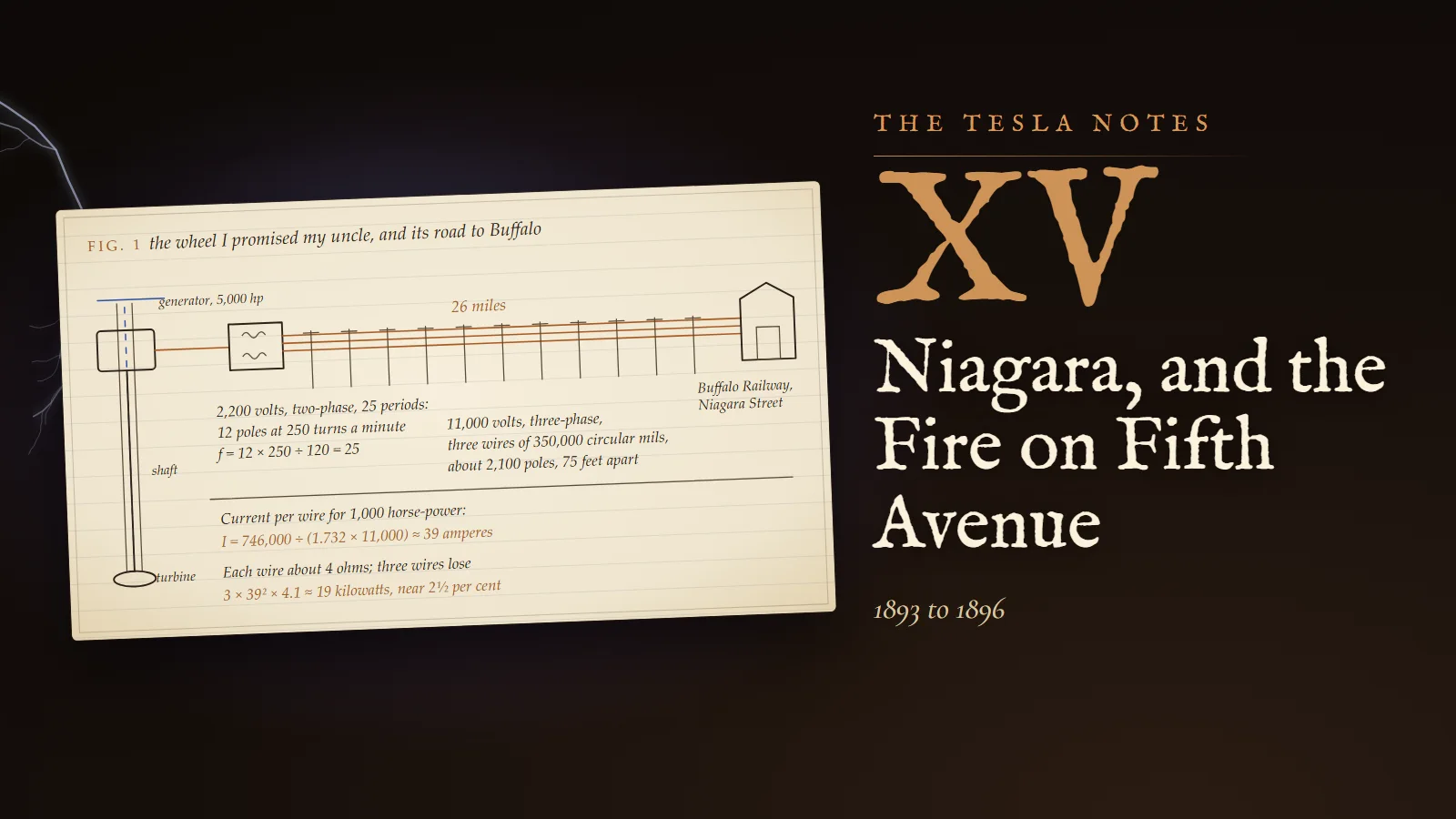 Tesla Notes 15: Niagara, and the Fire on Fifth Avenue (1893 to 1896)
Tesla's notebook, 1893 to 1896: why Niagara ran at 25 periods, why 11,000 volts saved the copper, and what a fire takes from an inventor and what it leaves.
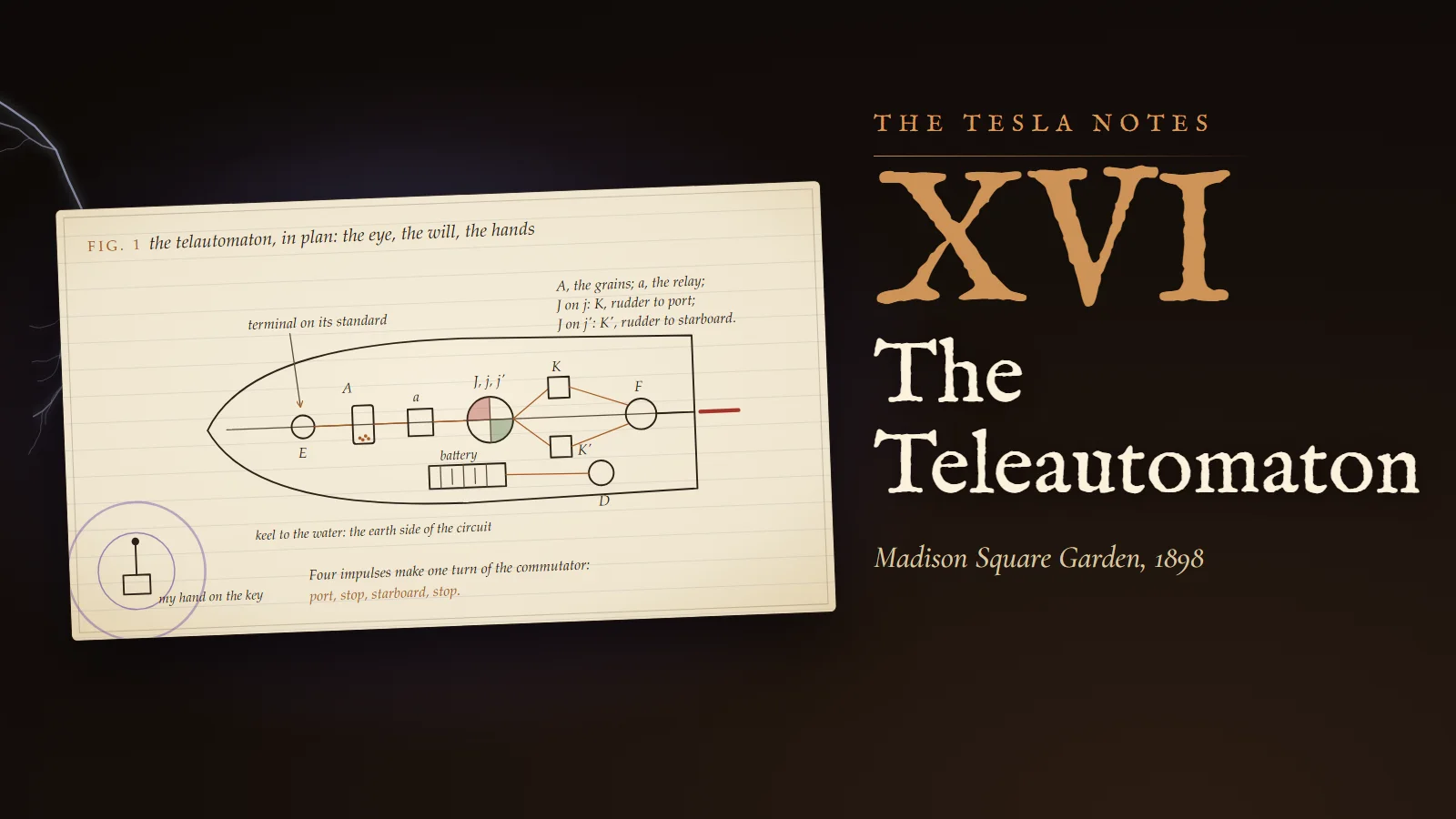 Tesla Notes 16: The Teleautomaton (Madison Square Garden, 1898)
Tesla's notebook of 1897 and 1898: how a coherer, a tuned circuit and a four-quarter commutator steered a boat, and why he thought it would end war.
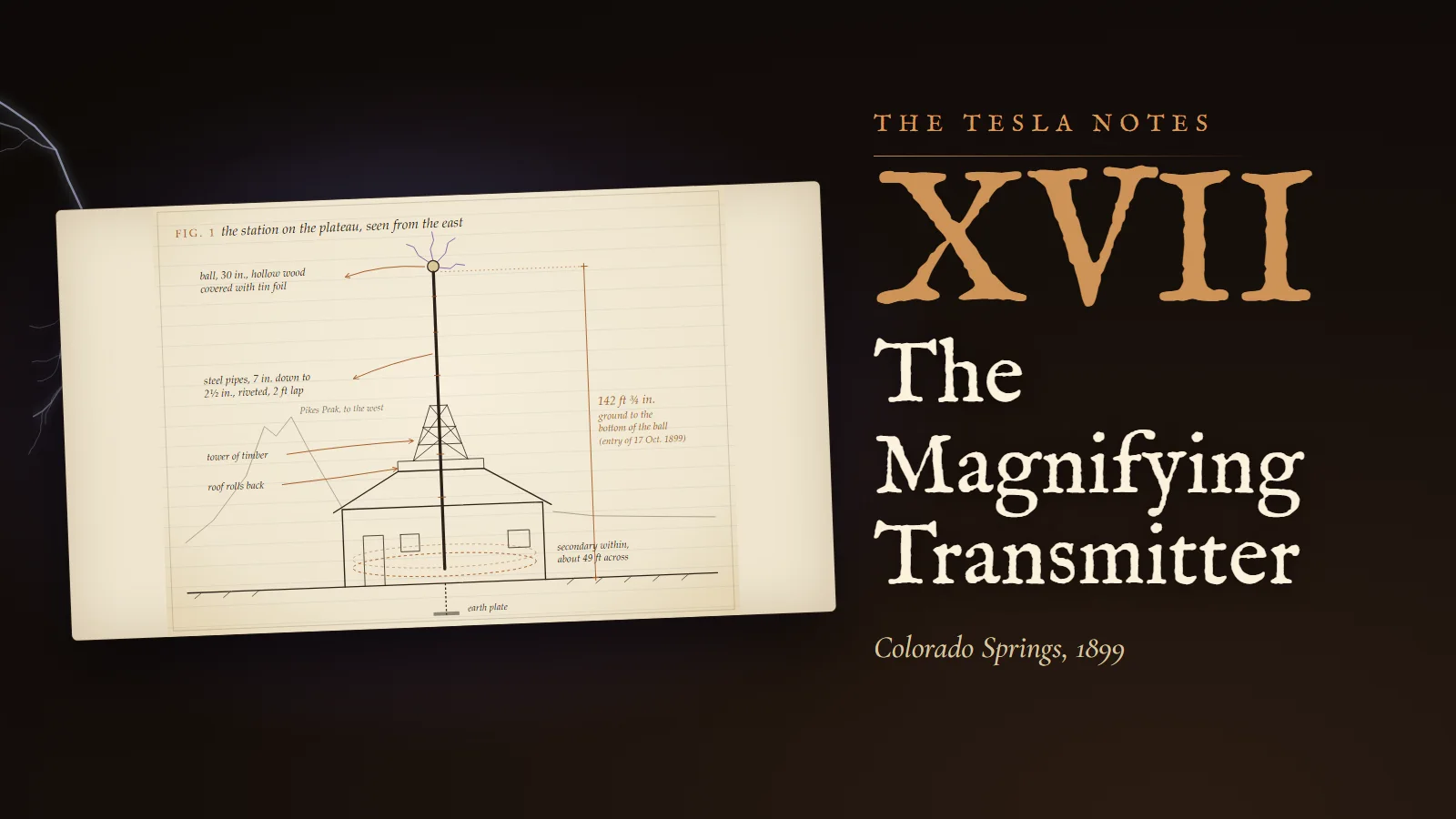 Tesla Notes 17: The Magnifying Transmitter (Colorado Springs, 1899)
Tesla's 1899 Colorado Springs notebook: the extra coil as a quarter wave, why a ball on top lowers its pitch, and three ways he measured capacity.
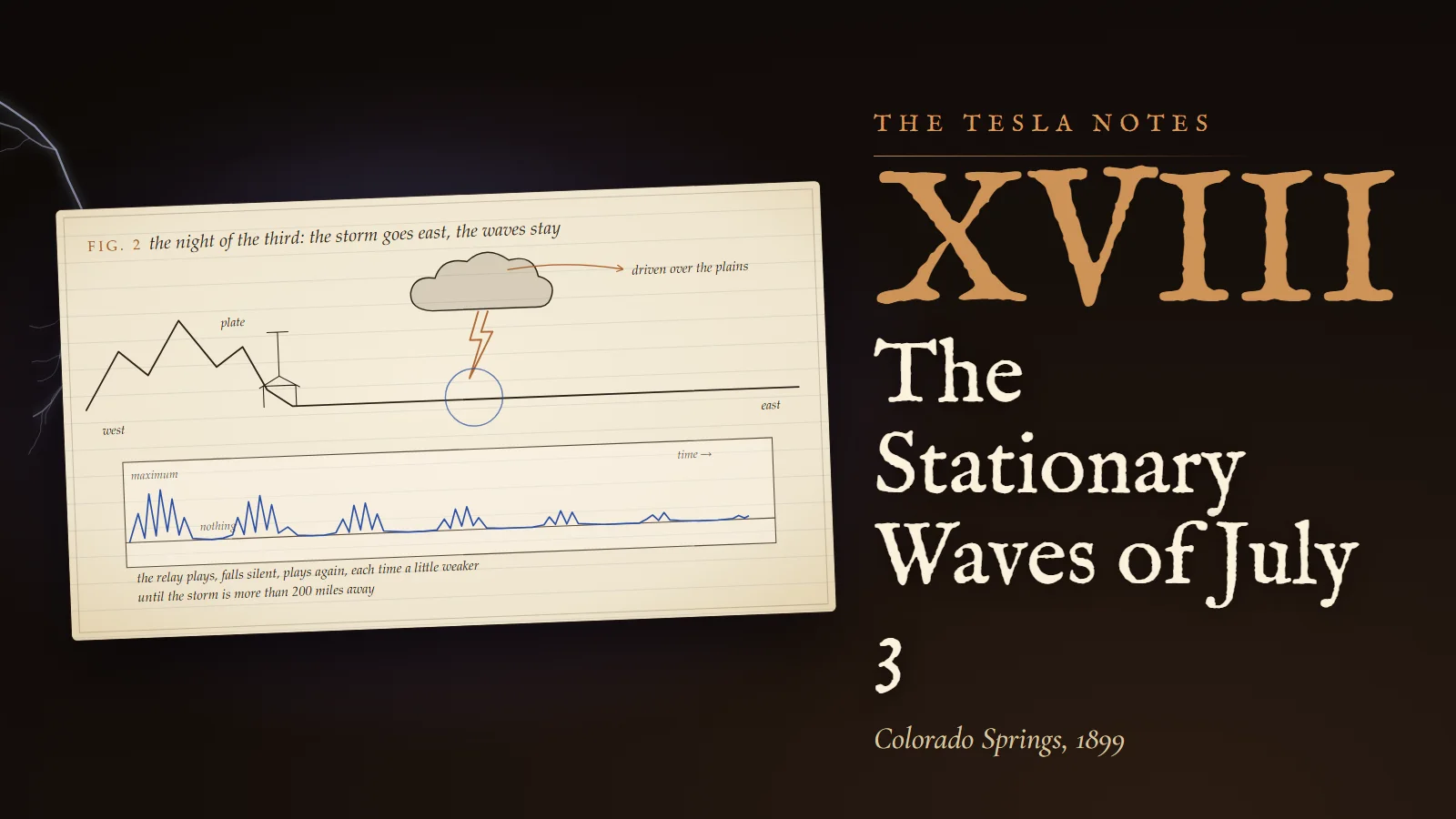 Tesla Notes 18: The Stationary Waves of July 3 (Colorado Springs, 1899)
Tesla's night of 3 July 1899: the receding storm, his stationary waves, the 6 Hz of patent 787,412, and why Schumann's 7.83 Hz is a near-miss.
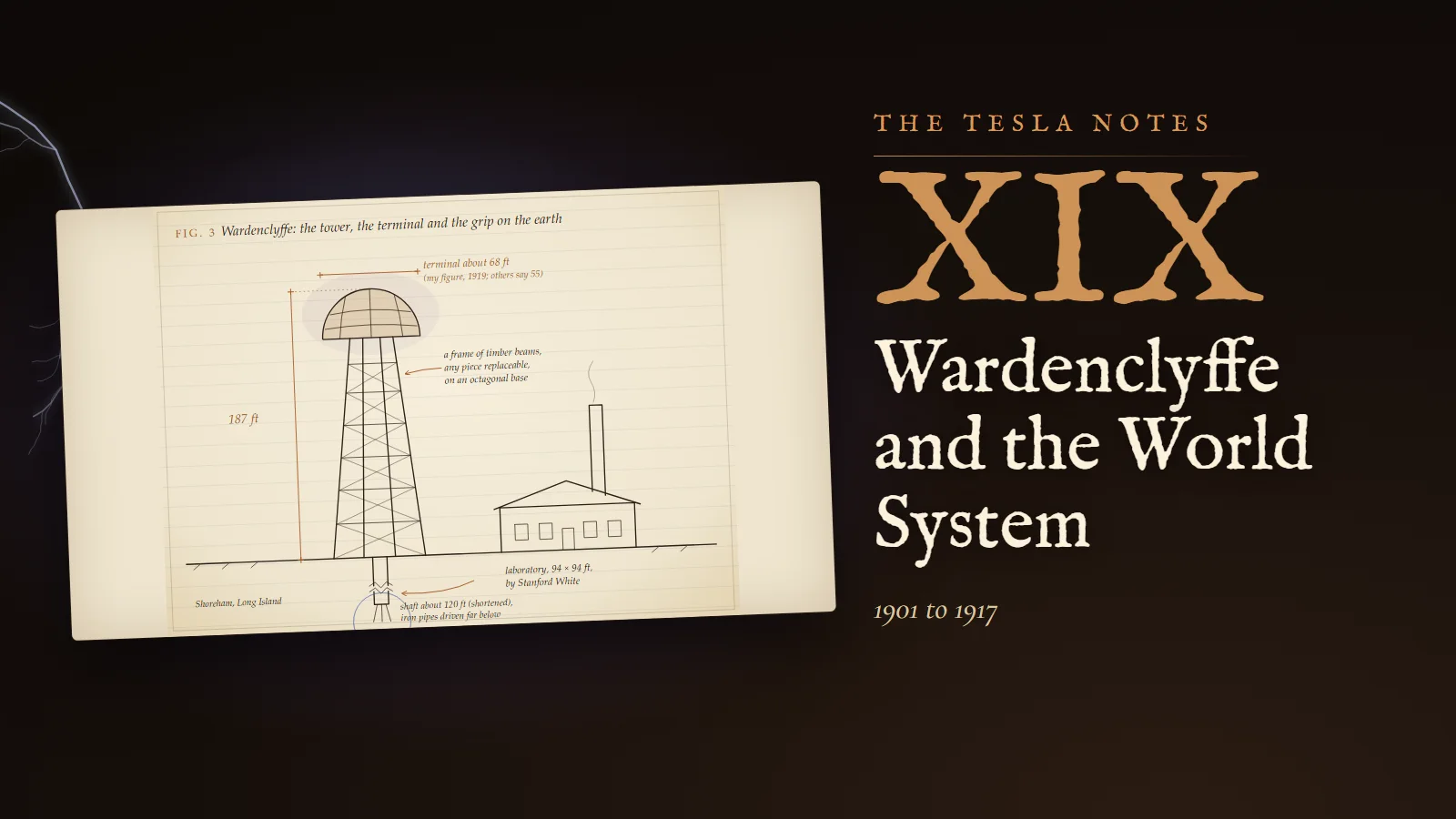 Tesla Notes 19: Wardenclyffe and the World System (1901 to 1917)
Tesla's Wardenclyffe tower: why the terminal was huge and smooth (E = V/r, C = 4πε₀r), Marconi in 1901, and an honest verdict on wireless power.
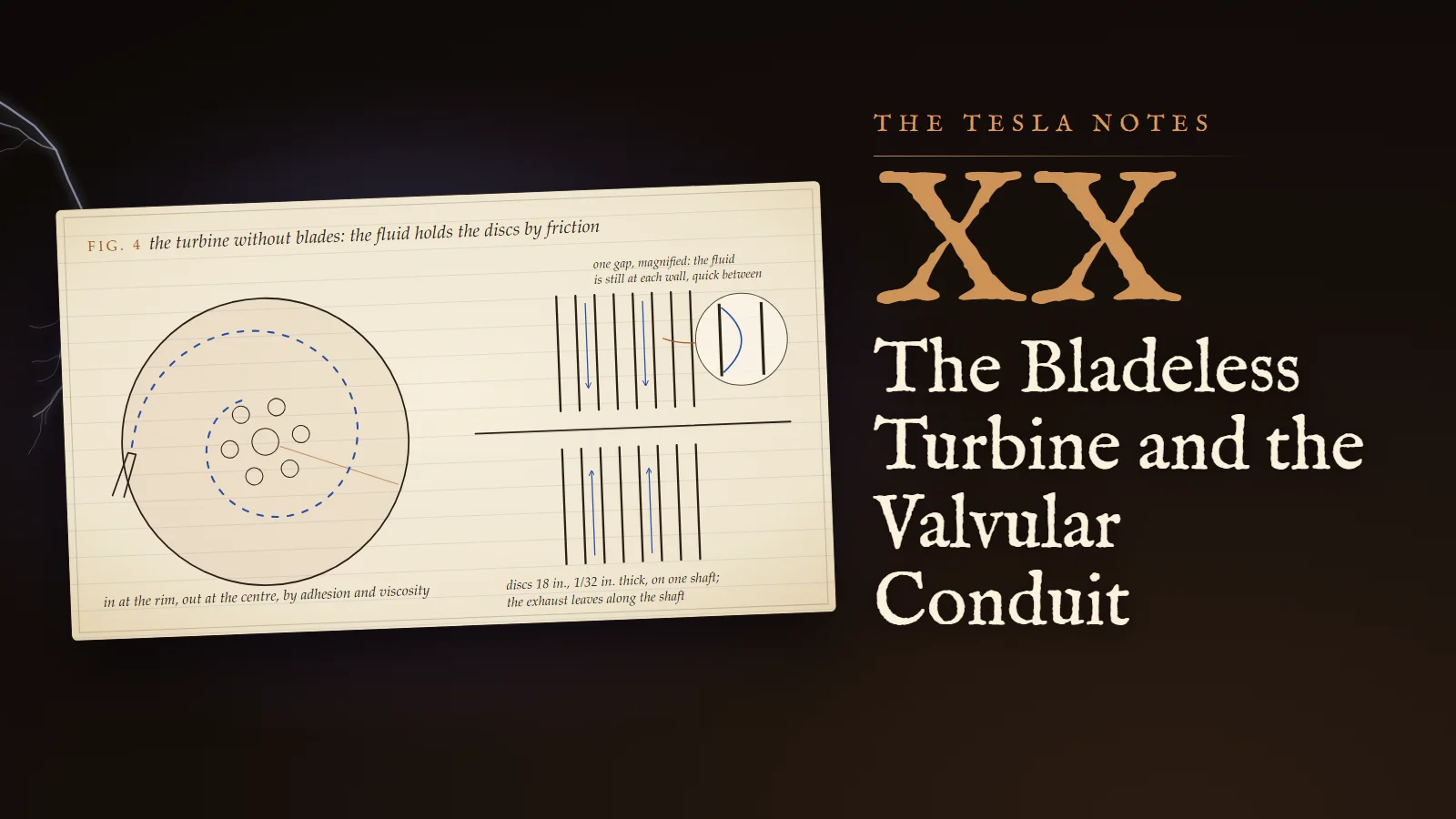 Tesla Notes 20: The Bladeless Turbine and the Valvular Conduit
Tesla's disc turbine and valve worked by hand, tested against 2021 measurements, and the end of his story: 1943, John G. Trump and Belgrade.








Comments