





Paris, August 1889, under Eiffel's new tower, which half of Paris calls a disgrace. I came for the Exposition and the machines, and I have found something larger than any machine. In the halls and cafés the electricians talk of one name: Hertz, the young professor from Karlsruhe, who has made Maxwell's waves with a spark and a ring of wire, and measured their length in a lecture room. If he is right, the space around every alternating current is full of motion that travels at the speed of light. I have spent seven years making alternating currents do work in wires. I must know what they are doing outside them. This book follows the question for three years, from a café in Paris to a laboratory in Bonn, and it ends in an argument I lost and do not regret.
No wonder then that the publication of Dr. Heinrich Hertz's results caused a thrill as had scarcely ever been experienced before.
Nikola Tesla, "The True Wireless", Electrical Experimenter, May 1919
Paris, August 1889. The news from Karlsruhe
I write down what I have heard and read, in the order I believe it happened, so that I can test it later against the papers themselves.
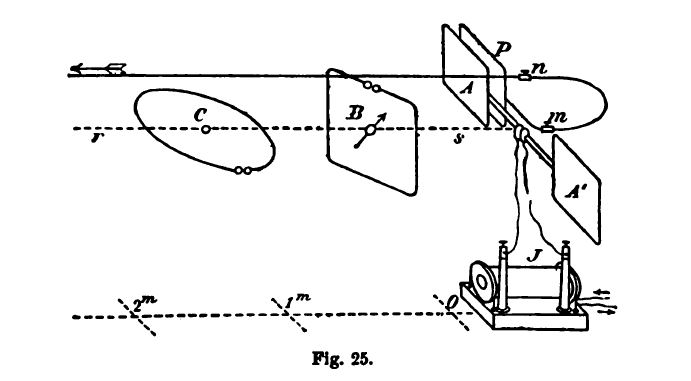
In the autumn of 1886 Hertz noticed that the discharge of a Leyden jar through one flat spiral of wire made sparks jump in a second spiral near it, unconnected. He followed the hint for two years. His oscillator is two straight rods in line, with a small spark gap between their inner ends, and a large sphere or plate at each outer end to give it capacity. An induction coil charges the two halves until the gap breaks down, and the charge then rushes back and forth along the rods, as in a Leyden jar circuit, but much faster, because the capacity is small and the self-induction is that of a straight wire. His detector is simpler still: a ring of wire with a gap of a fraction of a millimetre, in which a tiny spark appears when the ring is in the right place.
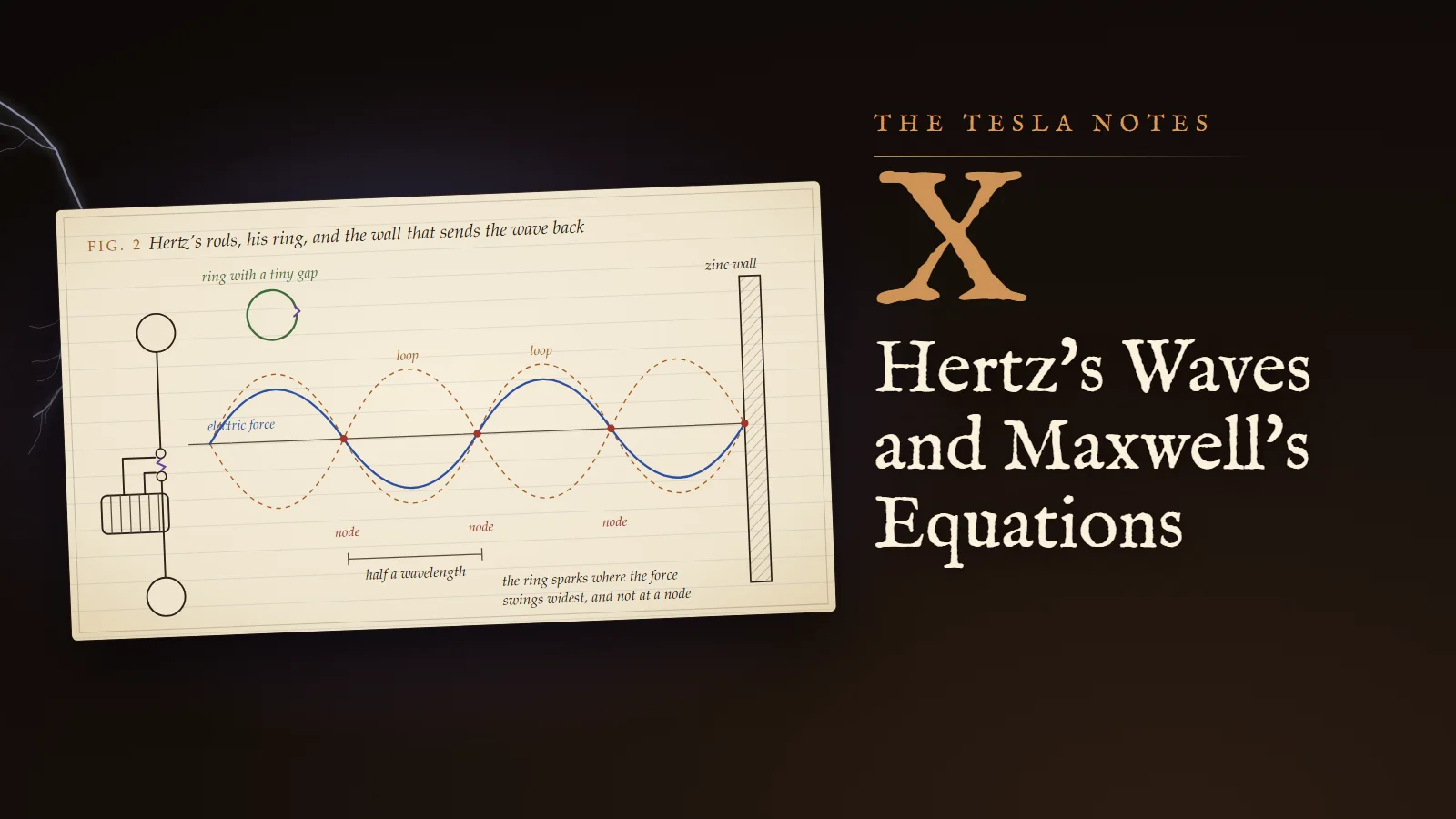
With these two he did what Maxwell had said could be done and what no one had done. He set the oscillator at one end of his lecture room and a sheet of zinc on the far wall. Carrying the ring between them, he found places where the spark was strong and places where it vanished, fixed in the room, as if the air itself were divided into compartments. They are the nodes and loops of a standing wave: the wave from the oscillator and its reflection from the zinc, adding in some places and cancelling in others. From the distance between the nodes he had the length of the wave. Later, with smaller oscillators at the focus of mirrors of sheet zinc, he made beams of these waves, reflected them, refracted them through a prism of pitch, and showed that a grating of wires stops them when the wires are parallel to the oscillator and lets them pass when the wires are crossed. Every property of light, with waves a thousand thousand times longer.
Reflection
The Berlin Academy offered a prize in 1879 for an experimental decision on Maxwell's theory, Helmholtz having set the problem. It lapsed uncollected. Hertz, Helmholtz's own student, collected the honour if not the prize, eight years late, in a provincial technical school with apparatus a good mechanic could make in a week. I feel the thrill everyone feels. I also feel something less comfortable. My whole system rests on what currents do in conductors and iron. If the space around them is a sea of waves, what fraction of my energy is going out into it, and why have I never noticed it? I want to see the sparks in the ring with my own eyes. As soon as I am free of Pittsburgh I shall build the apparatus.
Margin
The papers are in Wiedemann's Annalen, in German, which I read as easily as my own language. I have ordered the volumes for 1887, 1888 and 1889 sent to New York. Hertz has also, I am told, solved Maxwell's equations for the space around his oscillator and drawn the lines of electric force detaching themselves from the rods in closed loops and moving off. I must see those drawings.
Grand Street, February 1890. Maxwell's twentieth chapter
Before I repeat an experiment I want to understand the theory it is meant to prove. I have spent three weeks of evenings with the second volume of Maxwell's Treatise, the chapter he calls the electromagnetic theory of light. It is hard going. Maxwell writes as if the reader had already understood him, and he changes his symbols from chapter to chapter. I have reduced his argument to the simplest case I could find, and written it out as I would explain it to a student.
Calculation
The two ideas. First, Faraday's: a changing magnetic induction through any circuit produces an electromotive force around it. Second, Maxwell's own, which he called the displacement current: when the electric force in an insulator changes, the change acts exactly like a current, and produces magnetic force around it as a current in a wire would. A condenser being charged is then a circuit closed through the glass. The current does not stop at the coating; it continues through the dielectric as a displacement, and the circuit is complete.
The case. Let a disturbance travel in the direction x through air. Let the electromotive intensity have only a component Q, in the direction y, and the magnetic force only a component γ, in the direction z. Both depend only on x and on the time t. Let K be the specific inductive capacity of the medium and µ its magnetic permeability, both in electromagnetic measure.
- Faraday's law, applied to a small rectangle in the plane of x and y, of length dx and height 1. The electromotive force around it is the difference of Q at its two ends, (∂Q/∂x) dx. The induction through it is µγ dx. The force equals minus the rate of change of the induction: µ ∂γ/∂t = −∂Q/∂x.
- Maxwell's law of the total current, applied to a small rectangle in the plane of x and z. The magnetic force around it is the difference of γ at its two ends, which is −(∂γ/∂x) dx with the sense taken in the right-handed order. This equals 4π times the current through it. In air there is no conduction, only displacement, and the displacement is K Q/(4π), so its rate of change gives a current (K/4π) ∂Q/∂t. Then: K ∂Q/∂t = −∂γ/∂x.
- Differentiate the second equation with respect to t: K ∂²Q/∂t² = −∂²γ/∂x∂t.
- From the first equation, ∂γ/∂t = −(1/µ) ∂Q/∂x. Differentiate this with respect to x: ∂²γ/∂t∂x = −(1/µ) ∂²Q/∂x².
- Substitute: K ∂²Q/∂t² = (1/µ) ∂²Q/∂x², that is, ∂²Q/∂t² = (1/(Kµ)) ∂²Q/∂x².
- This is the equation of a vibrating string, d'Alembert's equation, and its solutions are any shape whatever moving along x without change at the speed V, where V² = 1/(Kµ). So V = 1/√(Kµ).
- Now the numbers. In air µ = 1 in electromagnetic measure. And K, which is 1 for air in electrostatic measure by definition, becomes 1/v² in electromagnetic measure, where v is the ratio of the electromagnetic to the electrostatic unit of quantity. Therefore in air V = v. The disturbance travels at the ratio of the units.
- Weber and Kohlrausch measured that ratio in 1856 by discharging a Leyden jar whose charge they had measured electrostatically through a galvanometer which measured it magnetically. In Maxwell's reckoning their result is 310,740 kilometres per second. Fizeau, with his toothed wheel in 1849, measured the velocity of light as 314,858 kilometres per second, Foucault in 1862 about 298,000, and Michelson's figure of 1879 is close to 299,900.
- The disturbance also comes out transverse: Q and γ are both at right angles to the direction of travel, and to each other. Light is transverse; Fresnel proved it from polarisation sixty years ago.
Maxwell, when he first saw the agreement in 1862, wrote that "we can scarcely avoid the inference that light consists in the transverse undulations of the same medium which is the cause of electric and magnetic phenomena." He was then a man of thirty, and he had the number from a German measurement made for quite another purpose. Hertz has now made the undulations with his own hands.
Margin
Kirchhoff found in 1857 that an electrical disturbance runs along a wire without resistance at this same speed. So the speed of light was already in the telegraph wire, unrecognised, before Maxwell put it into the ether. And it is in my Leyden jar: last month I found the period of my jar to be 2π√(LC)/v, with L and C in centimetres. The ratio of the units sits in the middle of every oscillating circuit, waiting.
Reflection
I admire this argument more than I can say, and I distrust its foundation. Maxwell built his displacement current in a medium of whirling cells and idle wheels, a mechanical model he later set aside while keeping the equations. The equations survive the model. But they still require a medium in which the displacement occurs, the luminiferous ether, and the ether required by transverse waves of this speed must be as rigid as steel, while the planets move through it without resistance. A solid to light and a fluid to the Earth. I cannot picture such a substance. And what I cannot picture I do not understand, however well I can manipulate its equations.
Grand Street, March 1890. A wire that measures light
Hertz's standing waves in air require a large room, a zinc wall, and a patience for faint sparks. There is an easier way to see the same thing, and Hertz used it too: let the wave run along a wire, reflect from its end, and come back.
Calculation
First, the frequency of Hertz's first oscillator, from Kelvin's formula, as nearly as I can estimate it. Two copper rods, each a metre long and half a centimetre thick, end to end, with spheres of 30 centimetres diameter at their far ends.
- The capacity of an isolated sphere in electrostatic measure equals its radius: 15 cm for each. The two spheres act in series through the gap, so the capacity of the oscillator is about 7.5 cm. I neglect the capacity of the rods, which is smaller.
- The self-induction of a straight wire of length l and radius a, the current returning at a great distance: L = 2l(log(2l/a) − 1). With l = 200 cm and a = 0.25 cm: 2l/a = 1,600, log 1,600 = 7.378, L = 400 × 6.378 = 2,551 cm.
- T = 2π√(LC)/v = 2π√(2,551 × 7.5)/(3 × 10¹⁰) = 2π × 138.3/(3 × 10¹⁰) = 2.90 × 10⁻⁸ second.
- f = 1/T = 34.5 million periods per second. The current in the rod is far from uniform, being greatest at the gap and least at the spheres, and the rods have capacity of their own, so my lumped estimate may be wrong by half; it is the order of magnitude I need.
- The length of the wave in air: λ = vT = 3 × 10¹⁰ × 2.90 × 10⁻⁸ = 870 centimetres, nearly nine metres. The nodes of a standing wave stand half a wavelength apart: some four and a third metres.
So the waves are a few metres long, and a lecture room of fifteen metres holds a few of them. This is why Hertz could do the experiment at all. With my four jars and loop of rod, at 1¼ million periods, the wave would be 240 metres long, and no room on earth would show its nodes.
Experiment No. 1
The arrangement I shall make, drawn as Plate X. From one side of an oscillator a bare copper wire runs across the laboratory on silk cords, twelve metres, and its far end is free. The wave runs out along the wire and is reflected at the free end without change of sign, for the charge arriving there has nowhere to go and piles up, so the potential at a free end is greatest. If the end is joined to a large plate, so large that its potential can hardly change, the reflected wave returns inverted and the end becomes a node. Between the two, along the wire, the outgoing and returning waves make fixed nodes, half a wavelength apart, which a small Geissler tube or a gap held near the wire will find.
Margin, added in December
Hertz reported that waves guided by wires travel more slowly than the waves in air, at some two-thirds of the speed. If so, Maxwell is wrong somewhere, for the theory says that a wave on a thin wire in air is a wave in the air, guided, and must travel at the same speed. Now Sarasin and de la Rive at Geneva have repeated the measurements with great care and find that the spacing of the nodes is the same in air and along the wire, provided the same ring is used to find them. They found something else, which they call multiple resonance: the length of wave measured depends on the ring, not on the oscillator. The oscillator's train dies so fast that it contains a spread of frequencies, and each ring picks from it the length to which it is itself tuned. This is a lesson for me. A detector is a tuned circuit and answers to its own note. A strongly damped source has no single note at all.
Draftsman's note
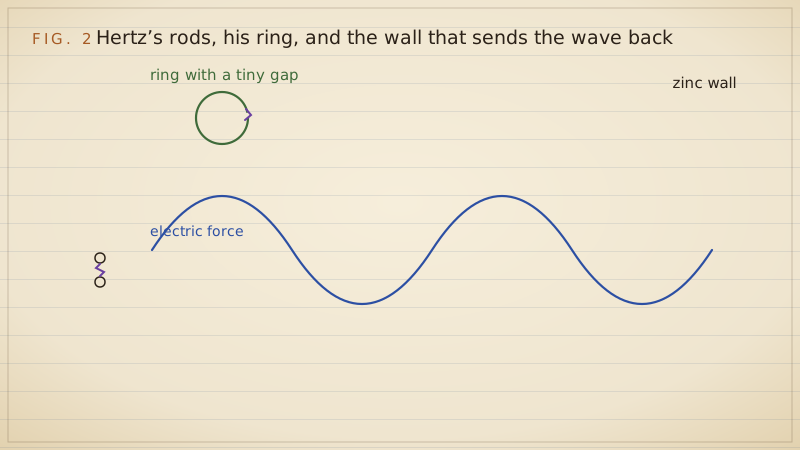
Fig. 2. The oscillator is drawn upright at the left, as Hertz drew his, with the induction coil below it: two rods, two spheres, the gap in the middle with a violet spark. The zinc wall at the right is hatched. Between them the standing wave: the envelope dashed in copper, the wave itself in blue, the nodes as red dots, with the node at the wall where the electric force must vanish on the metal. Half a wavelength marked below with a bracket. The ring is drawn small and green, with its gap, above a loop.
Grand Street, 14 December 1890. What I object to
I have built the oscillator and the ring, and I have seen the sparks. They are real. I have now spent a month trying to make the waves do something useful, and I have found my objections. I write them down plainly, so that I can be shown wrong.
Calculation
The first objection is one of distance. From Hertz's solution for the space around his oscillator I take only this result, which I have checked in the simplest case. The electric force near a small oscillator has a part that falls as the cube of the distance, the ordinary electrostatic force of the two charged halves, and a part that falls only as the first power of the distance, the radiated wave. At distance r the second exceeds the first in the ratio (2πr/λ)². They are equal at r = λ/(2π).
- For Hertz's first oscillator, λ ≈ 8.7 metres, so the boundary lies at 8.7/6.28 = 1.4 metres.
- At 0.5 metre the ratio is (2π × 0.5/8.7)² = (0.361)² = 0.13. The electrostatic force is nearly eight times the wave.
- At 10 metres the ratio is (2π × 10/8.7)² = (7.22)² = 52. The wave dominates, but both are small: the static part has fallen by (10/0.5)³ = 8,000 and the wave by 20.
- For my own lamps and tubes at 20,000 periods a second the wavelength is 15 kilometres, and the boundary lies at 2.4 kilometres. My whole laboratory, and any room I shall ever light, is deep inside the electrostatic region. The radiated wave is there, but it is a feeble accompaniment to the field I can use directly.
The second objection is one of energy. Where does the energy of Hertz's spark go? I have watched his kind of gap, short and hot, between polished balls, with an induction coil that charges perhaps fifty times a second. The ring's spark is a fraction of a millimetre long and visible only in a dark room. The source's spark is a centimetre long and roars. I believe that most of the energy is spent in the gap and the conductors as heat, and that the part which leaves as waves is small. Lodge and others assert the opposite. I shall examine it with a better source.
The third objection is one of method. Everyone who has followed Hertz has gone looking for electromagnetic effects, the induction of currents in rings and wires. To do so they use apparatus in which the electromagnetic effects are enormous and the electrostatic effects excessively small: an induction coil short-circuited at its terminals by the very spark that sets the oscillator going. The great electrostatic forces that a coil of high potential and high frequency can produce are never seen. I think the more promising road lies there.
Reflection
I write these objections with discomfort, because Hertz is a better mathematician than I am and Maxwell a far greater one. But my business is the energy that reaches the far end, and I do not see how much of it can reach the far end by this road. A source in a room radiating into all directions, with the energy spreading over a sphere whose area grows as the square of the distance, must give at a mile a hundred million times less on each square foot than at a few feet. I want something that travels the way current travels in a wire, guided, and loses nothing on the way except the resistance. Whether the earth, or the upper air, or a single wire can serve as that guide is a question for a later book.
Grand Street, December 1891. Hertz's experiments with my new coil
Two years ago I wanted to behold the miracle with my own eyes. Now I have, and with means vastly greater than his. Since the spring I have had the oscillation transformer, with a secondary in tune with a condenser discharge, giving sparks of many inches. With it I have gone over the whole ground of Hertz's experiments once more, carefully, from the beginning.
Experiment No. 2
Oscillator: the coil's secondary feeding two rods with spheres, in place of the Ruhmkorff coil Hertz used. Detector: a ring of copper wire of 35 centimetres radius, with a micrometer gap. Procedure: the ring carried about the laboratory at different distances and positions, the gap observed in darkness through a lens.
Results. Every phenomenon Hertz describes appears, and greatly magnified in intensity. The ring sparks brightly across the whole length of the laboratory. But the sparks are capricious in a way that the theory of waves in free space does not explain. They change when I move the leading wires of the coil, when I touch the gas pipe with one hand, when an assistant stands near the ring or far from it, when the window frame is moved. They are strongest near conductors connected to the ground, whatever the distance from the oscillator. A wave in free space should care little for the gas pipes. A disturbance propagated by currents in the conductors and the ground, and by electrostatic induction through the room, cares for nothing else.
I conclude, as far as my experiments go, that the effects Hertz observed are real but susceptible of a different and simpler explanation than the radiation of transverse waves through the ether: they are for the greater part the electrostatic and conductive actions of the oscillator on the bodies around it, including the observer. The waves exist; I believe they are the smaller part of what happens.
Margin
At Columbia College in May I said what I believe about the ether, and I hold to it: "I must confess, that I cannot believe in two electricities, much less in a doubly-constituted ether." One electricity and one medium, under strain for static effects and in motion for magnetic ones. Of the investigators who followed Hertz I said that "Starting with the idea of producing electro-magnetic waves, they turned their attention, perhaps, too much to the study of electro-magnetic effects, and neglected the study of electrostatic phenomena." The light in my tubes is produced by electrostatic force, at frequencies far below those of light. It needs no wave of light's length to make it.
Reflection
I owe Hertz a great deal, and I want to be fair to him. His immortal merit, it seems to me, is less in what he proved about the ether than in that he turned the attention of every experimenter to the processes taking place in the medium around a circuit. Before him we thought of a current as something inside a wire. After him no one can. I shall go to Bonn when I next cross to Europe and show him what I have found. If I am wrong, he is the one man who can show me exactly where.
Bonn, 1892. A visit to Dr. Hertz
After London and Paris, and after Gospić, where I buried my mother, I went to Bonn. The professor received me in his laboratory as a colleague: a slight man of thirty-five, very courteous, with a fine head and the patience of a mathematician. I had brought my notes of the Grand Street experiments, a description of the coil, and my conclusions.
I told him what I had seen: the effects magnified a hundredfold with the new apparatus, and the sparks in the ring behaving as electrostatic and conductive actions rather than as waves in free space. I explained why I thought the energy radiated by his oscillator small and the energy spent in the spark large, and why I believed that for the transmission of energy the ground and the conductor would serve and the waves would not. He listened to all of it. He asked careful questions about the coil, about the frequency, about the way I had found the nodes. He was not convinced. I had come expecting an argument, and I would have welcomed one. What I found was disappointment, and I could not tell whether it was in me or in his own work, and I did not ask.
Calculation
On the train back along the Rhine I tried to put my case in one sum, to see whether it was as strong as I thought. A source in open space spreading its energy over a sphere delivers, at distance r, a fraction A/(4πr²) of its power to a receiver of area A. For a receiving ring of 35 centimetres radius, A = π × 35² = 3,850 cm². At 10 metres, 4πr² = 1.26 × 10⁷ cm², and the fraction is 3,850/1.26 × 10⁷ = 3 × 10⁻⁴. At 10 kilometres it is 3 × 10⁻¹⁰. No engineer would build a system of transmission on such numbers. Hertz never claimed one could. When he was asked whether his waves would serve for signalling, he did not think they would, and for what he had in his hands he was right.
Margin, January 1894
Hertz is dead at Bonn, on the first day of the year, at thirty-six. I think of the afternoon in his laboratory and of how little either of us said that mattered. Twenty-seven years after that visit, when I came to write of it in the Electrical Experimenter, I could find only one way to say it: "He seemed disappointed to such a degree that I regretted my trip and parted from him sorrowfully." I still think my explanation of my own observations was right. I have never stopped thinking that he was the finest experimenter of my generation.
Problems I set myself
1. Hertz's later oscillators, at the focus of his zinc mirrors, gave waves about 66 centimetres long. Find the frequency, the distance between nodes in front of a reflecting wall, and the distance from the wall to the nearest loop of electric force.
Answer. f = v/λ = 3 × 10¹⁰/66 = 4.5 × 10⁸ periods per second, 450 million. The nodes stand half a wavelength apart, 33 centimetres. The wall is itself a node of electric force (the force along a conducting surface must vanish), so the first loop is a quarter wavelength from it: 16.5 centimetres.
2. In paraffin the specific inductive capacity is about 2.2 times that of air and µ = 1. How fast does the disturbance travel in it, and what is the wavelength in paraffin of a wave of 35 million periods?
Answer. V = 1/√(Kµ), so in a medium whose K is 2.2 times that of air, V = v/√2.2 = 3 × 10¹⁰/1.483 = 2.02 × 10¹⁰ cm per second. The frequency is unchanged at the boundary, so λ = V/f = 2.02 × 10¹⁰/(3.5 × 10⁷) = 578 cm, against 857 cm in air. The refractive index, if Maxwell is right, is √2.2 = 1.48, and for paraffin measured with light it is about 1.43: close, though light's index depends on its colour and these long waves see the substance differently.
3. For an oscillator whose wavelength is 8.7 metres, find the distance at which the radiated part of the electric force equals the electrostatic part, and the ratio of the two at 30 centimetres and at 5 metres.
Answer. They are equal at r = λ/(2π) = 8.7/6.283 = 1.38 metres. The ratio is (2πr/λ)². At 0.3 metre: (2π × 0.3/8.7)² = (0.217)² = 0.047, so the electrostatic force is twenty-one times the radiated part. At 5 metres: (2π × 5/8.7)² = (3.61)² = 13.0, so the radiated part is thirteen times the other.
To the student who reads this later
You write in four lines what took Maxwell twenty equations and me three weeks. In empty space: ∇ · E = 0, ∇ · B = 0, ∇ × E = −∂B/∂t, ∇ × B = µ₀ε₀ ∂E/∂t. Take the curl of the third: ∇ × (∇ × E) = −∂(∇ × B)/∂t = −µ₀ε₀ ∂²E/∂t². Since ∇ × (∇ × E) = ∇(∇ · E) − ∇²E and the divergence is zero, ∇²E = µ₀ε₀ ∂²E/∂t², the wave equation with speed c = 1/√(µ₀ε₀). With µ₀ = 4π × 10⁻⁷ and ε₀ = 8.854 × 10⁻¹² in your units, µ₀ε₀ = 1.1127 × 10⁻¹⁷ and c = 2.998 × 10⁸ metres per second. Heaviside and Hertz put Maxwell into this form in 1884 to 1890; my K and µ are your ε/ε₀ and µ/µ₀, and my "ratio of the units" is your c, which since 1983 has been fixed by definition at 299,792,458 metres per second. Your E is my Q, your B my µγ, and my one-dimensional calculation is the curl equations written for a wave travelling along x.
Now the honest part. The ether I could not picture does not exist; Michelson and Morley failed to find the Earth's motion through it in 1887, before any of these entries, and Einstein in 1905 showed that the equations need no medium at all. Hertz was right that his waves were transverse electromagnetic waves travelling through space, and I was wrong to call them of little value: they carry your radio, your television, your radar and the telephone in your pocket. I was wrong too about the energy of his oscillator. An open rod radiates strongly. Your formula for the radiation resistance of a short dipole, 80π²(l/λ)² ohms, gives for Hertz's two metres of rod at nine metres wavelength about 40 ohms, far more than the few ohms of his spark: his oscillator lost most of its energy as waves, within a few periods. That fast radiation, as much as the spark, is why his trains were so short and why the Geneva rings each picked their own note. My closed coils and jars radiate almost nothing, and I generalised from them too quickly.
Where I was right: within a sixth of a wavelength of a source the near field dominates, and short-range transfer of energy, in your wireless chargers, your contactless cards and your induction cookers, works by near-field coupling of tuned circuits, the electrostatic and magnetic actions I preferred to waves. At low frequencies, waves guided along the conducting ground, described by Zenneck in 1907 and Sommerfeld in 1909, carry signals over the curve of the Earth. My observations in Grand Street, sparks that depended on the gas pipes and the people in the room, were near-field effects in a cluttered laboratory, and Hertz, looking at the same kind of thing, understood more of it than I allowed.
What to try: remove the turntable from a microwave oven, put in a plate covered evenly with chocolate or cheese, and heat it for twenty seconds. The melted spots lie at the loops of a standing wave, half a wavelength apart, about 6 centimetres. Multiply twice the spacing by the frequency printed on the back of the oven (2.45 × 10⁹) and you have measured the speed of light with your dinner, as Hertz measured it with his lecture room. Then find a pair of parallel wires and a small radio transmitter and look for the nodes along them with a neon lamp, as Lecher did at Vienna in 1890.
If you want to tell me I was wrong about Hertz, I will listen more patiently than I did in Bonn: come and ask me.
Sources and liberties
The Tesla Notes are a modern reconstruction written in Nikola Tesla's voice by Eternal Gardens. Dates, patents, lectures, apparatus and quotations come from the sources below; the private reflections, the order of the working and the sketches are ours.
- Nikola Tesla, "The True Wireless", Electrical Experimenter, May 1919 (the thrill at Hertz's results, the experiments with Hertz's apparatus in Grand Street "parallel with high frequency alternators", the oscillation transformer as means "vastly superior", the visit to Bonn in 1892, and his view of Hertz's merit): Wikisource
- Nikola Tesla, "Experiments with Alternate Currents of Very High Frequency and Their Application to Methods of Artificial Illumination", AIEE, Columbia College, 20 May 1891 (the two quoted sentences on the ether and on electrostatic phenomena, the Hertz and Lodge passages, the comparison of electrostatic and electromagnetic effects with distance): text at tfcbooks.com
- J. C. Maxwell, "On Physical Lines of Force", Part III, Philosophical Magazine, 1862 (Weber and Kohlrausch's 310,740,000,000 millimetres per second, Fizeau's 314,858,000,000, and the sentence quoted): Wikisource
- J. C. Maxwell, A Treatise on Electricity and Magnetism, 2 vols (Clarendon Press, Oxford, 1873), vol. 2, chapter XX, "Electromagnetic Theory of Light": archive.org
- Heinrich Hertz: his professorships at Karlsruhe (1885 to 1889) and Bonn (from 1889), the Riess spirals of 1886, the oscillator, the Berlin prize problem, and his death on 1 January 1894: Wikipedia; H. Hertz, Electric Waves, trans. D. E. Jones (Macmillan, London, 1893): archive.org
- Hertz's drawing of his apparatus, 1888, public domain: Wikimedia Commons
- History of the speed of light (Fizeau 1849, Foucault 1862, Weber and Kohlrausch 1856, Kirchhoff 1857): Wikipedia
- É. Sarasin and L. de la Rive, "Sur la résonance multiple des ondulations électriques de M. Hertz se propageant le long de fils conducteurs", Archives des Sciences Physiques et Naturelles (Geneva), vol. 23, 1890; and J. G. O'Hara, "A 'Horrible Conflict with Theory' in Heinrich Hertz's Experiments on Electromagnetic Waves", European Review 15 (2007), 545 onward: Cambridge Core
- W. B. Carlson, Tesla: Inventor of the Electrical Age (Princeton University Press, 2013), for Tesla's visit to the Paris Exposition in 1889 and his learning of Hertz there.
Tesla's account of the Bonn visit, written in 1919, is the only one; there is no independent record of the meeting, its month, or what was said, and our description of Hertz's laboratory and of the conversation is reconstruction. Tesla's December 1891 experiments with Hertz's apparatus are known only from his brief 1919 summary; the details of Experiment No. 2 are ours. The figures for Hertz's first oscillator are the notebook's lumped estimate; later estimates put its frequency nearer 50 million periods a second.