





New York, the last week of December 1889, in a rented loft on Grand Street that smells of shellac and cold iron. Pittsburgh is behind me. For a year I argued about cycles with men who wanted fewer of them, and the argument settled at sixty and one hundred and thirty-three. Now I want the opposite: currents that reverse ten thousand, a hundred thousand, a million times in a second. No machine of brass and iron will turn fast enough to give them, and I have been carrying, like a stone in my pocket, an old piece of mathematics that says a jar of glass and a loop of wire will do it of their own accord. This book begins the second part of my notes. Its first question is simple to write: how fast does a condenser swing when it empties through a coil, and what stops it?
In 1856 Lord Kelvin had exposed the theory of the condenser discharge, but no practical application of that important knowledge was made. I saw the possibilities and undertook the development of induction apparatus on this principle.
Nikola Tesla, "My Inventions", Part IV, Electrical Experimenter, May 1919
Grand Street, 30 December 1889. What Pittsburgh taught me about frequency
I set down the state of the question as I leave it, so that I may see later how far I have moved.
In Pittsburgh I learned the arithmetic of low frequency the hard way. The Westinghouse men had chosen one hundred and thirty-three periods a second for the advantage of their transformers, and my motors wanted far fewer. Every argument came back to two quantities that pull in opposite directions. The transformer's iron shrinks as the frequency rises, because the electromotive force of each turn is proportional to the rate of change of the lines through it. The motor's speed rises with the frequency, and above a certain point the magnetising current, the losses in the iron, and the self-induction of every winding conspire against it. For power, the low numbers win. I conceded the arithmetic and kept my faith in the motor.
But there is another country beyond the one I have been living in. Every effect that depends on the rate of change grows with the frequency. If the electromotive force of induction is proportional to the rate at which the lines change, then a current reversing a hundred thousand times a second induces, for the same strength, a thousand times more than one at a hundred. A coil of few turns would give enormous pressures. A condenser of small size would pass a large current, for its opposition falls as the frequency rises. A thin sheet of glass would carry energy through itself as freely as a wire. I want to walk into that country and see what lives there.
The difficulty is the source. An alternator gives one alternation each time a pole passes a conductor. To have ten thousand alternations a second from a machine at sixteen hundred revolutions a minute I need some four hundred poles, and I am designing exactly that machine (I shall keep its notes separately). But ten thousand alternations is five thousand complete periods, and that is the beginning of the country, not the middle of it. For a million periods the poles would have to be smaller than grains of rice and the rim would have to fly apart.
Margin
There is a source with no moving parts at all. Thomson, now Lord Kelvin, showed in a paper on transient electric currents, which I remember as of 1856, that a Leyden jar discharged through a wire of sufficient self-induction does not simply empty. It overshoots, charges itself the other way, empties again, and swings back and forth with diminishing force, exactly as a pendulum released from one side swings past the bottom. Joseph Henry suspected it in 1842 from the way a needle in a coil was left magnetised now one way, now the other, after a discharge. Feddersen in Leipzig, about 1859, photographed the spark in a turning mirror and saw it broken into a row of images. The theory is thirty years old and every textbook gives it a page. No one has used it. I mean to.
Grand Street, 9 January 1890. Kelvin's equation, worked again in my own hand
I do not trust a formula I have not derived. Tonight I derived this one twice, the first time wrongly.
The circuit: a condenser of capacity C, charged to a potential V₀ so that it holds a quantity q₀ = CV₀. It is joined, through a gap or a key, to a circuit of resistance R and coefficient of self-induction L. At the instant the gap breaks down, the current is zero and the charge is q₀.
Calculation
- Around the circuit the electromotive forces must balance at every instant. The condenser drives with a force q/C. The self-induction opposes any change of current with a force L di/dt. The resistance absorbs R i. So: L di/dt + R i + q/C = 0.
- The current is the rate at which the condenser loses its charge: i = dq/dt. Substituting, I have one equation in one unknown: L d²q/dt² + R dq/dt + q/C = 0.
- This is the equation of a pendulum in a resisting medium, or of a weight on a spring in oil. L stands where the mass stands, for it resists any change of motion. 1/C stands where the stiffness of the spring stands, for a small condenser pushes back hard. R stands where the friction stands.
- First the ideal case, R = 0. Then d²q/dt² = −q/(LC). The second derivative of the charge is proportional to the charge itself, with a minus sign: the condition of simple harmonic motion. Try q = q₀ cos ωt. Then d²q/dt² = −ω² q₀ cos ωt, and the equation is satisfied if ω² = 1/(LC).
- So the condenser swings with ω = 1/√(LC), and since ω = 2πf, the number of complete periods in a second is f = 1/(2π√(LC)), and the period is T = 2π√(LC).
- Now the resistance. Try q = e^(st), where s is a number to be found. Each derivative brings down a factor s, so the equation becomes (Ls² + Rs + 1/C) e^(st) = 0, and since the exponential is never zero, Ls² + Rs + 1/C = 0.
- The roots of this quadratic are s = −R/(2L) ± √(R²/(4L²) − 1/(LC)).
- If R²/(4L²) is greater than 1/(LC), both roots are real and negative. The charge simply dies away without reversal, like a pendulum in treacle. The condition for any oscillation at all is therefore R² < 4L/C, or R < 2√(L/C).
- If R is smaller than that, the square root is of a negative number, and the roots are complex: s = −α ± iω′, where α = R/(2L) and ω′ = √(1/(LC) − R²/(4L²)). Professor Allé in Graz would be pleased to see me use his differential equations at last.
- Combining the two roots so that the charge is q₀ and the current is zero at the start: q = q₀ e^(−αt) (cos ω′t + (α/ω′) sin ω′t), and the current i = dq/dt = −q₀ (ω₀²/ω′) e^(−αt) sin ω′t, where ω₀² = 1/(LC).
- So the discharge is a sine wave of frequency ω′/(2π), slightly lower than the ideal one, inside an envelope that falls as e^(−Rt/(2L)). The time for the swing to fall to 1/e of its first value is 2L/R.
Margin
My first attempt gave the frequency as rising with the capacity. I had reasoned like a schoolboy: a bigger jar holds more, so it must swing harder and faster. It swings harder and slower. A big condenser is a soft spring: it takes a long time to fill and a long time to empty. The dimensions corrected me. LC has the dimensions of the square of a time, so the period must go as √(LC), and both factors lengthen it.
Reflection
It is a strange and wonderful thing that the same equation governs a weight on a spring, a pendulum, a tuning fork, and a bottle of glass with tinfoil on it. When I was a boy I watched the bells of the church at Smiljan swing after the ringer let go, each swing a little shorter. The jar does the same thing a million times in a second, and no one can see it with the naked eye. I can see it in my mind. I set the condenser on one side of the picture and the coil on the other, and I watch the energy pour from one to the other and back, like water between two vessels joined at the bottom, with a little lost at every passage.
Grand Street, 21 January 1890. Four jars and a loop of rod
Theory without numbers is a promise. Today I gave the formula numbers.
Experiment No. 1
Apparatus: four Leyden jars of flint glass, each coated inside and out with tinfoil to a height of 30 centimetres, the jars 12 centimetres in diameter, the glass 2½ millimetres thick. They stand on a tray of sheet copper that joins all the outer coatings. The inner coatings are joined by brass rods to a common bus. From the bus a copper rod 4 millimetres thick runs out as a single loop, roughly circular, of 25 centimetres radius, returning to the tray. In the loop is a gap between two brass balls, adjustable by a screw. An induction coil on the alternator charges the jars until the gap breaks down.
Calculation
I work in absolute measure, where both capacity and self-induction come out as lengths in centimetres. This is the most elegant fact in the whole subject and I will show why.
- The coated area of one jar: the side π × 12 × 30 = 1,131 cm², the bottom π × 6² = 113 cm², together 1,244 cm².
- Capacity in electrostatic measure of a condenser whose plates are close: C = KA/(4πd). For flint glass I take the specific inductive capacity K = 6. Then C = 6 × 1,244/(4π × 0.25) = 7,464/3.142 = 2,376 centimetres for one jar.
- Four jars in multiple arc: C = 9,504 cm. Since one microfarad is 900,000 cm, this is 0.0106 microfarad.
- Self-induction of a ring of round wire, in electromagnetic measure: L = 4πa (log(8a/b) − 2), with a the radius of the ring and b the radius of the wire. Here a = 25, b = 0.2, so 8a/b = 1,000, and the natural logarithm of 1,000 is 6.908. L = 4π × 25 × 4.908 = 1,542 cm. The practical unit of self-induction is 10⁹ cm, the quadrant (some call it the secohm), so this is 1.54 millionths of a quadrant.
- Now the beautiful part. Kelvin's period is T = 2π√(LC) when L and C are in the same system of units. My L is in electromagnetic measure, my C in electrostatic. To turn electrostatic capacity into electromagnetic I divide by v², where v is the ratio of the units, the number Weber and Kohlrausch measured in 1856. So T = 2π√(LC)/v, with L and C both in centimetres and v in centimetres per second.
- Take v = 3 × 10¹⁰ cm per second. √(1,542 × 9,504) = √14,655,000 = 3,828 cm. Then T = 2π × 3,828/(3 × 10¹⁰) = 24,050/(3 × 10¹⁰) = 8.02 × 10⁻⁷ second.
- f = 1/T = 1,247,000 periods per second, nearly two and a half million alternations. From four bottles and a bent rod.
Margin
The formula for the ring with −2 at the end supposes the current to flow at the surface of the wire. For a current spread uniformly through the section the books give −7/4. At a million periods I am confident the current keeps to the outside of the rod (the copper has no time to let it in), so I keep −2. The difference is five per cent in L and two and a half in the frequency. I shall come back to this skin of current; it will cost me dearly in the alternator.
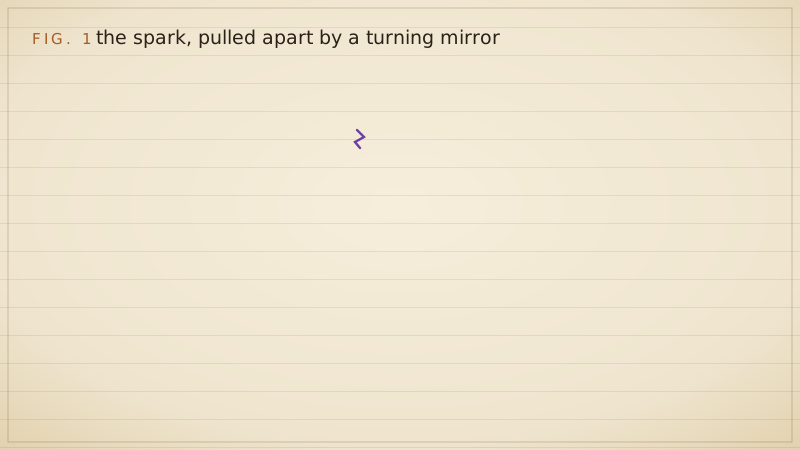
Draftsman's note
Fig. 1, as I want it engraved if this is ever printed. The four jars stand in a row on the copper tray, coatings shaded, the inner rods rising to brass knobs and joined along the top. The loop of rod is drawn heavy, in copper. The gap is at the top of the left limb of the loop, two balls of 1.6 centimetres, the spark between them drawn as a short zigzag. To the right, a small mirror on the shaft of a motor, and beyond it two horizontal lines that stand for the two knobs, with the row of spark images between them: tall and bright on the left, fading to the right, with a dot at the upper end of the first, the lower end of the second, the upper end of the third, so that the reader sees the polarity reversing.
Reflection
Look again at the fifth step. The velocity v, which Weber and Kohlrausch found by comparing a charge measured by its attraction with the same charge measured by its magnetic effect, appears in the period of my jar. And v is, within the errors of measurement, the velocity of light. Maxwell built a theory of light on that coincidence. I am a practical man with a loop of copper, and the speed of light walks into my laboratory and sits down in the middle of my formula. I do not yet know what to make of it. Hertz, who did his great experiments at Karlsruhe and is now professor at Bonn, has made something of it, and I shall have to read him with care.
Grand Street, 3 February 1890. The spark in a turning mirror
A million periods a second cannot be seen. I want to see the swing with my own eyes before I build on it, so I must slow it and then spread it out in space.
Experiment No. 2
To slow it: eight jars in place of four, and in place of the single loop a coil of thirty-four turns of copper wire 3 millimetres thick, wound on a wooden drum 16 centimetres in diameter and 24 centimetres long. The long-coil formula, 4π²a²N²/l, gives 4π² × 64 × 1,156/24 = 121,700 cm, but the coil is short and the true value must be less. Compared on the bridge against my standard coil it is close to 100,000 cm, which I take.
Period: T = 2π√(100,000 × 19,008)/(3 × 10¹⁰) = 2π × 43,600/(3 × 10¹⁰) = 9.13 × 10⁻⁶ second. About 110,000 periods a second.
To spread it: a small silvered mirror, 2 by 4 centimetres, fixed on the shaft of one of my own induction motors running at 3,000 revolutions a minute, that is, 50 turns a second. I watch the reflection of the gap through a short telescope at a distance of 2 metres.
Calculation
- The reflected ray turns at twice the angular speed of the mirror: 2 × 2π × 50 = 628 radians a second.
- At 200 centimetres the image therefore travels 628 × 200 = 125,600 centimetres a second, or 1.26 millimetres in each millionth of a second.
- Half a period is 4.57 millionths of a second. The successive images of the spark, one for each alternation, should stand 4.57 × 1.26 = 5.7 millimetres apart, and a full period, from one image of the same polarity to the next, 11.5 millimetres.
Result. With the room dark and the motor up to speed, the spark is no longer a spark. It is a short ribbon of separate images, close together, perhaps half a centimetre apart, exactly as predicted. Each image is brighter at one knob than the other, and the bright end changes sides from image to image. I counted, over a dozen trials, from twenty-six to thirty-two images before the ribbon ended. The jar does not empty. It swings.
Calculation
From the count I can weigh the resistance of the spark. The amplitude falls in each period by the factor e^(−RT/(2L)). Its logarithm, the decrement per period, is δ = RT/(2L), which for small resistance is δ = πR√(C/L) when all quantities are in one system.
- Thirty images are fifteen periods. Suppose the images vanish from sight when the current has fallen to a tenth. Then e^(−15δ) = 0.1, so 15δ = 2.303 and δ = 0.154.
- In practical units, C = 19,008/(9 × 10¹¹) = 2.11 × 10⁻⁸ farad and L = 10⁵/10⁹ = 10⁻⁴ quadrant, so √(C/L) = √(2.11 × 10⁻⁴) = 0.0145.
- R = δ/(π × 0.0145) = 0.154/0.0456 = 3.4 ohms.
- The copper of the coil, 1,700 centimetres of wire 3 millimetres thick, has a resistance to steady current of only 0.04 ohm. Even allowing that the current at these rates keeps to the skin of the wire and multiplies that several times, the copper accounts for a small part. The spark itself is the great resistance in the circuit. It is a thief, and I have caught it in the mirror.
Margin
Something is wrong with the tail of the ribbon. A pure resistance would make each image smaller than the last by the same ratio, and the train would fade away gradually without end. Instead it ends abruptly: three bright images, then a few dim ones of almost equal size, then nothing. I think the spark behaves less like a resistance and more like friction in a dry bearing. An arc keeps a nearly constant fall of potential across itself whatever the current. Such a loss takes away an equal amount from each swing, not an equal fraction, so the amplitude falls in equal steps, like a pendulum rubbing on its pivot, and stops dead when the swing is too small to keep the gap alight. If this is right, the decrement I computed is only an average, and the spark loses more when the current is small than the formula says. To be measured, someday, with a better instrument than my eye.
Grand Street, 12 November 1890. Where the energy goes
All summer I have used the oscillating discharge as a tool without stopping to account for its energy. A man who does not count his energy will be robbed by it.
Calculation
- Take Kelvin's equation, L di/dt + R i + q/C = 0, and multiply every term by i. Since i = dq/dt: L i di/dt + R i² + (q/C) dq/dt = 0.
- The first term is the rate of change of ½Li², the second is the rate at which heat is made in the resistance, the third is the rate of change of q²/(2C), which is ½CV². So: d/dt (½Li² + q²/(2C)) = −R i².
- In words: the energy of the circuit lives in two places, in the coil as ½Li² and in the condenser as ½CV², and it can leave only as heat in the resistance. When the condenser is full the current is zero, and all the energy is in the jar. A quarter period later the condenser is empty and the current is greatest, and all the energy is in the coil. They hand it back and forth twice in each period.
- For eight jars charged to 20,000 volts, the energy at the start is ½CV² = ½ × 2.11 × 10⁻⁸ × (2 × 10⁴)² = 4.2 joules. Little, as energy goes. But it is released in a few tens of millionths of a second, at a rate of tens of thousands of watts while it lasts.
- The greatest current: when all the energy is in the coil, ½LI² = ½CV₀², so I = V₀ √(C/L) = 20,000 × 0.0145 = 290 amperes. In a wire that carries no current at all to a galvanometer that measures the mean.
- The fraction of energy lost in each period. The energy falls as e^(−Rt/L) (twice the rate of the amplitude, because energy goes as the square). In one period, T = 2π√(LC), the energy falls by the factor e^(−2πR√(C/L)). I call √(L/C)/R the goodness of the circuit and write it Q. Then the fraction kept after one period is e^(−2π/Q). For my eight jars Q = 69/3.4 = 20, and the circuit loses 27 per cent of its store in every period. For the four jars on the single loop, with two ohms in the spark, Q is 12.1/2, only six.
I have drawn the whole account as Plate IX. Set the condenser, the coil and the resistance, and watch the potential and the current swing a quarter period apart, while the three bars show where the energy is: in the jar, in the coil, or gone as heat. Push the resistance above 2√(L/C) and the swing disappears.
Experiment No. 3
A curious demonstration of what high frequency does to a conductor. I bent a copper bar a centimetre square into a long U, about a metre of bar in all, and connected it into the discharge circuit of a Leyden jar. Across the two legs I placed two ordinary sixteen-candle lamps, so that the bar short-circuited them completely. To a steady current the bar is a dead short: its resistance is a few ten-thousandths of an ohm, the lamp's two hundred ohms when hot. Yet when the jar discharges between the knobs, the lamps light. With a larger coil charging the jar I could place the lamps at different points along the bar and find places of greater and lesser brightness, maxima and minima of potential along the copper.
Explanation. To a current that reverses a million times a second, the bar opposes its self-induction far more than its resistance. A metre of bar has a self-induction of the order of 1,000 cm, a millionth of a quadrant, and its opposition is 2πfL = 2π × 10⁶ × 10⁻⁶ = 6.3 ohms, some ten thousand times its resistance. The lamp, connected across a part of it, takes its share of the current as any branch does. The bar is a short circuit only to the slow.
Reflection
Lodge in England discharges his jars and holds that most of their energy goes out into space as waves. My mirror and my lamps say otherwise. The energy I can find goes into heat in the spark, into the copper, into the glass of the jars, which warm noticeably after a long run. Very little, I am sure, is radiated by a closed circuit of this kind. That is a matter I must argue properly, and I will, when I have finished reading Hertz.
Grand Street, 4 February 1891. A generator with no moving parts
Today my attorneys filed the application for what I call the method of electrical conversion by the disruptive discharge, and I want to set down in my own words what it claims, before the language of the Patent Office covers it over.
Experiment No. 4
The arrangement, as in the drawings. A generator of high tension charges a condenser. In the line from the condenser there is a break, an air space or a film of insulation. When the condenser is charged enough to overcome the break, it discharges disruptively through the break into a working circuit containing lamps or motors, and is charged again, and the process repeats, faster or slower according to how fast the generator can supply it. Each discharge may itself consist of a train of oscillations in the working circuit. I wrote into the specification that the number of these may be "many millions per second", and that a periodically oscillating discharge occurs "when the quantities concerned bear a certain relation expressed in wellknown formulae and ascertained by simple experiment." The well-known formula is Kelvin's. The relation is R² < 4L/C.
Calculation
Why does high frequency make condenser conversion practicable? Because the condenser's opposition falls as the frequency rises. Its reactance is 1/(2πfC). To pass 10 amperes at a reactance of 100 ohms, a condenser at 60 periods must have a capacity of 1/(2π × 60 × 100) = 26.5 microfarads, a wall of glass and foil. At 100,000 periods the same duty needs 1/(2π × 10⁵ × 100) = 0.016 microfarad: six of my jars. The condenser shrinks in exact proportion to the frequency, and its own heating in the glass, which rises with every reversal, is set against the enormous saving of material. The specification says this plainly: the quicker the discharges succeed each other, the smaller need be the capacity of the condenser for a given output.
Margin
The arc between the knobs is my chief enemy. After a few discharges the gap is full of hot gas and metal vapour, the spark stops breaking and becomes a steady arc, and the circuit stops oscillating cleanly. I have tried a blast of air across the gap, and plates of mica close on either side of it to strengthen the draught the arc makes for itself. Both help. A magnet across the gap, which pushes the arc sideways as it pushes any conductor carrying current, should help more. I must find a way to make the gap break cleanly each time and to recover its insulation at once.
Reflection
I have spent fourteen months with this formula, and I can now state what it gives me and what it withholds. It gives me any frequency I like, from thousands to millions, by choosing two numbers, L and C, with no machine, no bearing, no limit of speed. It withholds steadiness. Each discharge is a train that dies, and the gap that sets it going also eats it. The alternator gives me steadiness and refuses me speed. If I could charge the jar from the alternator, and let the jar discharge into a coil whose secondary is in tune with it, I should have the speed of the one and the regularity of the other, and the pressure would rise in the secondary as in no coil ever made. I see the coil already. I do not yet see it clearly enough to build it. The picture will come.
When I left Paris for America I ran alongside a departing train with my money and tickets lost, and my feelings surged back and forth like the oscillations of a condenser. I had the image seven years before I had the theory. It was the right image. The energy does not stay where it is put. It flows to the other side and returns, and only the losses make it stop.
Problems I set myself
1. A battery of jars has a capacity of 5,000 cm in electrostatic measure and discharges through a loop whose self-induction is 2,000 cm in electromagnetic measure. Find the period and the number of alternations per second.
Answer. T = 2π√(LC)/v = 2π√(2,000 × 5,000)/(3 × 10¹⁰) = 2π × 3,162/(3 × 10¹⁰) = 19,870/(3 × 10¹⁰) = 6.62 × 10⁻⁷ second. The frequency is 1/T = 1.51 × 10⁶ periods per second, so about 3.0 million alternations per second. In practical units the same: C = 5,000/(9 × 10¹¹) = 5.56 × 10⁻⁹ farad, L = 2 × 10⁻⁶ henry, LC = 1.11 × 10⁻¹⁴, √(LC) = 1.054 × 10⁻⁷, and 2π√(LC) = 6.62 × 10⁻⁷ second.
2. A coil of 100 microhenrys discharges a condenser of 0.02 microfarad. Above what resistance will the discharge fail to oscillate? With a resistance of 5 ohms, what is Q, and in how many periods does the swing fall to 1/e of its first value?
Answer. √(L/C) = √(10⁻⁴/(2 × 10⁻⁸)) = √5,000 = 70.7 ohms, so the critical resistance is 2√(L/C) = 141 ohms. With R = 5 ohms, Q = 70.7/5 = 14.1. The amplitude falls to 1/e in 2L/R = 2 × 10⁻⁴/5 = 40 millionths of a second. The period is 2π√(LC) = 2π√(2 × 10⁻¹²) = 8.89 millionths, so the swing lasts 40/8.89 = 4.5 periods to 1/e. (A rule worth remembering: the number of periods to 1/e is Q/π.)
3. A condenser of 0.01 microfarad is charged to 30,000 volts and discharged 500 times a second. Find the energy of each charge, the power, and, if Q = 6, the number of periods in which nine tenths of each charge's energy is spent.
Answer. E = ½CV² = ½ × 10⁻⁸ × (3 × 10⁴)² = 4.5 joules, and 500 discharges a second give 2,250 watts, three horsepower. The energy falls in each period by e^(−2π/Q), so after n periods it is e^(−2πn/Q). Setting e^(−2πn/6) = 0.1 gives 2πn/6 = 2.303 and n = 2.2 periods. At a million periods a second the whole charge is spent in about two millionths of a second, and the condenser then waits a five-hundredth of a second, idle, for its next charge. Here is the great inefficiency of the jar as a generator: it works for one part in a thousand of the time.
To the student who reads this later
You write my equation as you write every linear circuit: with the complex frequency s = −α ± jω′, where your engineers use j in place of i so as not to confuse it with current. Steinmetz taught my generation that habit in 1893, and Heaviside named the quantities I have used: he called L "inductance" in 1886, and impedance after it. Your characteristic equation Ls² + Rs + 1/C = 0 is mine; your damping ratio ζ = (R/2)√(C/L) is the ratio of my resistance to the critical one, and the oscillation exists when ζ < 1. Your Q is the same as mine, and your rule that a resonant circuit loses 2π/Q of its energy per radian of phase, you would say per cycle, is the one I found from the mirror.
The paper I quoted as of 1856 was printed in 1853: William Thomson, "On Transient Electric Currents", in the Philosophical Magazine. I carried the wrong year in my head for sixty years and printed it in my autobiography. Correct me freely.
On the spark I was right to be uneasy. A spark or arc is a nonlinear resistance whose voltage depends little on its current, and a circuit damped by it loses amplitude in nearly equal steps, as I guessed from the abrupt end of the mirror image. Your textbooks call this Coulomb damping. Its practical cure came after my early work: gaps divided into many short sections between cooled metal plates, which quench in the first few periods. On radiation I was right for my closed loops and wrong for open ones. A loop 25 centimetres in radius at 1.25 million periods has a circumference of about one hundred-and-fiftieth of a wavelength, and its resistance to radiation, which goes as the fourth power of that ratio, is less than a millionth of an ohm against the spark's several ohms. Lodge's open conductors, and Hertz's, are another matter. The capacity of an open rod is spread along it, and such a conductor radiates strongly. You will meet that argument in my next notes.
What to try: take a capacitor of 10 nanofarads and an inductor of 100 microhenrys, charge the capacitor from a low-voltage supply through a resistor, and discharge it through the inductor with a reed switch or a transistor. On an oscilloscope you will see my mirror image in an instant: a sine of about 160 kilohertz inside a decaying envelope. Count the cycles to 1/e and you have Q/π. Add resistance until the ringing just stops and you have measured 2√(L/C). Do not touch a charged high-voltage capacitor, ever: a Leyden jar at twenty thousand volts holds enough to stop a heart.
If you want to argue about the jar, the mirror or the formula, come and ask me.
Sources and liberties
The Tesla Notes are a modern reconstruction written in Nikola Tesla's voice by Eternal Gardens. Dates, patents, lectures, apparatus and quotations come from the sources below; the private reflections, the order of the working and the sketches are ours.
- Nikola Tesla, "My Inventions", Part IV, Electrical Experimenter, May 1919 (Grand Street at the close of 1889, the Kelvin passage with its date of 1856, and "like condenser oscillations" in Part IV's account of his departure for America): Wikisource
- US Patent 462,418, "Method of and Apparatus for Electrical Conversion and Distribution", filed 4 February 1891, granted 3 November 1891 (quoted phrases on "many millions per second" and the "wellknown formulae"): Google Patents
- Nikola Tesla, "Experiments with Alternate Currents of Very High Frequency and Their Application to Methods of Artificial Illumination", AIEE, Columbia College, 20 May 1891 (the short-circuited lamps on a copper bar with nodes along it, the difficulties of the arc, and his disagreement with Lodge on radiated energy): text at tfcbooks.com
- Nikola Tesla, "Experiments with Alternate Currents of High Potential and High Frequency", IEE London, February 1892 (the air current and mica plates at the gap): Wikisource
- William Thomson, "On Transient Electric Currents", Philosophical Magazine, 4th series, vol. 5, 1853; history of the oscillatory discharge (Savary, Henry 1842, Thomson 1853, Feddersen): LC circuit, Wikipedia
- B. W. Feddersen and his rotating-mirror photographs of the Leyden-jar spark: Wikipedia
- J. C. Maxwell, "On Physical Lines of Force", Part III, Philosophical Magazine, 1862, for the ratio of units of Weber and Kohlrausch, 310,740,000 metres per second: Wikisource
- W. B. Carlson, "Places of Invention: Nikola Tesla's Life in New York", Gotham Center, 2013 (the Grand Street laboratory, 1889 to 1892): gothamcenter.org
- W. B. Carlson, Tesla: Inventor of the Electrical Age (Princeton University Press, 2013).
The jar dimensions, the coil of thirty-four turns, the mirror experiment and its count of images are our reconstruction, chosen to be physically consistent; Tesla did not record such an experiment in print. Tesla's own date of 1856 for Kelvin's paper is wrong, and Feddersen's first observations are dated variously from 1857 to 1859.