
Budapest, in the first months of 1882, a city of bridges and of noise, and I hear every bit of the noise. I came here for the telephone enterprise and found it not yet begun, took work as a draftsman at the Central Telegraph Office, and then fell ill in a way the doctors cannot name. Now the illness is lifting. The problem of the alternating current motor, which I carried out of Graz and through Prague, has come back with the strength, and I feel that the solution is somewhere behind my eyes, waiting for me to turn round quickly enough to see it. This notebook is where I mean to catch it.
As I uttered these inspiring words the idea came like a flash of lightning and in an instant the truth was revealed.
Nikola Tesla, "My Inventions", Part III, Electrical Experimenter, April 1919
Budapest, 1881. A draftsman at the Central Telegraph Office
The wave of the American telephone has reached the Continent, and Budapest is to have an exchange. A friend of our family stands at the head of the enterprise, and on the strength of a report that proved premature I came here to join it. There was nothing yet to join. So I accepted a place as a draftsman in the Central Telegraph Office of the Hungarian Government, at a salary I shall not record even in a private book. The Inspector-in-Chief noticed that I could calculate, and since then I have done calculations, designs and estimates for new installations. When the Telephone Exchange opens, I am to take charge of it. Mr. Puskás, who organised the whole undertaking, has said so.
Calculation
Estimate for a subscriber's line, written for the Inspector and copied here because I enjoyed it.
- Galvanised iron wire, 4 mm in diameter. Cross-section: π × (2 mm)² = 12.6 mm².
- Iron conducts about six or seven times worse than copper. I take the specific resistance of the wire at 0.1 ohm for a wire one metre long and one square millimetre in section.
- Resistance per kilometre: 0.1 × 1,000 ÷ 12.6 = 7.9 ohms, call it 8.
- A subscriber three kilometres from the exchange, on a single wire with earth return: about 24 ohms of line, small beside the coils of the instruments.
- Resistance is the smaller enemy on a telephone line. The larger is the capacity of a long wire to the earth and the induction from its neighbours, which blur and mingle the voices. These I cannot yet put into numbers.
Margin
I have made several improvements to the apparatus of the central station and I have a repeater, an amplifier for weak telephone currents, working in rough form on my bench. I shall not patent it. There is no time and there is no money, and there is something larger in my head that leaves no room.
Reflection
Calculation for the Government in the day, and at night the old problem from Graz. I have learned in Prague to take the commutator off the machine in my mind and look at what remains: a ring of iron, a winding, and currents that alternate inside it as the ring turns. The answer is in that ring. I am as sure of it as I am of my own pulse.
Budapest, late 1881. The illness
I write this with difficulty and only so that, if I recover, I shall believe it happened.
My senses have become unbearable. I hear the ticking of a watch with three rooms between me and it. A fly settling on the table makes a dull thud in my ear. A carriage passing at a distance of a few miles shakes my whole body, and the whistle of a locomotive twenty or thirty miles away makes my chair vibrate so strongly that the pain is beyond enduring. I sleep with the legs of my bed on rubber cushions. Sunlight broken by the railings of a bridge strikes my skull like blows. In the dark I can tell that an object is near, at four metres, by a creeping sensation on my forehead. My pulse goes from a few beats to two hundred and sixty. A physician with a great reputation gives me bromide of potassium every day and says the case is unique and incurable.
Reflection
He is wrong about the second word. I have decided to live. I have a friend, an athlete, devoted beyond what I deserve, who walks with me every day and makes me breathe and eat and argue. My health is returning, and with it a vigour of mind I have not known before. I am almost sorry that the struggle will soon be over, because I have so much energy to spare. When I took up this problem in Graz it was a resolve. Now it is a vow. If I fail I will perish, and I feel that the battle is won. The solution is in the deep recesses of the brain, and I cannot yet give it expression.
Margin
An observation for the physicists, if I ever meet one who will listen. My hearing at its worst could not be explained by any increase in the loudness of sounds. It was as if the threshold had fallen, as if every small vibration of the floor and air had been magnified by some resonance in me. A small impulse, repeated in time, can do enormous work. I note it for no reason I can give.
Budapest, City Park, an afternoon in February 1882. The sand
I must write it tonight, while my hands are still shaking.
Szigeti and I walked in the City Park in the late afternoon. I was reciting poetry, as I do; I know whole books by heart, word for word, and one of them is Goethe's Faust. The sun was going down, and it brought to my mind the passage from the scene before the city gate, when Faust watches the sun set and longs for wings to follow it:
"Sie ruckt und weicht, der Tag ist uberlebt,
Dort eilt sie hin und fordert neues Leben.
Oh, dass kein Flugel mich vom Boden hebt
Ihr nach und immer nach zu streben!"Goethe, Faust I, as printed in "My Inventions", Part III, April 1919
The glow retreats, done is the day of toil;
It yonder hastes, new fields of life exploring;
Ah, that no wing can lift me from the soil
Upon its track to follow, follow soaring!The English verse printed beside it in the same issue
The sun that retreats and hastes away and is followed, followed. As I spoke the words the idea came like a flash of lightning. I took a stick and drew in the sand of the path, and Szigeti, who is no electrician, understood the drawing at once, which is how I knew it was true. The images were sharp and clear and had the solidity of metal and stone, so solid that I said to him: see my motor here, watch me reverse it.
Draftsman's note
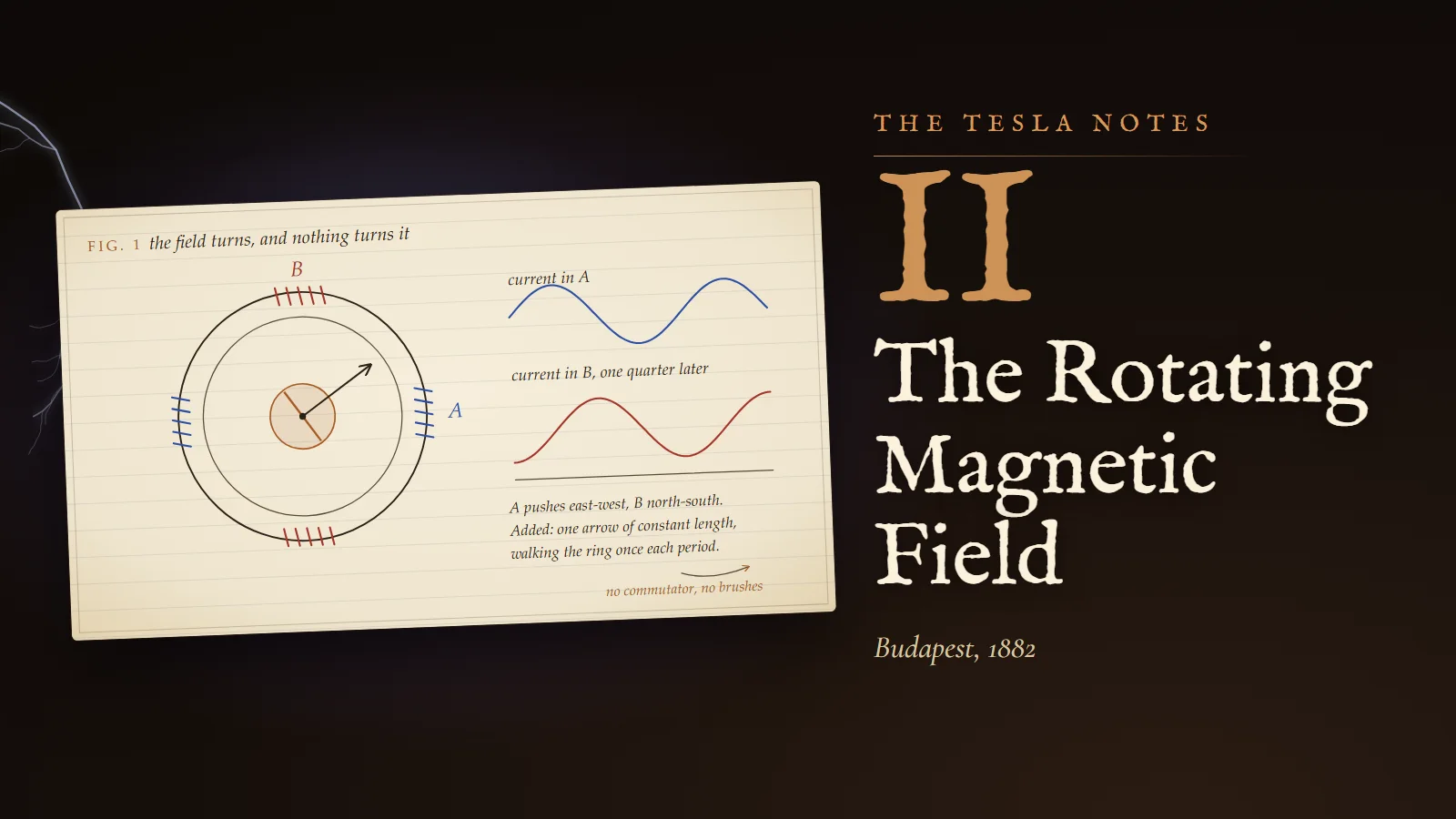
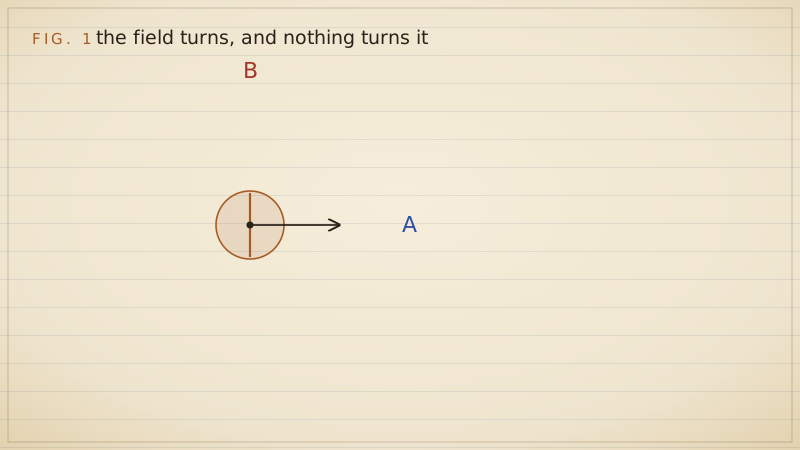
What I drew in the sand, redrawn properly as Fig. 1. A ring of iron. Round it, four coils: two opposite each other on the horizontal line, A and A, connected together so that their fields add across the ring; two opposite each other on the vertical line, B and B, likewise connected. Inside the ring, free on a spindle, a piece of iron, or a drum of copper. Into the coils A goes an alternating current. Into the coils B goes another alternating current of the same strength and period, but a quarter period behind the first. Nothing else. No brushes, no commutator, no moving contact anywhere.
Calculation
Why it turns. I write it as I saw it, then check it as Allé would.
- Let the current in A be I cos ωt. The coils A make, at the centre of the ring, a field along the horizontal line proportional to their current, Bx = B cos ωt, where B is the field made by the full current.
- The current in B is a quarter period later: I cos(ωt − 90°) = I sin ωt. The coils B make a field along the vertical line: By = B sin ωt.
- The two fields at the centre compound like two forces at right angles. The strength of the resultant is √(Bx² + By²) = B √(cos² ωt + sin² ωt) = B.
- Its direction makes with the horizontal the angle whose tangent is By/Bx = sin ωt/cos ωt = tan ωt. The angle is ωt itself.
- Therefore the resultant field has constant strength B and points in the direction ωt. It goes round the ring uniformly, once in every period of the currents.
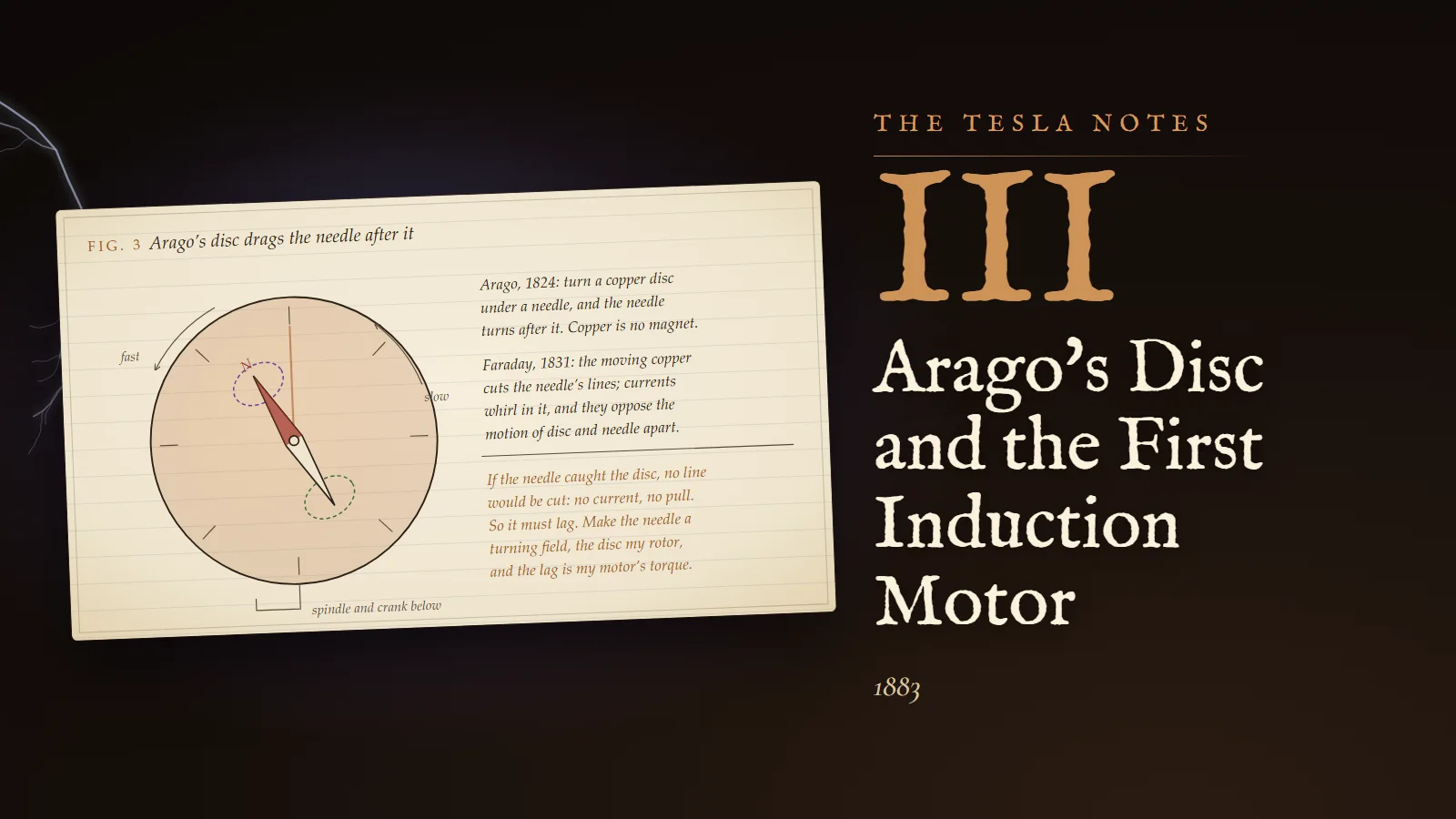
The field turns, and nothing turns it. The iron of the ring stands still. The copper of the coils stands still. Two currents that only swell and fall, each along its own fixed line, add up to one field of constant strength that walks round and round, and a rotor inside must follow it, as the needle followed the copper disc in Arago's experiment. Poeschl's steady pull was the wrong picture. This is a pull that travels.
Calculation
See my motor here; watch me reverse it. Exchange the two wires of coil B.
- The current in B becomes −I sin ωt, and By = −B sin ωt.
- The strength is unchanged: √(cos² ωt + sin² ωt) = 1, times B.
- The tangent of the angle is −sin ωt/cos ωt = tan(−ωt). The angle is −ωt.
- The field turns the other way, with the same speed and strength. The motor reverses by the exchange of two wires, with no gearing and no change in the machine.
Reflection
I cannot describe what I felt. Pygmalion, seeing his statue come to life, could not have been more moved. Six years of it: the Gramme machine in Graz, the twisted leads, the compass staggering round under my hand, Prague, this city, the illness. A thousand secrets of nature that I might have stumbled on by accident I would give for this one, which I have wrested from her against all odds. We walked home in the dark and I talked the whole way, and Szigeti let me.
Budapest, March 1882. The arithmetic of the turning field
The flash is a fact. Now it must stand up to arithmetic, in every case, or it is a poem.
Calculation
First, the field everywhere round the gap of the ring, away from the centre too. A coil on the line at angle φ, carrying current i, makes at a point of the gap at angle θ a field that I take as proportional to i cos(θ − φ): strongest on its own line, nothing at right angles to it, reversed on the far side. With A at φ = 0 and B at φ = 90°:
- B(θ, t) = B cos ωt cos θ + B sin ωt sin θ.
- By the formula for the cosine of a difference, cos θ cos ωt + sin θ sin ωt = cos(θ − ωt).
- Therefore B(θ, t) = B cos(θ − ωt).
Read it slowly. At any instant the field round the gap has the shape of one cosine, greatest at the angle θ = ωt. As time goes on the whole shape slides round without changing. A north pole and a south pole, made of nothing but timing, travelling round the ring.
Calculation
Now three currents, each a third of a period behind the last, in three pairs of coils set at 120° to each other round the ring. Does it still turn? I worked this standing at the drawing board with a ruled sheet hidden under the estimate I was meant to be finishing.
- Coil m stands at the angle φm = 120° × m, for m = 0, 1, 2. Its current is I cos(ωt − φm).
- The field at θ: B(θ, t) = B Σ cos(ωt − φm) cos(θ − φm).
- Use the product rule: cos X cos Y = ½[cos(X − Y) + cos(X + Y)]. With X = θ − φm and Y = ωt − φm, X − Y = θ − ωt, the same for every coil, and X + Y = θ + ωt − 2φm.
- So B(θ, t) = ½B Σ cos(θ − ωt) + ½B Σ cos(θ + ωt − 2φm).
- The first sum has three equal terms: (3/2)B cos(θ − ωt).
- In the second, 2φm takes the values 0°, 240°, 480° = 120°. Three cosines of angles equally spaced round the circle: their sum is zero, as three equal forces at 120° are in balance.
- Therefore B(θ, t) = (3/2) B cos(θ − ωt).
The same turning field, half as strong again as the field of one coil. The same argument works for any number k of currents spaced by 360°/k in coils spaced by 360°/k, provided k is three or more, and gives (k/2) B cos(θ − ωt). For k = 2 the formula fails, because two currents half a period apart are the same current reversed; that is why the two-current arrangement needs its currents a quarter period apart, in coils a quarter turn apart. I have drawn all of this as Plate II. Press Play, choose the number of currents, and with two currents move the lag between them.
Margin
What if the lag is wrong? Suppose the currents in A and B differ by an angle φ that is not 90°. Then Bx = B cos ωt and By = B cos(ωt − φ).
- The square of the strength is cos² ωt + cos²(ωt − φ), times B².
- Writing cos² u = ½(1 + cos 2u): this is 1 + ½[cos 2ωt + cos(2ωt − 2φ)].
- By the sum of two cosines: ½[cos 2ωt + cos(2ωt − 2φ)] = cos φ cos(2ωt − φ).
- So the strength squared is B²[1 + cos φ cos(2ωt − φ)], swinging between B²(1 + cos φ) and B²(1 − cos φ) twice each period.
- The ratio of greatest to least strength is √[(1 + cos φ)/(1 − cos φ)] = cot(φ/2).
At φ = 90°, cot 45° = 1: a circle, constant strength. At φ = 60°, cot 30° = √3 = 1.73: an ellipse, the field nearly doubling and halving its pull every half period, and a motor shaking on its bearings. At φ = 0 the ratio is infinite: the two currents are one, and the field only pulsates on a fixed line. So the quarter period is the right lag, and nothing about it is approximate.
Margin
Added in May 1888, after the lecture before the American Institute: I gave this in the form of the equation of a circle, r² = x² + y², and said there that "for a uniform field the disposition of the two coils at right angles will secure the theoretical result, and the intensity of the shifting poles will be constant." It took me six years to say aloud what I wrote in the sand in six seconds.
Budapest, April 1882. One field that swells is two fields that turn
A night question, worth a page. Why does one alternating current not turn a rotor? I know that it does not: I proved it with the compass in Graz, and the plate shows it. But I want the reason in the same language as the rest.
Calculation
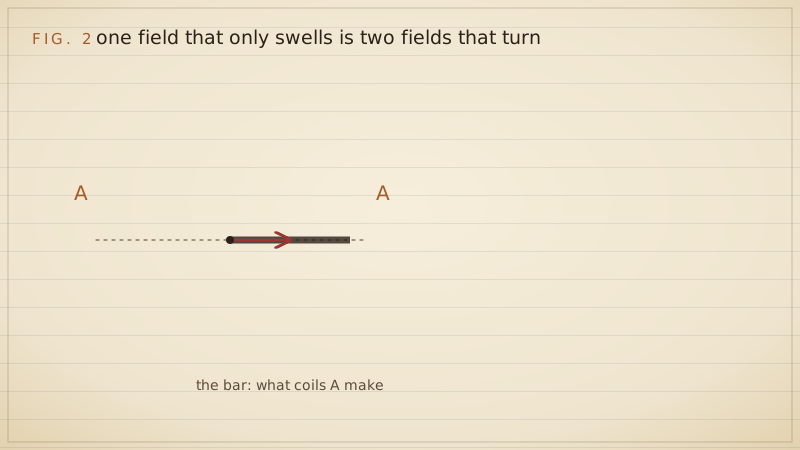
- One coil on the horizontal line, current I cos ωt. Its field at the centre is a vector along the horizontal: (B cos ωt, 0).
- Write the zero as ½B sin ωt − ½B sin ωt, and the cosine as ½B cos ωt + ½B cos ωt.
- Then (B cos ωt, 0) = (½B cos ωt, ½B sin ωt) + (½B cos ωt, −½B sin ωt).
- The first part has constant strength ½B and turns at angle +ωt. The second has constant strength ½B and turns at angle −ωt.
- Therefore one pulsating field is exactly two turning fields of half strength, turning in opposite directions.
Now the rotor at rest feels both halves equally, one pulling it forward and one back, and it stays where it is. Push it by hand in one direction, and it runs with one half and against the other. The half it runs with slips past it slowly and pulls hard; the half it runs against rushes past at nearly twice the speed. I shall have to work out which pull wins and by how much, but I suspect the one it runs with, and that such a motor, once started, will keep going. A motor that must be pushed to start is a poor servant. Two currents, or three, give the field that turns of itself, and that is the motor I want.
Experiment No. 1
Performed in the mind, with the rotor of Fig. 1. I feed A and B correctly and let the copper drum run unloaded. It comes up nearly to the speed of the field, but not quite. If it ever reached the field's speed, the field would stand still relative to the copper, no lines would be cut, no current would flow in the drum, and there would be no pull. So it must always lag a little. I load it with a brake: it falls further behind, more current flows in the copper, the pull increases, and it settles at a new speed. The motor regulates itself by its own lag. I must find the law of that lag with numbers. Not tonight.
Experiment No. 2
Also in the mind. A rotor of hardened steel, magnetised, in place of the copper drum. It cannot start: the field sweeps past it too fast for its inertia, pulling it forward and back. But if I bring it up to the speed of the field by hand, it locks to the field and runs exactly in step, at any load it can carry, until it is overloaded and falls out. A second kind of motor: synchronous, with constant speed and little starting effort, beside the first kind, which starts strongly and gives way a little with load. I think the world will need both.
Calculation
The speed of the field. With one pair of coils per current, the field goes round once per period: at f periods a second, 60f revolutions a minute. If the ring is wound with two pairs of poles for each current, the pattern of the field repeats twice round the ring, and it advances only half a turn per period. In general, with p pairs of poles, the field turns at n = 60f/p revolutions a minute. Fifteen periods a second from a two-pole Gramme machine at 900 revolutions give a field turning at 900 revolutions in a two-pole motor: the motor runs nearly in step with the generator that feeds it, by electricity alone, as if they were on one shaft.
Margin
And the source of the currents. I had it in Prague and did not know what it was. A Gramme ring tapped at two points opposite gives one alternating current; tapped at four points a quarter turn apart, through four slip rings, it gives two currents a quarter period apart. Tapped at three points 120° apart, three currents a third of a period apart. The generator I need is an ordinary dynamo with its commutator thrown away and slip rings in its place. The system is complete: generator, line, motor, and not one sliding contact that carries the working current through a spark.
Budapest, May 1882. Seven-league boots
I have given myself up to the pure joy of picturing machines. Ideas come in an uninterrupted stream and my only difficulty is to hold them fast. The machines I conceive are real to me in every detail, even to the marks of wear on the bearings. I keep them running in my mind because they are more beautiful running.
Calculation
A list, so that I do not lose any. The types of motors and modifications of the system that I have evolved since the afternoon in the park, in less than two months:
- The induction motor: ring stator with two or three currents, armature of closed coils of copper, or a solid drum or disc, in which the turning field induces the currents that it then drags.
- The synchronous motor: the same stator, with an armature magnetised by a separate continuous current, running exactly in step.
- The combination: an induction winding to start, a magnetised armature to hold step once there.
- Motors of other speeds, from more pairs of poles in the motor than in the generator, by the rule n = 60f/p.
- The transformer with a ring core and two or three primary windings, in which the turning field induces currents in a secondary without any motion at all.
- The two-current system on three wires, one wire serving as a common return for both currents.
- The generator: any dynamo with slip rings at the proper points of its winding.
Reflection
It is perhaps providential that I must earn my bread, for otherwise I would do nothing but this until I fell over. The Exchange is opening and I am in charge of it. Mr. Puskás speaks of Paris, where the Edison company has its works, and says there may be a place for me. Paris has capital, and capital builds machines. I have the whole system in my head and not one piece of it in metal. That must change.
Margin
I am aware that I have proved everything here with currents that are perfect sines. A real dynamo gives a wave with humps and flats, and the field it makes will wobble as it turns. The principle survives a wobble. The efficiency may not. I shall want machines that give a clean sine, and I shall want to measure.
Problems I set myself
1. Two coils at right angles carry equal currents that differ in phase by 60° in place of 90°. Find the greatest and least strength of the resultant field, in terms of the field B of one coil, and their ratio.
Answer. The strength squared is B²[1 + cos 60° cos(2ωt − 60°)] = B²[1 + ½ cos(2ωt − 60°)], which runs between 1.5B² and 0.5B². The strength runs between √1.5 B = 1.22B and √0.5 B = 0.71B. Their ratio is √3 = 1.73, which is cot 30°, as the general rule cot(φ/2) requires.
2. A three-current motor is wound with two pairs of poles for each current and fed at 25 periods a second. How fast does the field turn? Show that exchanging the connections of any two of the three coils reverses it.
Answer. n = 60f/p = 60 × 25/2 = 750 revolutions a minute. Exchange the currents of coils 1 and 2, so that coil m at φm carries I cos(ωt + φm) in place of I cos(ωt − φm). Then the product rule gives ½B Σ cos(θ + ωt − 2φm) + ½B Σ cos(θ − ωt), and now it is the first sum whose angle is the same for every coil, (3/2)B cos(θ + ωt), while the second, with 2φm spaced round the circle, vanishes. The field (3/2)B cos(θ + ωt) turns the other way.
3. A single coil makes a pulsating field B cos ωt. A rotor turns forward at the angular speed (1 − s)ω, where s is a small number. Using the decomposition into two half fields, find the speed at which each half field slips past the rotor, as a fraction of ω.
Answer. The forward half turns at +ω and slips past the rotor at ω − (1 − s)ω = sω: a slip of s. The backward half turns at −ω and passes the rotor at ω + (1 − s)ω = (2 − s)ω: a slip of 2 − s. The rotor feels a gentle wind from one half and a gale from the other, and its torque is the difference of the two pulls.
To the student who reads this later
You will write all of this on one line. Represent the field of a coil by a complex number and let a rotating vector stand for each current: then the turning field is (3/2) B e^(jωt), and its value at angle θ is the real part of (3/2) B e^(j(ωt − θ)), which is my cosine. Your engineers call it the space vector. The decomposition of a pulsating field into two counter-rotating halves, which I worked as a night question, became the standard account of the single-phase motor in the textbooks: the forward field gives a torque curve, the backward field gives another at slip 2 − s, and the motor runs on their difference. It also explains why a single-phase motor in your refrigerator needs a starting winding, with its current shifted in phase by a capacitor, to make, for a moment, a turning field.
I was not alone, and you should know it. In 1879 Walter Baily showed in London a copper disc turned by four electromagnets switched in sequence by hand, a field that jumped round in steps. In Turin, Galileo Ferraris built a rotating-field apparatus in 1885 and published his paper on electrodynamic rotations in March 1888, two months before my lecture in New York; I filed my patents in October 1887. I had the idea in 1882 and a model running in 1883, but I printed nothing until 1888, and priority belongs in print as well as in the mind. History has given the rotating field to both of us, and I can bear that. The three-current system I listed in May 1882 became the system of the world: in 1891 a three-phase line carried power some 175 kilometres from Lauffen to Frankfurt, and every great power network in your century runs on three phases.
What to try: three small coils on a ring of transformer iron, fed from a three-phase supply through resistors, or from a two-phase source made with a capacitor in series with one coil. Put a compass needle, or better an aluminium can on a pin, at the centre. Exchange two wires and watch it reverse. Then use a single phase and watch it refuse to start, and give it a flick with your finger in either direction.
If you want to hear how the sand looked in the evening light, come and ask me.
Sources and liberties
The Tesla Notes are a modern reconstruction written in Nikola Tesla's voice by Eternal Gardens. Dates, patents, lectures, apparatus and quotations come from the sources below; the private reflections, the order of the working and the sketches are ours.
- Nikola Tesla, "My Inventions", Electrical Experimenter, 1919, Parts III and IV (Budapest, the telephone enterprise, the illness, the walk in the City Park, the Faust lines, the two months of invention): https://en.wikisource.org/wiki/My_Inventions
- Nikola Tesla, "A New System of Alternate Current Motors and Transformers", AIEE, May 1888 (the equation of the circle and the quotation in the margin): http://www.tfcbooks.com/tesla/1888-05-16.htm
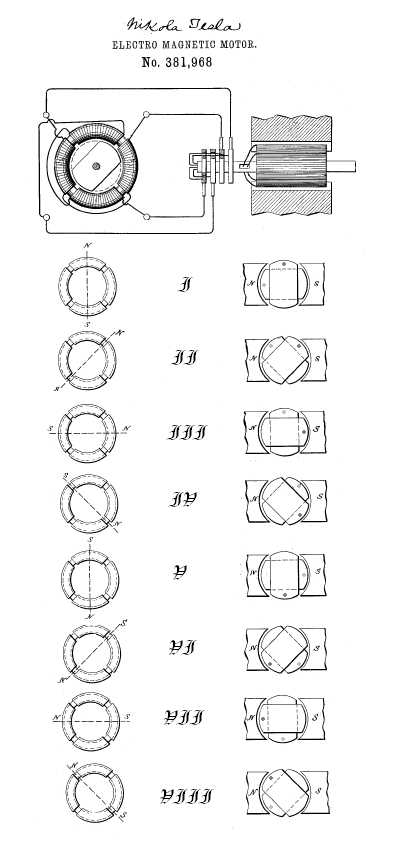
- US Patent 381,968, Electro-Magnetic Motor, filed 12 October 1887, granted 1 May 1888: https://patents.google.com/patent/US381968A/en; drawing via Wikimedia Commons: https://commons.wikimedia.org/wiki/File:RMFpatent.PNG
- Nikola Tesla Museum, Belgrade, on the induction motor and the date February 1882: https://tesla-museum.org/en/extraordinary-world/induction-motor/
- On Antal (Anthony) Szigeti: https://teslauniverse.com/nikola-tesla/people/antal-anthony-szigeti
- Galileo Ferraris and the IEEE Milestone "Rotating Fields and Early Induction Motors, 1885-1888": https://en.wikipedia.org/wiki/Galileo_Ferraris; Walter Baily, 1879: https://en.wikipedia.org/wiki/Walter_Baily%27s_Motor
- The Lauffen to Frankfurt three-phase transmission of 1891, 175 km: https://en.wikipedia.org/wiki/International_Electrotechnical_Exhibition
"My Inventions" says only "one afternoon" and names no companion: the month of February 1882 comes from later sources, and the friend is identified as Antal Szigeti by later biographers. The scene of the sand drawing is Tesla's own dramatisation, written in 1919; that he conceived the rotating field in Budapest in 1882 is generally accepted. The Electrical Experimenter printed the Faust lines without umlauts, and we keep its spelling. The decomposition of a pulsating field, the line estimate for the telephone office and the dated list of motor types are our reconstruction of how the working may have gone; the types themselves are those Tesla later patented.